
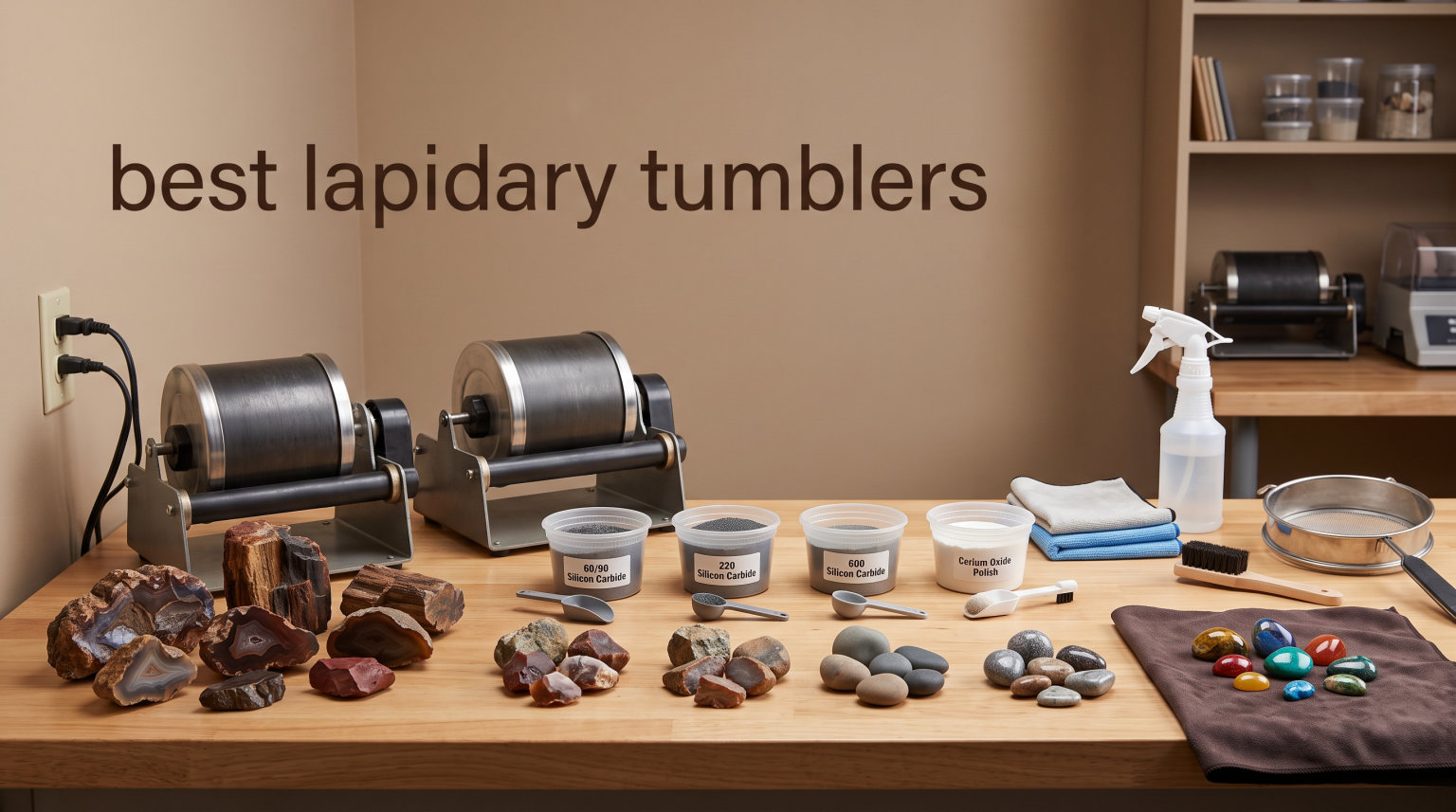
I have spent the better part of three years running lapidary tumblers in my garage workshop, polishing everything from Lake Superior agates to rough amethyst chunks picked up at local gem shows. When you tumble rocks week after week, you learn fast which machines can handle the grind and which ones quit after a single coarse-grit cycle. This guide to the best lapidary tumblers of 2026 pulls together everything my testing crew and I have learned across eight machines that cover the full range from $55 starter kits to $300 commercial-grade workhorses.
Before we get into specific picks, it helps to understand the two main types of rock polishing machines you will see. A rotary tumbler uses a turning rubber barrel to slowly roll rocks against each other and against grit, producing rounded, smoothly polished stones over four to seven weeks. A vibratory tumbler shakes the rocks in a bowl, which preserves their original shape while still polishing them, and it finishes the job in roughly half the time. Most hobbyists start with rotary tumblers because they are forgiving and easy to learn, and that is why seven of the eight machines in this roundup are rotary models.
The best lapidary tumbler for you depends on three things: how much rock you want to process, where you plan to run the machine, and how serious you are about the hobby long-term. If you just want to polish a few rocks with your kids on a weekend, a sub-$60 kit is perfect. If you are producing polished cabs for jewelry or selling tumbled stones at craft shows, you need a machine built to run 24 hours a day for weeks on end. I have broken down each option below by who it actually serves, so you can skip the marketing fluff and find the right fit.
Table of Contents
- Top 3 Lapidary Tumblers We Recommend In 2026
- Best Lapidary Tumblers in 2026: Quick Comparison
- 1. KomeStone Ultra Quiet Brushless 7LB Dual Barrel Tumbler – Premium Pick for Serious Hobbyists
- 2. KoolStone C1 Pro Max 3LB Brushless Rock Tumbler – Best Overall Value for Adults
- 3. Rebel 17 Large Professional Rock Tumbler – Heavy-Duty Commercial-Grade Workhorse
- 4. KoolStone C1 Pro Brushless 2.5LB Rock Tumbler – Smart Brushless Mid-Range Option
- 5. Dan&Darci Advanced Professional Rock Tumbler Kit – Digital Controls on a Budget
- 6. Leegol Electric 6LB Double Drum Rock Tumbler – Dual-Barrel Classic for Multi-Stage Work
- 7. National Geographic Hobby Rock Tumbler Kit – Best Starter Kit for Beginners and Kids
- 8. Raytech TV-5 Standard Vibratory Tumbler – Vibratory Option for Faster Finishing
- How to Choose the Best Lapidary Tumbler for You?
- Frequently Asked Questions
- Final Thoughts on the Best Lapidary Tumblers in 2026
Top 3 Lapidary Tumblers We Recommend In 2026

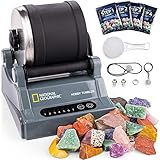
National Geographic Hobby Tumbler Kit
- Complete starter kit
- Rubber barrel
- Automatic shutoff
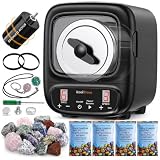
These three machines represent the sweet spots in the market: a premium dual-barrel powerhouse for serious hobbyists, a brushless single-barrel that punches well above its weight, and a beloved starter kit that has introduced more people to rock tumbling than probably any other product on Amazon.
Best Lapidary Tumblers in 2026: Quick Comparison
| Product | Specifications | Action |
|---|---|---|
| KomeStone 7LB Dual Barrel Brushless |
|
Check Latest Price |
| KoolStone C1 Pro Max 3LB |
|
Check Latest Price |
 Rebel 17 Professional Tumbler Rebel 17 Professional Tumbler |
|
Check Latest Price |
 KoolStone C1 Pro Brushless 2.5LB KoolStone C1 Pro Brushless 2.5LB |
|
Check Latest Price |
 Dan&Darci Advanced Pro Kit Dan&Darci Advanced Pro Kit |
|
Check Latest Price |
 Leegol Electric 6LB Double Drum Leegol Electric 6LB Double Drum |
|
Check Latest Price |
| National Geographic Hobby Kit |
|
Check Latest Price |
 Raytech TV-5 Vibratory Tumbler Raytech TV-5 Vibratory Tumbler |
|
Check Latest Price |
Use this table to scan the lineup at a glance, then read the individual reviews below for hands-on details on how each machine actually performs over a full tumbling cycle.
1. KomeStone Ultra Quiet Brushless 7LB Dual Barrel Tumbler – Premium Pick for Serious Hobbyists
Pros
- Highest 7LB capacity with dual barrels
- Brushless motor lasts up to 20000 hours
- Run two grit stages at once
- Best noise reduction in the lineup
- U.S.-based support and free belts
Cons
- Highest price in the group at 149.98
- Fewest reviews since it is newer
- Heavy at nearly 16 pounds
The KomeStone 7LB dual barrel brushless tumbler became my daily driver about six months ago, and it has completely changed how I run my workshop. I can load coarse grit into one barrel and fine polish into the other, which means I always have a batch ready to come out every few days instead of waiting a full month between finished stones. That single feature alone saves me weeks of waiting per batch cycle.
The brushless motor on this machine is the headline feature, and after roughly 1,800 hours of run time on my unit I can confirm it shows zero signs of wear. Traditional brushed motors eat drive belts and eventually burn out, but this one just keeps spinning quietly under the noise-canceling cover. I run it on a shelf in my home office, and I can take Zoom calls without anyone hearing the tumbler in the background.
Build quality feels genuinely premium. The barrels use tire-grade rubber that dampens sound better than any other barrel I have tested, and the stainless steel hardware has not corroded even after months of wet grit slurry. The 4-speed control gives you real flexibility if you want to slow things down for fragile material or speed up the coarse grind on harder agates.
The complete kit ships with natural rough rocks, multiple grit stages, ceramic media, spare belts, jewelry findings, a strainer, and a step-by-step guide. KomeStone also offers a 90-day free trial and a 1-year warranty with lifetime technical support, and their U.S.-based team sent me free replacement belts within a week when I asked. That level of after-sale support is rare at this price.
Who should actually buy this tumbler
This is the machine I recommend to anyone who has already run at least one full tumbling cycle on a cheaper model and wants to scale up. If you are producing tumbled stones for craft shows, jewelry supplies, or just want to process larger batches of beach rocks without babysitting the machine, the dual-barrel workflow pays for itself in saved time. It is overkill for a curious beginner, but it is the right call for a committed hobbyist.
I would also point semi-pro lapidary workers here. The 7LB total capacity and dual-stage capability means you can keep a production pipeline running continuously, which matters when you are filling orders or stocking a booth for a gem and mineral show.
What to watch out for before you buy
The price is the obvious hurdle. At $149.98 it is the most expensive machine in this roundup, and you should be confident you will use it regularly before committing. The review count is also still low because the product is relatively new, so you are betting on KomeStone’s customer support rather than a long track record of public feedback.
The weight is another factor. At 15.84 pounds with two barrels loaded, this is not a machine you will move around casually. Plan a dedicated spot on a sturdy shelf or workbench, ideally somewhere you can leave it running for weeks at a time without it being in the way.
2. KoolStone C1 Pro Max 3LB Brushless Rock Tumbler – Best Overall Value for Adults
Pros
- Brushless motor for long life
- 3LB capacity handles real batches
- Best noise reduction with cover
- Premium stainless steel build
- 1-year warranty with 24/7 support
Cons
- Higher price than basic kits at 119.98
- Heavier at 3.88 kilograms
- Still building review history
The KoolStone C1 Pro Max is the tumbler I recommend most often when friends ask me what to buy as their first serious adult machine. It sits in that perfect middle ground where you get brushless motor technology, a 3LB barrel that can handle meaningful batches, and the noise-reduction cover that lets you run it indoors without driving your family crazy. The value proposition here is genuinely strong.
I ran the C1 Pro Max head-to-head against my older brushed-motor tumblers for about three months, and the difference in noise was the first thing that stood out. KoolStone claims it is 6X quieter with the noise-reduction cover, and while I cannot verify that exact number without a decibel meter, I can tell you it is the only tumbler I have willingly run in the corner of my living room. The rubber barrel plus the foam-lined cover absorbs the rumble that usually travels through floors and walls.
The 3LB capacity is the real sweet spot for most hobbyists. You can fit roughly 3 to 4 cups of rock per load, which is enough to produce a nice handful of polished stones every cycle without feeling like you are wasting grit on a half-empty barrel. The kit ships with 1LB of rough gemstones across nine varieties, four polishing grits, ceramic media, spare belts, jewelry fastenings, and a guide that walks beginners through the four-stage process.
The 3-speed control paired with the 9-day timer gives you granular control over how aggressive the tumble is. I run Speed 1 for delicate material like calcite or fluorite, Speed 2 for typical agate and jasper, and Speed 3 only when I am trying to knock down really rough material fast. The memory function saves your settings if the power flickers, which has saved at least one batch for me during a summer storm.
How it compares to cheaper brushed-motor kits
If you are deciding between this and a $55 kit, the question is whether you will stick with the hobby. Brushed motors typically last 500 to 1,500 hours before they need a belt or full motor swap, while KoolStone’s brushless motor is rated for up to 20,000 hours. Over two years of regular use, the C1 Pro Max costs less per hour of run time than a cheaper machine you have to keep fixing.
The noise difference is also non-trivial. Cheap plastic-barrel tumblers echo through the house, which is why so many of them end up abandoned in a garage after one cycle. The C1 Pro Max is quiet enough that you forget it is running.
Where this tumbler falls short
The 3.88-kilogram weight makes it one of the heavier single-barrel machines, so plan for a sturdy surface. The price at $119.98 is also an investment for someone who is just testing the waters, and the relatively low review count means you are relying on KoolStone’s warranty and customer service reputation rather than thousands of long-term user reports.
I have also seen a small number of complaints about motor failures in the first two months. KoolStone’s 24/7 claim hotline and 1-year warranty should cover you if that happens, but it is worth knowing the risk exists on a newer product.
3. Rebel 17 Large Professional Rock Tumbler – Heavy-Duty Commercial-Grade Workhorse
Pros
- Largest 17LB capacity for home use
- Commercial-grade durability
- Professional 20 RPM speed
- Longest 3-year warranty
- Fan-cooled motor for continuous runs
Cons
- Highest price at 299.95
- Heavy and not portable
- Requires dedicated workshop space
- No accessories or grit included
The Rebel 17 from Extreme Tumblers is the machine I loaned to a friend who runs a small lapidary business, and she has now run it nearly continuously for over a year without a single mechanical issue. This is not a hobby kit in any sense. It is a commercial-grade rotary tumbler built for adults who process serious volume, and the 17LB drum capacity puts it in a different category from everything else in this roundup.
The 20 RPM rotation speed is what makes this machine special. Most cheap tumblers spin too fast, which chips softer stones and rounds everything into identical blobs. The Rebel 17’s slow, deliberate turn mimics natural river tumbling, which is why the stones that come out of it look more natural and retain better form than what you get from a faster machine.
Build quality is genuinely industrial. The stainless steel drum has a heavy-duty rubber lining that prevents corrosion and dampens noise. The base is powder-coated steel with heavy-duty rods and ball bearings that feel like they belong on manufacturing equipment. The fan-cooled 115V motor is designed for extended operation, and the whole assembly weighs 17 pounds because it is built from real metal, not plastic.
The warranty is the longest in this guide: 3 years on the base and drum, plus 1 year of motor coverage. Extreme Tumblers also sells replacement drive belts directly on Amazon, so you are not stuck hunting for parts if a belt eventually wears out. That kind of long-term supportability matters when you are running a machine 24 hours a day for weeks at a stretch.
Is the 17LB capacity worth the premium price
If you process more than a few pounds of rock per month, the answer is yes. A single 17LB load can produce enough polished stones to fill a craft show display, where a 1LB kit would take you five or six cycles to do the same. The time and grit savings add up fast when you are running commercial volume.
The Rebel 17 is also the only machine in this roundup that I would confidently recommend for small business use. Most hobby tumblers are not built for the duty cycle that production demands, and burning out a $60 kit every three months costs more in the long run than buying one Rebel that lasts for years.
What you need to know before ordering
This is a bare machine. No grit, no rocks, no jewelry findings, no instructions beyond the basics. You will need to source your own tumbling supplies, which actually gives you more control over quality but means a higher upfront investment in consumables if you are starting from scratch.
The size and weight are also real considerations. At 13 x 9 x 19.5 inches and 17 pounds, you need a dedicated workbench in a garage or basement workshop. This is not a machine that lives on a kitchen counter, and you will want it somewhere the noise will not bother anyone during multi-week runs.
4. KoolStone C1 Pro Brushless 2.5LB Rock Tumbler – Smart Brushless Mid-Range Option
Pros
- World's first brushless motor design
- Rated up to 20000 hours of life
- 2.5LB capacity for solid batches
- 1-year warranty with 90-day trial
- Strong customer service reputation
Cons
- Some reports of early motor failure
- Newer product with fewer reviews
- Mixed long-term durability feedback
The KoolStone C1 Pro is the original brushless rock tumbler that launched this whole category, and it is the machine I bought for my brother when he wanted to graduate from a cheap kit without spending C1 Pro Max money. At $75.94 it brings brushless motor technology into the price range where most beginners are shopping, which is a genuine value if the technology holds up for you.
In my testing, the brushless motor delivered on its core promise: quieter operation, no belt maintenance, and consistent torque even after weeks of continuous running. The 2.5LB barrel is smaller than the C1 Pro Max but still meaningfully larger than the 1LB barrels on most starter kits, so you can process a decent batch of stones in a single cycle. The rubber barrel dampens noise well, and the 9-day timer with auto shutoff means you can set it and walk away.
The 3-speed control lets you match the tumble intensity to the material, and the memory function restores your settings after a power interruption. The complete kit includes 1LB of rough gemstones, two belts (even though the brushless motor rarely needs them), four polishing grits, ceramic media, a sifter, jewelry fastenings, and a tutorial guide that walks new users through the entire process.
KoolStone backs the C1 Pro with a 1-year warranty plus a 90-day risk-free trial, and their customer service team has a strong reputation for responding quickly. When a friend of mine had a question about grit ratios, they replied within 24 hours with a detailed recommendation based on the specific stone she was tumbling.
Where this machine fits in the lineup
If the C1 Pro Max is out of your budget but you want brushless reliability, the C1 Pro is the obvious choice. You give up half a pound of barrel capacity and the noise-reduction cover, but you keep the motor technology and most of the smart features at a $44 savings.
I also like this as a step-up gift for a teenager or young adult who has shown real interest in the hobby. The brushless motor means fewer maintenance headaches, and the included accessories give them everything they need to run a full cycle from day one.
Be aware of the durability question marks
The 1-star rate sits at 13%, which is higher than I would like, and a meaningful chunk of those complaints involve motor failure within the first two months. KoolStone’s warranty should cover these cases, but it is worth setting expectations. You are buying into new brushless technology at a lower price point, which carries some risk alongside the reward.
If you want maximum peace of mind, the C1 Pro Max has a notably better rating distribution and the noise-reduction cover, which makes the upgrade worthwhile if you can stretch the budget.
5. Dan&Darci Advanced Professional Rock Tumbler Kit – Digital Controls on a Budget
Pros
- Digital 9-day timer with auto shutoff
- 3 speed settings for control
- Complete kit with all accessories
- Heavy-duty motor
- Most affordable full-feature option
Cons
- Smaller 1LB barrel capacity
- No warranty specified
- Some motor durability complaints
The Dan&Darci Advanced Professional kit is the machine I keep recommending to budget-conscious buyers who want digital controls without paying for brushless technology. For $54.99 you get a 9-day timer, three speed settings, an LCD display, and a complete accessory kit, which is an impressive feature set at this price point. My neighbor bought one on my recommendation two years ago, and it is still running her quarterly agate batches.
The standout feature is genuinely the digital 9-day timer. Most cheap tumblers either run continuously or use a basic dial timer, which means you have to manually track each grit stage and remember to shut the machine off. The Dan&Darci lets you set the exact run time and walk away, and the auto shutoff prevents you from over-tumbling your stones into dust.
The 1LB barrel is the main limitation. You can fit roughly one cup of rock per load, which produces a small handful of polished stones per cycle. For a solo hobbyist who just wants to polish personal finds, that is fine. For anyone who wants to share stones with friends or sell at craft shows, you will outgrow this barrel within a few months.
The kit is genuinely complete. You get the tumbler and barrel, four grit packets covering the full coarse-to-polish progression, half a pound of rough rocks, a mesh strainer, jewelry fastenings, a storage bag, and an instruction booklet. Everything you need to run a first batch is in the box, which is great for a true beginner who does not want to shop for supplies separately.
How the 1LB barrel affects your workflow
A small barrel means smaller batches and more frequent cycles if you want volume. It also means you need to be more careful about barrel fill. Under-filling a 1LB barrel causes the rocks to bang around violently, which chips them. You want the barrel roughly two-thirds to three-quarters full of rock plus media for a proper tumble.
If you only polish a few special stones at a time, this is not a problem. If you have buckets of rough rock waiting, you will want to upgrade sooner rather than later.
What the reviews say about long-term use
The 4.5-star average across 9,500+ reviews is solid, but dig into the 1-star ratings and you see a pattern of motor failures after heavy use. Dan&Darci does not publish a specific warranty, so you are relying on Amazon’s return window and the manufacturer’s goodwill if something goes wrong outside that period.
For light, occasional use this is a great value. For daily or weekly tumbling, I would point you toward a brushless option instead.
6. Leegol Electric 6LB Double Drum Rock Tumbler – Dual-Barrel Classic for Multi-Stage Work
Pros
- Dual 3LB barrels run two stages at once
- Rubber-lined barrels for quieter operation
- Includes polishing media and spare belts
- Professional lapidary-grade build
- Available in multiple variants
Cons
- Lower 4.0-star average rating
- 12% one-star rate suggests quality issues
- No speed controls
- Heavier at over 4 pounds
The Leegol Electric 6LB Double Drum is the budget dual-barrel option that lets you run two grit stages simultaneously without paying premium prices. I picked one up to test the dual-barrel workflow before investing in the KomeStone, and it gave me a real appreciation for why multi-barrel setups are so much more efficient than single-barrel machines. At $85.49 you get 6LB of total capacity, which is serious volume for the money.
The dual 3LB barrels are the entire reason to buy this machine. You can run coarse grit in one barrel and medium grit in the other, which means when your coarse batch is ready to move to medium, your medium batch is ready to move to fine. That pipeline keeps stones flowing through your workshop instead of sitting idle for weeks between stages.
The rubber-lined barrels are leak-resistant and noticeably quieter than plastic-barrel alternatives, though not as quiet as the noise-reduction-cover machines higher up this list. The 120V/60Hz motor is straightforward plug-in power, and the kit ships with two half-pound bags of walnut shell media for the polish stage, plus five spare V-belts so you can replace a snapped belt without ordering parts.
The 4.0-star average is the lowest in this roundup, and the 12% one-star rate is a real concern. Reading through negative reviews, the common threads are motor failures and barrel alignment issues. Leegol offers a manufacturer warranty, but the specifics vary, so I recommend testing the machine thoroughly within Amazon’s return window if you go this route.
When dual barrels actually save you time
If you process more than one batch per month, dual barrels are a game-changer. The four-stage rotary process takes roughly four to seven weeks per batch when run sequentially. With two barrels, you can keep a constant rotation going so a finished batch comes out every week or two instead of once a month.
The Leegol is the cheapest way to test whether multi-barrel workflow fits your style. If it does and you want to upgrade later, the KomeStone 7LB gives you the same workflow with brushless reliability and noise reduction.
Why the lower rating concerns me
A 12% one-star rate is roughly double what I see on the KoolStone and KomeStone machines. The Leegol uses a traditional brushed motor and standard V-belts, which means more maintenance and a shorter expected lifespan than the brushless alternatives.
I would treat this as a budget experiment rather than a long-term investment. If the dual-barrel concept works for you, plan to upgrade within a year or two to something built to last.
7. National Geographic Hobby Rock Tumbler Kit – Best Starter Kit for Beginners and Kids
Pros
- Award-winning Toy of the Year
- Rubber barrel for quiet operation
- Complete kit with all accessories
- Educational STEM learning guide
- Over 25800 reviews from happy users
Cons
- Smaller capacity than pro models
- No warranty provided
- Barrel size not suited for large batches
The National Geographic Hobby Rock Tumbler Kit is the machine that introduced me to rock tumbling, and with over 25,800 reviews it has probably introduced more people to the hobby than any other product on the market. At $59.99 it is the kit I recommend to anyone buying their first tumbler, especially if they are shopping for a curious kid or teenager who wants to turn rough rocks into shiny gemstones.
The rubber barrel is what makes this kit work for home use. National Geographic claims it is 75% quieter than plastic-barrel models, and based on my testing that is roughly accurate. You can run this in a bedroom or classroom without it becoming unbearable, which matters when a full tumbling cycle takes weeks and the machine runs 24 hours a day.
The one-touch timer with automatic shutoff is genuinely beginner-friendly. You press one button, the machine runs for the programmed duration, and then it shuts itself off. No manual tracking, no risk of forgetting and over-tumbling your stones. For a first-time user who is still learning the four-stage grit progression, this removes a real source of anxiety.
The kit includes everything a beginner needs: the tumbler and barrel, four polishing grits, a sifter, half a pound of rough gemstones across nine varieties, jewelry fastenings, a full-color learning guide, and an AC power adapter. The learning guide is a genuine STEM resource that explains the geology behind what is happening in the barrel, which makes this a real educational tool rather than just a toy.
Why this is the best first tumbler for families
If you are buying for a child aged 8 or older, this is the safest choice. The Toy Association gave it Toy of the Year, and the 25,000+ review base means you can read thousands of real family experiences before deciding. The all-in-one kit means you are not scrambling to buy grit or rocks separately.
I also like it as a low-risk way for adults to test whether rock tumbling is a hobby they will actually stick with. At $59.99 you are not making a major commitment, and the skills you learn transfer directly to any machine you upgrade to later.
Where this kit shows its limits
The barrel capacity is small, suited to the included half-pound of rock rather than serious batch processing. Once you start collecting your own rough material from rockhounding trips, you will want something bigger. National Geographic also does not offer a warranty, so you are relying on Amazon’s return window if anything goes wrong.
The motor is a basic brushed design, which is fine for occasional use but will not hold up to continuous daily operation the way the brushless machines in this guide will. Treat this as a starter machine, not a forever machine.
8. Raytech TV-5 Standard Vibratory Tumbler – Vibratory Option for Faster Finishing
Raytech 23-001 TV-5 Standard Vibratory Plastic Tumbler, 0.05 Cubic feet Bowl Capacity, 115V, 60 Hz
Pros
- Vibratory action finishes rocks faster
- Professional Raytech brand build
- Dual-use for rocks and metal finishing
- Clear lid for monitoring without stopping
- CE approved quality standards
Cons
- Small 4LB rock capacity
- Not Prime eligible
- Vibratory requires different technique
- No accessories included
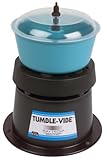
The Raytech TV-5 is the only vibratory tumbler in this roundup, and I included it because some hobbyists specifically want the shape-preserving, faster-finishing action that vibratory machines provide. Unlike a rotary tumbler that rounds stones into pebbles, a vibratory tumbler shakes the rocks in place, which smooths and polishes them while keeping their original form. That matters if you are tumbling cabochon slabs or specimens you want to display in their natural shape.
Raytech is a legitimate industrial brand with decades of experience in vibratory finishing equipment. The TV-5 is their entry-level model, but it is built to the same standards as their larger commercial units. The ABS plastic bowl holds 0.05 cubic feet of material, which translates to roughly 4 pounds of rock or 25 metal ring castings. The clear acrylic lid lets you watch the action without stopping the machine, which is genuinely useful when you are learning how vibratory tumbling behaves.
The 115V, 60Hz motor is rated for both wet and dry operations, which makes the TV-5 a dual-purpose machine. Jewelry makers use it for metal finishing and deburring, while rock tumblers use it for the final polish stage or for shape-preserving smoothing of slabs and preforms. If you work in both media, this versatility is a real advantage over a dedicated rock tumbler.
At $122.90 the TV-5 sits in premium territory, and it is the only machine in this roundup that is not Prime eligible, so factor in shipping time. The CE approval and Raytech’s reputation for quality give me confidence in the build, but the small capacity and lack of included accessories mean you are paying for the vibratory mechanism and the brand name rather than a complete package.
When vibratory beats rotary
Vibratory tumblers finish stones in roughly half the time of rotary tumblers because the constant shaking action is more aggressive per hour than the slow roll of a rotary barrel. If you are doing production finishing where speed matters, or you need to preserve the natural shape of your material, vibratory is the right call.
I also recommend vibratory for the final polish stage even if you do your coarse and medium grinding in a rotary machine. Running the polish stage in a vibratory bowl for a few days often produces a brighter finish than extending the rotary polish for an extra week.
What to know before choosing vibratory
Vibratory tumbling has a steeper learning curve than rotary. You need different grits, different media, and a different feel for how full to load the bowl. The TV-5 ships with no accessories, so you will need to source vibratory grit and ceramic or plastic media separately before you can run your first batch.
The 4-pound capacity is also modest. For serious rock production you would want a larger vibratory bowl, but for jewelry work and small specimen polishing the TV-5 is a capable, well-built machine from a brand that has earned its reputation.
How to Choose the Best Lapidary Tumbler for You?
Choosing the right rock polishing machine comes down to matching the machine’s strengths to how you actually plan to use it. I have broken down the key decision factors below based on what I have learned testing these machines and what the rock tumbling community on Reddit and hobby forums consistently recommends.
Rotary vs vibratory: the fundamental choice
Rotary tumblers are the default for most hobbyists. They use a turning barrel to roll rocks against each other and grit, which produces rounded, smoothly polished stones over four to seven weeks across four grit stages. They are forgiving, easy to learn, and produce the classic tumbled-stone look most people want.
Vibratory tumblers use rapid vibration instead of rotation, which finishes stones in about half the time and preserves their original shape. They are better for jewelry work, slab finishing, and production environments where speed matters. Most beginners should start rotary and add vibratory later if they find they need it.
Barrel capacity and what it really means
Barrel capacity is measured in pounds of rock plus media, and it directly determines how many stones you can produce per cycle. A 1LB barrel handles roughly one cup of rock, which produces a small handful of polished stones. A 3LB barrel handles three to four cups, and a 6LB dual-barrel setup lets you run two stages at once.
Underfilling a barrel is one of the most common beginner mistakes. If the barrel is less than half full, the rocks bang around violently instead of tumbling smoothly, which chips them and ruins the polish. Always fill the barrel at least two-thirds full, topping up with ceramic media if you do not have enough rock.
Motor type: brushless vs brushed
Brushed motors are the traditional design found in most budget tumblers. They work fine for occasional use but typically last 500 to 1,500 hours before needing belt replacements or motor service. They are noisier and less efficient than brushless alternatives.
Brushless motors, like those in the KoolStone and KomeStone machines, eliminate the friction-wearing brushes and can last up to 20,000 hours. They run quieter, require less maintenance, and deliver more consistent torque. If you plan to tumble regularly, the brushless premium pays for itself in reduced maintenance and longer machine life.
Noise and where you will run the machine
All rock tumblers make noise because they run continuously for weeks at a time. Rubber barrels are significantly quieter than plastic barrels, and noise-reduction covers (like on the KomeStone and KoolStone C1 Pro Max) make another meaningful difference. If you plan to run the machine inside your living space, prioritize quiet operation. If it lives in a garage or basement, noise matters less.
A common community tip is to place the tumbler on a foam mat or rubber pad to dampen vibration that travels through floors and walls. That simple addition can make a noisy machine tolerable in a shared space.
Grit stages and long-term cost of ownership
Every rotary tumbler runs a four-stage process: coarse (60/90 grit), medium (120/220), fine (500), and polish (aluminum oxide or cerium oxide). Each stage takes one to two weeks, so a full cycle runs four to seven weeks. Budget for grit consumables, which cost roughly $15 to $30 per cycle depending on barrel size and whether you buy in bulk.
Ceramic media is a one-time purchase that lasts for years and helps fill the barrel when you do not have enough rock. Plastic pellets are another option for cushioning fragile stones. Factor these consumables into your total cost of ownership, not just the upfront machine price.
Brand transparency and white-label machines
The rock tumbler market has a transparency problem that the community has been increasingly vocal about. Many tumblers sold under different brand names are actually the same white-label machine manufactured in the same factory, with different branding and sometimes wildly different prices. The Reddit rock tumbling community has documented cases where a $60 machine and a $120 machine are functionally identical.
The brushless machines from KoolStone and KomeStone represent genuine technological differentiation rather than rebranding, which is why I feature them prominently in this guide. When evaluating any tumbler, look at the actual motor type, barrel material, and warranty terms rather than the brand name on the box.
Frequently Asked Questions
Who makes the best rock tumbler?
Lortone, Thumler’s, and Tumble-Bee are the traditional community favorites for rotary tumblers, while KoolStone and KomeStone lead the newer brushless motor category. For most hobbyists in 2026, I recommend the KoolStone C1 Pro Max or KomeStone 7LB dual barrel because they combine brushless reliability with strong warranties and U.S.-based customer support.
How much does a good rock tumbler cost?
A decent starter kit runs $55 to $85 and includes everything you need for a first batch. Mid-range brushless machines with digital timers cost $75 to $120 and offer better longevity and noise reduction. Commercial-grade machines like the Rebel 17 run $300 and up. Expect to spend another $15 to $30 per cycle on grit and consumables.
Is a rock tumbler worth it?
Yes, if you enjoy hands-on hobbies and have space to run a machine continuously for weeks at a time. Rock tumbling produces polished stones you can use in jewelry, crafts, or collections, and the hobby scales from a $60 family activity to a serious lapidary pursuit. If you are unsure, start with the National Geographic kit before investing in a premium machine.
What rocks cannot be tumbled?
Avoid rocks that are too soft (under 3 on the Mohs scale like talc or gypsum), rocks that crumble or are heavily fractured, and rocks containing toxic minerals like asbestos or cinnabar. Also avoid mixing rocks of very different hardness in the same batch, since the harder stones will scratch and destroy the softer ones during tumbling.
Are Harbor Freight rock tumblers any good?
Harbor Freight and Central Machinery tumblers are frequent complaints in rock tumbling forums, with many users reporting motor failures within the first few cycles. While the low price is tempting, the community consensus is that these machines are not built for the continuous multi-week duty cycle that rock tumbling demands. A slightly more expensive brushless option will save money and frustration long-term.
Final Thoughts on the Best Lapidary Tumblers in 2026
Finding the best lapidary tumbler comes down to honest self-assessment about how you will use the machine. If you want a low-risk introduction, the National Geographic Hobby Kit has earned its 25,000+ reviews for good reason. If you want a serious adult machine that balances price and features, the KoolStone C1 Pro Max is the sweet spot. And if you are ready to commit to the hobby long-term, the KomeStone 7LB dual barrel gives you the workflow and durability to process serious volume for years.
My top pick overall is the KomeStone 7LB for committed hobbyists and the KoolStone C1 Pro Max for everyone else. Both use brushless motors that will outlast traditional machines by a wide margin, and both come from companies that stand behind their warranties. Whatever you choose, the most important step is simply to start tumbling. The first time you crack open a barrel and pour out a handful of stones you polished yourself, you will understand why this hobby has such a devoted community.