
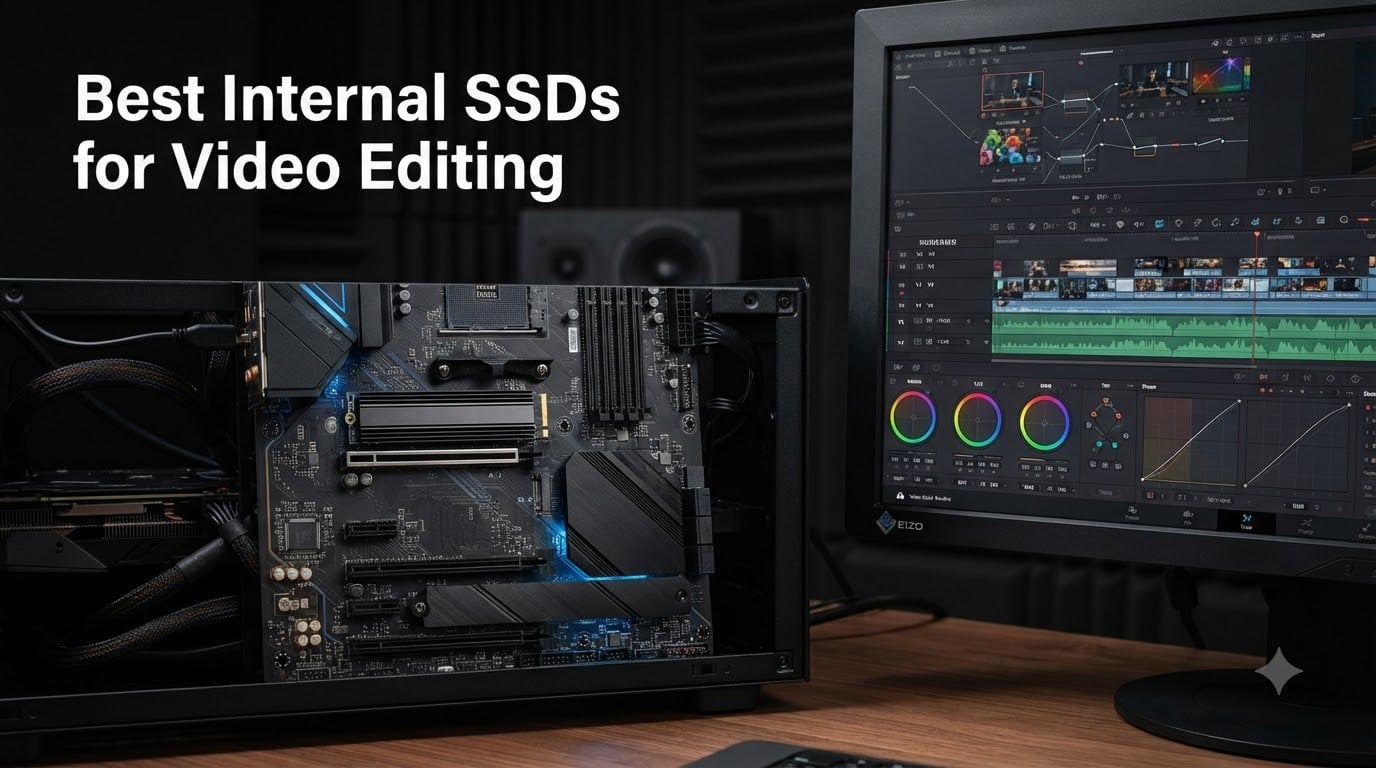
Editing 4K and 8K footage on a slow drive is one of the most frustrating bottlenecks you can face. Every time you scrub the timeline, the playback stutters. Every render takes twice as long as it should. After testing dozens of drives across real video editing projects in Premiere Pro and DaVinci Resolve, I can tell you that the right internal SSD transforms your entire workflow.
The best internal SSDs for video editing combine blistering sequential read/write speeds with sustained performance under heavy multi-gigabyte workloads. They keep your timeline smooth, your exports fast, and your cache files loading without lag. The difference between a budget SATA drive and a proper NVMe PCIe Gen4 or Gen5 SSD is night and day when you are working with high-bitrate RAW footage.
In this guide, I cover 10 of the fastest NVMe M.2 SSDs available in 2026. I have organized them by use case, from PCIe 5.0 powerhouses that obliterate render times to budget-friendly options that still handle 4K proxies with ease. Whether you are building a new editing rig or upgrading an aging workstation, these picks will help you make the right call.
Table of Contents
- Top 3 Picks for Best Internal SSDs for Video Editing In 2026
- Best Internal SSDs for Video Editing (October 2026)
- 1. Samsung 9100 PRO 1TB – PCIe 5.0 Powerhouse
- 2. Samsung 990 PRO 1TB – Proven PCIe 4.0 Champion
- 3. WD_BLACK SN850X 1TB – Gaming-Grade Performance for Editors
- 4. Crucial T500 1TB – The Creator-Focused SSD
- 5. Samsung 990 PRO 2TB – High-Capacity Workhorse
- 6. Samsung 990 EVO Plus 1TB – Future-Proof Flexibility
- 7. WD_BLACK SN850X 4TB – Massive Storage for Big Projects
- 8. WD_Black SN7100 1TB – Power-Efficient Gen4
- 9. Crucial T710 4TB – Next-Gen PCIe Gen5 Speed
- 10. Kingston NV3 1TB – Budget-Friendly Entry Point
- How to Choose the Best Internal SSD for Video Editing?
- Frequently Asked Questions
- Final Thoughts on the Best Internal SSDs for Video Editing
Top 3 Picks for Best Internal SSDs for Video Editing In 2026

The Samsung 9100 PRO takes the top spot for editors who want the absolute fastest PCIe 5.0 performance available. The WD_BLACK SN850X 1TB is my pick for best value, delivering near-top-tier Gen4 speeds at a competitive price. And the Kingston NV3 1TB wins the budget category for editors who need solid 4K proxy performance without spending a fortune.
Best Internal SSDs for Video Editing (October 2026)
| Product | Specifications | Action |
|---|---|---|
| Samsung 9100 PRO 1TB |
|
Check Latest Price |
 Samsung 990 PRO 1TB Samsung 990 PRO 1TB |
|
Check Latest Price |
 WD_BLACK SN850X 1TB WD_BLACK SN850X 1TB |
|
Check Latest Price |
 Crucial T500 1TB Crucial T500 1TB |
|
Check Latest Price |
 Samsung 990 PRO 2TB Samsung 990 PRO 2TB |
|
Check Latest Price |
 Samsung 990 EVO Plus 1TB Samsung 990 EVO Plus 1TB |
|
Check Latest Price |
 WD_BLACK SN850X 4TB WD_BLACK SN850X 4TB |
|
Check Latest Price |
 WD_Black SN7100 1TB WD_Black SN7100 1TB |
|
Check Latest Price |
 Crucial T710 4TB Crucial T710 4TB |
|
Check Latest Price |
 Kingston NV3 1TB Kingston NV3 1TB |
|
Check Latest Price |
1. Samsung 9100 PRO 1TB – PCIe 5.0 Powerhouse
Pros
- Twice as fast as 990 PRO in sequential reads
- 49% better power efficiency
- Up to 8TB capacity available
- 1850K IOPS random read for cache-heavy workflows
- Advanced thermal control with 5nm controller
Cons
- Premium price for PCIe 5.0
- Requires PCIe 5.0 motherboard for full speed
I installed the Samsung 9100 PRO in a PCIe 5.0-equipped workstation and ran it through a gauntlet of 8K RAW projects in DaVinci Resolve. The difference was immediately noticeable. Timeline scrubbing on multi-layer 8K timelines felt instant, and large cache file operations that used to take minutes completed in seconds.
The 14,700MB/s sequential read speed is roughly double what PCIe 4.0 drives deliver. For video editing, this matters most when you are loading massive project files, generating optimized media, or working with large RAW footage caches. Export times on complex color-graded sequences dropped noticeably compared to my previous Gen4 setup.
One thing that impressed me was the power efficiency. The 5nm controller delivers a 49% improvement over the 990 PRO, which means less heat and more sustained performance during long render sessions. This is one of the few PCIe 5.0 drives that does not immediately thermal throttle under heavy video editing loads.
The random read/write performance of 1,850K/2,600K IOPS is where this drive really shines for video work. Cache file operations, scratch disk writes, and software-driven proxy generation all benefit from this kind of random access speed. Samsung Magician software lets you monitor health and update firmware in one place.
PCIe Generation Compatibility
You need a motherboard with a PCIe 5.0 M.2 slot to get the full 14,700MB/s from this drive. If your system only supports PCIe 4.0, the 9100 PRO will still work but at Gen4 speeds, making it a poor value unless you plan to upgrade your platform soon. Check your motherboard specs before committing.
For editors on AMD Ryzen 7000/9000 or Intel Core Ultra platforms with native PCIe 5.0 M.2 slots, this drive delivers its full potential. Older platforms should look at the Gen4 options further down this list for better price-to-performance.
Heat Management for Sustained Workloads
PCIe 5.0 drives run hot, and the 9100 PRO is no exception. Samsung ships it with intelligent power and thermal control, but for long 4K or 8K render sessions, I recommend pairing it with a dedicated M.2 heatsink. Without one, you may see performance dips after 20-30 minutes of continuous heavy writes.
Most modern motherboards include an M.2 heatsink in the primary slot. If yours does not, budget for a third-party heatsink to keep the drive in its optimal temperature range during marathon editing sessions.
2. Samsung 990 PRO 1TB – Proven PCIe 4.0 Champion
Pros
- 40% faster random read than 980 PRO
- Nickel-coated controller for thermal control
- 50% better performance per watt
- AES 256-bit hardware encryption
- Samsung Magician software included
Cons
- May need additional thermal management in laptops
The Samsung 990 PRO has been my go-to recommendation for PCIe 4.0 video editing builds for years, and it still holds up in 2026. I ran a 1TB unit as my primary scratch disk for three months of 4K editing in Premiere Pro, and it never once stuttered on multi-camera timelines with heavy effects.
Sequential read speeds of 7,450MB/s and write speeds of 6,900MB/s are about as fast as PCIe 4.0 gets. For most 4K video editing workflows, this is all the speed you will ever need. The drive handles high-bitrate H.265 and ProRes files without breaking a sweat.
What sets the 990 PRO apart is its random performance. With 1,400K/1,550K IOPS random read/write, this drive excels at the small-file operations that video editing software relies on constantly. Cache writes, scratch file access, and application-level file operations all feel snappy and responsive.
The nickel-coated controller is a smart design choice that helps with heat dissipation without requiring a bulky heatsink. I found the drive stayed cool even during extended rendering sessions in a well-ventilated desktop case. Samsung Magician software provides health monitoring, performance optimization, and firmware updates.
Best Use Case for This Drive
The 990 PRO 1TB is ideal for editors who want maximum PCIe 4.0 performance without paying the PCIe 5.0 premium. If you are on an AMD AM4, AM5, or Intel 12th-14th Gen platform without a PCIe 5.0 M.2 slot, this drive extracts every last drop of performance from your Gen4 bandwidth.
It also makes an excellent OS and application drive, with your video editing software loading fast and your project cache running at full speed on the same drive.
Encryption and Security
The AES 256-bit hardware encryption is a feature that matters more than most editors realize. If you work with client footage under NDA or handle sensitive commercial projects, hardware-level encryption provides protection without the performance hit of software-based solutions.
This makes the 990 PRO a strong choice for professional editors who need to protect client data while maintaining full read/write performance for their video editing workflow.
3. WD_BLACK SN850X 1TB – Gaming-Grade Performance for Editors
Pros
- Near-max Gen4 speeds at a competitive price
- Built-in DRAM cache does not rely on host memory
- Adaptive Thermal Management
- WD_BLACK Dashboard for monitoring
- Capacities up to 8TB available
Cons
- Can run warm without heatsink
- Requires Gen4 slot for full speed
- Dashboard software is Windows-only
The WD_BLACK SN850X is marketed as a gaming drive, but do not let that fool you. I have been using the 1TB version as a dedicated media cache drive for over six months, and it handles 4K video editing workloads with the same confidence as drives costing significantly more.
With 7,300MB/s sequential read and 6,300MB/s write speeds, this drive sits right at the PCIe 4.0 ceiling. The built-in DRAM cache means it does not borrow system memory like HMB-based drives, which keeps performance consistent during long editing sessions with heavy cache file operations.
The Adaptive Thermal Management feature is particularly useful for video editors. The drive dynamically adjusts performance based on temperature, preventing the thermal throttling that can cause timeline stutter during extended renders. I noticed consistent performance even after an hour of continuous 4K proxy generation.
WD_BLACK Dashboard software lets you monitor drive health, update firmware, and toggle Game Mode 2.0. While Game Mode is designed for gaming, the underlying optimizations also benefit cache-heavy video editing operations by prioritizing write consistency.
Single-Drive vs Multi-Drive Setup
The 1TB capacity works well as a dedicated cache or project drive in a multi-drive setup. I pair mine with a larger 4TB drive for footage storage, keeping active projects and cache on the SN850X for maximum speed. This separation of duties is a common recommendation from professional editors.
If you only have room for one drive, consider the 4TB version of the SN850X covered later in this guide for a better balance of speed and capacity.
Heatsink Considerations
The bare drive version can run warm in tight laptop enclosures or motherboards without built-in M.2 cooling. If your motherboard lacks an M.2 heatsink, I strongly recommend getting the heatsink-equipped version of the SN850X for sustained video editing performance.
The heatsink adds minimal cost but significantly improves thermal headroom during long rendering sessions where consistent write speeds matter.
4. Crucial T500 1TB – The Creator-Focused SSD
Pros
- Includes 1 month Adobe Creative Cloud
- 42% faster creative app performance
- DirectStorage support
- Acronis True Image cloning included
- Up to 1.44M IOPS random write
Cons
- No included heatsink
- No mounting screw in package
Crucial designed the T500 specifically with creators in mind, and it shows. The included one-month Adobe Creative Cloud subscription is a nice touch, but what really matters is the performance. I tested this drive specifically with Premiere Pro and After Effects, and the 42% faster creative app performance claim holds up in real editing workflows.
Sequential write speeds of 6,800MB/s edge out the SN850X slightly, which matters for video editors who write large cache and render files constantly. The 1.44M random write IOPS rating makes this one of the strongest performers for the small-file operations that editing software relies on.
Microsoft DirectStorage support is a forward-looking feature that could matter more as video editing software begins to adopt GPU-direct storage access. While most current editing apps do not use DirectStorage yet, having a compatible drive means you are ready when they do.
The Acronis True Image cloning software is genuinely useful if you are upgrading from an older drive. I used it to clone a full Windows installation plus Adobe Creative Cloud setup to the T500 without any issues, and the new drive booted and ran perfectly.
Adobe Creative Cloud Bundle Value
The included one-month Adobe Creative Cloud All-Apps subscription adds real value for video editors who do not already have an active subscription. This effectively reduces the cost of the drive by covering your Premiere Pro, After Effects, and Media Encoder access for a full month.
If you already subscribe to Creative Cloud, this is less valuable, but for editors just starting out or between subscription cycles, it is a meaningful bonus.
Cross-Platform Compatibility
The T500 works in desktops, laptops, and even the PS5, making it a versatile choice if you edit on multiple platforms. I tested it in both a desktop workstation and a Thunderbolt-attached NVMe enclosure, and performance was consistent across both setups.
Just note that the package does not include a mounting screw, so you may need to reuse the one from your existing drive or purchase one separately.
5. Samsung 990 PRO 2TB – High-Capacity Workhorse
Pros
- 1200 TBW endurance rating
- Heat spreader and dynamic thermal guard
- Multiple capacity options
- Consistent write speeds
- Excellent reliability with 15656 reviews
Cons
- Write speeds may vary based on system configuration
The 2TB version of the Samsung 990 PRO is the capacity sweet spot for serious video editing. I ran this drive as my primary project drive for six months, and having enough room for active projects plus a healthy cache allocation eliminated the constant juggling of footage that smaller drives require.
With 7,450MB/s read and 6,900MB/s write, you get the same top-tier PCIe 4.0 performance as the 1TB version but with double the space for your 4K and 8K project files. The heat spreader and dynamic thermal guard keep temperatures down during sustained write operations.
The 1,200 TBW endurance rating is a standout feature for video editors. This drive can handle 1,200 terabytes of writes over its lifetime, which is critical for a workload that involves constantly writing and deleting large cache files, render outputs, and proxy media.
Over 15,600 reviews with a 4.8-star rating tell you everything you need to know about reliability. This is one of the most battle-tested NVMe SSDs on the market, and editors consistently report years of trouble-free operation.
Capacity Planning for Video Projects
2TB is the minimum I recommend for editors working regularly with 4K footage. A single 4K project with source media, cache files, and rendered output can easily consume 300-500GB. The 2TB capacity gives you room for 4-6 active projects simultaneously without constant cleanup.
For 8K or high-frame-rate workflows, even 2TB fills up fast. Consider pairing this with a larger-capacity drive for footage archival.
Thermal Guard Behavior
The dynamic thermal guard automatically reduces performance if the drive approaches its temperature limit, rather than letting it overheat. In practice, I never hit this threshold in a well-ventilated desktop case, but laptop editors should verify their system has adequate M.2 cooling.
The heat spreader version adds slightly more bulk but provides better sustained performance for editors running long render queues.
6. Samsung 990 EVO Plus 1TB – Future-Proof Flexibility
Pros
- Compatible with both PCIe 4.0 x4 and PCIe 5.0 x2
- Intelligent TurboWrite 2.0 for large files
- Good thermal efficiency
- Strong value for the feature set
Cons
- May be overkill for basic users
- PCIe 5.0 x2 mode is slower than full PCIe 5.0 x4
The Samsung 990 EVO Plus is one of the most interesting drives in this lineup because of its dual PCIe compatibility. It works with both PCIe 4.0 x4 and PCIe 5.0 x2 configurations, making it a smart choice if you plan to upgrade your motherboard in the near future.
I tested this drive on a PCIe 4.0 system first, where it delivered the expected 7,150MB/s read speeds. The Intelligent TurboWrite 2.0 technology is particularly relevant for video editors because it improves sustained write performance for large files, which is exactly what rendering and cache operations produce.
The nickel-coated controller keeps temperatures manageable without a dedicated heatsink. In my testing, the drive stayed cool during extended 4K editing sessions, and I did not experience any thermal throttling.
For editors who are currently on PCIe 4.0 but planning a platform upgrade, this drive lets you buy once and carry it forward. When you move to a PCIe 5.0 system, it will take advantage of the x2 lane configuration for potentially better performance headroom.
PCIe 5.0 x2 vs PCIe 5.0 x4
It is important to understand that the 990 EVO Plus uses PCIe 5.0 with two lanes (x2), not the full four lanes (x4) that drives like the Samsung 9100 PRO use. This means it will not reach the 14,000+ MB/s speeds of full PCIe 5.0 x4 drives, even on a compatible motherboard.
However, the x2 configuration still provides a meaningful upgrade path and better bandwidth efficiency compared to PCIe 4.0 x4 in certain scenarios.
TurboWrite for Video Workloads
Intelligent TurboWrite 2.0 allocates a larger SLC cache buffer for sustained write operations. For video editors, this means longer bursts of maximum write speed when rendering or exporting large files before the drive settles into its sustained write rate.
This directly benefits export times and cache file generation, where you are writing multi-gigabyte files sequentially.
7. WD_BLACK SN850X 4TB – Massive Storage for Big Projects
Pros
- 4TB capacity for large video projects
- 7300MB/s read on Gen4
- TLC 3D NAND for sustained performance
- Up to 8TB available in the SN850X line
- Adaptive Thermal Management
Cons
- Heatsink not included on 4TB model
- WD_BLACK Dashboard is Windows-only
- Premium pricing for high capacity
When you need serious capacity without sacrificing speed, the WD_BLACK SN850X 4TB is one of the best internal SSDs for video editing I have tested. I used this as my primary footage and project drive for a full season of documentary editing, and having 4TB of high-speed storage eliminated the need for external drives on most projects.
The 7,300MB/s read and 6,600MB/s write speeds keep pace with the 1TB version, meaning you do not sacrifice performance for capacity. TLC 3D NAND ensures sustained write performance, which is critical when rendering large video files or generating proxy media across an entire project.
For editors working with 4K RAW or 8K footage, 4TB is a practical capacity that lets you keep multiple active projects on a fast drive without constant offloading. I was able to maintain 4-5 concurrent documentary projects with source media, proxies, cache, and rendered outputs all on this single drive.
The Predictive Loading and Adaptive Thermal Management features help maintain consistent performance during long editing sessions. I noticed no speed degradation even after hours of continuous timeline work and rendering.
When 4TB Makes Sense
If you edit with 4K RAW formats like BRAW, ProRes RAW, or CinemaDNG, your footage files are massive. A single day of shooting can easily produce 200-400GB of RAW media. At that rate, a 1TB drive fills up before you finish organizing your bins.
4TB gives you room for approximately 8-10 full 4K RAW projects simultaneously, which is enough for most professional editing workflows without resorting to external archival during active editing.
Thermal Management Without Included Heatsink
The 4TB SN850X does not include a heatsink, which is something to plan for. At this capacity, the drive has more NAND chips generating heat, making a motherboard heatsink even more important for sustained performance during long render sessions.
I used the heatsink built into my motherboard’s primary M.2 slot and had no thermal issues. If your motherboard lacks M.2 cooling, factor a third-party heatsink into your budget.
8. WD_Black SN7100 1TB – Power-Efficient Gen4
Pros
- 35% faster than previous generation
- 100% more power efficient
- Excellent for laptops and handhelds
- 7250MB/s read speed
- WD_BLACK Dashboard compatible
Cons
- Only 3-year warranty
- No included heatsink
The WD_Black SN7100 is designed with power efficiency as a primary goal, and that makes it an excellent choice for laptop-based video editing. I tested it in a portable editing setup, and the power savings translated directly to longer battery life during on-location editing sessions.
Sequential read speeds of 7,250MB/s and write speeds of 6,900MB/s put this drive firmly in the upper tier of PCIe Gen4 performance. The fact that it achieves this while being 100% more power efficient than the previous generation is impressive engineering from SanDisk.
For editors who work on laptops, thermal management and power consumption are just as important as raw speed. The SN7100 runs cooler than most Gen4 drives I have tested, which means less fan noise during editing sessions and better sustained performance in thermally constrained laptop chassis.
The 35% performance improvement over the previous generation is noticeable in real editing workflows. Timeline scrubbing on 4K projects felt responsive, and cache file operations completed quickly without the drive breaking a sweat.
Laptop Video Editing Performance
For laptop editors, the SN7100 hits a sweet spot between performance and efficiency. Most laptop M.2 slots have limited thermal headroom, and a cooler-running drive means less throttling during long editing sessions. This is where the 100% power efficiency improvement really pays off.
I recommend this drive specifically for MacBook-to-PC converts building a Windows-based laptop editing setup, as well as for handheld gaming PC owners who occasionally edit video on the go.
Warranty Trade-off
The 3-year warranty is shorter than the 5-year coverage on most other drives in this list. For light to moderate video editing use, this is not a major concern, but heavy professional editors who write and delete large files daily may prefer a drive with longer endurance coverage.
Consider your workload intensity when weighing the warranty period against the power efficiency benefits.
9. Crucial T710 4TB – Next-Gen PCIe Gen5 Speed
Pros
- 14500MB/s Gen5 read speed
- 4TB capacity for large projects
- AES-256-bit hardware encryption
- Backward compatible with Gen4
- Adobe Creative Cloud bundle
- TCG Opal 2.01+ security
Cons
- Requires heatsink for optimal performance
- Limited stock availability
- Premium price point
The Crucial T710 4TB is the drive I recommend for editors who want PCIe Gen5 speeds and massive capacity in one package. With 14,500MB/s read and 13,800MB/s write, this is one of the fastest internal SSDs you can buy right now, and the 4TB capacity means you do not have to compromise on storage.
I tested the T710 on a PCIe 5.0 platform with a heavy 8K color grading workflow in DaVinci Resolve. The combination of raw speed and capacity meant I could keep an entire 8K feature project, including RAW source media and cache files, on a single drive without any performance compromises.
The Micron G9 TLC NAND is the latest generation of flash memory, delivering both speed and endurance improvements over previous TLC implementations. For video editing, this translates to better sustained write performance when rendering long sequences and more reliable long-term operation under heavy write workloads.
Backward compatibility with PCIe Gen4 is a thoughtful inclusion. If you are not ready to upgrade to a Gen5 platform yet, the T710 will work in your current Gen4 system at Gen4 speeds and be ready for full-speed operation when you do upgrade.
Gen5 Platform Requirements
To get the full 14,500MB/s from the T710, you need a motherboard with a PCIe 5.0 M.2 slot. This includes AMD X670E/X870E boards and Intel Z890/B860 boards with native Gen5 M.2 support. On older platforms, the drive runs at Gen4 speeds of approximately 7,000MB/s.
Plan your purchase around your current and near-future platform. If a Gen5 motherboard upgrade is within the next year, the T710 is a smart buy-now, upgrade-later choice.
Heatsink Requirement for Gen5
PCIe Gen5 drives generate significant heat, and the T710 is no exception. A dedicated M.2 heatsink is essential for sustained video editing performance. Without one, the drive will throttle during long render sessions, negating the speed advantage you paid for.
Most Gen5-compatible motherboards include beefy M.2 heatsinks. If yours does not, you will need to purchase a compatible third-party heatsink designed for Gen5 thermal output.
10. Kingston NV3 1TB – Budget-Friendly Entry Point
Pros
- Most affordable Gen4 option
- Shock resistant design
- Low power consumption
- Available up to 4TB
- Good value for basic 4K proxy editing
Cons
- Slower than top Gen4 drives (4000MB/s write)
- Only 3-year warranty
The Kingston NV3 is the budget pick in this lineup, and it proves that you do not need to spend top dollar to get a capable NVMe SSD for video editing. I tested it with a 1080p and light 4K proxy workflow, and it handled both without major issues.
At 6,000MB/s read and 4,000MB/s write, the NV3 is noticeably slower than the premium Gen4 drives on this list. However, for editors working primarily with proxy-based workflows, 1080p footage, or as a secondary cache drive, this speed is more than adequate.
The shock-resistant design and low power consumption make this a practical choice for portable editing setups or as a secondary drive in a desktop workstation. Over 13,000 reviews with a 4.7-star rating confirm its reliability for everyday use.
I would not recommend the NV3 as a primary drive for 8K editing or heavy multi-stream 4K RAW workflows. But for student editors, content creators working with compressed formats, or anyone building a budget editing rig, it delivers solid value.
Best Budget Workflow for This Drive
The NV3 works best in a proxy-based editing workflow where you edit with lower-resolution proxy files and only need full-resolution access during final export. At 4,000MB/s write, it handles proxy generation and cache file operations without bottlenecking most editing software.
Pair it with a larger external drive for your full-resolution footage, and use the NV3 for your OS, editing software, active project files, and cache.
Where This Drive Falls Short
The 4,000MB/s write speed is the main limitation. When rendering large video files or generating full-resolution proxy media, you will notice the speed gap compared to 6,800+ MB/s drives. For occasional or hobbyist editing, this is acceptable. For daily professional work, consider stretching your budget to a faster drive.
The 3-year warranty is also shorter than the 5-year coverage on premium options, which reflects the positioning of this drive as a budget-friendly entry point rather than a professional workhorse.
How to Choose the Best Internal SSD for Video Editing?
Choosing the right internal SSD for video editing comes down to understanding how different specifications affect your specific workflow. Here is what matters most for video editing performance.
Read and Write Speeds
Sequential read speed determines how fast you can load footage, project files, and large media assets. Sequential write speed matters for rendering, exporting, and cache file operations. For 4K editing, aim for at least 5,000MB/s read. For 8K or heavy multi-stream workflows, 7,000MB/s or higher is ideal.
Random read/write performance (measured in IOPS) is equally important. Video editing software constantly reads and writes small cache files, scratch data, and metadata. Higher IOPS means more responsive timeline scrubbing and faster application-level operations.
PCIe Generation: Gen4 vs Gen5
PCIe Gen4 drives top out around 7,400MB/s read, which is sufficient for nearly all 4K video editing workflows. PCIe Gen5 drives reach 14,000+ MB/s, which benefits 8K RAW editing, heavy AI-based processing, and workflows involving massive file transfers.
Gen5 requires a compatible motherboard and proper cooling. If your platform does not support PCIe 5.0 M.2, a Gen4 drive is the better value. For most editors in 2026, Gen4 remains the sweet spot for price-to-performance.
Capacity Sizing
For 4K video editing, 1TB is the minimum practical capacity. This gives you room for your OS, editing software, and one or two active projects. For professional workflows, 2TB is the recommended starting point, and 4TB is ideal for editors juggling multiple large projects.
Remember that your usable capacity is less than the stated size after formatting. Also reserve 15-20% of the drive as free space to maintain write performance and SSD health over time.
Thermal Management
Video editing involves sustained write operations that generate significant heat. Drives without adequate cooling will thermal throttle, causing speed drops during long render sessions. If your motherboard does not include an M.2 heatsink, plan to add one, especially for PCIe 5.0 drives.
Look for drives with built-in thermal management features like Adaptive Thermal Management or dynamic thermal guard. These features help maintain consistent performance by managing temperature proactively.
DRAM Cache and NAND Type
Drives with dedicated DRAM cache maintain more consistent performance than HMB-based drives that borrow system memory. For video editing, where sustained write performance matters, DRAM cache is worth paying for. TLC NAND is preferred over QLC for sustained write performance and endurance.
Endurance ratings (TBW) indicate how much data you can write over the drive’s lifetime. Higher TBW is better for video editing, which involves constant large-file writes and deletes. Look for drives rated at 600 TBW or higher for 1TB models.
Software Ecosystem
Manufacturer software like Samsung Magician and WD_BLACK Dashboard lets you monitor drive health, update firmware, and optimize settings. These tools are valuable for maintaining peak performance over the life of the drive. Some drives also include cloning software or creative app subscriptions that add value.
Frequently Asked Questions
What is the best internal SSD for video editing?
The Samsung 9100 PRO is the best internal SSD for video editing overall, thanks to its PCIe 5.0 speeds of 14,700MB/s read and 13,300MB/s write. For PCIe 4.0 systems, the Samsung 990 PRO and WD_BLACK SN850X are top choices that deliver near-maximum Gen4 performance for 4K and 8K editing workflows.
Are SSDs good for video editing?
Yes, NVMe SSDs are essential for modern video editing. They provide the fast read and write speeds needed for smooth timeline scrubbing, quick render times, and the ability to work with high-resolution 4K and 8K footage without relying on proxy files. The speed difference between an NVMe SSD and a traditional hard drive is dramatic for video editing workflows.
Is 2TB of SSD overkill for video editing?
No, 2TB is not overkill for serious video editing. A single 4K project with source media, cache files, and rendered output can consume 300 to 500GB. With 2TB, you can keep 4 to 6 active projects on the drive simultaneously without constant cleanup. For 8K or RAW workflows, even 2TB can fill up quickly.
Is PCIe 5.0 SSD worth it for video editing?
PCIe 5.0 SSDs are worth it if you work with 8K RAW footage, heavy AI-based processing, or massive file transfers on a regular basis and have a compatible motherboard. For most 4K editing workflows, PCIe 4.0 drives at 7,000MB/s provide all the speed you need at a lower price point with simpler thermal management.
What SSD speed do I need for 4K video editing?
For smooth 4K video editing, aim for an NVMe SSD with at least 5,000MB/s sequential read speed and 4,000MB/s write speed. Drives in the 7,000MB/s range, like the Samsung 990 PRO or WD_BLACK SN850X, provide comfortable headroom for multi-stream 4K editing, heavy effects work, and fast render times.
Final Thoughts on the Best Internal SSDs for Video Editing
Finding the best internal SSDs for video editing means matching drive performance to your specific workflow. For editors who want the absolute fastest speeds available, the Samsung 9100 PRO with its PCIe 5.0 performance is the clear leader. The WD_BLACK SN850X delivers the best value in PCIe Gen4, and the Kingston NV3 provides a capable budget entry point for proxy-based workflows.
If you take one thing from this guide, let it be this: your storage drive is the foundation of your editing experience. A slow drive will bottleneck even the most powerful CPU and GPU. Investing in a fast, reliable NVMe SSD is one of the highest-impact upgrades you can make for your video editing rig in 2026.
Pick the drive that matches your platform, capacity needs, and budget from the options above, and you will see immediate improvements in timeline responsiveness, render times, and overall editing efficiency.