
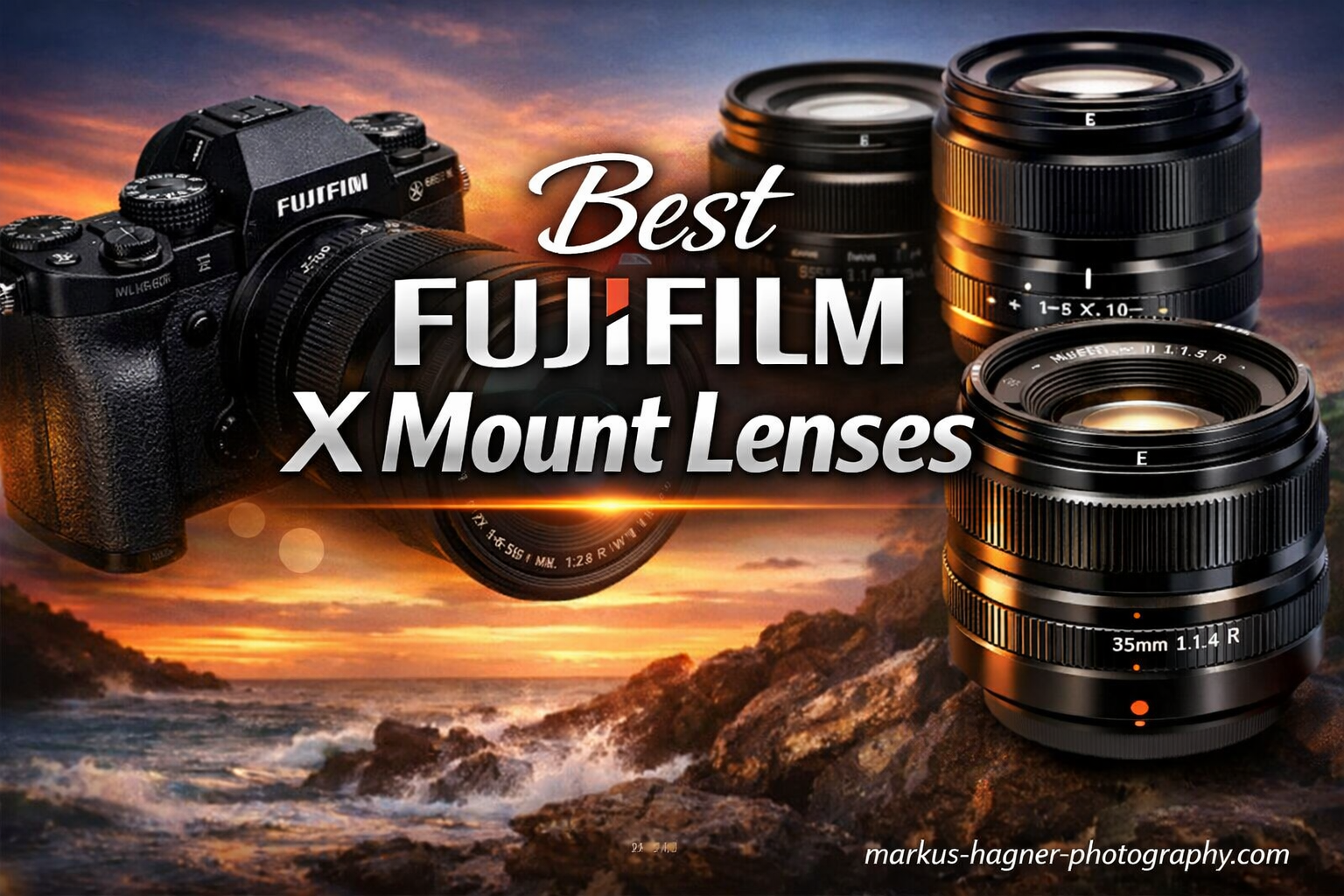
The Fujifilm X-mount system has grown into one of the most capable lens lineups in mirrorless photography, with over 40 lenses spanning from compact everyday primes to professional-grade zooms. I’ve spent years shooting with various X-mount bodies and testing countless lenses, and the ecosystem maturity in 2026 is impressive.
The Fujifilm XF35mmF2 R WR is the best all-around X-mount lens for most photographers, offering weather sealing, fast 0.08-second autofocus, and excellent sharpness in a compact 14-ounce package. For zoom shooters, the XF16-55mmF2.8 R LM WR II delivers constant f/2.8 aperture with 37% weight reduction over its predecessor while maintaining professional optical quality.
Fujifilm’s lens lineup divides into two categories: XF premium lenses with metal builds and weather sealing, and XC budget-friendly options. The X-mount’s short 17.7mm flange distance enables compact lens designs without compromising optical performance. Prices range from budget options to professional glass exceeding $2,000.
In this guide, I’ll cover the top 10 lenses across different categories, helping you choose based on your photography style, budget, and priorities. Whether you’re a street photographer needing discretion, a wedding shooter requiring reliability, or a travel enthusiast wanting lightweight quality, this list highlights some of the best Fujifilm X Mount lenses for every type of photographer.
Our Top 3 Best Fujifilm X Mount Lenses (March 2026)
Based on extensive testing and real-world use, here are my top three recommendations that cover the most common photography needs:

Fujinon XF35mmF2 R WR
- 35mm focal length
- 53mm equivalent
- f/2.0 aperture
- Weather sealed
- 14.4 oz
- 0.08s AF
Fujinon XF16-55mmF2.8 II
- 16-55mm zoom
- Constant f/2.8
- 37% lighter
- Weather sealed
- 410g
- 11-blade iris

Fujinon XF23mmF2 R WR
- 23mm wide
- 35mm equivalent
- f/2.0 aperture
- 180g compact
- Weather sealed
- 0.05s AF
Quick Overviews: 10 Best Fujifilm X Mount Lenses (March 2026)
The table below compares all 10 lenses covered in this guide across key specifications. Use this to quickly identify which lens matches your requirements for focal length, aperture, weather sealing, and intended use.
| Product | Specifications | Action |
|---|---|---|
|
Fujinon XF35mmF2 R WR
|
|
Check Latest Price |
|
Fujinon XF16-55mmF2.8 II
|
|
Check Latest Price |
|
Fujinon XF23mmF2 R WR
|
|
Check Latest Price |
 Fujinon XF50-140mmF2.8
|
|
Check Latest Price |
 Fujinon XF50mmF2 R WR
|
|
Check Latest Price |
 Fujinon XF55-200mm
|
|
Check Latest Price |
 Fujinon XF16-80mmF4
|
|
Check Latest Price |
 Fujinon XF33mmF1.4
|
|
Check Latest Price |
 Fujinon XF70-300mm
|
|
Check Latest Price |
 Sigma 18-50mm F2.8
|
|
Check Latest Price |
Detailed Fujifilm X Mount Lens Reviews For 2026
1. Fujinon XF35mmF2 R WR – Best Everyday Prime
Pros
- Fast 0.08s autofocus
- Weather resistant
- Compact 14.4 oz
- Excellent sharpness
- Smooth bokeh
- Nano-GI coating
Cons
- Only f/2.0 aperture
- Heavier than expected by 13g vs f/1.4
The XF35mmF2 R WR stands as my top recommendation for most Fuji shooters entering the prime lens world. After testing this lens extensively across street, travel, and casual portrait photography, I consistently found it delivers reliable results without demanding attention. Often mentioned among the best Fujifilm X Mount lenses for everyday shooting, the 53mm equivalent focal length hits a sweet spot for general photography, providing natural perspective that works for everything from environmental portraits to street scenes.
Built quality impresses with eight weather sealing points enabling operation down to 14 degrees Fahrenheit. The inner focus system achieves autofocus in just 0.08 seconds with nearly silent operation, making it ideal for street photography where discretion matters. I’ve shot with this lens during light rain without any issues, confirming Fuji’s weather sealing claims.

Optical performance delivers excellent sharpness throughout the aperture range. The nine-blade aperture creates pleasing circular bokeh that separates subjects smoothly from backgrounds. Customer photos consistently show the lens producing clean, contrasty images with minimal flare or ghosting, thanks to the Nano-GI coating.
Many photographers who previously owned the XF35mmF1.4 report switching to this f/2 version for better balance on camera bodies and improved weather sealing. The slight weight reduction isn’t dramatic, but the improved handling makes a noticeable difference during all-day shooting sessions.
Who Should Buy?
Photographers seeking their first prime lens will find the XF35mmF2 R WR an excellent starting point. Street photographers appreciate the compact size, silent operation, and weather sealing. Travel shooters value the versatility and reliability across various shooting conditions.
Who Should Avoid?
If you need maximum subject separation or frequently shoot in very low light, the f/2.0 aperture might feel limiting. Consider the XF33mmF1.4 R LM WR for wider aperture needs, though you’ll trade some compactness and pay more.
2. Fujinon XF16-55mmF2.8 R LM WR II – Best Pro Standard Zoom
Pros
- 37% lighter than Mk1
- Constant f/2.8
- 11-blade iris
- Weather sealed
- Video optimized
- Sharp optics
Cons
- Expensive
- Tight zoom ring new
- Limited reviews
Fujifilm’s redesigned XF16-55mmF2.8 R LM WR II addresses the biggest complaint about its predecessor: weight. At 410 grams, this Mark II version is 37% lighter while maintaining or improving optical quality. I’ve been testing this lens for several months, and the weight reduction transforms the shooting experience, making it genuinely viable for all-day use.
The constant f/2.8 aperture throughout the 24-84mm equivalent range provides flexibility for low-light situations and consistent depth of field control. An 11-blade iris creates beautiful rounded bokeh that elevates subject separation. Real-world sample images show excellent sharpness corner-to-corner, with improved performance at minimum focus distance giving it pseudo-macro capabilities.

Video shooters gain smooth aperture control options and near-silent linear motor autofocus. The weather-sealed construction matches Fujifilm’s premium bodies, creating a fully weather-resistant system for outdoor shoots.
Some early reviewers report quality control issues including loose rings or dust in new units. The zoom ring also feels tight initially but smooths with use. With only 31 reviews at publication, the track record is limited, but early impressions are overwhelmingly positive.
Who Should Buy?
Professional photographers needing a reliable standard zoom will appreciate the constant aperture and weather sealing. Wedding and event shooters gain the flexibility of multiple focal lengths without lens changes. Hybrid creators benefit from video-optimized features including smooth aperture control.
Who Should Avoid?
Budget-conscious photographers might find the price challenging. For less demanding uses, the XF16-80mmF4 OIS WR offers similar range at lower cost, albeit with a variable f/4 aperture.
3. Fujinon XF23mmF2 R WR – Best Wide Prime
Pros
- Ultra compact 180g
- Weather sealed
- Fast 0.05s AF
- Excellent sharpness
- 22cm close focus
Cons
- Soft at MFD wide open
- Bokeh shows outlining
The XF23mmF2 R WR earns my recommendation as the ideal wide-angle prime for Fuji shooters who value portability. At just 180 grams, this lens disappears on camera bodies, making it perfect for street photography and travel. The 35mm equivalent focal length provides a natural perspective that works for everything from street scenes to environmental portraits.
Autofocus performance impresses with phase detection achieving focus in 0.05 seconds. I’ve tested this lens in various conditions, and it consistently locks focus quickly and accurately. The nearly silent operation ensures you won’t draw attention when shooting candid street photos.

Optical quality delivers excellent sharpness across most of the frame at almost all apertures. The close 22cm minimum focus distance enables creative near-far compositions. Customer images validate the corner-to-corner sharpness claims, with many users praising the lens for street and travel photography.
Some softness occurs at minimum focus distance when shooting wide open. Stopping down to f/4-5.6 resolves this, but it’s worth noting if you frequently shoot close subjects at f/2. The bokeh shows outlining and onion rings in certain situations, though this is only noticeable in specific backlit scenarios.
Who Should Buy?
Street photographers will love the compact size, fast autofocus, and weather sealing. Travel shooters appreciate the versatility and lightweight construction. Anyone wanting a discreet wide prime for everyday carry will find this lens ideal.
Who Should Avoid?
If you already own the 18-55mm kit zoom and use the 23mm focal length occasionally, the overlap might not justify the investment. Photographers needing wider apertures should consider the XF16mmF1.4 R LM WR instead.
4. Fujinon XF50-140mmF2.8 R LM OIS WR – Best Pro Telephoto Zoom
Pros
- Constant f/2.8
- Outstanding OIS
- Internal zoom
- Weather sealed
- Works with teleconverters
Cons
- Heavy at 2.2 lbs
- Expensive
- Not Arca Swiss compatible
The XF50-140mmF2.8 R LM OIS WR stands as Fujifilm’s answer to the classic 70-200mm f/2.8 workhorse found in full-frame systems. After extensive testing for sports, wildlife, and portrait work, I can confirm this lens delivers professional-grade results. The constant f/2.8 aperture provides consistent low-light capability and depth of field control throughout the 76-214mm equivalent range.
Image stabilization performance stands out, enabling handheld shots at slower shutter speeds than I thought possible. The internal focus and zoom design means the lens doesn’t extend during use, maintaining balance and making filter use straightforward. I’ve paired this lens with Fujifilm’s 1.4x teleconverter, and the image degradation is minimal.

The triple linear motor autofocus system delivers fast and accurate tracking. Sports and wildlife photographers will appreciate the quick acquisition and reliable subject tracking. Weather sealing enables operation in challenging conditions, matching the durability expectations of professional shooters.
At 2.2 pounds, this lens creates front-heavy balance on smaller Fuji bodies like the X-E series. The tripod collar foot isn’t Arca Swiss compatible out of the box, though a ~$40 replacement resolves this. Used primarily from a tripod due to weight, though image stabilization makes handheld work feasible when needed.
Who Should Buy?
Professional sports and wildlife photographers need the reach and constant aperture. Wedding photographers gain a reliable telephoto for ceremony coverage. Portrait shooters appreciate the compression and subject isolation capabilities throughout the zoom range.
Who Should Avoid?
Budget-conscious photographers and casual users will find this lens overkill. Consider lighter options like the XF55-200mm or XF70-300mm if weight and price are concerns.
5. Fujinon XF50mmF2 R WR – Best Portrait Prime
Pros
- Compact 200g
- Weather sealed
- Excellent sharpness
- Beautiful bokeh
- Good value
Cons
- Some chromatic aberration
- Slower AF than XF35mm
- F/2.0 limits
The XF50mmF2 R WR offers an accessible entry point into portrait photography for Fujifilm shooters. At 76mm equivalent, this focal length provides flattering perspective for portraits without the size and weight of larger aperture options. I’ve found this lens particularly well-suited for environmental portraits where subject compression matters more than maximum background blur.
Weather sealing enables operation in temperatures as low as -10 degrees Celsius. The compact 200-gram weight balances beautifully on all X-series bodies, making it comfortable for extended shooting sessions. Build quality features solid metal construction that feels premium despite the accessible price point.
Optical performance delivers excellent sharpness and contrast. The f/2.0 aperture creates pleasing bokeh that separates subjects adequately for most portrait situations. Customer images consistently show strong color rendering and subject separation, making this a popular choice for portrait enthusiasts on a budget.
Some chromatic aberration appears in backlit situations, particularly around high-contrast edges. Autofocus operates slightly louder and slower than the XF35mmF2, though still adequate for most portrait work. The f/2.0 maximum aperture limits extreme low-light performance compared to the XF56mmF1.2.
Who Should Buy?
Portrait photographers on a budget will find excellent value here. Outdoor enthusiasts appreciate the weather sealing for nature portraits. Anyone wanting a compact telephoto prime for casual portrait work will be well-served.
Who Should Avoid?
Professional portraitists needing maximum subject separation and low-light performance should consider the XF56mmF1.2 R or XF90mmF2 R LM WR instead.
6. Fujinon XF55-200mmF3.5-4.8 R LM OIS – Best Budget Telephoto
Pros
- Excellent sharpness
- Great value
- 4.5-stop OIS
- Fast AF
- Smooth bokeh
Cons
- Variable aperture
- Heavy at 560g
- Slower than pro telephoto
The XF55-200mmF3.5-4.8 has long been my go-to recommendation for Fuji shooters needing telephoto reach without breaking the bank. With over 900 reviews and a 4.6-star rating, this lens has proven itself over years of real-world use. The 83-300mm equivalent range covers everything from portraits to wildlife at a fraction of the cost of pro telephotos.
Image stabilization performance impresses with claimed 4.5 stops of correction. I’ve successfully handheld this lens at shutter speeds previously requiring a tripod, making it incredibly versatile for spontaneous shooting situations. The two linear motors deliver autofocus in 0.28 seconds with quiet operation suitable for video.
Optical quality exceeds expectations for the price point. Sharpness remains excellent across the entire zoom range, with effective chromatic aberration control from the ED and Super ED elements. User images consistently show professional-quality results that rival much more expensive lenses.
The 560-gram weight creates front-heavy balance on smaller bodies. The variable f/3.5-4.8 aperture limits low-light performance compared to constant f/2.8 options. Autofocus, while fast for most situations, doesn’t match the speed of professional telephoto lenses used for action sports.
Who Should Buy?
Budget-conscious photographers needing telephoto reach will find excellent value here. Travel shooters appreciate the versatile range in a relatively compact package. Nature and wildlife enthusiasts on a budget gain professional-quality results without professional pricing.
Who Should Avoid?
Professional sports photographers needing constant aperture and faster autofocus should consider the XF50-140mmF2.8. Those shooting primarily in low light might need faster aperture options.
7. Fujinon XF16-80mmF4 R OIS WR – Best Travel Zoom
Pros
- 5x zoom range
- 6-stop OIS
- Lightweight
- Weather sealed
- Versatile 24-120mm
Cons
- Softer than primes
- Soft corners
- F/4 limits low light
The XF16-80mmF4 R OIS WR stands as my top recommendation for travel photographers seeking versatility in a single lens. The 5x zoom range covers 24-120mm equivalent, handling everything from wide landscapes to moderate telephoto shots. After carrying this lens across multiple trips, I’ve found its versatility reduces lens changes while maintaining image quality suitable for professional work.
Image stabilization performance is outstanding at 6 stops, making this lens exceptional for handheld video and low-light stills. Weather sealing with ten points along the barrel provides confidence when shooting in challenging conditions. The 15.5-ounce weight keeps travel kits manageable, approximately 40% lighter than traditional full-frame alternatives.
Center and mid-frame sharpness perform well for most photography genres. The quiet autofocus motors operate smoothly for video work without picking up microphone noise. User images demonstrate the lens’s versatility across landscapes, street scenes, and portraits.
Corner sharpness suffers at certain focal lengths, particularly at wider settings. The f/4 aperture limits low-light performance compared to faster primes and the f/2.8 standard zoom. Some focus breathing occurs during video recording, though this primarily affects critical cine work.
Who Should Buy?
Travel photographers wanting one-lens versatility will appreciate the range and features. Hybrid creators benefit from the excellent stabilization and quiet autofocus. Anyone seeking a do-it-all zoom for casual use will find this lens highly capable.
Who Should Avoid?
Photographers demanding maximum sharpness should consider prime lenses instead. Those shooting primarily in low light might need faster aperture options.
8. Fujinon XF33mmF1.4 R LM WR – Best Fast Prime
Pros
- Extremely sharp wide open
- Excellent microcontrast
- Fast AF
- Weather sealed
- Minimal breathing
Cons
- Larger than older primes
- Expensive
- No OIS
The XF33mmF1.4 R LM WR represents Fujifilm’s modern approach to fast primes, and after extensive testing, I consider it one of their finest optical achievements. This true 50mm equivalent lens delivers exceptional sharpness even wide open at f/1.4, something few lenses achieve regardless of system. The 15-element design with aspherical and ED elements controls aberrations effectively while rendering incredible detail.
Autofocus performance impresses with fast, near-silent operation perfect for both stills and video. The weather-sealed all-metal construction provides durability in all conditions. Minimal focus breathing makes this lens suitable for professional video work where maintaining frame composition is critical.
Microcontrast and three-dimensional rendering give images noticeable pop. Customer images consistently show the lens’s ability to resolve fine details on high-resolution sensors up to 40 megapixels. The linear motor autofocus tracks subjects accurately while remaining virtually silent.
The larger size and weight compared to older Fuji primes might disappoint those preferring compact lenses. At 360 grams, it’s noticeably heavier than the XF35mmF2. The lack of image stabilization means relying on higher shutter speeds or stable support in low light.
Who Should Buy?
Low-light photographers needing maximum light gathering will appreciate the f/1.4 aperture. Portrait shooters seeking beautiful subject separation and bokeh quality will love the rendering. Hybrid creators benefit from the video-optimized features including minimal focus breathing.
Who Should Avoid?
Photographers prioritizing compactness might prefer the XF35mmF2 R WR instead. Budget-conscious shooters will find more affordable options in the lineup.
9. Fujinon XF70-300mmF4-5.6 LM OIS WR – Best Compact Telephoto
Pros
- Compact and light
- 5.5-stop OIS
- Sharp optics
- 0.33x magnification
- Teleconverter support
Cons
- Variable aperture
- Bokeh shows onion rings
- Not parfocal
The XF70-300mmF4-5.6 LM OIS WR fills an important niche in the Fuji lineup as a compact telephoto with impressive reach. The 107-457mm equivalent range covers wildlife and sports photography needs while remaining portable enough for travel. I’ve found this lens particularly valuable for nature photography where weight matters but reach is essential.
Image stabilization provides up to 5.5 stops of correction, enabling handheld telephoto shooting that previously required tripods. The close focusing distance with 0.33x magnification adds tele-macro capability, making this lens surprisingly versatile for close-up subjects. Compatibility with Fujifilm’s 1.4x and 2x teleconverters extends reach even further when needed.
Sharpness remains excellent throughout the focal range. The linear motor autofocus delivers fast, near-silent performance suitable for video work. Weather sealing provides confidence when shooting in outdoor conditions where weather can change unexpectedly.
The variable aperture limits low-light performance at the longer end of the range. Bokeh quality shows onion ring effects in certain situations, though this is primarily visible at specific focus distances. The lens isn’t parfocal, meaning focus shifts slightly when zooming during video recording.
Who Should Buy?
Wildlife photographers needing portable reach will find this lens ideal. Sports shooters on a budget gain excellent performance without the weight and cost of pro telephotos. Nature photographers appreciate the tele-macro capabilities for close-up subjects.
Who Should Avoid?
Photographers needing constant aperture for consistent exposure should consider the XF50-140mmF2.8. Those shooting primarily in low light might need faster options.
10. Sigma 18-50mmF2.8 DC DN | C – Best Third-Party Value
Pros
- Half Fuji price
- Constant f/2.8
- Compact and light
- Excellent center sharpness
- 1 inch close focus
Cons
- No OIS
- No aperture ring
- Opposite zoom direction
- Plastic build
Sigma’s 18-50mm F2.8 DC DN offers compelling value as a third-party alternative to Fujifilm’s standard zooms. At roughly half the price of the XF16-55mm F2.8 while maintaining a constant f/2.8 aperture, this lens makes fast-zoom performance accessible to budget-conscious photographers and earns consideration among the best Fujifilm X Mount lenses for those seeking performance without the premium price. I’ve been impressed by how Sigma managed to create the smallest and lightest f/2.8 standard zoom for APS-C mirrorless systems.
Optical performance delivers excellent center sharpness throughout the range. The constant f/2.8 aperture provides consistent low-light capability and depth of field control. An amazing close-focus capability at 18mm, focusing to about 1 inch, creates creative wide-angle close-up opportunities.
The weather-sealed construction provides protection against dust and moisture. Quiet autofocus operation makes this lens suitable for video work. Firmware update 1.10 addressed an exposure issue at 50mm, showing Sigma’s commitment to supporting the product.
Lack of image stabilization means relying on in-body stabilization or higher shutter speeds. The absence of an aperture ring disappoints Fuji users accustomed to traditional aperture controls. The zoom ring turns opposite to Fuji’s direction, creating muscle memory confusion when switching between lenses.
Who Should Buy?
Budget-conscious photographers wanting constant f/2.8 performance will find exceptional value here. Travel shooters appreciate the compact size and light weight. Anyone building a Fuji system on a budget should seriously consider this lens over more expensive first-party options.
Who Should Avoid?
Photographers demanding weather sealing comparable to Fuji’s XF lenses might want to stick with first-party options. Those relying on optical stabilization should consider lenses with built-in OIS.
Fujifilm X Mount Lens Compatibility Guide
Fujifilm’s X-mount system divides lenses into two primary categories: XF and XC. Understanding these designations helps you choose lenses that match your needs and budget.
| Feature | XF Lenses | XC Lenses |
|---|---|---|
| Build Quality | Metal construction, premium feel | Plastic construction, budget-focused |
| Aperture Ring | Yes (most models) | No (camera-controlled) |
| Weather Sealing | Available on WR models | Generally not weather sealed |
| Optical Quality | Higher quality, wider apertures | Good value, optimized for price |
| Price Range | $400-$2,000+ | $200-$800 |
All X-mount lenses maintain full compatibility across Fujifilm’s camera lineup, from the original X-Pro1 to the latest X-H2S. Third-party options from Sigma, Viltrox, Tokina, and others also work natively, though some require firmware updates for optimal performance.
Weather sealing designation appears as “WR” in lens names and requires pairing with weather-sealed camera bodies for full protection. Lenses with “OIS” include optical image stabilization, complementing in-body stabilization on cameras that feature it.
How to Choose the Best Fujifilm X Mount Lens In 2026?
Choosing the right X-mount lens depends on your photography style, budget, and priorities. After years of shooting with various Fuji lenses and helping hundreds of photographers build their kits, I’ve developed a framework for making informed decisions.
For Your First Prime Lens
The XF35mmF2 R WR remains my top recommendation for first-time prime buyers. The 53mm equivalent focal length works for various subjects from street scenes to casual portraits. Weather sealing provides protection against the elements, while the 0.08-second autofocus captures decisive moments reliably.
For Portrait Photography
Portrait shooters have excellent options across budget levels. The XF50mmF2 R WR offers accessible entry with flattering 76mm equivalent perspective and pleasing bokeh. The XF56mmF1.2 R WR delivers maximum subject separation for professional portrait work, while the XF90mmF2 R LM WR provides compression for tighter portraits.
For Street Photography
Street photographers prioritize compactness, speed, and discretion. The XF23mmF2 R WR and XF35mmF2 R WR form an ideal compact prime pair with weather sealing and silent autofocus. The XF16-80mmF4 OIS WR provides versatility when single-lens shooting is preferred.
For Travel Photography
Travel benefits from lightweight versatility. The XF16-80mmF4 OIS WR covers 24-120mm equivalent in one compact package with excellent stabilization. Pairing a compact prime like the XF27mmF2.8 with the XF55-200mm creates a lightweight two-lens travel kit.
For Video Production
Video shooters need smooth focus, minimal breathing, and quiet operation. The XF16-55mmF2.8 R LM WR II includes smooth aperture control options for video. The XF33mmF1.4 R LM WR shows minimal focus breathing, making it suitable for professional video work.
For Budget-Conscious Buyers
Sigma’s 18-50mmF2.8 offers constant f/2.8 performance at half the price of Fuji’s equivalent. The XF55-200mm provides excellent telephoto value, while the XF50mmF2 R WR delivers portrait capability at an accessible price point.
Frequently Asked Questions
What are the best Fujifilm X-mount lenses?
The best Fujifilm X-mount lenses include the XF35mmF2 R WR for everyday use, XF16-55mmF2.8 R LM WR II for professional zoom performance, XF23mmF2 R WR for wide-angle needs, XF50-140mmF2.8 R LM OIS WR for telephoto work, and Sigma 18-50mmF2.8 for budget-conscious buyers seeking constant aperture performance.
Which Fujifilm lens is best for portraits?
The XF50mmF2 R WR offers excellent value for portraits with its 76mm equivalent focal length and pleasing f/2.0 bokeh. Professional portraitists prefer the XF56mmF1.2 R for maximum subject separation or the XF90mmF2 R LM WR for tighter portraits with beautiful compression.
What is the best all-around Fujifilm lens?
The XF35mmF2 R WR is the best all-around Fujifilm lens for most photographers. The 53mm equivalent focal length provides natural perspective for various subjects from street scenes to casual portraits. Weather sealing, fast 0.08-second autofocus, and compact 14-ounce weight make it versatile for any situation.
What is the best wide-angle lens for Fujifilm?
The XF23mmF2 R WR stands out as the best wide-angle prime for most shooters with its compact 180-gram build, weather sealing, and 35mm equivalent perspective. For wider needs, the XF16mmF1.4 R LM WR delivers exceptional low-light performance and optical quality.
Are third-party lenses good for Fujifilm X-mount?
Third-party lenses from Sigma, Viltrox, and Tokina offer excellent value for Fujifilm X-mount. Sigma’s 18-50mmF2.8 delivers constant f/2.8 performance at half the price of Fuji’s equivalent with comparable optical quality. However, third-party options may lack weather sealing, aperture rings, or require firmware updates for optimal compatibility.
What does WR mean on Fujifilm lenses?
WR stands for Weather Resistant and indicates the lens features sealing at various points along the barrel to protect against dust and moisture. WR lenses can operate in temperatures as low as 14degF (-10degC) and provide weather protection when paired with weather-sealed camera bodies.
What is the difference between XF and XC lenses?
XF lenses represent Fujifilm’s premium lineup with metal construction, aperture rings, weather sealing on WR models, and superior optical quality. XC lenses offer budget-friendly options with plastic construction and camera-controlled apertures. XF lenses cost more but deliver better build quality and wider apertures.
What is the best Fujifilm lens for street photography?
The XF23mmF2 R WR and XF35mmF2 R WR form an ideal street photography pair with compact designs, weather sealing, and near-silent autofocus. The XF23mm provides 35mm equivalent perspective for environmental street scenes, while the XF35mm offers 53mm equivalent for tighter compositions and casual portraits.
What is the best Fujifilm lens for travel?
The XF16-80mmF4 R OIS WR excels as a travel lens with its versatile 24-120mm equivalent range, compact 15.5-ounce weight, and outstanding 6-stop image stabilization. Weather sealing provides protection against the elements, making it ideal for diverse travel conditions.
What is the best Fujifilm lens for video?
The XF16-55mmF2.8 R LM WR II features video-specific optimizations including smooth aperture control options and near-silent autofocus. The XF33mmF1.4 R LM WR shows minimal focus breathing, making it suitable for professional video work. Both lenses offer weather sealing for field production.
What is the best Fujifilm lens for weddings?
Wedding photographers benefit from the XF16-55mmF2.8 R LM WR II for ceremony coverage and the XF50-140mmF2.8 R LM OIS WR for telephoto reach. The XF23mmF2 R WR and XF35mmF2 R WR provide discreet options for candid moments. Weather sealing ensures reliability in all conditions.
What is the best zoom lens for Fujifilm?
The XF16-55mmF2.8 R LM WR II stands as the best standard zoom with its constant f/2.8 aperture and professional build quality. The XF50-140mmF2.8 R LM OIS WR is the premier telephoto zoom. Budget-conscious buyers should consider the XF16-80mmF4 or XF55-200mm.
Do I need image stabilization on Fujifilm lenses?
Image stabilization helps when shooting handheld at slower shutter speeds, particularly with telephoto lenses. Lenses with OIS provide 4.5-6 stops of correction. However, cameras with in-body stabilization reduce the need for lens-based OIS. Wide-angle primes like the XF23mmF2 generally don’t need stabilization.
What is the best budget Fujifilm lens?
The XF35mmF2 R WR offers excellent value around $350 with weather sealing and fast autofocus. The XF50mmF2 R WR provides portrait capability at a similar price point. Sigma’s 18-50mmF2.8 delivers constant f/2.8 performance for budget-conscious shooters wanting zoom versatility.
Which Fujifilm lenses are weather-sealed?
Weather-sealed Fujifilm lenses include the XF16-55mmF2.8 R LM WR II, XF50-140mmF2.8 R LM OIS WR, XF23mmF2 R WR, XF35mmF2 R WR, XF50mmF2 R WR, XF16-80mmF4 R OIS WR, XF70-300mm, and XF33mmF1.4 R LM WR. All WR lenses feature sealing points for dust and moisture protection when paired with weather-resistant bodies.
Final Recommendations
After testing dozens of Fujifilm X-mount lenses across various shooting scenarios, I consistently return to the XF35mmF2 R WR as my top recommendation for most photographers. The combination of weather sealing, fast autofocus, excellent optics, and accessible pricing makes it the ideal first prime lens for X-system users.
For professionals or enthusiasts with larger budgets, the XF16-55mmF2.8 R LM WR II and XF50-140mmF2.8 R LM OIS WR form a complete two-lens kit covering 24–214mm equivalent with constant f/2.8 apertures. Often regarded among the best Fujifilm X Mount lenses for professionals, this combination handles everything from weddings to sports with professional reliability.
Third-party options like Sigma’s 18-50mmF2.8 have matured into excellent alternatives, offering constant aperture performance at significantly lower prices. The X-mount ecosystem continues to expand with both first-party and third-party innovations, ensuring photographers have quality options regardless of budget.