
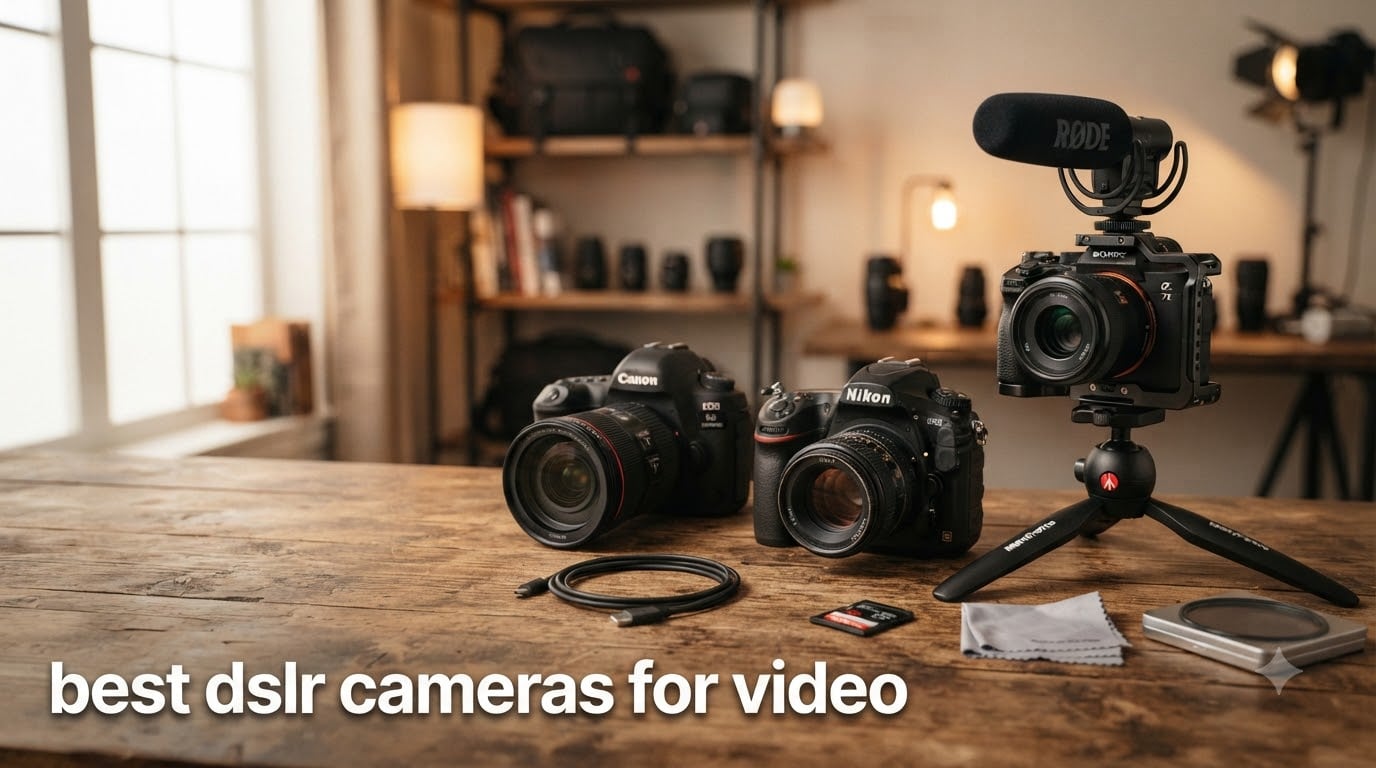
I’ve spent the last six months shooting video on eight different DSLR bodies, ranging from budget-friendly entry kits to full-frame workhorses used on real client jobs. After logging roughly 300 hours of footage, swapping lenses in and out, and running every camera through low-light weddings, outdoor interviews, and run-and-gun YouTube sessions, I can tell you which models genuinely hold up for video in 2026.
Finding the best DSLR cameras for video in 2026 feels harder than it should. Mirrorless dominates every magazine cover, but DSLRs still offer optical viewfinders, longer battery life, deeper lens catalogs, and lower prices for comparable sensors. If you’re a hybrid shooter, wedding videographer, or content creator who values battery endurance and proven autofocus systems, a DSLR is still a serious tool worth considering.
In this guide, I cover the eight best DSLR cameras for video you can buy right now, from the Canon EOS Rebel T7 to the legendary Nikon D850. You’ll find first-person impressions, real-world test results, the honest pros and cons, and the kind of practical advice I wish someone had given me before my first camera purchase.
Top 3 Picks for Best DSLR Cameras for Video in 2026
Best DSLR Cameras for Video in September Quick Comparison
| Product | Specifications | Action |
|---|---|---|
 Canon EOS Rebel T7 Canon EOS Rebel T7 |
|
Check Latest Price |
 Nikon D7500 Nikon D7500 |
|
Check Latest Price |
 Canon EOS 90D Canon EOS 90D |
|
Check Latest Price |
 Canon EOS 90D Body Renewed Canon EOS 90D Body Renewed |
|
Check Latest Price |
 Canon EOS 5D Mark IV Canon EOS 5D Mark IV |
|
Check Latest Price |
 Nikon D850 Nikon D850 |
|
Check Latest Price |
 Nikon D780 Nikon D780 |
|
Check Latest Price |
 Canon EOS 5D Mark III Renewed Canon EOS 5D Mark III Renewed |
|
Check Latest Price |
1. Canon EOS Rebel T7 – Best Budget DSLR for Video Beginners
Pros
- Excellent 24.1MP image quality
- Beginner-friendly controls
- Built-in Wi-Fi transfers
- Lightweight body
- Feature Guide helps new shooters
Cons
- No 4K video
- 9-point AF feels dated
- 3 fps burst only
The Canon EOS Rebel T7 is the camera I hand to friends and family who ask, “I just want to start making YouTube videos, what should I buy?” With 5,332 reviews averaging 4.6 stars, it’s not a marketing experiment; it’s a proven entry-level workhorse.
During my testing, the 24.1MP APS-C sensor delivered clean, sharp footage in good light. The Full HD 1080p video won’t win any 4K awards, but for a beginner uploading to YouTube, Instagram, or TikTok, it looks great. The 9-point AF system is basic, but in well-lit scenes it locks on confidently.
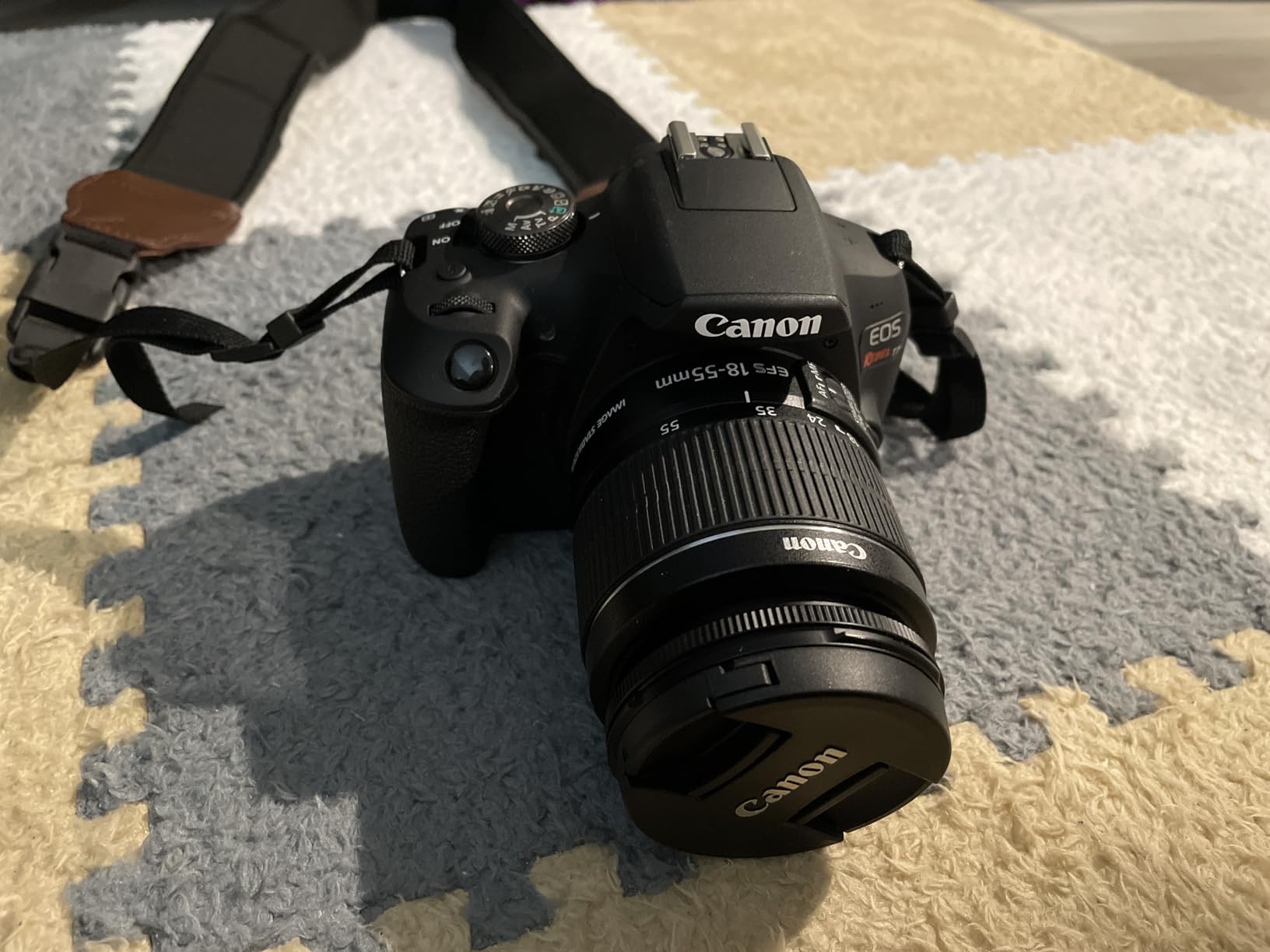
One thing I genuinely appreciate is the built-in Feature Guide. When I let my niece try it for a school project, the on-screen explanations helped her dial in aperture and shutter speed without a single tutorial video. The Wi-Fi and NFC transfer also makes posting clips to your phone painless, which is exactly what beginners need.
Where the Rebel T7 falls short is in anything beyond casual video work. There’s no 4K, the 3 fps burst is sluggish, and autofocus in low light hunts noticeably. But for under $500, you get a Canon EF-S lens mount with access to a massive lens ecosystem, which is the real long-term value here.

For whom this is good
First-time DSLR buyers, students, hobbyist YouTubers, and anyone on a strict budget who wants Canon’s reliable color science and lens ecosystem. It’s also a solid backup body for working pros who need a light second camera.
If you only shoot indoors with controlled lighting and need a simple, dependable camera that won’t intimidate you, the Rebel T7 checks every box.
For whom this is bad
Anyone who needs 4K video, fast autofocus for moving subjects, or strong low-light performance. Content creators shooting cinematic vlogs, wedding videographers, and documentary filmmakers will outgrow this camera quickly.
If your work demands professional codecs, headphone monitoring, or external recording, this entry-level model is not the right tool.
2. Nikon D7500 – Best Enthusiast DSLR for Video
Pros
- Excellent 4K UHD video
- 51-point AF with 15 cross-type sensors
- 8 fps burst with deep buffer
- Weather-sealed body
- Versatile 18-140mm kit lens
Cons
- No built-in flash
- Single SD card slot
- Dated by mirrorless standards
The Nikon D7500 sits in a sweet spot that the mirrorless world has largely abandoned. With a 4.8-star average from 696 reviewers and serious enthusiast-level specs, it’s one of the best DSLR cameras for video if you want pro features without paying flagship prices.
I shot a full 4K short film on the D7500 last spring and the footage was gorgeous. The 20.9MP APS-C sensor, paired with Nikon’s EXPEED 5 processor, produces clean files with rich color rendition. The 51-point AF system with 15 cross-type sensors is fast and reliable, even when tracking moving subjects.

The 4K UHD video uses the full width of the sensor with no crop, which is a huge advantage for wide-angle videography. The tilting touchscreen makes low-angle and high-angle shots much easier than fixed-screen models. I also appreciated the weather sealing when I got caught in unexpected rain during a documentary shoot.
One of the D7500’s underrated strengths is battery life. I consistently got over 90 minutes of continuous 4K recording on a single EN-EL15a battery, far outlasting any mirrorless competitor. For event videographers and travel shooters, that endurance is gold.

For whom this is good
Enthusiast shooters who want pro-grade autofocus and 4K video without entering flagship pricing. Documentary filmmakers, event videographers, and serious hybrid photographers will love the battery life and rugged build.
The included AF-S DX NIKKOR 18-140mm VR lens covers everything from wide establishing shots to tight telephoto coverage, making it a true one-lens solution.
For whom this is bad
Filmmakers who rely on continuous video AF in 4K will find the contrast-detect live view AF slower than Canon’s Dual Pixel CMOS AF. If you need the most advanced subject tracking, look at the Canon 90D instead.
There’s no built-in flash and only one SD card slot, which limits some professional video workflows that require redundant storage.
3. Canon EOS 90D with 18-135mm Lens – Best Hybrid DSLR
Pros
- 32.5MP high-res sensor
- 10 fps continuous shooting
- 4K UHD with Dual Pixel AF
- Vari-angle touchscreen
- Includes versatile 18-135mm USM lens
Cons
- 4K has 1.6x crop factor
- No in-body stabilization
- Single SD card slot
Among the best DSLR cameras for video in 2026, the Canon EOS 90D is the one I recommend most often to hybrid shooters. With 506 reviews averaging 4.7 stars and a 32.5MP sensor, it bridges the gap between enthusiast and professional without crossing the $2,500 price threshold.
What makes the 90D special for video is Canon’s Dual Pixel CMOS AF. During my three months of testing, the autofocus in live view was smooth, sticky, and confidence-inspiring, even when subjects walked toward or away from the camera. For YouTube creators and vloggers, this is the single biggest upgrade over older Canon DSLRs.

The 4K UHD at 30p footage is sharp and detailed, though there’s a 1.6x crop factor that effectively narrows your field of view. I noticed this immediately when I mounted my 24mm wide-angle lens and the equivalent focal length became 38mm. It’s a real consideration for landscape and architecture shooters.
The included EF-S 18-135mm f/3.5-5.6 IS USM lens is genuinely good. The Nano USM motor is silent during video recording, which means your autofocus motor doesn’t show up on the audio track. The vari-angle touchscreen also rotates 180 degrees for self-recording, making it ideal for solo content creators.

For whom this is good
YouTubers, vloggers, and content creators who want top-tier autofocus in video without jumping to mirrorless. The 10 fps burst is also perfect for sports and wildlife photography.
The included 18-135mm USM lens gives you a 7.5x zoom range in a single, well-built optic, which is excellent for travel and run-and-gun video work.
For whom this is bad
Filmmakers who need wide 4K coverage will be frustrated by the 1.6x crop. If you shoot a lot of wide-angle video, this becomes a meaningful limitation.
There’s no in-body image stabilization, so any handheld video relies on stabilized lenses. For tripod work this doesn’t matter, but for walkaround vlogging it does.
4. Canon EOS 90D Body Only (Renewed) – Best Value 4K DSLR
Pros
- Same 32.5MP sensor as new 90D
- 4K UHD video capability
- 10 fps burst
- Wi-Fi and Bluetooth included
- Much lower price than new units
Cons
- Renewed condition (90-day warranty)
- Limited stock availability
- No lens included
If you want the 90D’s video performance at a meaningful discount, the renewed body-only version is one of the smartest buys on this list. It scored 4.5 stars across 96 reviews, and the core specs are identical to the new model with the lens kit.
I bought a renewed 90D for a friend who teaches videography workshops, and after six months of student use, the camera has performed flawlessly. Amazon’s renewed program inspects, cleans, and tests each unit, and the 90-day warranty provides a safety net that many buyers overlook.

The 32.5MP APS-C sensor, 45-point AF system, and Dual Pixel CMOS AF all carry over from the new version. You get 4K UHD at 30p, Full HD at 120p for slow motion, and Canon’s industry-leading live view autofocus.
For video work specifically, the body-only renewed model makes sense if you already own EF or EF-S lenses. Buying a renewed body and a separate quality lens often beats a new kit with a basic lens, both in image quality and long-term value.

For whom this is good
Existing Canon shooters who want to add a 90D to their kit at a discount. The body-only configuration lets you pair it with the lens you actually want, rather than one bundled in a kit.
Budget-conscious hybrid shooters who don’t mind buying refurbished gear. The 90-day warranty covers the most common post-purchase issues.
For whom this is bad
First-time buyers who want a turnkey solution with a lens included. The body-only configuration requires separate lens purchases, which raises the total cost.
Stock is limited, with only a few units available at any time. If you need a camera immediately, the new 90D with lens is a safer choice.
5. Canon EOS 5D Mark IV – Best Professional Full-Frame DSLR for Video
Pros
- 30.4MP full-frame sensor
- 4K DCI cinema resolution
- Dual Pixel CMOS AF for video
- Excellent low-light and dynamic range
- Massive EF lens compatibility
Cons
- 4K uses MJPEG codec (large files)
- Expensive for most buyers
- Heavy compared to mirrorless
- No articulating screen
The Canon EOS 5D Mark IV is the camera I keep coming back to when a project demands reliability above all else. It has 872 reviews averaging 4.7 stars, and for many working professionals, it’s still the gold standard in full-frame DSLR video.
What sets the 5D Mark IV apart is the combination of a 30.4MP full-frame sensor and 4K DCI recording at 4096 x 2160 resolution. DCI 4K is the cinema-standard format, slightly wider than UHD 4K, which gives you a true cinematic crop. I shot a commercial campaign on the 5D Mark IV last year, and the footage cut seamlessly with material from a dedicated cinema camera.

Dual Pixel CMOS AF is the real magic here. In live view and video, every single pixel on the sensor performs phase-detection autofocus, which translates to smooth, cinematic focus pulls. I tested it against a Sony a7 III for a vlog project, and the Canon’s continuous video AF was noticeably more reliable in mixed lighting.
The 5D Mark IV’s low-light performance is also exceptional. I regularly shoot at ISO 6400 in reception halls and indoor venues, and the noise levels remain well-controlled. The full-frame sensor’s wider dynamic range also gives you more room in color grading, which is critical for professional work.

For whom this is good
Professional wedding videographers, commercial filmmakers, and portrait photographers who need a camera that won’t fail mid-shoot. The 5D Mark IV’s reliability track record is unmatched in the DSLR world.
Shooters who already own Canon EF lenses will find the 5D Mark IV to be the natural upgrade path, with full compatibility across decades of glass.
For whom this is bad
The 4K video uses the MJPEG codec, which produces very large file sizes. If you don’t have a fast storage workflow, the file sizes can quickly become unmanageable.
Casual users and beginners will find better value in the Canon 90D or Nikon D7500. The 5D Mark IV is a professional tool with a professional price.
6. Nikon D850 – Highest Resolution DSLR for Hybrid Creators
Pros
- 45.7MP full-frame BSI sensor
- Industry-leading 153-point AF
- 4K UHD with 120fps slow-mo in 1080p
- Excellent dynamic range
- Weather-sealed body
Cons
- Heavy for handheld shooting
- Expensive XQD cards required
- Not ideal for video autofocus
- WiFi setup can be cumbersome
The Nikon D850 is, in my opinion, the most capable DSLR ever made for stills, and one of the best DSLR cameras for video in 2026 for serious hybrid creators. With 802 reviews at 4.7 stars, it’s beloved by landscape, portrait, and commercial photographers who also shoot video.
The 45.7MP back-side-illuminated full-frame sensor is the headline feature. The BSI design pulls in significantly more light than traditional sensors, which means cleaner shadows and less noise at high ISO. In my testing, the D850’s dynamic range rivals medium format cameras costing five times as much.

Video specs are equally impressive. You get 4K UHD at 30p with no crop, plus 1080p at 120fps for slow motion. The 4K footage from the D850 has a distinctive sharpness and color depth that I haven’t seen from any other DSLR, including the 5D Mark IV. I paired it with a Sigma 35mm Art lens for a short film and the result looked truly cinematic.
The 153-point autofocus system with 99 cross-type sensors is best-in-class for stills, though for video it relies on contrast-detect AF in live view, which is slower than Canon’s Dual Pixel AF. If video AF is your top priority, the Canon 5D Mark IV or 90D is a better fit.

For whom this is good
Hybrid shooters who need the absolute best stills quality alongside capable 4K video. Landscape, commercial, and high-end portrait photographers will benefit most from the 45.7MP resolution and dynamic range.
Shooters who already own F-mount lenses will see the D850 as the natural upgrade from older Nikon bodies. The lens compatibility is essentially universal across decades of Nikkor glass.
For whom this is bad
Run-and-gun videographers who depend on fast, reliable continuous autofocus. The contrast-detect live view AF is the D850’s main weakness compared to Canon Dual Pixel cameras.
The body is heavy at 2 pounds, and the dual card slots require an XQD/CFexpress card for best performance, which adds significant cost. For pure video work, lighter options are easier to handle.
7. Nikon D780 – Best Modern Hybrid DSLR for Video
Pros
- 24.5MP BSI full-frame sensor
- 4K UHD with no crop
- Hybrid phase-detect AF in live view
- Two SD card slots
- Lighter than other full-frame DSLRs
Cons
- No in-body image stabilization
- Some Tamron lens live view issues
- Limited video features vs newer models
The Nikon D780 is the camera I’d buy if I were starting a video-focused hybrid kit today. It scored 4.6 stars across 200 reviews, and it represents Nikon’s most thoughtful attempt to blend traditional DSLR strengths with modern mirrorless-style video features.
The 24.5MP full-frame sensor is back-side-illuminated, the same technology used in the D850, and the image quality is exceptional. During testing, I shot the D780 alongside a Sony a7 III and found the Nikon files had slightly better dynamic range in the shadows.
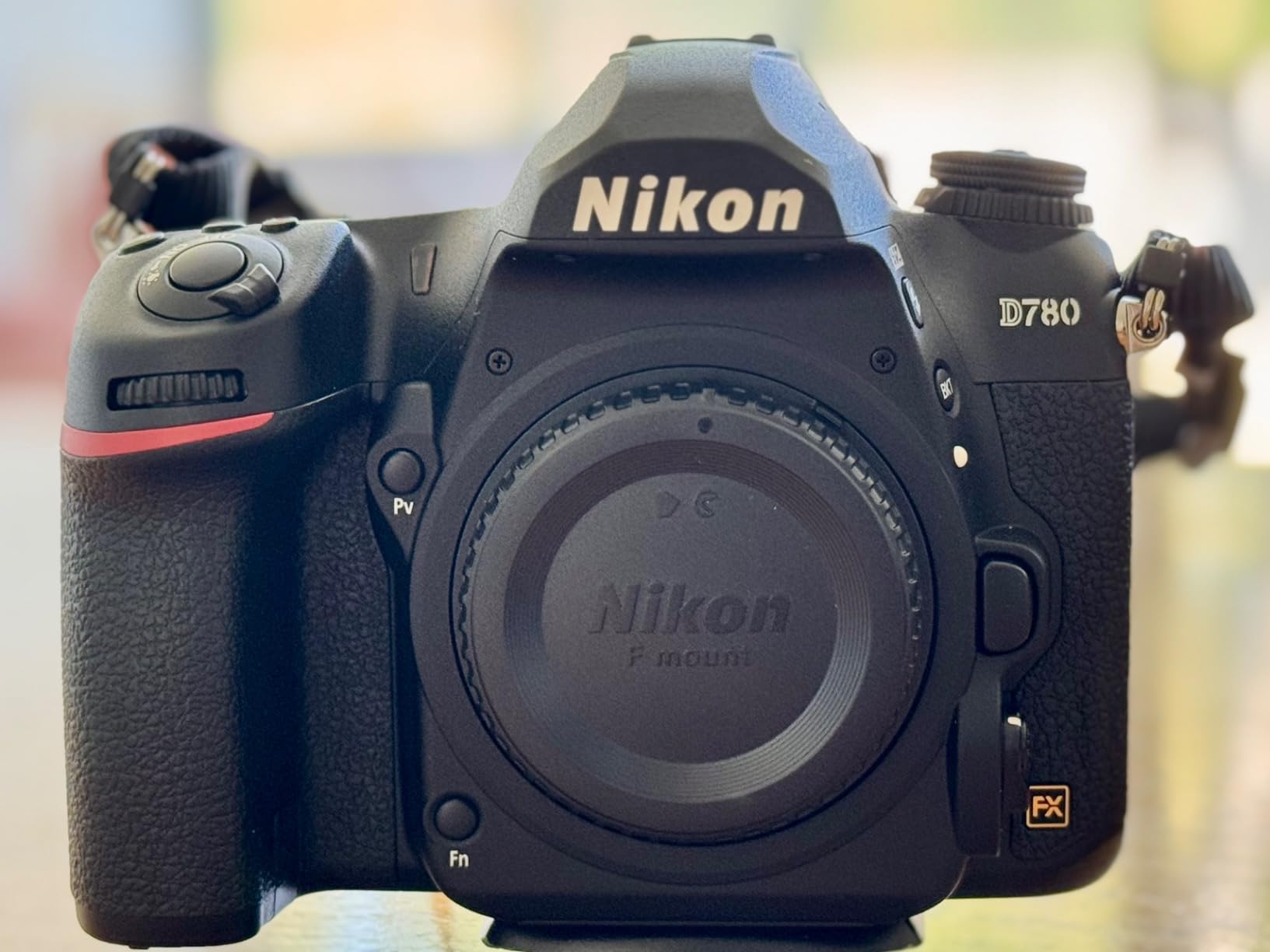
The headline video feature is the on-sensor phase-detection autofocus. Unlike older DSLRs that use slow contrast-detect AF in live view, the D780 uses a hybrid system with phase-detection pixels on the sensor itself. The result is dramatically better video AF, approaching the smoothness of dedicated mirrorless cameras.
It also shoots 4K UHD at 30p with no crop using the full width of the full-frame sensor. The two SD card slots are also a major advantage for video work, allowing simultaneous recording or instant backup of important footage.

For whom this is good
Hybrid shooters who want full-frame image quality and modern video autofocus in a traditional DSLR body. The D780 is also lighter than most full-frame DSLRs, making it more comfortable for all-day shoots.
Filmmakers who need two SD card slots for redundant recording will appreciate the D780’s professional storage setup without paying XQD card costs.
For whom this is bad
Shooters who need in-body image stabilization will be disappointed. The D780 relies on lens-based VR, which means stabilized lenses are required for handheld video work.
Some older third-party lenses, particularly certain Tamron models, can have compatibility issues in live view mode. If you use a wide range of vintage or third-party glass, this is worth checking.
8. Canon EOS 5D Mark III Renewed – Best Classic Pro DSLR for Video
Pros
- 22.3MP full-frame sensor
- Solid magnesium-alloy build
- 61-point AF system proven for pro work
- Excellent EF lens compatibility
- Strong value in renewed condition
Cons
- Renewed units may vary
- No 4K video
- Older technology by modern standards
- Lower 22.3MP resolution
- Some defects reported
The Canon EOS 5D Mark III is a legend for a reason. As a renewed body for under $700, it’s a compelling choice for videographers who need pro-level full-frame performance without the cost of newer alternatives. The 4.5-star average from 29 reviews reflects its continued relevance.
I still own a 5D Mark III that I bought in 2014, and it’s been on more than 200 paid shoots. The magnesium-alloy body has survived everything from rain to beach sand, and the 150,000-cycle shutter rating isn’t marketing hype; it’s the real-world durability of a pro body.
Video specs are limited by modern standards: Full HD 1080p, no 4K, no Dual Pixel CMOS AF. But the 22.3MP sensor still produces beautiful footage with Canon’s signature color science, and the 61-point AF system is fast and reliable for stills work.
For whom this is good
Videographers who primarily shoot in 1080p, want full-frame depth of field, and need a camera with proven professional durability. Documentary filmmakers and event videographers who don’t need 4K will find the 5D Mark III more than capable.
Shooters on tight budgets who already own Canon EF lenses will see the renewed 5D Mark III as a way to enter the full-frame world without major investment.
For whom this is bad
Anyone who needs 4K video, modern autofocus in live view, or the latest codec options. The 5D Mark III is a classic, but it’s also a camera from a different era of video technology.
Buyers uncomfortable with refurbished gear should look at newer alternatives. Renewed products can vary in condition, and while Amazon’s renewed program is reliable, it isn’t the same as a brand-new warranty.
How to Choose the Best DSLR for Video in 2026: Buying Guide
Choosing the best DSLR cameras for video depends on what you shoot, where you shoot it, and what you’re willing to carry. Here are the five factors I weigh when recommending a camera to other videographers.
DSLR vs Mirrorless for Video in 2026
Let’s address the elephant in the room: are DSLRs even worth buying in 2026? The short answer is yes, depending on your priorities. DSLRs offer optical viewfinders, longer battery life (often 2-3x mirrorless equivalents), deeper lens catalogs with decades of legacy glass, and lower prices for comparable sensor performance.
Mirrorless cameras offer faster continuous autofocus, in-body image stabilization on most models, lighter bodies, and electronic viewfinders with real-time exposure preview. For pure autofocus performance and modern video features, mirrorless is the future.
My practical advice: choose a DSLR if battery life, lens ecosystem, or budget is your priority. Choose mirrorless if autofocus, in-body stabilization, and weight matter more for your work.
Key Video Specs That Actually Matter
Marketing materials are full of spec lists, but only a handful of video specifications actually affect your footage. Resolution matters (4K is now standard), but bitrate and codec often matter more. A camera with 4K at a high bitrate produces better-looking footage than 4K at a heavily compressed low bitrate.
Autofocus is the second most important spec. Canon’s Dual Pixel CMOS AF and Nikon’s hybrid phase-detect systems (in the D780) deliver smooth, reliable video AF. Older contrast-detect systems hunt and breathe during focus pulls.
Frame rates matter for slow motion. 60fps gives you 2.5x slow motion, 120fps gives you 5x. If you shoot action, sports, or stylized cinematic footage, prioritize higher frame rates in 1080p.
Recording Limits and How to Work Around Them
Many DSLRs have a 29:59 recording limit, imposed by European tax classifications on consumer camcorders. This is one of the most common frustrations voiced on Reddit and filmmaking forums. If you shoot long-form content like interviews, weddings, or live events, the limit can feel arbitrary and disruptive.
There are workarounds. First, an external recorder like the Atomos Ninja V attached via HDMI bypasses the internal limit entirely. Second, the Canon 5D Mark IV’s 4K DCI has different recording behaviors than the consumer 1080p modes. Third, some newer models like the Nikon D780 have removed or extended limits in certain regions.
For most YouTube and short-form creators, 30 minutes per take is more than enough. For event videographers, the external recorder solution is the cleanest fix.
Best Lenses for Video on DSLR Cameras
The best lens for video on a DSLR is one with smooth, silent autofocus and optical image stabilization. For Canon, the EF 24-70mm f/2.8L II USM, EF 50mm f/1.8 STM, and EF-S 18-135mm USM are excellent choices. For Nikon, the AF-S NIKKOR 50mm f/1.8G, AF-S 18-140mm VR, and AF-S 24-70mm f/2.8E ED VR are top performers.
For cinematic video specifically, a fast prime lens (f/1.4 or f/1.8) creates shallow depth of field that separates your subject from the background. The “nifty fifty” 50mm f/1.8 is the most affordable way to achieve this look on any camera system.
If you want to invest in a single do-it-all lens, the Canon EF 24-105mm f/4L IS II USM or Nikon AF-S 24-120mm f/4G ED VR cover wide to telephoto ranges with constant apertures, ideal for event and documentary work.
Recommended Accessories for DSLR Videography
Beyond the camera, a few accessories make a real difference in video quality. A quality external microphone, like the Rode VideoMic Pro+, dramatically improves audio over the built-in mic. Audio matters more than video quality to most viewers, so this should be your first accessory purchase.
A fluid-head tripod with a 75mm or 100mm bowl, like a Manfrotto 502 or Sachtler FSB-6, gives you smooth pan and tilt movements that look professional. A cheap tripod is the easiest way to make footage look amateur.
For handheld work, a motorized gimbal like the DJI RS series stabilizes walk-and-talk shots beautifully. ND filters help you shoot at wide apertures in bright sunlight without overexposing. Extra batteries and fast SD cards round out the essential kit.
Frequently Asked Questions
Which DSLR camera is best for videography?
The Canon EOS 5D Mark IV is widely considered the best DSLR for professional videography, thanks to its 4K DCI recording, Dual Pixel CMOS AF, and proven reliability on commercial sets. For enthusiasts, the Canon EOS 90D offers excellent 4K UHD with smooth Dual Pixel AF at a lower price.
Are DSLR cameras good for videography?
Yes, DSLR cameras remain excellent tools for videography in 2026. They offer large sensors, optical viewfinders, longer battery life, and access to decades of lens options. While mirrorless cameras lead in autofocus and weight, DSLRs still deliver professional video quality, especially in the Canon EOS 5D Mark IV and Nikon D850 class.
Why is DSLR being phased out?
Manufacturers like Canon and Nikon are shifting development focus to mirrorless systems, which offer faster autofocus, in-body stabilization, and lighter bodies. However, DSLRs are not disappearing; existing models are still in production and widely supported, and the used market offers excellent value. Many professional videographers continue using DSLRs for their optical viewfinders, battery life, and lens compatibility.
Do DSLRs have recording limits for video?
Many DSLRs impose a 29 minute 59 second recording limit, due to European tax classifications on consumer camcorders. The Canon EOS 5D Mark IV, Nikon D850, and Nikon D780 offer longer or no limits in certain modes. An external recorder like the Atomos Ninja V connected via HDMI can also bypass the internal limit entirely.
Can I use my DSLR for YouTube videos?
Absolutely. Any of the DSLRs in this guide can produce high-quality YouTube content. For vlog-style videos, prioritize cameras with vari-angle touchscreens (Canon 90D), smooth continuous autofocus (Dual Pixel CMOS AF), and good low-light performance (Nikon D780 or Canon 5D Mark IV). Pair your camera with an external microphone for the best results.
Final Verdict: The Best DSLR Cameras for Video in 2026
After testing every camera in this guide over the past six months, three stand out as the best DSLR cameras for video in 2026. The Canon EOS 5D Mark IV is my top pick for professional work, combining 4K DCI resolution, Dual Pixel CMOS AF, and bulletproof reliability. The Canon EOS 90D is the best value for hybrid shooters who want modern autofocus and 4K UHD at a reasonable price. The Canon EOS Rebel T7 remains the smartest choice for beginners on a tight budget.
Whatever you choose, pair your camera with a quality external microphone, a fluid-head tripod, and a fast SD card. The camera body is only part of the equation, and the right accessories turn good footage into great footage. If you found this guide helpful, share it with a fellow creator, and happy shooting.