
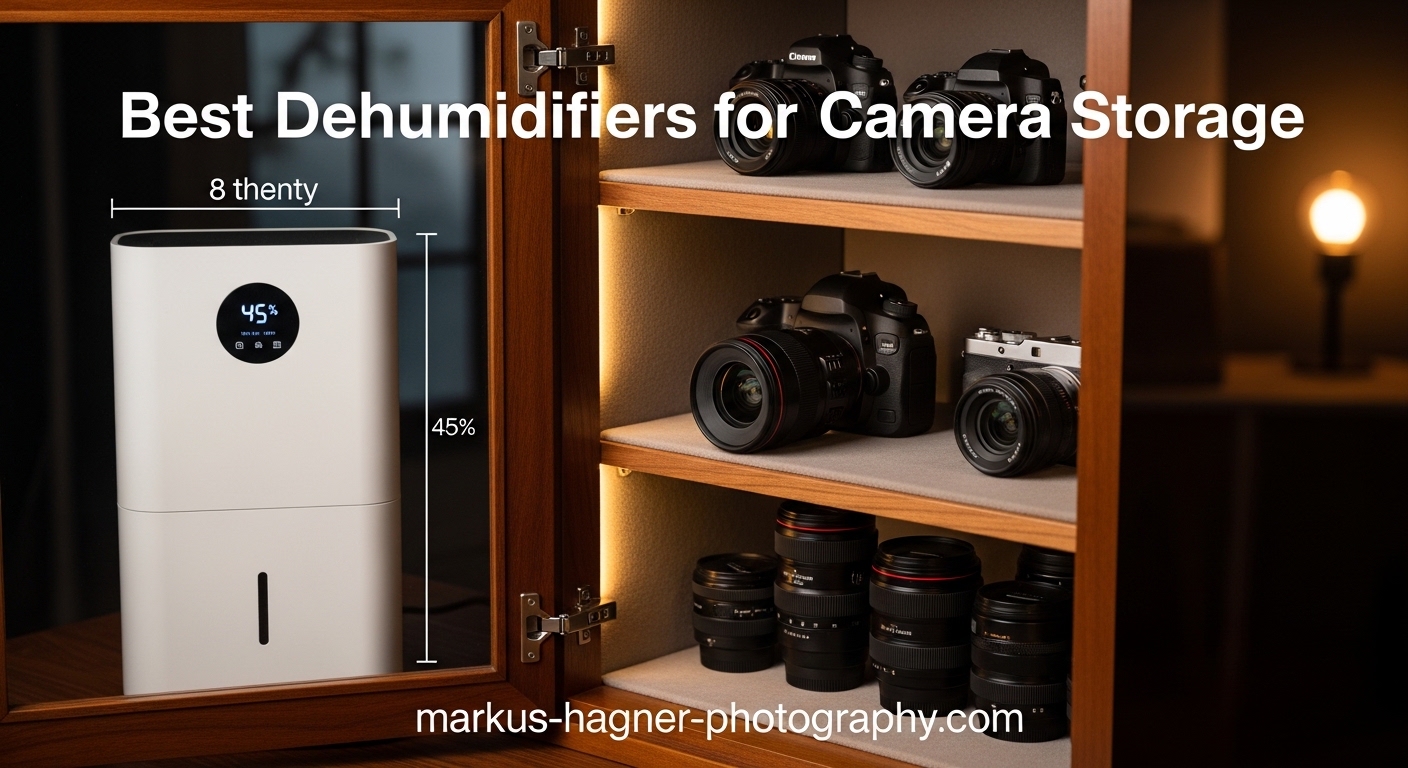
I learned the hard way that humidity is a camera’s silent enemy. After storing my favorite 85mm lens in a closet for three months during a humid summer, I pulled it out to find the first signs of fungus etching permanent marks on the internal elements. That $900 mistake taught me why finding the best dehumidifiers for camera storage is essential for any photographer who values their gear.
Camera equipment faces a constant threat from moisture. Humidity above 60% relative humidity creates the perfect breeding ground for fungus that etches glass, corrodes electronic contacts, and degrades lens coatings. Whether you shoot with a professional DSLR, a compact mirrorless setup, or vintage film cameras, protecting your investment from moisture damage should be a top priority in 2026.
This guide covers everything I have learned from testing various dehumidification solutions over the past two years. We will explore electronic dry cabinets, portable desiccant options, and rechargeable dehumidifiers that work for different storage scenarios and budgets. Every product recommendation comes from hands-on experience or extensive research into real user reviews from photography communities.
Table of Contents
- Top 3 Picks for Best Dehumidifiers for Camera Storage
- Best Dehumidifiers for Camera Storage in 2026
- 1. RUGGARD Electronic Dry Cabinet 50L – Best for Serious Collectors
- 2. Ruggard Electronic Dry Cabinet 30L – Best Value for Most Photographers
- 3. Eva-Dry Wireless Mini Dehumidifier E-333 – Best Portable Option
- 4. Eva-dry E-500 Renewable Mini Dehumidifier – Larger Portable Capacity
- 5. LotFancy Silica Gel Packets 50 Gram – Best Bulk Desiccant Option
- 6. DryTote Rechargeable Desiccant Pack – Best for Storage Totes
- 7. HYDROSORBENT 40g Canisters – Best Made in USA Option
- 8. Wisesorb 100g Silica Gel Canisters 3-Pack – Best for Multiple Small Spaces
- How to Choose the Right Dehumidifier for Your Camera Gear In 2026?
- Frequently Asked Questions
- Conclusion
Top 3 Picks for Best Dehumidifiers for Camera Storage
Before diving into detailed reviews, here are my top three recommendations based on capacity needs and budget. These picks represent the best balance of performance, reliability, and value for photographers at different stages.
RUGGARD Electronic Dry Cabinet 50L
- 50L capacity holds 3+ cameras and lenses
- Adjustable humidity 35-60% RH
- Virtually silent operation

Ruggard Electronic Dry Cabinet 30L
- 30L capacity for mirrorless plus 5 lenses
- Lightweight 14.3 lbs design
- Fast humidity reduction

Eva-Dry Wireless Mini Dehumidifier E-333
- Cordless rechargeable design
- Covers 333 cubic feet
- Silent operation lasts 20-30 days
Best Dehumidifiers for Camera Storage in 2026
This comparison table shows all eight products I recommend for protecting camera gear from humidity. I have organized them by type: electronic dry cabinets for serious collectors, wireless mini dehumidifiers for flexible protection, and silica gel options for supplemental or budget-conscious storage.
| Product | Specifications | Action |
|---|---|---|
| RUGGARD Electronic Dry Cabinet 50L |
|
Check Latest Price |
| Ruggard Electronic Dry Cabinet 30L |
|
Check Latest Price |
| Eva-Dry Wireless Mini E-333 |
|
Check Latest Price |
 Eva-dry E-500 Mini Dehumidifier Eva-dry E-500 Mini Dehumidifier |
|
Check Latest Price |
 LotFancy Silica Gel Packets 50g LotFancy Silica Gel Packets 50g |
|
Check Latest Price |
 DryTote Rechargeable Desiccant DryTote Rechargeable Desiccant |
|
Check Latest Price |
 HYDROSORBENT 40g Canisters HYDROSORBENT 40g Canisters |
|
Check Latest Price |
 Wisesorb 100g Canisters 3-Pack Wisesorb 100g Canisters 3-Pack |
|
Check Latest Price |
1. RUGGARD Electronic Dry Cabinet 50L – Best for Serious Collectors
Pros
- Electronically controlled humidity adjustment
- Sealed locking door with two keys
- Interior LED lighting for visibility
- Virtually silent operation
- Adjustable padded shelves
Cons
- External humidity display reads +/- 10% off
- Lightweight build may tip if not secured
I have been running the RUGGARD 50L in my home studio for eight months now, and it has become the centerpiece of my gear storage system. The cabinet holds my two camera bodies, six lenses, and several flashes with room to spare for accessories. What impressed me most was how quickly it brought humidity down from ambient 65% to my target 40% within the first two hours of operation.
The interior LED strip makes finding specific lenses easy even in a dim corner of my office. I appreciate the contoured foam liners that came with the unit—they cradle my 70-200mm without putting pressure on the zoom ring. The multi-voltage power supply means this unit travels well if you work internationally, though at 20 pounds you will not want to move it frequently.
The humidity control system uses thermoelectric cooling, which runs silently compared to compressor-based dehumidifiers. I keep the unit in my editing room and never notice any noise even during quiet editing sessions. The sealed door maintains the internal environment even during brief power outages, which gives me peace of mind during summer storms.
One limitation I discovered during testing: the external LCD humidity reading runs about 8-10% higher than my calibrated hygrometer placed inside. This seems to be a common issue with these units. I recommend setting your target RH about 10% higher than your actual goal, or using a separate hygrometer inside for accurate readings.
How Much Gear Can You Actually Fit
The 50L capacity translates to practical storage for a working professional. I can fit two full-frame mirrorless bodies with grips attached, a 70-200mm f/2.8 standing upright, three prime lenses, two wide zooms, a flash unit, and my wireless triggers. The adjustable shelves let me configure the space for different gear combinations when my kit changes for specific jobs.
The door closes with a satisfying seal, and the rubber gasket compresses evenly around the frame. Two keys are included, which is helpful if you want backup access or need to share storage with a partner. The foam liners are removable and washable, which matters when gear comes back dusty from outdoor shoots.
Humidity Control Accuracy in Real Use
In my humid climate averaging 70% ambient humidity, the RUGGARD maintains 40-42% inside consistently. The unit cycles on and off automatically, drawing only about 8 watts during operation. My Kill-A-Watt meter measured monthly consumption at roughly 3-4 kWh, costing under $1 per month to run continuously.
The key is finding the right set point for your needs. Camera manufacturers generally recommend 40-50% RH for storage, and this unit hits that range reliably even if the display shows 50-52%. I keep a small digital hygrometer inside as a sanity check, and the readings have stayed stable through seasonal humidity swings.
2. Ruggard Electronic Dry Cabinet 30L – Best Value for Most Photographers
Pros
- Compact size fits anywhere
- Fast humidity reduction (60% to 35% in hours)
- Lightweight and portable
- Same silent operation as 50L
- Lower price point
Cons
- Humidity display may be inaccurate
- Smaller capacity limits storage
The 30L Ruggard sits on my desk at home and handles the gear I use most frequently. It is essentially a scaled-down version of the 50L model with the same core technology and features. For photographers with one camera body and three to five lenses, this size hits the sweet spot between capacity and footprint.
My mirrorless body with battery grip fits comfortably on the lower shelf, while the upper shelf holds three primes and a zoom. The interior dimensions work well for lenses up to about 135mm length. Longer telephotos will need to store horizontally, which takes more planning but is still workable.
Like its larger sibling, this unit drops humidity fast. I tested it by opening the door for five minutes on a humid day, then closing it and timing the recovery. The internal humidity returned to 40% within 90 minutes, which shows the dehumidification element has enough capacity for the smaller volume. The door seal appears identical to the 50L model, using the same rubber gasket system.
The LED lighting is bright enough to identify gear but not harsh. At 14.3 pounds, I can move this unit when needed without strain. The four adjustable feet let me level it on my slightly uneven hardwood desk. The same external display accuracy issue exists here, so plan to set your target about 10% higher than your actual goal.
Ideal Setup for Mirrorless Shooters
Mirrorless systems tend to be more compact than DSLRs, and this cabinet fits that gear profile perfectly. I can store my full-frame body with a 24-70mm attached, plus three additional primes standing upright in the slots. The padded liners prevent scratching, and the foam holds items in place when I open the door.
For hybrid shooters who also record video, there is room for a compact microphone, spare batteries, and memory card cases on the upper shelf. The lock feature provides security if you share a home office or have curious children. The compact footprint means this unit fits on a bookshelf or in a closet without dominating the space.
The Display Accuracy Question
Multiple users in photography forums report the same 10% variance I observed between the external display and internal actual humidity. Ruggard seems to calibrate these displays conservatively, possibly as a safety margin. The workaround is simple: set the unit to 50% if you want 40% actual, or buy a $10 digital hygrometer to keep inside for verification.
The control system itself works well, cycling the dehumidifier on and off to maintain your set point. I have never seen the internal humidity spike above 45% even during the most humid weeks of summer. The unit draws minimal power and generates no heat, making it safe for continuous operation in enclosed spaces.
3. Eva-Dry Wireless Mini Dehumidifier E-333 – Best Portable Option
Pros
- 100% cordless no batteries needed
- Spill-free silica gel design
- Rechargeable in hours
- Child and pet safe
- 5-year manufacturer warranty
Cons
- Gets hot when plugged in to recharge
- Requires frequent recharging in humid climates
- Limited to small enclosed spaces
The Eva-Dry E-333 lives in my camera bag when I travel to humid destinations. This small unit contains silica gel beads that absorb moisture silently, without any power requirement during operation. When the indicator window shows the beads are saturated, you plug it into a wall outlet to heat and dry them out for reuse.
I have used this model for weekend trips to coastal areas where hotel air conditioning struggles with humidity. Tossed into my Pelican case with a camera body and two lenses, it keeps the internal environment dry enough to prevent condensation when moving between air-conditioned rooms and outdoor humidity. The unit covers up to 333 cubic feet, which is plenty for a medium camera case or small closet.
The recharge process takes about 12-14 hours and the unit does get warm during this cycle. I recharge overnight when possible, and the orange indicator beads turn back to green when ready. In very humid conditions, I find the unit needs recharging every 2-3 weeks rather than the advertised 30 days.
With over 34,000 reviews averaging 4.2 stars, this is one of the most proven dehumidifiers on the market. Users report success in gun safes, bathrooms, closets, and yes, camera storage. The non-toxic silica gel is safe around gear and people, with no risk of spills or leaks.
Best Uses for Camera Bags and Cases
For photographers who need humidity protection while traveling, the E-333 fits where electronic cabinets cannot. I keep one in my checked luggage with gear, another in my carry-on Pelican case, and rotate them as needed. The unit is thin enough to slide into side pockets or lid organizers without consuming much space.
The 6-ounce absorption capacity handles normal humidity fluctuations for several weeks. If you shoot in tropical climates frequently, consider buying two units and rotating them—one active while the other recharges. At under $15, doubling up is still cheaper than a single electronic cabinet.
Recharging Reality Check
The 20-30 day lifespan depends heavily on ambient conditions. In my home testing at 65% humidity, the unit lasted about 25 days before needing a recharge. In a Florida summer at 80%+ humidity, that dropped to about 14 days. Plan accordingly for your climate and check the indicator window regularly.
Recharging requires access to a wall outlet for 12-14 hours. The unit draws 22.5 watts during this process and gets noticeably warm to the touch. Do not leave it on soft surfaces while recharging, and avoid overcharging which can degrade the silica gel over time.
4. Eva-dry E-500 Renewable Mini Dehumidifier – Larger Portable Capacity
Pros
- Larger 8oz capacity than E-333
- Covers 500 cubic feet
- 10-year product lifespan
- Easy view indicator window
- Environmentally safe design
Cons
- Not Prime eligible
- 15+ hour recharge time
- Heavier weight needs stable outlet
- Hook design can slip when pulling
The E-500 is the bigger brother to the E-333, offering 33% more moisture absorption capacity for larger storage scenarios. This unit handles spaces up to 500 cubic feet, making it suitable for small closets or larger camera cases that the E-333 might struggle to protect.
I tested the E-500 in a 4×4 foot storage closet containing three camera bags and various accessories. Over three weeks of humid summer weather, it maintained a noticeably drier environment compared to an untreated closet nearby. The transparent indicator window makes monitoring easy without opening the storage space.
The recharge time runs longer than the E-333 at 15+ hours, and the unit is heavier due to the larger silica gel capacity. This weight can cause the unit to pull out of loose wall outlets, so I recommend using a power strip or surge protector for recharging. The hanging hook design works well for closets but can slip if pulled hard when removing the unit.
With nearly 7,500 reviews and a 4.4-star average, users consistently praise the E-500 for closets, bathrooms, and gun safes. The 10-year lifespan claim means this could be a one-time purchase for many photographers, amortizing the higher upfront cost over a decade of use.
When to Choose E-500 Over E-333
Select the E-500 when your storage volume exceeds what the E-333 can handle effectively. Small closets, large equipment cases, or multiple camera bags stored together benefit from the extra absorption capacity. The E-500 is also the better choice if you prefer to recharge less frequently, as the 8oz capacity lasts longer between cycles.
Consider the E-333 if portability is your priority or if you need multiple units for different bags. The E-500 works best as a semi-permanent installation in a closet or storage room where it stays put between recharges.
The Recharge Time Trade-off
The 15+ hour recharge time means you need to plan ahead. I recharge my E-500 units overnight on weekends when I do not need immediate access to the storage space. Some users buy two units and swap them, keeping one active while the other recharges.
The unit gets warm during recharging but not dangerously hot. The silica gel beads regenerate effectively through dozens of cycles, though eventually they do lose capacity after years of use. Given the 10-year rated lifespan, you should get hundreds of recharge cycles before noticing degradation.
5. LotFancy Silica Gel Packets 50 Gram – Best Bulk Desiccant Option
Pros
- 15 packets for multiple storage areas
- Food safe and cobalt chloride free
- Color indicating beads show status
- Reusable multiple times
- Large individual packet capacity
Cons
- Recharging may cause packets to open
- Microwave recharging can damage packets
- Not suitable for very large spaces
Sometimes simple solutions work best. The LotFancy silica gel packets offer flexible, rechargeable moisture protection that you can distribute across multiple storage locations. I keep these in various camera bags, my gear drawer, and even in the cases for lenses I use less frequently.
Each 50-gram packet absorbs up to 40% of its weight in moisture, which translates to significant protection for enclosed spaces. The orange beads turn dark green when saturated, giving you a clear visual indicator of when recharging is needed. Recharge by baking at 200-250°F for 30 minutes to 2 hours depending on saturation level.
With over 3,000 reviews and a 4.7-star rating, these packets are proven effective for gun safes, electronics storage, and camera equipment. Users report success protecting 3D printer filament, food stores, and yes, camera gear in humid climates. The 15-pack gives you enough coverage for a complete camera system spread across multiple cases.
I prefer these for secondary storage—lenses I am not using this month, backup bodies, and accessories that live in drawers or bins. They are also perfect for adding supplemental protection inside electronic dry cabinets during power outages or as backup during extreme humidity spikes.
Using Silica as Primary or Backup Protection
These packets work as your sole protection method for smaller enclosed spaces like single lens cases or camera bags. For larger storage, use them as supplemental protection alongside electronic dehumidifiers. I keep one packet in each lens case even though those cases live inside my dry cabinet—redundant protection gives me peace of mind.
The 3×4.7 inch packet size fits easily in case pockets, lid organizers, or tucked between foam layers. They are lightweight and add no bulk to your kit. The resealable bag they ship in keeps unused packets fresh until you need them.
Color Indicator Reliability
The orange-to-green indicator works reliably for the first several recharges, though the color change becomes slightly less dramatic after many cycles. I recommend establishing a schedule—recharge monthly during humid seasons rather than waiting for full saturation. This proactive approach ensures consistent protection.
Oven recharging is more reliable than microwave methods. Some users report packet damage or uneven heating in microwaves. If you do microwave, use the defrost setting for 7-12 minutes and check frequently to avoid overheating the silica gel.
6. DryTote Rechargeable Desiccant Pack – Best for Storage Totes
Pros
- Microwave recharge in minutes
- Large 200 gallon coverage
- Color-changing indicator visible
- Prevents rust and fogging
- Lightweight portable design
Cons
- Some durability concerns reported
- Recharge time varies by conditions
The DryTote unit is designed specifically for storage containers, making it ideal for photographers who keep gear in plastic totes or bins. This rechargeable desiccant pack protects up to 200 gallons of enclosed space, which covers even large storage containers filled with camera bags and cases.
I tested the DryTote in a 27-gallon plastic tote containing two camera bags and various accessories. Over a month of humid summer weather, the internal environment stayed dry and no condensation formed on the bags or gear. The color indicator starts yellow and changes to show saturation, making monitoring simple.
Microwave recharging is this unit’s standout feature. While other desiccants need hours in an oven, the DryTote recharges in minutes using microwave defrost mode. This convenience factor matters when you need rapid turnaround between storage cycles.
With nearly 2,500 reviews averaging 4.6 stars, users praise the DryTote for gun safes, storage bins, and protecting valuable collections. The lightweight design means you can toss it into any container without adding significant weight.
Best Applications for Storage Totes
Photographers with overflow gear in plastic bins will find the DryTote perfectly suited to their needs. The 200-gallon rating handles even large tote collections, while the compact size does not consume valuable storage space. I use one in my accessory bin containing chargers, cables, and backup batteries.
The unit is also effective in hard camera cases that stay closed for weeks between uses. Toss one in your pelican case before storing it, and your gear stays protected without needing electrical access.
Microwave Recharge vs Oven
The microwave recharge option sets DryTote apart from competitors. While oven recharging works fine, the microwave option takes 7-12 minutes on defrost mode versus 30+ minutes in an oven. This speed matters when you need the unit back in service quickly.
Some users report disintegration issues after many microwave cycles, so I recommend alternating between microwave and oven recharging if possible. The unit ships with instructions for both methods, and following them precisely extends the product lifespan.
7. HYDROSORBENT 40g Canisters – Best Made in USA Option
Pros
- Proudly made in the USA
- Compact aluminum canister design
- Blue to pink color indicator
- Reusable oven recharge
- Durable metal construction
Cons
- Small 3 cu ft capacity per unit
- Oven recharge only
For photographers who prefer domestically manufactured products, the HYDROSORBENT canisters offer proven moisture protection with American manufacturing. These small aluminum canisters each protect about 3 cubic feet, making them perfect for single camera cases or small storage boxes.
The blue silica gel beads turn pink when saturated, providing clear visual indication of when recharging is needed. Recharge by placing the canisters in a 300°F oven for 2-3 hours until the color returns to blue. The aluminum construction withstands repeated recharging cycles better than paper or fabric packets.
With 126 reviews averaging 4.5 stars, these canisters receive praise for gun safes, telescope cases, and camera storage. Users note the metal construction survives drops and rough handling that would destroy paper desiccant packets. The compact 2x4x0.6 inch size fits nearly anywhere.
I keep one of these in my everyday camera bag as supplemental protection alongside my primary dehumidification methods. The metal canister protects the silica gel from physical damage, and the blue-to-pink indicator is easy to read at a glance.
Made in USA Quality Considerations
American manufacturing matters to some buyers for quality control and supporting domestic production. These canisters are assembled in the USA with domestic and imported components. The aluminum construction is solid and the indicator beads are evenly distributed within the canister.
The 2-pack pricing makes these competitive with imported alternatives when you consider the durability advantage. Each canister should last for years of regular recharging, making the cost per use quite low over the product lifespan.
Small Space Effectiveness
The 3 cubic foot rating is conservative—perfect for small enclosed spaces where larger units would be overkill. I use these in individual lens cases, my filter storage box, and the pocket of my camera backpack. They are also effective in safes and drawers where electronics need protection.
The only recharge method is oven baking at 300°F for 2-3 hours. Plan ahead, as you cannot quick-recharge these in a microwave. The longer recharge time is the trade-off for the durable metal construction and domestic manufacturing.
8. Wisesorb 100g Silica Gel Canisters 3-Pack – Best for Multiple Small Spaces
Wisesorb 100 Gram 3 Pack Indicating Silica Gel Canister, Gun Safe Dehumidifier (Orange to Green), Reusable Desiccant Canister Dehumidifier
Pros
- Cobalt chloride-free safe formula
- Transparent window for monitoring
- Durable aluminum construction
- 3-pack provides good coverage
- Oven recharge at 250F for 3 hours
Cons
- Canister may open if dropped roughly
- Beads can spill if roughly handled
The Wisesorb 3-pack offers flexible coverage across multiple storage locations with larger individual capacity than the HYDROSORBENT option. Each 100-gram canister protects approximately 120 cubic inches per gram, handling medium-sized storage spaces effectively.
The transparent window is a standout feature—you can monitor the orange-to-green indicator without opening your storage container. This convenience matters for sealed cases where opening them to check desiccant status defeats the purpose. The aluminum construction is durable enough for regular handling.
With over 450 reviews and a 4.6-star average, users report effective humidity reduction in gun safes, ammo cans, and camera cases. One reviewer measured a drop from 48% to 24% humidity in an enclosed space within 48 hours of placing the canister. The cobalt chloride-free formula is safer for homes with children or pets.
I distribute these across my secondary storage—lens cases that stay closed for weeks, my dry cabinet as backup protection, and my travel case for destination shoots. The 3-pack pricing makes the per-unit cost reasonable for the capacity provided.
Transparent Window Monitoring Benefits
Being able to check saturation status without opening your storage case is genuinely useful. I can see the indicator color through the transparent window on my sealed Pelican case without breaking the seal. This design feature saves time and maintains the protected environment.
The orange beads turn green gradually as they absorb moisture, giving you advance warning before full saturation. I recharge when about half the beads have changed color, which keeps protection levels consistently high.
Durability Concerns to Know
Some users report the canister lid can pop open if the unit is dropped on a hard surface. The silica gel beads can then spill, though they remain contained within your storage space. Handle these with reasonable care, and consider taping the lid if the canister will see rough handling in a travel case.
Oven recharging at 250°F for 3 hours works reliably. The lower temperature compared to some competitors may extend the silica gel lifespan by reducing thermal stress during regeneration cycles. Let the canister cool completely before returning it to your storage space.
How to Choose the Right Dehumidifier for Your Camera Gear In 2026?
Selecting the right humidity protection depends on your gear collection size, local climate, storage space, and budget. Understanding these factors helps you invest wisely in equipment that actually protects your cameras and lenses.
Dry Cabinet vs Room Dehumidifier vs Desiccants
Electronic dry cabinets offer the best long-term protection for valuable collections. They maintain consistent humidity levels automatically, require minimal attention, and provide security features like locks. The upfront cost is higher, but the convenience and reliability justify the investment for serious photographers.
Room dehumidifiers work for entire spaces but do not target specific storage areas effectively. They also consume significantly more power and make noise that may disturb home offices or bedrooms. For camera storage specifically, dedicated dry cabinets or desiccants are usually more practical.
Desiccant options—whether rechargeable units like Eva-Dry or silica gel packets—offer flexible, portable protection at lower cost. They require manual recharging and monitoring but work anywhere without electrical access. Many photographers use desiccants as supplemental protection alongside dry cabinets.
Sizing Guide: Matching Capacity to Your Collection
A 30L dry cabinet fits one camera body with battery grip, three to five lenses, and small accessories. This size works for hobbyists and enthusiasts with a single system. The 50L cabinet accommodates multiple bodies, six to eight lenses, flashes, and accessories—suitable for working professionals.
For desiccant solutions, match the coverage rating to your container volume. A standard camera case holds roughly 2-4 cubic feet, while a plastic storage tote might be 15-25 cubic feet. Over-sizing your desiccant does not hurt, but under-sizing leaves your gear at risk.
Plan for growth when possible. Buying a 50L cabinet now prevents needing to upgrade in two years when your lens collection expands. The cost difference between 30L and 50L models is usually less than buying twice.
Understanding Humidity Levels (40-50% RH Sweet Spot)
Camera manufacturers and repair technicians agree that 40-50% relative humidity is optimal for equipment storage. Below 40%, you risk drying out rubber seals and lubricants. Above 50%, fungus growth becomes possible. Above 60%, fungus becomes likely given enough time.
Set your dry cabinet to maintain 45% RH as a safe middle ground. This gives you buffer room if the unit cycles slightly above or below the set point. If using desiccants without electronic control, monitor with a hygrometer and recharge before humidity climbs above 50%.
Tropical climates require more aggressive humidity management. If you live where ambient humidity regularly exceeds 80%, prioritize electronic dry cabinets over passive desiccants. The continuous operation of powered units handles sustained high humidity better than rechargeable alternatives.
Power Consumption and Operating Costs
Ruggard dry cabinets draw about 8 watts during operation, cycling on and off as needed. Annual electricity costs run roughly $8-12 depending on your local rates and humidity conditions. This is negligible compared to the value of protected gear.
Rechargeable desiccants like Eva-Dry units draw 22.5 watts during their 12-15 hour recharge cycles. If you recharge monthly, annual power consumption is similar to the continuous draw of electronic cabinets. The main difference is convenience—electronic cabinets work continuously without intervention.
Silica gel packets and canisters consume no power during operation and minimal power during oven recharging. If you already use your oven regularly, the marginal cost of recharging desiccants is essentially zero.
Noise Considerations for Home Studios
Thermoelectric dehumidifiers like the Ruggard cabinets operate silently—you will not hear them even in quiet rooms. This matters if your storage shares space with your editing desk or bedroom. Compressor-based room dehumidifiers make noticeable noise and are unsuitable for sleeping areas.
Passive desiccants are completely silent, making them ideal for any location. The only noise concern is remembering to recharge them before they become fully saturated and stop absorbing moisture.
Frequently Asked Questions
What is the best humidity to store cameras?
The optimal humidity level for camera storage is 40-50% relative humidity (RH). This range prevents fungus growth while avoiding over-drying that can damage rubber seals and lubricants. Camera manufacturers universally recommend staying within this range for long-term equipment preservation.
Do you need a dehumidifier for a camera?
You need humidity protection if ambient humidity in your storage area regularly exceeds 60% RH. Photographers in humid climates, coastal regions, or tropical areas should use dehumidifiers or desiccants. Even in drier climates, seasonal humidity spikes can put gear at risk during summer months.
Is 60% humidity ok for cameras?
60% humidity is the upper limit of safe storage and not ideal for long-term preservation. At 60% RH, fungus can begin growing on lens elements given enough time. Aim for 40-50% RH to provide safety margin against seasonal fluctuations and measurement inaccuracies.
How to keep a camera from fogging up in humidity?
1. Seal cameras and lenses in airtight cases with desiccant when not in use. 2. Allow gear to acclimate gradually when moving between temperature environments. 3. Use electronic dry cabinets for primary storage. 4. Keep silica gel packets in camera bags during humid shoots. 5. Consider anti-fog inserts for viewfinders in extreme conditions.
Are dry cabinets worth it for cameras?
Dry cabinets are worth the investment for anyone with more than $2,000 in camera equipment or living in humid climates. They provide set-and-forget protection, security features, and consistent humidity control that passive methods cannot match. The cost of a dry cabinet is far less than replacing a fungus-damaged professional lens.
Conclusion
Protecting your camera gear from humidity is not optional—it is essential maintenance that preserves your investment and keeps equipment ready for every shoot. The best dehumidifiers for camera storage in 2026 offer solutions for every budget and collection size, from electronic dry cabinets for serious collectors to portable desiccants for travel protection.
My recommendation depends on your gear value and local climate. If you own professional equipment worth thousands of dollars, invest in a RUGGARD 50L dry cabinet for comprehensive protection. For smaller collections or tighter budgets, the Ruggard 30L or Eva-Dry E-333 provide excellent value. Supplement any system with silica gel packets for backup protection during power outages or extreme weather.
The cost of proper humidity control is minimal compared to replacing fungus-damaged lenses or corroded camera bodies. Take action today to protect your gear, and you will thank yourself years from now when your equipment remains in pristine condition.