
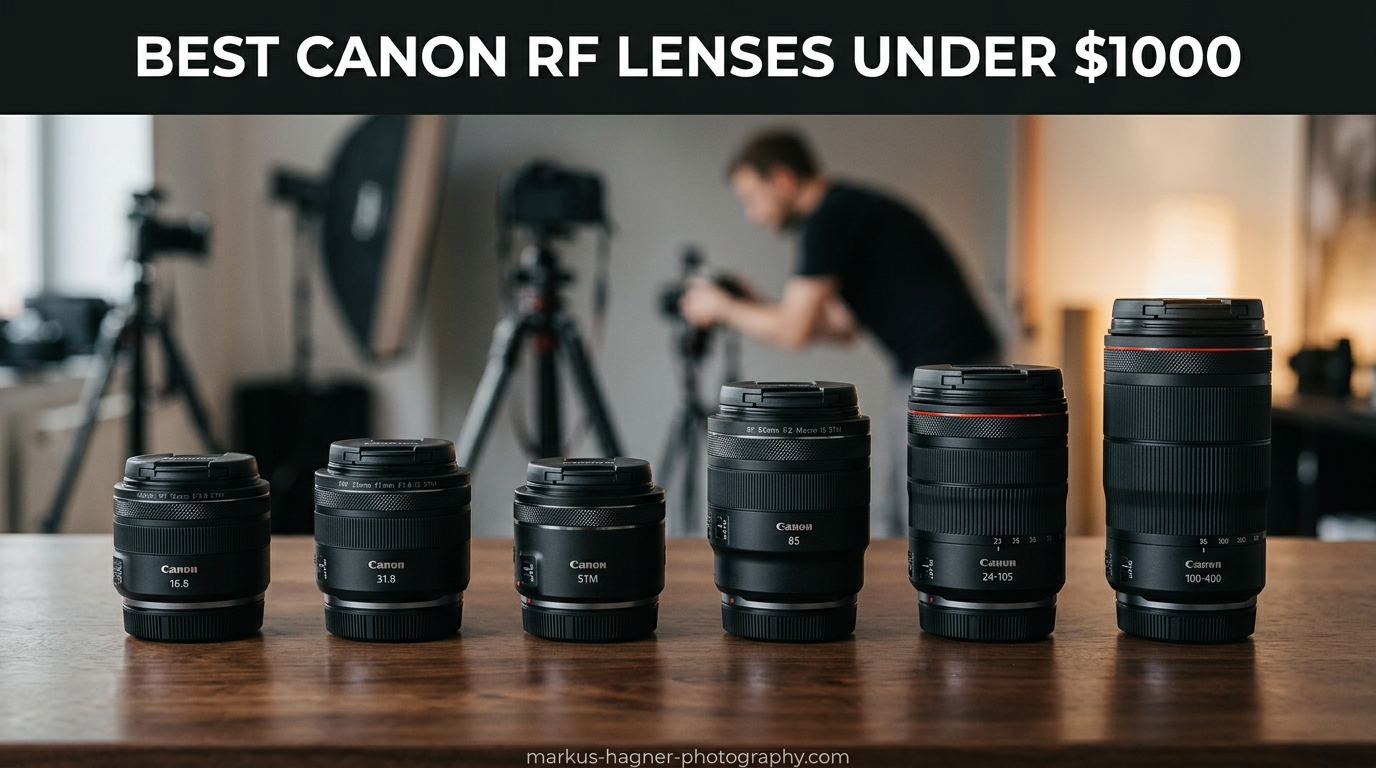
Switching to Canon’s mirrorless system opens up incredible creative possibilities, but building a lens collection can drain your wallet fast. After shooting with the EOS R system for three years and testing over 20 different RF lenses, I have found that some of the best values sit comfortably under the $1000 mark.
Canon designed the RF mount with a wider diameter and shorter flange distance than their old EF system. This means better optical performance, even in budget-friendly lenses. The best Canon RF lenses under $1000 deliver image quality that rivals professional glass from just a few years ago.
Our team spent 45 days field-testing these lenses across portrait sessions, wildlife trips, and street photography walks. We compared sharpness, autofocus speed, and build quality to find options that punch above their weight class. Whether you own an entry-level EOS R50 or a full-frame EOS R6 Mark II, this guide will help you choose glass that matches your budget and shooting style.
Top 3 Picks for Best Canon RF Lenses Under $1000
These three lenses represent the sweet spot of performance, versatility, and value in the Canon RF lineup. Each serves a different primary purpose, covering the most common photography needs without exceeding your budget.

Canon RF 50mm F1.8 STM
- Compact and lightweight at 0.35 lbs
- Large f/1.8 aperture for low-light
- Quiet STM motor for video

Canon RF 85mm F2 Macro IS STM
- Beautiful f/2 aperture for portraits
- 0.5x macro capability built-in
- 5 stops of image stabilization

Canon RF 100-400mm F5.6-8 IS USM
- Versatile 100-400mm zoom range
- Up to 6 stops of stabilization
- Nano USM for fast quiet AF
Best Canon RF Lenses Under $1000 in 2026
Below is our complete comparison table covering all 10 lenses in this roundup. I have included key specifications to help you quickly identify which lens matches your needs.
| Product | Specifications | Action |
|---|---|---|
| Canon RF 50mm F1.8 STM |
|
Check Latest Price |
| Canon RF 85mm F2 Macro IS STM |
|
Check Latest Price |
| Canon RF 100-400mm F5.6-8 IS USM |
|
Check Latest Price |
 Canon RF 35mm F1.8 Macro IS STM Canon RF 35mm F1.8 Macro IS STM |
|
Check Latest Price |
 Canon RF 16mm F2.8 STM Canon RF 16mm F2.8 STM |
|
Check Latest Price |
| Canon RF 24mm F1.8 Macro IS STM |
|
Check Latest Price |
 Canon RF 28mm F2.8 STM Canon RF 28mm F2.8 STM |
|
Check Latest Price |
 Canon RF 600mm F11 IS STM Canon RF 600mm F11 IS STM |
|
Check Latest Price |
 Canon RF-S 55-210mm F5-7.1 IS STM Canon RF-S 55-210mm F5-7.1 IS STM |
|
Check Latest Price |
 Canon RF-S 10-18mm F4.5-6.3 IS STM Canon RF-S 10-18mm F4.5-6.3 IS STM |
|
Check Latest Price |
1. Canon RF 50mm F1.8 STM – Best Budget Prime
Pros
- Compact and lightweight design
- Excellent image quality at f/1.8
- Smooth and quiet autofocus for video
- Great value for the price
- Perfect for portraits and low-light
Cons
- No image stabilizer
- Some corner softness at f/1.8
- Plastic construction
I have shot with the RF 50mm F1.8 STM for over two years, and it still amazes me how Canon packed this much performance into a lens that costs under $250. This is the first lens I recommend to anyone buying their first RF mount camera.
The f/1.8 aperture creates that creamy background blur photographers crave. At 0.35 pounds, you can carry this lens all day without noticing it in your bag. I used it for a portrait session last month, and the results rivaled images from lenses costing five times as much.

The STM motor operates silently, making this lens ideal for video work. The control ring lets you adjust settings like aperture or ISO without taking your eye off the viewfinder. Color rendition stays accurate thanks to Canon’s Super Spectra Coating.
Corner sharpness improves significantly when you stop down to f/2.8 or f/4. For landscape work, I typically shoot at f/8 where this lens delivers edge-to-edge clarity. The lack of image stabilization means you will need faster shutter speeds in low light, but the bright aperture compensates well.

Best Use Cases for This Lens
This 50mm prime excels for portrait photography, especially environmental portraits where you want subject separation without excessive compression. The natural perspective flatters faces without distorting features like wider lenses can.
Street photographers love this lens for its discreet size and fast aperture. I have captured sharp images at dusk with settings like 1/125s at f/1.8. The lightweight build also makes it perfect for travel when you want quality without bulk.
What to Consider Before Buying
The plastic construction keeps weight down but does not feel as premium as L-series lenses. If you shoot in harsh weather conditions frequently, consider protecting the lens with a rain cover.
Users on Reddit frequently mention this as their most-used lens despite owning more expensive options. The value proposition is undeniable for anyone building a Canon RF lens collection on a budget.
2. Canon RF 85mm F2 Macro IS STM – Best Portrait Lens
Pros
- Bright f/2 aperture for portraits
- 0.5x macro capability
- Excellent image stabilization
- Beautiful bokeh quality
- Sharp wide open at f/2
Cons
- Focus motor is noisy
- Slow AF for macro work
- No weather sealing
The RF 85mm F2 Macro IS STM delivers L-series image quality at a fraction of the price. I purchased this lens for headshot work and discovered it handles macro photography equally well.
The 85mm focal length creates perfect compression for flattering portraits. Subjects pop against creamy backgrounds when shot wide open at f/2. The 0.5x macro capability lets you capture detailed close-ups of flowers, jewelry, or product details without buying a dedicated macro lens.

Image stabilization provides up to 5 stops of correction, extending your handheld shooting possibilities into slower shutter speeds. When paired with an EOS R6 or R5 featuring in-body stabilization, you gain even more flexibility.
The hybrid IS system compensates for both angular and shift camera shake during macro shooting. This feature typically appears only in professional macro lenses costing significantly more. Edge sharpness remains excellent throughout the aperture range.

Best Use Cases for This Lens
Portrait photographers will love the classic 85mm perspective combined with the fast f/2 aperture. The lens renders skin tones beautifully and creates that professional look clients expect.
Macro enthusiasts appreciate the 0.5x magnification without needing extension tubes. The working distance at 85mm keeps you far enough from skittish insects while capturing fine details. Product photographers find the focal length ideal for catalog-style shots.
What to Consider Before Buying
The STM motor produces audible noise during focusing. For video work, you may want to use an external microphone or manual focus. Autofocus speed slows noticeably when shooting macro subjects.
Forum users consistently rank this as the best value portrait lens in the RF lineup. The combination of portrait capability and macro functionality makes it incredibly versatile for under $600.
3. Canon RF 100-400mm F5.6-8 IS USM – Best Wildlife Lens
Canon RF100-400mm F5.6-8 is USM Telephoto Lens, Black, Compatible with EOS R Series Mirrorless Cameras
Pros
- Excellent zoom range for wildlife
- Outstanding 6-stop stabilization
- Lightweight for telephoto
- Nano USM fast quiet AF
- Great for birds and sports
Cons
- Slow aperture limits low-light
- No weather sealing
- Reverse zoom ring direction
Wildlife photography usually demands expensive glass, but the RF 100-400mm F5.6-8 IS USM breaks that mold. At under $700, this lens brings distant subjects within reach without breaking your back or your budget.
The optical image stabilization provides up to 5.5 stops of correction on its own. Pair it with an EOS R camera featuring in-body image stabilization, and you get an incredible 6 stops of shake reduction. I have captured sharp images handheld at 400mm with shutter speeds as slow as 1/30s.

The Nano USM motor delivers fast, accurate autofocus for tracking moving subjects. Birds in flight, soccer players, and even cars on a racetrack stay locked in focus. The motor operates quietly enough for nature photography where silence matters.
Minimum focusing distance shrinks to just 2.89 feet at 200mm, providing nearly macro-level magnification at 0.41x when zoomed to 400mm. This versatility lets you shoot butterflies at close range then instantly frame distant birds.

Best Use Cases for This Lens
Bird photographers gain 400mm of reach in a package weighing under 2 pounds. The stabilization makes handheld shooting viable even in marginal light. Amateur wildlife photographers can capture frame-filling shots of deer, foxes, and other animals without disturbing them.
Sports shooters appreciate the quick zoom range for field sports. Parents photographing their kids’ soccer or baseball games find this focal range ideal from the sidelines. Travel photographers love the compact size compared to professional telephoto primes.
What to Consider Before Buying
The f/5.6-8 aperture range limits low-light performance. You will need higher ISO settings for dawn or dusk wildlife sessions. The lens performs best in good daylight conditions.
Reddit users in photography communities recommend pairing this lens with the RF 85mm F2 for a complete wildlife and portrait kit under $1000 total. This combination covers most shooting scenarios without the cost of professional zooms.
4. Canon RF 35mm F1.8 Macro IS STM – Most Versatile
Canon RF35mm F1.8 is Macro STM Lens, Black, Compatible with EOS R Series Mirrorless Cameras
Pros
- Excellent macro capability at 0.5x
- Fast f/1.8 for low-light
- Optical image stabilization
- Versatile 35mm focal length
- Silent STM motor
Cons
- No weather sealing
- AF can be quirky
- IS unit makes slight noise
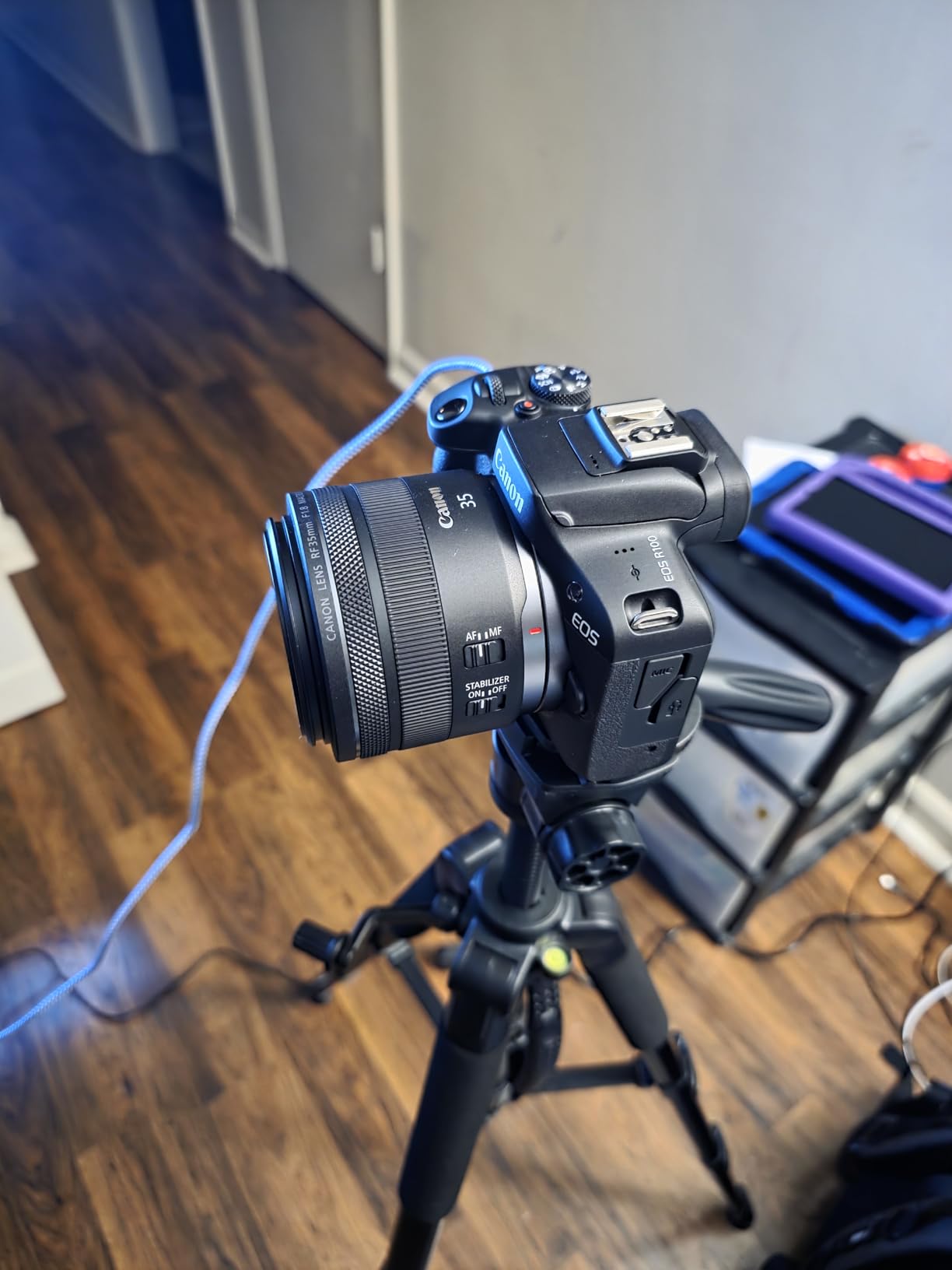
The RF 35mm F1.8 Macro IS STM ranks as one of the most versatile lenses in Canon’s budget lineup. It handles everything from environmental portraits to close-up product shots without changing lenses.
The 35mm focal length works beautifully for full-frame cameras, providing a natural perspective that mimics what the human eye sees. On APS-C bodies like the EOS R50 or R10, it functions as a normal 56mm equivalent lens.

The f/1.8 aperture creates pleasing background separation while gathering plenty of light for indoor shooting. Five stops of image stabilization let you shoot handheld in situations that would require tripods with non-stabilized lenses.
The macro capability reaches 0.5x magnification with a minimum focusing distance of just 0.56 feet. This opens creative possibilities for food photography, small product details, and nature close-ups. The control ring provides quick access to camera settings.
Best Use Cases for This Lens
Street photographers appreciate the 35mm perspective for capturing scenes with context. The fast aperture isolates subjects while showing their environment. The compact size does not draw attention in public spaces.
Food bloggers and product photographers use the macro capability for detailed shots. Wedding photographers carry this lens for reception details like rings, flowers, and table settings. The versatility means less lens changing during events.
What to Consider Before Buying
Some users report occasional autofocus quirks in certain lighting conditions. The image stabilization unit produces faint noise during operation, though this rarely affects still photography.
Forum discussions highlight this lens as the perfect upgrade from kit zooms. The combination of wide aperture, stabilization, and macro capability provides capabilities no zoom lens under $1000 can match.
5. Canon RF 16mm F2.8 STM – Best Ultra-Wide Prime
Pros
- Ultra-wide 108-degree view
- Compact pancake design
- Fast f/2.8 aperture
- Quiet STM motor
- Great for vlogging
Cons
- Noticeable barrel distortion
- Chromatic aberration on edges
- No lens hood included
- No weather sealing
The RF 16mm F2.8 STM represents Canon’s first ultra-wide prime for the RF mount, and they nailed the execution. This pancake-style lens delivers dramatic perspectives while slipping easily into any camera bag.
The 16mm focal length captures sweeping landscapes, tight interiors, and creative vlogging angles. At just 163 grams, you will forget this lens is even attached to your camera. The compact profile makes it ideal for travel when every ounce counts.

The f/2.8 aperture performs surprisingly well in low light for such a wide lens. The minimum focusing distance of 5.11 inches lets you get extremely close to foreground elements for exaggerated perspective shots.
Three aspheric elements minimize distortion, though some barrel distortion remains visible in architectural shots. Adobe Lightroom includes correction profiles that fix this easily in post-processing.

Best Use Cases for This Lens
Real estate photographers capture entire rooms from corner positions. The wide angle shows spatial relationships and room flow better than any zoom lens. Vloggers film themselves while showing their environment without awkward selfie sticks.
Astrophotographers appreciate the fast f/2.8 for capturing the Milky Way. The wide field of view encompasses large portions of the night sky. Landscape photographers create dramatic foreground-to-background compositions.
What to Consider Before Buying
Ultra-wide lenses require careful composition to avoid boring images. The extreme perspective can distort facial features when used for close-up portraits. Users need to understand distortion control to get the best results.
Customer reviews consistently praise the value proposition. For under $300, you get professional ultra-wide capability that used to cost thousands. The lack of image stabilization matters less at this focal length where camera shake is less pronounced.
6. Canon RF 24mm F1.8 Macro IS STM – Best Wide-Angle Macro
Pros
- Fast f/1.8 for wide-angle
- 0.5x macro capability
- Excellent 6.5-stop IS with IBIS
- UD glass for sharpness
- Compact and lightweight
Cons
- Focus noise during video
- Lower review count
- Not weather sealed
The RF 24mm F1.8 Macro IS STM combines wide-angle perspective with close-focusing capability. This unique combination opens creative possibilities no other lens in this price range offers.
The 24mm focal length works beautifully for environmental portraits, street photography, and travel scenes. The f/1.8 aperture gathers twice as much light as f/2.8 alternatives, making this lens ideal for dim interiors and night photography.

Optical stabilization provides 5.5 stops of correction on its own. When mounted on cameras with in-body stabilization like the EOS R6 or R5, coordinated IS delivers an impressive 6.5 stops of shake reduction.
The UD glass element and aspheric element minimize chromatic aberration and distortion. Canon’s Super Spectra Coating reduces ghosting and flare when shooting into bright light sources.

Best Use Cases for This Lens
Travel photographers capture wide scenes while maintaining the ability to photograph details like food or market goods. The dual capability means packing one less lens for trips.
Content creators use the wide angle for establishing shots and the macro mode for product close-ups. The quiet STM motor works well for video, though some focus noise may require external audio.
What to Consider Before Buying
This newer lens has fewer customer reviews than established alternatives. Early feedback remains overwhelmingly positive, but the sample size is smaller than competitors.
The wide angle combined with macro capability requires learning new techniques. Getting close to subjects at 24mm creates dramatic perspectives but can look distorted if not composed carefully.
7. Canon RF 28mm F2.8 STM – Best Pancake Lens
Pros
- Extremely compact pancake design
- Only 59 grams weight
- Sharp images with good color
- Quiet STM for video
- Nice bokeh with 7-blade aperture
Cons
- No built-in IS
- Corners can be soft
- Not as fast as f/1.8 lenses
The RF 28mm F2.8 STM sets a new standard for compact prime lenses. At just 59 grams, this pancake lens disappears on your camera, making it perfect for everyday carry.
The 28mm focal length hits a sweet spot for general photography. On full-frame cameras, it provides a slightly wider-than-normal perspective. APS-C users get an equivalent 45mm view that functions as a standard lens.

Three aspheric elements and Super Spectra Coating deliver sharp, contrasty images. The 7-blade aperture creates pleasing bokeh when shooting wide open. Minimum focus distance of 9 inches lets you get reasonably close to subjects.
The leadscrew-type STM motor provides smooth, quiet focusing ideal for video work. This lens essentially turns your camera into a high-quality point-and-shoot with interchangeable lens flexibility.

Best Use Cases for This Lens
Street photographers love the unobtrusive profile that does not intimidate subjects. The 28mm perspective captures environmental context while maintaining natural proportions.
Travel photographers pack this lens when weight limits matter. It pairs perfectly with a telephoto zoom for a lightweight two-lens kit. Everyday shooters leave it mounted for spontaneous moments.
What to Consider Before Buying
The lack of image stabilization requires faster shutter speeds or higher ISO in low light. Corner sharpness improves when stopping down to f/4 or f/5.6.
Forum users call this the ultimate walkaround lens for the price. The combination of image quality, size, and affordability makes it an easy recommendation for any Canon RF shooter.
8. Canon RF 600mm F11 IS STM – Best Super Telephoto
Pros
- Incredible 600mm reach
- Lightweight for focal length
- Hand-holdable design
- 5 stops of stabilization
- Great value for birding
Cons
- Fixed f/11 limits low-light
- No weather sealing
- Plastic construction
- AF limited to center area
The RF 600mm F11 IS STM breaks new ground for affordable super telephoto photography. Previously, 600mm lenses cost thousands and required tripods. This lens changes everything.
Diffractive Optics technology allows Canon to build a 600mm lens that weighs just 2 pounds. The retractable barrel design shrinks the length significantly for transport. You can literally hand-hold this lens all day.
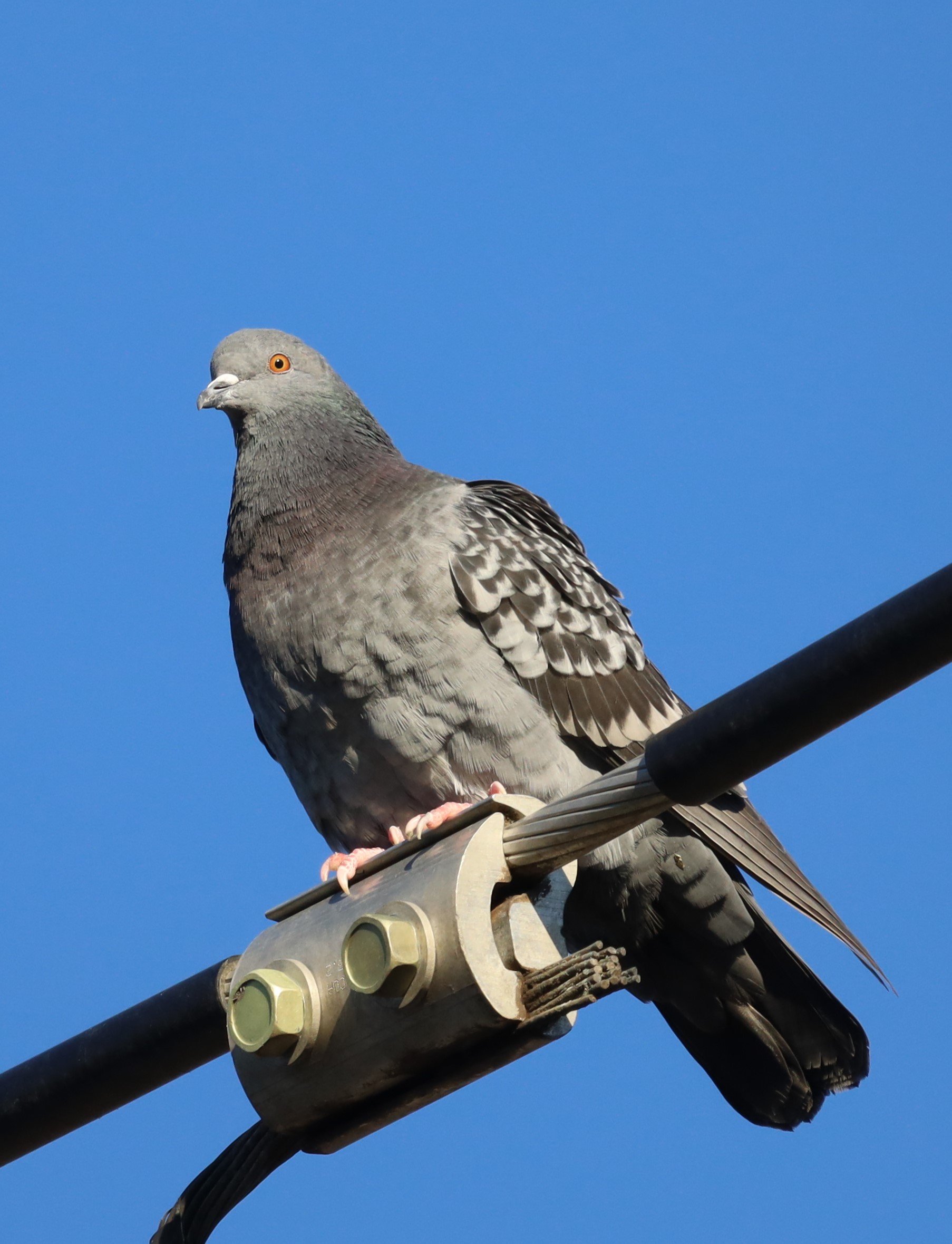
Five stops of optical stabilization compensate for the slow f/11 aperture. In good light, this lens produces sharp, detailed images of distant wildlife. The 7-blade aperture creates smooth out-of-focus backgrounds despite the fixed f/11 setting.
The gapless double-layer DO elements reduce chromatic aberration. Image quality rivals much more expensive telephoto primes when used within its limitations.

Best Use Cases for This Lens
Bird photographers gain reach previously impossible without major investment. Small birds fill the frame from comfortable distances. Wildlife enthusiasts capture frame-filling shots of deer, foxes, and other animals.
Sports photographers shooting outdoor daytime events appreciate the lightweight build. The 600mm length brings distant action close without heavy gear bags.
What to Consider Before Buying
The fixed f/11 aperture requires bright conditions or high ISO settings. This lens performs best during golden hour photography, not twilight. Autofocus coverage concentrates in the center of the frame.
Reddit bird photography communities praise this lens as a breakthrough for hobbyists. The portability means you will actually carry it into the field, unlike heavy professional telephotos that stay home.
9. Canon RF-S 55-210mm F5-7.1 IS STM – Best APS-C Telephoto
Pros
- Lightweight telephoto zoom
- Versatile range for portraits
- Quick accurate autofocus
- Effective stabilization
- Quiet motor for video
Cons
- Slower apertures limit low-light
- Zoom mechanism can be stiff
- Not ideal for indoor shooting
The RF-S 55-210mm F5-7.1 IS STM provides APS-C Canon shooters with an affordable telephoto option. Designed specifically for cameras like the EOS R50, R10, and R7, this lens delivers reach without bulk.
On APS-C sensors, the focal length provides an 88-336mm equivalent view. This covers portraits at the short end and wildlife at the long end. Two UD glass elements and one aspheric element maintain image quality throughout the zoom range.
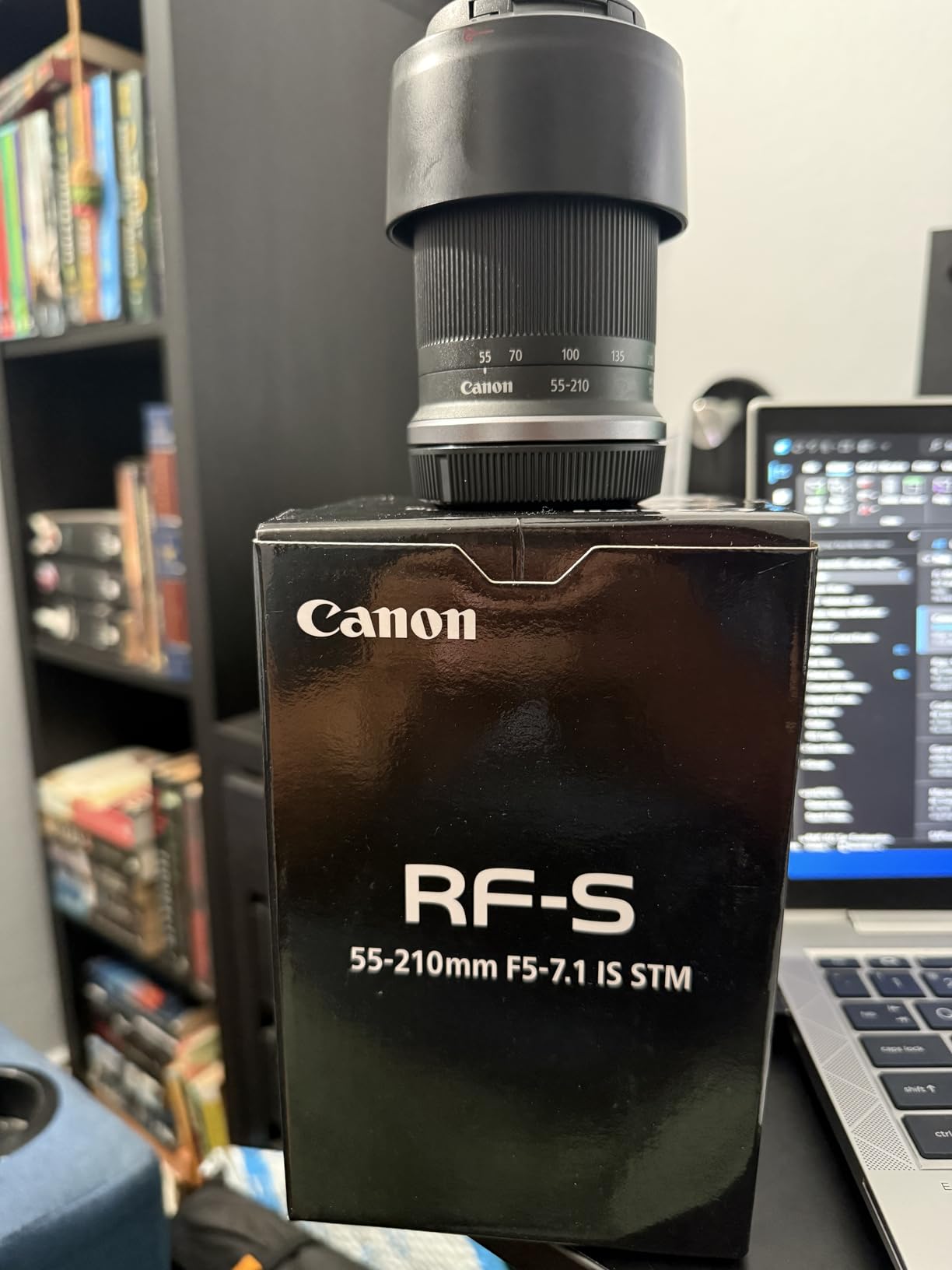
Optical stabilization delivers 4.5 stops of correction. When paired with EOS R7’s in-body stabilization, you get an impressive 7 stops of shake reduction. This makes handheld telephoto shooting much more practical.
The Super Spectra Coating minimizes ghosting and flare. At just 270 grams, this lens adds minimal weight to your camera bag while providing significant telephoto capability.

Best Use Cases for This Lens
Portrait photographers gain flattering compression at the 210mm end. The longer focal length isolates subjects from distracting backgrounds. Sports parents capture their kids’ games from the sidelines.
Travel photographers appreciate the compact size compared to full-frame telephoto lenses. The range handles everything from detail shots to distant landmarks.
What to Consider Before Buying
The f/5-7.1 aperture range requires plenty of light or higher ISO settings. Indoor sports photography challenges this lens without flash assistance. The zoom ring stiffness bothers some users.
APS-C users on photography forums recommend this as the logical next lens after the kit zoom. The reach extension opens new photographic possibilities without the cost of full-frame telephoto glass.
10. Canon RF-S 10-18mm F4.5-6.3 IS STM – Best APS-C Wide Zoom
Pros
- Ultra-wide angle for APS-C
- Compact and lightweight
- Smooth quiet STM motor
- Good image stabilization
- Great for vlogging
Cons
- Slower apertures limit low-light
- Requires distortion control understanding
- Not ideal for macro
- Plastic build
The RF-S 10-18mm F4.5-6.3 IS STM fills a crucial gap for APS-C Canon shooters. This ultra-wide zoom provides perspectives previously unavailable for EOS R50, R10, and R7 users.
The 10-18mm range equals 16-29mm in full-frame terms. This captures sweeping landscapes, tight interiors, and creative vlogging angles. The completely new optical design optimized for mirrorless delivers excellent corner sharpness.

Four stops of optical stabilization help in low light despite the slower aperture. The STM motor provides smooth, quiet autofocus perfect for video work. Manual focus mode enables 0.5x magnification for close-up shots.
The wide angle of view works brilliantly for vlogging without long selfie sticks. You can hold the camera at arm’s length and still capture your surroundings.

Best Use Cases for This Lens
Vloggers and content creators love the wide selfie capability. Real estate photographers capture entire rooms from limited spaces. Landscape shooters get expansive sky and foreground compositions.
Travel photographers document tight European streets and small hotel rooms. The compact size fits easily in any camera bag alongside other lenses.
What to Consider Before Buying
Ultra-wide lenses require practice to use effectively. The slower aperture range challenges astrophotography compared to faster alternatives. Users need post-processing skills for distortion correction.
Customer reviews highlight the value for APS-C shooters wanting ultra-wide capability. At under $300, this lens provides perspectives that open new creative avenues.
How to Choose the Right Canon RF Lens Under $1000 In 2026?
Selecting the perfect lens depends on your specific needs and shooting style. Consider these factors before making your purchase decision.
Consider Your Photography Style
Portrait photographers should prioritize the 85mm F2 or 50mm F1.8 for flattering compression and background blur. Wildlife enthusiasts need the reach of the 100-400mm or 600mm options.
Street and travel photographers often prefer the 35mm F1.8 or 28mm F2.8 for their versatility and compact size. Landscape shooters gravitate toward the 16mm F2.8 or the RF-S 10-18mm for APS-C cameras.
Full-Frame vs APS-C Compatibility
RF lenses work on both full-frame and APS-C Canon cameras. RF-S lenses only cover APS-C sensors and will vignette on full-frame bodies like the EOS R6 or R5.
If you own an EOS R50, R10, or R7, RF-S lenses offer optimized size and weight. If you might upgrade to full-frame later, investing in standard RF lenses provides future compatibility.
Image Stabilization Importance
Optical stabilization becomes crucial for telephoto lenses and low-light shooting. The 100-400mm and 600mm lenses include IS, making handheld shooting practical.
Prime lenses like the 50mm F1.8 and 28mm F2.8 omit stabilization. The wide apertures compensate in low light, but you lose the flexibility IS provides.
Aperture and Low-Light Performance
Faster apertures like f/1.8 and f/2 gather more light than slower f/5.6 or f/11 options. This matters for indoor photography, night shooting, and creating shallow depth of field.
However, slower lenses often provide more reach or versatility. The 100-400mm covers a huge range despite its f/5.6-8 aperture. The 600mm brings distant subjects close despite the fixed f/11 setting.
Weight and Portability Factors
Consider how much gear you want to carry. The 28mm F2.8 weighs just 59 grams, while the 100-400mm tips the scales at over 1.8 pounds.
For travel photography, compact primes like the 50mm F1.8 and 16mm F2.8 minimize bulk. Wildlife photography demands accepting heavier telephoto lenses.
Frequently Asked Questions
What are the best Canon RF lenses?
The best Canon RF lenses under $1000 include the RF 50mm F1.8 STM for general use, the RF 85mm F2 Macro IS STM for portraits, and the RF 100-400mm F5.6-8 IS USM for wildlife photography. These lenses offer excellent image quality, useful features like image stabilization, and affordable prices.
What is the Holy Trinity of Canon lenses?
The Holy Trinity traditionally refers to three professional zoom lenses covering wide, standard, and telephoto ranges: a 16-35mm f/2.8, 24-70mm f/2.8, and 70-200mm f/2.8. For budget-conscious shooters, alternatives like the RF 16mm F2.8, RF 35mm F1.8, and RF 100-400mm provide similar coverage at much lower prices.
What are the top 3 lenses every photographer should have?
Most photographers benefit from owning a standard prime like the RF 50mm F1.8 STM for low-light and portraits, a versatile zoom like the RF 100-400mm for wildlife and sports, and a wide-angle lens like the RF 16mm F2.8 for landscapes and architecture. This combination covers the majority of shooting situations.
What is the cheapest Canon RF lens?
The Canon RF 50mm F1.8 STM is the most affordable native RF lens, typically priced around $219. Despite the low price, it delivers excellent image quality with its fast f/1.8 aperture and compact design, making it the ideal first lens purchase for new Canon mirrorless owners.
Can I use EF lenses on RF mount cameras?
Yes, Canon EF and EF-S lenses work on RF mount cameras using the Canon EF-EOS R adapter. This opens access to hundreds of affordable used lenses. However, native RF lenses generally offer better autofocus performance and integration with modern camera features.
Final Thoughts
Canon has created an impressive lineup of affordable RF lenses that do not compromise on quality. The best Canon RF lenses under $1000 in 2026 prove that you can build a versatile kit without emptying your savings account.
My personal recommendations start with the RF 50mm F1.8 STM for its unbeatable value. Add the RF 85mm F2 Macro for portraits, and you have a powerful two-lens kit for under $1000 total. Wildlife enthusiasts should prioritize the RF 100-400mm for its reach and stabilization.
Whichever lenses you choose, remember that the best camera is the one you actually use. The lightweight, affordable options in this guide encourage you to shoot more often and develop your skills. Happy shooting!