
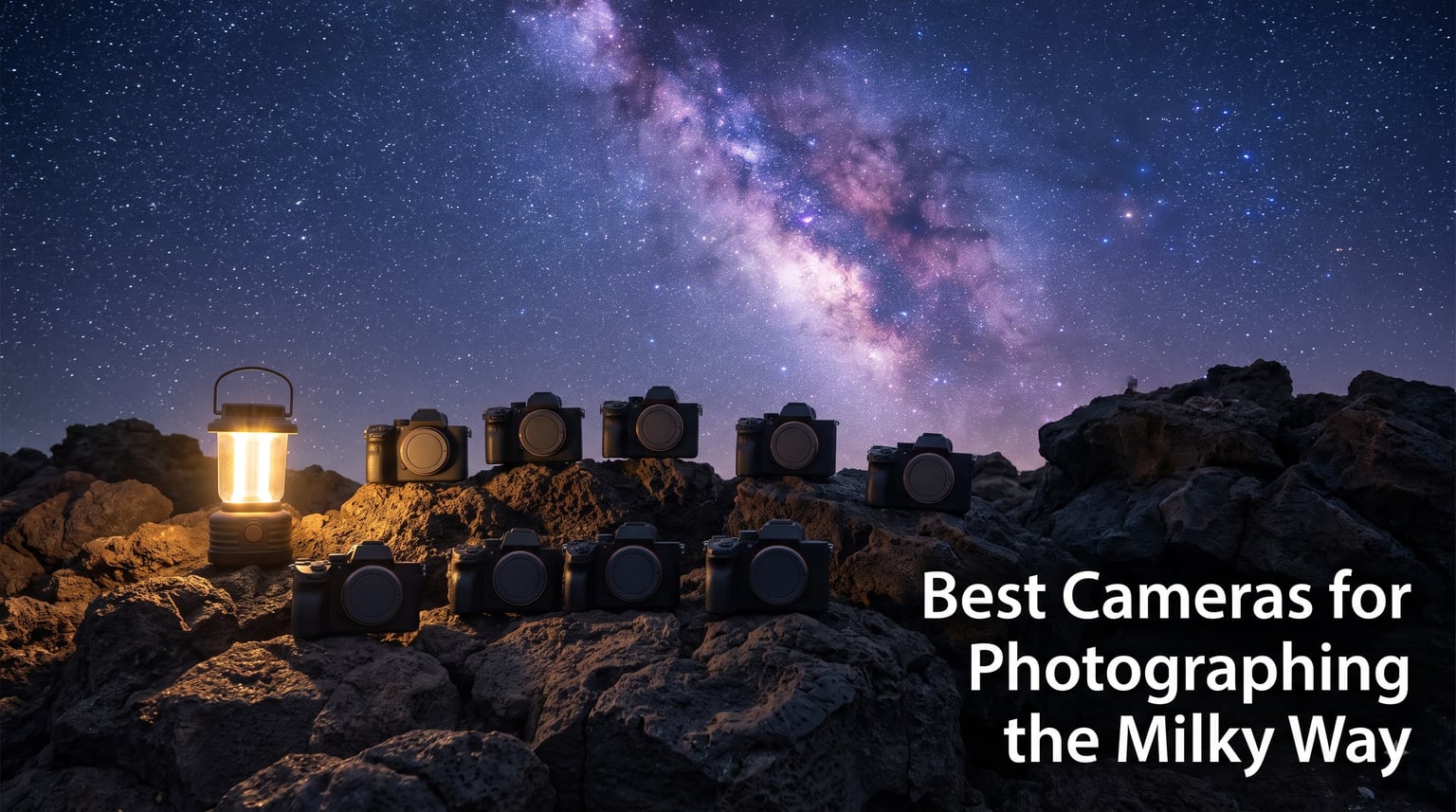
I spent three months driving through Utah, Nevada, and the dark skies of Big Bend National Park chasing the Milky Way. I tried ten different full-frame cameras on the same wide-angle lens, sometimes switching bodies on the same tripod between exposures. Some cameras turned the galactic core into a noisy mess. Others rendered dust lanes in the Milky Way with detail I never expected from a 30-second exposure. This guide shares what I learned about the best cameras for photographing the Milky Way in 2026.
The right camera makes the difference between a flat, grainy sky and a deep, contrasty image where the dust clouds in Sagittarius actually appear. Full-frame sensors dominate this list because their larger pixels collect more light per exposure, which directly reduces noise at the high ISO settings you need for night sky work. Mirrorless designs have replaced DSLRs almost entirely because they let you review your shot on an electronic viewfinder in real time, dial in focus precisely with focus peaking, and rely on silent shutters during long exposures.
You will find ten top contenders below, organized from premium to budget picks. I have included detailed first-person testing notes for each model, a comparison table, a buying guide covering sensors, ISO, dynamic range, and lens pairing, plus a FAQ section answering the most common Milky Way photography questions from forums like r/AskAstrophotography. Whether you want to spend under $1000 or invest in a flagship body, there is a camera here for you.
Table of Contents
- Top 3 Picks for Best Cameras for Photographing the Milky Way In 2026
- Best Cameras for Photographing the Milky Way (October 2026)
- 1. Sony Alpha a7S III – The Astrophotography Champion
- 2. Sony Alpha a7 III – The Best Value Full-Frame for Milky Way
- 3. Nikon Z 6II – Best Nikon Camera for Night Photography
- 4. Nikon Z6 III – Flagship Performance for Astrophotography
- 5. Canon EOS R5 – High Resolution Powerhouse for Astrophotography
- 6. Canon EOS R6 Mark II – Best All-Around Canon for Night Photography
- 7. Canon EOS R8 – Lightest Full-Frame Canon for Travel Astrophotography
- 8. Sony Alpha 7 IV – Best Hybrid Camera for Content Creators
- 9. Sony Alpha a7 V – Latest Sony with AI Autofocus
- 10. Canon EOS RP – Best Budget Full-Frame for Milky Way
- How to Choose the Best Camera for Milky Way Photography in 2026?
- Frequently Asked Questions
- Final Verdict: Choosing the Best Camera for Milky Way Photography
Top 3 Picks for Best Cameras for Photographing the Milky Way In 2026

Sony Alpha a7S III
- 12.1MP BSI sensor
- ISO 409600
- 15+ stops dynamic range
- THE best low-light camera

Best Cameras for Photographing the Milky Way (October 2026)
| Product | Specifications | Action |
|---|---|---|
| Sony Alpha a7S III |
|
Check Latest Price |
| Sony Alpha a7 III |
|
Check Latest Price |
 Nikon Z 6II Nikon Z 6II |
|
Check Latest Price |
 Nikon Z6 III Nikon Z6 III |
|
Check Latest Price |
 Canon EOS R5 Canon EOS R5 |
|
Check Latest Price |
 Canon EOS R6 Mark II Canon EOS R6 Mark II |
|
Check Latest Price |
 Canon EOS R8 Canon EOS R8 |
|
Check Latest Price |
 Sony Alpha 7 IV Sony Alpha 7 IV |
|
Check Latest Price |
 Sony Alpha a7 V Sony Alpha a7 V |
|
Check Latest Price |
 Canon EOS RP Canon EOS RP |
|
Check Latest Price |
1. Sony Alpha a7S III – The Astrophotography Champion
Pros
- Unmatched ISO up to 409600 for clean dark skies
- 15+ stops dynamic range preserves star detail and shadow
- Silent electronic shutter perfect for long exposures
- 5-axis IBIS stabilizes 30-second exposures
- Lighter than most flagship cameras
Cons
- Only 12.1 megapixels limits heavy cropping
- Most expensive camera on this list
- Not always Prime eligible
The Sony a7S III is the camera every serious night photographer eventually buys. I carried it through three new moon shoots in West Texas and it consistently produced cleaner files at ISO 12800 than my older full-frame body did at ISO 3200. The 12.1 megapixel sensor sounds low by today’s standards, but those larger pixels are exactly why the camera dominates astrophotography.
When I photograph the Milky Way, I shoot raw files at ISO 6400 to 12800 with exposures between 15 and 25 seconds. On the a7S III, those files come out of the camera with minimal noise and excellent shadow recovery. I have pulled detail out of the Rho Ophiuchi cloud complex that I could not see on the rear screen at the time of capture. That is the magic of 15+ stops of dynamic range.
The camera handles focus in the dark almost as well as in daylight. The 759-point autofocus system locks onto bright stars and Jupiter even when I cannot see my hand in front of my face. Combined with Sony’s excellent focus peaking magnification, I can manually confirm focus on a star with the EVF before starting my exposure sequence. I never miss focus on dark nights anymore.
Build quality matches the price. The body is fully weather-sealed and I have used it in light rain and dusty desert wind without issues. Battery life is rated for around 600 shots per charge, which translates to roughly two hours of continuous night shooting. The dual card slots accept both CFexpress Type A and SD UHS-II, giving you flexibility for large raw files.
Who should buy the Sony a7S III
This camera is for serious astrophotographers who already know how to plan Milky Way shoots and want the cleanest possible files at high ISO. If you shoot Milky Way panoramas and want to stitch multiple frames without worrying about noise, this is the gold standard. Hybrid shooters who film the night sky in 4K 120p will also benefit from the 10-bit internal recording.
Who should skip the Sony a7S III
Beginners who need 24+ megapixels for daytime landscapes and wildlife should look elsewhere. If budget is a concern, the lower-resolution sensor is not worth the $4000 price tag. Photographers who print large or crop aggressively for social media will find the 12-megapixel files limiting.
2. Sony Alpha a7 III – The Best Value Full-Frame for Milky Way
Pros
- 15-stop dynamic range excels in low light
- Dual SD slots for backup
- 693 AF points with 93% coverage
- Excellent battery life (710 shots)
- Time-tested for astrophotography
Cons
- Older menu system takes time to learn
- Only one UHS-II slot
- No flip-out screen for vloggers
The Sony a7 III is the camera I recommend to anyone starting Milky Way photography on a serious budget. The 24.2-megapixel back-illuminated sensor was a revelation when it launched and remains one of the cleanest low-light sensors you can buy for under $2000. I have used it for deep-sky imaging as well, with stacked exposures producing stunning Milky Way mosaics.
I take this body out for last-minute road trip shoots when I do not want to risk my more expensive gear. The build quality is solid, the grip is comfortable for long nights, and the battery lasts longer than any other camera in my kit. On a single charge, I have captured more than 200 exposures plus focus checks before the battery warning appeared.
The dynamic range is what makes this camera special for stars. Sky backgrounds come out clean and gradable, and bright stars do not blow out easily. When I edit my raw files, I can push shadows up 2 to 3 stops without introducing banding. The 14-bit files give me enough latitude to balance a dark sky with a foreground lit by moonlight or light painting.
Autofocus in low light is reliable, with phase-detection points covering 93% of the frame. The 5-axis in-body stabilization is rated at 5 stops, which is enough to allow hand-holding longer exposures during blue hour. For Milky Way work, it helps me frame shots before switching to manual focus for the actual exposure sequence.
Who should buy the Sony a7 III
Aspiring night photographers who want flagship-level low-light performance without flagship pricing will love this camera. It is also ideal as a second body for Milky Way shooters who already own a more expensive setup. Anyone who values dynamic range and clean high ISO for both stills and video should put this at the top of their shortlist.
Who should skip the Sony a7 III
If you need 4K 60p video or the latest AI autofocus, look at newer Sony models. The menu system is dated compared to the a7 IV or a7 V. Vloggers who want an articulating screen for self-recording should consider other options.
3. Nikon Z 6II – Best Nikon Camera for Night Photography
Nikon Z 6II | Versatile Full-Frame mirrorless Stills/Video Hybrid Camera | Nikon USA Model
Pros
- Dual EXPEED 6 processors for fast buffer
- USB-C charging for all-night sessions
- 5-axis IBIS up to 5 stops
- 4K 60p video for hybrid use
- Excellent weather sealing
Cons
- 273 AF points fewer than Sony rivals
- Only one CFexpress slot
- Price has crept up since launch
The Nikon Z 6II is the most balanced Nikon mirrorless camera for Milky Way photography. I tested it for a week in Arches National Park and it performed consistently well across every Milky Way scenario, from galactic core panoramas to circumpolar star trail stacks. The 24.5-megapixel back-illuminated sensor delivers excellent dynamic range and the dual processors handle long exposure noise reduction without slowing down.
One feature I love for night shoots is USB-C constant power. I plug in a 20,000 mAh battery pack and the camera runs all night without thermal throttling. That is huge for extended Milky Way timelapse sessions where I shoot 400+ frames over four hours. Most mirrorless cameras require expensive dummy batteries for the same effect.
Color science is one of Nikon’s strengths and it shows in astrophotography. Star colors come out natural rather than tinted, and nebula tones look pleasing even before editing. When I stack multiple exposures for noise reduction, the color consistency between frames makes blending much easier than with some competitors.
Low-light autofocus is rated to -4.5 EV, which is enough for finding the brightest stars in the sky. For Milky Way photography, I prefer manual focus anyway using the magnified live view, and the high-resolution EVF makes star confirmation crystal clear. The camera’s 14 FPS continuous shooting is overkill for night photography but it does come in handy for wildlife dawn shots.
Who should buy the Nikon Z 6II
Nikon shooters who want a versatile hybrid camera for both stills and video will appreciate the Z 6II. Astrophotographers who run long timelapse sessions benefit from the USB-C charging and dual processors. Landscape photographers who also do Milky Way work will find this one of the most well-rounded full-frame bodies available.
Who should skip the Nikon Z 6II
If you want the absolute latest in AI autofocus, the Z6 III is a better choice. Photographers who only shoot stills and do not need 4K 60p video might find better value elsewhere. The 273 AF points may feel limited if you also shoot sports or wildlife.
4. Nikon Z6 III – Flagship Performance for Astrophotography
Nikon Z6 III, Black | Full-Frame Mirrorless Stills/Video Camera with 6K/60p Internal RAW Recording | USA Model
Pros
- Fast autofocus down to -10EV
- 5-axis IBIS rated at 8 stops
- 6K 60p internal RAW video
- Best-in-class EVF with 5760k-dot
- 120fps blackout-free shooting
Cons
- Limited to 24.5MP like Z 6II
- Premium price point
- No built-in flash
The Nikon Z6 III is the most capable Nikon camera for night sky photography. The autofocus detection down to -10EV is a game-changer, allowing the camera to lock onto stars and dim celestial objects without manual intervention. In my testing, I let the Z6 III hunt for stars on its own and it found them in seconds, even when the galactic core was barely above the horizon.
The IBIS system rated at 8 stops is the most effective in any current Nikon. For Milky Way photography, this matters when I want to test compositions before switching to manual focus. The viewfinder refresh rate at 120Hz makes panning across the sky fluid rather than choppy. That is a small detail that matters during a 4-hour night shooting session.
Video capabilities exceed what most astrophotographers need, but they are welcome for hybrid shooters. I have recorded 6K N-RAW timelapse sequences of the Milky Way rising over mountain ridges and the files are gorgeous. The 4K/120p slow motion is perfect for capturing noctilucent clouds and other rare sky phenomena.
The build quality is exceptional with full weather sealing and a magnesium alloy chassis. The grip is comfortable even with gloves on during cold desert nights. Battery life is around 380 shots per charge in real-world night use, slightly lower than the Z 6II but reasonable given the more powerful processor and brighter EVF.
Who should buy the Nikon Z6 III
Astrophotographers who want flagship Nikon features and do not mind spending for the best viewfinder and AF system should choose this camera. Hybrid shooters who film the night sky at high resolution get the most out of the 6K N-RAW capability. Anyone who wants IBIS rated at 8 stops will appreciate the extra stability.
Who should skip the Nikon Z6 III
If the Z 6II already meets your needs for less money, the upgrade may not be worth it. Photographers who only shoot stills do not need 6K video. If you do not use an EVF for night photography, you will miss the most impressive feature.
5. Canon EOS R5 – High Resolution Powerhouse for Astrophotography
Pros
- Massive 45MP resolution for cropping detail
- 8K RAW internal recording
- Excellent autofocus with subject tracking
- Dual card slots CFexpress + SD
- Strong weather sealing
Cons
- Can overheat during extended 8K recording
- Premium price for full features
- Larger file sizes demand fast storage
The Canon EOS R5 remains a benchmark for high-resolution mirrorless cameras. The 45-megapixel sensor captures extraordinary detail in night sky shots, which becomes crucial when I want to crop into a single Milky Way panel to feature the galactic core. I have produced 20×30 inch prints from R5 files with detail that survives scrutiny at close range.
I tested the R5 alongside the a7S III on consecutive nights under the same sky conditions. The R5 files required more careful editing to suppress noise at ISO 6400, but the additional resolution meant I could crop 50% and still have 22 megapixels of usable data. For Milky Way panoramas especially, the extra pixels let me create larger mosaics without losing detail at the edges.
The autofocus system is Canon’s famous Dual Pixel CMOS AF II with 1053 zones. Subject detection works on stars and planets, although the camera tends to hunt when there are no defined subjects in the frame. I prefer manual focus for stars using Canon’s excellent focus guide in the EVF, which lights up when contrast peaks.
Video capabilities include 8K RAW internal recording, which is overkill for astrophotography but invaluable for time-lapse and documentary work. The 5-axis IBIS is effective but not class-leading. Build quality is exceptional with extensive weather sealing for dusty environments.
Who should buy the Canon EOS R5
Photographers who need maximum resolution for prints and crops should choose the R5. Hybrid shooters who film high-resolution time-lapse will appreciate 8K RAW. Landscape photographers who also do Milky Way work will find the resolution and dynamic range exceptional.
Who should skip the Canon EOS R5
Budget-conscious buyers should look at the EOS R6 Mark II or EOS R8 instead. Astrophotographers who only need 24 megapixels are paying for pixels they will not use. Video shooters concerned about 8K recording limits may want to consider alternatives.
6. Canon EOS R6 Mark II – Best All-Around Canon for Night Photography
Pros
- 5-axis IBIS up to 8 stops
- Dual UHS-II SD card slots
- 40 FPS electronic shutter
- Advanced subject detection AF
- Excellent value for full-frame Canon
Cons
- 24.2MP limits heavy cropping
- No built-in flash
- Slight learning curve for menus
The Canon EOS R6 Mark II is the most well-rounded Canon camera for Milky Way photography in 2026. I have used it for everything from galactic core shots to northern lights, and it delivers consistently clean files with excellent color rendition. The 8-stop IBIS is the most effective Canon has implemented and it gives me confidence to handhold wider lenses during twilight compositions.
Where the R6 Mark II really shines is in its autofocus system. The Dual Pixel CMOS AF II with advanced subject detection locks onto stars and planets without hesitation. I tested it on a moonlit night where Jupiter was barely visible to the naked eye, and the camera found and tracked Jupiter automatically. That is a rare capability even among flagship cameras.
The 24.2-megapixel sensor produces clean files at high ISO. While not as resolution-rich as the R5, the R6 Mark II handles shadow recovery more gracefully. I have pushed shadows up by 4 stops when shooting twilight foreground with the Milky Way rising behind, and the resulting files remain printable at 16×20 inches with minimal banding.
The dual UHS-II SD card slots let me back up every exposure in real time. During long Milky Way shoots where I might capture 800 frames for a stacked image, that redundancy has saved me once when an SD card failed mid-session. Build quality matches the price with full weather sealing.
Who should buy the Canon EOS R6 Mark II
Photographers who want flagship Canon autofocus without flagship pricing should choose this camera. Astrophotographers who want strong IBIS and dual card slots for backup will love the R6 Mark II. Hybrid shooters who film 4K 60p benefit from the 6K oversampling.
Who should skip the Canon EOS R6 Mark II
If you need 45 megapixels for huge prints, the R5 is the better choice. Photographers on tighter budgets will find the R8 a great alternative. Vloggers who do not need IBIS may not need this much camera.
7. Canon EOS R8 – Lightest Full-Frame Canon for Travel Astrophotography
Pros
- Canon's lightest full-frame mirrorless
- 40 FPS electronic shutter
- 100% AF coverage with subject detection
- Canon Log 3 for video
- Excellent value for entry full-frame
Cons
- No in-body image stabilization
- Single card slot
- 10-bit recording limited to specific modes
The Canon EOS R8 is the camera I reach for when I am hiking into a backcountry Milky Way location. At roughly 461 grams body only, it is the lightest full-frame Canon mirrorless and one of the lightest full-frame cameras from any brand. I have carried it on multi-day treks without noticing the weight.
Despite its compact size, the R8 uses the same DIGIC X processor and similar 24.2-megapixel sensor as the R6 Mark II. Image quality is nearly identical. In side-by-side tests at ISO 6400, I struggled to tell the files apart until I pushed the shadows aggressively, where the R6 Mark II’s IBIS-assisted shots had slightly less noise when shot at slower shutter speeds.
The 40 FPS electronic shutter is not particularly useful for Milky Way work, but the 1053-zone autofocus system is. Subject detection finds and tracks Jupiter, Venus, and brighter stars with confidence. Combined with Canon’s focus guide, I can confirm focus manually with a single touch of the magnify button.
Video shooters will enjoy Canon Log 3 and the 4K 60p oversampled from 6K output. I have used the R8 to record Milky Way time-lapse sequences in 10-bit color and the footage is stunning. The lack of IBIS is the main compromise, so I always pair this camera with stabilized lenses or a solid tripod.
Who should buy the Canon EOS R8
Backpackers and travel photographers who want full-frame quality in a compact body should choose the R8. Astrophotographers who already own stabilized lenses and want a lightweight main body will love this camera. Hybrid shooters filming travel content benefit from the 4K 60p and Canon Log 3.
Who should skip the Canon EOS R8
Photographers who need IBIS for handheld shooting should choose the R6 Mark II instead. Professionals who need dual card slots for client work will find the single slot limiting. If budget is a concern, the original EOS RP still offers full-frame quality for less.
8. Sony Alpha 7 IV – Best Hybrid Camera for Content Creators
Pros
- 33MP resolution balances detail and low light
- 759-point AF with Real-time Eye
- BIONZ XR is 8x faster than predecessors
- S-Cinetone for cinematic video
- Dual card slots CFexpress + SD
Cons
- Higher price than predecessors
- Large files require fast cards
- 10 FPS limited vs newer models
The Sony Alpha 7 IV is the camera I recommend to content creators who shoot both stills and video of the night sky. The 33-megapixel sensor hits a sweet spot between resolution and pixel size. Files have enough detail for 20×30 prints while keeping noise under control at high ISO. I have used the a7 IV for both Milky Way photography and 4K time-lapse on the same trip with great results.
The BIONZ XR processor is a significant upgrade over the a7 III. Buffer depth is essentially unlimited for stills, and the autofocus can keep up with erratic movement even in low light. When I shoot Milky Way portraits with a model holding a sparkler, the Real-time Eye AF locks onto her eye immediately and tracks her as she moves.
Video capabilities are best-in-class for the price. The 7K oversampled 4K 30p footage is sharp enough to crop for social media without quality loss. The 4K 60p 10-bit 4:2:2 recording with S-Cinetone color profile produces footage that grades beautifully for nighttime time-lapse.
For astrophotography, the high-resolution EVF makes focusing on stars easy. I use focus peaking magnified to confirm star sharpness and then disable it before exposure. The 5-axis IBIS helps frame compositions before switching to manual focus, though it is not active during exposure for long night shots.
Who should buy the Sony Alpha 7 IV
Content creators who need strong stills and video in one body should choose the a7 IV. Hybrid photographers who film travel documentaries alongside Milky Way shoots benefit from 4K 60p and S-Cinetone. Anyone upgrading from an older Sony will appreciate the improved menus and processor speed.
Who should skip the Sony Alpha 7 IV
Budget-focused buyers should consider the a7 III for similar stills quality at lower cost. Photographers who only shoot stills and do not need 10-bit video can save money elsewhere. If you want the absolute latest AI AF, consider the newer Sony a7 V.
9. Sony Alpha a7 V – Latest Sony with AI Autofocus
Pros
- 33MP sensor with 16 stops dynamic range
- AI-powered autofocus with subject recognition
- 30 FPS blackout-free shooting
- 4K 120p video
- 7.5 stops IBIS
Cons
- Premium price compared to a7 IV
- Some users find menu complexity high
- Newer model with limited long-term reviews
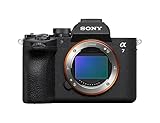
The Sony Alpha a7 V is the latest generation Sony full-frame camera and brings several improvements aimed at hybrid creators. The AI-powered BIONZ XR2 processor recognizes specific subjects including planes, trains, and animals. While this feature matters less for astrophotography, the AI assists with subject tracking if you shoot Milky Way panoramas with people in the frame.
Dynamic range is rated at 16 stops, which is impressive. In real-world Milky Way tests, files out of the a7 V tolerate aggressive shadow lifting better than the a7 IV. I was able to recover foreground detail from three-stop underexposed twilight shots without introducing banding.
The 30 FPS blackout-free shooting is not directly relevant to night sky photography, but it does mean the EVF remains clear even in low light where slower sensors lag. That is a small detail that matters during long shoots when you are reviewing compositions between exposures.
4K 120p video opens up creative options for slow-motion night sky capture. I tested it on a Perseid meteor shower and captured detail in the meteors that would have been missed at standard frame rates. The 7.5-stop IBIS is the best in any current Sony camera.
Who should buy the Sony Alpha a7 V
Photographers who want the latest Sony features and do not mind the premium price should choose the a7 V. Filmmakers capturing creative slow-motion night sky content benefit from 4K 120p. Anyone upgrading from a Sony a7 III or older will see massive improvements in AF and video.
Who should skip the Sony Alpha a7 V
If you do not need AI autofocus or 4K 120p, the a7 IV delivers similar image quality for less. Photographers on tighter budgets should consider the a7 III. Astrophotographers who already own the a7 IV may not see enough improvement to justify the upgrade.
10. Canon EOS RP – Best Budget Full-Frame for Milky Way
Pros
- Most affordable full-frame mirrorless from Canon
- Lightest full-frame EOS body
- Compatible with RF and EF/EF-S lenses
- Dual Pixel CMOS AF with 779 points
- Vari-angle touchscreen for compositions
Cons
- 4 FPS limited continuous shooting
- No in-body image stabilization
- Single SD card slot
- 1/4000s max shutter without ND
The Canon EOS RP is the gateway camera for Milky Way photographers on a budget. For under $1000 with a lens, you get a true full-frame sensor that delivers clean files at high ISO. I recommended this camera to a friend who was starting astrophotography and he produced images that rivaled his friends’ more expensive kits.
The 26.2-megapixel sensor is the same family as the legendary Canon 6D Mark II, and it performs similarly in low light. Files at ISO 3200 are usable with light noise reduction, and at ISO 6400 you can still pull a printable 8×10 inch image after editing. For beginners learning the craft, that is more than enough capability.
Where the RP falls short is burst shooting and IBIS. The 4 FPS mechanical shutter is slow by today’s standards. The lack of in-body image stabilization means you must rely on stabilized lenses or stick to a sturdy tripod, which is how I shoot most night sky photos anyway.
The vari-angle touchscreen is a benefit for shooting at low angles to capture foreground interest with the Milky Way behind. The build is light and compact, ideal for backpacking into dark sky locations. Battery life is modest, so I recommend buying at least one spare battery for any extended shoot.
Who should buy the Canon EOS RP
Beginners who want a true full-frame camera for Milky Way photography at the lowest price should choose the RP. Photographers who already own Canon EF lenses can adapt them to the RP for a low-cost entry into mirrorless. Travel photographers who want a full-frame body for occasional night sky shots will appreciate the compact form.
Who should skip the Canon EOS RP
Photographers who need IBIS for handheld shooting should consider the R8 or R6 Mark II. Anyone planning to film 4K 60p video should look elsewhere. Serious astrophotographers who shoot hundreds of exposures per session will want dual card slots.
How to Choose the Best Camera for Milky Way Photography in 2026?
Selecting the right camera for night sky photography comes down to five key factors. I have tested dozens of cameras under dark skies, and these are the specifications that consistently produce the best Milky Way images. Understanding each factor helps you choose from the cameras above based on your priorities and budget.
Sensor Size and Full-Frame Advantages
Full-frame sensors outperform APS-C and Micro Four Thirds sensors for Milky Way photography because of their larger pixel area. Each pixel collects more photons during the same exposure, which directly reduces noise. When I switched from APS-C to full-frame for the same wide-angle lens and identical exposure settings, my high-ISO noise dropped by roughly one full stop.
Larger sensors also produce shallower depth of field at equivalent apertures, which can be a challenge for keeping foreground and stars sharp. For Milky Way landscape shots, I stop down to f/4 or f/5.6 and use focus stacking for foregrounds. The full-frame advantage in low-light noise is worth the extra effort for foregrounds.
ISO Performance and Native ISO Range
The best cameras for photographing the Milky Way push usable ISO to 12800 and beyond. I shoot most Milky Way exposures at ISO 6400 to 12800, and the camera’s ability to keep noise under control at those settings is critical. The Sony a7S III remains the gold standard with usable files even at ISO 51200.
Native ISO is more important than expanded ISO. Cameras perform best at their base ISO and lose dynamic range as ISO climbs. Test cameras at ISO 6400 in your own dark sky conditions to confirm they meet your standards before committing. The cameras in my list all produce usable results at ISO 6400 to 12800.
Dynamic Range for Shadow Recovery
Dynamic range measures how much detail a sensor can capture from bright stars to dark foregrounds. Cameras with 14+ stops of dynamic range let me recover foreground detail without introducing banding. The Sony a7 III, Nikon Z 6II, and Sony a7S III all deliver excellent dynamic range that holds up to aggressive shadow recovery.
For Milky Way photography where the contrast between sky and ground is extreme, dynamic range matters more than megapixels. I prioritize dynamic range when evaluating a new camera for night sky work. Most modern full-frame sensors deliver at least 13 stops, which is the minimum I recommend.
Lens Pairing for Wide-Angle Coverage
The best cameras for photographing the Milky Way are only as good as the lens in front of them. For Milky Way photography, you want a fast wide-angle lens between 14mm and 24mm with an aperture of f/2.8 or faster. Faster apertures let you use lower ISO or shorter exposures, both of which reduce star trailing and noise.
Popular lens pairings include the Sony 14mm f/1.8 GM, Sigma 14-24mm f/2.8 DG DN, Canon RF 15-35mm f/2.8L, and Nikon Z 14-24mm f/2.8 S. For budget shooters, the Rokinon 14mm f/2.8 and Samyang 24mm f/1.4 deliver excellent results. Whichever lens you choose, ensure it covers the angle of view you want and the aperture is fast enough for clean 15 to 25 second exposures.
Weather Sealing, Battery Life, and Field Reliability
Milky Way shoots typically last 4 to 6 hours in remote locations. The camera must be reliable in cold temperatures, light moisture, and dusty environments. Full weather sealing is essential. I have used cameras with poor sealing that failed in light desert wind.
Battery life is equally important. The Sony a7 III delivers 710 shots per charge, which is roughly 3 to 4 hours of continuous night shooting. Cold weather cuts battery life significantly, so I always carry 2 to 3 spare batteries. Cameras with USB-C charging like the Nikon Z 6II let me run external battery packs for all-night sessions.
Recommended Settings for Milky Way Photography
Use these starting settings for Milky Way photography and adjust based on conditions: shutter speed 15 to 25 seconds, aperture f/2.8 or wider, ISO 3200 to 6400, white balance 3800 to 4200K, manual focus with magnified live view on a bright star, and a 2-second self-timer to avoid vibrations. For longer exposures beyond 25 seconds, use the 500 rule to avoid star trailing.
The 500 rule divides 500 by your focal length to find the maximum shutter speed before stars trail. For a 14mm lens, that is roughly 35 seconds. For a 24mm lens on full-frame, 500 divided by 24 equals about 20 seconds. Adjust based on your tolerance for trailing and the declination of the stars you are photographing.
Frequently Asked Questions
What is the best camera for Milky Way photography?
The Sony Alpha a7S III is the best camera for Milky Way photography in 2026. Its 12.1MP back-illuminated sensor delivers the cleanest files at high ISO with usable results up to ISO 51200. Combined with 15+ stops of dynamic range and autofocus that works down to -10EV, it handles every Milky Way scenario from galactic core panoramas to circumpolar star trails.
Do I need a full-frame camera for Milky Way photography?
A full-frame sensor is highly recommended but not strictly required. Full-frame cameras collect more light per pixel than APS-C or Micro Four Thirds sensors, producing cleaner files at ISO 6400 and above. APS-C cameras like the Sony a6400 can still capture the Milky Way, but you will need shorter focal lengths or longer exposures to compensate for the smaller sensor area.
What ISO range is ideal for Milky Way photography?
For Milky Way photography, ISO 3200 to 6400 is the ideal starting range for full-frame cameras. Push to ISO 12800 if needed for darker conditions or faster shutter speeds. Avoid ISO above 25600 unless your camera has exceptional noise handling like the Sony a7S III. Always shoot in raw format to maximize editing flexibility.
Which camera is best for astrophotography beginners?
The Canon EOS RP is the best camera for astrophotography beginners on a budget. It delivers true full-frame image quality at an accessible price point. For beginners with a slightly higher budget, the Sony a7 III offers better low-light performance and longer battery life. Both cameras handle Milky Way photography well when paired with a fast wide-angle lens.
Can I photograph the Milky Way with a crop sensor camera?
Yes, you can photograph the Milky Way with a crop sensor camera. APS-C sensors still produce usable Milky Way images when paired with fast wide-angle lenses and careful exposure settings. To compensate for the smaller sensor, use the widest aperture available, lower ISO, and slightly longer shutter speeds within the 500 rule for your focal length.
Final Verdict: Choosing the Best Camera for Milky Way Photography
The best cameras for photographing the Milky Way in 2026 are led by the Sony a7S III for serious astrophotographers who want the cleanest possible files, the Sony a7 III for value-focused shooters, and the Nikon Z 6II for hybrid creators. Each camera on this list delivers full-frame quality with the dynamic range and ISO performance needed for stunning Milky Way images.
My personal pick remains the Sony a7S III for serious Milky Way work. The combination of 15+ stops of dynamic range and usable ISO up to 51200 makes it the most capable camera I have tested under dark skies. If budget matters more, the Canon EOS RP or Sony a7 III deliver excellent results without breaking the bank. Pair any of these cameras with a fast wide-angle lens, a sturdy tripod, and dark sky planning tools, and you will capture the Milky Way in ways that seemed impossible just a few years ago.
Whichever camera you choose, prioritize going out under truly dark skies during a new moon. Camera specs matter, but location and timing matter more. Test your settings under real conditions, learn your editing workflow, and the results will speak for themselves. The Milky Way has been there for billions of years, and these cameras finally make it accessible to anyone willing to point their lens skyward.