
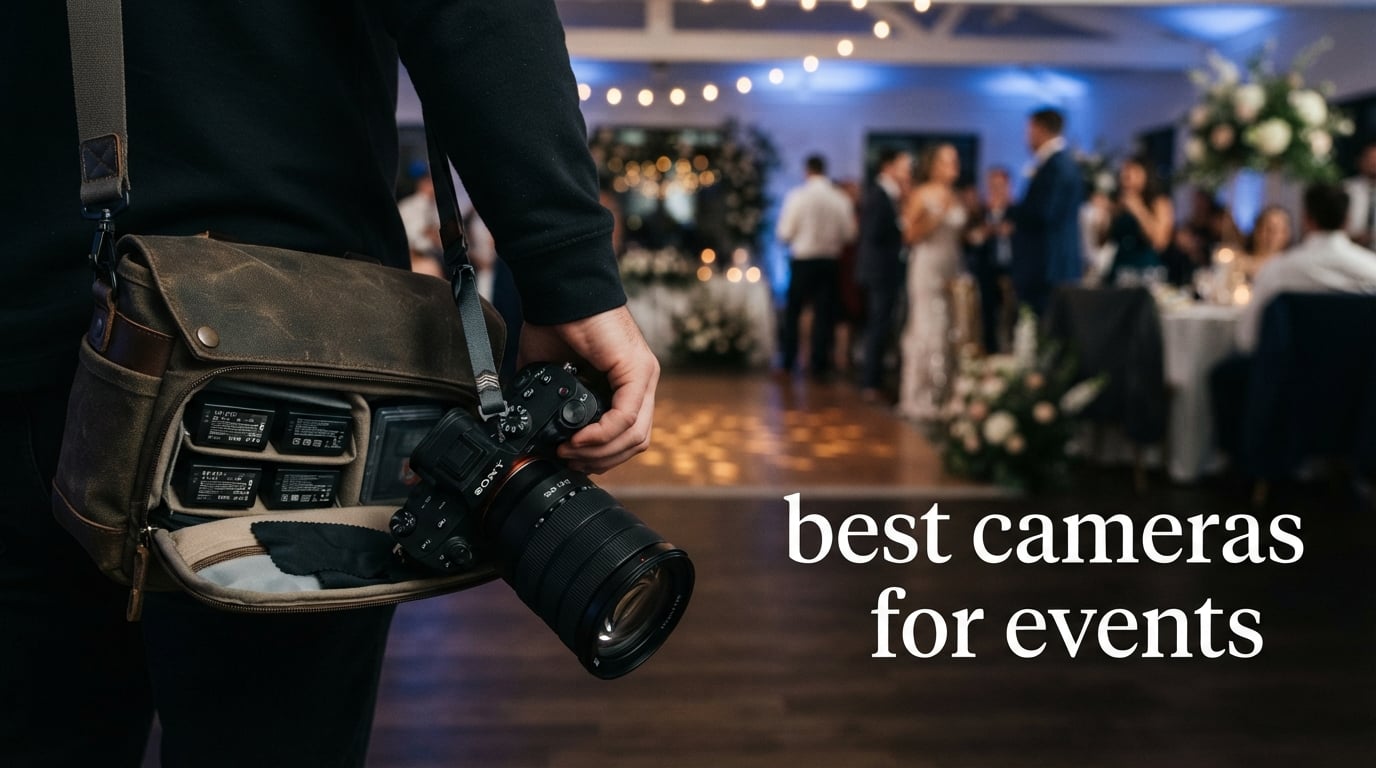
The best cameras for events combine a large sensor, dependable subject-tracking autofocus, fast burst shooting, and a recording workflow you can trust when a moment happens once. For weddings, conferences, parties, and concerts, my strongest all-round pick is the Canon EOS R6 Mark II; the Nikon Z5 II is a compelling full-frame alternative for dim venues, while the Canon EOS R7 suits action-heavy coverage when reach matters.
An event photography camera has to work through mixed lighting, people walking into frame, fast entrances, and long stretches without a break. A camera that looks great on a specification sheet but has weak autofocus, little stabilization, or no sensible media plan can make a demanding assignment harder than it needs to be.
I reviewed all eight cameras here around the things that change real coverage: full-frame versus APS-C sensor size, low-light autofocus, burst rate, in-body stabilization, video, and card slots. The right body is only part of the kit, but it determines how confidently you can concentrate on faces, timing, and the room rather than on the camera.
The top 3 picks answer most event-shooting needs
The Canon EOS R6 Mark II is the balanced choice because its 24.2MP full-frame sensor, subject detection, 40fps electronic burst option, 8-stop IBIS, and dual UHS-II card slots all address common event risks. Its kit lens covers a useful 24-105mm range for a single-camera start, although a brighter lens remains a smart addition for darker rooms.
The Nikon Z5 II earns the value badge on capability rather than a stripped-down feature list: it has a 24.5MP BSI full-frame sensor, autofocus rated down to -10EV, 7.5 stops of stabilization, 4K/60p, N-RAW, and two SD slots. The Canon EOS R7 is the action-minded alternative, with 30fps electronic shooting, pre-shooting, 7-stop IBIS, and a 32.5MP APS-C sensor.
The best cameras for events in 2026 are easy to compare here
| Product | Specifications | Action |
|---|---|---|
 Canon EOS R6 Mark II Canon EOS R6 Mark II |
|
Check Latest Price |
 Nikon Z5 II with 24-50mm Nikon Z5 II with 24-50mm |
|
Check Latest Price |
 Canon EOS R7 Canon EOS R7 |
|
Check Latest Price |
 Canon EOS R6 Mark III Canon EOS R6 Mark III |
|
Check Latest Price |
 Nikon Z6 III Nikon Z6 III |
|
Check Latest Price |
 Nikon Z 8 Nikon Z 8 |
|
Check Latest Price |
 Canon EOS R8 Canon EOS R8 |
|
Check Latest Price |
 Sony Alpha 7R VI Sony Alpha 7R VI |
|
Check Latest Price |
Read the table as a decision shortcut, not as a substitute for handling a camera. Full-frame models generally give the cleaner starting point in dark receptions and concerts, while the R7’s APS-C format can be a real advantage when a speaker or performer is far from your position.
For paid assignments, I put dual card recording and a second body ahead of headline resolution. Community discussions make the same point repeatedly: a missed file or a dead battery does more damage than choosing a body with fewer megapixels.
1. The Canon EOS R6 Mark II is the best all-round event camera
Pros
- 24.2MP full-frame sensor
- 8-stop IBIS
- 40fps electronic burst
- subject detection
- dual UHS-II slots
Cons
- Heavier for long handheld use
- RF lens selection is limited
I put the EOS R6 Mark II first because its feature set makes sense from ceremony through dance floor. The 24.2MP full-frame CMOS sensor leaves a practical balance between image detail and manageable editing files, and the DIGIC X processor supports a 12fps mechanical or 40fps electronic burst when the moment moves quickly.
Its Dual Pixel CMOS AF II has 1,053 AF zones and recognizes people, animals, vehicles, aircraft, trains, and horses. For a wedding photography camera, the people detection is the feature I would build around, because it is designed for the face-and-eye work that repeats throughout a ceremony and reception.
The R6 Mark II also has sensor-shift, 5-axis IBIS rated up to 8 stops. That does not replace a fast shutter speed for movement, but it can help keep static room scenes, décor, and quieter candid frames steadier when handholding.
Hybrid shooters get internal 4K/60p C-Log video and 6K ProRes RAW recording in the supplied product details, along with dual UHS-II card slots. That dual-slot setup is a major distinction for paid event coverage, where recording a second copy can remove one avoidable point of failure.
The Canon EOS R6 Mark II fits full-day hybrid coverage
This is the body I would choose for someone photographing a ceremony, portraits, speeches, and a reception while also making short video clips. The 24.2MP resolution is sufficient for a broad range of deliverables without asking every card and computer to handle extreme file sizes.
A 24-70mm zoom is the natural first pairing for room coverage, groups, entrances, and fast transitions. Adding a fast 50mm or 85mm gives you a stronger option for speeches and dim dance-floor portraits, which mirrors the two-lens approach photographers frequently recommend in event forums.
The Canon EOS R6 Mark II needs battery and lens planning
Product feedback praises the camera’s stabilization, burst shooting, and subject detection, while extended-use comments flag battery life and handheld weight. I would pack spare batteries, rotate cards deliberately, and avoid treating the included 24-105mm f/4-7.1 lens as the only lens for a truly dark reception.
The body provides no built-in flash, so a separate lighting plan matters for party photography. A compatible external flash, used thoughtfully with ambient light, can be more helpful than pushing sensitivity ever higher when the venue allows it.
2. The Nikon Z5 II is the strongest full-frame low-light value pick
Pros
- AF rated to -10EV
- 7.5-stop stabilization
- 3000-nit EVF
- 4K/60p
- dual SD slots
Cons
- Newer body with few reviews
- 24-50mm lens has a modest aperture range
The Nikon Z5 II puts several event-friendly basics in one package: a 24.5MP BSI-CMOS FX-format sensor, EXPEED 7 processing, up to 30fps continuous shooting, and two SD card slots. I like that it starts with a moderate full-frame resolution rather than chasing a huge file size that can slow a long editing queue.
The standout specification is autofocus detection down to -10EV. That rating is relevant to candlelit ceremonies, venue corners, and concert scenes where the human eye sees the action but a lesser system may struggle to lock on.
Nikon lists 7.5 stops of built-in image stabilization and nine subject-detection categories. Its 3000-nit EVF also deserves attention for outdoor conferences or daylight-to-indoor transitions, where a clear viewfinder can make framing and exposure checks less tiring.
For video, the Z5 II records 4K/60p and 12-bit N-RAW in-camera according to the product data. N-RAW gives a video editor more latitude than a finished compressed look, but it also asks for a prepared storage and post-production workflow.
The Nikon Z5 II serves dark receptions and compact kits well
I see the Z5 II as a smart match for low-light event photography where full-frame capture, stabilization, and a backup SD recording path matter more than extreme resolution. The included 24-50mm zoom is compact for arriving light, and it covers group scenes and environmental portraits at the wide end.
For an all-day wedding, I would add a bright normal or portrait lens rather than rely on the kit zoom after the lights go down. This is also a sensible camera for a conference photographer who needs an unobtrusive full-frame body and a bright EVF for indoor-to-outdoor movement.
The Nikon Z5 II requires measured confidence as a newer model
The product listing has only 14 reviews, even though its rating is 4.8. That is a useful early signal, not the same depth of long-term owner feedback available for models with hundreds of reviews.
Test your exact card settings, video codec, and battery routine before a client job. Having dual SD slots is reassuring, but the practical reliability comes from formatting cards, checking both files, and carrying more power than a schedule appears to require.
3. The Canon EOS R7 is the best APS-C body for fast event action
Pros
- 32.5MP APS-C detail
- 30fps electronic burst
- 7-stop IBIS
- 651 AF zones
- dual UHS-II slots
Cons
- APS-C is less suited to very dim venues
- some video modes crop
The EOS R7 is my APS-C recommendation because its 32.5MP sensor, 651 autofocus zones, and 30fps electronic shutter make it well suited to fast action. That combination is attractive for conferences where a keynote speaker is distant, outdoor ceremonies, school events, and performers who stay beyond the reach of a standard zoom.
Canon gives the R7 Dual Pixel CMOS AF II, subject detection for people, animals, and vehicles, plus RAW Burst Mode with half-second pre-shooting. Pre-shooting can be particularly useful when you are waiting for a ribbon cut, reaction, applause, or a performer’s peak movement.
The body has sensor-shift, 5-axis IBIS rated up to 7 stops and dual UHS-II SD card slots. At 1.1 pounds in the supplied details, it is also much lighter than many full-frame event bodies, which can matter after hours of working a crowded floor.
The compromise is sensor size. APS-C does not make the R7 unsuitable for events, but a full-frame camera typically gives a more forgiving starting point in low light, especially once you need fast shutter speeds to stop movement.
The Canon EOS R7 gives distant subjects more useful reach
For conference photography and concerts where you cannot move close to the stage, the APS-C field of view makes a telephoto lens frame tighter. The 32.5MP resolution also leaves room to crop when the shot needs a small adjustment after the event.
I would pair it with a stabilized standard zoom for general work and a telephoto zoom for stage coverage. A wide-aperture lens still matters indoors, because stabilization can steady your hands but cannot freeze a moving dancer or musician.
The Canon EOS R7 asks for more care in very dark rooms
The R7 has a native ISO range of 100-32000, expandable to 51200, but sensor format remains the more important consideration than any one sensitivity number. For a dim reception or club, use a fast lens, a flash where appropriate, and realistic expectations about how far you can push ambient-only exposure.
Its dual UHS-II slots make it a stronger paid-work candidate than a single-slot body, but it is best viewed as an action-focused system choice rather than a full-frame substitute in every lighting situation. This is the best camera for party photography when the party is well lit and the pace is high.
4. The Canon EOS R6 Mark III is the premium stabilized Canon choice
Pros
- 32.5MP full-frame sensor
- 40fps burst
- pre-continuous shooting
- 8.5-stop IBIS
- dual card formats
Cons
- Newer model with fewer reviews
- CFexpress workflow needs planning
The EOS R6 Mark III is for the Canon event shooter who wants more resolution without giving up speed. Its 32.5MP full-frame CMOS sensor and DIGIC X processing deliver more detail than the R6 Mark II, while the camera still reaches up to 40fps continuous shooting.
Canon lists 20 frames of pre-continuous shooting, people, animal, and vehicle detection, plus Register People Priority. I would see the latter as particularly relevant to an event with a couple, keynote presenter, or honoree whose face needs to stay at the center of your coverage.
The headline physical advantage is 8.5 stops of 5-axis IBIS at the center, with 7.5 stops at the periphery. A stabilised body helps with hand-held venue details and slower-moving candid scenes, though it does not cancel subject motion at an energetic reception.
The R6 Mark III uses a CFexpress Type B slot and a UHS-II SD slot. That is a capable two-card arrangement, but it means I would plan media purchases, card readers, and a clear ingest routine around two different formats.
The Canon EOS R6 Mark III rewards detail-focused event coverage
This body fits a photographer who delivers large group portraits, tightly cropped candid images, and venue work that benefits from the extra resolution. The full-frame sensor and 32.5MP count offer more framing flexibility than a 24MP body without going into the extreme file sizes of a 66.8MP option.
I would select it for weddings, brand activations, and formal corporate work where the lead subjects are predictable and the final gallery may include large detail-rich files. Its 40fps capability is also there for entrances, quick reactions, and confetti-like moments.
The Canon EOS R6 Mark III needs a mixed-card workflow
CFexpress Type B and UHS-II SD are not interchangeable, so bring both formats and test dual-recording behavior before the event. A fast camera becomes less useful when the card plan is improvised or the reader at home cannot handle one of the media types.
The listing’s 77 reviews and 4.7 rating show positive early reception, but a newer body has a shorter public track record than an established workhorse. I would prioritize familiarity with menus and controls over using every advanced feature on the first paid job.
5. The Nikon Z6 III is the best photo-and-video hybrid for dim venues
Pros
- 6K/60p N-RAW
- 4K/120p
- 4000-nit EVF
- AF to -10EV
- 8-stop IBIS
Cons
- Video battery planning is needed
- product data contains conflicting slot fields
The Nikon Z6 III is the strongest choice here when photo and video have equal importance. It combines a 24.5MP full-frame sensor with 6K/60p internal N-RAW, oversampled 4K UHD, 4K/120p, and Full HD/240p slow motion in the supplied technical specifications.
Its autofocus is rated down to -10EV and uses deep-learning multi-subject recognition. Those facts, together with a sensitivity range of ISO 100-64000 that expands to ISO 204800, point directly at the hard lighting conditions of receptions, concert venues, and evening launch parties.
Nikon rates the 5-axis IBIS at up to 8 stops. The 4000-nit, 5760k-dot EVF with a 120fps refresh rate is another practical feature, since a bright, responsive finder is helpful when you are framing in glare or moving quickly between light levels.
The listed product details say CFexpress Type B and SD card slots, while a separate product field shows one slot available. Because paid-event backup is too important for assumptions, verify the exact recording configuration for the body and firmware you will use before relying on it for redundant capture.
The Nikon Z6 III supports a serious video post-production workflow
N-RAW is the reason to consider this camera over a stills-first body if you need to grade video extensively. The format records 12-bit raw video information according to the product data, which gives an editor more material for balancing difficult mixed lighting after the event.
That freedom has a tradeoff: raw footage needs capable cards, substantial storage, and a computer that can keep editing fluid. For simple social clips delivered fast, oversampled 4K may be the more practical capture choice than recording every segment in raw.
The Nikon Z6 III needs careful reliability preparation
Feedback in the product data calls out video battery life as an area to plan for, and that is sensible for any long video block. Bring charged spares, know your record-limit and heat-management approach, and schedule camera checks around natural breaks such as speeches or session changes.
The Z6 III has 200 reviews and a 4.5 rating, with owners praising the EVF, video ability, and improved autofocus. I would choose it for a hybrid shooter who already understands Nikon Z lenses and wants a full-frame body designed to move from stills to finished video.
6. The Nikon Z 8 is the professional high-resolution event workhorse
Nikon Z 8 | Professional Full-Frame mirrorless Stills/Video Hybrid Camera | Nikon USA Model
Pros
- 45.7MP stacked sensor
- AF to -9EV
- 8K/60p and 4K/120p
- weather sealing
- dual slots
Cons
- Large files slow editing
- complex menus can slow beginners
The Nikon Z 8 is a professional body for assignments where image detail, fast action, and demanding video are all part of the brief. Its 45.7MP stacked CMOS sensor, EXPEED 7 engine, and 20fps RAW burst create a serious stills platform for large group images, stage work, and images that may need heavy cropping.
The camera offers 20, 30, 60, and 120fps shooting options, plus pre-release capture. Its deep-learning autofocus detects focus as low as -9EV and tracks people, pets, birds, and vehicles with subject detection and 3D tracking.
Video specifications include internal 8K/60p and 4K/120p recording, with 12-bit N-RAW and ProRes RAW. Weather-sealed construction and 5.5-stop, 5-axis IBIS make the Z 8 especially interesting for outdoor ceremonies, unpredictable weather, and fast-moving assignments that carry into the night.
It has CFexpress Type B and SD card slots. That gives a professional event photographer an appropriate path for redundant stills capture, provided the cards are prepared and the recording mode is checked before guests arrive.
The Nikon Z 8 fits demanding deliverables and challenging locations
I would put the Z 8 on a shortlist for a photographer who needs to crop aggressively, make large prints, or deliver both stills and high-resolution video. Concert photography also benefits from the fast shooting options and autofocus in low light, especially when a performer’s distance changes quickly.
Its weather sealing adds practical confidence for outdoor event photography, but no camera should be treated casually in sustained rain. A rain cover, lens cloths, and a dry place to change cards remain part of the plan.
The Nikon Z 8 makes the most sense with a disciplined file workflow
More megapixels do not automatically make a better event image. A 45.7MP file gives more detail and crop room, but it takes more storage and can make culling, backup, and delivery slower after an event with thousands of exposures.
Forum discussions often favor mid-range professional bodies for routine weddings because speed, familiarity, and manageable files can outweigh flagship specifications. Choose the Z 8 when its detail and video headroom are part of your deliverables, not simply because the number on the sensor is larger.
7. The Canon EOS R8 is the lightest full-frame entry for events
Pros
- Lightweight full-frame body
- 40fps shooting
- 4K/60p from 6K
- Dual Pixel AF II
- vari-angle screen
Cons
- Limited battery life
- does not include a built-in flash
The Canon EOS R8 makes full-frame event shooting more approachable in a lightweight body. It uses a 24.2MP full-frame CMOS sensor and DIGIC X processor, reaches up to 40fps, and has Dual Pixel CMOS AF II with a quoted 1,053 AF zones.
Canon lists full-width coverage across 1,062 zones and automatic detection for people, animals, vehicles, aircraft, trains, and horses. For people-focused events, face and eye detection can help you concentrate on composition while the camera handles much of the initial focus acquisition.
Video capability is also substantial for its size: oversampled 4K/60p from 6K, Full HD up to 180fps, Canon Log 3, and HDR PQ. The 3-inch vari-angle touchscreen is helpful for low-angle dance-floor frames, overhead composition, and quick adjustment when you cannot put your eye to the finder.
The product data describes it as lightweight but flags limited battery life, and it has no built-in flash. That frames the R8 as a highly capable compact body that benefits from a deliberate power and lighting kit rather than a carefree all-day solution.
The Canon EOS R8 suits roaming photographers and backup-body roles
I would choose the R8 for an event photographer who spends much of the night moving through a crowd and wants a small full-frame body. It is also an attractive second camera in a Canon RF setup, with one body carrying a wide zoom and the R8 carrying a fast portrait lens.
Its 24.2MP files are a reasonable size for rapid culling, cloud transfer, and gallery delivery. The full-frame sensor makes it a better low-light starting point than many small APS-C alternatives, assuming the lens is bright enough for the environment.
The Canon EOS R8 needs backup power and media awareness
Battery capacity is a recurring concern in its supplied review feedback, so do not take one battery to a full-day event. Keep spares charged and accessible, and change them during calm transitions rather than during the first dance or a keynote announcement.
Unlike the dual-slot bodies above, the supplied data does not list dual card slots for the R8. I would therefore be more comfortable treating it as a compact personal-event body or a backup camera than as the only body responsible for irreplaceable paid-event files.
8. The Sony Alpha 7R VI is the maximum-resolution event camera
Pros
- 66.8MP stacked sensor
- 30fps blackout-free
- AI pose recognition
- 16 stops dynamic range
- dual CFexpress slots
Cons
- Very large files
- limited review history
The Sony Alpha 7R VI is the specialist pick for event photographers who need the most image detail in this group. Its fully stacked 66.8MP Exmor RS sensor, BIONZ XR2 engine with AI processing, and 30fps blackout-free shooting make it a formidable camera for high-detail corporate, editorial, and brand-activation coverage.
Sony lists up to 60 AF/AE calculations per second, AI-based human pose estimation, and real-time AF tracking that recognizes humans, animals, birds, insects, cars, trains, and airplanes. Pose estimation can be useful in crowded scenes where a face turns away but the assigned subject remains visible.
The supplied data includes 8K video capability, 4K/60p without cropping, 16 stops of dynamic range, and dual CFexpress Type A card slots. This is a powerful hybrid camera for a shooter whose post-production process can absorb very large high-resolution files.
The camera’s ISO range is listed as 100-32000, expandable to 102400, and it has 5-axis IBIS with digital stabilization. Those are strong specifications, but huge resolution should never be confused with automatic low-light superiority; exposure, lens aperture, and subject movement still decide whether a frame is usable.
The Sony Alpha 7R VI is made for crop-heavy and detail-rich assignments
I would consider this body for corporate events, large venue images, and editorial deliverables where one frame may need several crops. A 66.8MP file makes it easier to pull a speaker portrait from a wider stage composition, provided focus and shutter speed were right in the first place.
The 30fps blackout-free burst is also useful when the action is brief and unpredictable. Pair it with fast Sony E-mount or FE lenses and high-capacity CFexpress Type A media so the rest of the kit does not limit the sensor.
The Sony Alpha 7R VI demands storage and workflow discipline
Large files require more card capacity, faster backups, and more patience in culling. For a photographer delivering a standard event gallery quickly, a 24MP or 32.5MP body may be the more practical tool even when the Sony produces more detail.
The listing has 10 reviews and a 4.4 rating, so its owner-feedback base is still small. I would only commit it to a critical assignment after learning its card, autofocus, and file-handling behavior in lower-stakes work.
The right event camera depends on light, distance, and delivery needs
Start with the event you actually shoot, because “events” includes very different working conditions. A daytime conference, a candlelit ceremony, a nightclub party, and a concert pit all reward different strengths.
Full-frame bodies are the safer choice for low-light weddings and parties
Full-frame sensors such as those in the R6 Mark II, Z5 II, R6 Mark III, Z6 III, Z 8, R8, and Alpha 7R VI generally give a more comfortable foundation for low-light work. They do not make shutter speed irrelevant, but they give you more flexibility when balancing a fast lens, ambient light, and movement.
For a wedding, prioritize reliable people detection, dual card slots, a familiar control layout, and spare batteries. The R6 Mark II is the clean all-round answer, while the Z5 II brings an appealing low-light autofocus rating and dual SD slots.
APS-C bodies are useful when reach and speed matter most
The EOS R7 should not be dismissed simply because it is APS-C. Its 32.5MP sensor, 30fps electronic burst, pre-shooting, and dual UHS-II slots make it a strong fit for stage work, conferences, outdoor ceremonies, and sporting-style events where you cannot stand close.
In a very dim room, compensate with a fast lens and lighting strategy rather than expecting any crop-sensor body to match a full-frame camera automatically. The lens is part of the exposure system, not an accessory chosen after the body.
Dual card slots are the professional safeguard for paid assignments
Dual slots appear on the R6 Mark II, Z5 II, R7, R6 Mark III, Z 8, and Alpha 7R VI in the supplied product data. They let you create a second copy while shooting when the selected recording mode supports it, which is a major protection against a card failure.
They do not replace backups. At the first safe break, put used cards somewhere secure, then make more than one copy after the event; the familiar event-photography rule is that two copies are one copy, and one copy is none.
Moderate resolution is usually faster for high-volume delivery
Megapixels matter for large prints and aggressive crops, but a 24MP or 24.5MP full-frame body is already capable of strong event work. Smaller files move faster through cards, backups, previews, editing software, online galleries, and client delivery.
Choose 32.5MP, 45.7MP, or 66.8MP when your work truly benefits from extra crop room or detail. The R6 Mark III offers a middle route; the Z 8 and Alpha 7R VI are better for photographers who deliberately want large files and have a workflow that supports them.
Video work needs a heat, power, and media plan
4K/60p, 6K/60p, 8K/60p, and raw video modes ask more of any camera system than a few stills. Before an event, record a realistic test clip with your intended card, lens, ambient temperature, and power setup, then see how long your workflow remains comfortable.
Do not promise a continuous recording duration based only on a headline specification. Use fresh batteries, appropriate approved media, air around the camera, and a second body ready for handoff if the schedule includes long talks, performances, or ceremonies.
Fast zooms and one fast prime cover most first event kits
A standard zoom around 24-70mm is the workhorse for groups, room scenes, entrances, and quick transitions. A 50mm or 85mm prime with a wide aperture adds separation and gathering power in darker rooms, while a telephoto zoom solves stage and conference distance.
For a first paid event, I would choose lenses I can operate instinctively over a large collection of unfamiliar glass. Forum advice frequently returns to the same practical pairing: a standard zoom plus a fast normal or portrait lens, with an external flash added where the venue and your skill allow.
The most common event-camera questions have clear answers
What is the best camera for events?
The Canon EOS R6 Mark II is the best all-round camera for events in this list because it combines a 24.2MP full-frame sensor, people-focused Dual Pixel CMOS AF II, up to 40fps electronic shooting, up to 8 stops of IBIS, 4K/60p video, and dual UHS-II card slots. Choose the Nikon Z5 II when low-light autofocus and dual SD slots are your priority.
What is the best affordable camera for event photography?
The Canon EOS R7 is the value-oriented event photography choice in this group. Its 32.5MP APS-C sensor, 30fps electronic burst, pre-shooting, 7-stop IBIS, people detection, and dual UHS-II SD slots make it capable for conferences, outdoor events, and well-lit parties. A fast lens or flash matters more as light falls.
Do I need dual card slots for weddings?
For paid wedding work, dual card slots are strongly recommended because they can record a second copy while you shoot when your selected recording mode supports it. The Canon EOS R6 Mark II, Nikon Z5 II, Canon EOS R7, Canon EOS R6 Mark III, Nikon Z 8, and Sony Alpha 7R VI list dual slots in the supplied product data.
What is the 80 20 rule in photography?
The 80 20 rule in photography is a planning idea: a small share of decisions produces much of the result. For events, focus your attention on reliable exposure, subject autofocus, positioning, a versatile lens, and backup media before chasing rare features. Those basics affect far more final images than extra specifications you do not use under pressure.
What colors are the most photogenic at an event?
Photogenic colors are usually the ones that work with the venue light and do not create distracting color casts on skin. Neutral tones, coordinated colors, and separation between the subject and background tend to photograph well. For event coverage, expose for faces first and watch for mixed lighting from LEDs, windows, and colored stage lights.
The Canon EOS R6 Mark II remains the best event-camera starting point
The Canon EOS R6 Mark II is my top choice because it balances full-frame image quality, people-focused autofocus, stabilization, burst speed, video, and dual-card reassurance without making high-resolution files the main priority. Pick the Nikon Z5 II for an excellent low-light-oriented full-frame kit, the Canon EOS R7 for action and reach, or the Z6 III when N-RAW video is central to your deliverables.
The best cameras for events in 2026 are the ones you can operate calmly in the light you face, with lenses, batteries, cards, and a backup plan already sorted. Choose the system that fits your regular assignments, practice it before the event day, and keep your attention on the moments that cannot be repeated.