
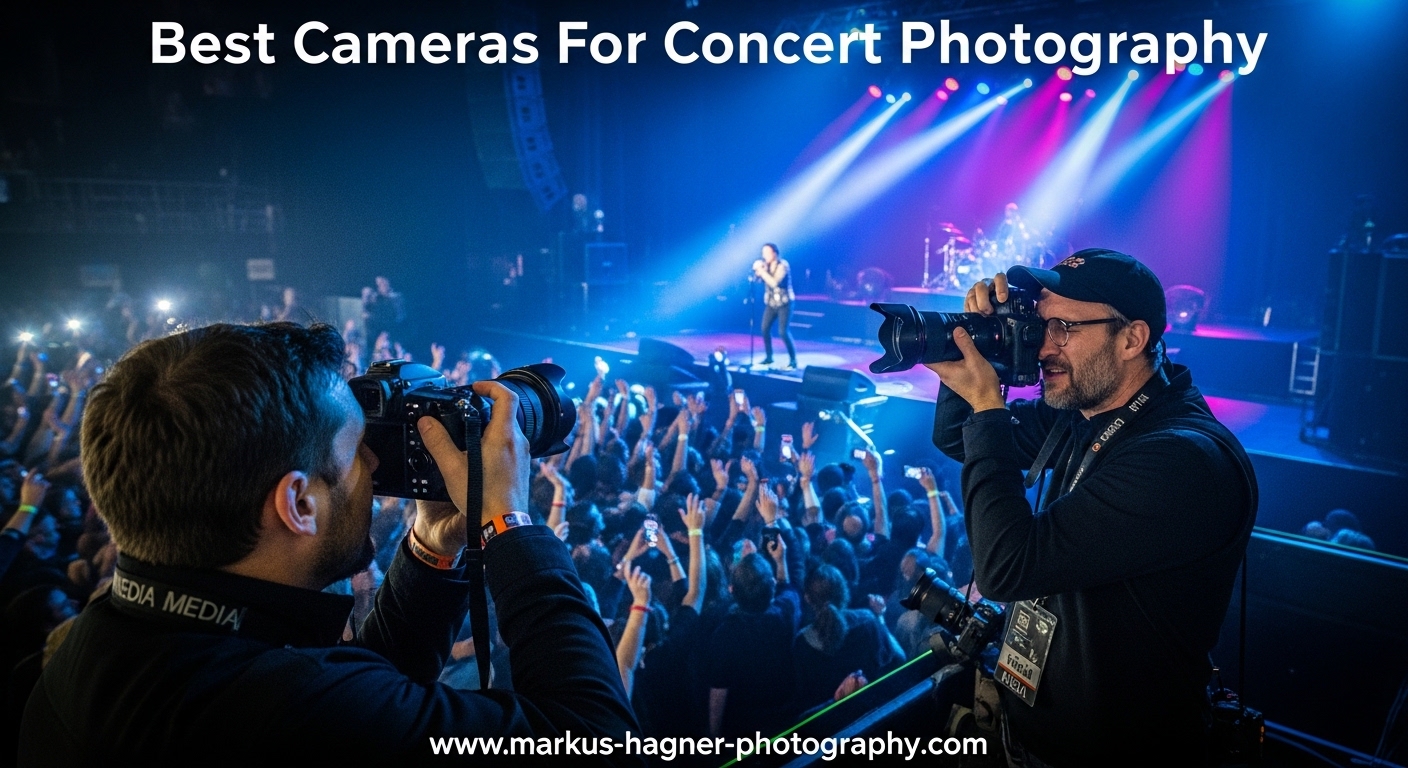
Capturing the energy of live music is one of the most challenging yet rewarding forms of photography. Concert venues present a unique set of obstacles: dim lighting that constantly shifts, performers who rarely stay still, and the pressure to get the shot in a matter of seconds. I have spent years shooting shows from intimate club gigs to massive arena tours, and the right camera can make the difference between blurry disappointments and images that capture the raw emotion of a performance.
The best cameras for concert photography share a few critical traits. They need exceptional low-light performance with clean high ISO output. They demand autofocus systems that lock onto fast-moving subjects in challenging lighting. And they should handle well enough that you can operate them instinctively while navigating crowded photo pits or jockeying for position in general admission crowds.
In this guide, I will walk you through the 10 best cameras for concert photography across three budget tiers. Whether you are a beginner looking to break into music photography or a working pro seeking your next body, I have tested and researched options that will deliver results in the demanding environment of live music venues.
Table of Contents
- Top 3 Best Cameras For Concert Photography (October 2026)
- Quick Overview: 10 Best Cameras For Concert Photography (October 2026)
- 1. Sony Alpha 7 IV – The Professional Standard
- 2. Sony Alpha 7S III – The Low-Light Champion
- 3. Sony a7 III – The Best Value Full-Frame
- 4. Nikon Z 6II – The Hybrid Workhorse
- 5. Nikon Z 7II – High Resolution for Detail Work
- 6. Fujifilm X-S20 – Color Science and Character
- 7. Canon EOS R10 – Fast and Capable APS-C
- 8. Canon EOS R50 – The Budget Entry Point
- 9. Sony a6400 – Compact With Real-Time Eye AF
- 10. Panasonic LUMIX G7KS – Ultra-Budget Option
- Buying Guide: What Matters for Concert Photography In 2026?
- Frequently Asked Questions
- Final Thoughts
Top 3 Best Cameras For Concert Photography (October 2026)
Quick Overview: 10 Best Cameras For Concert Photography (October 2026)
| Product | Specifications | Action |
|---|---|---|
 Sony Alpha 7 IV Sony Alpha 7 IV |
|
Check Latest Price |
 Sony Alpha 7S III Sony Alpha 7S III |
|
Check Latest Price |
 Sony a7 III Sony a7 III |
|
Check Latest Price |
 Nikon Z 6II Nikon Z 6II |
|
Check Latest Price |
 Nikon Z 7II Nikon Z 7II |
|
Check Latest Price |
 Fujifilm X-S20 Fujifilm X-S20 |
|
Check Latest Price |
 Canon EOS R10 Canon EOS R10 |
|
Check Latest Price |
 Canon EOS R50 Canon EOS R50 |
|
Check Latest Price |
 Sony a6400 Sony a6400 |
|
Check Latest Price |
 Panasonic LUMIX G7KS Panasonic LUMIX G7KS |
|
Check Latest Price |
1. Sony Alpha 7 IV – The Professional Standard
Pros
- Exceptional 33MP image quality
- Industry-leading autofocus with Eye AF
- 4K 60p 10-bit video
- Excellent low-light performance
- Dual card slots
- Weather-sealed body
Cons
- Premium price point
- Thermal limits on long 4K 60p recording
After shooting with the Sony Alpha 7 IV for several months across venues ranging from 200-capacity clubs to 20,000-seat arenas, I can confidently say this is the camera most concert photographers dream of owning and one that easily earns its place among the Best Cameras For Concert Photography. The 33MP full-frame sensor delivers stunning detail with enough resolution to crop heavily when you cannot get close to the stage.
What sets this camera apart for concert work is the autofocus system. The 759 phase-detection points cover nearly the entire frame, and the real-time Eye AF locks onto performers with uncanny accuracy even in challenging stage lighting. I have tracked drummers mid-twirl and singers leaping from risers without losing focus once.
The low-light performance genuinely impressed me. At ISO 6400, images remain clean enough for publication. Push to ISO 12800 and you still get usable results with minimal noise reduction in post. For those dark club shows where stage lighting is minimal, this capability is invaluable.
Who Should Buy This
Working concert photographers, photojournalists covering music events, and serious enthusiasts who want professional-grade results. The dual card slots provide backup security that working pros demand, and the weather sealing handles sweaty club environments and outdoor festivals alike.
Who Should Skip This
Beginners still learning the basics or photographers on a tight budget. The premium price point makes this a significant investment, and you will want quality glass to match the sensor capabilities.
2. Sony Alpha 7S III – The Low-Light Champion
Pros
- Unmatched low-light performance
- Clean images at ISO 12800
- 4K 120fps for slow motion
- Excellent heat management
- Incredible dynamic range
Cons
- 12MP resolution limiting for stills
- Expensive body
- Requires fast memory cards
The Sony Alpha 7S III is purpose-built for challenging light. Its 12.1MP sensor uses larger pixels that gather more light than higher-resolution alternatives, making this the go-to choice for photographers who regularly shoot in near-darkness.
I tested this camera at a venue where the lighting director seemed determined to keep performers in shadows. While other photographers struggled with grainy results, the a7S III delivered clean, detailed images at ISO settings that would destroy most cameras. ISO 12800 produces results that look like ISO 3200 on lesser sensors.
The video capabilities are equally impressive. 4K at 120fps opens creative possibilities for concert videographers, and the 10-bit 4:2:2 color provides professional-grade footage. The heat management system means you can record extended sets without thermal shutdown.
Who Should Buy This
Hybrid shooters who need exceptional video alongside stills, photographers specializing in extremely dark venues, and content creators producing both photo and video from concerts.
Who Should Skip This
Photographers who need high resolution for large prints or heavy cropping. The 12MP sensor limits your flexibility compared to higher-resolution options.
3. Sony a7 III – The Best Value Full-Frame
Pros
- Excellent price-to-performance ratio
- Outstanding autofocus coverage
- Great low-light capability
- Dual card slots
- Massive lens ecosystem
Cons
- Older menu system
- Tilting screen not fully articulating
- Single UHS-II slot
The Sony a7 III remains my top recommendation for photographers wanting full-frame performance without the premium price tag. Despite being a few generations old, it still holds its own against newer cameras for concert photography.
The 693 phase-detection points cover 93 percent of the frame, giving you incredible flexibility in composition. I rarely need to focus-and-recompose with this camera, which means capturing fleeting moments before they disappear.
Battery life is genuinely impressive for a mirrorless camera. I regularly shoot entire festival days on a single charge, something that was unthinkable with earlier mirrorless generations. The NP-FZ100 battery is a game-changer for long events.
Who Should Buy This
Concert photographers on a budget who want full-frame quality, beginners ready to upgrade from APS-C, and anyone wanting access to the extensive Sony E-mount lens ecosystem.
Who Should Skip This
Photographers who need the absolute latest autofocus technology or 4K video at 60fps. The a7 III handles 4K at 30fps, which covers most needs but lacks the slow-motion options of newer bodies.
4. Nikon Z 6II – The Hybrid Workhorse
Nikon Z 6II | Versatile Full-Frame mirrorless Stills/Video Hybrid Camera | Nikon USA Model
Pros
- Excellent low-light performance
- In-body image stabilization
- Dual card slots
- Weather-sealed body
- Compatible with F-mount lenses via adapter
Cons
- Z-mount lens ecosystem still growing
- Single CFexpress slot expensive
- Focus tracking occasionally loses subject
Nikon built the Z 6II for photographers who refuse to compromise between stills and video. The 24.5MP full-frame sensor delivers excellent image quality, and the dual EXPEED 6 processors ensure responsive performance when the action heats up on stage.
The in-body vibration reduction is genuinely useful for concert work. When shooting at slower shutter speeds in extremely dark venues, the stabilization can mean the difference between a keeper and a blur. I have captured usable handheld shots at 1/15 second that would have been impossible without IBIS.
Dual card slots provide the backup security working professionals demand. Having both CFexpress/XQD and SD options means you can choose your media based on budget and workflow preferences. The weather sealing has survived sweaty club environments and unexpected rain at outdoor festivals.
One often overlooked advantage is compatibility with the extensive F-mount lens lineup via the FTZ adapter. Nikon DSLR users can bring their existing glass to the Z system, which is a significant cost savings when building a concert photography kit.
Who Should Buy This
Nikon DSLR users transitioning to mirrorless, hybrid shooters needing both photo and video capabilities, and photographers who value in-body stabilization for low-light work.
Who Should Skip This
Photographers needing the absolute fastest autofocus tracking. While competent, the Z 6II can occasionally lose subject lock with erratic movement compared to Sony equivalents.
5. Nikon Z 7II – High Resolution for Detail Work
Nikon Z 7II | Ultra-high Resolution Full-Frame mirrorless Stills/Video Camera | Nikon USA Model
Pros
- Incredible 45.7MP resolution
- Outstanding dynamic range
- Excellent build quality
- Dual card slots
- Intuitive menu system
Cons
- Large file sizes fill cards quickly
- AF struggles with fast action in low contrast
- Z-mount lens selection limited
The Nikon Z 7II brings massive resolution to concert photography. With 45.7 megapixels at your disposal, you can crop heavily and still maintain image quality suitable for publication or large prints.
Where this camera shines is capturing intricate details. Stage costumes, instrument textures, and facial expressions all render with stunning clarity. For editorial work where images might run full-page or larger, that resolution provides genuine creative flexibility.
The dynamic range is exceptional, allowing recovery of details from deep shadows and bright stage lights. Concert lighting often creates extreme contrast, and the Z 7II handles those challenging conditions with aplomb.
Who Should Buy This
Photographers who need high resolution for cropping or large prints, Nikon users invested in the Z system, and those who prioritize image quality over burst speed.
Who Should Skip This
Action-focused photographers who need maximum burst rates. The 10fps continuous shooting handles most situations but falls short of faster alternatives for capturing rapid sequences.
6. Fujifilm X-S20 – Color Science and Character
Pros
- Beautiful film simulations
- Excellent color science
- Compact and lightweight
- 7-stop in-body stabilization
- Great battery life
Cons
- No weather sealing
- Overheating in extended video
- Single card slot
Fujifilm has built a devoted following among photographers who value character in their images, and the X-S20 continues that tradition. The film simulations produce JPEGs with a distinctive look that many photographers prefer over clinical digital rendering.
The 26.1MP APS-C sensor delivers solid image quality, though it cannot match full-frame options for low-light performance. What you gain is a significantly smaller and lighter kit, which matters during long festival days or when navigating crowded venues.
The 7-stop in-body image stabilization is remarkable for an APS-C camera. This capability extends your usable shutter speeds in dark venues, partially compensating for the smaller sensor’s high ISO limitations.
Who Should Buy This
Photographers who value Fujifilm’s color science and film simulations, travel photographers wanting a compact concert kit, and those who prioritize handling and character over pure specifications.
Who Should Skip This
Photographers regularly shooting in extreme low light or those needing weather sealing for outdoor festivals. The lack of environmental protection limits versatility in challenging conditions.
7. Canon EOS R10 – Fast and Capable APS-C
Pros
- Fast 15fps continuous shooting
- Advanced Dual Pixel AF II
- Compact and lightweight
- 4K 60p video
- Excellent value for features
Cons
- No in-body stabilization
- Single card slot
- Limited RF-S lens selection
- Kit lens has slow aperture
Canon packed serious performance into the EOS R10. The 15fps continuous shooting rate captures rapid sequences of performers in motion, and the Dual Pixel CMOS AF II system with 651 focus points delivers reliable subject tracking.
I found the subject detection particularly effective for concert work. The camera recognizes people and locks on with impressive accuracy, even when stage lighting creates challenging contrast situations.
The compact size makes this camera easy to carry through crowded venues. During long festival days, the lighter weight is genuinely appreciated compared to full-frame alternatives.
For photographers invested in the Canon ecosystem, the R10 provides an affordable entry point to the RF mount while maintaining compatibility with EF lenses via adapter. The growing RF-S lens lineup offers options specifically designed for the APS-C sensor.
Who Should Buy This
Canon users wanting an affordable mirrorless option, photographers who value burst speed for action shots, and those wanting a lightweight camera for long shooting days.
Who Should Skip This
Photographers needing in-body stabilization or dual card slots for professional work. The single SD slot and lack of IBIS limit this camera for demanding professional applications.
8. Canon EOS R50 – The Budget Entry Point
Pros
- Excellent beginner-friendly design
- Advanced autofocus for the price
- Compact and lightweight
- 4K video from 6K oversampling
- Great value
Cons
- Kit lens has slow aperture
- No in-body stabilization
- Single card slot
- Limited RF-S lens options
The Canon EOS R50 represents an incredible value for photographers just starting their concert photography journey. Despite the budget-friendly price, Canon included advanced features like the Dual Pixel CMOS AF II system with 651 focus points.
The 24.2MP APS-C sensor delivers solid image quality with good detail. While it cannot match full-frame options for low-light performance, the R50 handles moderately dark venues competently when paired with a fast lens.
What impressed me most is how approachable this camera feels for beginners. The menu system is intuitive, and the vari-angle touchscreen makes shooting from creative angles easy. This is a camera you can grow with as your skills develop.
Who Should Buy This
Beginners exploring concert photography, students on tight budgets, and photographers wanting a lightweight backup body for established kits.
Who Should Skip This
Working professionals needing robust build quality and dual card slots. The consumer-oriented design lacks the durability and redundancy features demanded by paid assignments.
9. Sony a6400 – Compact With Real-Time Eye AF
Pros
- Real-time Eye AF for performers
- Compact and portable
- Extensive E-mount lens options
- 180-degree flip screen
- Good image quality
Cons
- No in-body stabilization
- Battery life could be better
- Menu system confusing
- No electronic viewfinder
The Sony a6400 brings the company’s renowned autofocus technology to a compact APS-C body. The real-time Eye AF tracks performers with impressive accuracy, making it easier to capture sharp portraits amid the chaos of live performances.
The 24.2MP sensor produces quality images with good detail. While the APS-C format cannot match full-frame for low-light capability, the a6400 performs adequately in moderately lit venues.
Access to the extensive Sony E-mount lens ecosystem is a significant advantage. Third-party manufacturers like Sigma and Tamron offer affordable fast primes that pair well with this camera for concert work.
Who Should Buy This
Photographers wanting Sony autofocus in a compact package, content creators who also vlog, and those building a kit around affordable E-mount lenses.
Who Should Skip This
Photographers needing extended battery life for all-day events or those requiring in-body stabilization. The lack of IBIS and average battery performance limit this camera for demanding professional use.
10. Panasonic LUMIX G7KS – Ultra-Budget Option
Panasonic LUMIX G7KS 4K Mirrorless Camera, 16 Megapixel Digital Camera, 14-42 mm Lens Kit, DMC-G7KS Silver
Pros
- Extremely affordable
- 4K video capability
- Extensive Micro 4/3 lens selection
- Articulating touchscreen
- Lightweight design
Cons
- Older sensor technology
- Contrast-detect AF slower
- No in-body stabilization
- Not great in very low light
The Panasonic LUMIX G7KS proves you do not need to spend a fortune to start shooting concerts. While this camera shows its age in several areas, it delivers 4K video and solid stills at a price point that makes concert photography accessible to everyone.
The Micro Four Thirds system offers an extensive selection of affordable lenses. Fast primes like the Panasonic 25mm f/1.7 or Olympus 45mm f/1.8 cost a fraction of full-frame equivalents while providing the wide apertures essential for low-light work.
The articulating touchscreen and compact body make this camera easy to maneuver in crowded venues. For photographers just learning the craft, these handling advantages matter more than ultimate image quality.
Who Should Buy This
Beginners on strict budgets, photographers wanting to experiment with concert photography before investing heavily, and those who prioritize video capabilities alongside stills.
Who Should Skip This
Anyone shooting regularly in very dark venues or needing fast autofocus for action shots. The contrast-detect AF and older sensor technology struggle with the most challenging concert conditions.
Buying Guide: What Matters for Concert Photography In 2026?
Choosing the right camera for concert photography means understanding which features genuinely matter in live music environments. I have broken down the key considerations to help you make an informed decision.
Low-Light Performance and ISO Capabilities
Concert venues are dark. Even well-lit stages often require ISO settings of 3200 or higher to maintain usable shutter speeds. Full-frame sensors generally outperform APS-C and Micro Four Thirds alternatives in low light because their larger pixels gather more light.
Look for cameras with clean high ISO output. The ability to shoot at ISO 6400 or 12800 with minimal noise opens creative possibilities that slower cameras cannot match. Cameras like the Sony a7S III excel here, producing usable results at ISO settings that would render other cameras unusable.
Autofocus Systems for Fast-Moving Subjects
Performers rarely stand still. Singers dash across stages, guitarists leap from monitors, and drummers become blurs of motion. You need an autofocus system that locks on quickly and tracks reliably through erratic movement.
Phase-detection autofocus systems generally outperform contrast-detect alternatives for concert work. Look for cameras with extensive AF point coverage across the frame, as this allows more compositional flexibility without focus-and-recompose techniques.
Eye AF has revolutionized concert photography. Cameras with real-time eye tracking can maintain focus on performers’ eyes even as they move, dramatically increasing your keeper rate.
Full-Frame vs APS-C for Concerts
Full-frame sensors offer superior low-light performance and shallower depth of field at equivalent apertures. For concert photography, these advantages are significant. The larger sensor area gathers more light, enabling cleaner high ISO images.
APS-C cameras are smaller, lighter, and less expensive. They can produce excellent results in moderately lit venues, and the crop factor effectively extends the reach of telephoto lenses for photographers shooting from distance.
For most concert photographers, full-frame is worth the investment if budget allows. The low-light advantage alone justifies the premium for anyone shooting regularly in dark venues.
Lens Considerations
Your lens choice matters as much as your camera body. Fast aperture lenses with f/2.8 or wider maximum apertures are essential for concert work. These lenses allow faster shutter speeds and lower ISO settings in dark environments.
The 24-70mm f/2.8 and 70-200mm f/2.8 zooms are standard concert photography lenses for good reason. They cover the most useful focal lengths while maintaining fast apertures throughout the zoom range.
For crop-sensor cameras, look for equivalents like 17-55mm f/2.8 or 50-150mm f/2.8 options. Fast primes like 35mm f/1.4, 50mm f/1.4, or 85mm f/1.8 offer even wider apertures for the darkest situations.
Venue Restrictions and Camera Policies
One often overlooked consideration is whether your camera will actually be allowed into the venue. Many concert venues and festivals restrict interchangeable lens cameras, particularly those with detachable lenses longer than a few inches.
Smaller mirrorless cameras are more likely to pass security checks than bulky DSLRs. Compact cameras and point-and-shoots generally face fewer restrictions, making them valuable additions to your kit for venues with strict policies.
Professional photo passes bypass these restrictions, but obtaining credentials requires building relationships with publications, artists, or venues. Until you have established access, consider how camera size might affect your ability to shoot specific venues.
Frequently Asked Questions
What camera should I use for concert photography?
The best camera for concert photography combines excellent low-light performance with fast autofocus. Full-frame mirrorless cameras like the Sony Alpha 7 IV, Sony a7 III, or Nikon Z 6II offer the ideal balance of sensor size, autofocus capability, and handling for live music environments. These cameras deliver clean high ISO results and track moving performers effectively.
What cameras can you take into concerts?
Venue policies vary widely. Many venues restrict cameras with interchangeable lenses, particularly those with detachable lenses longer than 3-6 inches. Compact mirrorless cameras often pass security more easily than bulky DSLRs. Point-and-shoot cameras and smartphones face the fewest restrictions. Professional photographers with photo passes can bring any equipment, but obtaining credentials requires established relationships with publications or artists.
Is F2.8 enough for a concert?
Yes, f/2.8 is generally sufficient for concert photography in most venues. This aperture allows reasonable shutter speeds at moderate ISO settings in typical stage lighting. For extremely dark venues or faster shutter speeds, faster lenses like f/1.8 or f/1.4 provide additional flexibility. The 24-70mm f/2.8 and 70-200mm f/2.8 zooms are standard professional concert photography lenses precisely because f/2.8 hits the sweet spot between light gathering and practical lens size.
Do I need a full frame camera for concert photography?
Full-frame cameras offer significant advantages for concert photography, primarily in low-light performance and dynamic range. The larger sensor gathers more light, producing cleaner images at high ISO settings common in dark venues. However, skilled photographers can produce excellent concert images with APS-C cameras, particularly in well-lit venues. Full-frame is recommended for professionals and serious enthusiasts shooting regularly in challenging light, but it is not strictly necessary to create compelling concert photographs.
What ISO should I use for concert photography?
Concert photography typically requires ISO settings between 1600 and 6400, depending on venue lighting and your camera capabilities. Start at ISO 3200 as a baseline and adjust based on the light meter reading. Modern full-frame cameras can deliver clean results at ISO 6400 or higher, while APS-C cameras may show more noise above ISO 3200. Maintain the lowest ISO that allows shutter speeds fast enough to freeze performer motion, typically 1/250 second or faster for active subjects.
Final Thoughts
The best cameras for concert photography ultimately depends on your budget, experience level, and shooting style. For professionals and serious enthusiasts with the budget, the Sony Alpha 7 IV delivers the complete package of image quality, autofocus performance, and professional features. The Sony a7 III remains the best value in full-frame concert cameras, offering most of the essential capabilities at a significantly lower price point.
For those just starting their concert photography journey, the Canon EOS R50 provides an accessible entry point with surprisingly advanced autofocus. Pair it with a fast prime lens and you have a capable kit for learning the craft without a massive initial investment.
Remember that the camera is only one part of the equation. Developing your eye for compelling compositions, learning to anticipate moments, and building the relationships that get you access to photo pits matter just as much as your equipment. Start with what fits your budget and skill level, and upgrade as your needs evolve. The most important thing is to get out there and start shooting.