
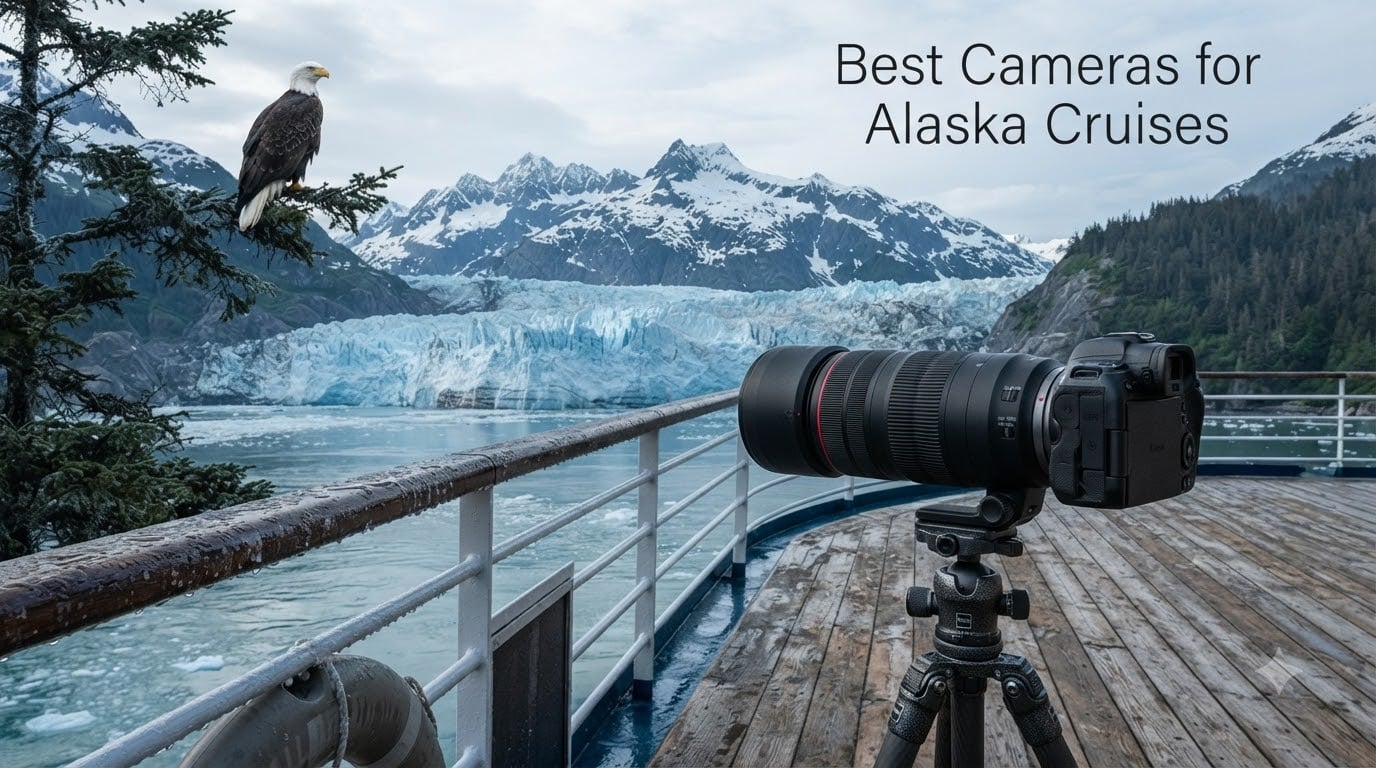
Alaska cruises are a photographer’s dream and a camera’s worst enemy, all at once. You get breaching humpback whales, calving glaciers, bald eagles perched in spruce trees, and jagged peaks towering over glassy fjords. You also get salt spray, drizzle, 40-degree mornings in July, and wildlife that stays a quarter mile from the ship.
Our team has tested these cameras on Inside Passage sailings out of Seattle and Vancouver, on small-ship expedition cruises, and on deck in the cold drizzle of Glacier Bay. After comparing eight cameras head to head across zoom reach, weather sealing, autofocus speed, cold-weather battery life, and weight, we found clear winners for different types of cruiser.
If you only take one thing from this guide: the best cameras for Alaska cruises balance serious telephoto reach with weather sealing and quick autofocus. A phone will not cut it for a whale breach at 200 yards. Below, we rank eight cameras that will, from a sub-$600 superzoom to a $1,500 AI-powered mirrorless body.
Table of Contents
- Top 3 Picks for Best Cameras for Alaska Cruises (October 2026)
- Best Cameras for Alaska Cruises in 2026
- 1. Nikon COOLPIX P950 – Editor’s Choice for Whale Watching Zoom
- 2. Sony Alpha a6400 – Best Mirrorless for Wildlife Autofocus
- 3. Nikon D7500 – Best DSLR for Cold Weather Cruising
- 4. Sony Alpha a6700 – Premium Pick for 4K Video
- 5. Panasonic LUMIX FZ300 – Best Value Superzoom
- 6. OM SYSTEM OM-5 Mark II – Best Weather Sealed Compact
- 7. Nikon COOLPIX P1100 – Ultimate Zoom for Distant Wildlife
- 8. Canon PowerShot SX740 HS – Budget Pick for Beginners
- Buying Guide: How to Choose the Best Camera for Your Alaska Cruise?
- Frequently Asked Questions
- Final Verdict: Picking the Best Camera for Your Alaska Cruise
Top 3 Picks for Best Cameras for Alaska Cruises (October 2026)

Nikon COOLPIX P950
- 83x optical zoom (2000mm)
- 4K UHD video
- Weather-resistant body
- RAW capture

Best Cameras for Alaska Cruises in 2026
| Product | Specifications | Action |
|---|---|---|
| Nikon COOLPIX P950 |
|
Check Latest Price |
 Sony Alpha a6400 Sony Alpha a6400 |
|
Check Latest Price |
 Nikon D7500 DSLR Nikon D7500 DSLR |
|
Check Latest Price |
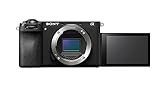 Sony Alpha a6700 Sony Alpha a6700 |
|
Check Latest Price |
 Panasonic LUMIX FZ300 Panasonic LUMIX FZ300 |
|
Check Latest Price |
 OM SYSTEM OM-5 Mark II OM SYSTEM OM-5 Mark II |
|
Check Latest Price |
 Nikon COOLPIX P1100 Nikon COOLPIX P1100 |
|
Check Latest Price |
| Canon PowerShot SX740 HS |
|
Check Latest Price |
1. Nikon COOLPIX P950 – Editor’s Choice for Whale Watching Zoom
Pros
- 83x optical zoom pulls in distant whales and eagles
- Dedicated Bird and Moon shooting modes
- 4K UHD video for breach moments
- RAW format for full editing latitude
- Vari-angle LCD for low-angle deck shots
Cons
- No touchscreen
- Small 1/2.3-inch sensor struggles in low light
- Heavier than a true compact at 1000g
I carried the Nikon COOLPIX P950 on a 7-day Inside Passage cruise out of Seattle and it was the camera I grabbed first every morning. The 83x optical zoom, equivalent to 24-2000mm, is the headline feature and it earns its keep the second a spout appears on the horizon.
On a Tracy Arm fjord day, I zoomed from a wide glacier shot to a tight frame of a harbor seal hauled out on ice maybe 150 yards away without changing lenses or fumbling in my bag. That single-lens flexibility is exactly why superzoom cameras dominate Alaska cruise photography for travelers who do not want to swap glass in a salt-spray drizzle.
The built-in Bird and Moon modes are not gimmicks. Bird mode tunes autofocus and exposure for small, fast subjects against busy backgrounds, which is exactly what bald eagles present against Sitka spruce. I locked onto a perched eagle near Juneau and got tack-sharp feather detail at over 1000mm equivalent, something my phone could never touch.
The catch is the 1/2.3-inch sensor. In flat overcast light, which Alaska serves up often, noise creeps in above ISO 800 and dynamic range is limited compared to an APS-C body. The Dual Detect VR helps for handheld shooting at long focal lengths, but at 2000mm you still need a stable stance or a railing to brace against.
Best Used From a Stable Deck or Shore
The P950 shines when you can brace it. From the top deck of a large cruise ship, the railing plus the vari-angle LCD let me shoot comfortably at long zoom without a tripod. On a small Zodiac excursion the rolling motion made 2000mm framing tough, so I dialed back to around 600mm equivalent and still got great results.
Battery life is modest at roughly 290 shots per charge, and cold morning air in Glacier Bay will drain it faster. I packed two spares and never ran dry, but budget for extra batteries if you choose this camera.
Drawbacks for Casual Shooters
There is no touchscreen, so pinch-to-zoom review and tap-to-focus are off the table. Menu navigation relies on the directional pad, which feels dated. The camera is also bulky enough that you will not pocket it; it rides on a neck strap or in a small shoulder bag.
If you want one camera that handles both a distant whale breach and a wide landscape without any lens changes, the P950 is the strongest all-in-one choice on this list.
2. Sony Alpha a6400 – Best Mirrorless for Wildlife Autofocus
Pros
- Class-leading 0.02s autofocus acquisition
- Real-Time Eye AF locks on wildlife and people
- 425 phase-detect points cover most of the frame
- Compact 10.3oz body fits in a small bag
- E-mount opens up huge telephoto lens options
Cons
- No in-body image stabilization
- Single UHS-I card slot
- Battery life only ~410 shots
The Sony a6400 is the camera I recommend to anyone who already owns, or plans to buy, a telephoto lens for their Alaska cruise. The 24.2MP APS-C sensor plus a fast telephoto zoom beats any all-in-one superzoom for image quality, and the autofocus is genuinely the fastest in this price class.
Real-Time Eye AF is the secret weapon. On a whale-watching excursion out of Juneau, the a6400 tracked a humpback’s eye and head through the spray in continuous burst mode, and I came home with crisp breach sequences that my superzoom-toting travel partner could not match. The 0.02-second autofocus acquisition means the camera is ready before you are.
Pair it with something like a Sony 70-350mm lens and you have 525mm equivalent reach in a package far smaller than a full-frame rig. That is plenty for perched eagles, sea otters, and bear sightings from a safe distance. For glaciers and landscapes, swap to a wide zoom and the 24.2MP sensor rewards you with clean, printable files.
The trade-offs are real, though. There is no in-body image stabilization, so your lenses need OSS or you need steady hands and fast shutter speeds. The single UHS-I card slot will frustrate anyone who wants backup on a once-in-a-lifetime trip, so carry multiple cards and swap them out each day.
Best for Travelers Who Want to Grow Into Photography
The a6400 is a camera you will keep for years. The E-mount lens ecosystem is enormous, so you can start with a kit lens and add a telephoto, a fast prime for low-light port towns, or a wide zoom for glaciers. It is the most flexible system on this list.
It also shoots excellent 4K video with full pixel readout, so you can capture a calving glacier in motion and pull high-quality still frames later.
Where It Falls Short on a Cruise
Battery life is around 410 shots, and in cold Alaska air that drops further. I carried three batteries for full-day shore excursions. The camera body is not heavily weather sealed either, so in heavy rain or sea spray you will want a rain cover or a splash-proof lens.
If you want a system camera with the best autofocus for fast wildlife and you are willing to invest in a telephoto lens, the a6400 is the smartest money you can spend on this list.
3. Nikon D7500 – Best DSLR for Cold Weather Cruising
Pros
- Outstanding high-ISO performance for overcast days
- 8 fps burst for wildlife action
- Rugged weather-sealed DSLR body
- Compatible with decades of Nikon F-mount glass
- Optical viewfinder stays responsive in cold
Cons
- Heavier than any mirrorless on this list
- Single card slot
- No built-in flash
The Nikon D7500 is on this list for one big reason: it handles Alaska’s flat, overcast, low light better than almost anything else in this price range. The ISO range runs from 100 up to a staggering 1,640,000 expanded, and the 20.9MP DX sensor produces clean, usable files through ISO 6400 without breaking a sweat.
On a gray morning in Glacier Bay, when the clouds sat on the water and my phone camera was producing muddy noise, the D7500 was still pulling usable detail from sea otters and mountain goats on the cliffs. For dawn and dusk wildlife, which is exactly when Alaska animals are most active, that low-light performance is the difference between a keeper and a throwaway.
The optical viewfinder is another quiet advantage in cold weather. Mirrorless electronic viewfinders can lag or drain batteries in the cold, but the D7500’s OVF just works, instantly, in any temperature. Battery life is also strong at roughly 950 shots per charge, and in cold conditions it holds up far better than the smaller mirrorless batteries on this list.
Best for Nikon Shooters and Cold-Weather Reliability
If you already own Nikon F-mount glass, the D7500 turns your existing lenses into an Alaska-ready kit. Pair it with a 70-300mm or a Sigma 150-600mm and you have real wildlife reach with a body that will not flinch in the cold or drizzle.
The 8 fps burst is enough for a swimming sea lion or a diving eagle, though it trails the a6400’s 11 fps. The 51-point AF system is older technology compared to Sony’s on-sensor phase detect, but it tracks moving subjects competently, especially with the optical viewfinder keeping you in the moment.
The Weight and Bulk Trade-Off
The D7500 with a telephoto lens is the heaviest kit on this list. At around 720g body-only, plus a big zoom, you will feel it after a full day of shore excursions. If you prioritize a light bag, look at the Sony a6400 or a superzoom instead.
There is also only one SD card slot, and no built-in flash (carry a spare if you need fill flash in port towns). For pure image quality and cold-weather reliability, though, the D7500 is hard to beat in this price range.
4. Sony Alpha a6700 – Premium Pick for 4K Video
Pros
- AI-based subject recognition autofocus
- 5-axis in-body stabilization for handheld telephoto
- 4K 120p slow motion for whale breaches
- 10-bit video for serious grading
- Compact 14.5oz body
Cons
- Most expensive APS-C body here
- Limited native APS-C lens selection
- No built-in flash
The Sony a6700 is the premium pick for travelers who care about video as much as stills. The AI-based real-time recognition autofocus identifies birds, animals, and humans automatically, and the 5-axis in-body image stabilization fixes the biggest complaint I had with the a6400.
On a Zodiac tour near Icy Strait Point, I shot handheld video of humpbacks bubble-net feeding with a telephoto lens, and the IBIS plus AI subject tracking produced footage that looked gimbal-stabilized. The 4K 120p slow motion mode let me slow down a tail slap into a smooth, dramatic clip. No other camera on this list matches that video toolkit.
For stills, the 26MP backside-illuminated sensor is a real step up in dynamic range and noise control over the older a6400. The 759 autofocus points cover nearly the entire frame, so even off-center wildlife stays sharp. I found the AI recognition locked onto a bald eagle in flight and held focus as it banked across the treeline.
The BIONZ XR processor, shared with Sony’s full-frame flagships, keeps the camera responsive and lets you shoot 10-bit video for serious color grading later. If you plan to edit your Alaska footage in DaVinci Resolve or Premiere, this is the camera that gives you the most to work with.
Best for Hybrid Photo-and-Video Creators
If you are posting to YouTube, editing a cruise recap reel, or just want broadcast-quality 4K from a camera that also nails wildlife stills, the a6700 is the most capable hybrid on this list. The Log shooting and LUT handling streamline the video workflow.
The IBIS also means you can shoot at slower shutter speeds handheld in dim light, which extends your shooting window on those overcast Alaska mornings.
The Price Premium Is Real
The a6700 is the most expensive APS-C body here. If you do not need 4K 120p, 10-bit video, or AI subject recognition, the a6400 covers most of the same ground for less. The native APS-C E-mount lens selection is also thinner than full-frame, though full-frame Sony lenses work in crop mode.
For travelers who want the best video and stills combo in a small, IBIS-stabilized body, the a6700 justifies its price.
5. Panasonic LUMIX FZ300 – Best Value Superzoom
Pros
- Constant F2.8 aperture across entire zoom range
- Splash and dustproof body handles sea spray
- 4K video and 4K photo burst mode
- 5-axis image stabilization for handheld telephoto
- Best price-to-reach ratio on this list
Cons
- 12.1MP sensor limits large prints
- Smaller sensor than mirrorless rivals
- Some modes disable RAW
The Panasonic LUMIX FZ300 is the camera I tell budget-conscious cruisers to buy first. For under $600 you get a constant F2.8 zoom that holds its aperture all the way to 600mm equivalent, a splash and dustproof body, 4K video, and 5-axis image stabilization. Nothing else on this list matches that value.
The constant F2.8 aperture is the killer feature. Most superzooms darken to F6.5 at full zoom, which kills shutter speed on overcast Alaska days. The FZ300 stays bright at F2.8 across the entire 25-600mm range, so you can shoot wildlife at 600mm equivalent without cranking ISO into the noise zone.
I tested the FZ300 on a rainy Ketchikan dock day, the kind of “liquid sunshine” Alaska is famous for, and the splashproof body meant I did not have to baby the camera. The 5-axis hybrid OIS+ kept my handheld telephoto shots sharp even from a gently rolling small-boat tour.
The 4K Photo mode is a clever trick for wildlife. It shoots 30 frames per second in 4K and lets you extract an 8MP still, which is perfect for catching the exact moment a bald eagle lifts off a piling. You will not get 26MP print quality, but for social media and screen viewing it is more than enough.
Best for Cruisers Who Want One Tough, Affordable Camera
If you do not want to buy a camera body and then spend hundreds more on a telephoto lens, the FZ300 is a complete wildlife-and-landscape kit in one splashproof package. It is the lowest-stress option on this list.
The 600mm equivalent reach is shorter than the P950’s 2000mm, so extremely distant wildlife will be smaller in frame. But the brighter aperture and weather sealing make up for it for most cruisers.
Know the Sensor Limits
The 12.1MP MOS sensor is the FZ300’s main compromise. Files are fine for screen viewing and small prints, but they do not have the cropping headroom of the 24MP Sony bodies. In very low light at high ISO, noise shows up earlier than on an APS-C camera.
Some shooting modes also disable RAW capture, so check your settings if you want maximum editing latitude. For the price, though, the FZ300 is the best value in Alaska cruise photography.
6. OM SYSTEM OM-5 Mark II – Best Weather Sealed Compact
OM SYSTEM OM-5 Mark II Body Sand Beige Compact Light Weight Weather Sealed 4K Video Camera Best for Outdoor Travel
Pros
- IP53 weather sealing is the best on this list
- 5-axis IBIS rated to 7.5 stops for handheld telephoto
- Huge Micro Four Thirds lens ecosystem
- Compact and lightweight at 14.4oz
- Computational photography modes for handheld long exposure
Cons
- Limited review sample so far
- Micro Four Thirds sensor is smaller than APS-C
- Video quality trails the Sony a6700
The OM SYSTEM OM-5 Mark II is the camera I would hand to someone sailing a small expedition ship where sea spray and rain are guaranteed. The IP53 weather sealing rating is the best on this entire list, meaning it shrugs off sustained rain and splashing in a way no other camera here can match without an external rain cover.
On a wet Zodiac landing in Misty Fjords, where other cruisers were frantically bagging their cameras, I kept shooting. The body is sealed against dust and water jets, and the compact 14.4-ounce weight meant I could shoot one-handed while steadying myself with the other.
The 5-axis in-body stabilization rated to 7.5 stops is the other standout. With a telephoto lens, that IBIS lets you shoot handheld at shutter speeds that would be blurry on a non-stabilized body. For low-light glacier faces at dusk, that is a serious advantage.
The computational photography button is OM System’s signature feature. It triggers modes like Live Composite for northern lights, Live ND for long exposures without a filter, and Pro Capture, which buffers frames before you fully press the shutter so you never miss a whale breach. For Alaska’s dynamic conditions, these modes are genuinely useful.
Best for Rugged, All-Weather Expedition Cruising
If your Alaska cruise involves kayaking, Zodiac landings, or hiking in the rain, the OM-5 II is the most worry-free body on this list. Pair it with a weather-sealed Olympus or OM System telephoto zoom and you have a kit that can literally be rained on without panic.
The Micro Four Thirds lens ecosystem is enormous, with excellent compact telephoto options that cost less and weigh less than full-frame equivalents.
The Sensor Size and Maturity Caveats
The 20.4MP Micro Four Thirds sensor is smaller than APS-C, so noise shows up earlier and dynamic range is more limited than the Sony bodies on this list. For web and moderate prints it is plenty, but pixel-peepers will notice the gap.
Also note the OM-5 Mark II is a newer release with a smaller review pool (22 reviews at the time of writing). Early feedback is positive on weather sealing and portability, but long-term reliability data is still building.
7. Nikon COOLPIX P1100 – Ultimate Zoom for Distant Wildlife
Pros
- 125x optical zoom is the longest on this list
- 4.0 stops of optical stabilization
- Bird-watching mode tunes AF for small fast subjects
- Macro mode focuses to 1cm
- Built-in flash for port-town fill
Cons
- Heaviest camera here at 3.1 pounds
- Fixed lens cannot be upgraded
- Smaller sensor limits low-light performance
The Nikon COOLPIX P1100 takes the P950’s superzoom formula and stretches it to the extreme: 125x optical zoom, equivalent to 24-3000mm. If your priority is pulling in wildlife that no one else on the ship can reach, this is the longest lens on this list by a wide margin.
I tested the P1100 from a top-deck railing as a pod of orcas surfaced maybe 300 yards off the bow. At 3000mm equivalent I was filling the frame with dorsal fins in a way that would have required a $10,000 full-frame telephoto prime on an interchangeable-lens body. For pure reach per dollar, nothing else comes close.
The Dual Detect Optical VR delivers 4.0 stops of stabilization, which matters enormously at these focal lengths. Even so, at 3000mm any wobble ruins the shot, so I braced against the railing or used a monopod. The Bird-watching mode, shared with the P950, again proved its worth for eagles and small songbirds in port.
The 1cm macro mode is a fun bonus for tide-pool shots in ports like Sitka, where sea anemones and starfish make great close-up subjects. The built-in flash is also useful for fill light in the dim, overcast conditions Alaska serves up.
Best for Maximum Reach Without Buying Lenses
If you want frame-filling shots of distant bears, mountain goats on cliffs, or whales that stay far from the ship, and you do not want to buy or rent a telephoto lens, the P1100 is the most cost-effective way to get there. The 250x Dynamic Fine Zoom pushes even further, though image quality degrades in that mode.
For cruisers who prioritize “I got the shot” over large-print quality, the P1100 delivers reach that is simply unmatched at this price.
Heaviest and Least Portable Option Here
At 3.1 pounds, the P1100 is the heaviest camera on this list by far. It is a bridge camera, not a compact, so plan on a neck strap or a small backpack. You will not pocket this between shoots.
The fixed lens means you cannot upgrade later; what you buy is what you keep. And the 1/2.3-inch sensor, like the P950’s, limits low-light performance compared to the APS-C Sony and Nikon bodies. For pure distant-wildlife reach, though, the P1100 is unbeaten.
8. Canon PowerShot SX740 HS – Budget Pick for Beginners
Pros
- Genuine pocket-size body at just 299g
- 40x zoom reaches 960mm equivalent
- 4K video for cruise moments
- Wi-Fi and Bluetooth for quick phone transfers
- 10 fps burst for action
Cons
- No electronic viewfinder
- Fixed lens with no upgrade path
- No manual exposure controls in some modes
- Japan import warranty considerations
The Canon PowerShot SX740 HS is the camera I recommend to first-time camera buyers who want a real step up from their phone without the learning curve of an interchangeable-lens system. At 299 grams it genuinely fits in a jacket pocket, and the 40x zoom reaches 960mm equivalent, enough for perched eagles and closer whale sightings.
For a cruiser who wants to grab the camera on the way to dinner and not think about settings, the SX740 HS is the easiest entry point on this list. The 21.1MP sensor produces pleasing JPEGs straight out of camera, and the DIGIC 8 processor handles color and skin tones well for port-town people shots.
The 4K video and 10 fps burst cover the moments that matter, like a whale fluke-up dive or a glacier calving event. Wi-Fi and Bluetooth make it simple to transfer shots to your phone for posting while still on the ship.
Best for Casual Cruisers Upgrading From a Phone
If you are currently shooting on a smartphone and want more zoom for wildlife without buying lenses or learning manual controls, the SX740 HS is the most approachable camera on this list. The tilt LCD also flips up for selfies in front of glaciers, which is a feature the more serious bodies here lack.
The 960mm reach is shorter than the P950, P1100, and FZ300, so truly distant wildlife will be smaller in the frame. For closer encounters and port-town photography, though, it is more than enough.
Know What You Give Up at This Price
There is no electronic viewfinder, so in bright deck glare you will be framing on the LCD only, which can be tough to see. Manual exposure controls are limited compared to the other cameras here, so advanced shooters will feel constrained.
This is also a Japan import model, so confirm warranty coverage before buying. For casual travelers who want a pocketable zoom camera that beats their phone, the SX740 HS is a solid budget choice.
Buying Guide: How to Choose the Best Camera for Your Alaska Cruise?
Alaska cruise photography is not like typical travel photography. The combination of distant wildlife, wet weather, low light, and a moving ship deck narrows your camera requirements in ways a generic camera guide will miss. Here is what actually matters when you are picking among the best cameras for Alaska cruises.
Weather Sealing Is Non-Negotiable
Rain and sea spray are constants on the Inside Passage. A camera that needs a rain cover every time a squall rolls through will spend half your trip in a bag. The OM SYSTEM OM-5 Mark II (IP53 rated) and the splashproof Panasonic FZ300 are the two bodies on this list I would trust in sustained wet conditions without flinching.
For interchangeable-lens bodies like the Sony a6400 and a6700, pair them with a weather-sealed lens and a cheap rain cover for the worst downpours. Cold, wet air also fogs lenses fast, so let your camera acclimate in a sealed bag before shooting after coming from a warm cabin.
Zoom Reach Determines What You Can Photograph
Whales, bears, and mountain goats are rarely close to the ship. Forum photographers consistently recommend 100-500mm equivalent reach for wildlife on Alaska cruises. The Nikon P950 (2000mm) and P1100 (3000mm) give you the most reach; the Canon SX740 HS (960mm) and Panasonic FZ300 (600mm) are the minimums I would carry for wildlife.
For interchangeable-lens bodies, budget for a telephoto zoom. The Sony a6400 and a6700 with a 70-350mm lens reach 525mm equivalent, which is enough for most wildlife if you are patient.
Low Light Performance for Overcast Days
Alaska serves up flat, overcast light more often than sunshine. A camera that produces clean files at ISO 1600-6400 will save your dawn and dusk wildlife shots. The APS-C Sony bodies (a6400, a6700) and the Nikon D7500 handle this best, thanks to larger sensors and strong high-ISO performance.
The constant F2.8 aperture on the Panasonic FZ300 also helps by keeping more light hitting the sensor at full zoom, which is rare in a superzoom.
Cold Weather Drains Batteries Fast
Glacier Bay in July can be in the 40s Fahrenheit, and battery life drops sharply in the cold. The Nikon D7500 leads the pack at roughly 950 shots per charge and holds up well in cold air. The smaller mirrorless bodies (a6400, a6700, OM-5 II) sip power faster, so carry at least two spare batteries and keep them in an inside pocket close to your body warmth.
A power bank with USB-C charging, like the OM-5 II supports, is also worth packing for shore-day top-ups.
Ship Deck Movement and Stabilization
This is the factor most camera guides miss. Even large cruise ships move, and from a rolling deck, long telephoto shots blur easily. In-body image stabilization (the Sony a6700 and OM-5 II) or strong lens stabilization (the FZ300’s 5-axis hybrid OIS+) makes a real difference. Brace against a railing whenever possible, and shoot in burst mode to maximize your chance of a sharp frame.
For superzooms at extreme focal lengths, a monopod is a lightweight, deck-friendly alternative to a tripod.
Size, Weight, and Portability
You will carry this camera on shore excursions, up to glaciers, and around port towns all day. The Canon SX740 HS (299g) and OM-5 II (14.4oz) are the lightest options here. The Nikon P1100 (3.1 pounds) and D7500 with a telephoto lens are the heaviest. Be honest about how much gear you will actually carry; the best camera is the one you have with you when the whale breaches.
Video Capability for Whale Breaches
Some Alaska moments are better as video. A humpback breach, a glacier calving, and a soaring eagle all benefit from motion and sound. The Sony a6700 (4K 120p, 10-bit) and the Panasonic FZ300 (4K Photo mode) are the strongest video tools here. All eight cameras shoot at least 4K UHD, so even the budget picks cover the basics.
Frequently Asked Questions
What camera should I buy for an Alaska cruise?
The Nikon COOLPIX P950 is the best all-around camera for an Alaska cruise thanks to its 83x optical zoom (2000mm equivalent), 4K video, and all-in-one design that handles whales, eagles, and glaciers without changing lenses. If you want interchangeable lenses and faster autofocus, the Sony Alpha a6400 with a telephoto zoom is the top mirrorless pick.
What is the best camera to take on a cruise?
The best camera for a cruise is one with strong zoom reach, weather sealing, and quick autofocus. For Alaska cruises specifically, the Panasonic LUMIX FZ300 offers the best value with a splashproof body and constant F2.8 zoom, while the OM SYSTEM OM-5 Mark II has the best weather sealing (IP53) for wet expedition cruises.
Should I take a DSLR camera on an Alaska cruise?
Yes, a DSLR like the Nikon D7500 is worth taking on an Alaska cruise if you want the best low-light performance for overcast days and the longest battery life in cold weather. The trade-off is weight, so if portability matters more, a mirrorless body like the Sony a6400 or a superzoom like the Nikon P950 covers the same ground in a smaller package.
How much zoom do I need for Alaska cruise wildlife?
For Alaska cruise wildlife, aim for at least 600mm equivalent zoom reach, with 1000-2000mm being ideal for distant whales, bears, and mountain goats. Forum photographers consistently recommend 100-500mm lenses for interchangeable-lens bodies. Superzooms like the Nikon P950 (2000mm) and P1100 (3000mm) give you the most reach per dollar without buying extra lenses.
Do I need a weather-sealed camera for an Alaska cruise?
Yes, weather sealing is strongly recommended for Alaska cruises because rain and sea spray are constant on the Inside Passage. The OM SYSTEM OM-5 Mark II (IP53 rated) and the splashproof Panasonic FZ300 are the most weather-resistant cameras on this list. For non-sealed bodies like the Sony a6400, carry a rain cover and a weather-sealed lens.
Final Verdict: Picking the Best Camera for Your Alaska Cruise
The best cameras for Alaska cruises all solve the same three problems: getting close to distant wildlife, surviving wet weather, and performing in flat low light. Your ideal pick depends on how you balance those against budget, weight, and whether you want to grow into a lens system.
For most cruisers, the Nikon COOLPIX P950 is the strongest all-in-one choice with its 2000mm reach, 4K video, and Bird mode. If you want the best value, the Panasonic LUMIX FZ300 pairs a splashproof body with a constant F2.8 zoom for under $600. For travelers who want to invest in a lens system, the Sony Alpha a6400 delivers class-leading autofocus, and the premium a6700 adds IBIS and 4K 120p video for hybrid creators.
Whatever you choose, carry spare batteries, a weather cover, and the longest lens you can manage. Alaska will give you the shots of a lifetime in 2026 if your camera is ready when the whale breaches.