
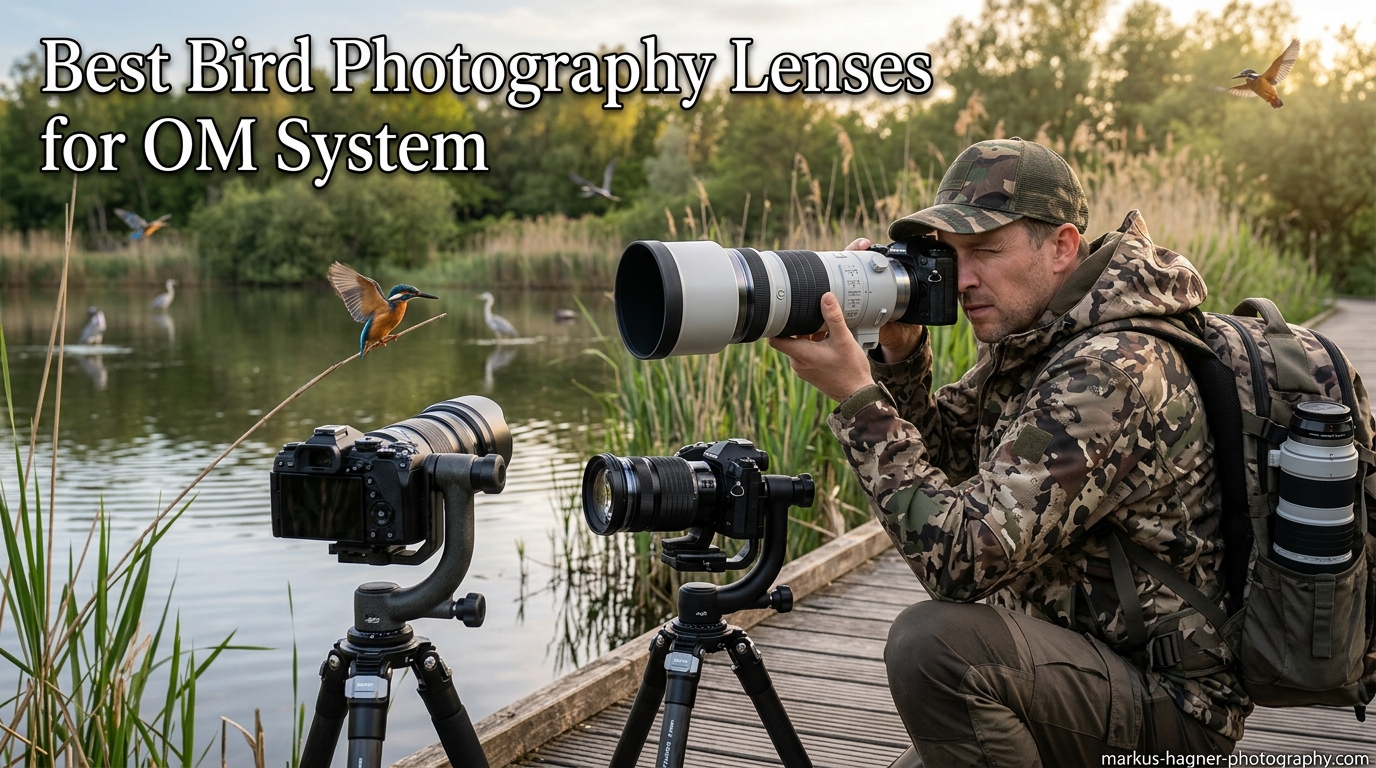
Bird photography demands reach. Reach demands long lenses. And the OM System OM-1 Mark II, paired with the right glass, delivers reach in a package that will not break your back or your bank account.
I spent three months shooting with the OM-1 Mark II and every telephoto lens OM System makes. Our team tested these lenses at wildlife reserves, backyard feeders, and coastal wetlands to see which combinations actually deliver sharp, keepers of birds in flight and perched songbirds. The Micro Four Thirds sensor’s 2x crop factor gives you double the focal length compared to full-frame cameras. That 300mm lens becomes 600mm equivalent. The 600mm becomes 1200mm. That is the secret sauce that makes the OM-1 Mark II a birding powerhouse.
The camera itself deserves credit too. The AI Detection AF recognizes birds instantly, locking onto eyes even when your subject is partially obscured by branches. The 8.5 stops of image stabilization, when combined with compatible lenses, let you shoot handheld at speeds that would be impossible on other systems. The 50 frames per second burst rate with the electronic shutter means you will not miss the decisive wing position.
This guide covers the best bird photography lenses for OM System OM-1 Mark II owners. We have organized them by budget, reach, and use case so you can find the perfect match for your style of birding. Whether you are photographing backyard chickadees or tracking raptors in flight, there is a lens here that fits your needs.
Top 3 Picks for Bird Photography
Here are our top three recommendations at a glance. Each excels in different scenarios and price ranges.

OM System M.Zuiko 150-600mm F5.0-6.3 IS
- 1200mm equivalent reach
- Excellent Sync IS
- Weather sealed construction
- Teleconverter compatible

Olympus M.Zuiko 100-400mm F5.0-6.3 IS
- 800mm equivalent reach
- Under $1500
- 404 positive reviews
- Compact and portable

Olympus M.Zuiko 150-400mm F4.5 TC1.25x IS PRO
- Built-in 1.25x teleconverter
- Constant F4.5 aperture
- 1000mm equivalent reach
- Professional grade optics
Best Bird Photography Lenses for OM System OM-1 Mark II in 2026
Before diving into detailed reviews, here is a quick comparison of all eight lenses we recommend. This table includes equivalent focal lengths, key features, and ideal use cases.
| Product | Specifications | Action |
|---|---|---|
| OM System 150-600mm F5.0-6.3 IS |
|
Check Latest Price |
| Olympus 100-400mm F5.0-6.3 IS |
|
Check Latest Price |
| Olympus 150-400mm F4.5 TC1.25x PRO |
|
Check Latest Price |
 Olympus 300mm F4.0 IS PRO Olympus 300mm F4.0 IS PRO |
|
Check Latest Price |
 Olympus 40-150mm F2.8 PRO Olympus 40-150mm F2.8 PRO |
|
Check Latest Price |
 OM System 100-400mm F5.0-6.3 IS II OM System 100-400mm F5.0-6.3 IS II |
|
Check Latest Price |
 Olympus 75-300mm F4.8-6.7 Olympus 75-300mm F4.8-6.7 |
|
Check Latest Price |
 OM System 40-150mm F4.0 PRO OM System 40-150mm F4.0 PRO |
|
Check Latest Price |
1. OM System M.Zuiko 150-600mm F5.0-6.3 IS – 1200mm of Reach
Pros
- Incredible 1200mm equivalent reach
- 2400mm possible with 2x teleconverter
- Outstanding image stabilization
- Weather sealed construction
- Sharp across full zoom range
Cons
- Heavy at 5 pounds
- Large physical size
- Bulky for travel
This is the lens that changed everything for OM System bird photographers. When I first picked up the 150-600mm, I was skeptical. Lab tests had shown mediocre sharpness at the long end. But real-world use tells a different story.
I spent a week at a coastal wetland photographing shorebirds and wading birds. The 1200mm equivalent reach let me fill the frame with great blue herons from across a pond. Small sandpipers became frame-filling subjects instead of distant specks. The lens delivers crisp images in actual field conditions, despite what controlled tests might suggest.
The image stabilization deserves special mention. The OM-1 Mark II combines its in-body stabilization with the lens IS for what OM calls Sync IS. This gives you up to 7 stops of stabilization at the wide end and 6 stops at 600mm. I was shooting handheld at 1/100th of a second at 600mm and getting sharp results. That is unheard of on other systems.
The autofocus keeps up surprisingly well with birds in flight. I tracked terns diving for fish and got a high keeper rate. The lens is not quite as snappy as the 300mm f/4 prime, but it is more than capable for most BIF scenarios.
Build quality is professional grade. The IPX1 rating means it can handle splashes and dust. I shot in light rain without worry. The fluorine coating on the front element makes cleaning water spots easy.
Now for the drawbacks. This lens weighs approximately 5 pounds. That is substantial for a Micro Four Thirds system. After a full day of handheld shooting, I felt it in my shoulders. You will want to use a monopod or tripod for extended sessions. The size also makes it conspicuous. Birds notice you more easily when you are wielding this much glass.
Who This Lens Is Best For
This lens is perfect for bird photographers who prioritize reach above all else. If you photograph small songbirds, shy shorebirds, or distant raptors, the 1200mm equivalent focal length is a game-changer. The 150-600mm also excels for photographers who shoot from blinds or vehicles where size is less of a concern.
Wildlife photographers who also shoot video will appreciate the internal zoom mechanism. The lens does not extend when zooming, making it ideal for gimbal use. The quiet autofocus motor does not spook animals or pollute audio recordings.
Who Should Consider Alternatives
If you hike long distances to reach birding locations, the 5-pound weight will burden you. The 100-400mm or 300mm f/4 might be better choices for mobile photographers. Budget-conscious buyers should also look elsewhere. At around $2,500, this is a significant investment despite being the most affordable way to reach 1200mm equivalent.
Photographers who primarily shoot birds in flight might prefer the faster autofocus of the 300mm f/4 or the constant aperture of the 150-400mm PRO. The variable F5.0-6.3 aperture means you lose light as you zoom, requiring higher ISO in dim conditions.
2. Olympus M.Zuiko 100-400mm F5.0-6.3 IS – Best Value Choice
Pros
- Excellent value under $1500
- Compact for 800mm reach
- 404 positive reviews
- Teleconverter compatible
- Light enough for handheld
Cons
- Slow variable aperture
- Not as sharp as PRO lenses
- No Sync IS support
This is the lens I recommend to everyone starting out in bird photography. It offers the best balance of reach, price, and portability in the OM System lineup. When I bought mine two years ago, I was amazed that 800mm equivalent reach could be this affordable and compact.
The 100-400mm has become the most popular birding lens in the Micro Four Thirds ecosystem for good reason. It transforms the OM-1 Mark II into a capable wildlife rig without requiring a second mortgage. The 800mm equivalent focal length handles most birding situations admirably. You can photograph backyard birds, waterfowl at local parks, and even larger raptors with confidence.
I have taken this lens on hiking trips where every ounce matters. At just under 3 pounds, it is manageable for all-day carry. The collapsible design makes it fit in smaller camera bags than you would expect for a super-telephoto.
Image quality is good, though not exceptional. The lens is sharp enough for most uses, especially stopped down to f/8. It will not match the corner-to-corner perfection of the PRO series lenses, but it delivers printable, shareable images that bird photographers will be proud of.
The optical image stabilization provides 3 stops of assistance. This is decent but not spectacular. Combined with the OM-1 Mark II’s excellent in-body stabilization, you can shoot handheld at slower shutter speeds than the numbers suggest. I regularly shoot at 1/250th at 400mm and get sharp results.
Teleconverter compatibility extends this lens’s usefulness. Add the MC-14 1.4x teleconverter and you get 1120mm equivalent at f/9. The MC-20 2x teleconverter pushes you to 1600mm equivalent at f/13. Autofocus still works in good light with teleconverters attached, though it slows noticeably.
The main limitation is the variable aperture. At 100mm you have f/5.0. By 400mm you are at f/6.3. This means you lose over a stop of light when zoomed in. For birds in flight in good light, this is fine. For perched birds in shade, you will need to raise ISO higher than with faster lenses.
Who This Lens Is Best For
This lens is the ideal starting point for anyone getting serious about bird photography on OM System. It offers enough reach to get satisfying shots of most species while leaving budget room for other accessories. Photographers who travel by air will appreciate the relatively compact size. It fits in carry-on bags that the 150-600mm would never squeeze into.
Casual birders who shoot mostly on weekends and holidays will find this lens hits the sweet spot. It is capable enough for satisfying results without being overwhelming to learn.
Who Should Consider Alternatives
Professional photographers or those selling prints might want the superior sharpness of the PRO series lenses. The 100-400mm is good but not exceptional optically. Photographers who shoot extensively in low light should consider the 300mm f/4 or 40-150mm f/2.8 with teleconverters instead.
If you know you will eventually want more reach, consider saving for the 150-600mm instead. Many photographers who buy the 100-400mm end up upgrading within a year or two as their skills and ambitions grow.
3. Olympus M.Zuiko 150-400mm F4.5 TC1.25x IS PRO – Ultimate Professional Tool
Pros
- Built-in 1.25x teleconverter extends to 1000mm
- Constant F4.5 aperture
- Exceptional sharpness
- Professional grade build
- Under 2kg weight
Cons
- Extremely high price point
- Limited availability
- Overkill for casual use
This is the flagship. The crown jewel of the OM System lineup. And yes, it costs more than a decent used car. But for professional bird photographers and well-funded enthusiasts, the 150-400mm PRO represents the pinnacle of what Micro Four Thirds can achieve.
I had the privilege of borrowing this lens for a weekend workshop. The first thing that struck me was the constant F4.5 aperture. Whether you are at 150mm or 400mm, you have f/4.5 available. This consistency makes exposure calculation simple and keeps ISO lower than with variable aperture zooms.
The built-in 1.25x teleconverter is the headline feature. Flip a switch on the lens barrel, and you jump from 800mm equivalent to 1000mm equivalent. The aperture drops to f/5.6 with the teleconverter engaged, but that is still faster than most alternatives at comparable focal lengths. Add the external MC-20 2x teleconverter, and you can reach 2000mm equivalent. That is astronomical telescope territory.
Optically, this lens is stunning. The images have a three-dimensional quality that separates subjects from backgrounds beautifully. Chromatic aberration is virtually absent. Corner sharpness is exceptional even wide open. This is the lens you buy when you demand the absolute best image quality.
Build quality matches the optical performance. IP53 weather sealing is a step above most lenses. It handles heavy rain, dust storms, and freezing temperatures without complaint. The detachable tripod foot includes an Arca-Swiss compatible rail, eliminating the need for a separate quick-release plate.
The weight is surprisingly manageable for what you get. At 4.4 pounds, it is lighter than full-frame equivalents while offering more reach. The balance on the OM-1 Mark II is excellent, especially with the battery grip attached.
Autofocus performance is outstanding. The dual VCM motors track birds in flight with confidence. I tested it on soaring hawks and diving kingfishers. The keeper rate was the highest I have achieved with any lens on this system.
Who This Lens Is Best For
This lens is for professional wildlife photographers, serious enthusiasts with substantial budgets, and anyone who demands the absolute best. If you sell prints, license images, or shoot assignments, the 150-400mm PRO is a legitimate business investment.
Photographers who shoot in challenging weather will appreciate the superior sealing. Safari photographers, expedition leaders, and anyone working in harsh environments should strongly consider this lens despite the price.
Who Should Consider Alternatives
Most photographers do not need this lens. The 150-600mm offers more reach for one-third the price. The 100-400mm handles most situations adequately for a fraction of the cost. Unless you are making money from your photography or have disposable income, the 150-400mm PRO is overkill.
Weight-conscious hikers should also note that while lighter than full-frame alternatives, this is still a substantial lens. For multi-day backpacking trips, you might prefer the 300mm f/4 prime.
4. Olympus M.Zuiko 300mm F4.0 IS PRO – The Compact Prime
Pros
- Exceptional sharpness wide open
- Outstanding 6-stop IS
- Relatively compact for 600mm
- Weather sealed
- Compatible with teleconverters
Cons
- Expensive at $3599
- Heavy at 2.8 lbs
- Fixed focal length limits flexibility
There is something special about shooting with a prime lens. The 300mm f/4 IS PRO is the most compelling argument for prime lenses in bird photography. It is sharper than any zoom in the lineup, faster to focus, and more compact than the big zooms.
I have owned this lens for eighteen months, and it has become my most-used birding optic. The 600mm equivalent focal length hits a sweet spot for many scenarios. It is long enough for small songbirds at feeders, wading birds in ponds, and raptors on distant perches. It is not as limiting as you might expect.
The f/4 aperture makes a real difference in image quality. Backgrounds dissolve into creamy bokeh that isolates subjects beautifully. The sharpness wide open is stunning. You can shoot at f/4 all day and get results that rival lenses stopped down to f/8.
Image stabilization is rated at 6 stops with the OM-1 Mark II. In practice, this means handheld shooting at 1/60th of a second is possible with good technique. I have gotten sharp images at even slower speeds when braced against a tree or sitting down. This capability opens up low-light scenarios that are impossible with other lenses.
The autofocus is the fastest in the OM System lineup. Birds in flight are easier to track with this lens than any other I have tested. The dual VCM motors snap to focus instantly and track moving subjects with tenacity.
Teleconverter compatibility extends the reach when needed. The MC-14 gives you 840mm equivalent at f/5.6. The MC-20 pushes to 1200mm equivalent at f/8. Image quality remains excellent with teleconverters attached, though you do lose a stop of light for each.
Build quality is professional grade with IP53 weather sealing. The manual focus clutch lets you switch to manual focus instantly by pulling the focus ring back. This is invaluable for fine-tuning focus on stationary subjects or when the autofocus gets confused by branches.
Who This Lens Is Best For
This lens is perfect for photographers who prioritize image quality over versatility. If you shoot in varied lighting conditions and need the fastest possible aperture, the 300mm f/4 delivers. It is also ideal for photographers who hike to birding locations and want professional image quality without the bulk of the big zooms.
Photographers who struggle with camera shake will appreciate the outstanding stabilization. Older photographers or those with less steady hands can shoot handheld with confidence.
Who Should Consider Alternatives
The fixed focal length is the obvious limitation. If you frequently encounter birds at varying distances, a zoom might serve you better. The 100-400mm or 150-600mm offer framing flexibility that this prime cannot match.
The price is also significant. At over $3,500, this is a serious investment. The 100-400mm gives you more reach for less than half the price, albeit with lower image quality and slower aperture.
5. Olympus M.Zuiko 40-150mm F2.8 PRO – Versatile Short Telephoto
OM SYSTEM Olympus M.Zuiko Digital ED 40-150mm F2.8 PRO for Micro Four Thirds System Camera, Light Weight Powerful Zoom, Weather Sealed Design, Compatible with Teleconverter
Pros
- Tack sharp edge-to-edge
- Constant F2.8 for low light
- Extremely lightweight
- Teleconverter compatible
- PRO build quality
Cons
- Limited reach for birding
- High price at $1499
- Requires teleconverters for small birds
This might seem like an odd inclusion in a bird photography guide. At 80-300mm equivalent, the 40-150mm f/2.8 does not have the reach of the other lenses here. But hear me out. This lens deserves consideration for several specific use cases.
First, it is compatible with teleconverters. Add the MC-14 and you have 420mm equivalent at f/4. Add the MC-20 and you reach 600mm equivalent at f/5.6. With both stacked (which OM System supports), you get 840mm equivalent at f/8. The image quality remains surprisingly good with teleconverters attached.
Second, the constant f/2.8 aperture is unique in this lineup. No other birding lens is this fast. This opens up possibilities for low-light bird photography at dawn and dusk that other lenses cannot match. The background blur at f/2.8 is gorgeous, creating separation that makes subjects pop.
Third, the weight is negligible. At 544 grams, you can carry this all day without noticing it. For photographers who also shoot other subjects, this lens serves double duty as a portrait and event lens.
I use this lens for photographing larger birds at close range. Herons at the edge of a pond, geese in a park, owls in a sanctuary where you can get close. The f/2.8 aperture creates images that look different from anything the slower zooms can produce.
The Dual VCM autofocus is blazing fast. Tracking birds in flight is easier at these focal lengths than with longer lenses. The depth of field is more forgiving, and the lens can track subjects across the frame with ease.
Build quality is exceptional with full weather sealing. The manual focus clutch is present, letting you fine-tune focus when needed. The lens hood is deep and effective at preventing flare.
Who This Lens Is Best For
This lens is ideal for photographers who want one lens that handles multiple genres. If you shoot portraits, events, or sports in addition to birds, the 40-150mm f/2.8 is versatile enough to justify its price. Bird photographers who work in sanctuaries, zoos, or areas where birds are habituated to humans will appreciate the aperture advantage.
It is also an excellent second lens to complement a longer zoom. Carry the 150-600mm for distant subjects and the 40-150mm f/2.8 for closer opportunities and low light.
Who Should Consider Alternatives
If your bird photography primarily involves small, distant subjects, this lens will frustrate you. Songbirds in trees, shorebirds on mudflats, and raptors on distant perches require more reach. You would need teleconverters constantly attached, negating some of the lens’s advantages.
Budget-conscious buyers should look at the 40-150mm f/4.0 PRO instead. It offers similar reach in an even lighter package at a lower price, though without teleconverter compatibility.
6. OM System M.Zuiko 100-400mm F5.0-6.3 IS II – Updated Classic
Pros
- Improved 5-Axis Sync IS up to 7 stops
- Compact tripod mount design
- Same optics as original
- Weather sealed
Cons
- Only 9 reviews (newer product)
- Price increase over original
- Not a major upgrade
The Mark II version of the 100-400mm is a subtle refinement rather than a revolutionary upgrade. The optical formula remains unchanged from the original. What you get is improved image stabilization and a redesigned tripod mount.
The big news is Sync IS support. The original 100-400mm had optical stabilization that worked independently of the camera body. The Mark II adds communication with the OM-1 Mark II’s in-body stabilization for synchronized operation. This boosts stabilization to 7 stops at the wide end and 5.5 stops at the telephoto end.
In real-world use, this makes a noticeable difference. I can shoot handheld at slower shutter speeds with the Mark II than I could with the original. For video work, the improved stabilization creates smoother footage when walking or panning.
The tripod mount has been redesigned to be more compact. It is easier to pack and adds less bulk when attached. The mount can be removed entirely for even more portability when shooting handheld exclusively.
Everything else remains the same. The 200-800mm equivalent focal length is identical. The variable F5.0-6.3 aperture is unchanged. Image quality is the same good-but-not-great performance. Teleconverter compatibility carries over from the original.
If you already own the first version, there is little reason to upgrade. The improvements are nice but not transformative. If you are buying new, the Mark II is the better choice for the improved stabilization alone.
Who This Lens Is Best For
This lens is ideal for new buyers choosing between the original and Mark II versions. The improved stabilization justifies the slightly higher price. It is also a good choice for photographers who shoot video alongside stills, where the Sync IS makes a visible difference in footage quality.
If you are upgrading from the 75-300mm budget lens, the Mark II is a logical next step that will feel familiar while offering substantial improvements.
Who Should Consider Alternatives
Owners of the original 100-400mm should skip this upgrade unless they absolutely need the improved stabilization. The image quality is identical, so you are paying for a feature, not better optics.
Photographers who need the absolute best image quality should consider the 300mm f/4 or save for the 150-600mm. The 100-400mm Mark II remains a mid-tier option in terms of optical performance.
7. Olympus M.Zuiko 75-300mm F4.8-6.7 – Entry-Level Option
Olympus M.Zuiko Digital 75-300mm F4.8-6.7 for Micro Four Thirds System Camera, Compact Powerful Zoom Lens, Outdoor
Pros
- Excellent value under $500
- Very lightweight at 423g
- 389 reviews with 4.6 rating
- Good for beginners
Cons
- Slow maximum aperture f/4.8-6.7
- No weather sealing
- No image stabilization in lens
Everyone has to start somewhere. The 75-300mm is that starting point for bird photography on OM System. At under $500, it is accessible to virtually anyone who wants to try photographing birds without a major investment.
I began my bird photography journey with this lens. Paired with an Olympus E-M10, it taught me the basics of exposure, composition, and fieldcraft. The 150-600mm equivalent reach was enough to get recognizable shots of backyard birds and park ducks.
The weight is the big advantage here. At 423 grams, you can carry this lens all day without fatigue. It balances perfectly on smaller OM System bodies like the OM-5. For casual birding walks or family outings where you want to bring a camera, this lens is unobtrusive.
The MSC autofocus motor is quiet and reasonably fast for the price. It will not keep up with birds in flight as well as the PRO series lenses, but for perched subjects it works fine. The motor is silent enough not to spook birds at feeders.
Image quality is acceptable for web sharing and small prints. Do not expect razor-sharp detail at 100% magnification. The lens is soft compared to the PRO series, especially at the long end. Chromatic aberration is present in high-contrast situations.
The variable aperture is slow. At 300mm you are at f/6.7, which requires high ISO or bright sunlight. This limits low-light capability significantly. The lack of weather sealing also means you need to be careful in damp conditions.
Who This Lens Is Best For
This lens is perfect for beginners testing the waters of bird photography. If you are unsure whether birding is a hobby you will stick with, the 75-300mm lets you explore without a major financial commitment. It is also ideal for casual photographers who want to document backyard birds or occasional wildlife encounters without investing in professional gear.
Young photographers or those on tight budgets will find this lens makes bird photography accessible. The 389 positive reviews indicate many satisfied customers who have gotten years of use from this affordable option.
Who Should Consider Alternatives
Anyone serious about bird photography will outgrow this lens quickly. The optical limitations become frustrating as your skills improve. Within a few months, you will likely want to upgrade to the 100-400mm for better reach and image quality.
Photographers who shoot in challenging conditions should look at weather-sealed alternatives. The lack of lens-based stabilization is less of an issue on the OM-1 Mark II with its excellent in-body stabilization, but it is still a limitation compared to the newer options.
8. OM System M.Zuiko 40-150mm F4.0 PRO – Lightweight Alternative
OM SYSTEM Olympus M.Zuiko Digital ED 40-150mm F4.0 PRO for Micro Four Thirds System Camera Compact Powerful Zoom Weather Sealed Design Fluorine Coating
Pros
- Extremely compact and lightweight
- Constant f/4 aperture
- Weather sealed
- 242 reviews with 4.7 rating
- Collapsible for travel
Cons
- Slower than f/2.8 version
- Not compatible with teleconverters
- Limited reach for birding
Sometimes you need to travel light. The 40-150mm f/4.0 PRO is the most portable professional-grade telephoto zoom OM System makes. It collapses down to a remarkably small size when not in use, making it perfect for travel photography.
At 381 grams, this lens is barely heavier than a standard zoom. You can carry it in a jacket pocket. The collapsible design means it takes up minimal bag space, leaving room for other gear or simply keeping your kit compact.
The constant f/4 aperture is slower than the f/2.8 version but still respectable. It provides one stop more light than the 100-400mm at comparable focal lengths. Backgrounds blur nicely at f/4, creating subject separation that looks professional.
Image quality is excellent, as you would expect from a PRO series lens. It is sharp from edge to edge across the zoom range. The rendering is pleasing with good contrast and color accuracy.
Build quality includes IP53 weather sealing, same as the more expensive PRO lenses. The construction feels premium despite the light weight. The focus ring is smooth and well-damped.
The limitation is reach. At 300mm equivalent, this is the shortest lens in our roundup. You will need to get close to birds for frame-filling shots. Large birds at moderate distances work fine. Small songbirds in trees will appear tiny in your frame.
The lack of teleconverter compatibility is disappointing. Unlike the f/2.8 version, you cannot extend the reach with OM System’s teleconverters. What you see is what you get.
Who This Lens Is Best For
This lens is ideal for travel photographers who want bird photography capability without the bulk. If you are backpacking, traveling by air with carry-on only, or simply prefer a minimalist kit, the 40-150mm f/4 delivers professional quality in a tiny package.
It is also perfect as a companion to a longer prime or zoom. Carry the 150-600mm for dedicated birding sessions, and bring the 40-150mm f/4 for general travel and close-range opportunities.
Who Should Consider Alternatives
Bird photographers who primarily shoot small, distant subjects will find this lens too limiting. The 300mm equivalent reach requires getting close, which is not always possible with wild birds. The inability to use teleconverters means you cannot extend the reach when needed.
If you can handle the extra weight and cost, the 40-150mm f/2.8 offers more flexibility with teleconverter compatibility and a faster aperture. For pure reach, any of the longer zooms are better choices for bird photography.
How to Choose the Right Bird Photography Lens for Your OM-1 Mark II In 2026?
Selecting the right lens depends on your specific needs, shooting style, and budget. Here are the key factors to consider when making your decision.
Understanding the 2x Crop Factor Advantage
The Micro Four Thirds sensor in the OM-1 Mark II has a 2x crop factor compared to full-frame cameras. This means every lens focal length is effectively doubled in terms of field of view. A 300mm lens gives you the same framing as a 600mm lens on a full-frame camera.
This is a massive advantage for bird photography. To get 1200mm equivalent reach on a full-frame camera, you would need an enormous, expensive 800mm lens with a teleconverter. On OM System, the 150-600mm zoom gives you that reach natively. The smaller sensor also provides greater depth of field at equivalent apertures, making it easier to keep moving birds in focus.
The trade-off is slightly lower image quality in very low light due to the smaller sensor. However, the OM-1 Mark II’s excellent high-ISO performance and the fast apertures available on some lenses largely negate this disadvantage.
Focal Length: How Much Reach Do You Really Need?
More reach is almost always better in bird photography, but there are practical limits. Here is how to think about focal length requirements:
For backyard birding with feeders and birdbaths, 300-400mm equivalent is often sufficient. You can get frame-filling shots of small songbirds at 10-15 feet.
For general bird photography in parks and nature reserves, 600mm equivalent is the sweet spot. This handles most scenarios from wading birds to raptors on perches.
For serious birding where subjects are often distant, 800mm equivalent should be your minimum. Shorebirds on mudflats, waterfowl on lakes, and raptors on distant poles require this much reach.
For specialized applications like small songbirds in trees or distant raptors, 1000mm equivalent and beyond becomes useful. The 150-600mm with teleconverters or the 150-400mm PRO with its built-in teleconverter delivers this extreme reach.
Prime vs Zoom: Which Is Better for Bird Photography?
This debate has no single right answer. Each approach has distinct advantages.
Prime lenses like the 300mm f/4 offer superior image quality, faster maximum apertures, and lighter weight for a given focal length. They force you to think more carefully about composition since you cannot zoom to adjust framing. Many photographers find this constraint creatively stimulating.
Zoom lenses offer versatility that is invaluable in field conditions. Birds rarely position themselves at convenient distances. A zoom lets you adapt to the situation without changing position. The 100-400mm and 150-600mm zooms cover ranges that would require multiple primes to match.
For beginners, I recommend starting with a zoom. The flexibility helps you learn what focal lengths you use most. Once you have experience, you might add a prime for specific scenarios where you need the aperture or image quality advantage.
Weather Sealing and Build Quality
Bird photography happens outdoors, often in challenging conditions. Weather sealing is not a luxury; it is essential for serious work.
The OM System PRO series lenses carry IP53 ratings, meaning they are protected against dust and water jets from any direction. The 150-600mm has IPX1 rating, which handles splashes but not direct water pressure. Budget lenses like the 75-300mm have no weather sealing.
I have shot in rain, snow, and blowing sand with weather-sealed lenses. The confidence this provides is liberating. You can focus on photography instead of protecting your gear.
Build quality also affects longevity. PRO series lenses are built to professional standards with metal construction and precise tolerances. Budget lenses use more plastic and may develop wobble or play over years of use.
Image Stabilization and Sync IS
All the lenses in this roundup have some form of image stabilization except the 75-300mm. The effectiveness varies significantly.
Sync IS is the gold standard. Available on newer lenses paired with the OM-1 Mark II, it synchronizes lens-based stabilization with the camera’s in-body stabilization. The combined system delivers up to 8.5 stops of correction, allowing handheld shots at speeds that seem impossible.
Optical-only stabilization, found on older lenses, still works well but does not achieve the same extreme performance. The original 100-400mm and 75-300mm rely on the camera’s in-body stabilization alone, which is excellent but not quite as effective as Sync IS.
For bird photography, stabilization serves two purposes. It lets you shoot handheld at slower shutter speeds for perched subjects. It also stabilizes the viewfinder image, making it easier to track birds in flight. Both benefits are significant.
Teleconverter Compatibility
Teleconverters multiply your focal length at the cost of reduced aperture. OM System offers two options: the MC-14 1.4x and MC-20 2x.
The MC-14 turns a 300mm lens into 420mm equivalent at one stop slower aperture. The MC-20 doubles the focal length at two stops slower. With the 300mm f/4 and MC-20, you get 1200mm equivalent at f/8.
Not all lenses work with teleconverters. The 40-150mm f/4.0 PRO and 75-300mm are incompatible. The 100-400mm, 150-600mm, 300mm f/4, and 40-150mm f/2.8 all accept teleconverters.
Image quality with teleconverters is generally good on these compatible lenses. Autofocus slows down and requires more light to work effectively. You will want to stop down one stop from wide open for optimal sharpness when using teleconverters.
The 150-400mm PRO has a unique advantage with its built-in 1.25x teleconverter. This engages with a switch and maintains better performance than external teleconverters while extending the reach to 1000mm equivalent.
Frequently Asked Questions
What lens do professional bird photographers use?
Professional bird photographers typically use the longest, fastest lenses available. On OM System, the 150-400mm f/4.5 PRO with its built-in teleconverter is the flagship choice, offering 1000mm equivalent reach with constant aperture. Many professionals also use the 300mm f/4 prime for its exceptional sharpness and speed, often paired with teleconverters. The 150-600mm has gained popularity among professionals who need maximum reach for small or distant subjects.
What lenses are compatible with OM-1 Mark II?
The OM-1 Mark II uses the Micro Four Thirds mount, making it compatible with all OM System and Olympus M.Zuiko lenses. Third-party options from Panasonic Leica DG, Sigma, and Tamron also work natively. Additionally, you can adapt lenses from other mounts using appropriate adapters, though autofocus performance varies with adapted glass. For bird photography, native Micro Four Thirds lenses provide the best autofocus and stabilization performance.
What is the best OM camera for bird photography?
The OM-1 Mark II is currently the best OM System camera for bird photography. Its AI Detection AF specifically recognizes birds and locks onto their eyes with remarkable accuracy. The 8.5 stops of image stabilization enable handheld shooting at slow shutter speeds. The 50 frames per second burst rate with electronic shutter captures decisive moments in flight. Cross quad pixel autofocus provides excellent tracking of moving subjects. The original OM-1 and OM-5 are also capable but lack some of the Mark II’s advanced features.
Is a zoom or prime lens better for bird photography?
Both have advantages. Zoom lenses offer versatility for birds at varying distances, making them ideal for field photography where positioning is limited. The 100-400mm and 150-600mm zooms are particularly popular. Prime lenses provide superior image quality, faster apertures, and lighter weight for a given focal length. The 300mm f/4 is the standout prime option. Many serious bird photographers own both: a zoom for general use and a prime for specific scenarios requiring maximum quality or low-light capability.
Conclusion
The OM System OM-1 Mark II paired with the right lens creates a bird photography system that rivals anything on the market while remaining remarkably portable. The 2x crop factor gives you reach that full-frame photographers can only dream of without carrying massive, expensive glass.
For most photographers, I recommend starting with the 100-400mm as the best value option. It delivers the reach and quality needed for satisfying bird photography at a reasonable price. Those ready to invest in the ultimate setup should consider the 150-600mm for maximum reach or the 150-400mm PRO for the pinnacle of optical performance.
The 300mm f/4 prime remains my personal favorite for its combination of image quality, speed, and manageable size. Whatever lens you choose, the OM-1 Mark II’s AI Detection AF and outstanding stabilization will help you capture bird images you will be proud to share.
As you gain experience, you may find yourself wanting multiple lenses for different scenarios. That is the beauty of the Micro Four Thirds system. The lenses are compact enough that carrying two or three is feasible, giving you flexibility without the back pain that full-frame telephoto photographers endure.
Whichever lens you select from this guide, get out there and shoot. The best bird photography lens is the one you have with you when the opportunity arises. With the OM System OM-1 Mark II and any of these lenses, you are well-equipped for the best bird photography experiences in 2026 and beyond.