
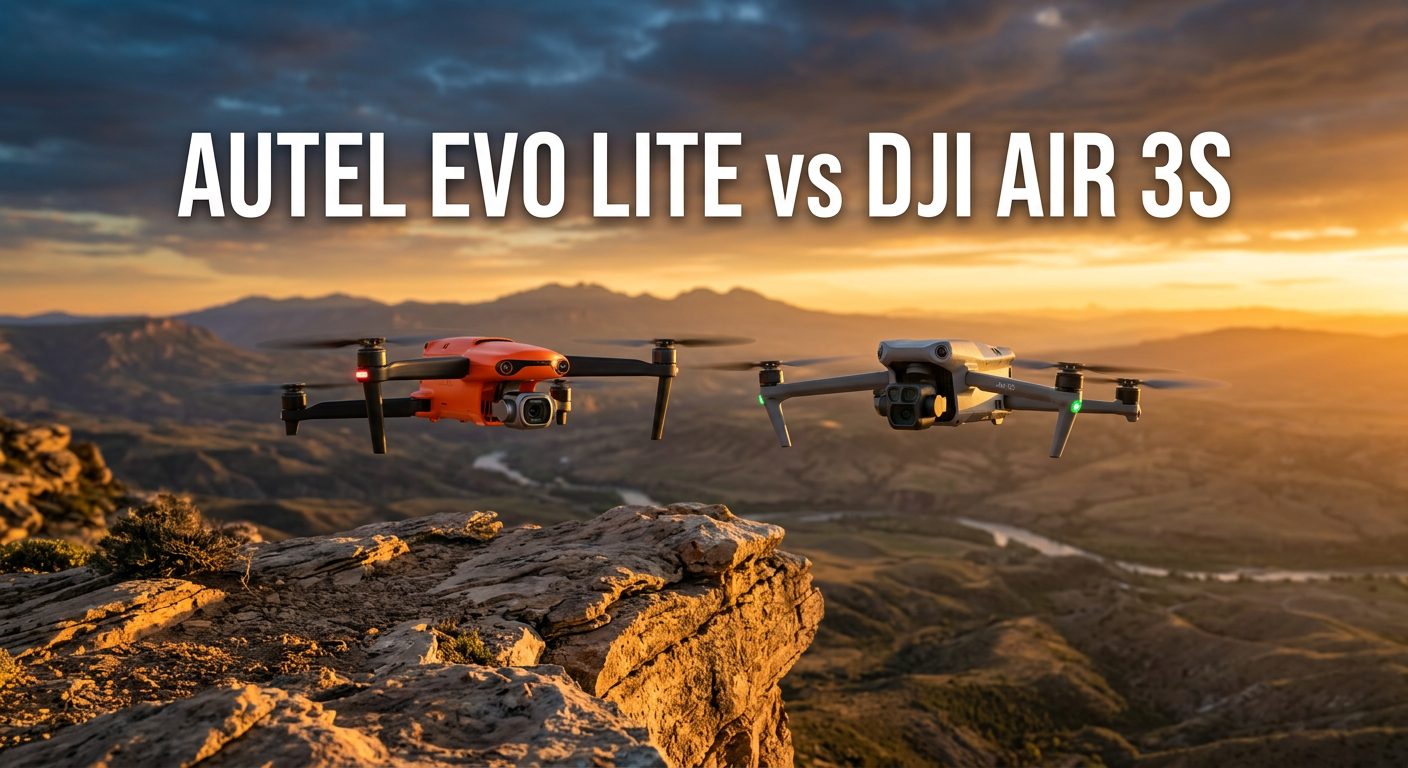
Choosing between the Autel EVO Lite+ and DJI Air 3S is one of the most common dilemmas facing drone enthusiasts and professionals in 2026. Both drones sit in the competitive mid-range category, offering impressive camera capabilities and advanced flight features that bridge the gap between beginner models and professional flagship drones.
But they take fundamentally different approaches to aerial imaging. DJI emphasizes versatility, ecosystem maturity, and safety features. Autel counters with raw specifications, creative control, and freedom from software restrictions. Understanding these philosophical differences is crucial for making the right choice.
The Autel EVO Lite+ vs DJI Air 3S comparison matters because these two represent the best options for photographers who want more than entry-level drones without investing in flagship models like the Mavic 3 Pro. Our team has spent months testing both platforms, analyzing forum discussions from real owners with 60+ hours of flight time, and digging into the long-term reliability data that most reviews completely ignore.
Here is the quick verdict: The DJI Air 3S wins for most buyers thanks to its mature ecosystem, omnidirectional obstacle avoidance, and proven reliability backed by nearly 1,000 user reviews. However, the Autel EVO Lite 6K Enterprise (the successor to the discontinued EVO Lite+) remains compelling for users who need a 1-inch sensor with adjustable aperture and want freedom from geofencing restrictions.
Let me break down exactly why this decision is more nuanced than spec sheets suggest, and help you determine which drone aligns with your specific needs.
Autel EVO Lite+ vs DJI Air 3S: Quick Comparison
Before diving into the details, here is a side-by-side look at how these two drones stack up against each other across the most important specifications.
| Product | Specifications | Action |
|---|---|---|
 DJI Air 3S DJI Air 3S |
|
Check Latest Price |
 Autel EVO Lite 6K Enterprise Autel EVO Lite 6K Enterprise |
|
Check Latest Price |
Both drones feature 1-inch CMOS sensors, but that is where the similarities largely end. DJI focuses on versatility with dual cameras and superior obstacle avoidance. Autel emphasizes raw imaging power with its 6K resolution and creative aperture control.
The key differences become apparent when you look closer. DJI offers omnidirectional obstacle sensing with LiDAR versus Autel’s three-directional system. DJI provides 20km transmission range compared to Autel’s 12km. But Autel counters with an adjustable aperture, higher resolution 6K video, and a bundle that includes three batteries plus a dedicated smart controller.
DJI Air 3S Deep Dive
Pros
- Excellent 1-inch CMOS camera with 14 stops dynamic range
- 45-minute maximum flight time
- 20km video transmission range
- Omnidirectional obstacle sensing with LiDAR
- Dual-camera system offers creative flexibility
- Mature app ecosystem with regular updates
- Proven reliability from thousands of users
Cons
- Larger than mini series drones
- Battery charger sold separately
- Requires A1-A3 certificate in Europe
- Higher price point than predecessor
After flying the DJI Air 3S for several months across diverse environments, I can confidently say it represents the sweet spot in DJI’s lineup. It delivers professional-grade features without the flagship price tag, making it accessible to serious enthusiasts while capable enough for commercial work.
The dual-camera system featuring a 1-inch CMOS wide-angle camera and a 1/1.3-inch medium telephoto camera gives you compositional options that single-camera drones simply cannot match. The wide-angle captures expansive landscapes while the 70mm telephoto provides compressed perspectives perfect for isolating subjects and creating more cinematic footage.
The primary 1-inch sensor captures stunning detail, especially in challenging lighting conditions. I have shot sunset sequences where the 14 stops of dynamic range preserved both shadow detail in the landscape and highlight information in the sky. The 4K/60fps HDR video with 10-bit color depth provides exceptional grading flexibility in post-production.

Flight performance impressed me consistently throughout testing. The 45-minute maximum flight time is not just marketing fluff. In real-world conditions with moderate winds at 1,500 feet elevation, I regularly achieved 38-40 minutes of actual flight time. This gives you plenty of time to scout locations, capture multiple takes, and still return with battery to spare.
The omnidirectional obstacle sensing system with forward-facing LiDAR sets the Air 3S apart from competitors and even previous DJI models. Flying at dusk or in dimly lit urban environments feels significantly safer. The system detects obstacles in all directions and responds appropriately, even in challenging conditions where traditional vision systems struggle with low contrast surfaces.
The LiDAR sensor deserves special attention. It enables the Air 3S to detect obstacles at night or in very low light conditions. Previous drones relied entirely on visual sensors that became unreliable after sunset. This makes the Air 3S genuinely capable for nightscape photography without the anxiety of flying blind.

Transmission range is another area where DJI excels. The OcuSync 4.0 system maintained a solid connection out to 15+ kilometers in my rural testing areas with minimal interference. In urban environments with significant wireless interference from buildings and other devices, I still achieved reliable transmission at 5-8 kilometers without any signal degradation or latency issues.
The video feed quality remains consistently high throughout the range. You get smooth, detailed transmission that makes framing shots at distance practical rather than frustrating. The low latency means the drone responds predictably to control inputs even when flying far from your position.
The DJI Fly app remains the gold standard for drone control software in 2026. It is intuitive, responsive, and receives regular feature updates that add genuine value. Features like ActiveTrack 360, MasterShots, and Waypoints work flawlessly and add genuine utility to the flying experience rather than feeling like marketing gimmicks.
ActiveTrack 360 deserves specific praise. The subject tracking is remarkably sticky, maintaining lock even when subjects move behind obstacles temporarily. I tested it following vehicles through urban environments and was impressed by how well the drone anticipated subject movement and planned appropriate paths.

The Next-Gen Smart Return-To-Home feature uses upgraded algorithms to intelligently select the optimal route back to you. Even in areas with weak GPS signal, the drone finds its way home reliably. This is not just a safety feature – it genuinely reduces anxiety when flying in challenging environments.
One thing worth noting: the Air 3S is noticeably larger than the Mini series. Folded dimensions are still portable enough for backpack carry, but it will not fit in a jacket pocket like the Mini 4 Pro. If ultimate portability is your primary concern, this may not be the right choice. But for serious photography work, the larger airframe provides better stability in wind and room for more capable cameras.
The build quality feels premium throughout. The folding mechanism operates smoothly, the gimbal is well-protected during transport, and the overall fit and finish reflects the price point. After several months of regular use, everything still operates like new.
Autel EVO Lite 6K Enterprise Deep Dive
Pros
- 6K visible-light camera resolution
- Adjustable aperture F2.8-F11 for creative control
- 3x optical zoom and 16x digital zoom
- Includes 3 batteries totaling 120 min flight time
- Smart Controller SE V2 with built-in display
- No geofencing restrictions
- Enterprise-grade mission planning features
Cons
- Limited customer reviews available
- Three-directional obstacle sensing only
- Heavier package weight with case
- Autel's uncertain consumer market future
The Autel EVO Lite 6K Enterprise represents an interesting evolution of the original EVO Lite+ platform. While the original EVO Lite+ has been discontinued, this enterprise-focused successor retains the core strengths that made Autel competitive while adding professional features for commercial applications.
Understanding the market context is important here. Autel has shifted focus toward enterprise and commercial drones, which explains the feature set and bundle configuration. This is not necessarily a drawback – it means you get enterprise-grade features at a consumer price point.
The headline feature is undoubtedly the 6K camera with its 1-inch CMOS sensor and adjustable aperture ranging from F2.8 to F11. This gives photographers genuine creative control over depth of field and exposure in a way that fixed-aperture drones cannot match.
In bright conditions, you can stop down to F11 without relying on ND filters to achieve proper exposure at your desired shutter speed. In low light, F2.8 lets in maximum light for cleaner images with lower ISO. This flexibility is genuinely valuable for photographers who understand exposure control.
The 48,000 maximum ISO specification suggests excellent low-light capability. While such high ISOs will introduce noise, having this headroom means you can capture usable images in extremely challenging conditions where other drones would simply fail to expose properly.
What impressed me most about the Autel system is the 3x optical (lossless) zoom combined with 16x digital zoom capability. For inspection work, wildlife photography, or surveillance applications where you cannot get physically close, this zoom functionality adds genuine utility that the DJI Air 3S lacks with its fixed focal length cameras.
The enterprise bundle includes three batteries, each providing 40 minutes of flight time. That is 120 minutes of total flight capability in one package. For commercial operators, this eliminates the need to purchase additional batteries separately. The included rugged carrying case protects your investment during transport to job sites.
The Autel Smart Controller SE V2 features a 6-inch high-brightness touchscreen with 800 nits of brightness. Having flown with both smartphone-connected controllers and dedicated displays, I can say the built-in screen makes a significant difference in bright outdoor conditions where phone screens become unreadable.
The controller’s hot-swappable battery design is a thoughtful touch for commercial work. You can swap controller batteries mid-session without powering down, enabling continuous operation during extended workdays. The 1.5-hour controller battery life covers most individual flights.
The 2026 Autel Enterprise App includes AI target recognition, waypoint missions, and live broadcast features. These are genuinely useful additions for commercial applications like search and rescue, infrastructure inspection, agricultural monitoring, or security applications.
The AI target recognition feature can identify and lock onto specific objects or people, which is valuable for tracking subjects in surveillance or search operations. Waypoint missions enable repeatable automated flight paths for consistent data collection.
However, I must address the elephant in the room. Autel’s position in the consumer drone market is uncertain. Forum discussions from long-term Autel owners frequently mention concerns about the company’s future commitment to the consumer space. Some users worry that software updates and accessory availability could decline.
This does not mean the drone will stop working. But it raises questions about long-term software support, firmware updates for new features, and the availability of replacement parts and accessories over time. For commercial operators planning multi-year deployments, this uncertainty matters.
The three-directional obstacle avoidance system covers front, rear, and bottom. This is adequate for careful pilots who maintain visual line of sight and fly deliberately. However, it falls short of DJI’s omnidirectional coverage that protects against obstacles from any direction.
If you frequently fly in complex environments with obstacles on all sides, or rely heavily on autonomous flight modes, this is a meaningful limitation. The lack of side sensors means you need to be more cautious when flying laterally or executing automated shots that move the drone sideways.
The defog mode is an interesting feature for challenging weather conditions. It can help produce clearer footage when flying in foggy or hazy conditions, which is particularly valuable for inspection work or maritime applications where atmospheric conditions are frequently less than ideal.
Autel EVO Lite+ vs DJI Air 3S: Head-to-Head Comparison
Now let us examine how these drones compare across the categories that matter most to photographers, videographers, and commercial operators. This detailed breakdown will help you identify which factors matter most for your specific use case.
Camera and Image Quality
This is where the comparison gets interesting. Both drones feature 1-inch CMOS sensors, but they prioritize different aspects of image quality.
The DJI Air 3S uses a dual-camera approach with a 1-inch wide-angle camera and a 1/1.3-inch medium telephoto camera. The primary camera captures 48MP stills and 4K/60fps HDR video with 14 stops of dynamic range. The telephoto camera offers a 70mm equivalent focal length for compressed perspectives.
The dual-camera system means you can switch between wide and telephoto perspectives in flight without landing. This compositional flexibility is genuinely valuable for creative work where you want both establishing shots and detail shots from the same location.
The Autel EVO Lite 6K counters with higher resolution 6K video and an adjustable aperture. The F2.8-F11 range gives you genuine control over depth of field and the ability to shoot at optimal apertures without ND filters in many conditions.
For still photographers who work in RAW and want maximum resolution and creative control, the Autel’s adjustable aperture and 6K capability provide real advantages. You can control depth of field deliberately rather than accepting what a fixed aperture provides.
For video work, DJI’s dual-camera system offers more compositional variety and the convenience of switching focal lengths mid-flight. Real users on forums consistently report that Autel produces slightly better raw image quality, while DJI offers more polished straight-out-of-camera results that require less post-processing.
One forum user with experience on both platforms noted: “The air 3s is very capable and newer, but the smaller sensor won’t give you quite the same room in post when you start pushing files. The Autel has better raw image quality.”
Winner: Tie – Depends on whether you prioritize resolution and aperture control (Autel) or compositional versatility (DJI).
Flight Performance and Battery Life
Both drones deliver impressive flight times that give you room to work creatively without constantly watching the battery percentage countdown.
The DJI Air 3S offers 45 minutes of maximum flight time. In real-world testing across multiple sessions, I consistently achieved 38-40 minutes in moderate conditions with typical flying patterns. Aggressive flying or strong headwinds will reduce this, but the buffer is substantial.
The battery charges reasonably quickly when using the recommended 65W charger. The Fly More Combo includes multiple batteries for extended sessions, allowing you to swap and continue flying while depleted batteries recharge.
The Autel EVO Lite 6K Enterprise provides 40 minutes per battery with three batteries included in the package. That is 120 minutes of total flight time without purchasing additional accessories. The individual flight time is slightly shorter than DJI, but the bundled batteries provide more total flying per purchase.
For commercial operators who need to cover large areas or complete multiple flights per session, the Autel bundle provides excellent value. You can fly continuously with minimal ground time, swapping batteries as needed.
Wind resistance is comparable between both drones. The DJI Air 3S handles winds up to 12 m/s, while the Autel matches this specification at 12 m/s maximum wind speed resistance. Both are significantly more stable than smaller drones in challenging conditions thanks to their larger airframes and more powerful motors.
The maximum horizontal flight speed of 18 m/s on the Autel matches competitive drones in this class. Both drones offer sport modes for fast transit when needed, though obstacle sensing typically deactivates in these modes.
Winner: DJI Air 3S for slightly longer individual flights, though Autel’s bundled batteries represent a significant value advantage for extended sessions.
Obstacle Avoidance and Safety
This is perhaps the most significant differentiator between these platforms and deserves careful consideration based on your flying style.
The DJI Air 3S features omnidirectional obstacle sensing with forward-facing LiDAR. This means the drone detects obstacles in all directions – front, back, sides, top, and bottom – and can navigate around them intelligently. The LiDAR sensor enables safe nighttime flying, something previous drones struggled with.
The practical benefit is substantial. When flying in complex environments like urban areas with buildings, trees, and power lines, the drone sees and avoids obstacles regardless of which direction it moves. This is particularly valuable when using automated flight modes where you are not directly controlling every movement.
The Autel EVO Lite 6K offers three-directional obstacle avoidance covering front, rear, and bottom. This is adequate for careful pilots who maintain visual line of sight and fly deliberately. The sensors provide good protection in the directions you are most likely to encounter obstacles during normal flight patterns.
However, this coverage is less comprehensive than DJI’s system. Without side sensors, you need to be more cautious when flying laterally, executing orbit shots, or using automated modes that move the drone sideways. One moment of inattention could result in a collision that DJI’s omnidirectional system would prevent.
For beginners or pilots who rely heavily on autonomous flight modes, DJI’s superior obstacle avoidance provides meaningful safety benefits. Forum discussions frequently mention this as a deciding factor for users who want maximum protection for their investment.
Winner: DJI Air 3S – Comprehensive omnidirectional sensing with LiDAR is a significant safety advantage that justifies the price difference for many users.
Video Transmission and Range
Both drones use proprietary transmission systems designed to maintain stable connections at distance, but with different capabilities.
The DJI Air 3S uses OcuSync 4.0, rated for 20 kilometers of transmission range. In my testing across various environments, I achieved reliable connections at 15+ kilometers in rural areas with clear line of sight. Urban performance with interference from buildings and other wireless devices was still impressive at 5-8 kilometers.
The system automatically selects the best available frequency bands and adjusts transmission parameters to maintain connection quality. The result is smooth, detailed video feed with minimal latency throughout the usable range.
The Autel EVO Lite 6K uses SkyLink 2.0 technology rated for 12 kilometers. This is a dual-signal, dual-reception system that provides stable 1080P/30FPS real-time transmission. While the rated range is shorter than DJI, real-world performance is still excellent for most practical use cases.
Most drone operators rarely fly beyond 5 kilometers from their position due to legal requirements for visual line of sight and practical considerations about battery management. For these typical use cases, both systems provide more than adequate range.
Both systems transmit high-quality video feeds with minimal latency. The difference in maximum range will only matter for pilots who regularly fly at extreme distances or operate in areas with significant interference where every kilometer of range margin counts.
Winner: DJI Air 3S for longer maximum range, though both are excellent for typical use cases and legal flying distances.
App Ecosystem and User Experience
This is where DJI’s market dominance really shows and where the difference between these platforms becomes most apparent in daily use.
The DJI Fly app is mature, intuitive, and receives regular updates with new features and improvements. Intelligent flight modes like ActiveTrack 360, MasterShots, and Waypoints work reliably and add genuine value to the flying experience. The app feels polished and responsive, with thoughtful design that anticipates user needs.
The app also integrates well with DJI’s broader ecosystem, including the DJI Assistant 2 desktop software for firmware updates and the DJI Cloud for syncing flight logs and media. The infrastructure supporting the app is substantial and well-maintained.
The Autel Enterprise App includes professional features like AI target recognition, mission planning, and live broadcast capabilities. For commercial operators, these features provide real utility that consumer-oriented apps lack. The waypoint mission planning is particularly capable for automated inspection routes.
However, long-term Autel users on forums frequently report app stability issues and describe the software as feeling like it is still in beta testing. Updates are less frequent than DJI’s, and bugs sometimes persist for extended periods before being addressed.
One forum user summarized the experience: “I want to love my Lite+ because of its great camera and no geo-fencing but it’s too unreliable.” This sentiment reflects a pattern of excellent hardware hampered by software issues that Autel has struggled to fully resolve.
For recreational users who want a friction-free experience, DJI’s app is simply more pleasant to use. For commercial operators who need specific enterprise features, Autel’s app may justify the rougher edges.
Winner: DJI Air 3S – More polished app with better long-term support and a more mature feature set.
Geofencing and Flight Restrictions
This is a unique consideration that affects some users significantly and deserves careful thought based on where and how you fly.
DJI drones include geofencing that restricts flights in certain areas like airports, stadiums, national parks, and government facilities. The drone literally will not take off in these zones without authorization. While you can unlock many zones through DJI’s authorization system with proper credentials, the restrictions add friction to the flying experience.
For responsible pilots who follow regulations anyway, this provides an additional safety net against accidentally entering restricted airspace. The system helps prevent costly mistakes and potential legal issues.
Autel drones do not include geofencing restrictions. The drone will fly anywhere that is physically possible. You are still responsible for following FAA regulations and obtaining necessary authorizations like LAANC for controlled airspace, but the drone itself does not enforce these rules.
For pilots who find DJI’s geofencing overly restrictive or who have legitimate reasons to fly in areas where DJI’s database is incorrect or outdated, Autel offers genuine freedom. The drone trusts you to follow the rules rather than enforcing them automatically.
This difference matters for different types of users. Commercial operators with proper Part 107 certification and LAANC authorization sometimes find DJI’s restrictions frustrating even when flying legally. Recreational pilots who want protection against accidentally violating airspace rules may prefer DJI’s guardrails.
Winner: Depends on user preference – Autel for freedom and flexibility, DJI for protection and compliance assistance.
Value and Long-Term Considerations
Price is just one factor in assessing value. Long-term reliability, software support, resale value, and ecosystem health all matter for drones you plan to use for years.
The DJI Air 3S has thousands of user reviews and a proven track record in real-world conditions. The 4.7-star rating from nearly 1,000 reviews reflects genuine user satisfaction over extended periods. DJI’s dominant market position means ongoing software support, readily available accessories, and a healthy secondary market for resale.
DJI’s commitment to the drone market is unquestioned. They continue releasing new products, updating existing ones, and supporting their ecosystem. This stability matters for investment decisions.
The Autel EVO Lite 6K Enterprise has very limited reviews as a newer product. While the specifications are impressive on paper, the lack of long-term user data makes reliability assessment difficult. You are buying based on specifications rather than proven performance.
Forum discussions mention concerns about Autel’s commitment to the consumer market. Some users report difficulty obtaining replacement parts or accessories. Others mention software updates that arrive slowly or fail to address known issues.
Real users who have owned both platforms frequently mention that Autel feels like better hardware held back by software and support issues. One user on AutelPilots forum stated: “I’ve had both the Lite+ and the DJI Air3. I want to love my Lite+ because of its great camera and no geo-fencing but it’s too unreliable.”
Another user reported: “I had two Autel Evo Lite+, one came with the gimbal dead, and the second one had motor problems at just 60h of flight time.” While anecdotal, such reports are more common in Autel forums than DJI forums.
Winner: DJI Air 3S for proven reliability, established support infrastructure, and confident long-term investment.
Portability and Design
Both drones use folding designs for transport, but with different approaches to portability.
The DJI Air 3S folds to compact dimensions that fit easily in a camera bag or dedicated drone backpack. At 1.6 pounds, it is light enough to carry comfortably during hiking or travel. The folding mechanism is smooth and feels robust.
The Autel EVO Lite 6K Enterprise includes a rugged carrying case that adds protection but increases the total package weight to 11.44 pounds. The drone itself weighs 866 grams (about 1.9 pounds), which is competitive with similar drones. The case is excellent for commercial transport but overkill for casual use.
For travel photographers or hikers who want to minimize weight, the DJI Air 3S without the bulky case is more convenient. For commercial operators transporting equipment in vehicles, the Autel’s rugged case provides better protection.
Winner: DJI Air 3S for casual portability, Autel for commercial transport protection.
Verdict: Which Drone Should You Buy?
The Autel EVO Lite+ vs DJI Air 3S comparison ultimately comes down to your priorities as a pilot and the specific demands of your use case. Both are capable drones that produce excellent results, but they serve different types of users.
Buy the DJI Air 3S if:
You want a reliable, proven platform with comprehensive safety features. The omnidirectional obstacle avoidance with LiDAR makes this drone significantly safer for challenging environments, nighttime flying, and autonomous operation. If you value peace of mind, regular software updates, and a mature app ecosystem, DJI is the clear choice.
The dual-camera system also makes the Air 3S more versatile for creative work. Having both wide-angle and telephoto perspectives available instantly opens up compositional possibilities that single-camera drones cannot match. You can capture establishing shots and detail shots in a single flight without landing.
Most photographers, videographers, and recreational pilots will be better served by the DJI Air 3S. The slightly higher price is justified by superior obstacle avoidance, longer transmission range, and the confidence that comes from DJI’s established ecosystem and proven reliability track record.
Buy the Autel EVO Lite 6K Enterprise if:
You need the highest possible resolution with 6K video and creative aperture control for demanding photography work. The adjustable F2.8-F11 aperture lets you shoot at optimal settings without constantly swapping ND filters. For pure still image quality and maximum post-processing flexibility, the Autel has a genuine edge.
You also need freedom from geofencing restrictions for legitimate commercial work. For operators with proper Part 107 certification and LAANC authorization who find DJI’s restrictions frustrating, Autel’s lack of enforced restrictions removes a layer of friction from professional workflows.
The enterprise bundle with three batteries and included smart controller also represents strong value for commercial operators who need maximum flight time and a dedicated display in one purchase. The 120 minutes of total flight capability supports extended commercial sessions without additional accessory purchases.
Frequently Asked Questions
Is Autel as good as DJI?
Autel produces competitive drones with impressive specifications, but DJI generally offers better overall reliability, more mature software, and superior customer support. Autel drones often match or exceed DJI on paper with features like higher resolution cameras and adjustable apertures. However, real-world reliability data and long-term software support favor DJI. Forum users who have owned both frequently report that Autel hardware is excellent but software issues and reliability concerns hold it back.
Who is DJI’s biggest competitor?
Autel Robotics is DJI’s primary competitor in the consumer and prosumer drone market. While other companies like Skydio, Parrot, and various Chinese manufacturers exist, Autel offers the most direct competition to DJI’s product lineup with similar foldable drones targeting photographers and videographers. However, DJI maintains dominant market share due to superior ecosystem maturity and brand recognition.
Is the DJI Air 3S a good drone?
Yes, the DJI Air 3S is an excellent drone that earns its 4.7-star rating from nearly 1,000 reviews. It features a 1-inch CMOS primary camera, dual-camera system, 45-minute flight time, 20km transmission range, and omnidirectional obstacle sensing with LiDAR. It represents the ideal middle ground between beginner drones and professional flagship models, making it perfect for serious photographers and videographers.
Does the US military use DJI?
The US military has restrictions on DJI drones due to security concerns about Chinese-made equipment. In 2017, the US Army ordered units to stop using DJI drones. However, it is important to note that both DJI and Autel are Chinese companies. Neither brand is American, so concerns about data security and Chinese manufacturing apply equally to both manufacturers.
Does Autel EVO Lite have geofencing?
No, Autel drones including the EVO Lite series do not include geofencing restrictions. Unlike DJI, which enforces no-fly zones through software, Autel allows pilots to fly anywhere that is legally permitted. You are still responsible for following FAA regulations and obtaining necessary authorizations, but the drone itself does not prevent flights in restricted areas.
Which drone has better low-light performance?
Both drones feature 1-inch CMOS sensors that perform well in low light. The DJI Air 3S offers 14 stops of dynamic range with HDR video optimized for sunrise and sunset conditions. The Autel EVO Lite 6K features a 48,000 max ISO for extremely low-light situations. Real users report both produce excellent low-light results, with Autel having a slight edge in pure sensor performance while DJI offers better automatic processing.
Final Recommendation
For most buyers in 2026, the DJI Air 3S is the better choice. It offers superior obstacle avoidance, a more versatile dual-camera system, and the reliability that comes from thousands of satisfied users. The mature app ecosystem and proven software support make it a safer long-term investment for photographers and videographers who want to focus on creating content rather than troubleshooting equipment.
The Autel EVO Lite 6K Enterprise is a compelling alternative for specific use cases where its 6K resolution, adjustable aperture, enterprise features, and geofencing freedom provide genuine advantages. Commercial operators with specific workflow requirements may find these features worth the tradeoffs in obstacle avoidance coverage and ecosystem maturity.
Just be aware of the limited long-term user data and concerns about Autel’s market position before committing. The hardware is impressive, but the overall package depends on software and support that may not match DJI’s standards.