
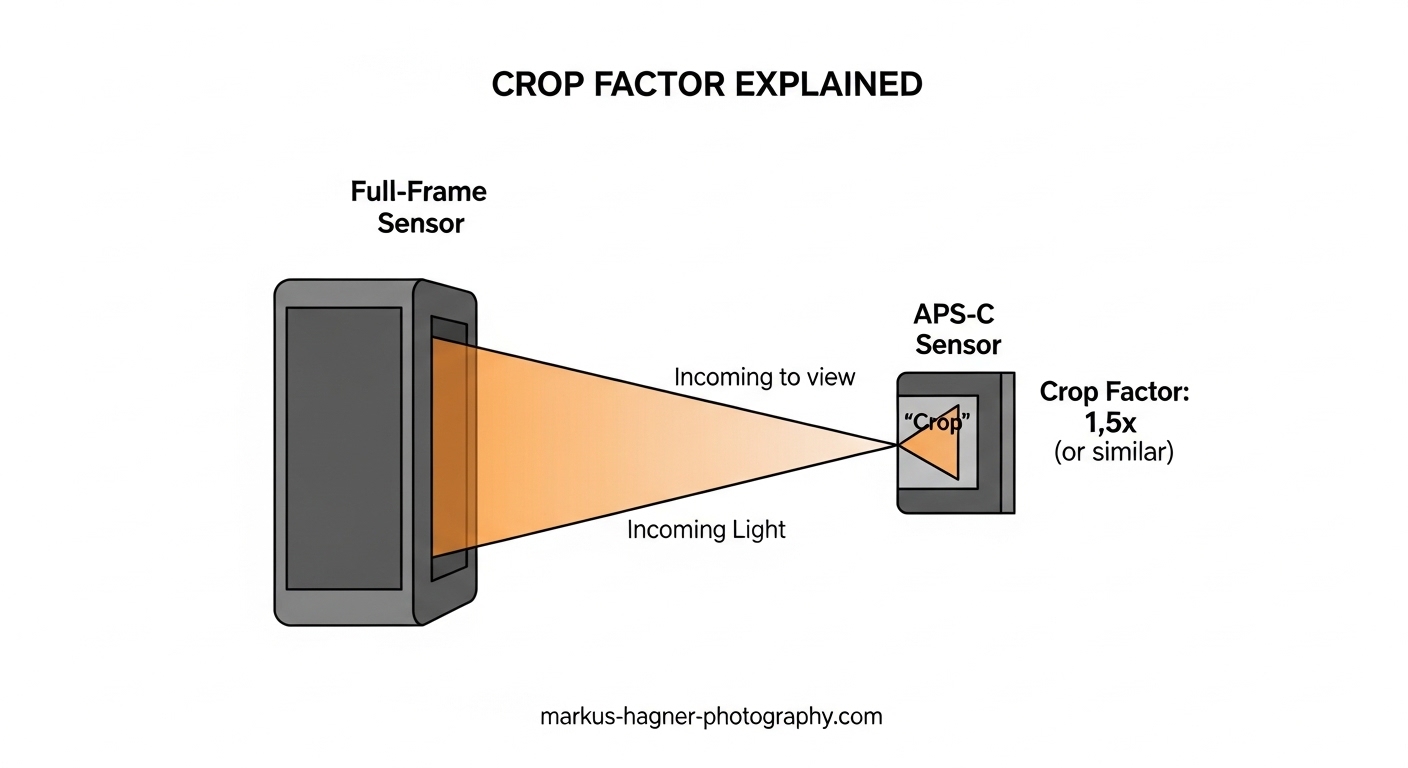
Crop factor is the ratio of a 35mm full-frame sensor’s diagonal to your camera sensor’s diagonal. In plain terms, it tells you how much smaller your sensor is compared to a full-frame — and that size difference directly changes the field of view you get from any given lens.
If you’ve ever mounted a 50mm lens on an APS-C camera and noticed the image looked more like a 75mm shot, that’s crop factor at work. The lens didn’t change. The sensor just captures a smaller portion of the image circle the lens projects.
Understanding crop factor is one of the most practical things you can learn as a photographer. It affects every lens decision you make, every time you switch camera systems, and every time you try to match a field of view you saw on someone else’s setup.
Why 35mm Film Is the Reference Point for Crop Factor?
Before digital cameras existed, 35mm film was the standard format used in the vast majority of consumer and professional cameras. A single frame of 35mm film measures 36mm x 24mm — a size that became so universal that photographers built entire systems of lenses, techniques, and expectations around it.
When digital sensors arrived, manufacturers couldn’t immediately produce sensors at the same 36mm x 24mm size. The cost of fabricating large silicon wafers made it prohibitive for consumer cameras. So they built smaller sensors instead — but they still wanted photographers to use the same lenses and understand focal lengths in familiar terms.
That’s why 35mm became the reference. If you say “a 50mm equivalent,” every experienced photographer immediately knows the angle of view you mean, regardless of which camera system they shoot with. The 35mm standard acts as a universal language for describing what a lens will see.
Full-frame digital cameras replicate the 36mm x 24mm dimensions of 35mm film exactly, giving them a crop factor of 1.0x — meaning no crop at all. Every other sensor format is smaller, which is why their crop factors are always greater than 1.
What Is Crop Factor and How Does It Change Your Lens Focal Length?
Crop factor is a number that describes how much smaller your camera’s sensor is compared to a full-frame sensor. It is sometimes called the focal length multiplier. Multiply your lens’s actual focal length by the crop factor to get the equivalent focal length on full-frame — the angle of view you would need on a full-frame camera to match your shot.
Here’s the critical thing most beginners get wrong: the lens focal length does not actually change. A 50mm lens is still a 50mm lens on any camera. What changes is the angle of view captured by the sensor.
Think of it this way. A lens projects a circular image onto the camera’s focal plane — this is called the image circle. A full-frame sensor captures a large rectangular crop of that circle. A smaller APS-C sensor captures only the center portion of the same circle. Because the APS-C sensor captures a narrower slice of the image, the resulting photo looks like you zoomed in, even though no zooming happened.
This is a field of view change, not a focal length change. But because the visual effect mimics zooming, photographers use the equivalent focal length as a shorthand to describe what you’re actually seeing in the frame.
How to Calculate Crop Factor Using the Pythagorean Theorem?
Crop factor is calculated by dividing the diagonal of a full-frame sensor by the diagonal of your sensor. Here’s the formula:
Crop Factor = Full-frame diagonal ÷ Sensor diagonal
To find a sensor’s diagonal, you use the Pythagorean theorem on the sensor’s width and height. Here is the step-by-step process:
- Find your sensor’s dimensions in millimeters. For example, Nikon’s APS-C DX sensor measures approximately 23.5mm x 15.6mm.
- Calculate the diagonal. Diagonal = √(width² + height²) = √(23.5² + 15.6²) = √(552.25 + 243.36) = √795.61 ≈ 28.2mm
- Calculate the full-frame diagonal. Full-frame is 36mm x 24mm. Diagonal = √(36² + 24²) = √(1296 + 576) = √1872 ≈ 43.3mm
- Divide full-frame diagonal by your sensor diagonal. 43.3 ÷ 28.2 ≈ 1.5x crop factor
This is where the 1.5x number for Nikon and Sony APS-C cameras comes from. Canon’s APS-C sensors are slightly smaller at approximately 22.3mm x 14.9mm, which produces a 1.6x crop factor when you run the same calculation.
Most photographers never need to calculate crop factor from scratch. Manufacturers publish the crop factor for every camera. But understanding the math helps you see exactly what’s happening — your sensor physically captures a smaller rectangle of the image circle your lens throws.
Common Sensor Sizes and Their Crop Factors
Different sensor formats have different crop factors. This table shows the most common sensor types, their approximate dimensions, and how that translates to a crop factor you apply to every lens you mount.
| Sensor Format | Approximate Dimensions | Crop Factor | Example Cameras |
|---|---|---|---|
| Medium Format | 44mm x 33mm and larger | 0.64x – 0.8x | Hasselblad X2D, Fujifilm GFX100 |
| Full-Frame (35mm) | 36mm x 24mm | 1.0x (reference) | Sony A7 IV, Nikon Z6 III, Canon R6 Mark II |
| APS-H | 28.7mm x 19mm | ~1.3x | Some older Canon 1D series |
| APS-C (Nikon, Sony, Fujifilm) | 23.5mm x 15.6mm | 1.5x | Nikon Z50, Sony A6700, Fujifilm X-T5 |
| APS-C (Canon) | 22.3mm x 14.9mm | 1.6x | Canon EOS R10, Canon 90D |
| Micro Four Thirds (MFT) | 17.3mm x 13mm | 2.0x | OM System OM-5, Panasonic G9 II |
| 1-inch sensor | 13.2mm x 8.8mm | 2.7x | Sony RX100 series, DJI cameras |
| Nikon CX / 1-inch | 13.2mm x 8.8mm | 2.7x | Nikon 1 series (discontinued) |
Notice that medium format sensors have a crop factor below 1.0x. This means a lens mounted on a medium format camera delivers a wider field of view than the same lens on a full-frame camera. Medium format is the only common sensor type that is larger than the 35mm reference standard.
The practical takeaway from this table: every time you step down in sensor size, you lose field of view with any given lens. A wide-angle lens on Micro Four Thirds shoots more like a standard lens on full-frame. A telephoto on Micro Four Thirds reaches dramatically further — which is why MFT cameras became popular with bird photographers.
How Crop Factor Changes Your Effective Focal Length
The formula for equivalent focal length is simple:
Equivalent Focal Length = Actual Lens Focal Length × Crop Factor
So a 50mm lens on a 1.5x APS-C camera behaves like a 75mm lens would on full-frame. The angle of view is identical to a 75mm shot on a 36mm x 24mm sensor. Here are practical examples across the focal length range:
| Actual Focal Length | APS-C 1.5x Equivalent | APS-C 1.6x Equivalent | MFT 2.0x Equivalent |
|---|---|---|---|
| 14mm (ultra-wide) | 21mm | 22.4mm | 28mm |
| 24mm (wide) | 36mm | 38.4mm | 48mm |
| 35mm (standard-wide) | 52.5mm | 56mm | 70mm |
| 50mm (standard) | 75mm | 80mm | 100mm |
| 85mm (portrait) | 127.5mm | 136mm | 170mm |
| 200mm (telephoto) | 300mm | 320mm | 400mm |
| 400mm (super-telephoto) | 600mm | 640mm | 800mm |
To answer a common question directly: yes, a 35mm lens on an APS-C camera with a 1.5x crop factor gives you a 52.5mm equivalent — essentially the same field of view as a 50mm lens on full-frame. This is why 35mm lenses became the go-to “nifty fifty” replacement for APS-C shooters.
A key insight from this table: crop factor hurts wide-angle photography more than it helps. Trying to shoot landscape or architecture on APS-C with a 24mm lens? You’re getting the equivalent of 36mm — a loss of that ultra-wide perspective. To truly shoot wide on APS-C, you need a 12-16mm lens to match what a 18-24mm delivers on full-frame.
On the telephoto end, crop factor becomes a significant advantage. That 400mm lens becomes a 600mm equivalent on APS-C — giving you extra reach without paying for a 600mm prime lens. This is why crop sensor cameras remain popular with wildlife and sports photographers who need maximum reach within a budget.
Does Crop Factor Affect Depth of Field and Aperture?
This is where things get more technical — and where most online explanations fall short. Crop factor does not change the aperture marking on your lens. An f/1.8 lens is still f/1.8 on any camera. The exposure, light gathering, and brightness of the image remain the same regardless of sensor size.
However, crop factor does affect depth of field. To get the same framing as a full-frame camera, you either need to use a shorter focal length or stand further from your subject on a crop sensor. Both of these changes affect depth of field, even if your aperture stays the same.
Here is a practical illustration. On full-frame, shooting a portrait at 85mm f/1.8 at 2 meters gives you shallow depth of field with nice background separation. To match that framing on APS-C (1.5x), you’d use a 56mm lens at the same distance. The depth of field at 56mm f/1.8 is noticeably deeper — you lose some of that background blur.
This is what photographers mean by “aperture equivalence.” To get the same depth of field on APS-C as 85mm f/1.8 on full-frame, you’d need approximately f/1.2 on a 56mm lens. The exposure stays consistent, but the optical depth of field behavior changes.
For most photographers, especially beginners, this difference is subtle. Modern fast primes designed for APS-C cameras — like 56mm f/1.2 lenses from Fujifilm and others — exist specifically to compensate for this, delivering full-frame-like depth of field performance on smaller sensors.
Crop Factor in Practice: Wildlife, Portraits, and Landscapes
Understanding crop factor in theory is one thing. Knowing how it changes your real-world shooting decisions is what actually matters when you’re buying lenses or choosing a camera system.
Wildlife and Bird Photography
Crop sensor cameras are genuinely advantageous here. Wildlife photographers often need every millimeter of reach they can get. A 500mm lens on a Nikon Z50 (1.5x APS-C) delivers 750mm equivalent reach. On a Micro Four Thirds camera, a 300mm lens gives you 600mm equivalent — in a much lighter package than a 600mm prime would be.
This is a real, practical advantage. Many serious bird photographers deliberately choose APS-C or MFT systems for telephoto work, even when they own full-frame systems for other genres. The crop factor isn’t a compromise here — it’s a feature.
Portrait Photography
Portrait photographers face a different calculation. Classic portrait focal lengths on full-frame — 85mm, 105mm, 135mm — produce a field of view that flatters faces and gives natural compression. On APS-C (1.5x), you’d want something around a 56mm or 50mm prime to match that framing.
The depth of field consideration matters more here than in wildlife. If you’re used to shooting full-frame portraits at 85mm f/1.4 and switch to APS-C, you’ll notice your background separation changes. A 56mm f/1.4 on APS-C gives similar framing but slightly more depth of field than 85mm f/1.4 on full-frame. You can compensate by shooting with a faster aperture, like f/1.2, or by reducing your working distance.
Landscape and Architecture Photography
This is where crop sensor cameras feel most limiting. If you love shooting ultra-wide — 16mm, 14mm, or even 12mm on full-frame — you’ll need to go significantly wider to match that on a crop sensor. A 12mm lens on APS-C (1.5x) only gives you 18mm equivalent. Getting genuinely ultra-wide on APS-C often means using specialized lenses like a 10-20mm or even 8mm fisheye.
Wide rectilinear lenses for APS-C are available but can be expensive and less optically refined than their full-frame counterparts. This is one area where full-frame cameras maintain a real advantage for photographers who prioritize extreme wide-angle work.
Street and Travel Photography
Street photographers often use 35mm or 50mm full-frame equivalents for their natural, human-eye perspective. On APS-C, a 23mm or 24mm lens gives you that same equivalent. Many manufacturers offer very good and affordable 23mm f/2 primes (Fujifilm, Sony, etc.) specifically designed for this use case. Crop sensors actually work well for street and travel because the camera systems are often smaller and lighter than full-frame.
Lens Abbreviations Explained: DX, EF-S, FE, and More
Camera manufacturers use different naming conventions to indicate whether a lens is designed for crop sensors or full-frame sensors. Understanding these abbreviations helps you avoid buying incompatible lenses and tells you what image circle a lens projects.
Nikon
DX lenses are designed for Nikon’s APS-C crop sensor cameras (Z50, Zfc, etc.). They project a smaller image circle. You can mount DX lenses on a full-frame Nikon body, but the camera will automatically switch to a cropped DX mode, reducing your effective megapixels. FX lenses are designed for full-frame and project an image circle large enough to cover the full sensor. FX lenses work on both DX and FX bodies without any restrictions.
Canon
EF-S lenses are Canon’s APS-C lenses for DSLR cameras. They physically cannot mount on Canon’s full-frame DSLRs due to a rear element that would contact the mirror. EF lenses are full-frame DSLR lenses and work on all EF-mount cameras. For Canon’s mirrorless RF system, RF-S lenses are APS-C specific, while standard RF lenses cover full-frame.
Sony
E mount lenses (often called APS-C E-mount) are designed for Sony’s crop sensor bodies like the A6700. FE lenses cover full-frame and work on both full-frame (A7 series, A9 series) and APS-C E-mount cameras. Using an FE lens on an APS-C camera works perfectly — the larger image circle simply captures the center portion.
Fujifilm and Micro Four Thirds
Fujifilm’s XF and XC lenses are designed for their APS-C X-mount system. Micro Four Thirds lenses from Olympus (OM System) and Panasonic are cross-compatible between brands — any MFT lens works on any MFT body regardless of manufacturer. This cross-compatibility is one of the reasons MFT became a strong ecosystem.
The general rule: full-frame lenses always work on crop sensor cameras of the same mount (or with an adapter). Crop-specific lenses generally cannot be used effectively on full-frame cameras without significant image degradation or physical incompatibility.
Common Crop Factor Myths Debunked
These misconceptions come up constantly in photography forums and beginners’ groups. Getting them right will save you confusion and bad purchasing decisions.
Myth 1: Crop factor physically changes the focal length of the lens. It does not. A 50mm lens has a 50mm focal length on any camera. The sensor captures a narrower portion of the image circle, which changes the angle of view — but the lens optics are unchanged. The only thing that actually changes is what portion of the scene the sensor records.
Myth 2: Crop sensor cameras are always inferior to full-frame. This depends entirely on what you’re shooting. For wildlife and sports, a 1.5x or 2x crop can be a genuine advantage. Modern APS-C sensors from Fujifilm, Sony, and Nikon have excellent image quality that rivals full-frame cameras from five years ago. The “full-frame is always better” argument ignores context.
Myth 3: Crop factor changes your aperture. Strictly speaking, no — the aperture on your lens does not change. However, to achieve equivalent depth of field and equivalent total light gathered (which matters for comparing noise levels at matched settings), you would need to adjust the aperture by the crop factor. This is aperture equivalence — a separate, more advanced concept that doesn’t affect your day-to-day shooting decisions for most photographers.
Myth 4: You always lose image quality on a crop sensor. The sensor size affects how much light each pixel can gather (affecting noise), but sensor technology improves constantly. A modern 26-megapixel APS-C sensor can outperform older full-frame sensors in many real-world situations. Crop factor and image quality are related but not the same thing.
Frequently Asked Questions
How does crop factor affect focal length?
Crop factor doesn’t change the actual focal length of your lens — it changes the field of view you capture. Multiply your lens’s focal length by the crop factor to find the equivalent focal length on full-frame. For example, a 50mm lens on a 1.5x APS-C camera gives the same angle of view as a 75mm lens on full-frame.
Is a 35mm lens on APS-C equivalent to 50mm on full-frame?
Yes, on an APS-C camera with a 1.5x crop factor, a 35mm lens gives an equivalent focal length of 52.5mm — essentially the same field of view as a 50mm lens on full-frame. On Canon APS-C cameras (1.6x crop), a 35mm lens gives a 56mm equivalent.
Does crop factor affect aperture?
Crop factor does not change the aperture number on your lens. An f/1.8 lens still gathers the same amount of light per unit area regardless of sensor size. However, to achieve the same depth of field as a full-frame camera, you would need to open up by roughly one stop when using a crop sensor at equivalent framing.
Can I use full-frame lenses on a crop sensor camera?
Yes, full-frame lenses are generally compatible with crop sensor cameras of the same mount. The lens projects a large image circle and the crop sensor captures only the center portion, which is perfectly fine. Some manufacturers (Canon EF-S, Nikon DX) make crop-specific lenses that cannot be used on full-frame bodies without issues.
What is the difference between 1.5x and 1.6x crop factor?
The difference is very small in practice. Canon’s APS-C sensors are slightly smaller than Nikon’s and Sony’s, producing a 1.6x crop factor versus 1.5x. On a 50mm lens, this means 80mm equivalent (Canon) versus 75mm equivalent (Nikon/Sony). The 5mm difference in equivalent focal length is rarely noticeable in real shooting.
Final Thoughts
Crop factor is one of those concepts that sounds more complicated than it is. At its core, it simply tells you how your sensor size changes the angle of view you get from any lens.
The formula is straightforward: multiply your lens focal length by the crop factor to get the equivalent full-frame perspective. A smaller sensor means a narrower field of view — which hurts wide-angle shooting but extends your telephoto reach.
Once you understand what crop factor actually does — and what it doesn’t do — lens and camera decisions become much clearer. Whether you’re choosing a wildlife setup on APS-C, picking a portrait prime for Micro Four Thirds, or figuring out what wide-angle lens you need for landscape work on a crop sensor, this knowledge helps you make smarter, better-informed choices for 2026 and beyond.