
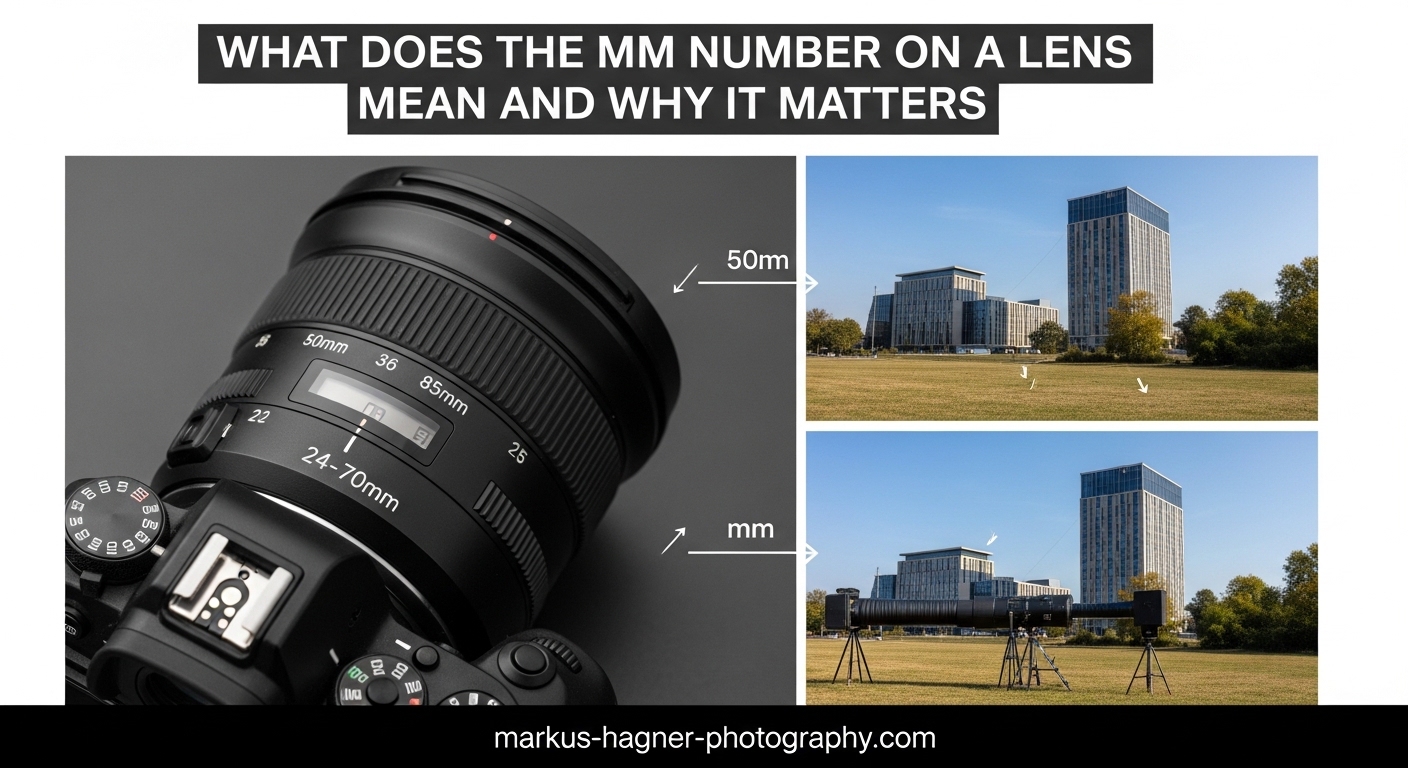
If you have ever looked at a camera lens and wondered what those mm numbers actually mean, you are not alone. The mm number on a lens refers to focal length, which is measured in millimeters from the optical center of the lens to your camera’s image sensor. This number determines two crucial things: how much of the scene you can capture and how large your subjects appear in the frame.
Understanding what the mm number on a lens means transforms how you choose lenses and compose your shots. In this guide, I will break down focal length in plain terms, explain each focal length category, and show you exactly why this number matters for your photography in 2026.
What Does the mm Number on a Lens Mean?
The mm number printed on your lens represents focal length, measured in millimeters. This measurement tells you the optical distance from the point where light rays converge inside the lens (the optical center) to the image sensor plane when the lens is focused at infinity.
Think of it this way: a 50mm lens has an optical distance of 50 millimeters between its optical center and your sensor. A 200mm lens has 200 millimeters of optical distance. The longer this distance, the more “zoomed in” your view becomes.
This measurement standard dates back to the 35mm film format, which became the reference point for all focal length discussions. When photographers talk about focal length, they are almost always referring to how a lens would perform on a full-frame sensor (the same size as 35mm film). This becomes important when we discuss crop sensors later.
The mm number is not a physical measurement of the lens barrel itself. Some compact 200mm lenses are physically shorter than 200mm, while others match their focal length more closely. The number represents optical properties, not physical dimensions.
Focal Length: The Technical Explanation
Focal length controls two fundamental aspects of your image: angle of view and magnification. These two properties work together to define how your final photograph looks.
Angle of view refers to how much of the scene your lens captures. A wide-angle lens (low mm number) captures a broad swath of the scene, often exceeding what your eyes can see at once. A telephoto lens (high mm number) captures a narrow slice, isolating specific subjects from their surroundings.
Magnification describes how large subjects appear in your frame. At longer focal lengths, subjects appear larger because the lens is effectively cropping into the scene. This is why a 200mm lens makes distant wildlife appear much closer than a 50mm lens would.
How Focal Length Changes Perspective
Here is where things get interesting. Different focal lengths do not just zoom in or out. They actually change the perspective relationship between foreground and background elements.
Wide-angle lenses exaggerate distance. Objects close to the camera appear larger, while background elements seem smaller and farther away. This creates a sense of depth and space in your images.
Telephoto lenses compress distance. They make background elements appear closer to your foreground subject. This compression effect is why portrait photographers often choose 85mm or longer lenses. The compression flatters facial features by reducing the appearance of nose protrusion.
The Optical Center and Infinity Focus
The technical definition of focal length always references infinity focus. When your lens is focused on something extremely far away (like distant mountains or stars), the optical center sits at a specific distance from the sensor. That distance is your focal length.
For practical purposes, you do not need to calculate this yourself. The manufacturer has already determined and labeled the lens with its focal length. What matters is understanding that this standardized measurement lets you compare lenses across different brands and formats.
Focal Length Ranges Explained
Photographers group lenses into categories based on their focal length ranges. Each category excels at different types of photography. Here is what you need to know about each range.
Ultra-Wide Angle (8-24mm)
Ultra-wide lenses capture an enormous field of view. These lenses see more than your eyes can take in at once, which makes them perfect for situations where you want to emphasize space or fit massive subjects into the frame.
I reach for ultra-wide lenses when photographing real estate interiors, expansive architectural spaces, or creative landscape shots where I want dramatic foreground elements to dominate the composition. The exaggerated perspective makes foreground subjects appear massive while pushing the background into the distance.
Common uses include real estate photography, interior design shoots, astrophotography, and creative landscape work. Be aware that faces can look distorted at these focal lengths, so avoid using ultra-wide lenses for traditional portraits.
Wide Angle (24-35mm)
Wide-angle lenses offer a generous field of view without the extreme distortion of ultra-wide lenses. The 24-35mm range has become incredibly popular for travel, street photography, and landscape work.
A 24mm lens captures roughly 84 degrees diagonally on a full-frame sensor. This gives you plenty of room to include environmental context around your subject. The 35mm focal length is often called a “classic” wide angle, offering a slightly tighter view that many photographers find versatile for everyday shooting.
These focal lengths work beautifully for environmental portraits where you want to show your subject within their surroundings. They also excel at landscape photography, street scenes, and travel documentation.
Standard (35-85mm)
Standard focal lengths produce images that look natural to our eyes. The 50mm lens is the classic example, often described as seeing the world similar to human vision. This range produces minimal distortion while maintaining a natural perspective.
Within this range, 35mm offers a slightly wider view perfect for street photography and environmental portraits. The 50mm focal length serves as an excellent general-purpose lens. Moving up to 85mm, you enter portrait territory where facial features begin to flatten flatteringly.
Many photographers consider 50mm the perfect learning lens because it forces you to move your feet rather than zoom. This constraint actually improves composition skills over time.
Telephoto (85-300mm)
Telephoto lenses narrow your angle of view significantly while increasing magnification. These lenses make distant subjects appear much closer than they actually are.
Portrait photographers love the 85-135mm range because of the pleasing compression effect on facial features. At these focal lengths, faces look natural without the distortion that wider lenses can introduce. The background also compresses closer to the subject, creating intimate portrait compositions.
Beyond portraits, this range serves sports photographers, wildlife enthusiasts shooting from moderate distances, and anyone needing to isolate subjects from busy backgrounds. A 200mm or 300mm lens can turn a chaotic scene into a clean, focused composition.
Super Telephoto (300mm and Beyond)
Super telephoto lenses take magnification to extreme levels. Wildlife photographers, bird photographers, and sports photographers shooting from stadium sidelines rely on these powerful optics.
A 600mm lens makes subjects appear twelve times closer than a 50mm lens would. This dramatic magnification lets you photograph shy wildlife from distances that will not disturb your subjects. Sports photographers use these lenses to capture athletes from the sidelines with frame-filling compositions.
These lenses require technique and often benefit from tripod support. The narrow angle of view makes handheld shooting challenging, and any camera movement gets magnified along with your subject.
Why the mm Number Matters for Your Photography
Understanding focal length transforms your lens buying decisions and your creative output. Here is why the mm number should matter to you.
Making Informed Lens Purchases
When you understand what focal length does, you can choose lenses that match your photography style. Instead of buying random lenses, you can target specific mm ranges that serve your needs.
For example, if you love portrait photography, investing in an 85mm or 135mm lens makes more sense than buying another wide-angle option. If landscapes are your passion, a high-quality 16-35mm zoom might serve you better than that telephoto you were considering.
Controlling Distance to Your Subject
One of the most practical aspects of focal length is how it affects your working distance. Lower mm numbers let you work closer to your subject while still capturing plenty of context. Higher mm numbers require you to stand farther back.
I learned this lesson photographing my nephew’s soccer game. With a 50mm lens, I needed to stand practically on the sideline to get decent shots. Switching to a 200mm lens let me photograph from the bleachers while still filling the frame with action.
Creative Control Over Perspective
Focal length gives you creative control over how your images feel. Want dramatic, expansive landscapes? Go wide. Want intimate portraits with creamy backgrounds? Go telephoto. The mm number is your creative dial.
Experienced photographers often choose focal length before they even look at other lens characteristics. The perspective and feel they want determines the mm range, and then they select the best lens within that range based on budget and quality needs.
Genre-Specific Recommendations
Different photography genres benefit from different focal lengths. Here are some common pairings:
Landscape photographers typically work between 14mm and 35mm, though some prefer longer focal lengths for isolating distant mountain peaks. Portrait photographers gravitate toward 85mm to 135mm for flattering facial rendering. Street photographers often choose 28mm to 50mm for quick, intimate captures. Wildlife photographers need 300mm to 600mm or longer for distant subjects. Macro photographers use specialized lenses typically around 90mm to 105mm.
The Crop Sensor Factor: Understanding Equivalents
If you shoot with an APS-C or Micro Four Thirds camera, your focal length behaves differently than the number printed on the lens suggests. This is where crop factor comes into play.
Crop factor describes how a smaller sensor effectively “crops” the image compared to a full-frame sensor. APS-C sensors have a crop factor of 1.5x (Nikon, Sony, Fujifilm) or 1.6x (Canon). Micro Four Thirds sensors have a 2x crop factor.
To find your equivalent focal length, multiply the lens mm by your crop factor. A 50mm lens on an APS-C camera (1.5x crop) behaves like a 75mm lens on full frame. That same 50mm on Micro Four Thirds (2x crop) equals 100mm equivalent.
This matters for two reasons. First, it affects how your images look. That 50mm lens becomes a short telephoto on crop sensors, changing its character from standard to portrait-friendly. Second, it affects your lens purchasing decisions. If you want the equivalent of a 35mm lens on your APS-C camera, you actually need to buy approximately a 24mm lens.
Manufacturers sometimes list both the actual focal length and the 35mm equivalent on their lenses. Always check which number you are looking at, especially with compact cameras and smartphones where the equivalent focal length gets advertised more prominently.
Frequently Asked Questions
Is 35mm or 50mm better?
Neither is inherently better. 35mm offers a wider view that works well for street photography, environmental portraits, and travel. 50mm provides a tighter, more natural view similar to human vision, making it excellent for general photography and traditional portraits. Choose 35mm if you want to include more context in your images. Choose 50mm if you prefer a cleaner, more focused composition. Many photographers own both and use them for different situations.
What does a 600mm lens mean?
A 600mm lens is a super telephoto lens with extreme magnification. It captures a very narrow angle of view, making distant subjects appear approximately twelve times larger than a standard 50mm lens would. Wildlife photographers, bird photographers, and sports photographers use 600mm lenses to photograph subjects from far distances. These lenses are typically large, heavy, and require good technique or tripod support for sharp results.
Which is better, 2.8mm or 3.6mm?
These extremely low numbers usually appear on security camera lenses, not photography lenses. A 2.8mm security lens captures a wider field of view than a 3.6mm lens. Choose 2.8mm if you need to monitor a broad area like a parking lot. Choose 3.6mm for slightly more magnification on specific areas. For photography, these focal lengths would create extremely distorted images with massive barrel distortion.
What is a 24mm lens good for?
A 24mm lens excels at landscape photography, real estate interiors, architectural photography, and environmental portraits. It captures a wide 84-degree diagonal field of view on full-frame cameras, allowing you to include expansive scenes in your frame. The 24mm focal length is wide enough to create dramatic perspectives while remaining relatively free of the extreme distortion found in ultra-wide lenses. Many photographers consider 24mm the sweet spot for wide-angle work.
Conclusion
The mm number on a lens represents focal length, which controls your angle of view and magnification. Lower numbers give you wider views, while higher numbers narrow your view and magnify distant subjects. This number matters because it determines your working distance, affects perspective relationships in your images, and guides which lenses you should buy for your photography style.
For beginners in 2026, I recommend starting with a standard prime lens around 35mm or 50mm. These focal lengths teach you to move and compose deliberately while producing natural-looking images. Once you understand how one focal length behaves, adding wide or telephoto options to your kit becomes a purposeful decision rather than a guessing game.
The best way to internalize what mm means is to experiment. Shoot the same scene at different focal lengths and compare the results. Notice how perspective shifts, how background compression changes, and how your relationship to the subject evolves. That hands-on experience will teach you more about focal length than any specification sheet ever could.