
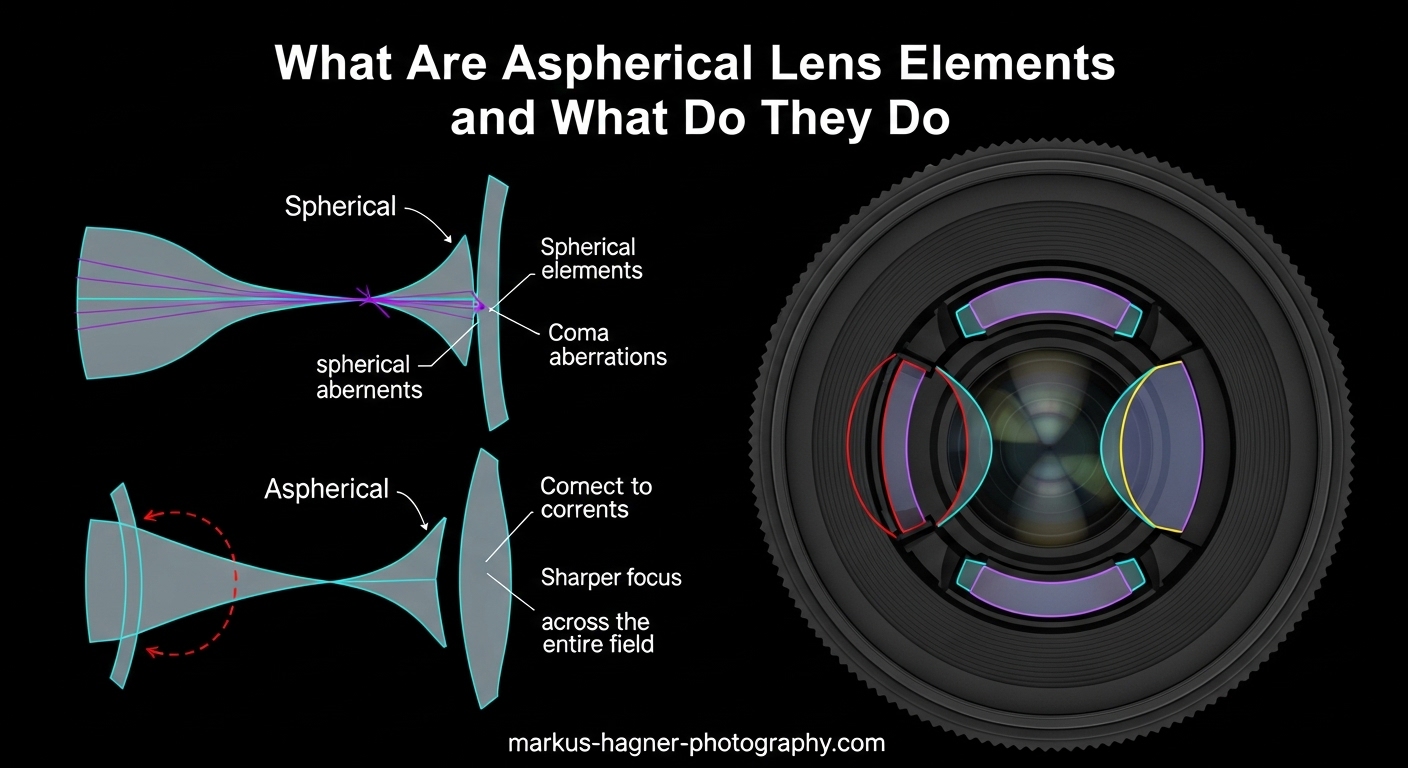
Aspherical lens elements are optical components with a surface curvature that changes gradually from the center to the edges, unlike traditional spherical lenses which have a uniform curve. This variable curvature corrects spherical aberration, ensuring all light rays converge at a single focal point for sharper images with better edge-to-edge performance. In this guide, I will explain exactly what aspherical lens elements do, how they work, and when they matter most for your photography.
When I first started learning about lens technology, I kept seeing “ASPH” markings on lens barrels and wondered what made these elements so special. After years of shooting with various lenses and researching optical design, I have come to appreciate why aspherical lens elements have become a cornerstone of modern lens manufacturing. Let me break down this technical topic in a way that actually makes sense for photographers.
Understanding aspherical lens elements helps you make better purchasing decisions and appreciate the engineering behind your favorite lenses. Whether you are shopping for a new wide-angle lens or simply curious about optical technology, this guide covers everything you need to know about aspherical lens elements and what they do.
The impact of aspherical technology extends throughout the photographic industry. From professional cinema lenses to smartphone cameras, aspherical elements have enabled optical designs that would have been impossible just a few decades ago. As sensor resolution continues to increase, the demand for lenses that can resolve fine detail across the entire frame makes aspherical correction more relevant than ever for serious photographers.
What Are Aspherical Lens Elements?
Aspherical lens elements are glass or plastic optical components whose surface profile deviates from a perfect sphere. The term “aspherical” simply means “not spherical,” but this seemingly simple difference has profound implications for image quality. Traditional spherical lenses have surfaces that form part of a perfect sphere, like a slice off a ball. Aspherical lenses, by contrast, have curves that change shape as you move from the center toward the edges.
Think of it this way: a spherical lens is like a dome with a consistent curve throughout. An aspherical lens is more sophisticated, with a curve that flattens or changes character near the periphery. This variable curvature is precisely calculated to bend light rays in a way that spherical surfaces simply cannot achieve.
The mathematical description of an aspheric surface involves what optical engineers call the conic constant and aspheric coefficients. Without getting too deep into the math, these values define exactly how the surface curvature changes across the lens. Different lens designs use different aspheric profiles depending on what optical problems they need to solve.
The deviation from spherical form can take several shapes. A paraboloid surface has a conic constant of -1 and perfectly focuses parallel light to a single point. Hyperboloid and ellipsoidal surfaces provide different correction characteristics. Most photographic lenses use more complex aspheric profiles that combine these basic shapes with higher-order polynomial corrections.
Historical Development of Aspherical Technology
Aspherical lens elements first appeared in photographic lenses decades ago, but early versions were extremely expensive and difficult to manufacture. Canon introduced the first aspherical lens element for SLR cameras in 1971 with the FD 55mm f/1.2 AL. This groundbreaking lens demonstrated what was possible with aspherical correction, though its high price reflected the manufacturing challenges of the era.
Early aspherical elements required grinding and polishing by hand, a time-consuming process that resulted in low yields and high costs. Only the most expensive professional lenses could justify the expense. Throughout the 1970s and 1980s, aspherical elements appeared primarily in exotic lenses from Leica, Zeiss, and other premium manufacturers.
The breakthrough came with precision glass molding technology in the 1990s. This manufacturing method allowed aspherical elements to be produced at scale, dramatically reducing costs. By the early 2000s, aspherical elements began appearing in consumer-grade lenses. Today, you will find aspherical lens elements in lenses from every major manufacturer at virtually every price point.
Canon, Nikon, Sony, Fujifilm, Panasonic, Olympus, Sigma, Tamron, and many other manufacturers all rely heavily on aspherical technology. They have become essential tools for lens designers seeking to create compact, high-performance optics that meet the demands of modern high-resolution sensors.
The Difference Between Aspherical and Spherical Elements
The fundamental difference between spherical and aspherical elements lies in their surface geometry. A spherical surface has constant curvature throughout, meaning any point on the surface lies at the same distance from an imaginary center point. This uniform curvature is simple to manufacture but creates optical problems when used for image formation.
An aspherical surface breaks this uniform pattern. The radius of curvature changes continuously from the optical axis toward the edges. This changing curvature is what enables aspherical elements to correct aberrations that spherical elements cannot. The manufacturing complexity is significantly higher, but the optical benefits justify the effort.
In a multi-element lens design, spherical and aspherical elements often work together. Spherical elements provide basic optical power and correction, while aspherical elements address specific aberrations that spherical designs cannot correct efficiently. The strategic placement of aspherical elements within the optical formula determines their effectiveness.
Understanding Spherical Aberration: The Problem Aspherical Elements Solve
To understand why aspherical lens elements matter, you first need to understand the problem they solve: spherical aberration. This optical defect occurs in all spherical lenses and has plagued lens designers since the earliest days of photography. Spherical aberration happens because spherical surfaces cannot focus all incoming light rays to a single point.
Here is what occurs inside a spherical lens: when parallel light rays enter the lens, rays passing through the center focus at one point, while rays passing through the periphery focus at a different point. The outer rays bend more than necessary, causing them to converge closer to the lens than the central rays. This creates a situation where there is no single, sharp focal point, resulting in images that appear soft or lacking in contrast.
The effect is most noticeable when shooting at wide apertures. At f/1.4 or f/1.8, spherical aberration can cause noticeable softness, especially when you examine the fine details in your images. Stopping down the aperture reduces the problem simply because you are blocking those problematic peripheral rays, but this limits your creative options and light-gathering capability.
Spherical aberration manifests in several ways that affect image quality. Images may appear soft or hazy, particularly in the mid-frequency details that give photographs their snap and clarity. Highlights can take on a glowing quality that robs contrast from your images. In severe cases, you might notice that your images never seem truly sharp, even at the optimal focus distance.
The Science Behind Spherical Aberration
Spherical aberration occurs because the angle at which light strikes a spherical surface varies from center to edge. When light enters a spherical lens, the refractive power effectively increases toward the periphery. This causes marginal rays, those passing through the outer portions of the lens, to focus at a point closer to the lens than paraxial rays, which pass through near the optical axis.
The result is a focal region rather than a focal point. Light converges over a range of distances rather than at a single plane. This spread of light reduces the concentration of energy at the intended focal point, decreasing image sharpness and microcontrast. In technical terms, spherical aberration affects the modulation transfer function (MTF) of the lens, reducing its ability to resolve fine detail.
Longitudinal spherical aberration refers to the spread of focal points along the optical axis. Lateral spherical aberration describes how this error varies across the image field. Both types contribute to image degradation, and both can be corrected or minimized through aspherical lens design.
How Spherical Aberration Affects Your Images
The visual impact of spherical aberration extends beyond simple softness. When examining images from lenses with significant spherical aberration, you may notice several characteristic flaws. Fine details in textures like fabric, foliage, or architecture lose definition. The overall image lacks the crisp appearance of a well-corrected lens.
Contrast suffers because light that should contribute to the image at the focal plane is instead scattered across a range of distances. This scattered light reduces the difference between light and dark areas, creating images that appear flat or hazy. The effect is particularly noticeable in challenging lighting conditions where contrast is already limited.
Focus shift is another consequence of spherical aberration. As you stop down the aperture, the effective focus point moves because you are using different portions of the lens. This can cause images focused wide-open to appear slightly out of focus when stopped down, requiring focus compensation that complicates the shooting process.
Why Modern Sensors Make Correction More Important
This optical defect becomes increasingly problematic as lens designs push toward wider maximum apertures and wider angle of view coverage. Fast prime lenses and ultra-wide-angle zooms face the greatest challenges with spherical aberration. Before aspherical elements became practical, lens designers had to use multiple corrective elements to minimize this aberration, resulting in larger, heavier, and more expensive lenses.
Modern high-resolution sensors have made spherical aberration correction even more critical. A 45-megapixel or 60-megapixel sensor demands lenses that can resolve detail at a level that would have been unimaginable in the film era. Spherical aberration that might have gone unnoticed on lower-resolution capture becomes glaringly obvious when images are viewed at 100% magnification on a high-megapixel camera.
The pixel density of contemporary sensors means that even small amounts of spherical aberration can spread light across multiple pixels, reducing the sharpness of each individual pixel. For photographers investing in high-resolution camera bodies, lenses with aspherical correction help ensure that the sensor’s resolving power is not wasted on optically inferior glass.
How Do Aspherical Lens Elements Work?
Aspherical lens elements solve spherical aberration by varying the surface curvature from the center to the edge of the lens. Instead of a uniform spherical curve, the aspheric surface is precisely shaped to bend peripheral light rays differently than central rays. This variable curvature ensures that all light rays, regardless of where they pass through the lens, converge at the same focal point.
The genius of aspherical design lies in its targeted correction. Near the optical axis, the surface may closely approximate a sphere. As you move toward the periphery, the curvature gradually changes. This change is calculated to compensate for the natural tendency of spherical surfaces to over-refract marginal rays. The result is a lens element that brings all light to a common focus.
Imagine the aspherical surface as having a flatter profile near the edges compared to what a sphere would have. This flatter profile reduces the refractive power at the periphery, counteracting the tendency of spherical surfaces to bend outer rays too strongly. The exact shape depends on the specific optical requirements of the lens design.
Light Ray Convergence Explained
With a properly designed aspherical element, parallel light rays entering the lens all meet at precisely the same point on the optical axis. This creates a true focal point rather than the focal region produced by spherical lenses. The practical benefit is immediately apparent: images become sharper, with better contrast and more detail resolution.
This improved light convergence also affects out-of-focus rendering. Lenses with well-corrected spherical aberration produce smoother, more pleasing bokeh because the light is properly concentrated at the focal point rather than spread across a range. Background highlights render as clean circles rather than showing the bright-ring effect sometimes seen in lenses with significant spherical aberration.
The concentration of light at a single focal point improves efficiency as well. More of the light gathered by the lens actually contributes to the image at the sensor plane. This can result in slightly brighter images at a given exposure setting, though the effect is usually small compared to the sharpness and contrast improvements.
The Conic Constant and Surface Profile
Optical engineers describe aspheric surfaces using mathematical formulas that go beyond simple spherical geometry. The surface profile is typically expressed as a base conic section (paraboloid, hyperboloid, or ellipsoid) modified by polynomial terms. The conic constant determines the basic shape of the curve, while additional coefficients fine-tune the surface for specific optical requirements.
A conic constant of zero describes a sphere. Negative values describe ellipsoids, paraboloids, and hyperboloids. Different conic constants correct different amounts of spherical aberration. For photographic lenses, the optimal conic constant depends on factors including the element position in the optical formula, the aperture of the lens, and the intended use of the correction.
The aspheric coefficients add further control over the surface shape. These higher-order terms allow lens designers to optimize the profile for complex correction requirements. A typical aspheric surface might be described by a conic constant plus four to eight aspheric coefficients, each controlling a different aspect of the curve.
The mathematical expression for an aspheric surface typically takes the form of a power series expansion. Each term in the series controls a specific aspect of the surface deviation from spherical. The fourth-order term might address basic spherical aberration, while higher-order terms correct residual errors and optimize performance across the entire aperture.
Element Position in the Optical Formula
The position of an aspherical element within a lens design significantly affects its contribution to aberration correction. An aspherical element near the front of the lens operates on light before it has been significantly modified by other elements. An aspherical element near the rear affects light that has already passed through most of the optical system.
Front-group aspherical elements are particularly effective for correcting distortion in wide-angle lenses. The light at this position enters at the most extreme angles, making geometric correction most efficient. Rear aspherical elements often focus on correcting spherical aberration and other residual errors that affect image quality at the sensor plane.
Complex lens designs may incorporate multiple aspherical elements at different positions, each addressing specific aberrations. A professional zoom lens might include two or three aspherical elements positioned strategically throughout the optical formula. This multi-element approach enables comprehensive correction across the entire zoom range and aperture range.
Why This Matters for Photographers
For photographers, the technical details matter less than the practical results. Aspherical lens elements deliver tangible improvements you can see in your images. Sharpness improves across the frame, not just at the center. Contrast increases, giving images more punch and dimensionality. Lenses can be made smaller and lighter while maintaining or exceeding the optical quality of older, larger designs.
I have shot extensively with lenses that use aspherical elements, and the difference is often visible in the final images. Wide-open performance in particular benefits significantly. A fast prime lens with aspherical correction can deliver usable results at f/1.4 or f/1.8 that would have been impossible with purely spherical designs from earlier eras.
The practical implication for lens selection is straightforward: when comparing similar lenses, the presence of aspherical elements generally indicates a design optimized for image quality. While not the only factor to consider, aspherical correction has become a reliable indicator of a manufacturer’s commitment to optical performance.
Key Benefits and Applications of Aspherical Lens Elements
Aspherical lens elements offer several important benefits that have made them essential in modern lens design. Understanding these advantages helps you appreciate why manufacturers emphasize aspherical elements in their marketing and why certain lens designs depend on them.
Improved Sharpness and Edge Performance
The most direct benefit of aspherical lens elements is improved image sharpness. By correcting spherical aberration at the source, aspherical elements deliver crisper images with better detail resolution. This improvement is most noticeable at wide apertures and toward the edges of the frame, where spherical aberration traditionally causes the greatest image degradation.
Edge performance is particularly important for wide-angle lenses and architectural photography, where corner-to-corner sharpness matters. Aspherical elements help maintain image quality across the entire field of view, producing photographs that remain sharp from center to corner. This uniform sharpness is something I always look for when evaluating lens performance.
The improvement in edge performance comes from correcting the spherical aberration that affects peripheral rays most severely. Before aspherical elements, lens designers often accepted compromised edge performance as the price for a compact, affordable lens. Modern aspherical designs can deliver excellent edge quality without the size and weight penalties of older approaches.
Compact Lens Design with Fewer Elements
Before aspherical elements became practical, lens designers corrected spherical aberration by adding more lens elements to the optical formula. These additional elements added weight, size, and potential for flare and internal reflections. Aspherical elements can replace multiple spherical elements while providing equivalent or superior aberration correction.
This reduction in element count translates directly to smaller, lighter lenses. Modern zoom lenses would be significantly bulkier without aspherical elements. A contemporary 24-70mm f/2.8 zoom with aspherical elements is far more manageable than an equivalent design using only spherical optics would be. For photographers who carry their gear for extended periods, this weight reduction matters.
Fewer elements also mean fewer air-to-glass surfaces where reflections can occur. Each element surface represents a potential source of flare and ghosting when bright light sources are in or near the frame. By achieving equivalent correction with fewer elements, aspherical designs can actually improve flare resistance compared to older multi-element spherical designs.
Wide-Angle Lens Benefits
Wide-angle lenses benefit enormously from aspherical elements. The wide field of view means light enters the lens at extreme angles, particularly at the edges of the frame. Spherical aberration becomes increasingly severe at these wide angles, making correction essential for acceptable image quality.
Retrofocus wide-angle designs for SLR and mirrorless cameras require significant optical correction due to the distance between the rear element and the sensor. Aspherical elements make it possible to design wide-angle lenses with excellent correction in a relatively compact package. Without aspherical technology, wide-angle lenses would either be much larger or would deliver noticeably inferior image quality.
Distortion correction represents another benefit for wide-angle lenses. Barrel distortion, where straight lines bow outward near the frame edges, is a common problem in wide-angle designs. Aspherical elements can help correct this distortion optically, reducing or eliminating the need for software correction in post-processing.
Fast Aperture Lens Benefits
Lenses with large maximum apertures face increased spherical aberration because more peripheral light enters the lens at wide apertures. An f/1.4 lens captures light from a much larger angle than an f/2.8 lens, meaning the spherical aberration problem scales with aperture width.
Aspherical elements make fast lenses practical by correcting this aberration at the source. A 50mm f/1.4 with an aspherical element can deliver excellent sharpness wide-open, whereas a purely spherical design would require significant stopping down to achieve similar results. This is why virtually all modern fast primes incorporate aspherical elements.
Portrait photographers particularly benefit from fast aperture performance. The ability to shoot at f/1.4 or f/1.8 with confidence in image quality enables the shallow depth of field effects that define portrait photography. Aspherical correction helps ensure that the in-focus portions of these images are rendered with maximum sharpness.
Zoom Lens Applications
Zoom lenses present unique challenges because they must maintain optical performance across a range of focal lengths. Spherical aberration varies with focal length, making correction complex. Aspherical elements provide a powerful tool for lens designers to optimize performance throughout the zoom range.
Many high-quality zoom lenses use multiple aspherical elements to address different aberrations at different focal lengths. A 24-70mm zoom might include one or two aspherical elements, while a superzoom covering an even wider range could use three or more. These elements help maintain consistent image quality as you zoom from wide to telephoto.
The constant-aperture zoom lenses favored by professionals depend heavily on aspherical technology. Maintaining f/2.8 across a 3x or 4x zoom range while delivering professional image quality requires sophisticated correction. Aspherical elements make these designs possible without the enormous size that would be required with purely spherical optics.
Distortion Correction
Beyond spherical aberration, aspherical elements can also help correct geometric distortion. Barrel distortion, common in wide-angle lenses, causes straight lines near the edges of the frame to bow outward. Pincushion distortion, more common in telephoto lenses, causes lines to bow inward.
By shaping the aspheric surface appropriately, lens designers can minimize these distortions optically rather than relying on software correction. While modern cameras can apply digital distortion correction, optical correction preserves more image quality and avoids the slight loss of resolution that comes with digital manipulation.
Architectural and product photographers particularly value distortion-free rendering. When photographing buildings or products with straight lines, even moderate distortion can be problematic. Lenses with aspherical elements designed for distortion correction deliver images that require less post-processing and maintain maximum detail across the frame.
Improved Contrast and Microcontrast
The correction of spherical aberration by aspherical elements improves overall image contrast. When light rays converge properly at the focal plane rather than being scattered, the difference between light and dark areas increases. This improved contrast gives images more visual impact and dimensionality.
Microcontrast, the ability to render fine tonal distinctions in small details, also benefits from aspherical correction. This characteristic contributes to the perceived sharpness and three-dimensional quality of images from well-corrected lenses. Photographers often describe images from lenses with good microcontrast as having a certain “pop” or clarity.
How Are Aspherical Lens Elements Manufactured?
The manufacturing of aspherical lens elements involves specialized techniques that are more complex and costly than producing spherical elements. Understanding these manufacturing methods explains why aspherical lenses cost more and why certain quality differences exist between lenses at different price points.
Precision Glass Molding
Precision glass molding is the most common method for producing aspherical elements for consumer camera lenses. This process involves heating glass preforms to a softened state and pressing them into precision-molded aspheric shapes. The molds themselves are created using diamond machining to achieve the required surface accuracy.
This method allows for high-volume production once the molds are created, making it economically viable for consumer and professional lenses. The glass used must have appropriate thermal properties to withstand the molding process without developing internal stresses or optical inhomogeneities. Modern molded glass aspheres can achieve excellent optical quality suitable for demanding photographic applications.
The quality of molded aspherical elements has improved dramatically over the years. Early molded elements sometimes showed slight variations or surface irregularities. Contemporary precision molding can produce elements with surface accuracies measured in fractions of a wavelength of light, suitable for even the most demanding professional applications.
Diamond Turning
Single-point diamond turning uses an ultra-precision lathe with a diamond cutting tool to machine the aspheric surface directly into the glass or optical plastic. This subtractive process can achieve extremely high surface accuracy and is often used for prototype production or small-batch manufacturing.
Diamond turning works particularly well for infrared optical materials and certain crystalline substances. For visible-light camera lenses, diamond-turned elements sometimes receive additional polishing to achieve the surface smoothness required for optimal image quality. This process is more expensive than molding but offers flexibility for specialized designs.
The diamond tool creates an exceptionally smooth surface as it cuts. However, the spiral tool path of a lathe can leave microscopic patterns that may affect optical performance at certain wavelengths. For this reason, diamond-turned elements used in visible light applications often undergo additional processing to remove these patterns.
Precision Polishing
Traditional precision polishing can produce aspherical surfaces, though it requires significantly more time and skill than polishing spherical elements. Computer-controlled polishing machines use small polishing tools guided by surface measurement data to selectively remove material and create the desired aspheric profile.
Magneto-rheological finishing (MRF) represents an advanced form of precision polishing. This technique uses a magnetically stiffened fluid as the polishing medium, allowing extremely precise control over material removal. MRF can achieve surface accuracies measured in nanometers, making it suitable for the most demanding optical applications.
Polished aspherical elements represent the highest quality but also the highest cost. This method is typically reserved for specialized applications or premium lenses where the ultimate optical performance justifies the expense. The surface quality from precision polishing can exceed that of molded elements, though modern molding has narrowed the gap significantly.
Hybrid Aspheres
Hybrid aspherical elements combine a spherical glass substrate with an aspherical resin layer applied to one surface. The resin, typically a UV-cured optical polymer, is molded to create the aspheric profile while the glass provides the primary optical power and durability.
This approach reduces manufacturing cost compared to full-glass aspheres and allows designs that would be difficult or impossible with glass alone. Hybrid elements are common in consumer-grade lenses where they provide aspherical benefits at accessible price points. The main limitation is that the polymer layer may have different thermal and aging characteristics than the surrounding glass.
Manufacturers have developed increasingly sophisticated hybrid technologies. Modern optical polymers offer improved stability and optical properties compared to earlier generations. Some premium lenses use hybrid elements for specific correction purposes where the combination of glass and polymer offers advantages over either material alone.
Cost Implications
The specialized manufacturing processes required for aspherical elements add cost compared to spherical elements. A single aspherical element can cost several times more to produce than an equivalent spherical element. This cost difference explains why budget lenses often use fewer aspherical elements, or smaller aspherical elements placed strategically in the optical path.
However, the overall cost impact on lens price is moderated by the fact that aspherical elements can replace multiple spherical elements while delivering superior performance. The net effect is often a lens that performs better at a similar or only slightly higher price point than would be possible with purely spherical designs.
The cost of aspherical manufacturing has decreased significantly as the technology has matured. What was once an exotic feature found only in professional lenses has become commonplace across the price spectrum. This democratization of aspherical technology has raised the baseline for lens quality throughout the industry.
Quality Variations at Different Price Points
Not all aspherical elements are created equal. The manufacturing method and quality control standards affect the optical performance of the finished element. Premium lenses typically use higher-precision manufacturing processes and more stringent quality selection.
Larger aspherical elements present greater manufacturing challenges than smaller ones. A large-diameter aspherical element for a fast wide-angle lens requires more precise manufacturing than a small element in a compact telephoto. This partly explains why fast wide-angle primes command premium prices despite often containing fewer elements than zoom lenses.
The surface accuracy specification indicates how closely the manufactured element matches the designed profile. Premium lenses may specify surface accuracy in terms of peak-to-valley error measured in fractions of a wavelength. Consumer lenses may accept larger tolerances that still provide significant improvement over spherical designs.
How to Identify Aspherical Lens Elements in Camera Lenses
One of the practical challenges photographers face is determining whether a particular lens contains aspherical elements. Manufacturers use various markings and specifications to indicate aspherical construction, but these are not always obvious. Here is how you can identify aspherical lens elements when evaluating lenses.
Lens Markings and Designations
Most manufacturers mark their lenses to indicate aspherical element usage. Look for abbreviations like ASPH, Aspherical, AL (Aspherical Lens), or similar designations on the lens barrel. These markings typically appear near the front element or on the side of the lens barrel where specifications are printed.
Leica lenses often carry ASPH designation directly in the name, such as the Summilux-M 35mm f/1.4 ASPH. Canon marks lenses with aspherical elements using “AL” or “GMo” (Glass Molded aspheric) in technical specifications. Nikon uses “AS” in their lens technology descriptions. Sony includes aspherical element information in their optical design diagrams and specifications.
Sigma designates aspherical elements in their lens names and specifications. Tamron includes aspherical element counts in their technical data. Fujifilm marks their aspherical elements in optical diagrams and specification sheets. Each manufacturer has their own convention, but the information is almost always available if you know where to look.
Specification Sheets and Marketing Materials
Lens specification sheets almost always list the number of aspherical elements in the optical formula. Look for language like “2 aspherical elements” or “including 1 aspherical element” in the product description. Manufacturers prominently feature aspherical elements in their marketing because these represent a quality feature.
Optical diagrams provided by manufacturers often show aspherical elements with a distinct marking, such as a different color or a specific notation. These diagrams reveal not just the presence of aspherical elements but their position in the optical path, which affects how they contribute to aberration correction.
The total element count specification typically breaks down spherical and aspherical elements separately. A specification reading “15 elements in 12 groups, including 2 aspherical elements” tells you both the overall complexity and the aspherical contribution. This information helps evaluate the optical sophistication of a lens design.
Popular Lenses with Aspherical Elements
Many popular lenses incorporate aspherical elements. Examples include the Canon EF 35mm f/1.4L II USM with its large Blue Spectrum Refractive (BR) optical element combined with aspherical design, the Nikon AF-S NIKKOR 24-70mm f/2.8E ED VR with three aspherical elements, and the Sony FE 55mm f/1.8 ZA with its aspherical element contributing to its renowned sharpness.
Even relatively affordable lenses like the Canon EF-S 18-55mm kit lens incorporate aspherical elements. This democratization of the technology means that many photographers benefit from aspherical correction without necessarily realizing it. Checking your lens specifications can reveal what technology is working in your current gear.
The Panasonic Lumix S Pro 50mm f/1.4 contains two aspherical elements that contribute to its exceptional optical performance. The Fujifilm XF 23mm f/1.4 R uses an aspherical element to achieve its characteristically sharp rendering. Understanding which lenses incorporate aspherical technology helps inform purchasing decisions based on optical priorities.
When Aspherical Elements Matter Most
Aspherical correction provides the greatest benefit in certain lens categories. Wide-angle lenses below 28mm equivalent focal length gain significant improvement from aspherical elements. Fast primes with maximum apertures of f/1.8 or wider depend on aspherical correction for wide-open performance. Professional zoom lenses require aspherical elements to maintain quality across their focal length range.
For slower telephoto lenses or normal focal length lenses at moderate apertures, aspherical correction provides less dramatic improvement. A 50mm f/2.8 lens might perform well with purely spherical design. The benefits scale with the optical challenges that spherical aberration presents.
Understanding when aspherical elements matter most helps prioritize lens selection. If you frequently shoot wide-open with fast primes or wide-angle lenses, prioritizing lenses with quality aspherical elements makes sense. For more moderate applications, the aspherical specification may be less critical to your decision.
Frequently Asked Questions
What do aspherical elements do?
Aspherical lens elements correct spherical aberration by ensuring all light rays converge at the same focal point. This improves image sharpness, especially towards the edges of the frame, and allows for more compact lens designs with fewer elements.
What is the purpose of aspheric lenses?
The primary purpose of aspheric lenses is to correct spherical aberration, an optical defect where light rays focus at different points depending on where they pass through the lens. This correction results in sharper images across the entire frame, particularly in wide-angle and fast-aperture lenses where the aberration is most pronounced.
What are the disadvantages of aspheric lenses?
The main disadvantages of aspherical lenses are higher manufacturing costs and more complex production processes compared to spherical elements. This cost increase is typically reflected in lens pricing. Additionally, hybrid aspherical designs using resin layers may have different long-term stability characteristics compared to all-glass construction.
Do aspherical lenses improve image quality?
Yes, aspherical lenses significantly improve image quality by correcting spherical aberration. This results in sharper, clearer images with better edge-to-edge performance and improved contrast. The improvement is particularly noticeable in wide-angle lenses and lenses with large maximum apertures, where spherical aberration causes the greatest image degradation.
Conclusion
Aspherical lens elements represent one of the most important advances in optical design for photographers. By correcting spherical aberration through variable surface curvature, these elements deliver sharper images with better edge performance while enabling more compact lens designs. Understanding what aspherical lens elements are and what they do helps you appreciate the engineering in your lenses and make more informed purchasing decisions.
When evaluating lenses for your photography kit, consider the presence and positioning of aspherical elements as one indicator of optical quality. While not the only factor determining image quality, aspherical correction plays a vital role in modern lens performance, particularly for wide-angle lenses, fast primes, and professional zooms. Check your lens specifications to discover what optical technology is already working in your current gear.
The evolution of aspherical technology from exotic professional feature to mainstream design element reflects its fundamental importance in optical engineering. As camera sensors continue to demand ever-higher resolution, lenses with aspherical correction will remain essential tools for photographers seeking the best possible image quality from their equipment.