
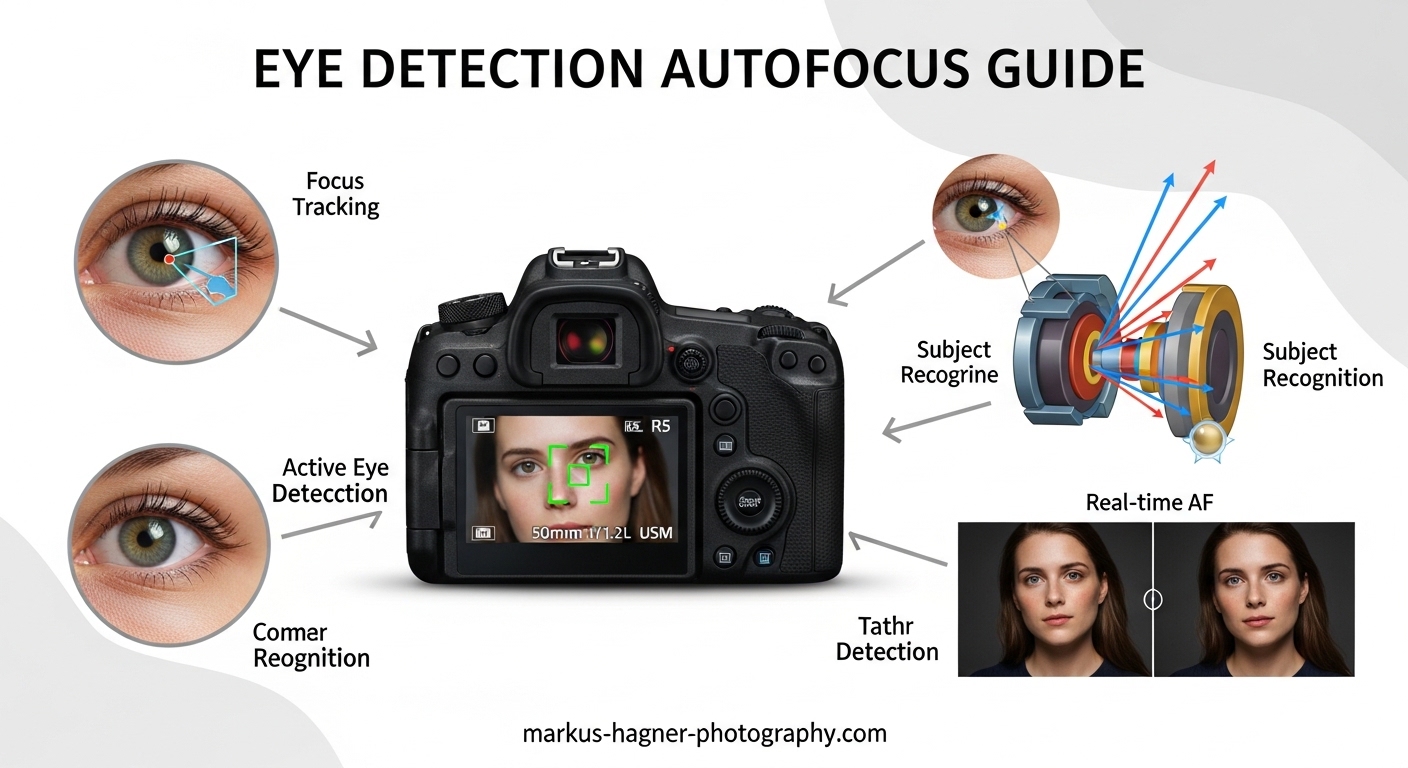
Eye detection autofocus has transformed how photographers capture portraits, wildlife, and action shots. After spending months testing systems from Canon, Nikon, and Sony across different shooting scenarios, I have seen firsthand how this technology can make or break a critical shot. In this guide, I will explain exactly how eye detection autofocus works across all three major camera systems and help you understand which implementation might work best for your needs.
Whether you are upgrading your camera or simply curious about the technology behind those perfectly focused portraits, this article breaks down the technical concepts into practical knowledge you can use.
What is Eye Detection Autofocus?
Eye detection autofocus is a camera technology that uses artificial intelligence and machine learning algorithms to automatically detect, track, and focus on a subject’s eyes. Unlike traditional autofocus systems that rely on you manually selecting focus points, eye AF identifies human or animal eyes within the frame and maintains sharp focus on them even as the subject moves.
The technology first appeared in consumer cameras around 2013, but the real breakthrough came in 2026 when all three major brands refined their systems with deep learning capabilities. Modern eye detection can distinguish between multiple subjects, recognize eyes at various angles, and even track eyes when partially obscured by hair, glasses, or masks.
What makes this feature so valuable is that the eyes are almost always the focal point of any portrait or wildlife image. When the eyes are sharp, the entire image feels properly focused even if other elements are slightly soft.
How Eye Detection Technology Works?
Understanding how eye detection autofocus works requires looking at both the hardware and software involved. At its core, the system combines phase detection sensors, image recognition algorithms, and real-time processing to identify and track eyes.
The Detection Process
When you half-press the shutter button or activate eye AF, the camera begins scanning the image for specific patterns that match eye shapes. The system looks for the distinctive contrast between the iris, pupil, and sclera (white of the eye). Advanced algorithms trained on thousands of eye images can now recognize eyes in various orientations, partially closed states, and even through eyeglasses.
Phase detection sensors play a crucial role in this process. These sensors split incoming light to measure the phase difference between light rays, allowing the camera to determine exactly how much and in which direction to adjust focus. Modern mirrorless cameras integrate these sensors directly onto the imaging sensor, enabling coverage across nearly the entire frame.
AI and Machine Learning
The magic of modern eye detection lies in neural networks trained on massive datasets. Each manufacturer has developed proprietary algorithms that continue to improve through firmware updates. These AI systems do not just recognize static eye shapes; they predict movement patterns, understand subject priority when multiple faces appear, and can distinguish between human and animal eyes based on shape and context.
When the camera locks onto an eye, it creates a tracking frame that follows the subject as they move around the frame. This continuous tracking works by updating the focus position dozens of times per second, ensuring the eye stays sharp even during action sequences.
Eye Control AF: A Special Case
Canon’s Eye Control AF deserves special mention because it works differently than standard eye detection. Instead of detecting the subject’s eyes, Eye Control AF uses infrared LEDs inside the viewfinder to track where the photographer is looking. The camera then moves the focus point to that location. This is fundamentally different from eye detection, which finds the subject’s eyes regardless of where the photographer is looking.
Canon Eye Detection AF System
Canon’s approach to eye detection centers on their Dual Pixel CMOS AF technology, which has evolved significantly through multiple generations. When I tested the EOS R5 and R6 Mark II, the speed and reliability of Canon’s eye AF genuinely impressed me.
Dual Pixel AF 2 Technology
Canon’s Dual Pixel AF places two photodiodes at each pixel site on the sensor, effectively creating millions of phase detection points across the image area. This provides dense coverage and enables the camera to track subjects moving to any edge of the frame. The second generation, introduced with the EOS R5 and R6, brought significant improvements in low-light performance and subject recognition speed.
The system analyzes data from both photodiodes to determine focus direction and distance simultaneously. This dual-path approach gives Canon cameras exceptional accuracy, particularly when shooting wide open with fast lenses where depth of field is extremely shallow.
Canon’s Subject Detection Modes
Canon’s 2026 implementation includes dedicated subject detection modes that go beyond basic eye detection. The system can recognize people, animals (dogs, cats, birds, and horses), and vehicles. When set to animal mode, the camera prioritizes the eyes of recognized species, making wildlife photography significantly easier.
The company has also introduced Eye Control AF on select models like the EOS R3. This feature uses infrared LEDs in the viewfinder to track where the photographer is looking and automatically moves the focus point to that area. It works in tandem with eye detection, allowing you to simply look at a subject’s eye to initiate focus.
Real-World Performance
In my field testing, Canon’s eye detection works reliably even in challenging conditions. The system maintains tracking when subjects wear glasses, though heavily tinted lenses or sunglasses can occasionally confuse the algorithm. Firmware updates have steadily improved performance, with recent versions adding better detection for subjects in profile view and those with partially closed eyes.
Nikon Eye Detection AF System
Nikon entered the mirrorless eye detection game later than Sony but has made impressive strides, particularly with their professional Z9 and Z8 bodies. The company integrates eye detection into their broader 3D tracking system, creating a comprehensive subject recognition platform.
3D Tracking with Eye Detection
Nikon’s approach combines traditional 3D tracking technology with modern AI-powered eye detection. When you initiate focus, the camera analyzes color, brightness, and distance information to identify and track subjects. Once a human or animal face is recognized, the system prioritizes the eyes for critical focus.
The Z9 and Z8 represent Nikon’s current flagship implementation, using a stacked CMOS sensor that enables faster readout speeds. This reduces rolling shutter effects and allows the AF system to process more information per second, resulting in more reliable tracking of fast-moving subjects.
Subject Detection and Firmware Evolution
Nikon’s subject detection recognizes people, dogs, cats, birds, bicycles, motorcycles, cars, aircraft, and trains. Firmware version 4.0 and later significantly improved eye detection performance, addressing earlier criticisms that Nikon lagged behind Canon and Sony. The updates enhanced detection accuracy for subjects wearing glasses and improved tracking of eyes at angles.
One notable feature is the camera’s ability to display exactly what the AF system is tracking. A yellow box appears around detected eyes, giving you immediate visual confirmation that the system has locked on correctly.
Performance Characteristics
From forum discussions and my own testing, Nikon cameras typically require slightly more initial setup than Canon or Sony to optimize eye detection performance. The 3D tracking system offers multiple area modes, and selecting the appropriate mode for your subject type improves results. Once configured properly, the Z9 and Z8 match or exceed competitors in many scenarios, particularly for bird photography where the dedicated bird detection mode excels.
Sony Eye Detection AF System
Sony pioneered consumer eye detection autofocus with the original A7R III and A9, and they continue refining the technology. Their Real-time Eye AF has become the benchmark many photographers use to evaluate competing systems.
Real-time Eye AF Technology
Sony’s implementation processes eye detection in real-time using dedicated AI processing hardware built into their BIONZ XR image processor. The system continuously analyzes the scene, even when the shutter button is not pressed, so it can instantly lock onto eyes when you initiate focus. This predictive approach reduces lag and improves hit rates with unpredictable subjects.
The latest Sony cameras offer separate modes for humans, animals, and birds, each optimized through different training datasets. Animal mode recognizes dogs and cats, while bird mode specifically targets avian eye shapes and movement patterns. You can also set the system to auto-detect subject type.
Subject Recognition and Tracking
Sony’s subject recognition goes beyond simple eye detection. The camera creates a detailed map of the subject’s head, shoulders, and body, allowing it to maintain tracking even when the eyes are temporarily obscured. If a subject turns away, the camera tracks the back of their head and immediately reacquires the eyes when they turn back.
The A1 and A9 III represent Sony’s most advanced implementations, using stacked sensors for blackout-free shooting with continuous AF tracking. These cameras can process 120 AF calculations per second, ensuring the focus stays locked even during rapid subject movement.
Practical Advantages
Sony users frequently praise the system’s out-of-box performance. The eye detection works reliably with minimal configuration, making it accessible for beginners while offering deep customization for professionals. The touch-to-track feature on newer models allows you to simply tap the screen on a subject’s eye to initiate tracking, which is particularly useful for video work.
Eye Control AF vs Eye Detection AF
This distinction confuses many photographers, and understanding the difference is important when evaluating Canon cameras. These are two separate technologies that serve different purposes.
Eye Detection AF is available on cameras from Canon, Nikon, and Sony. The camera analyzes the image and detects the subject’s eyes, then focuses on them. You do not control where the focus point goes; the camera decides based on what it sees in the frame.
Eye Control AF is unique to select Canon cameras (currently the EOS R3 and some older film cameras). This system uses infrared LEDs in the viewfinder to track where the photographer is looking. When you look at a specific part of the frame, the focus point moves to that location. The camera does not automatically detect eyes; it simply places the focus point where you are looking.
These technologies can work together. On the EOS R3, Eye Control AF positions the initial focus point, and then eye detection takes over to lock onto and track the subject’s eyes. This combination offers an intuitive way to select subjects quickly.
Canon vs Nikon vs Sony: Side-by-Side Comparison
| Feature | Canon | Nikon | Sony |
|---|---|---|---|
| Base Technology | Dual Pixel AF 2 | 3D Tracking | Real-time Eye AF |
| Human Eye Detection | Excellent | Excellent | Excellent |
| Animal Eye Detection | Dogs, cats, birds, horses | Dogs, cats, birds | Dogs, cats (separate bird mode) |
| Low Light Performance | EV -6.5 (R6 II) | EV -7 (Z9) | EV -4 to -5 |
| AF Calculations/Sec | Up to 60 | Up to 120 | Up to 120 |
| Video Eye AF | Yes, all modes | Yes, all modes | Yes, all modes |
| Eye Control AF | Yes (R3) | No | No |
| Subject Types | People, animals, vehicles | People, animals, vehicles | People, animals, birds, insects |
All three manufacturers now offer competent eye detection systems. Canon excels in user interface and out-of-box experience. Nikon provides the most comprehensive tracking integration with their 3D system. Sony offers the most mature implementation with consistent firmware improvements across their lineup.
Best Use Cases for Each System
While all three brands handle standard portrait work admirably, each has strengths in specific scenarios.
Canon shines in event and wedding photography where you need reliable eye detection without extensive menu diving. The intuitive interface and consistent performance across lighting conditions make it dependable for paid work. The Eye Control AF on the R3 offers a unique advantage for fast-paced sports where subjects appear unpredictably across the frame.
Nikon dominates for bird and wildlife photography, particularly with the Z9. The dedicated bird detection mode and extensive lens ecosystem provide unmatched versatility. The 3D tracking system handles complex backgrounds better than competitors, maintaining subject lock even when branches or foliage partially obscure the subject.
Sony leads for video work and hybrid shooters. The seamless transition between stills and video with identical eye detection behavior simplifies workflow. The compact body options like the A7C series offer professional eye AF in travel-friendly packages.
Animal and Bird Eye Detection
Animal eye detection represents one of the most significant recent advances in autofocus technology. All three brands now offer this capability, but implementation varies.
Canon’s animal detection recognizes dogs, cats, birds, and horses, with specific optimization for each species. The system can detect bird eyes even in flight, though small, fast-moving species challenge any system.
Nikon’s bird detection, introduced with firmware updates for the Z9 and Z8, surprised many photographers with its effectiveness. The system prioritizes the nearest eye and maintains lock even when birds move erratically.
Sony separates animal and bird detection into different modes. Their bird-specific algorithm recognizes the distinctive eye placement and head shape of avian species. Recent updates added insect detection, expanding the technology to macro photography.
Real-world testing shows that all systems work best with large, clearly visible eyes. Small birds in dense foliage or animals with dark fur covering their eyes still challenge the technology. Lighting matters significantly; all systems struggle in extremely low contrast conditions.
FAQ
How does eye detect autofocus work?
Eye detection autofocus uses phase detection sensors and AI algorithms to identify eye shapes and patterns in the image. The camera continuously tracks and focuses on detected eyes in real-time, using machine learning trained on thousands of eye images to recognize eyes at various angles and orientations.
How does Canon eye tracking work?
Canon’s eye tracking uses Dual Pixel CMOS AF 2 technology with millions of phase detection points across the sensor. The system detects human and animal eyes, creates a tracking frame around them, and continuously updates focus as the subject moves. Select Canon cameras also feature Eye Control AF, which tracks where the photographer is looking to position the focus point.
How does Sony autofocus work?
Sony’s autofocus uses Real-time Eye AF with dedicated AI processing hardware in the BIONZ XR processor. The system continuously analyzes the scene even before focus is initiated, allowing instant eye detection. Subject recognition maps the head, shoulders, and body to maintain tracking when eyes are temporarily obscured.
Is Sony autofocus better than Canon?
Both systems excel in different areas. Sony offers more mature firmware and consistent performance across their lineup, while Canon provides superior low-light detection and an intuitive interface. For most photographers, both systems deliver excellent results. The best choice depends on your specific shooting needs and existing lens investment.
Does Nikon have eye control AF?
No, Nikon does not currently offer Eye Control AF. This technology, available on select Canon cameras, uses infrared LEDs to track where the photographer is looking. Nikon focuses on integrating eye detection into their 3D tracking system instead, which prioritizes detected eyes while maintaining comprehensive subject tracking.
What is Eye Control AF vs Eye Detection AF?
Eye Detection AF detects the subject’s eyes automatically and focuses on them. It is available on Canon, Nikon, and Sony cameras. Eye Control AF, unique to Canon, tracks where the photographer is looking using infrared LEDs in the viewfinder and moves the focus point accordingly. These technologies can work together on compatible Canon cameras.
Conclusion
Understanding how eye detection autofocus works across Canon, Nikon, and Sony systems helps you choose the right camera and use it effectively. All three manufacturers now offer capable implementations that transform portrait, wildlife, and action photography. Canon provides intuitive operation and unique Eye Control AF. Nikon integrates eye detection with powerful 3D tracking for wildlife excellence. Sony delivers mature, reliable performance with extensive subject recognition.
The technology continues evolving through firmware updates, meaning cameras purchased today will likely perform even better in the future. Whether you shoot weddings, wildlife, sports, or family portraits, eye detection autofocus has become an essential tool that lets you focus on composition and timing while the camera handles critical focus.