
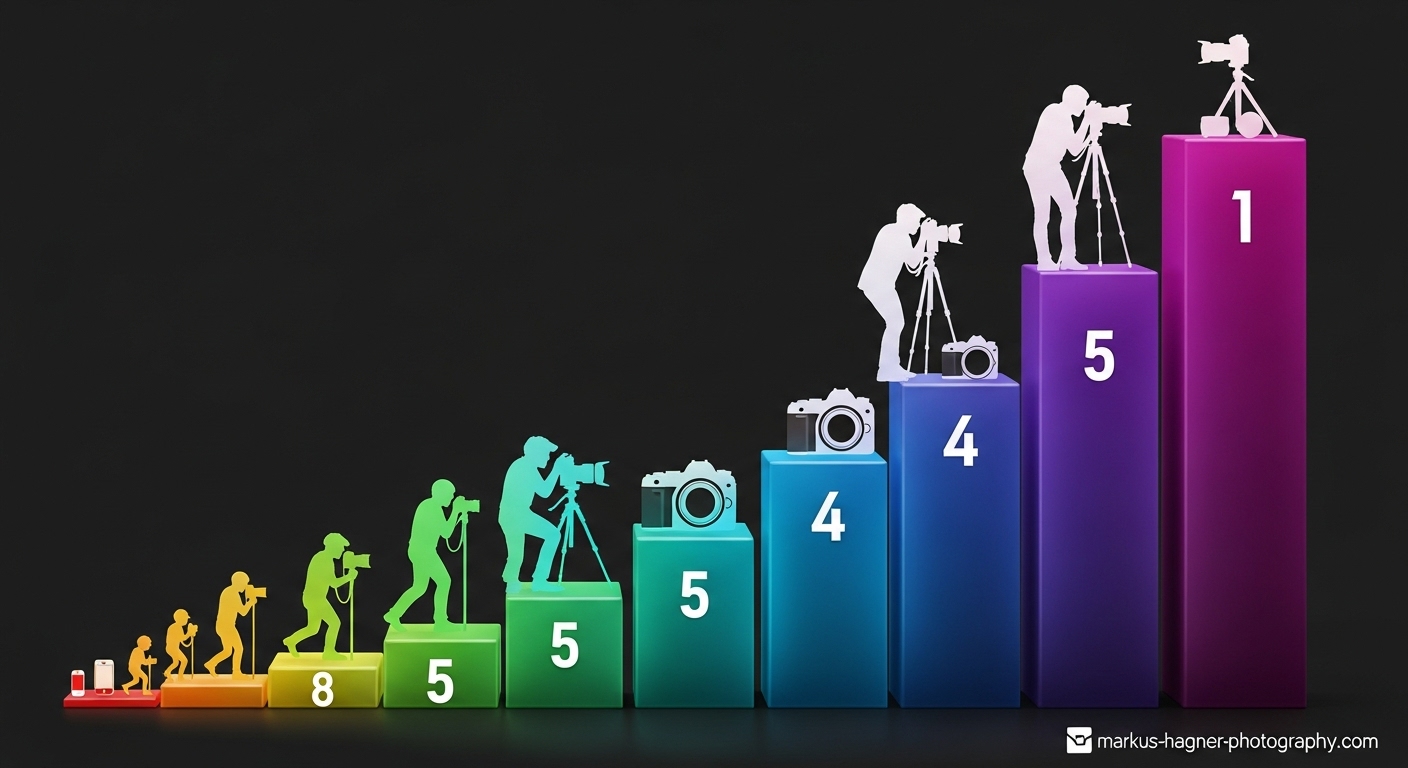
I’ve been exactly where you are right now—holding a camera, wondering where to begin, and dreaming of creating images that stop people in their tracks. Photography isn’t just about taking pictures; it’s a journey of growth, creativity, and self-discovery. Through my 15+ years behind the lens, I’ve identified seven distinct levels that every amateur photographer progresses through on their way to mastery. These levels aren’t rigid boxes but rather natural stages of growth that I’ve observed in countless photographers, including myself. Whether you’re just starting out or looking to break through to the next level, this comprehensive guide will walk you through each stage, complete with the challenges you’ll face, the skills you need to develop, and actionable tips to accelerate your progression. Let’s dive into the seven levels of the amateur photographer and discover how you can master your craft.
Understanding Photographer Progression: Why Levels Matter
Before we jump into the specific levels, I want to share why understanding this progression matters so much. When I first started photography, I felt overwhelmed and frustrated. I’d look at professional work and wonder if I’d ever reach that level. What I didn’t realize then was that photography mastery isn’t a single leap but a series of manageable steps.
The seven levels I’m about to share with you serve as a roadmap for your photographic journey. They help you:
- Assess where you currently stand in your photography development
- Identify specific skills you need to focus on at each stage
- Set realistic goals for your progression
- Avoid common pitfalls that trap photographers at each level
- Measure your growth objectively over time
I’ve seen too many photographers give up because they tried to skip levels or expected overnight success. Photography is a marathon, not a sprint. Each level builds upon the previous one, creating a solid foundation for sustainable growth. When I embraced this structured approach to my own development, I progressed faster and enjoyed the journey more.
Level 1: The Curious Beginner
Characteristics
The Curious Beginner is where every photographer starts. I remember my first days with a camera like they were yesterday—everything feels new, exciting, and slightly overwhelming. At this stage, you’re:
- Shooting primarily in auto mode
- Fascinated by the idea of capturing moments
- Excited but intimidated by your camera’s capabilities
- Taking snapshots of anything and everything that catches your eye
- Learning basic camera handling and composition
Common Challenges
Oh, the challenges of being a beginner! I faced all of these and more:
- Technical overwhelm: Your camera has more buttons than a spaceship, and the manual might as well be written in ancient Greek
- Inconsistent results: Some shots turn out okay while others are completely unusable
- Composition struggles: Your photos look like snapshots rather than intentional compositions
- Exposure issues: Too bright, too dark, or somewhere in between but rarely just right
- Gear confusion: You’re not sure what equipment you really need versus what’s just nice to have
Essential Skills to Focus On
Based on my experience teaching beginners, here’s what you should prioritize at Level 1:
- Camera familiarity: Learn where the essential buttons are and what they do
- Basic composition: Start with the rule of thirds and simple framing techniques
- Light awareness: Begin noticing how light affects your subjects
- Steady shooting: Practice holding your camera steady to reduce blur
- Subject selection: Learn to identify interesting subjects worth photographing
Personal Experience: My Beginner Days
I’ll never forget my first camera—a simple point-and-shoot that I thought was the most advanced piece of technology in the world. I took hundreds of photos of my cat, my backyard, and anything else that sat still long enough. Most were terrible, but a few showed promise. What kept me going was the pure joy of capturing a moment exactly as I saw it.
My biggest breakthrough came when I stopped trying to take “perfect” photos and started focusing on learning one thing at a time. I spent a whole week just practicing the rule of thirds. The next week, I focused only on finding good light. This slow, deliberate approach built a foundation that served me well as I progressed.
Level 2: The Enthusiastic Novice
Characteristics
Welcome to Level 2, where the real addiction begins! The Enthusiastic Novice has moved beyond pure curiosity and developed a genuine passion for photography. At this stage, you’re:
- Starting to experiment with semi-automatic modes (Aperture Priority, Shutter Priority)
- Learning basic composition rules and applying them consciously
- Beginning to understand the exposure triangle (aperture, shutter speed, ISO)
- Taking more intentional photos rather than random snapshots
- Seeking out feedback and learning resources
Common Challenges
I remember this stage well—it’s exciting but also frustrating. The challenges include:
- Knowledge overload: You’re learning so much that it’s hard to apply it all at once
- Inconsistent application: You understand the concepts but struggle to execute them consistently
- Gear temptation: You’re starting to believe that better gear will make you a better photographer
- Creative blocks: You know the rules but struggle to make creative images
- Comparison trap: You’re looking at other photographers’ work and feeling discouraged
Essential Skills to Focus On
To progress from Level 2 to Level 3, focus on these key areas:
- Exposure triangle mastery: Understand how aperture, shutter speed, and ISO work together
- Composition techniques: Move beyond the rule of thirds to leading lines, framing, and patterns
- Light quality recognition: Learn to see and work with different types of light
- Basic post-processing: Start learning simple editing techniques
- Genre exploration: Try different types of photography to find what you enjoy
Personal Experience: Breaking Through Auto Mode
My transition from Level 1 to Level 2 was marked by one pivotal moment: I turned the mode dial from Auto to Aperture Priority. Suddenly, I had control over depth of field, and my portraits began to look completely different. I remember shooting my friend’s wedding (as a guest, not the photographer) and experimenting with different aperture settings. The look on her face when I showed her the photos with that beautiful background blur—priceless!
This stage was also when I discovered the photography community online. I joined forums, followed photographers on social media, and absorbed everything I could. The feedback I received, though sometimes harsh, was invaluable for my growth. I learned that constructive criticism is a gift, not an insult.
Level 3: The Skillful Apprentice
Characteristics
Level 3 is where things start getting serious. The Skillful Apprentice has moved beyond basic understanding and is developing technical proficiency. At this stage, you’re:
- Shooting confidently in manual mode
- Understanding and controlling exposure in various lighting conditions
- Developing a more refined sense of composition
- Beginning to develop your own photographic style
- Taking on small photography projects or assignments
Common Challenges
This is where many photographers get stuck, and I was no exception. The challenges include:
- Technical perfectionism: You’re so focused on getting everything technically right that you sometimes miss the creative moment
- Creative stagnation: You know the rules so well that your photos start looking formulaic
- Gear acquisition syndrome (GAS): You’re convinced that the next lens or camera body will solve all your problems
- Plateau frustration: You feel like you’re not improving as quickly as you did in the earlier levels
- Style confusion: You’re trying different styles but haven’t found your unique voice yet
Essential Skills to Focus On
To break through to Level 4, concentrate on these advanced skills:
- Advanced exposure control: Master challenging lighting situations
- Artistic composition: Learn to break the rules intentionally for creative effect
- Light shaping: Begin using modifiers and understanding light direction
- Post-processing workflow: Develop a consistent editing style
- Project-based shooting: Work on themed series to develop consistency
Personal Experience: My Technical Breakthrough
Level 3 was both the most challenging and most rewarding stage for me. I remember spending countless hours reading about exposure, practicing in different lighting conditions, and analyzing my results. My breakthrough came during a landscape photography workshop where the instructor challenged us to shoot only in manual mode for an entire weekend.
I was frustrated at first—my photos were terrible! But by the end of the weekend, something clicked. I could look at a scene and know exactly what settings I needed before even raising the camera to my eye. That moment of technical mastery was exhilarating and opened up creative possibilities I hadn’t imagined.
This was also when I learned the hard way about gear acquisition syndrome. I spent a small fortune on lenses and accessories that I rarely used. Eventually, I realized that my creativity was limited not by my gear but by my vision. That realization alone was worth the price of admission to Level 3.
Level 4: The Confident Intermediate
Characteristics
Congratulations! You’ve reached Level 4, where photography starts to feel like an extension of yourself. The Confident Intermediate has solid technical skills and is developing creative confidence. At this stage, you’re:
- Creating technically sound images consistently
- Developing a recognizable personal style
- Experimenting with advanced techniques and genres
- Building a portfolio of work you’re proud of
- Starting to share your work more widely
Common Challenges
Even at this level, challenges persist. I faced these myself:
- Finding your voice: You’re competent technically but struggling to develop a unique style
- Creative ruts: You sometimes feel like you’re creating the same images over and over
- Imposter syndrome: You look at professional work and feel like you’ll never reach that level
- Portfolio pressure: You’re building a body of work but unsure which pieces represent your best
- Genre specialization: You’re good at several types of photography but haven’t found your niche
Essential Skills to Focus On
To advance to Level 5, focus on these creative and business skills:
- Style development: Identify what makes your work unique and emphasize it
- Advanced storytelling: Learn to create images that tell compelling stories
- Genre specialization: Choose one or two genres to master deeply
- Portfolio curation: Learn to select and present your best work effectively
- Basic business skills: If you’re considering going pro, start learning the business side
Personal Experience: Finding My Creative Voice
Level 4 was when I truly found my photographic voice. I had been shooting everything—landscapes, portraits, street, events—but nothing felt quite right. Then, during a trip to the American Southwest, I discovered my passion for environmental portraits and storytelling.
I remember one particular image that changed everything: a weathered rancher against the backdrop of his dying ranch. The technical execution wasn’t perfect, but the emotional impact was undeniable. That image taught me more about photography than all the technical knowledge I had accumulated. It showed me that photography isn’t just about capturing what something looks like—it’s about capturing what something feels like.
This was also when I started taking my portfolio seriously. I became ruthless in editing my work, keeping only the images that truly represented my vision. It was painful to delete so many photos, but the resulting portfolio was much stronger and more cohesive.
Level 5: The Advanced Hobbyist
Characteristics
Level 5 represents a significant leap in both technical skill and artistic vision. The Advanced Hobbyist produces work that rivals many professionals but may not pursue photography as a full-time career. At this stage, you’re:
- Creating consistently excellent images across various conditions
- Developing a sophisticated personal style
- Mastering advanced techniques and post-processing
- Building a substantial, high-quality portfolio
- Possibly selling some work or taking on paid assignments
Common Challenges
Even advanced photographers face hurdles. I’ve experienced these challenges:
- Creative burnout: You’re producing high-quality work but sometimes feel creatively exhausted
- Perfectionism paralysis: You’re so focused on creating perfect images that you sometimes miss opportunities
- Business vs. art balance: If you’re taking paid work, you struggle to maintain your artistic integrity
- Comparison with professionals: You’re producing professional-quality work but still don’t consider yourself a “pro”
- Motivation maintenance: Without external pressure, it’s sometimes hard to stay motivated
Essential Skills to Focus On
To prepare for Level 6, develop these advanced skills:
- Advanced post-processing: Master complex editing techniques and develop a consistent style
- Personal project development: Create meaningful bodies of work around themes you’re passionate about
- Teaching and mentoring: Start sharing your knowledge with others
- Exhibition preparation: Learn how to prepare work for display or publication
- Artistic statement development: Learn to articulate your photographic vision and philosophy
Personal Experience: Developing My Style
Level 5 was when I truly came into my own as a photographer. I had been shooting for years, but suddenly everything clicked. My technical skills were second nature, allowing me to focus entirely on creative expression. I remember working on a long-term project documenting small-town life in America. This project taught me more about photography than any single technique or piece of gear ever could.
I also started experimenting more with post-processing at this stage. Instead of just correcting exposure and color, I began using editing as an extension of my creative vision. I developed presets and workflows that gave my work a consistent look and feel.
This was also when I faced my biggest bout with creative burnout. I was shooting so much and putting so much pressure on myself to create “perfect” images that I started to dread picking up my camera. The breakthrough came when I gave myself permission to create “bad” art—images that were just for me, not for my portfolio or social media. That freedom reignited my passion and took my work to new heights.
Level 6: The Passionate Artist
Characteristics
Level 6 photographers have transcended technical mastery and are creating work with significant artistic merit. The Passionate Artist uses photography as a medium for personal expression and social commentary. At this stage, you’re:
- Creating work with a distinct artistic vision and voice
- Developing cohesive bodies of work around meaningful themes
- Exhibiting or publishing your work regularly
- Influencing other photographers and contributing to the photography community
- Possibly teaching workshops or writing about photography
Common Challenges
The artistic level brings its own set of challenges:
- Artistic integrity vs. commercial success: Balancing your artistic vision with market demands
- Originality pressure: Feeling like everything has been done before
- Imposter syndrome at a higher level: Even with recognition, you may doubt your artistic merit
- Time management: Balancing personal projects, teaching, and possibly client work
- Artistic evolution: Pressure to keep evolving and not become repetitive
Essential Skills to Focus On
To reach Level 7, master these professional and artistic skills:
- Advanced project management: Develop and execute complex, long-term projects
- Marketing and promotion: Learn to effectively market your artistic work
- Networking and relationship building: Build professional relationships in the art world
- Business management: If going pro, master the business side of photography
- Artistic innovation: Continuously push the boundaries of your work and experiment with new approaches
Personal Experience: Artistic Evolution
Level 6 marked a profound shift in my relationship with photography. I stopped thinking of myself as someone who takes pictures and started seeing myself as an artist who uses photography as a medium. This wasn’t an arrogant claim—it was a fundamental shift in how I approached my work.
I remember working on a project about climate change in coastal communities. This project required me to learn not just photography skills but also research, interviewing, and storytelling techniques. The resulting exhibition was the most rewarding creative experience of my life up to that point.
This was also when I started teaching photography workshops. I was nervous at first—who was I to teach others? But I discovered that teaching forced me to articulate what I knew intuitively, which deepened my own understanding. The questions my students asked challenged me and pushed my work in new directions.
The biggest challenge at this level was dealing with the pressure to constantly innovate. There’s a fear that if you’re not pushing boundaries, you’re stagnating. I learned to balance this pressure by giving myself permission to revisit and refine earlier ideas and techniques. Sometimes evolution looks like revolution, and sometimes it looks like deeper exploration.
Level 7: The Emerging Professional
Characteristics
Welcome to the final level! The Emerging Professional has made the leap (or is making the leap) from amateur to professional. This doesn’t necessarily mean photography is your full-time job, but you’re operating at a professional level in terms of skill, business practices, and market presence. At this stage, you’re:
- Running a photography business or operating as a professional freelancer
- Creating consistent, high-quality work for clients or the art market
- Managing all aspects of a professional photography practice
- Building a reputation and client base in your specialty
- Contributing to the broader photography community
Common Challenges
The professional level presents a whole new set of challenges:
- Business management: Learning to handle contracts, finances, and administration
- Client acquisition and retention: Building a steady stream of clients
- Work-life balance: Avoiding burnout while meeting client demands
- Market differentiation: Standing out in a crowded marketplace
- Artistic integrity under pressure: Maintaining your vision while satisfying client needs
Essential Skills to Focus On
At Level 7, focus on these business and professional skills:
- Business operations: Master the day-to-day management of your photography business
- Marketing and sales: Develop effective strategies to attract and retain clients
- Financial management: Learn pricing, budgeting, and financial planning
- Client relations: Master communication and relationship management
- Continuous professional development: Stay current with industry trends and techniques
Personal Experience: Going Pro
My transition to Level 7 was both exciting and terrifying. I had been shooting at a professional level for years, but making the leap to full-time professional felt like jumping off a cliff. I remember handing in my notice at my day job and feeling a mix of exhilaration and pure terror.
The first year was brutal. I learned more about business in those twelve months than I had in my entire previous career. I made mistakes—lots of them. I underpriced my work, overcommitted to projects, and neglected my marketing. But each mistake was a lesson, and gradually I built a sustainable business.
One of the biggest surprises was how little time I actually spent shooting. As a professional photographer, I spend maybe 20% of my time behind the camera. The rest is consumed by editing, client communication, marketing, accounting, and all the other aspects of running a business.
The most rewarding part of reaching Level 7 has been seeing my work have real impact. Whether it’s a couple cherishing their wedding photos for decades, a business using my images to grow their brand, or a gallery exhibition that moves viewers, my photography now serves purposes beyond my personal expression.
Comprehensive Comparison Table
To help you visualize the progression through all seven levels, here’s a comprehensive comparison table based on my research and personal experience:
| Level | Name | Key Skills | Typical Gear | Focus Areas | Common Challenges | Time to Progress |
|---|---|---|---|---|---|---|
| 1 | Curious Beginner | Basic camera handling, auto mode shooting | Smartphone or compact camera | Exploration, simple captures | Technical overwhelm, inconsistent results | 3-6 months |
| 2 | Enthusiastic Novice | Composition basics, mode switching | Entry-level DSLR or mirrorless | Rule of thirds, basic exposure | Knowledge overload, gear temptation | 6-12 months |
| 3 | Skillful Apprentice | Manual exposure, lighting basics | DSLR with kit lens, basic accessories | Technical mastery, exposure control | Perfectionism, creative stagnation | 1-2 years |
| 4 | Confident Intermediate | Creative composition, genre exploration | Mirrorless system, prime lenses | Style development, storytelling | Finding your voice, imposter syndrome | 2-3 years |
| 5 | Advanced Hobbyist | Advanced editing, portfolio development | Advanced mirrorless, specialized lenses | Personal projects, artistic expression | Creative burnout, perfectionism | 3-5 years |
| 6 | Passionate Artist | Thematic project development, teaching | Professional gear, specialized equipment | Artistic vision, community contribution | Artistic integrity, originality pressure | 5-8 years |
| 7 | Emerging Professional | Business management, client relations | Full-frame system, pro accessories | Marketing, service delivery | Business challenges, work-life balance | 8+ years |
This table represents typical progression, but remember that everyone’s journey is unique. Some photographers move through levels more quickly, while others linger at certain stages to develop specific skills. The important thing is to focus on your own growth rather than comparing yourself to others.
Accelerating Your Progression: Pro Tips
Based on my journey and observations of countless other photographers, here are proven strategies to accelerate your progression through the levels:
Practice with Purpose
Random shooting won’t get you to the next level. I learned this the hard way after years of taking thousands of photos without significant improvement. Instead, practice with specific goals:
- Set weekly challenges: Focus on one specific skill each week
- Project-based learning: Work on themed projects rather than random shots
- Deliberate practice: Identify your weaknesses and work specifically on them
Seek Quality Feedback
Feedback is essential for growth, but not all feedback is created equal. I’ve found that the most valuable feedback comes from:
- Professional critiques: Join workshops or seek out professional portfolio reviews
- Peer groups: Form or join photography groups with members at or slightly above your level
- Mentorship: Find a photographer whose work you admire and ask for guidance
Study the Masters
You can’t develop your own voice until you understand what has come before. I’ve spent countless hours studying the work of master photographers across different genres and eras. This doesn’t mean copying their work—it means understanding their techniques, their approach to light and composition, and their unique vision.
Embrace Failure
Every level has its failures, and I’ve had plenty. The key is to reframe failure as learning. Some of my biggest breakthroughs came after my most frustrating failures. When a shoot doesn’t go well, instead of getting discouraged, ask yourself:
- What went wrong technically?
- What could I have done differently?
- What did I learn that I can apply next time?
Develop a Learning Routine
Consistency is crucial for skill development. I’ve found that establishing a regular learning routine helps me progress faster than sporadic, intensive study sessions. My routine includes:
- Daily shooting: Even if it’s just 15 minutes with my phone
- Weekly study: Reading articles, watching tutorials, or analyzing great photos
- Monthly review: Evaluating my progress and setting new goals
Common Pitfalls to Avoid at Each Level
Having guided many photographers through these levels, I’ve identified common pitfalls that can stall your progression. Here’s what to watch out for at each stage:
Level 1 Pitfalls
- Gear obsession: Thinking you need expensive equipment to start
- Perfectionism: Expecting professional results immediately
- Comparison: Looking at professional work and feeling discouraged
- Information overload: Trying to learn everything at once
Level 2 Pitfalls
- Rule dependency: Following composition rules rigidly without understanding why
- Technical tunnel vision: Focusing so much on settings that you miss the creative moment
- Gear acquisition syndrome: Believing new gear will solve your creative challenges
- Shooting in isolation: Not seeking feedback or community
Level 3 Pitfalls
- Technical perfectionism: Sacrificing creativity for technical correctness
- Style imitation: Copying other photographers’ styles rather than developing your own
- Shooting everything: Not specializing or developing depth in any genre
- Neglecting post-processing: Focusing only on capture and ignoring the power of editing
Level 4 Pitfalls
- Creative plateau: Creating competent but unremarkable work
- Portfolio paralysis: Being unable to edit your work effectively
- Genre hopping: Not committing to developing expertise in specific areas
- Isolation: Not engaging with the broader photography community
Level 5 Pitfalls
- Creative burnout: Pushing too hard and losing the joy of photography
- Commercial pressure: Compromising your vision for market acceptance
- Teaching too soon: Sharing knowledge before you’ve fully mastered it yourself
- Stagnation: Repeating successful formulas rather than evolving
Level 6 Pitfalls
- Artistic isolation: Working in a vacuum without external feedback
- Over-intellectualization: Getting lost in concepts rather than creating
- Neglecting craft: Focusing so much on concepts that technical skills suffer
- Resistance to change: Clinging to a successful style rather than evolving
Level 7 Pitfalls
- Business overwhelm: Letting administrative tasks consume all your time
- Underpricing: Not valuing your work appropriately
- Overcommitment: Taking on too much work and compromising quality
- Losing the love: Letting business pressures kill your passion for photography
Also Read: Tamron 28-200mm vs Sony 24-240
Gear Recommendations by Level
One of the most common questions I get is about gear. While gear doesn’t make the photographer, having the right tools for your level can definitely help your progression. Here are my recommendations based on each level:
Level 1 Gear Recommendations
- Camera: Any smartphone with a good camera or a basic point-and-shoot
- Essential accessories: None needed at this stage
- Focus: Learning composition and basic camera handling
Level 2 Gear Recommendations
- Camera: Entry-level DSLR or mirrorless camera
- Lens: Kit lens (18-55mm or similar)
- Essential accessories: Basic camera bag, extra battery, memory cards
- Focus: Understanding exposure and basic composition
Level 3 Gear Recommendations
- Camera: Mid-range DSLR or mirrorless with full manual controls
- Lens: Kit lens plus a prime lens (50mm f/1.8 is excellent and affordable)
- Essential accessories: Tripod, basic flash, remote shutter release
- Focus: Technical mastery and lighting basics
Level 4 Gear Recommendations
- Camera: Advanced enthusiast DSLR or mirrorless
- Lens: 2-3 quality lenses covering your preferred focal lengths
- Essential accessories: Speedlight, basic modifiers, quality tripod
- Focus: Developing style and creative expression
Level 5 Gear Recommendations
- Camera: Professional-grade crop sensor or entry full-frame camera
- Lens: High-quality primes and zoom lenses for your specialty
- Essential accessories: Advanced lighting equipment, specialized filters
- Focus: Artistic development and portfolio building
Level 6 Gear Recommendations
- Camera: Professional full-frame camera
- Lens: Professional-grade lenses optimized for your style
- Essential accessories: Complete lighting system, specialized equipment for your genre
- Focus: Artistic projects and professional development
Level 7 Gear Recommendations
- Camera: Professional full-frame or medium format system
- Lens: Premium lenses specific to your professional needs
- Essential accessories: Complete professional kit including backup systems
- Focus: Professional service delivery and business efficiency
Remember that these are general guidelines. The best gear is what helps you create the images you envision. I’ve seen stunning images created with basic equipment and mediocre images made with the most expensive gear. Focus on mastering what you have before upgrading.
Building Your Photography Portfolio Through the Levels
Your portfolio evolves as you progress through the levels. Here’s how to approach portfolio development at each stage:
Level 1 Portfolio
- Focus: Learning and experimentation
- Content: 10-15 of your best images, regardless of subject or style
- Purpose: Document your starting point and early progress
- Platform: Simple online gallery or social media account
Level 2 Portfolio
- Focus: Technical improvement and composition
- Content: 15-20 images showing understanding of basic techniques
- Purpose: Track your technical progress
- Platform: Personal website or dedicated portfolio platform
Level 3 Portfolio
- Focus: Technical mastery and consistency
- Content: 20-25 technically excellent images
- Purpose: Demonstrate your technical skills
- Platform: Professional portfolio website with basic categorization
Level 4 Portfolio
- Focus: Style development and creative expression
- Content: 25-30 images showing emerging personal style
- Purpose: Attract your first clients or exhibition opportunities
- Platform: Professional website with artist statement
Level 5 Portfolio
- Focus: Artistic vision and project development
- Content: 30-40 images including project series
- Purpose: Gallery representation or specialized client work
- Platform: Sophisticated website with project galleries
Level 6 Portfolio
- Focus: Artistic statement and community contribution
- Content: 40-50 images representing your best artistic work
- Purpose: Establish your artistic reputation
- Platform: Professional website with exhibition history and artist statement
Level 7 Portfolio
- Focus: Professional service and client work
- Content: 50+ images including both personal and client work
- Purpose: Attract high-end clients and gallery representation
- Platform: Comprehensive professional website with client list and testimonials
Also Read: Fujifilm Xt3 Vs Sony A7Iii
Community and Learning Resources
No photographer progresses in isolation. Here are resources I’ve found valuable at each level:
Level 1 Resources
- Online courses: Basic photography courses on platforms like Udemy or Skillshare
- Books: “Understanding Exposure” by Bryan Peterson
- Communities: Local photography clubs, online beginner forums
- Practice: Daily photo challenges, local photo walks
Level 2 Resources
- Workshops: Local photography workshops and classes
- Books: “The Photographer’s Eye” by Michael Freeman
- Communities: Flickr groups, specialized photography forums
- Practice: Weekly themed projects, peer review groups
Level 3 Resources
- Advanced courses: Specialized technique workshops
- Books: “Vision & Voice: Refining Your Vision” by David duChemin
- Communities: Professional photography associations, critique groups
- Practice: Personal projects, portfolio reviews
Level 4 Resources
- Mentorship: One-on-one mentoring with established photographers
- Books: “Within the Frame” by David duChemin
- Communities: Professional networks, art photography groups
- Practice: Exhibition opportunities, collaborative projects
Level 5 Resources
- Advanced workshops: Master classes with renowned photographers
- Books: “The Photographer’s Playbook” edited by Jason Fulford
- Communities: Professional organizations, gallery networks
- Practice: Teaching opportunities, artist residencies
Level 6 Resources
- Professional development: Business courses for artists
- Books: “Art & Fear” by David Bayles and Ted Orland
- Communities: Professional art organizations, curator networks
- Practice: Curatorial projects, speaking engagements
Level 7 Resources
- Business coaching: Professional business coaching
- Books: “Business for Unconventional Creatives” by Sean Low
- Communities: Professional associations, industry networks
- Practice: Mentorship, industry leadership
FAQ Section
How long does it take to progress through all 7 levels?
The journey through all 7 levels typically takes 8+ years, but everyone progresses at their own pace. Some photographers move through levels more quickly, while others linger at certain stages to develop specific skills. The important thing is to focus on your own growth rather than comparing yourself to others.
Can I skip levels or progress faster?
While it’s possible to progress more quickly with dedicated practice and quality instruction, each level builds on the previous one. Trying to skip levels often results in gaps in your knowledge and skills that will hold you back later. Focus on mastering each level before moving to the next.
Do I need expensive gear to reach higher levels?
No! While having appropriate gear for your level can help, it’s not the most important factor. I’ve seen photographers create stunning work with basic equipment and mediocre work with expensive gear. Focus on mastering your craft with whatever gear you have before upgrading.
How do I know when I’m ready to move to the next level?
You’re ready to move to the next level when you’ve consistently mastered the skills of your current level and are feeling challenged rather than overwhelmed by the next level’s requirements. Trust your instincts—if you’re feeling bored or stagnant, it’s probably time to push yourself.
Can I be at different levels in different genres?
Absolutely! It’s common to be at different levels in different areas of photography. You might be at Level 5 in portrait photography but only Level 3 in landscape photography. This is normal and reflects the different amounts of time and energy you’ve invested in each genre.
Is it necessary to reach Level 7 to be a successful photographer?
Not at all! Success in photography means different things to different people. Some photographers are perfectly happy and successful staying at Level 5 as advanced hobbyists. Others may reach Level 3 and find that’s enough for their needs. Define success on your own terms.
How important is formal education in photography progression?
Formal education can accelerate your progression, but it’s not necessary. Many successful photographers are self-taught. What matters more is your dedication to learning, practicing deliberately, and seeking quality feedback regardless of whether it comes through formal education or self-directed study.
What’s the biggest mistake photographers make when trying to progress?
The biggest mistake I see is focusing too much on gear and technical skills while neglecting artistic development and personal vision. Technical skills are important, but they’re only tools for expressing your unique vision. Balance technical learning with creative exploration.
Conclusion
Photography is a journey without a final destination. Even as I write this as a Level 7 photographer, I’m still learning, growing, and discovering new aspects of this incredible craft. The seven levels I’ve shared with you aren’t rigid boxes but rather guideposts for your journey.
Remember that progression isn’t linear. You may find yourself moving back and forth between levels as you explore new genres or face new challenges. That’s not just normal—it’s healthy. Each time you revisit a level, you bring new experience and perspective that makes the journey richer.
The most important advice I can give you is to stay curious, keep practicing, and never lose sight of why you picked up a camera in the first place. Whether you’re a Level 1 beginner just starting out or a Level 7 professional running a business, the joy of photography comes from the process of creation and discovery.
I encourage you to bookmark this guide and return to it as you progress. Use it as a roadmap, but don’t be afraid to take detours and explore side roads. Your unique journey is what will make your photography special.
Now pick up your camera, whatever level you’re at, and go create something amazing. The world needs your unique vision, and there’s no better time to start sharing it than right now.