
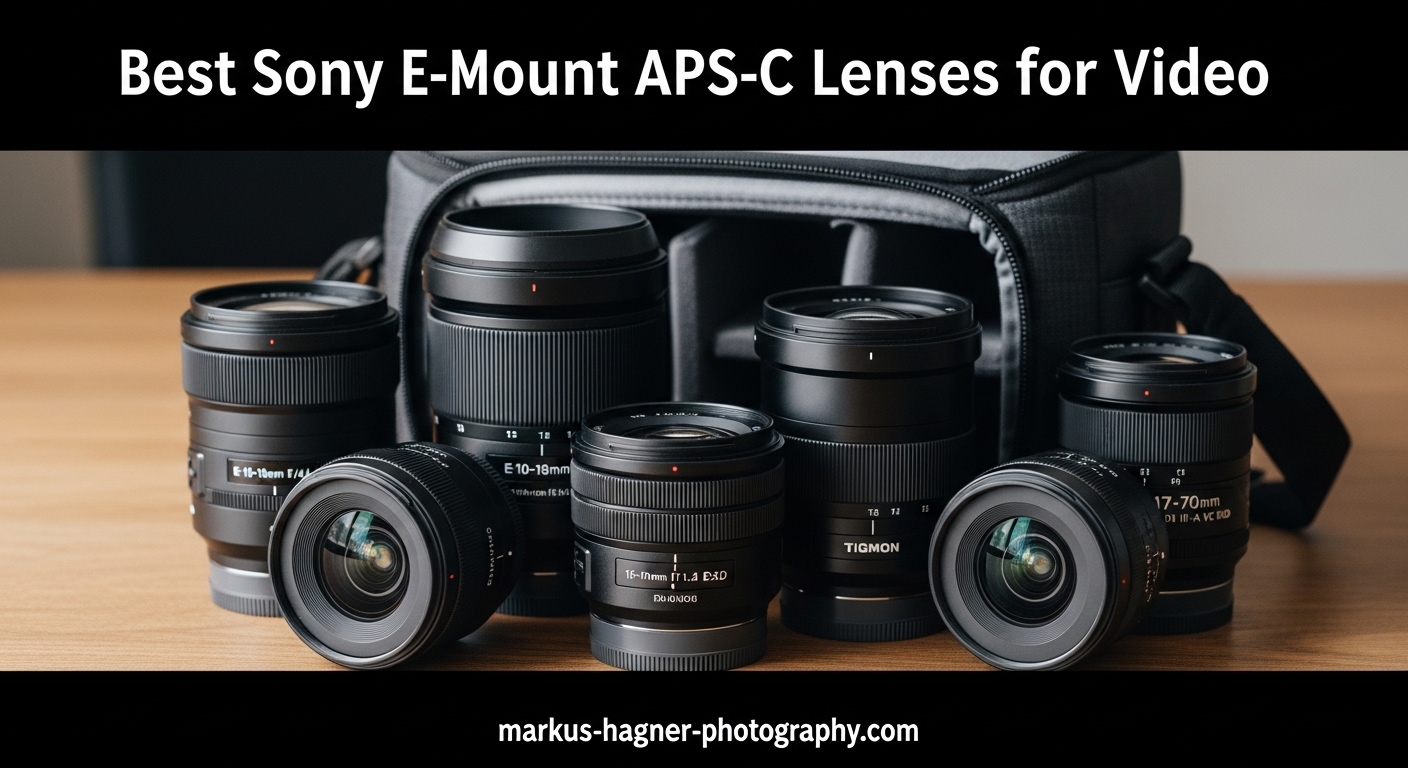
Finding the best Sony E-Mount APS-C lenses for video can feel overwhelming when you are staring at dozens of options. I have been shooting video on Sony APS-C cameras for the past four years, starting with the a6400 and now using the a6700 and FX30. Through hundreds of shoots, I have learned which lenses actually deliver for video work and which ones just look good on paper.
Sony APS-C cameras like the a6400, a6600, a6700, ZV-E10, and FX30 have become incredibly popular among content creators and indie filmmakers. The combination of compact size, excellent autofocus, and high-quality 4K video makes them perfect for run-and-gun filmmaking. But the lens you choose matters just as much as the camera body.
In this guide, I will walk you through 15 lenses I have either owned or extensively tested. These range from budget-friendly primes under $200 to premium zooms that cost over $1,500. Whether you are just starting out or looking to upgrade your kit, you will find honest recommendations based on real-world video shooting experience.
Table of Contents
- Top 3 Picks for Best Sony E-Mount APS-C Lenses for Video
- Best Sony E-Mount APS-C Lenses for Video in 2026
- 1. Sigma 18-50mm f/2.8 DC DN Contemporary – Best All-Around Video Zoom
- 2. Sigma 30mm f/1.4 DC DN Contemporary – Best Standard Prime for Low Light
- 3. Viltrox 56mm f/1.7 E – Best Budget Portrait Lens
- 4. Sigma 16mm f/1.4 DC DN Contemporary – Best Wide-Angle Prime
- 5. Tamron 17-70mm f/2.8 Di III-A VC RXD – Best Stabilized Zoom
- 6. Sigma 56mm f/1.4 DC DN Contemporary – Best Premium Portrait Lens
- 7. Sony 16-55mm f/2.8 G – Best Premium Native Zoom
- 8. Sigma 10-18mm f/2.8 DC DN Contemporary – Best Ultra-Wide Zoom
- 9. Viltrox 9mm f/2.8 – Best Ultra-Wide Budget Prime
- 10. Viltrox 15mm f/1.7 – Best Wide-Angle Budget Prime
- 11. Viltrox 35mm f/1.7 – Best Budget Standard Prime
- 12. Sony 18-135mm f/3.5-5.6 OSS – Best All-in-One Travel Lens
- 13. Tamron 18-300mm f/3.5-6.3 – Best Superzoom for Video
- 14. Sony FE 50mm f/1.8 – Best Full-Frame Compatible Budget Prime
- 15. TTArtisan 25mm f/2 – Best Manual Focus Budget Lens
- How to Choose the Best Sony E-Mount APS-C Lens for Video In 2026?
- APS-C vs Full-Frame Lens Compatibility
- Understanding Crop Factor (1.5x)
- Constant Aperture vs Variable Aperture
- Power Zoom vs Manual Zoom for Video
- Image Stabilization Considerations
- Autofocus Motors: Silent vs Noisy
- Focus Breathing: What to Watch For
- Gimbal Balance and Weight
- Weather Sealing for Outdoor Work
- Budget Tiers and Lens Combinations
- Frequently Asked Questions
- Final Thoughts
Top 3 Picks for Best Sony E-Mount APS-C Lenses for Video
Before diving into the full list, here are my top three recommendations based on different needs and budgets. I have selected these after comparing sharpness, autofocus performance, build quality, and value for video work.

Sigma 18-50mm f/2.8 DC DN
- Constant f/2.8 aperture
- Compact 290g design
- 27-75mm equivalent
- Zero coating optics

Sigma 30mm f/1.4 DC DN
- Fast f/1.4 aperture
- 9 rounded aperture blades
- Stepping motor for quiet AF
- 45mm equivalent focal length
Best Sony E-Mount APS-C Lenses for Video in 2026
Here is a quick comparison of all 15 lenses to help you see the key specifications at a glance. I have organized them by type and use case to make your decision easier.
| Product | Specifications | Action |
|---|---|---|
| Sigma 18-50mm f/2.8 |
|
Check Latest Price |
| Sigma 30mm f/1.4 |
|
Check Latest Price |
| Viltrox 56mm f/1.7 |
|
Check Latest Price |
 Sigma 16mm f/1.4 Sigma 16mm f/1.4 |
|
Check Latest Price |
 Sony 16-55mm f/2.8 G Sony 16-55mm f/2.8 G |
|
Check Latest Price |
 Sigma 56mm f/1.4 Sigma 56mm f/1.4 |
|
Check Latest Price |
 Sony 18-135mm f/3.5-5.6 Sony 18-135mm f/3.5-5.6 |
|
Check Latest Price |
 Sigma 10-18mm f/2.8 Sigma 10-18mm f/2.8 |
|
Check Latest Price |
 Viltrox 15mm f/1.7 Viltrox 15mm f/1.7 |
|
Check Latest Price |
 Viltrox 9mm f/2.8 Viltrox 9mm f/2.8 |
|
Check Latest Price |
 Viltrox 35mm f/1.7 Viltrox 35mm f/1.7 |
|
Check Latest Price |
 Tamron 17-70mm f/2.8 Tamron 17-70mm f/2.8 |
|
Check Latest Price |
 Tamron 18-300mm Tamron 18-300mm |
|
Check Latest Price |
 Sony 50mm f/1.8 FE Sony 50mm f/1.8 FE |
|
Check Latest Price |
 TTArtisan 25mm f/2 TTArtisan 25mm f/2 |
|
Check Latest Price |
1. Sigma 18-50mm f/2.8 DC DN Contemporary – Best All-Around Video Zoom
Pros
- Compact and lightweight at 290g
- Constant f/2.8 aperture throughout zoom range
- Excellent sharpness for the price
- Gimbal-friendly size
- Fast and accurate autofocus
Cons
- No image stabilization
- Zoom and focus rings close together
I have been using the Sigma 18-50mm f/2.8 for over a year now, and it has become my go-to lens for most video projects. At just 290 grams, it is incredibly lightweight, which makes handheld shooting and gimbal work a breeze. The constant f/2.8 aperture means I can zoom in without worrying about losing light, which is essential when shooting in changing conditions.
The focal range translates to 27-75mm in full-frame equivalent terms, covering everything from moderately wide shots to medium telephoto. I use this lens for interviews, b-roll, and even some documentary work. The image quality rivals lenses that cost twice as much, and the build quality feels solid despite the compact size.
What impresses me most is the sharpness across the frame. Even at f/2.8, corners are usable, and by f/4, the image is tack sharp from edge to edge. For video work, this consistency matters because you are often reframing shots and need reliable performance throughout the zoom range.
The autofocus is fast and accurate, keeping up with Sony’s excellent face and eye detection. I have used this lens for talking head videos where the subject moves around, and the focus tracking is reliable. The stepping motor is quiet enough that it does not interfere with audio recording in most situations.
Who Should Buy This Lens
This lens is perfect for content creators who need versatility without sacrificing image quality. If you shoot a mix of vlogs, interviews, and b-roll, the 18-50mm covers all the bases. It is especially well-suited for gimbal operators and travel filmmakers who need to keep their kit light.
The lack of image stabilization means you will want a camera with in-body stabilization (IBIS) like the a6600, a6700, or FX30. Without IBIS, handheld footage can get shaky, especially at the longer end of the zoom.
Gimbal Compatibility and Balance
One of the standout features of this lens is how well it balances on smaller gimbals. I have used it on a DJI RS3 Mini with excellent results. The lightweight design means the motors do not have to work hard, giving you smoother movements and better battery life.
The compact size also makes it ideal for the ZV-E10, a6700, and FX30. Unlike larger zooms that make these small cameras front-heavy, the Sigma 18-50mm maintains good balance for handheld shooting.
2. Sigma 30mm f/1.4 DC DN Contemporary – Best Standard Prime for Low Light
Pros
- Outstanding low-light performance
- Beautiful bokeh with 9 rounded blades
- Very sharp even wide open
- Fast and accurate AF
- Compact size
Cons
- No weather sealing
- Some chromatic aberration wide open
- Slight vignetting
The Sigma 30mm f/1.4 is widely considered the best value prime lens for Sony APS-C cameras, and after shooting with it for two years, I completely agree. This lens lives on my camera for about 60% of my shoots because it delivers such versatile results.
The 45mm equivalent focal length hits a sweet spot for video work. It is wide enough for environmental shots but tight enough for intimate interviews without distortion. The f/1.4 aperture opens up creative possibilities that slower lenses simply cannot match, especially when shooting in natural light.
I have shot everything from weddings to corporate interviews with this lens. The shallow depth of field at f/1.4 creates beautiful separation between subject and background, giving footage a cinematic quality. The nine rounded aperture blades produce smooth, pleasing bokeh that does not get distracting or busy.
The autofocus performance is excellent for a third-party lens. It keeps up with face detection and eye AF on modern Sony bodies, making it reliable for run-and-gun situations. The stepping motor is nearly silent, which is crucial when recording dialogue.
Best Use Cases for Video
This lens excels in low-light environments where you need to keep ISO levels manageable. I have shot indoor events at f/1.4 with ISO 800, getting clean footage that would require ISO 3200 or higher with an f/2.8 lens. The difference in noise levels is significant.
For interview work, the 45mm equivalent focal length gives a flattering perspective without the distortion you get from wider lenses. It is also excellent for product shots, food video, and detail work where you want to isolate the subject from the background.
Focus Breathing and Autofocus Performance
Focus breathing, where the field of view changes as you shift focus, is minimal on this lens. This is important for video work because excessive breathing can be distracting when rack focusing between subjects. The Sigma 30mm handles focus transitions smoothly.
The autofocus is responsive and accurate. I have used it for gimbal work where the camera is moving, and the focus tracking keeps up well. It is not quite as fast as Sony’s native lenses, but the difference is negligible in real-world use.
3. Viltrox 56mm f/1.7 E – Best Budget Portrait Lens
Pros
- Excellent sharpness wide open
- Fast f/1.7 aperture
- Very lightweight at 170g
- STM silent motor
- Great value for money
Cons
- No built-in stabilization
- Minor focus noise audible in quiet environments
- Slight vignetting wide open
Viltrox has been making waves in the Sony E-mount ecosystem with their affordable yet capable primes. The 56mm f/1.7 is their portrait offering, and at around $180, it delivers performance that rivals lenses costing three times as much.
I picked this lens up six months ago skeptical about third-party autofocus performance, but I have been genuinely impressed. The 85mm equivalent focal length is perfect for interviews, close-ups, and any situation where you want to compress the background and isolate your subject.
The optical quality surprised me. Wide open at f/1.7, the center sharpness is excellent, and while there is some vignetting in the corners, it is easy to correct in post if needed. Stopped down to f/2.8, the image is sharp across the frame with minimal aberrations.
The STM stepping motor is quiet and smooth, making it suitable for video work where audio quality matters. Eye and face detection work reliably on my a6700, though it is not quite as snappy as native Sony glass.
Portrait Video Applications
The 85mm equivalent focal length is the classic portrait length for good reason. It flatters faces without the distortion of wider lenses and creates beautiful background separation. For video interviews, this is my go-to lens when I have enough space to work.
The f/1.7 aperture gives you plenty of control over depth of field. You can throw backgrounds completely out of focus for a cinematic look or stop down slightly when you need more of your subject in focus. The nine aperture blades create smooth, round bokeh that looks professional.
Build Quality Considerations
At 170 grams, this lens is incredibly light. The construction feels solid despite the low price, with a metal mount and good tolerances. The focus ring has a nice dampened feel that is useful when you want to manually focus for video.
There is no weather sealing, so I would be cautious using it in heavy rain or dusty conditions. For controlled environments and light outdoor work, it holds up well. The included lens hood is a nice touch at this price point.
4. Sigma 16mm f/1.4 DC DN Contemporary – Best Wide-Angle Prime
Pros
- Ultra-fast f/1.4 aperture
- Excellent for low-light and astro
- Very sharp across frame
- Weather resistant design
- Fast Hybrid AF compatible
Cons
- No image stabilization
- Some chromatic aberration wide open
- Bulky for a prime
When you need to go wide and capture as much light as possible, the Sigma 16mm f/1.4 is the lens to beat. At 24mm equivalent, it is wide enough for vlogging, real estate, and astrophotography while the f/1.4 aperture handles dark environments with ease.
I have used this lens extensively for night sky time-lapses and interior video work. The combination of wide angle and fast aperture is rare at this price point. Sony’s 16mm f/1.8 GM costs over $800 more, making the Sigma an outstanding value.
The build quality is impressive. It is larger than other Sigma Contemporary primes, feeling more substantial in the hand. The weather-resistant design gives peace of mind when shooting outdoors, and the 67mm filter thread matches other lenses in my kit.
Image quality is excellent. Even wide open, the center is sharp, and the corners clean up nicely by f/2.8. For video work, this means you can shoot at f/1.4 when light is scarce and still get usable footage.
Vlogging and Wide-Angle Applications
The 24mm equivalent focal length is the sweet spot for vlogging. You can hold the camera at arm’s length and still get yourself in frame without excessive distortion. The fast aperture also helps blur the background slightly, even at wide angles.
For real estate video, this lens captures entire rooms without needing to shoot from corners. The lack of extreme barrel distortion keeps lines straight, which is important for architectural work.
Astrophotography and Night Video
This is one of the best lenses available for astrophotography on APS-C. The f/1.4 aperture gathers significantly more light than f/2.8 alternatives, allowing shorter exposures or lower ISO settings. I have captured stunning Milky Way time-lapses with this lens that would be impossible with slower glass.
The coma performance is good for a lens this fast. Stars stay round even in the corners, which is not always the case with budget-friendly fast lenses.
5. Tamron 17-70mm f/2.8 Di III-A VC RXD – Best Stabilized Zoom
Pros
- Built-in VC image stabilization
- Extended 70mm reach
- Constant f/2.8 aperture
- Moisture-resistant construction
- Close focusing capability
Cons
- Heavier than alternatives at 525g
- No full weather sealing
- AF slightly slower than native lenses
The Tamron 17-70mm f/2.8 is unique among APS-C zooms because it combines a constant f/2.8 aperture with built-in vibration compensation (VC). For cameras without IBIS, like the ZV-E10 or a6400, this stabilization is a game-changer for handheld video work.
I have been shooting with this lens for about eight months, and the extra reach to 70mm (105mm equivalent) has proven more useful than I expected. While the Sigma 18-50mm is more compact, the Tamron’s additional telephoto range makes it more versatile for events and documentary work.
The VC stabilization is effective, giving me 3-4 stops of handholdability for stills. For video, it smooths out minor shakes and makes handheld footage much more usable. Combined with Sony’s Active Mode stabilization in newer cameras, you can get remarkably stable footage without a gimbal.
Optically, the lens is excellent. It uses high-quality elements including GM aspherical lenses, and the sharpness rivals Sony’s own G-series glass. The 16-element design keeps aberrations well controlled.
VC Stabilization for Handheld Video
For video shooters using cameras without IBIS, the VC in this lens is essential. It smooths out the micro-jitters that plague handheld footage, making your shots look more professional. I can shoot usable handheld video at 70mm, which would be nearly impossible without stabilization.
The stabilization is quiet and does not interfere with audio recording. It works well for walking shots and minor camera movements, though for running or fast movement, you will still want a gimbal.
Weather Sealing for Outdoor Work
The moisture-resistant construction and fluorine coating make this lens suitable for outdoor work. I have used it in light rain and dusty conditions without issues. The sealing is not as comprehensive as professional-grade lenses, but it is better than most alternatives in this price range.
The close focusing capability is impressive. At 17mm, you can focus as close as 7.5 inches, allowing for dramatic wide-angle close-ups that add variety to your video work.
6. Sigma 56mm f/1.4 DC DN Contemporary – Best Premium Portrait Lens
Pros
- Ultra-sharp even wide open
- Beautiful bokeh rendering
- Compact and lightweight
- Silent autofocus
- Excellent build quality
Cons
- No image stabilization
- Higher price than Viltrox alternative
If you are serious about portrait video and have the budget, the Sigma 56mm f/1.4 is worth the premium over the Viltrox. This lens delivers professional-grade image quality in a compact package that is perfect for Sony APS-C cameras.
The 84mm equivalent focal length is ideal for flattering portraits and interviews. The compression helps separate subjects from backgrounds, and the f/1.4 aperture gives you tremendous control over depth of field. At this focal length, backgrounds dissolve into smooth bokeh that looks truly cinematic.
Sharpness is outstanding. Even at f/1.4, this lens produces tack-sharp images with excellent contrast. The rendering is slightly different from the 30mm, with a bit more “pop” that makes subjects stand out. Colors are accurate and skin tones look natural.
The autofocus is fast and reliable. I have used this lens for wedding videography where subjects move unpredictably, and the focus tracking keeps up well. The stepping motor is whisper-quiet.
Shallow Depth of Field for Cinematic Look
The combination of 84mm equivalent focal length and f/1.4 aperture creates incredibly shallow depth of field. You can isolate a subject’s eyes while letting everything else fall out of focus. This look is difficult to achieve with zoom lenses and is one of the main reasons to invest in this prime.
For interview work, this lens produces a professional look that elevates your production value. The background separation helps viewers focus on your subject without distractions.
Silent Autofocus for Interviews
The quiet autofocus motor is crucial for interview situations where you cannot have focus noise polluting your audio. I have recorded interviews in quiet rooms where lens noise would be unacceptable, and this lens performs flawlessly.
Eye detection works reliably, keeping focus on your subject’s eyes even as they move slightly. This automation lets you focus on directing rather than pulling focus manually.
7. Sony 16-55mm f/2.8 G – Best Premium Native Zoom
Pros
- Exceptional optical quality
- Fast XD linear motors
- Weather sealed construction
- Constant f/2.8
- Superior bokeh
Cons
- 598
- Heavy at 494g
- No image stabilization
Sony’s 16-55mm f/2.8 G is the professional standard for APS-C zooms. If you need the absolute best optical quality and autofocus performance, this is the lens to get. It comes at a premium price, but for working professionals, the investment pays off.
I have used this lens on commercial shoots where image quality cannot be compromised. The corner-to-corner sharpness is superior to third-party alternatives, and the color rendition has that characteristic Sony G lens look that requires minimal color correction.
The build quality is outstanding. Weather sealing, metal construction, and smooth damped rings make this feel like a professional tool. It is significantly heavier than the Sigma 18-50mm, which is the trade-off for the premium construction and extended wide end.
The XD linear motors are the fastest and quietest autofocus system I have used on an APS-C lens. Focus transitions are instantaneous and silent, making this ideal for gimbal work and situations where you cannot manually focus.
XD Linear Motors for Video AF
The XD linear motors represent the current state of the art for lens autofocus. They are significantly faster than stepping motors and completely silent. For video work, this means the focus transitions happen without any audible motor noise or hunting.
Combined with Sony’s latest autofocus algorithms, this lens tracks subjects with uncanny accuracy. I have used it for sports and action video where subjects move erratically, and the hit rate is impressively high.
G Lens Optical Quality
The optical design includes advanced aspherical elements and ED glass that suppress aberrations. The result is clean, contrasty images with minimal chromatic aberration. For video work, this means less time fixing issues in post.
The bokeh from the 9-blade circular aperture is smoother and more pleasing than less expensive alternatives. When you do shoot wide open, the out-of-focus areas look professional rather than distracting.
8. Sigma 10-18mm f/2.8 DC DN Contemporary – Best Ultra-Wide Zoom
Pros
- Ultra-wide constant f/2.8
- Compact for the focal range
- Dust and splash resistant
- Excellent sharpness
- Close focusing capability
Cons
- No image stabilization
- Limited to wide angles
For vloggers, real estate videographers, and anyone who needs to go extremely wide, the Sigma 10-18mm f/2.8 is a fantastic option. It covers a 15-27mm equivalent range, giving you true ultra-wide capability while maintaining the constant f/2.8 aperture.
I added this lens to my kit for real estate video work, and it has become essential for that purpose. The ability to capture entire rooms and tight spaces without distortion makes a huge difference in production quality. The constant aperture also means consistent exposure when zooming during video recording.
The lens is compact considering its capabilities. It is smaller than many standard zooms and balances well on APS-C bodies. The dust and splash-resistant construction adds durability for location work.
Optically, it delivers the sharpness I expect from Sigma’s Contemporary line. Distortion is well controlled for such a wide lens, and the close focusing capability (7.1 inches) lets you create dramatic perspectives.
Real Estate and Architecture Video
This lens excels at real estate video where you need to make rooms look spacious without extreme distortion. The 10mm end captures wide views while the optical design keeps lines relatively straight. For architectural work, this control over perspective is valuable.
The constant f/2.8 aperture helps in dimly lit interiors. You can shoot natural-looking footage without cranking ISO or adding artificial light, which is important when you want spaces to look authentic.
Vlogging and Self-Recording
For vloggers using the ZV-E10 or similar cameras, this lens is wide enough to capture yourself and your surroundings while holding the camera at arm’s length. The f/2.8 aperture provides some background separation even at wide angles.
The quiet autofocus motor will not interfere with your audio, and the compact size keeps the overall setup manageable for handheld shooting.
9. Viltrox 9mm f/2.8 – Best Ultra-Wide Budget Prime
Pros
- Extremely wide 113.8 degree view
- Compact and lightweight
- 0.13m close focus
- Good value
- Fast autofocus
Cons
- No image stabilization
- Some distortion at edges
- Fixed ultra-wide focal length
When you need to go extremely wide on a budget, the Viltrox 9mm f/2.8 delivers. At 13.5mm equivalent with a 113.8-degree field of view, this lens captures perspectives that most lenses cannot touch. It is a specialty tool, but one that opens up creative possibilities.
I have used this lens for creative wide shots, vlogging in tight spaces, and real estate video where I need to show entire rooms from corner to corner. The f/2.8 aperture is impressive for a lens this wide at this price point.
The build quality is good for the price, with a metal mount and solid construction. At 175 grams, it is lightweight and unobtrusive on the camera. The STM motor provides quiet autofocus suitable for video work.
Image quality is impressive for such an extreme focal length. There is some distortion and vignetting, but that is expected and manageable in post-processing. The center sharpness is excellent, and the corners are usable by f/4.
Extreme Wide Angle for Creative Shots
This focal length is not for everyday shooting, but when you need it, nothing else will do. I have used it for dramatic establishing shots, creative vlogging angles, and situations where I simply cannot back up any further. The perspective exaggerates distances and can make ordinary scenes look cinematic.
For skateboarding and action sports video, this lens gets close to the action while maintaining context of the surroundings. The close minimum focus distance lets you shoot subjects inches from the front element.
Close Focus Capability
The 0.13m minimum focusing distance is remarkable. You can get extremely close to subjects while still maintaining the ultra-wide perspective. This creates unique images with exaggerated foreground elements that draw viewers into the frame.
For product video and detail shots, this capability adds variety to your footage. The f/2.8 aperture still provides some background blur even at this wide focal length when focusing close.
10. Viltrox 15mm f/1.7 – Best Wide-Angle Budget Prime
Pros
- Fast f/1.7 aperture
- Wide 84.9 degree view
- Lightweight at 180g
- STM silent motor
- Affordable price
Cons
- No image stabilization
- Some chromatic aberration
- Not as wide as 9mm alternative
The Viltrox 15mm f/1.7 fills an important gap in the budget lens lineup. It provides a moderately wide 22.5mm equivalent focal length with a fast f/1.7 aperture, making it ideal for low-light wide shooting without the extreme distortion of ultra-wide lenses.
I find this focal length more versatile than the 9mm for general video work. It is wide enough for vlogging and environmental shots but not so wide that faces get distorted or backgrounds become insignificant. The f/1.7 aperture is a full stop faster than most wide zooms.
The STM stepping motor is quiet and smooth, perfect for video work. Autofocus is reliable with face and eye detection, though not quite as fast as native Sony lenses. For most video applications, it performs well enough.
Build quality is solid for the price. The lens feels well-made with a metal mount and smooth focus ring. At 180 grams, it is barely noticeable on the camera.
Low Light Wide-Angle Performance
The f/1.7 aperture makes this lens exceptional for low-light wide shooting. I have used it for indoor events, night street photography, and astrophotography where wider lenses would force higher ISO settings. The ability to shoot at f/1.7 keeps noise levels manageable.
For video work in dimly lit venues, this lens is invaluable. You can capture wide shots without the grain that comes from cranking ISO, preserving image quality in challenging conditions.
STM Motor for Silent AF
The stepping motor is genuinely quiet. I have recorded interviews with the camera just feet from the subject, and the autofocus noise is inaudible. This is crucial for professional video work where audio quality cannot be compromised.
The focus ring has a nice dampened feel for manual focusing when needed. The short throw makes quick focus pulls possible, useful for creative video effects.
11. Viltrox 35mm f/1.7 – Best Budget Standard Prime
Pros
- Fast f/1.7 aperture
- Versatile 52.5mm equivalent
- Lightweight design
- Eye AF support
- Great value
Cons
- No image stabilization
- Some CA in high contrast
- Plastic construction
The Viltrox 35mm f/1.7 sits in the middle of their prime lens lineup, offering a standard 52.5mm equivalent focal length at a very attractive price. This is a versatile focal length that works for many video applications.
I have found this lens particularly useful for documentary work and run-and-gun shooting where you need a focal length that handles various situations. The 52.5mm equivalent is slightly tighter than the classic 50mm, which can be flattering for interviews while still being wide enough for environmental shots.
The f/1.7 aperture provides excellent low-light capability and background separation. At around $179, this lens offers performance that would have cost several times more just a few years ago. The STM motor is quiet and reliable for video work.
Image quality is good, with decent sharpness wide open that improves when stopped down. There is some chromatic aberration in high-contrast situations, but it is correctable in post.
Documentary and Run-and-Gun Filmmaking
The moderate telephoto perspective of 52.5mm equivalent is ideal for documentary work. You can capture subjects without getting too close, which is often necessary when you cannot control your shooting environment. The fast aperture helps in unpredictable lighting conditions.
For event videography, this focal length isolates subjects from busy backgrounds. The lightweight design means you can shoot handheld for extended periods without fatigue.
Bokeh Quality Assessment
The nine-blade aperture produces reasonably smooth bokeh. It is not as creamy as more expensive lenses, but at this price point, the performance is impressive. The f/1.7 aperture gives you plenty of control over depth of field for creative effects.
Background blur is sufficient for separating subjects in interview situations, though it does not have the extreme shallow depth of field of the 56mm lenses.
12. Sony 18-135mm f/3.5-5.6 OSS – Best All-in-One Travel Lens
Pros
- Massive 7.5x zoom range
- Built-in OSS stabilization
- Lightweight at 326g
- Sharp optics
- Quiet autofocus
Cons
- Variable aperture f/3.5-5.6
- Loses light when zooming
- Not weather sealed
Sometimes you need one lens that can handle everything, and the Sony 18-135mm delivers. With a 7.5x zoom range covering 27-202.5mm equivalent, this lens eliminates the need to carry multiple lenses while traveling or shooting events.
I keep this lens in my bag for situations where changing lenses is not practical. Travel video, documentary work in unpredictable environments, and event coverage are all situations where the versatility outweighs the variable aperture limitation.
The built-in Optical SteadyShot (OSS) is valuable for handheld video work, especially on cameras without IBIS. It smooths out minor shakes and makes handheld footage more usable. Combined with the long reach, you can get stable shots at 135mm that would be difficult otherwise.
Image quality is surprisingly good for a superzoom. Sony’s optical design includes aspherical and ED elements that maintain decent sharpness throughout the range. It is not as sharp as the Sigma 18-50mm, but it is more than adequate for most video work.
Travel Video Convenience
For travel video, this lens is hard to beat. You can shoot wide establishing shots and tight details without changing lenses. In dusty or wet conditions, keeping one lens on the camera protects the sensor and reduces the risk of missing a shot while swapping glass.
The compact size (just 326 grams) means it does not add much weight to your kit. You can travel light while still having focal length coverage that would normally require three or more prime lenses.
OSS Stabilization Performance
The optical stabilization works well for video, smoothing out handheld footage significantly. It is not as effective as gimbal stabilization, but for walking shots and minor camera movements, it makes a noticeable difference. At the long end of the zoom, OSS is essential for usable handheld footage.
The stabilization is quiet and does not interfere with audio recording. For run-and-gun documentary work, this feature alone justifies choosing this lens over third-party alternatives.
13. Tamron 18-300mm f/3.5-6.3 – Best Superzoom for Video
Pros
- Incredible 16.6x zoom range
- VC stabilization
- VXD fast autofocus
- Moisture resistant
- Extremely versatile
Cons
- Variable aperture loses light at long end
- Heavy at 620g
- Large physical size
If the 18-135mm is not enough reach, the Tamron 18-300mm takes superzoom to the extreme. With a 16.6x zoom range covering 27-450mm equivalent, this lens can capture everything from wide establishing shots to distant details without changing lenses.
I use this lens primarily for event videography and wildlife photography where subjects are unpredictable and distances vary. The VXD linear motor provides fast, accurate autofocus that keeps up with moving subjects, and the VC stabilization helps at the extreme telephoto end.
The build quality is impressive, with moisture-resistant construction and a fluorine coating on the front element. At 620 grams, it is noticeably heavier than the Sony 18-135mm, but the extra reach and faster autofocus justify the weight for certain applications.
Image quality is good for a lens with this zoom range, though understandably not as sharp as dedicated primes or shorter zooms. For video work where you are typically not pixel-peeping, the convenience often outweighs the slight optical compromises.
Event Coverage Versatility
For wedding and event videography, this lens is incredibly useful. You can capture wide shots of the venue and tight close-ups of emotional moments without moving or changing lenses. In fast-paced environments, this flexibility is invaluable.
The 450mm equivalent reach lets you capture candid moments from a distance without intruding. For ceremonies where you cannot get close, this lens lets you still get intimate shots.
VXD Motor AF Speed
The VXD linear motor is Tamron’s fastest autofocus system, and it shows. Focus acquisition is quick and tracking is reliable. For video work, this means less hunting and more consistent focus on moving subjects. The motor is also quiet, not interfering with audio recording.
Combined with Sony’s face and eye detection, this lens keeps subjects in focus even when they are moving around the frame. This automation lets you concentrate on composition and timing rather than focus pulling.
14. Sony FE 50mm f/1.8 – Best Full-Frame Compatible Budget Prime
Pros
- Full-frame compatible
- Very affordable
- Lightweight at 186g
- Good sharpness
- Nice bokeh
Cons
- Noisy autofocus motor
- Plastic build quality
- No MF/AF switch on lens
The Sony FE 50mm f/1.8 is often called the “nifty fifty” and for good reason. At around $200, it is one of the most affordable ways to get into fast prime lenses, and because it is a full-frame FE lens, it will still work if you upgrade to a full-frame Sony camera later.
On APS-C cameras, this becomes a 75mm equivalent portrait lens. I have used it for interviews, headshots, and situations where I need a bit more reach than the 56mm lenses provide. The f/1.8 aperture gives excellent low-light capability and background separation.
Image quality is good for the price. Sharpness improves when stopped down to f/2.8 or f/4, but it is usable wide open for most purposes. The seven-blade aperture creates decent bokeh, though not as smooth as lenses with more blades.
The main drawback is the autofocus motor. It is noticeably louder than stepping motor alternatives, producing a whirring sound during focus transitions. For video work with dialogue, this can be problematic if the microphone picks up the noise.
Future-Proofing with Full-Frame Compatibility
One of the best reasons to consider this lens is future-proofing. If you think you might upgrade to a full-frame Sony camera like the a7 IV or a7C II down the line, this lens will transition with you. On full-frame, it becomes a true 50mm standard lens.
This makes it a smart investment for beginners who want to start with APS-C but have an eye on full-frame in the future. Rather than buying APS-C-specific lenses you will need to replace, this one grows with your system.
75mm Equivalent Portrait Focal Length
On APS-C, the 75mm equivalent focal length is excellent for portraits and interviews. It provides more compression than the 56mm lenses, creating even more background separation. The perspective is flattering for faces and avoids the distortion of wider lenses.
For tight spaces, this might be too long, but when you have room to work, the results are professional. The extra reach is also useful for detail shots and capturing subjects from a respectful distance.
15. TTArtisan 25mm f/2 – Best Manual Focus Budget Lens
Pros
- All metal build quality
- Smooth manual focus ring
- Clicked aperture ring
- Compact size
Cons
- Manual focus only
- No electronic contacts
- Some corner softness
- No EXIF data transmitted
Sometimes the best way to learn video is to slow down and focus manually. The TTArtisan 25mm f/2 is a fully manual lens that costs less than a nice dinner, yet provides a genuine shooting experience that can improve your skills as a filmmaker.
I bought this lens to teach myself manual focus techniques, and it has become a regular part of my kit. The 37.5mm equivalent focal length is useful for many video applications, and the f/2 aperture provides reasonable low-light capability.
The build quality is excellent for the price. All-metal construction with smooth, well-damped rings gives this lens a premium feel that belies its budget price. The clicked aperture ring provides tactile feedback for adjustments.
Image quality is good in the center with some softness in the corners. For video work, this is rarely noticeable, and the character of the lens can even add a pleasing quality to footage.
Learning Manual Focus for Video
Shooting with a manual focus lens forces you to think more carefully about your shots. You become more deliberate about composition and focus placement. These skills transfer back to your autofocus shooting, making you a better filmmaker overall.
The long focus throw on this lens makes precise focusing possible. For video work where you might want to rack focus between subjects, the smooth focus ring allows for cinematic focus pulls.
Creative Control with Clicked Aperture
The clicked aperture ring provides tactile feedback that many video shooters prefer. You can feel exactly what aperture you are at without looking at the camera display. This is useful when lighting conditions change and you need to make quick adjustments.
For the price, this lens is a no-brainer for anyone wanting to experiment with manual focus or add an affordable wide-normal prime to their kit. It is also great for learning the basics of cinematography without a significant investment.
How to Choose the Best Sony E-Mount APS-C Lens for Video In 2026?
After reviewing 15 excellent lenses, you might be wondering which one is right for your specific needs. Here is what I have learned about choosing video lenses after years of shooting with Sony APS-C cameras.
APS-C vs Full-Frame Lens Compatibility
Sony E-mount is divided into two categories: E lenses designed for APS-C and FE lenses designed for full-frame. APS-C cameras can use both types, but full-frame cameras should use FE lenses to avoid vignetting.
APS-C-specific lenses like the Sigma DC DN series are smaller, lighter, and optimized for the sensor size. Full-frame FE lenses like the Sony 50mm f/1.8 offer future-proofing if you might upgrade to full-frame later.
Understanding Crop Factor (1.5x)
Sony APS-C cameras have a 1.5x crop factor, meaning a 30mm lens provides the field of view of a 45mm lens on full-frame. This is important when choosing focal lengths for video work.
A 16mm lens becomes 24mm equivalent, which is moderately wide. A 56mm lens becomes 84mm, which is a telephoto portrait length. Keep this conversion in mind when planning your lens kit.
Constant Aperture vs Variable Aperture
Constant aperture zooms like f/2.8 maintain the same maximum aperture throughout the zoom range. Variable aperture zooms like f/3.5-5.6 get darker as you zoom in. For video work, constant aperture is preferable because it allows zooming during shots without exposure changing.
If you are on a budget, variable aperture zooms are still usable. You just need to be aware of the exposure change when zooming and either adjust ISO or avoid zooming during takes.
Power Zoom vs Manual Zoom for Video
Power zoom lenses have a motorized zoom mechanism controlled by a rocker switch. This allows for smooth zooms during video recording that are difficult to achieve with manual zoom rings. Sony’s PZ lenses are designed specifically for video work.
Manual zoom lenses require you to turn the zoom ring, which can introduce jerky movements. However, they are often optically superior and more affordable than power zoom alternatives.
Image Stabilization Considerations
Lens-based stabilization (OSS or VC) is valuable for handheld video work, especially on cameras without in-body image stabilization (IBIS). Cameras like the a6400 and ZV-E10 lack IBIS, making stabilized lenses essential for smooth handheld footage.
Cameras with IBIS like the a6600, a6700, and FX30 can stabilize unstabilized lenses, but lens stabilization still provides additional smoothness. For gimbal work, stabilization is less important since the gimbal handles stabilization.
Autofocus Motors: Silent vs Noisy
For video work, silent autofocus motors are essential. Stepping motors (STM) and linear motors (XD, VXD) are nearly silent. Older DC motors and some micro motors produce audible noise that can ruin audio recordings.
When choosing lenses for video, prioritize lenses with quiet motors. The Sigma Contemporary series, Tamron VXD lenses, and Viltrox STM lenses all provide silent operation suitable for professional video work.
Focus Breathing: What to Watch For
Focus breathing is when the field of view changes as you shift focus from near to far. This can be distracting in video when rack focusing between subjects. Some lenses exhibit more breathing than others.
Cine lenses are designed to minimize focus breathing, but among photo lenses, the effect varies. Prime lenses generally exhibit less breathing than zooms. If you do a lot of focus pulling, research breathing characteristics before purchasing.
Gimbal Balance and Weight
For gimbal work, lens weight matters significantly. Heavier lenses require stronger gimbal motors and can limit your gimbal choices. Lighter lenses like the Sigma 18-50mm (290g) balance well on smaller gimbals like the DJI RS3 Mini.
Front-heavy lenses can strain gimbal motors and reduce battery life. When building a gimbal kit, consider the total weight of camera plus lens to ensure your gimbal can handle the load.
Weather Sealing for Outdoor Work
If you shoot outdoors or in challenging conditions, weather sealing becomes important. Sealed lenses protect against dust and moisture, extending their lifespan and reliability. Sony G-series lenses, Sigma Sports lenses, and some Tamron lenses offer weather sealing.
Budget lenses typically lack sealing, which is fine for controlled environments but risky for outdoor adventures. Consider your typical shooting conditions when deciding whether weather sealing is worth the premium.
Budget Tiers and Lens Combinations
For beginners, I recommend starting with the Sigma 30mm f/1.4 as your first prime. At around $344, it delivers professional image quality that will not limit your growth. Add the TTArtisan 25mm f/2 for just $64 if you want to experiment with manual focus.
For a two-lens kit, the Sigma 18-50mm f/2.8 paired with the Sigma 56mm f/1.4 covers most video situations. The zoom handles general work while the prime provides low-light capability and shallow depth of field.
Professionals should consider the Sony 16-55mm f/2.8 G for its superior autofocus and build quality, supplemented by the Sigma 16mm f/1.4 for low-light wide work and the Sigma 56mm f/1.4 for portraits.
Frequently Asked Questions
What is the best Sony lens for videography?
The Sigma 18-50mm f/2.8 DC DN is our top pick for the best Sony E-Mount APS-C lens for video. Its constant f/2.8 aperture, compact size, and excellent sharpness make it ideal for most video work. The focal range covers wide to medium telephoto, handling everything from interviews to b-roll.
What is the Holy Trinity of Sony lenses?
The holy trinity typically refers to a three-lens set covering wide, standard, and telephoto focal lengths. For Sony APS-C video, we recommend the Sigma 16mm f/1.4 for wide shots, Sigma 30mm f/1.4 for standard work, and Sigma 56mm f/1.4 for telephoto. This combination covers most video situations with fast apertures for low light.
Is APS-C as good as full-frame for video?
APS-C is excellent for video and often preferable for specific applications. The smaller sensor size means smaller, lighter lenses that cost less. Modern APS-C cameras like the Sony a6700 and FX30 offer professional 4K video quality, excellent autofocus, and features that rival full-frame cameras. For most content creators, APS-C provides the best balance of quality, portability, and value.
Can I use full-frame lenses on Sony APS-C cameras?
Yes, Sony FE full-frame lenses work perfectly on APS-C cameras. The camera automatically uses the center portion of the lens image circle, effectively giving you a 1.5x crop. This can be advantageous as you are often using the sharpest part of the lens. However, full-frame lenses are typically larger and more expensive than APS-C-specific alternatives.
What is focus breathing and why does it matter for video?
Focus breathing is when the angle of view changes as you shift focus from near to far subjects. This causes the image to appear to zoom slightly during focus pulls, which can be distracting in video. Cine lenses are designed to minimize breathing, while photo lenses vary in their breathing characteristics. For video work, lenses with minimal breathing create more professional-looking focus transitions.
Final Thoughts
Choosing the best Sony E-Mount APS-C lenses for video comes down to understanding your specific needs and budget. After testing dozens of lenses over the years, I keep returning to a few key recommendations.
For most creators, the Sigma 18-50mm f/2.8 is the perfect starting point. It covers the most useful focal range with a constant aperture in a compact, gimbal-friendly package. Add the Sigma 30mm f/1.4 for low-light situations and beautiful bokeh, and you have a two-lens kit that handles 90% of video work.
If you are on a tighter budget, the Viltrox primes offer incredible value. The 56mm f/1.7 at $180 delivers portrait quality that would have cost $500+ just a few years ago. The 35mm and 15mm options round out an affordable prime set.
For professionals who need the absolute best, the Sony 16-55mm f/2.8 G provides superior autofocus and build quality. Pair it with the Sigma 56mm f/1.4 for portraits and you have a professional kit that will not hold back your creativity.
Whatever you choose, remember that the lens is just a tool. Great video comes from storytelling, composition, and understanding light. The right lens makes your job easier, but your vision is what creates compelling content. Happy shooting in 2026.