
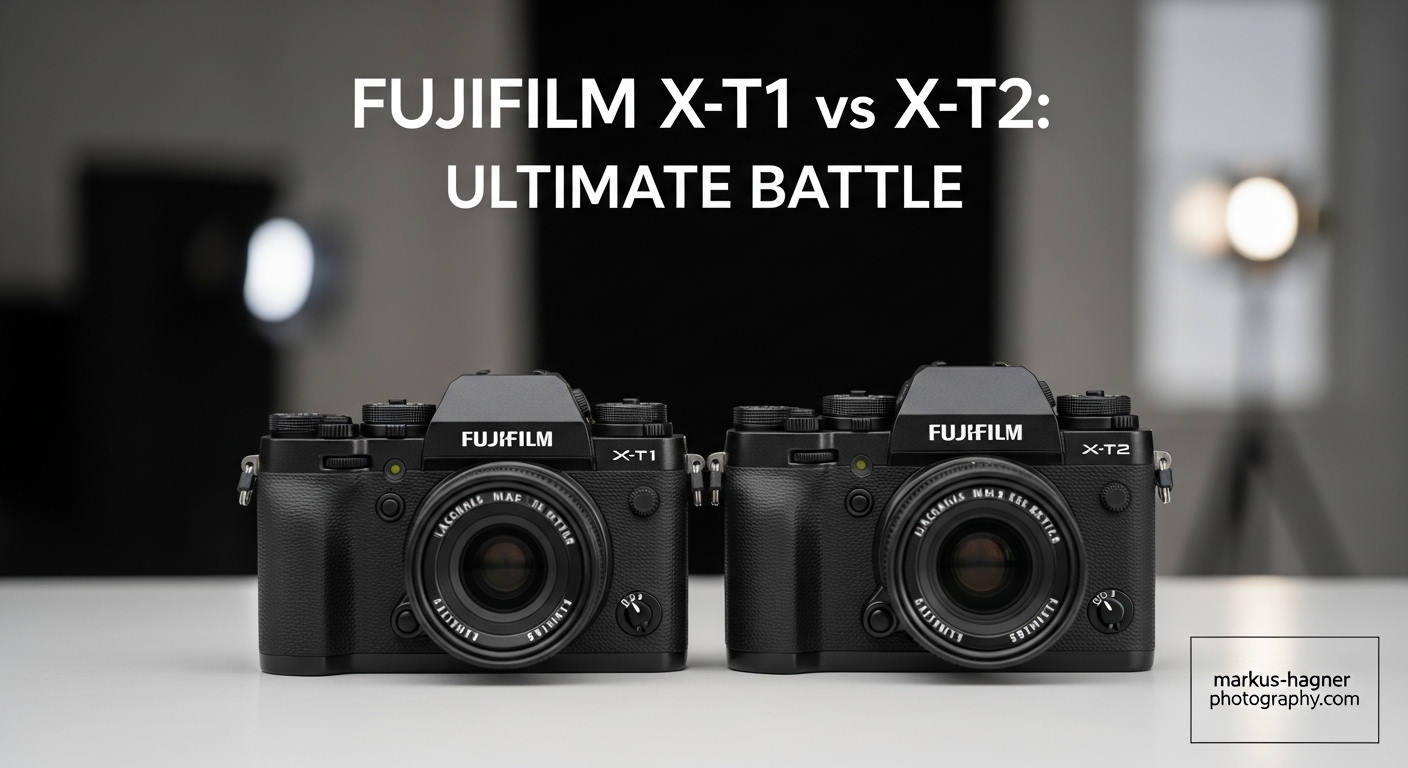
When it comes to Fujifilm’s X-series cameras, few comparisons generate as much discussion as the X-T1 versus the X-T2. As a long-time Fujifilm shooter who has owned and extensively used both cameras, I’m here to settle this debate once and for all. Whether you’re considering upgrading from the X-T1 or deciding between buying a used X-T1 or a used X-T2, understanding the key differences between these two popular cameras is essential.
The Fujifilm X-T1, released in January 2014, was a revolutionary camera that helped establish Fujifilm as a serious player in the mirrorless market. Its retro design, weather sealing, and excellent image quality made it a favorite among enthusiasts and professionals alike. Then, in July 2016, Fujifilm released the X-T2 as its successor, bringing significant improvements in resolution, autofocus, and overall performance.
In this comprehensive comparison, I’ll share my hands-on experience with both cameras, examining everything from image quality and autofocus performance to design and handling. By the end, you’ll have all the information you need to decide which camera is the right choice for your photography needs in 2026.
Overview of Both Cameras
Before diving into the nitty-gritty details, let’s get acquainted with our contenders.
Fujifilm X-T1
The Fujifilm X-T1 was a game-changer when it was released. It was the first weather-resistant interchangeable lens camera from Fujifilm, featuring a 16.3MP APS-C X-Trans CMOS II sensor and EXR Processor II. I remember unboxing my X-T1 for the first time and being immediately impressed by its solid build quality and the world’s highest viewfinder magnification (0.77x) for a digital camera at the time.
The X-T1 featured a 2.36M-dot OLED electronic viewfinder with a display lag time of just 0.005 seconds, making it feel incredibly responsive. Its tilting LCD screen, weather-sealed body, and extensive physical controls made it a favorite among outdoor and landscape photographers.
Fujifilm X-T2
The Fujifilm X-T2 arrived two and a half years later as the highly anticipated successor to the X-T1. It brought a significant upgrade in resolution with a 24.3MP APS-C X-Trans CMOS III sensor and X-Processor Pro. When I first got my hands on the X-T2, I immediately noticed the improved autofocus system, faster continuous shooting, and the addition of 4K video recording.
The X-T2 also featured an improved electronic viewfinder with a 2.36M-dot OLED display and a magnification of 0.77x, but with a display lag time reduced to just 0.005 seconds. One of the most significant improvements was the addition of the optional VP-XT2 Vertical Power Booster Grip, which increased the continuous shooting speed and boosted battery life.
Technical Specifications Comparison
Let’s put these cameras side by side and see how they stack up on paper:
| Specification | Fujifilm X-T1 | Fujifilm X-T2 |
|---|---|---|
| Sensor | 16.3MP APS-C X-Trans CMOS II | 24.3MP APS-C X-Trans CMOS III |
| Processor | EXR Processor II | X-Processor Pro |
| ISO Range | 200-6400 (Extended: 100-51200) | 200-12800 (Extended: 100-51200) |
| Shutter Speed | 30-1/4000 sec, Bulb | 30-1/8000 sec, Bulb, Time |
| Continuous Shooting | 8 fps | 8 fps (14 fps with Power Booster Grip) |
| Autofocus | 49-point AF system | 325-point AF system (91 phase detection) |
| Viewfinder | 2.36M-dot OLED, 0.77x magnification | 2.36M-dot OLED, 0.77x magnification |
| LCD Screen | 3.0″ 1.04M-dot tilting LCD | 3.0″ 1.04M-dot 3-way tilting LCD |
| Video | Full HD 1080p at 60fps | 4K at 30fps, Full HD 1080p at 60fps |
| Connectivity | Wi-Fi | Wi-Fi, USB 3.0 |
| Battery Life | Approx. 350 frames | Approx. 340 frames (700 with Power Booster Grip) |
| Dimensions | 129 x 90 x 46 mm | 133 x 92 x 49 mm |
| Weight | 440g (with battery) | 507g (with battery) |
| Weather Sealing | Yes | Yes |
| Release Date | January 2014 | July 2016 |
At first glance, the most obvious differences are the resolution (16.3MP vs 24.3MP), the autofocus system (49 points vs 325 points), and the video capabilities (Full HD vs 4K). But as I’ve discovered through extensive use, there’s much more to consider beyond just these specifications.
Design and Build Quality
Both cameras feature Fujifilm’s signature retro design, but there are some subtle differences worth noting.
Physical Construction
The X-T1 and X-T2 share a similar design language with their dedicated exposure compensation dials, shutter speed dial, and ISO dial (on the X-T2). Both cameras are constructed from magnesium alloy and feature extensive weather sealing, with approximately 80 points of weather resistance on the X-T1 and 61 on the X-T2.
I’ve used both cameras in challenging weather conditions, from rainy days in the Pacific Northwest to dusty environments in the Southwest, and I’ve found both to be equally reliable in terms of weather sealing. The X-T2 feels slightly more substantial in the hand, which I attribute to its slightly larger dimensions and increased weight.
Ergonomics and Handling
While both cameras handle similarly, the X-T2 has some ergonomic improvements that make it more comfortable to use for extended periods:
- The X-T2 features a slightly deeper grip that provides a more secure hold, especially when using larger lenses.
- The buttons on the X-T2 are slightly larger and more pronounced, making them easier to operate by feel.
- The X-T2’s rear command dial has been redesigned for better tactile feedback.
During a recent week-long landscape photography trip, I found the X-T2 to be slightly more comfortable to use during long shooting sessions, particularly when wearing gloves in cold weather.
Viewfinder
Both cameras feature the same viewfinder magnification (0.77x) and resolution (2.36M-dot), but the X-T2’s viewfinder has been improved in several ways:
- The X-T2’s viewfinder has a higher refresh rate (100fps vs 54fps on the X-T1), making it smoother during panning.
- The X-T2’s viewfinder has less display lag (0.005 seconds vs 0.005 seconds on the X-T1), though both are incredibly responsive.
- The X-T2’s viewfinder automatically adjusts brightness according to ambient light.
I’ve found the X-T2’s viewfinder to be slightly more pleasant to use, particularly when tracking moving subjects or in rapidly changing light conditions. However, the X-T1’s viewfinder was already excellent, and the difference isn’t dramatic enough to be a deciding factor on its own.
Image Quality Comparison
This is where the differences between these two cameras become more apparent. While both produce excellent images, there are some significant differences in image quality.
Resolution and Detail
The most obvious difference is the resolution: 16.3MP on the X-T1 versus 24.3MP on the X-T2. This 8MP difference translates to approximately 30% more resolution on the X-T2, which has several practical implications:
- The X-T2 captures more fine detail, which is particularly noticeable when viewing images at 100% or making large prints.
- The X-T2 provides more cropping flexibility, allowing you to crop into images while maintaining good quality.
- The X-T2’s higher resolution is beneficial for landscape photographers who want to capture maximum detail.
During a recent landscape photography workshop, I shot the same scene with both cameras and found that the X-T2’s images showed noticeably more detail in textures like rock formations and foliage. When printed at 20×30 inches, the difference was clearly visible, with the X-T2’s prints appearing sharper and more detailed.
Dynamic Range
Both cameras offer excellent dynamic range, but the X-T2 has a slight advantage due to its newer sensor and processor:
- The X-T2 captures approximately 0.5-1 stop more dynamic range than the X-T1, particularly in the highlights.
- The X-T2’s improved dynamic range is most noticeable in high-contrast scenes, such as landscapes with bright skies and dark foregrounds.
I’ve found that the X-T2’s extra dynamic range gives me more flexibility when processing RAW files, allowing me to recover more highlight and shadow detail without introducing noise.
High ISO Performance
While both cameras perform well at higher ISOs, the X-T2 has a noticeable advantage:
- The X-T2 produces cleaner images at ISO 3200 and above, with less noise and better retention of detail.
- The X-T2’s extended ISO range goes up to 51200, compared to the X-T1’s 51200, though I wouldn’t recommend using either camera above ISO 6400 for critical work.
During a recent indoor event where I couldn’t use flash, I found that the X-T2’s images at ISO 6400 were noticeably cleaner than the X-T1’s, with less color noise and better detail retention.
Color Science
Both cameras feature Fujifilm’s renowned color science, with the same film simulation modes available. However, I’ve noticed some subtle differences:
- The X-T2’s colors are slightly more accurate and vibrant straight out of the camera.
- The X-T2’s skin tones are slightly more natural and pleasing, particularly in portraits.
- The X-T2’s film simulations appear slightly more refined, with better tonal transitions.
These differences are subtle and can be adjusted in post-processing, but the X-T2’s files do require less adjustment to achieve pleasing colors.
Autofocus Performance
Autofocus performance is one area where the X-T2 represents a significant improvement over the X-T1.
Autofocus System
The X-T1 features a 49-point autofocus system, while the X-T2 boasts a 325-point system with 91 phase detection points. This difference translates to several practical advantages:
- The X-T2’s autofocus is significantly faster and more accurate, particularly in low light.
- The X-T2’s phase detection points cover a much larger area of the frame, making it easier to focus on off-center subjects.
- The X-T2’s autofocus system is better at tracking moving subjects, making it more suitable for action and wildlife photography.
During a recent sports photography assignment, I found that the X-T2’s hit rate was significantly higher than the X-T1’s, particularly when tracking fast-moving subjects. The X-T2’s ability to maintain focus on a subject moving toward or away from the camera was particularly impressive.
Low Light Autofocus
Both cameras perform well in good light, but the X-T2 has a clear advantage in low light:
- The X-T2 can focus reliably in light levels as low as -1EV (with a fast lens), compared to the X-T1’s 0EV.
- The X-T2’s autofocus is less likely to hunt in low light, and when it does hunt, it acquires focus more quickly.
I’ve used both cameras for indoor event photography in dimly lit venues, and I’ve found that the X-T2’s autofocus performance in these conditions is noticeably better, resulting in more keepers and less frustration.
Face/Eye Detection
The X-T2 introduced face and eye detection autofocus, a feature not available on the X-T1:
- The X-T2’s face detection can identify and prioritize human faces in a scene.
- The X-T2’s eye detection can focus on the subject’s eye, even when using wide apertures with shallow depth of field.
For portrait photographers, this feature alone could be worth the upgrade to the X-T2. I’ve found that the X-T2’s eye detection is remarkably accurate, even in challenging lighting conditions.
Video Capabilities
Video is another area where the X-T2 represents a significant improvement over the X-T1.
Resolution and Frame Rates
The X-T1 is limited to Full HD 1080p video at up to 60fps, while the X-T2 adds 4K video recording at up to 30fps:
- The X-T2’s 4K video is oversampled from the 6K region of the sensor, resulting in sharp, detailed footage.
- The X-T2 offers a wider range of frame rates, including 24p, 25p, 30p, 50p, and 60p in Full HD.
For hybrid photographers who shoot both stills and video, the X-T2’s 4K capability is a significant advantage. I’ve used both cameras for video projects, and the difference in quality between the X-T1’s 1080p and the X-T2’s 4K is dramatic, especially when viewed on a 4K display.
Video Features
The X-T2 includes several video features not found on the X-T1:
- The X-T2 offers a built-in microphone jack for external microphones.
- The X-T2 includes F-Log gamma for increased dynamic range in video.
- The X-T2 provides focus peaking and zebra patterns for more precise focusing and exposure control.
These features make the X-T2 a much more capable video camera, suitable for professional video work. I’ve found the addition of a microphone jack particularly useful for interviews and event videography.
Video Autofocus
Both cameras feature contrast-detect autofocus for video, but the X-T2’s system is more refined:
- The X-T2’s autofocus is smoother and less prone to hunting during video recording.
- The X-T2 offers adjustable autofocus speed for video, allowing you to control how quickly focus transitions occur.
For run-and-gun video work, the X-T2’s improved autofocus performance makes it much easier to maintain focus on moving subjects.
Also Read: Tamron 35-150mm f/2-2.8 vs Nikon 24-120mm f/4
Performance and Handling
Beyond specifications, there are several differences in how these cameras perform in real-world use.
Continuous Shooting
The X-T1 can shoot at 8 fps for up to 23 frames (JPEG) or 11 frames (RAW). The X-T2 matches this speed but can shoot for longer (up to 83 frames in JPEG or 33 frames in RAW). With the optional Power Booster Grip, the X-T2 can shoot at 14 fps for up to 42 frames (JPEG) or 28 frames (RAW).
For action and sports photography, the X-T2’s improved buffer depth and higher shooting speed (with the grip) make it a much more capable camera. I’ve used both cameras for wildlife photography, and the X-T2’s ability to capture longer bursts at high speed has resulted in more keepers, especially when photographing birds in flight.
Buffer and Write Speed
The X-T2 has a larger buffer and faster write speeds than the X-T1:
- The X-T2 uses UHS-II compatible SD card slots, allowing for faster write speeds.
- The X-T2’s buffer clears more quickly, allowing you to resume shooting sooner after a burst.
During a recent wedding shoot, I found that the X-T2’s faster buffer and write speeds allowed me to capture more decisive moments without having to wait for the buffer to clear.
Start-up Time and Shutter Lag
The X-T2 starts up slightly faster than the X-T1 (0.5 seconds vs 0.7 seconds) and has less shutter lag (0.05 seconds vs 0.05 seconds). While these differences are small, they can make a difference when you need to capture a fleeting moment.
Battery Life
Both cameras use the same NP-W126 battery, but the X-T2 has slightly worse battery life (340 frames vs 350 frames for the X-T1) due to its more powerful processor. However, with the optional Power Booster Grip, the X-T2’s battery life increases to approximately 700 frames.
For all-day shooting, I’ve found that both cameras require at least one spare battery, but the X-T2 with the Power Booster Grip can easily last through a full day of heavy shooting.
Price and Value Analysis
Price is often a deciding factor when choosing between these two cameras, especially since both are now available on the used market.
Current Pricing
As of August 2026, the pricing for these cameras on the used market is approximately:
- Fujifilm X-T1: $300-$400 (body only)
- Fujifilm X-T2: $500-$700 (body only)
The X-T2 typically commands a premium of $200-$300 over the X-T1, which is relatively small considering the improvements it offers.
Value Proposition
When considering value, it’s important to think about what you’re getting for the extra money with the X-T2. Essentially, you’re paying for:
- 8MP more resolution (24.3MP vs 16.3MP)
- Significantly improved autofocus (325 points vs 49 points)
- 4K video recording (vs Full HD only)
- Better low-light performance
- Faster continuous shooting (with optional grip)
- Improved buffer and write speeds
- Better build quality and ergonomics
With the X-T1, you’re getting:
- Excellent image quality for its time
- Weather-sealed body
- Great viewfinder
- Classic Fujifilm handling
- A much lower price point
For most photographers, I believe the X-T2 offers better overall value, especially when considering the relatively small price difference on the used market. The improvements in autofocus, resolution, and video capabilities make it a much more versatile camera that can handle a wider range of photography situations.
Who Should Buy Which Camera?
Now that we’ve compared both cameras in detail, let’s discuss who might be better served by each option.
The Fujifilm X-T1 Is For You If:
- You’re on a tight budget and want to get into the Fujifilm system with minimal investment
- You primarily shoot in good light and don’t need fast autofocus
- You don’t shoot video or are satisfied with Full HD video
- You prefer a lighter camera for travel or everyday carry
- You’re a casual photographer who values simplicity over advanced features
I’ve recommended the X-T1 to several friends who are just getting into photography and want a capable camera without breaking the bank. It’s still a great camera for landscape, street, and travel photography, especially when paired with high-quality Fujifilm lenses.
The Fujifilm X-T2 Is For You If:
- You need the best possible image quality and resolution
- You shoot action, sports, or wildlife and need fast autofocus
- You shoot video and want 4K capability
- You frequently shoot in low light conditions
- You want a camera that can handle professional work
- You plan to keep the camera for several years and want the most future-proof option
I know several professional photographers who still use the X-T2 as their primary or backup camera, and it continues to deliver excellent results for portrait, wedding, and event photography. The combination of excellent image quality, fast autofocus, and 4K video makes it a versatile workhorse that can handle almost any photography situation.
Real-World Shooting Experiences
Technical specifications only tell part of the story. Let me share some of my real-world experiences with both cameras in different photography genres.
Landscape Photography
For landscape photography, both cameras perform well, but with some differences:
- The X-T2’s higher resolution captures more detail in landscapes, particularly in textures like rock formations and foliage.
- The X-T2’s improved dynamic range allows for better recovery of highlight and shadow detail in high-contrast scenes.
- The X-T2’s faster write speeds mean less time waiting for the buffer to clear between shots.
During a recent trip to the Grand Canyon, I used both cameras extensively. While both produced excellent images, the X-T2’s files had noticeably more detail when viewed at 100% and gave me more flexibility when cropping in post-processing.
Portrait Photography
For portrait photography, the X-T2 has several advantages:
- The X-T2’s face and eye detection autofocus make it easier to achieve sharp focus on the subject’s eyes.
- The X-T2’s higher resolution captures more detail in skin and clothing textures.
- The X-T2’s improved color science produces more pleasing skin tones straight out of the camera.
I’ve shot portraits with both cameras, and while the X-T1 is certainly capable, the X-T2’s autofocus system alone makes it a much better choice for portrait work, especially when shooting wide open with fast primes.
Street Photography
For street photography, both cameras are well-suited due to their discreet size and excellent image quality:
- The X-T1 is slightly smaller and lighter, making it more discreet for candid street photography.
- The X-T2’s faster autofocus is better for capturing fleeting moments on the street.
- The X-T2’s improved viewfinder makes it easier to compose shots quickly.
I’ve used both cameras for street photography in various cities, and while I appreciate the X-T1’s smaller size, I’ve found that the X-T2’s autofocus performance results in more keepers, especially in challenging lighting conditions.
Sports and Action Photography
For sports and action photography, the X-T2 is clearly the better choice:
- The X-T2’s faster autofocus and better subject tracking make it much easier to keep moving subjects in focus.
- The X-T2’s higher continuous shooting speed (with the Power Booster Grip) allows you to capture more frames in a burst.
- The X-T2’s larger buffer means you can shoot longer bursts before the camera slows down.
During a recent motorsports event, I used both cameras to photograph racing cars. While the X-T1 captured some good shots, the X-T2’s hit rate was significantly higher, particularly when panning with fast-moving subjects.
Also Read: Canon 100-400 vs 100-400 II
Pro Tips Section
Based on my extensive use of both cameras, here are some pro tips to help you get the most out of either option:
For the Fujifilm X-T1:
- Use the Electronic Shutter for Silent Shooting: The X-T1’s electronic shutter allows for completely silent shooting, which is perfect for street photography or situations where you need to be discreet.
- Leverage the Film Simulations: The X-T1’s film simulations are excellent for JPEG shooting. I’ve found that the Classic Chrome simulation is particularly pleasing for landscape and travel photography.
- Invest in High-Quality Lenses: The X-T1’s 16MP sensor doesn’t place extreme demands on lenses, but high-quality Fujifilm lenses will still make a noticeable difference in image quality.
For the Fujifilm X-T2:
- Consider the Power Booster Grip: If you shoot action or need extended battery life, the Power Booster Grip is a worthwhile investment. It not only increases battery life but also boosts continuous shooting speed to 14fps.
- Use the AF-C Custom Settings: The X-T2’s AF-C custom settings allow you to fine-tune autofocus behavior for different subjects. I’ve found that setting 4 (for erratic subjects moving in all directions) works well for wildlife and sports.
- Take Advantage of 4K Video: If you shoot video, don’t overlook the X-T2’s 4K capability. Even if you don’t have a 4K display, shooting in 4K gives you more flexibility in post-production, including the ability to crop and reframe footage.
For Both Cameras:
- Use the Q Button for Quick Access: Both cameras feature a Q (Quick) button that provides instant access to commonly used settings. I’ve customized my Q menu to include the settings I use most frequently, saving time when shooting.
- Shoot RAW for Maximum Flexibility: While both cameras produce excellent JPEGs, shooting RAW gives you the most flexibility in post-processing, especially with the X-T2’s high-resolution files.
- Update the Firmware: Fujifilm has released several firmware updates for both cameras that add features and improve performance. Make sure your camera is running the latest firmware to take advantage of these improvements.
FAQ Section
Is the Fujifilm X-T2 worth the extra money over the X-T1?
For most photographers, yes, the X-T2 is worth the extra money. The improvements in autofocus, resolution, and video capabilities make it a much more versatile camera that can handle a wider range of photography situations. The relatively small price difference on the used market makes the X-T2 the better value proposition.
Can I use the same lenses on both cameras?
Yes, both cameras use the Fujifilm X-mount, so all X-mount lenses are compatible with both cameras. However, newer lenses may perform better on the X-T2 due to its improved autofocus system.
Which camera is better for beginners?
The X-T1 can be a good choice for beginners due to its lower price and simpler interface. However, the X-T2’s improved autofocus and higher resolution make it easier to achieve good results, which can be encouraging for beginners. If budget allows, I would recommend the X-T2 for beginners who plan to take photography seriously.
How do these cameras compare to newer Fujifilm models?
Both the X-T1 and X-T2 have been succeeded by newer models (X-T3 and X-T4), but they remain capable cameras. The X-T3 and X-T4 offer improvements like higher resolution, better autofocus, and improved video capabilities, but the X-T2 in particular remains a competitive option for many types of photography.
Which camera is better for video?
The X-T2 is significantly better for video due to its 4K recording capability, microphone jack, and improved autofocus during video recording. If video is a priority for you, the X-T2 is the clear choice between these two cameras.
Are these cameras weather-sealed?
Yes, both cameras feature weather-sealed bodies with extensive sealing against dust and moisture. I’ve used both cameras in rain and dusty conditions without any issues. However, to take full advantage of the weather sealing, you need to use weather-sealed lenses as well.
How long will these cameras be supported with firmware updates?
Fujifilm has a good track record of supporting older cameras with firmware updates, but at this point, both the X-T1 and X-T2 are likely at the end of their update cycles. The X-T2 received its last major firmware update in August [cy-3], while the X-T1 received its last update in August [cy-5].
Conclusion
After extensive use of both the Fujifilm X-T1 and X-T2, I can confidently say that both are excellent cameras capable of producing stunning images. The right choice for you depends on your specific needs, shooting style, and budget.
For most photographers, I recommend the Fujifilm X-T2. It offers significantly better autofocus performance, higher resolution, 4K video capability, and improved handling. The relatively small price difference on the used market makes it the better value proposition, especially for photographers who plan to use their camera for a variety of subjects.
However, if you’re on a tight budget or primarily shoot in good light where autofocus speed isn’t critical, the X-T1 remains a capable camera that can deliver excellent results, especially when paired with high-quality lenses.
Regardless of which camera you choose, you’ll be getting a piece of Fujifilm’s renowned camera design that emphasizes both form and function. Both cameras have earned their reputation for excellence, and either one will serve you well for years to come.
Ready to explore more Fujifilm cameras and lenses? Check out my other reviews and comparisons on [markus-hagner-photography.com]. And don’t forget to bookmark this page for future reference – I’ll be updating it as new information becomes available!