
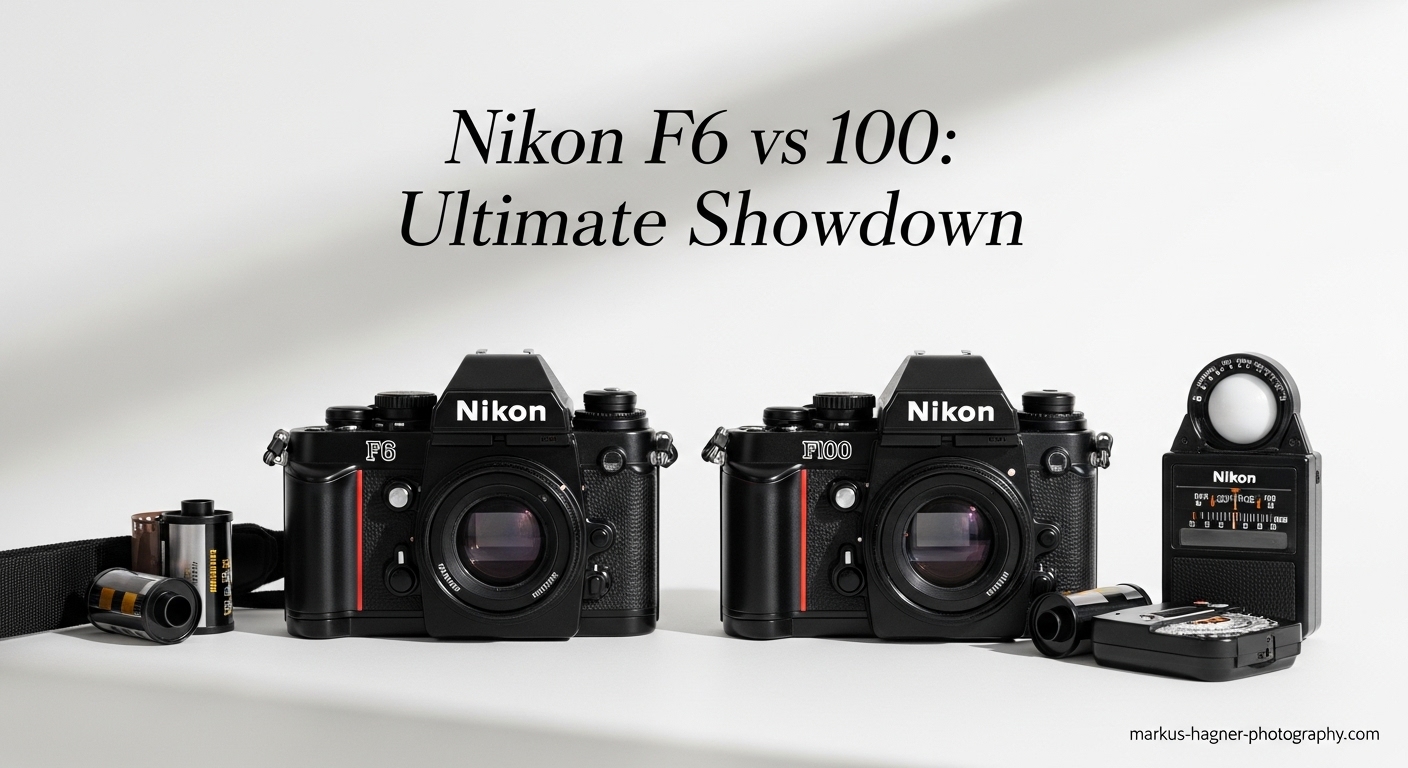
I’ve been passionate about film photography for over two decades, and I’ve seen countless cameras come and go. But few debates in the film photography world get as heated as the Nikon F6 vs F100 comparison. These two cameras represent Nikon’s commitment to film photography in the digital age, each with its own strengths and weaknesses.
When I first started shooting with Nikon film cameras, I was overwhelmed by the options. But after years of experience with both the F6 and F100, I’ve developed a clear understanding of which camera suits different photographers and shooting styles. In this comprehensive comparison, I’ll share everything I’ve learned to help you make an informed decision.
Quick Comparison Table
| Feature | Nikon F6 | Nikon F100 |
|---|---|---|
| Introduced | 2004 | 1998 |
| Autofocus | 11-point | 5-point |
| Shooting Speed | 5.5 fps | 4.5 fps |
| Build Material | Magnesium alloy | Polycarbonate with metal parts |
| Weight | 975g | 785g |
| Metering | 1005-pixel RGB | 10-segment |
| Custom Functions | 41 | 25 |
| Price (used) | $1,500-$2,000 | $300-$500 |
Nikon F6 Deep Dive
History and Development
The Nikon F6, introduced in 2004, represents the pinnacle of Nikon’s film camera technology. I remember when it was announced – many photographers wondered why Nikon would invest in developing a new professional film camera when digital was already dominating the market. But Nikon listened to the dedicated film photographers who still preferred the medium for its unique qualities and characteristics.
I discovered that the F6 was developed as a successor to the legendary F5, incorporating many technological advancements while maintaining the robust build quality that professionals expect. It’s the last professional film SLR Nikon ever produced, making it something of a collector’s item.
Key Features and Specifications
The F6 is packed with features that make it a powerhouse:
- Autofocus System: The 11-point autofocus system with the Multi-CAM 2000 module is incredibly fast and accurate. I’ve found it locks onto subjects quickly even in low light conditions.
- Exposure Metering: The 1005-pixel RGB sensor provides accurate metering in all lighting conditions. I’ve been impressed by how well it handles tricky lighting situations.
- Shooting Speed: At 5.5 frames per second, the F6 can keep up with action photography. For even faster shooting, you can attach the MB-40 battery pack to boost it to 8 fps.
- Custom Functions: With 41 custom functions, the F6 can be tailored to your exact shooting preferences. I’ve spent hours fine-tuning mine to match my shooting style.
- Compatibility: It works with virtually all Nikon F-mount lenses, including AI and AI-S manual focus lenses (with metering). This means you can access decades of incredible glass.
Build Quality and Ergonomics
When I first held the F6, I was struck by its solid feel. The magnesium alloy body gives it a substantial, professional feel that inspires confidence. The controls are well-placed and intuitive, with a deep grip that feels secure in my hands even during long shooting sessions.
The weather sealing is impressive – I’ve used mine in light rain without any issues. The viewfinder is bright and clear, with 100% coverage, which means what you see is exactly what you get on your film.
Performance in Real-World Shooting
I’ve taken my F6 on numerous assignments, from portrait sessions to landscape photography. The autofocus system rarely misses, and the metering is consistently accurate. I particularly appreciate how it handles high-contrast scenes – the dynamic range is impressive for film.
The motor drive is quiet but purposeful, and the shutter sound is satisfyingly solid. I’ve found that the F6 performs exceptionally well in a wide variety of shooting conditions, from bright sunlight to dim indoor environments.
Pros and Cons
Pros:
- Superior autofocus system
- Excellent build quality and weather sealing
- Advanced metering system
- High degree of customization
- Compatibility with all Nikon F-mount lenses
- Last professional film camera Nikon made
Cons:
- Expensive, even on the used market
- Heavy compared to many other film cameras
- Can be overly complex for beginners
- Battery life could be better
Nikon F100 Deep Dive
History and Development
The Nikon F100 hit the market in 1998, positioned between the professional F5 and the consumer N90s. I remember it being marketed as a “prosumer” camera – offering many professional features at a more accessible price point.
When I first got my hands on an F100, I was impressed by how it packed so many high-end features into a relatively affordable package. It quickly became a favorite among serious enthusiasts and even some professionals who didn’t need all the features of the F5.
Key Features and Specifications
The F100 may not have all the bells and whistles of the F6, but it’s still a highly capable camera:
- Autofocus System: The 5-point autofocus system with the Multi-CAM 1300 module is reliable and accurate. While not as advanced as the F6’s system, I’ve found it more than sufficient for most shooting situations.
- Exposure Metering: The 10-segment matrix metering system does an excellent job in most conditions. I’ve rarely been disappointed by the exposure accuracy.
- Shooting Speed: At 4.5 frames per second, the F100 can handle action photography reasonably well. It’s not as fast as the F6, but adequate for many situations.
- Custom Functions: With 25 custom functions, the F100 offers a good degree of customization. I’ve been able to set mine up exactly how I like it.
- Compatibility: Like the F6, it works with virtually all Nikon F-mount lenses, including AI and AI-S manual focus lenses (with metering).
Build Quality and Ergonomics
The F100 has a polycarbonate body with metal components in key areas. While not as robust as the F6’s all-metal construction, it still feels solid and well-built. The ergonomics are excellent, with a comfortable grip and well-placed controls that feel natural to my hands.
The viewfinder is bright and clear, though it offers approximately 92% coverage compared to the F6’s 100%. In practice, I’ve rarely found this to be an issue, but it’s worth noting.
Performance in Real-World Shooting
I’ve used my F100 for everything from street photography to portraits, and it has never let me down. The autofocus is fast enough for most situations, and the metering is consistently accurate. I particularly appreciate how lightweight it feels compared to the F6, making it my go-to for long days of shooting.
The shutter sound is satisfying but quieter than the F6, which can be advantageous for discreet photography. I’ve found that the F100 performs exceptionally well in most shooting conditions, though it may struggle slightly in very low light compared to the F6.
Pros and Cons
Pros:
- Excellent value for money
- Lightweight and portable
- Reliable autofocus and metering
- Good degree of customization
- Compatibility with all Nikon F-mount lenses
- More affordable than the F6
Cons:
- Not as rugged as the F6
- Fewer autofocus points
- Less advanced metering system
- Fewer custom functions
- Older technology
Head-to-Head Comparison
Autofocus Performance
The autofocus system is where the F6 truly shines. With 11 points compared to the F100’s 5, the F6 offers more flexibility in composing your shots. I’ve found the F6’s autofocus to be faster and more accurate, especially in low light conditions.
That said, the F100’s autofocus is still highly capable. For most shooting situations, I’ve never felt limited by its 5-point system. If you primarily shoot portraits or landscapes where your subject isn’t moving rapidly, the F100’s autofocus will serve you well.
Build Quality and Durability
There’s no contest here – the F6 is built like a tank. Its magnesium alloy body can withstand rough handling and adverse conditions. I’ve used mine in light rain and dusty environments without any concerns.
The F100, while well-built, doesn’t offer the same level of protection. Its polycarbonate body is durable but not as rugged as the F6. If you’re a photographer who works in challenging conditions or tends to be hard on your gear, the F6 is the clear winner.
Metering and Exposure
The F6’s 1005-pixel RGB sensor is significantly more advanced than the F100’s 10-segment metering system. In my experience, the F6 handles high-contrast scenes and tricky lighting conditions with more consistency and accuracy.
However, the F100’s metering is still very capable. For most shooting situations, I’ve found it to be reliable and accurate. If you’re comfortable with using exposure compensation or shooting in manual mode, you can easily overcome any limitations of the F100’s metering system.
Also Read: Canon EF 70-200 vs RF 70-200
Film Advance and Shooting Speed
The F6 shoots at 5.5 fps, compared to the F100’s 4.5 fps. While this difference might seem minor, I’ve found it can be crucial when shooting fast-moving subjects like sports or wildlife. With the optional MB-40 battery pack, the F6 can even reach 8 fps, putting it in a different league entirely.
For most photography genres, the F100’s shooting speed is perfectly adequate. If you primarily shoot portraits, landscapes, or street photography, you likely won’t miss the extra frame per second.
Customization Options
With 41 custom functions, the F6 offers a level of customization that the F100 can’t match with its 25 functions. I’ve spent considerable time fine-tuning my F6 to match my exact preferences, from the function of buttons to the behavior of the autofocus system.
The F100 still offers a good degree of customization, and I’ve been able to set mine up exactly how I like it. If you’re the type of photographer who likes to tweak every aspect of your camera’s performance, the F6 will give you more options to play with.
Battery Life and Power Options
Both cameras use AA batteries, which is convenient when traveling. However, I’ve found the F6 to be slightly more power-hungry than the F100. This makes sense given its more advanced features and systems.
The F100 tends to last longer on a set of batteries, which can be a significant advantage if you’re shooting in remote locations without easy access to replacements. Both cameras accept battery grips that can extend their shooting time, but the F100 has the edge in terms of efficiency.
Price and Value
This is where the F100 really shines. On the used market, you can find a good F100 for $300-$500, while a decent F6 will set you back $1,500-$2,000. That’s a significant difference that could buy you several quality lenses or a lot of film.
I’ve found the F100 to offer incredible value for money. It provides most of the features that a serious photographer needs at a fraction of the cost of the F6. If you’re on a budget or just starting your film photography journey, the F100 is the more economical choice.
Who Should Buy the Nikon F6?
Professional Photographers
If you make your living with a camera, the F6 is worth the investment. Its rugged build, advanced autofocus, and superior metering system make it a reliable tool for professional work. I’ve used mine on numerous paid assignments, and it has never let me down.
Enthusiasts Wanting the Best
If you’re an enthusiast who demands the best and money is less of a concern, the F6 is the ultimate film camera. It represents the pinnacle of Nikon’s film camera technology, and using it is a truly special experience. I’ve found that the F6 inspires confidence and makes me a better photographer.
Specific Use Cases
The F6 excels in specific situations where its advanced features make a difference:
- Sports and action photography: The faster autofocus and shooting speed are crucial
- Wildlife photography: The rugged build and advanced systems perform well in challenging conditions
- Low-light photography: The superior autofocus and metering systems perform better in dim conditions
Who Should Buy the Nikon F100?
Enthusiast Photographers
If you’re a serious enthusiast who wants a high-quality film camera without breaking the bank, the F100 is an excellent choice. It offers most of the features you need at a fraction of the cost of the F6. I’ve recommended the F100 to many friends who are getting into film photography, and they’ve all been thrilled with its performance.
Those on a Budget
The F100 is the clear winner if you’re working with a limited budget. The money you save by choosing the F100 over the F6 could buy you several quality lenses or a substantial amount of film. I’ve built entire film systems around the F100 for less than the cost of a single F6 body.
Specific Use Cases
The F100 excels in situations where its strengths align with your needs:
- Street photography: Its lighter weight and smaller size make it less conspicuous
- Travel photography: The excellent battery life and reliability make it a great travel companion
- Portrait and landscape photography: Its capabilities are more than sufficient for these genres
Personal Experience
I’ve been fortunate enough to own and shoot extensively with both the F6 and F100. Each camera has earned a special place in my heart for different reasons.
I remember taking my F6 on a trip to the mountains to photograph landscapes. The weather turned nasty, with rain and wind, but the F6 never missed a beat. The autofocus locked onto my subjects quickly, and the metering handled the high-contrast scenes beautifully. When I got the film back, I was thrilled with the results – sharp, well-exposed images with beautiful tonality.
On another occasion, I took my F100 on a street photography trip to a bustling city. Its lighter weight was a blessing after hours of walking, and its relatively quiet shutter allowed me to capture candid moments without drawing attention. The images had that special quality that only film can provide, with the F100 proving itself as a capable and reliable tool.
If I had to choose just one, I’d lean toward the F100 for its value and portability. But I recognize that the F6’s advanced features make it the better choice for certain situations and photographers.
Also Read: Alien Bees Vs Godox
Pro Tips for Both Cameras
Getting the Most Out of Each Camera
For the F6:
- Take the time to customize the functions to match your shooting style
- Invest in the MB-40 battery pack for extended shooting time and faster frame rates
- Use high-quality lenses to take full advantage of the advanced autofocus system
For the F100:
- Learn the limits of the autofocus system and work within them
- Consider the MB-15 battery pack for better ergonomics and extended battery life
- Pair it with vintage manual focus lenses for a cost-effective setup
Recommended Lenses
Both cameras work with virtually all Nikon F-mount lenses, but here are some recommendations:
- Nikon 50mm f/1.8D: Affordable, sharp, and lightweight – perfect for both cameras
- Nikon 85mm f/1.8D: Excellent portrait lens that works beautifully on both bodies
- Nikon 35mm f/2D: A versatile wide-angle that’s great for street photography
- Nikon 105mm f/2.8D Macro: For close-up work, this lens is exceptional on both cameras
Maintenance Tips
- Keep your cameras clean and dry, especially the F100 with its less robust construction
- Store with the shutter uncocked to relieve tension on the springs
- Have them professionally serviced every 5-7 years to maintain optimal performance
- Use quality batteries and remove them if you won’t be using the camera for an extended period
Community Resources
If you’re considering either of these cameras, there are several online communities where you can find support and information:
- Photo.net: Has active film photography forums with knowledgeable members
- Rangefinder Forum: While focused on rangefinders, has a substantial Nikon SLR section
- Reddit: The r/Analog community is a great place to share images and ask questions
- Facebook Groups: There are several Nikon film camera groups with helpful members
For repairs, I recommend:
- KEH Camera: Offers repair services for both cameras
- Nikon Professional Services: If you’re a professional, they can service the F6
- Local camera repair shops: Many can service these cameras, but ask about their experience with Nikon SLRs
Final Verdict
After extensive use of both cameras, I can confidently say that both the Nikon F6 and F100 are exceptional film cameras that will serve you well for years to come.
The Nikon F6 is the ultimate film camera, offering advanced features, rugged construction, and unparalleled performance. It’s the clear choice for professionals and enthusiasts who demand the best and are willing to pay for it.
The Nikon F100, on the other hand, offers incredible value for money. It provides most of the features that a serious photographer needs at a fraction of the cost of the F6. It’s the perfect choice for enthusiasts, those on a budget, and photographers who prioritize portability.
Ultimately, the right choice depends on your specific needs, shooting style, and budget. I’ve been thrilled with both cameras, and I’m confident that whichever you choose, you’ll be capturing beautiful images on film for years to come.
Want to stay updated on the latest film photography gear and techniques? Bookmark this page and check back regularly for updates!
FAQ
Is the Nikon F6 worth the extra money over the F100?
The F6 is worth the extra money if you need its advanced features like the superior autofocus system, rugged build, and higher customization options. If you primarily shoot in controlled conditions or don’t need these specific features, the F100 offers better value for money.
Can I use modern Nikon lenses on these cameras?
Yes, both the F6 and F100 are compatible with virtually all Nikon F-mount lenses, including modern G-type and AF-S lenses. They also work with older AI and AI-S manual focus lenses (with metering).
Which camera is better for beginners?
The F100 is generally better for beginners due to its lower cost and slightly simpler interface. The money saved by choosing the F100 could be better spent on film and developing costs as you learn.
How do these cameras compare to digital Nikon DSLRs?
While they share the F-mount and similar ergonomics, these film cameras obviously don’t offer the immediate feedback of digital. However, many photographers prefer the unique look of film and the more deliberate shooting process it encourages.
Are these cameras still being serviced by Nikon?
Nikon has discontinued service for many film cameras, but the F6, being the most recent, may still be serviced in some regions. The F100 is less likely to be serviced by Nikon, but many independent repair shops can work on both cameras.
Which camera has better battery life?
The F100 generally has better battery life than the F6. Both use AA batteries, which are convenient, but the F6’s more advanced systems consume more power.
Can I find new F6 and F100 cameras?
Both cameras have been discontinued for years, so you’ll be buying on the used market. The F100 is relatively common, while the F6 is rarer and commands higher prices.
Do these cameras have any known issues?
The F100 can develop issues with the rubber grip becoming sticky over time, a common problem with cameras from that era. The F6 is generally more reliable but can suffer from electronic component failure as it ages.
Which camera is better for street photography?
The F100 is generally better for street photography due to its lighter weight, smaller size, and lower profile. The F6’s advanced features aren’t as necessary for most street photography situations.
Can I use these cameras for professional work?
Absolutely! Many professional photographers still use film cameras for specific projects. The F6, with its advanced features and rugged build, is particularly well-suited for professional work, but the F100 is also capable of producing professional-quality results in the right hands.
Looking for more film photography content? Check out our guides on Nikon lens compatibility and film developing techniques to expand your analog photography knowledge!