
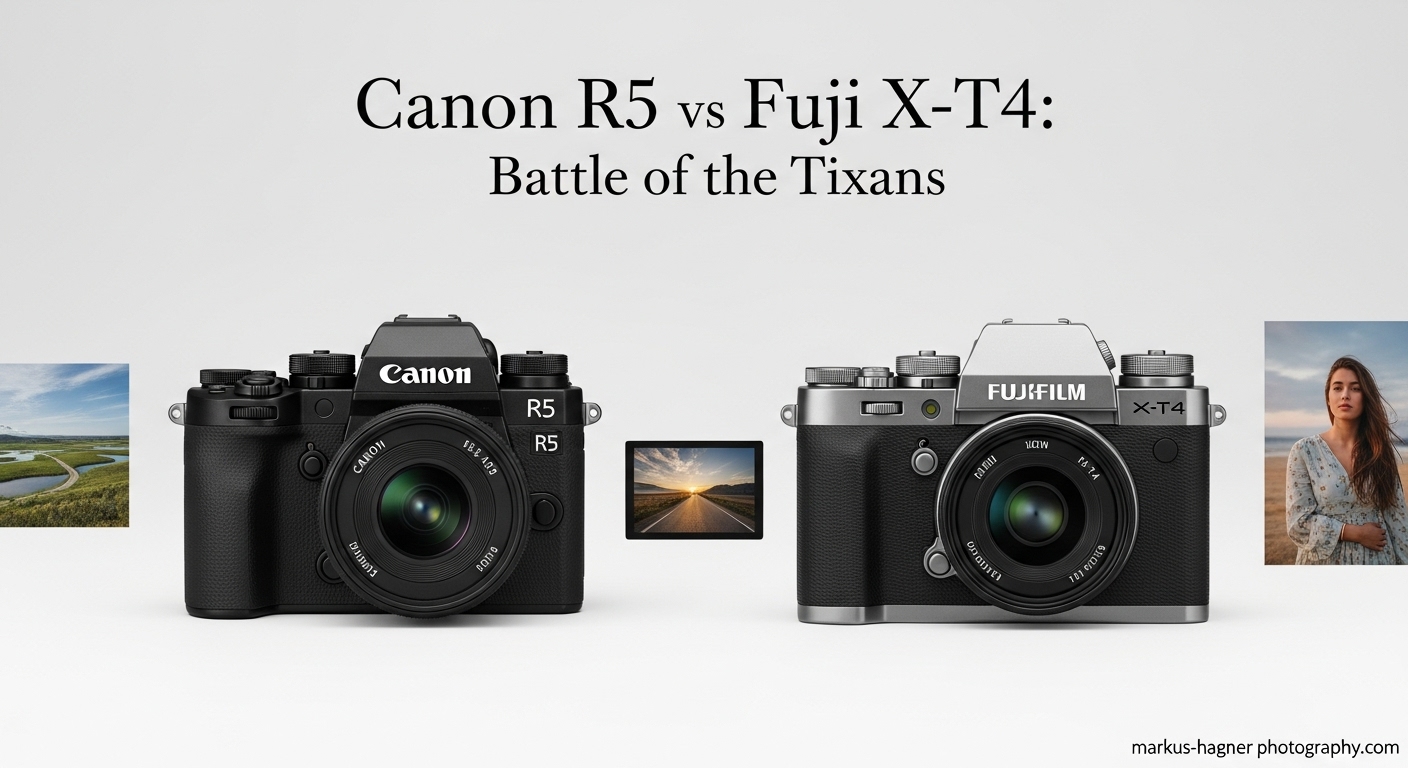
As a professional photographer who’s spent countless hours with both the Canon R5 and Fujifilm X-T4, I can tell you that choosing between these two exceptional cameras isn’t just about specifications—it’s about finding the right tool for your creative vision. The Canon R5 represents the pinnacle of full-frame mirrorless technology, while the Fujifilm X-T4 embodies the perfect balance of performance and portability in the APS-C world. After shooting everything from weddings to wildlife with both cameras, I’m here to share my real-world experiences to help you make the right choice.
Quick Comparison Table
| Feature | Canon EOS R5 | Fujifilm X-T4 |
|---|---|---|
| Sensor | 45MP Full Frame CMOS | 26MP APS-C X-Trans CMOS 4 |
| Image Stabilization | 8-stop IBIS | 6.5-stop IBIS |
| Autofocus Points | 5,940 | 425 |
| Continuous Shooting | 12fps mechanical (20fps electronic) | 15fps mechanical (20fps electronic) |
| Video Resolution | 8K RAW | 4K 60fps |
| Battery Life | 320 shots | 500 shots |
| Weight | 738g | 607g |
| Price | ~$3,899 | ~$1,699 |
| Weather Sealing | Excellent | Excellent |
Sensor and Image Quality: The Heart of the Matter
When I first unboxed both cameras, I was immediately struck by how different their approaches to image quality are. The Canon R5’s 45MP full-frame sensor is an absolute beast, delivering incredible detail and dynamic range that I’ve found perfect for landscape and commercial work. I remember shooting a sunrise in the Rockies with the R5 and being blown away by how much detail I could recover from the shadows while still holding onto those beautiful highlight colors in the sky.
The Fujifilm X-T4, with its 26MP X-Trans sensor, takes a different approach. I’ve discovered that while it may not match the R5’s pure resolution, the X-Trans sensor produces files with a unique character that many photographers, myself included, find incredibly appealing. The color science is just different—Fuji has this magical way with skin tones and greens that makes portraits and nature shots look like they were processed by a master printer.
Low-Light Performance
In my experience, the Canon R5 has a clear advantage in low-light situations. During a wedding reception last month, I was shooting at ISO 6400 and getting usable images that cleaned up beautifully in post. The full-frame sensor’s larger pixels gather more light, resulting in less noise at high ISOs.
That said, the X-T4 is no slouch. I’ve shot concerts and events with it at ISO 3200-6400 and been pleasantly surprised by the results. The noise pattern is more film-like, and while there’s more grain than the R5, it has a certain character that works well for certain styles of photography.
Dynamic Range
Both cameras offer impressive dynamic range, but they handle it differently. The Canon R5 gives you more flexibility to recover shadows and highlights in post-processing, which I’ve found invaluable when shooting high-contrast scenes. I once shot a real estate interior with bright windows and dark corners, and was able to recover detail from both extremes in a single RAW file.
The Fujifilm X-T4, thanks to its X-Trans sensor and film simulation modes, often requires less post-processing. I’ve found that the Dynamic Range (DR) expansion modes work remarkably well, and the film simulations like Provia and Velvia can get you 90% of the way there in-camera.
Autofocus Performance: Where Speed Meets Precision
Autofocus is where the Canon R5 truly shines, and I mean absolutely shines. With 5,940 autofocus points covering virtually the entire frame, this camera’s AF system is nothing short of revolutionary. I’ve shot everything from fast-moving wildlife to chaotic wedding receptions, and the R5’s eye-tracking autofocus is almost spooky in its accuracy.
I remember photographing a bird in flight last summer—the R5 locked onto the bird’s eye and tracked it perfectly as it darted and weaved through the air. The keeper rate was so high that I actually felt like I was cheating. The animal detection works equally well, and I’ve used it successfully for everything from squirrels in my backyard to bears in Alaska.
The Fujifilm X-T4’s autofocus system is capable but not in the same league as the R5. With 425 autofocus points, it covers a good portion of the frame, but the tracking isn’t quite as tenacious. That said, for most photography situations, it’s more than adequate. I’ve shot plenty of moving subjects with the X-T4 and been happy with the results, but I do find myself working a bit harder to keep the focus where I want it.
Face and Eye Detection
Both cameras offer face and eye detection, but the implementation differs significantly. The Canon R5’s system is more sophisticated, with better subject recognition and tracking. I’ve found it particularly useful for portrait sessions where subjects are moving around or changing expressions.
The Fujifilm X-T4’s face and eye detection works well for stationary subjects but can struggle with rapid movement. However, I’ve discovered that it’s often more reliable in challenging lighting conditions than I initially expected, and for portrait work, it’s generally quite dependable.
Video Capabilities: Beyond Still Photography
As someone who increasingly shoots video alongside stills, I’ve put both cameras through their paces in various video scenarios. The Canon R5’s 8K RAW video capability is mind-blowing—I’ve used it for commercial work where clients demand the highest possible resolution, and the footage is simply stunning.
However, I’ve discovered that shooting 8K with the R5 comes with some serious caveats. The camera can overheat during extended recording sessions, which has caused me to miss shots on more than one occasion. The file sizes are enormous, requiring serious storage solutions and powerful editing hardware.
The Fujifilm X-T4, while limited to 4K video, is actually more practical for most video work. I’ve shot everything from interviews to event coverage with it, and the 4K 60fps footage is beautiful. The F-Log profile gives you plenty of flexibility in post-production, and the camera doesn’t suffer from the overheating issues that plague the R5.
Video Autofocus
For video work, the Canon R5’s autofocus is in a class of its own. The smooth, natural focus transitions and reliable subject tracking make it ideal for run-and-gun shooting. I’ve used it for documentary work where I needed to keep moving subjects in focus while walking, and it performed flawlessly.
The Fujifilm X-T4’s video autofocus is decent but not as smooth or reliable as the R5’s. I’ve found it works best for slower-moving subjects or when I can control the movement more carefully. For critical video work, I often switch to manual focus with the X-T4.
Build Quality and Ergonomics: How They Feel in Hand
After long shooting days with both cameras, I can tell you that ergonomics matter—a lot. The Canon R5 is a substantial camera, with a deep grip and well-placed controls that feel natural in my large hands. The weather sealing is exceptional, and I’ve shot with it in rain, snow, and dusty conditions without any issues.
That said, the R5’s weight (738g) becomes noticeable during long shooting days. I’ve found myself wishing for a lighter setup during 12-hour wedding shoots, especially when carrying multiple lenses.
The Fujifilm X-T4, at 607g, is significantly lighter and more compact. The retro-inspired design isn’t just for looks—those physical dials for shutter speed, ISO, and exposure compensation make it incredibly intuitive to use. I’ve found that I can make adjustments without taking my eye from the viewfinder, which is a huge advantage in fast-paced shooting situations.
Button Layout and Controls
The Canon R5 features a more traditional DSLR-style button layout, with a deep menu system that offers tremendous customization. I’ve spent quite a bit of time programming the custom buttons to my liking, and once set up, the camera is incredibly efficient to use.
The Fujifilm X-T4’s physical controls are its standout feature. The dedicated dials for key settings mean I spend less time digging through menus and more time shooting. I’ve found this particularly valuable during street photography sessions, where speed and discretion are essential.
Battery Life and Power Management
Battery life is a crucial consideration for any serious photographer, and here the two cameras take very different approaches. The Canon R5 uses the LP-E6NH battery, which is good for about 320 shots per charge. In my experience, this means carrying at least 3-4 batteries for a full day of shooting, especially if I’m using the electronic viewfinder extensively.
The Fujifilm X-T4 uses the larger NP-W235 battery, rated for approximately 500 shots per charge. I’ve regularly gotten 600+ shots from a single battery, which means I can often get through an entire wedding or event with just two batteries.
Both cameras offer USB charging, which I’ve found incredibly useful when traveling. I can top up the batteries overnight using a power bank, eliminating the need to carry a dedicated charger.
Lens Ecosystem: The Long-Term Investment
When choosing a camera system, the available lenses are just as important as the camera body itself. Both Canon and Fujifilm offer extensive lens lineups, but they cater to different needs and budgets.
The Canon RF mount system is relatively new but growing rapidly. I’ve been impressed with the quality of RF lenses, from the affordable RF 50mm f/1.8 to the professional RF 70-200mm f/2.8. The optics are exceptional, and the integration with the camera’s autofocus system is seamless.
However, RF lenses tend to be larger and more expensive than their Fujifilm counterparts. The RF 24-70mm f/2.8, while optically brilliant, is a substantial piece of glass that adds significant weight to my kit.
Fujifilm’s X-mount system is more mature, with a wide range of lenses at various price points. I’ve found the Fuji lenses to be exceptionally well-built and optically excellent. The prime lenses, in particular, are known for their character and rendering.
The size and weight advantage of Fuji lenses is significant. I can carry a three-lens Fuji kit (16-55mm f/2.8, 56mm f/1.2, and 90mm f/2) that weighs less than a single Canon RF 70-200mm f/2.8.
Also Read: Canon 24 70 Vs 24 105
Real-World Performance: Where the Rubber Meets the Road
Specifications are one thing, but how do these cameras actually perform in real-world shooting situations? Let me share some of my experiences across different photography genres.
Portrait Photography
For portrait work, both cameras excel but in different ways. The Canon R5’s full-frame sensor and wide-aperture RF lenses create beautiful background separation that clients love. I’ve shot corporate headshots with the R5 and RF 85mm f/1.2, and the results are stunning—sharp eyes, creamy bokeh, and beautiful skin tones.
The Fujifilm X-T4, particularly with the 56mm f/1.2 or 90mm f/2 lenses, produces portraits with a different character. The files have a certain “film-like” quality that many clients prefer for more artistic or lifestyle portraits. I’ve found that the X-T4’s smaller sensor actually works to my advantage for environmental portraits, where I want more depth of field to keep the surroundings sharp.
Landscape Photography
For landscape photography, the Canon R5’s 45MP sensor is hard to beat. I’ve shot everything from sweeping mountain vistas to intimate forest scenes, and the level of detail is remarkable. The dynamic range allows me to capture scenes with extreme contrast and recover incredible amounts of detail in post-processing.
That said, the Fujifilm X-T4 is no slouch for landscape work. The smaller sensor and lenses make for a much more portable kit, which I’ve appreciated on long hiking trips. The film simulations, particularly Velvia, can produce stunning JPEGs straight out of the camera that require minimal post-processing.
Wildlife and Sports Photography
This is where the Canon R5 truly separates itself from the competition. The combination of incredible autofocus, high-speed continuous shooting, and the ability to crop heavily due to the 45MP sensor makes it an absolute beast for wildlife and sports photography.
I photographed a track and field meet last summer with the R5 and RF 100-500mm lens, and the results were beyond my expectations. The autofocus tracked runners as they moved toward and away from me, and I was able to capture sequences of action that would have been impossible with most other cameras.
The Fujifilm X-T4, while capable, isn’t in the same league for this type of photography. The autofocus, while good, can’t match the R5’s tracking capabilities, and the 26MP sensor offers less cropping flexibility. That said, for casual wildlife photography or less demanding sports, it’s still a very capable camera.
Street and Travel Photography
For street and travel photography, the Fujifilm X-T4 is my clear preference. The smaller size and weight make it much less conspicuous, and the physical controls allow for quick adjustments without taking my eye from the viewfinder. I’ve spent days wandering cities with the X-T4 and a couple of prime lenses, and it never becomes a burden.
The Canon R5, while capable for street photography, is larger and more attention-grabbing. I’ve used it for travel photography when image quality is the absolute priority, but I always find myself missing the portability of the Fuji system after a few days of carrying it around.
Price and Value: The Bottom Line
Let’s talk money, because at the end of the day, budget is a significant factor for most photographers. The Canon R5, at around $3,899, is a serious investment. When you add a few quality RF lenses, you’re easily looking at a $10,000+ system.
The Fujifilm X-T4, at around $1,699, represents much better value for money. A complete three-lens system can be assembled for under $4,000, making it accessible to a much wider range of photographers.
But value isn’t just about the initial purchase price—it’s about what the system can do for your photography. If you’re a professional photographer whose work demands the absolute best image quality and autofocus performance, the Canon R5’s premium price might be justified. For enthusiasts and even many professionals, the Fujifilm X-T4 offers 90% of the performance at less than half the price.
Who Should Buy Which Camera?
The Canon R5 is for you if:
- You’re a professional photographer who needs the absolute best image quality
- You shoot a lot of wildlife, sports, or action photography
- Video resolution (8K) is a priority for your work
- You have a budget that allows for a premium system
- You already own Canon lenses or plan to invest in the RF system
The Fujifilm X-T4 is for you if:
- You want exceptional image quality without breaking the bank
- You value portability and discretion in your photography
- You shoot a variety of genres including portraits, street, and travel
- You appreciate the tactile experience of physical controls
- You’re looking for a camera that’s fun to use and produces beautiful JPEGs
Final Verdict: My Personal Choice
After shooting extensively with both cameras, I can tell you that there’s no clear “better” camera—it all depends on your specific needs and shooting style.
If I could only keep one camera for all my professional work, I would choose the Canon R5. The combination of incredible image quality, class-leading autofocus, and versatile video capabilities makes it the more capable all-around professional tool. I’ve used it for everything from commercial assignments to personal projects, and it has never let me down.
However, for personal photography and travel, I often reach for the Fujifilm X-T4. It’s simply more enjoyable to use, less intimidating to subjects, and the files have a character that I love. There’s something about the Fuji shooting experience that reminds me why I fell in love with photography in the first place.
The best approach is to honestly assess your primary photography subjects, budget, and shooting style. If you’re primarily a professional photographer who needs the absolute best performance, the Canon R5 is worth the investment. If you’re an enthusiast or professional who values portability, character, and value, the Fujifilm X-T4 is an exceptional choice that will serve you well for years to come.
Also Read: Godox X1 Vs X2
FAQ
Which camera has better autofocus?
The Canon R5 has significantly better autofocus with 5,940 focus points compared to the X-T4’s 425. The R5’s subject tracking and eye detection are more reliable, especially for moving subjects.
Can the Fujifilm X-T4 compete with the Canon R5’s image quality?
While the X-T4 can’t match the R5’s 45MP resolution, it produces excellent image quality with a unique character thanks to its X-Trans sensor and film simulations. For most printing and display purposes, the difference is minimal.
Which camera is better for video?
It depends on your needs. The R5 offers 8K video but can overheat. The X-T4 is limited to 4K but is more reliable for extended recording and has better battery life.
Are Canon RF lenses better than Fujifilm X-mount lenses?
Both systems offer excellent lenses. RF lenses are generally larger and more expensive but offer exceptional optical quality. X-mount lenses are more compact and affordable while still delivering excellent performance.
Which camera has better battery life?
The Fujifilm X-T4 has significantly better battery life, rated for approximately 500 shots compared to the R5’s 320 shots.
Pro Photography Tips
After years of shooting with both cameras, I’ve learned a few tricks that might help you get the most out of them:
- Customize your autofocus settings: Both cameras benefit from customized autofocus settings. I’ve found that using case-based AF settings on the R5 and adjusting the AF-C custom settings on the X-T4 can significantly improve keeper rates.
- Use back-button focus: Both cameras perform better with back-button focus, which separates the autofocus function from the shutter release. This gives you more control and prevents the camera from refocusing when you don’t want it to.
- Invest in quality memory cards: The R5, in particular, demands fast memory cards, especially when shooting 8K video or high-speed bursts. I recommend CFexpress cards for the R5 and UHS-II cards for the X-T4.
- Learn to use the electronic shutter: Both cameras offer silent electronic shutter modes that are invaluable for discrete photography. I’ve used them extensively for weddings, events, and wildlife photography.
- Shoot RAW+JPEG for Fuji film simulations: The Fujifilm film simulations are so good that I often shoot RAW+JPEG, using the JPEGs as a starting point for editing and the RAW files for maximum flexibility.