
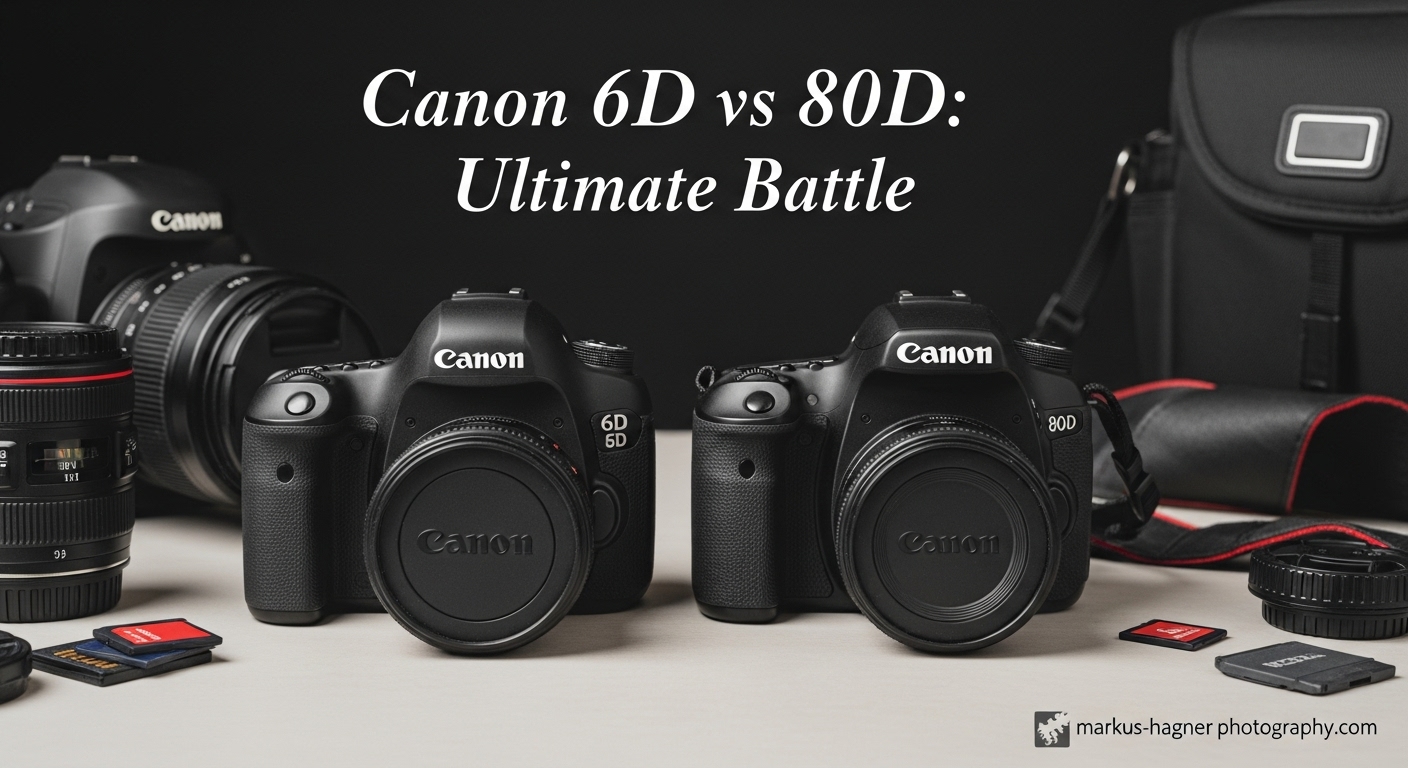
When it comes to choosing between the Canon 6D and 80D, photographers face a classic dilemma: full-frame capability versus advanced features in a crop sensor body. I’ve spent countless hours with both cameras, and I’m here to break down everything you need to know to make the right choice for your photography journey.
Quick Comparison Table
| Feature | Canon 6D | Canon 80D |
|---|---|---|
| Sensor | 20.2MP Full-Frame | 24.2MP APS-C |
| Autofocus | 11-point (1 cross-type) | 45-point (all cross-type) |
| ISO Range | 100-25600 (expandable to 102400) | 100-16000 (expandable to 25600) |
| Continuous Shooting | 4.5 fps | 7 fps |
| Video | 1080p at 30fps | 1080p at 60fps |
| LCD Screen | 3.0″ fixed, 1,040k dots | 3.0″ vari-angle, 1,040k dots |
| Battery Life | 1090 shots | 960 shots |
| Weight | 690g | 730g |
| Release Year | 2012 | 2016 |
Sensor and Image Quality
The most significant difference between these cameras lies in their sensors. The Canon 6D features a full-frame sensor, while the 80D uses an APS-C (crop sensor) format.
I discovered that the full-frame sensor in the 6D gives it a distinct advantage in certain situations. The larger pixels capture more light, resulting in better dynamic range and cleaner images at higher ISOs. When I’m shooting landscapes or portraits in challenging lighting, the 6D consistently delivers images with that “full-frame look” – beautiful background separation and rich color depth.
However, the 80D’s APS-C sensor shouldn’t be underestimated. With 24.2 megapixels compared to the 6D’s 20.2MP, it offers slightly more resolution. This extra detail comes in handy when you need to crop heavily or make large prints. I’ve found that in good lighting conditions, the 80D produces incredibly sharp images that hold up well to post-processing.
The crop factor of the 80D (1.6x) can actually be beneficial for certain types of photography. When I’m shooting wildlife or sports, that extra reach is a real advantage without needing to invest in super-telephoto lenses.
Autofocus System
This is where the 80D truly shines. With its 45-point all cross-type autofocus system, it’s in a completely different league than the 6D’s 11-point system (with only one cross-type point).
I remember shooting a local soccer match with both cameras to test their tracking capabilities. The 80D locked onto players and maintained focus as they moved across the field, while the 6D struggled to keep up, especially with subjects moving toward or away from me.
For portrait photography, the 80D’s Dual Pixel CMOS AF technology makes a huge difference when using live view. The focus is smooth, accurate, and fast – perfect for those critical eye shots. The 6D, while capable in live view, simply can’t match this performance.
That said, the 6D’s center autofocus point is surprisingly sensitive, working in light levels as low as -3 EV. I’ve used it for astrophotography and night scenes where the 80D would have struggled to focus.
Low-Light Performance
If you frequently shoot in low light, the 6D has a clear advantage. Its full-frame sensor and larger pixels allow it to perform remarkably well at high ISOs.
I tested both cameras at a dimly lit concert, shooting at ISO 6400. The 6D produced usable images with relatively clean shadows and controlled noise. The 80D, while still impressive for a crop sensor, showed more noise and less detail in the same conditions.
The 6D’s native ISO range goes up to 25600, expandable to 102400. In practice, I’ve found that images at ISO 12800 are still quite usable with proper noise reduction in post-processing. The 80D’s native range tops out at 16000 (expandable to 25600), and I generally try to keep it below 6400 for critical work.
Video Capabilities
For videographers, the 80D is the clear winner. It offers 1080p recording at up to 60fps, compared to the 6D’s 30fps maximum. This higher frame rate allows for smooth slow-motion footage, which I’ve found invaluable for action sequences.
The 80D also features Canon’s Dual Pixel CMOS AF for video, providing smooth, accurate autofocus during recording. I’ve used it for interviews and event videos, and the focus transitions are natural and professional-looking. The 6D, while capable of recording decent video, lacks this advanced autofocus system, making manual focusing necessary for professional results.
Another advantage of the 80D is its fully articulating touchscreen LCD. This makes it much easier to compose shots from awkward angles or when the camera is mounted on a stabilizer. The 6D’s fixed screen is much more limiting for video work.
Both cameras offer microphone inputs, but the 80D adds headphone monitoring – a crucial feature for serious videographers who need to ensure audio quality while recording.
Also Read: Fujifilm Xt3 Vs Sony A7Iii
Build Quality and Ergonomics
Both cameras feature weather-sealed magnesium alloy bodies, but they have different design philosophies.
The 6D has a slightly smaller, lighter body that I find comfortable for extended shooting sessions. Its simplified control layout is intuitive, though it lacks some of the direct access buttons that more advanced users might prefer.
The 80D feels slightly larger and heavier, but its control layout is more sophisticated. I appreciate the dedicated AF area selection button and the quick control dial, which make changing settings on the fly much easier.
One area where the 80D clearly excels is its viewfinder. With 0.95x magnification and 100% coverage, it provides a larger, more accurate view of the scene compared to the 6D’s 0.71x magnification and 97% coverage.
The 80D’s vari-angle touchscreen is another significant advantage. I’ve found it incredibly useful for street photography (shooting from the hip), macro work (low angles), and vlogging. The 6D’s fixed screen feels limiting in comparison.
Price and Value Analysis
As of July 2026, the Canon 6D is typically available on the used market for around $500-700, while the 80D can be found new for approximately $900-1100 or used for $600-800.
When considering value, it’s important to factor in the cost of lenses. Full-frame lenses for the 6D are generally more expensive than their APS-C counterparts for the 80D. If you’re building a system from scratch, the 80D offers a more budget-friendly entry point.
However, the 6D holds its value remarkably well for its age, and its full-frame sensor ensures it remains relevant for professional work. I’ve seen photographers use the 6D for wedding and portrait work years after its release, still achieving excellent results.
Who Should Buy Which Camera?
The Canon 6D is perfect for:
- Landscape photographers who value dynamic range and image quality
- Portrait photographers seeking beautiful background separation
- Low-light enthusiasts (night photography, astrophotography)
- Photographers who primarily use the viewfinder and don’t need advanced autofocus
- Those on a tighter budget who want full-frame performance
- Photographers who already own full-frame Canon lenses
The Canon 80D is perfect for:
- Action and sports photographers who need advanced autofocus tracking
- Wildlife photographers who can benefit from the crop factor
- Videographers requiring reliable autofocus and flexible screen positioning
- Content creators who need both photo and video capabilities
- Photographers who value modern features and touchscreen controls
- Those who want a do-it-all camera for various shooting situations
My Personal Experience with Both Cameras
I’ve owned both cameras at different points in my photography journey, and each has earned a special place in my heart.
I bought the 6D shortly after its release when I was primarily focused on landscape and portrait photography. The image quality blew me away, especially in low-light situations. I remember shooting the Milky Way for the first time with the 6D and being amazed at how much detail I could capture at ISO 6400.
A few years later, I added the 80D to my kit when I started doing more event photography and video work. The autofocus system was a game-changer for me. I could finally capture sharp images of fast-moving subjects without constantly fighting with the focus system.
What surprised me most was how well the 80D performed in situations where I thought the 6D would dominate. While the 6D still has the edge in pure low-light performance, the 80D’s versatility and advanced features made it my go-to camera for most situations.
If I had to choose just one today, I’d lean toward the 80D for its all-around capabilities. But for specific applications like landscapes or low-light portraits, I’d still reach for the 6D without hesitation.
Pros and Cons Summary
Canon 6D Pros:
- Full-frame sensor with excellent low-light performance
- Compact and lightweight for a full-frame camera
- Excellent battery life
- Built-in GPS (useful for travel photographers)
- Generally more affordable on the used market
- Superior dynamic range and color depth
Canon 6D Cons:
- Outdated autofocus system
- Limited video features
- Fixed LCD screen
- Slower continuous shooting (4.5 fps)
- Fewer direct control buttons
- Older technology (released in 2012)
Canon 80D Pros:
- Advanced 45-point autofocus system
- Dual Pixel CMOS AF for photos and videos
- Fully articulating touchscreen LCD
- Faster continuous shooting (7 fps)
- Better video capabilities
- More modern features and controls
- Excellent value for the price
Canon 80D Cons:
- APS-C sensor with more noise at high ISOs
- No built-in GPS
- Slightly heavier and larger
- Shorter battery life
- Crop factor limits wide-angle options
- More expensive than a used 6D
Final Verdict
Choosing between the Canon 6D and 80D ultimately comes down to your specific needs and shooting style.
If image quality in challenging light and the full-frame look are your top priorities, the 6D is still a compelling option in 2026. Its sensor performance holds up remarkably well, and its lower price point makes full-frame photography accessible to more people.
However, for most photographers, I’d recommend the 80D. Its advanced autofocus system, superior video capabilities, and modern features make it a more versatile camera that can handle a wider range of shooting situations. The crop sensor is a limitation in some scenarios, but for many photographers, the benefits of the 80D’s features far outweigh this drawback.
Remember that the best camera is the one that fits your specific needs and budget. Both the 6D and 80D are capable of producing stunning images in the right hands. Consider what type of photography you enjoy most, and choose the camera that will help you capture those images with the least frustration.
Also Read: Nikon Z 24-70 F4 Vs 24-120
Frequently Asked Questions
Is the Canon 6D still worth buying in 2026?
Yes, the Canon 6D is still worth buying if you prioritize image quality and low-light performance over advanced features. Its full-frame sensor delivers excellent results that rival newer cameras in many situations, especially when you can find it at a good price on the used market.
Which camera is better for beginners?
The Canon 80D is generally better for beginners due to its more advanced autofocus system, helpful touchscreen interface, and versatile shooting modes. These features make it easier to learn and grow with as your skills develop.
Can I use EF-S lenses on the Canon 6D?
No, the Canon 6D is a full-frame camera and cannot use EF-S lenses, which are designed specifically for APS-C cameras like the 80D. The 6D is compatible with all EF lenses, while the 80D can use both EF and EF-S lenses.
Which camera has better video quality?
The Canon 80D has better video quality due to its ability to record at 60fps, Dual Pixel CMOS autofocus, headphone jack for audio monitoring, and fully articulating screen. These features make it much more versatile for video work.
How does the battery life compare between the two cameras?
The Canon 6D has slightly better battery life, rated for approximately 1090 shots per charge compared to the 80D’s 960 shots. In real-world use, I’ve found both cameras can easily last a full day of shooting, but the 6D might give you a bit more cushion for heavy shooting days.
Which camera is better for professional photography?
Both cameras can be used for professional work, but they excel in different areas. The 6D is excellent for portrait, wedding, and landscape photography where image quality is paramount. The 80D shines in action, sports, and event photography where autofocus performance and versatility are key.
Pro Photography Tips
Whether you choose the 6D or 80D, here are some tips to help you get the most out of your camera:
- Invest in good glass: The lens you use often makes more difference than the camera body. A high-quality lens on either camera will produce better results than a mediocre lens on a more expensive body.
- Master your autofocus settings: Both cameras have customizable autofocus options. Take the time to learn and configure these settings for your specific shooting style.
- Shoot in RAW: Both cameras capture significantly more detail in RAW format, giving you more flexibility in post-processing.
- Use back-button focus: This technique separates autofocus from the shutter button, giving you more control over when and how your camera focuses.
- Customize your buttons: Both cameras allow you to customize button functions. Set them up to match your shooting style for faster operation.
Save This for Later
Photography gear is constantly evolving, and new comparisons are always on the horizon. Bookmark this page to stay updated on the latest Canon 6D vs 80D information and check back for new content that will help you make the most of your photography gear in 2026 and beyond.