
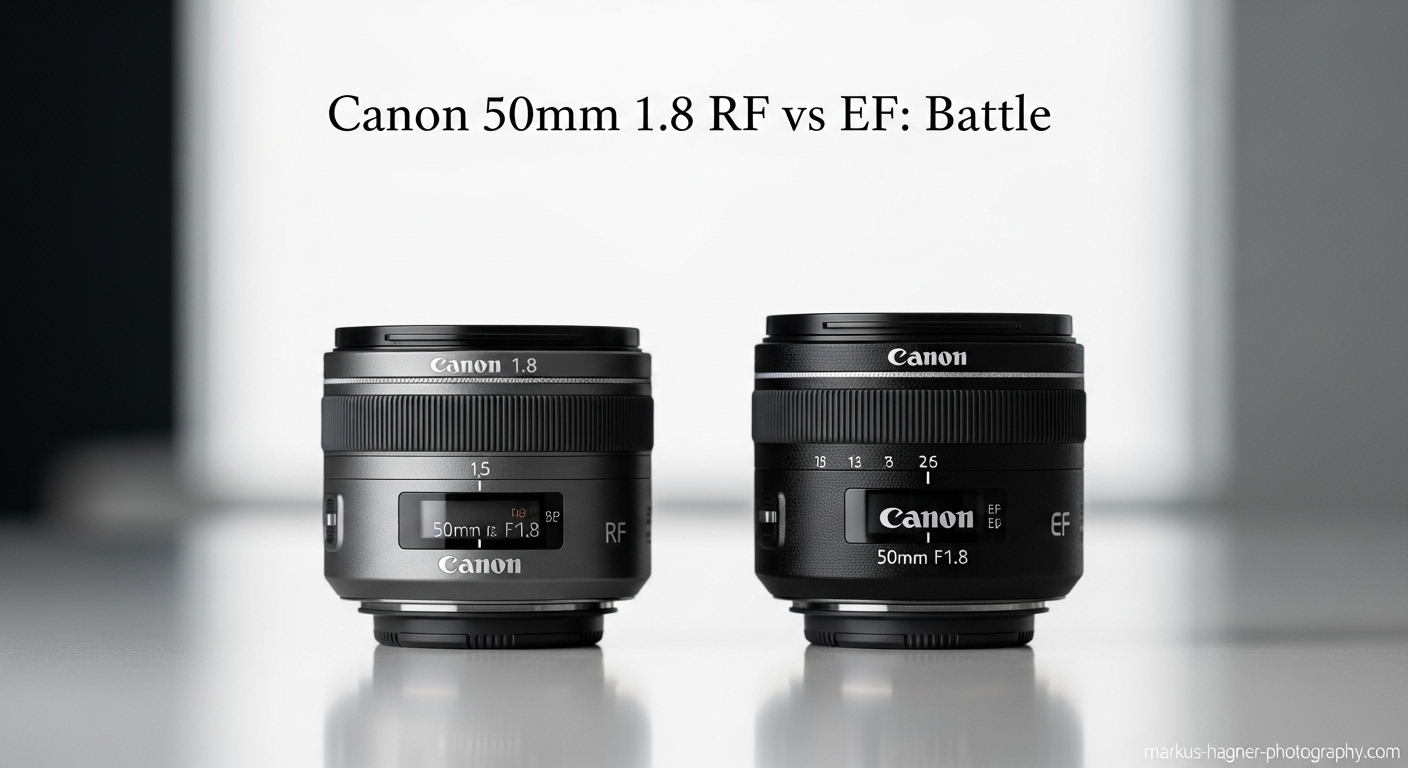
If you’ve been in photography for any length of time, you’ve probably heard about the “nifty fifty” – that beloved 50mm lens that seems to be in every photographer’s bag. Well, Canon offers two versions of this popular lens: the Canon 50mm 1.8 RF for their mirrorless system and the Canon 50mm 1.8 EF for their DSLR cameras. I’ve spent countless hours with both lenses, and I’m here to break down everything you need to know to make the right choice for your photography journey.
The Canon 50mm 1.8 RF and EF lenses represent two different eras of Canon’s technology. The EF version has been a longtime favorite for DSLR shooters, while the RF version is designed specifically for Canon’s mirrorless EOS R system. The main differences lie in their mount compatibility, optical design, autofocus performance, and build quality. While both lenses offer that classic 50mm field of view and wide f/1.8 aperture, they perform differently on modern camera systems. Your choice ultimately depends on which camera system you’re using and what features matter most to your photography style.
Understanding the Mount Systems: EF vs RF
Before we dive into the nitty-gritty details, let’s talk about the fundamental difference between these two lenses: the mount.
The EF (Electro-Focus) mount has been Canon’s standard for decades, used across their entire DSLR lineup. I remember getting my first Canon DSLR back in the day and being amazed at how the EF 50mm 1.8 made my photos look so much more professional than the kit lens. It was lightweight, affordable, and delivered beautiful images.
Then came the RF mount, introduced with Canon’s mirrorless EOS R system. The RF (R-Flange) mount features a shorter flange distance (the distance between the lens mount and the sensor), which allows for new optical designs and potentially better performance. When I switched to my first mirrorless Canon, I was curious to see how the RF version of this classic lens would compare.
Mount Compatibility
Here’s where things get interesting. EF lenses can be used on RF mount cameras with an adapter – Canon’s EF-EOS R adapter works brilliantly. I’ve been using my EF 50mm 1.8 on my mirrorless body for months, and the performance is excellent. However, RF lenses cannot be mounted on EF DSLR cameras – there’s simply no adapter that makes this possible.
This compatibility factor is crucial. If you’re invested in the DSLR system, the EF lens is your only choice. If you’re using mirrorless, you have options: use the native RF lens or adapt the EF version.
Physical Design and Build Quality
One of the first things you’ll notice when comparing these lenses is the difference in build quality.
Canon EF 50mm f/1.8 STM
The EF version has earned the nickname “plastic fantastic” for good reason. It’s incredibly lightweight at just 160g (5.6 oz), making it a breeze to carry around all day. I’ve taken this lens on countless photo walks, and I barely notice it in my bag.
However, the build quality reflects its budget-friendly price point. The lens barrel is made of plastic, and the focus ring is quite narrow and not the smoothest to operate. I discovered early on that this lens isn’t weather-sealed, so I’m extra careful when shooting in challenging conditions.
Canon RF 50mm f/1.8 STM
The RF version represents a significant upgrade in build quality. While still lightweight at 160g (5.6 oz), it feels more substantial in the hand. Canon has improved the overall construction with better materials and a more robust design.
What I particularly love about the RF version is the addition of a control ring. This customizable ring can be assigned to adjust various settings like aperture, ISO, or exposure compensation. It’s a game-changer for me when I’m shooting quickly and need to make adjustments without taking my eye off the viewfinder.
The RF lens also features a metal mount, compared to the plastic mount on the EF version – a small but meaningful difference in durability.
Optical Performance
Now let’s get to the heart of the matter: how do these lenses perform optically?
Sharpness
Both lenses are surprisingly sharp for their price point, but there are differences.
The EF 50mm 1.8 is sharp when stopped down to f/2.8 or beyond, but wide open at f/1.8, it’s a bit soft, especially in the corners. I’ve found it perfectly usable for portraits at f/1.8, as the slight softness can be flattering for skin tones.
The RF 50mm 1.8, however, shows noticeable improvement in sharpness wide open. Corner-to-corner sharpness is better even at f/1.8, and stopping down yields excellent results across the frame. When I’m shooting landscapes or architecture with this lens, I’m consistently impressed with the detail it captures.
Bokeh Quality
Both lenses produce pleasing bokeh, but with different characteristics.
The EF version creates smooth, circular bokeh points, though they can show a bit of “nervousness” in busy backgrounds. I’ve used it for countless portraits, and the subject separation is generally excellent.
The RF lens seems to have a slight edge in bokeh rendering, with smoother transitions and more circular out-of-focus highlights. This is likely due to optical improvements and a newer design. When I’m shooting portraits with the RF version, I notice that background elements melt away just a little more pleasingly.
Chromatic Aberration
Chromatic aberration (those purple or green fringes in high-contrast areas) is present in both lenses, as expected at this price point.
The EF lens shows moderate chromatic aberration wide open, particularly in high-contrast situations. I’ve learned to either stop down slightly or correct this in post-processing when it’s noticeable.
The RF lens handles chromatic aberration slightly better, though it’s still present wide open. Canon has clearly made some optical improvements here, but it’s not completely eliminated.
Vignetting and Distortion
Both lenses exhibit some vignetting wide open, which is typical for fast primes. The EF version shows more pronounced darkening in the corners at f/1.8, while the RF lens controls this a bit better.
Distortion is minimal in both lenses, with slight barrel distortion that’s easily correctable in post-processing. I rarely notice distortion issues with either lens in real-world shooting.
Autofocus Performance
Autofocus is where we see some significant differences between these two lenses, especially when used on modern mirrorless bodies.
Canon EF 50mm f/1.8 STM on DSLR
On a DSLR, the EF 50mm 1.8 uses Canon’s STM (Stepping Motor) technology, which provides smooth, quiet autofocus. It’s not the fastest focusing lens in Canon’s lineup, but it’s adequate for most situations.
I’ve used this lens for event photography and found that while it’s not lightning-fast, it’s reliable in good lighting conditions. In low light, it can hunt a bit before locking focus.
Canon EF 50mm f/1.8 STM on Mirrorless (with adapter)
When adapted to a mirrorless body, the EF lens’s autofocus performance improves significantly. Mirrorless cameras use contrast-detect and phase-detect autofocus on the sensor itself, which is generally more accurate than the separate AF system in DSLRs.
I’ve been amazed at how much snappier the EF lens feels on my mirrorless camera compared to my old DSLR. Eye detection works well, and tracking is more reliable.
Canon RF 50mm f/1.8 STM on Mirrorless
The RF lens was designed from the ground up for mirrorless cameras, and it shows. The autofocus is noticeably faster and quieter than the EF version, even when adapted.
What I love most about the RF lens is how confidently it locks onto subjects, even in challenging lighting conditions. When I’m shooting portraits, the eye detection is practically foolproof, keeping my subject’s eyes sharp even when they’re moving slightly.
Real-World Performance
Numbers and specifications are one thing, but how do these lenses actually perform in real photography situations?
Portrait Photography
Both lenses excel at portraits, thanks to the 50mm focal length and wide f/1.8 aperture.
With the EF lens, I’ve captured countless beautiful portraits over the years. The slight softness wide open can actually be flattering for portraits, and the subject separation is excellent. However, I’ve found that I need to stop down to f/2.8 or f/4 to get critical sharpness on eyes.
The RF lens gives me more confidence when shooting portraits wide open. The improved sharpness means I can trust that my subject’s eyes will be tack sharp at f/1.8, while still getting that beautiful background blur. The faster autofocus also means I capture more decisive moments.
Low-Light Situations
Both lenses perform well in low light thanks to their f/1.8 aperture, but there are differences.
The EF lens is capable in low light, but I’ve noticed that autofocus can struggle in very dim conditions. I’ve had to switch to manual focus on occasion when the lighting gets really challenging.
The RF lens handles low light situations more gracefully. The autofocus system is more sensitive, and I’ve found it locks onto subjects even in lighting conditions where the EF version would struggle. This makes the RF lens my go-to choice for indoor events and evening photography.
Street Photography
For street photography, both lenses have their advantages.
The EF lens is so small and lightweight that it’s incredibly discreet. I’ve spent entire days wandering cities with this lens, and it never draws attention. The manual focus isn’t the smoothest, but for street photography, I’m usually using autofocus anyway.
The RF lens is similarly compact, but the addition of the control ring gives me more flexibility when shooting quickly. I can adjust my exposure settings without taking my eye off the viewfinder or fumbling with camera controls. The improved autofocus also means I capture more fleeting moments on the street.
Everyday Use
For everyday photography, both lenses are excellent choices.
The EF lens has been my “walk around” lens for years. It’s versatile enough for most situations, and the image quality is excellent for the price. I’ve captured everything from family gatherings to travel photos with this lens, and it rarely disappoints.
The RF lens has become my new favorite for everyday use. The improved build quality gives me confidence that it will last for years, and the optical improvements are noticeable in my day-to-day shooting. The control ring has become an essential feature for me, allowing me to adjust settings quickly without interrupting my shooting flow.
Also Read: Canon 16 35 F4 Vs Sigma 18 35 F1 8
Price and Value
Price is often a deciding factor when choosing between lenses, so let’s break down the value proposition of each option.
Canon EF 50mm f/1.8 STM
The EF 50mm 1.8 has long been known as one of the best value lenses in photography. It’s incredibly affordable, often priced around $125-$150 new. For this price, you get a lens with excellent image quality when stopped down, making it a perfect first prime lens for beginners or a budget-friendly option for enthusiasts.
I’ve recommended this lens to countless friends starting in photography, and it’s never disappointed. The value proposition is simple: for a small investment, you get a significant improvement in image quality over most kit lenses.
Canon RF 50mm f/1.8 STM
The RF 50mm 1.8 is priced higher, typically around $200-$250 new. While this is more expensive than the EF version, it’s still very affordable compared to other RF mount lenses.
When I consider the improved build quality, better optical performance, and the addition of the control ring, I find the price increase justified. If you’re using a mirrorless Canon camera, the RF version offers better value in the long run due to its improved performance and compatibility with your system.
Adaptability and Future-Proofing
One of the most important considerations when choosing between these lenses is how they fit into your current and future photography plans.
Using EF Lenses on RF Bodies
As I mentioned earlier, EF lenses can be used on RF mount cameras with an adapter. Canon’s EF-EOS R adapter works brilliantly, maintaining autofocus speed and image quality.
I’ve been using my EF 50mm 1.8 on my mirrorless body for months, and the performance is excellent. The adapter adds a bit of length and weight, but it’s a small price to pay for the versatility of using your existing lens collection.
Using RF Lenses on EF Bodies
Unfortunately, there’s no way to use RF lenses on EF DSLR bodies. The shorter flange distance of the RF mount makes this physically impossible without additional optics, which would degrade image quality.
This means if you’re currently using a DSLR and plan to upgrade to mirrorless in the future, you might want to consider how your lens purchases fit into that plan. EF lenses will work on both systems (with an adapter for mirrorless), while RF lenses will only work on mirrorless bodies.
Future-Proofing Your Investment
When I think about future-proofing my photography gear, I consider both the lens mount and the technology.
The EF mount has been around since 1987, and Canon has supported it consistently. However, the company has clearly shifted its focus to the RF system for future development. Most new Canon lenses are now RF mount, and the innovation is happening in this system.
If you’re planning to stay with Canon long-term, investing in RF lenses makes sense, especially if you’re using or planning to use a mirrorless camera. The RF system is where Canon is focusing its research and development, so we can expect more innovations and improvements in this mount.
Who Should Buy Which Lens?
Now that we’ve covered all the details, let’s break down who should consider each lens.
You Should Buy the Canon EF 50mm f/1.8 STM If:
- You primarily use a Canon DSLR camera
- You’re on a tight budget
- You want the lightest possible lens for travel or everyday carry
- You already have EF lenses and want to maintain compatibility
- You plan to use the lens on both DSLR and mirrorless bodies (with adapter)
I’ve recommended the EF 50mm 1.8 to many friends who are just starting in photography with a Canon DSLR. It’s the perfect first prime lens, offering a significant step up in image quality from kit lenses at a very affordable price point.
You Should Buy the Canon RF 50mm f/1.8 STM If:
- You primarily use a Canon mirrorless camera
- You want the best possible performance from a 50mm lens on your mirrorless body
- You value the control ring for quick adjustments
- You want better build quality and weather sealing
- You’re investing in the RF system for the long term
Since switching to mirrorless, the RF 50mm 1.8 has become my go-to lens for everyday photography. The improved performance and features make it worth the extra cost for me, especially since I’m fully invested in the RF system.
Final Verdict
After spending considerable time with both lenses, I can confidently say that both the Canon 50mm 1.8 RF and EF are excellent lenses that offer tremendous value for their price.
The EF 50mm 1.8 remains one of the best budget lenses in photography, perfect for DSLR users or those who need an affordable, lightweight option. It’s capable of producing beautiful images and has earned its place as a classic “nifty fifty.”
The RF 50mm 1.8 represents an evolution of this classic lens, with improved build quality, better optical performance, and features designed specifically for mirrorless cameras. If you’re using a Canon mirrorless camera, the RF version is the clear choice for better performance and future-proofing your investment.
Ultimately, your choice should be based on your camera system and what features matter most to you. Both lenses will serve you well, but understanding their differences will help you make the right choice for your photography needs.
Also Read: Nikon Z6 II vs Sony A7 IV
Frequently Asked Questions
Can I use the Canon EF 50mm 1.8 on a mirrorless camera?
Yes, you can use the EF 50mm 1.8 on a Canon mirrorless camera with the EF-EOS R adapter. The adapter maintains autofocus speed and image quality, making it a great way to use your existing EF lenses on mirrorless bodies.
Is the RF 50mm 1.8 weather-sealed?
The RF 50mm 1.8 has basic weather sealing, offering more protection than the EF version. However, it’s not fully weather-sealed like Canon’s higher-end L-series lenses. I’d still be cautious when using it in challenging weather conditions.
Which lens is better for video?
The RF 50mm 1.8 is generally better for video due to its quieter STM motor and the addition of the control ring, which allows for smooth aperture adjustments while recording. However, both lenses can produce excellent video results when used properly.
Is the RF 50mm 1.8 worth the extra cost over the EF version?
If you’re using a Canon mirrorless camera, I believe the RF 50mm 1.8 is worth the extra cost. The improved build quality, better optical performance, and control ring make it a more versatile and capable lens that will serve you well for years to come.
Can I use the RF 50mm 1.8 on a DSLR?
No, you cannot use the RF 50mm 1.8 on a Canon DSLR. The RF mount is designed specifically for mirrorless cameras and is not compatible with DSLR bodies, even with an adapter.
Pro Tips for Getting the Most Out of Your 50mm Lens
Whether you choose the RF or EF version, here are some tips I’ve learned over the years to help you get the most out of your 50mm lens:
- Stop down for sharper images: Both lenses are sharpest when stopped down to f/2.8-f/4. If you need maximum sharpness, don’t shoot wide open unless necessary.
- Use the focal length to your advantage: The 50mm focal length is versatile but requires you to “zoom with your feet.” Move around to find the best composition rather than standing in one place.
- Watch your backgrounds: At f/1.8, backgrounds can become very busy. Pay attention to what’s behind your subject and adjust your position if needed.
- For RF users, customize the control ring: Take some time to set up the control ring for your most-used adjustment. I have mine set to control aperture, which allows me to make quick changes without taking my eye off the viewfinder.
- Consider a lens hood: Both lenses benefit from a lens hood, which helps reduce flare and protects the front element. The official Canon hoods are relatively inexpensive and worth the investment.
- Clean your lens regularly: These lenses don’t have weather sealing, so check the front element regularly for dust and smudges that could affect image quality.
Save This Article for Later
Photography gear decisions are important, and you might want to refer back to this comparison as you consider your options. I recommend bookmarking this article so you can easily find it when you’re ready to make your purchase. Camera gear is constantly evolving, and I’ll be updating this article as new information becomes available, so check back for the latest insights on these fantastic lenses.
Happy shooting, and I hope this comparison helps you choose the perfect 50mm lens for your photography journey!