
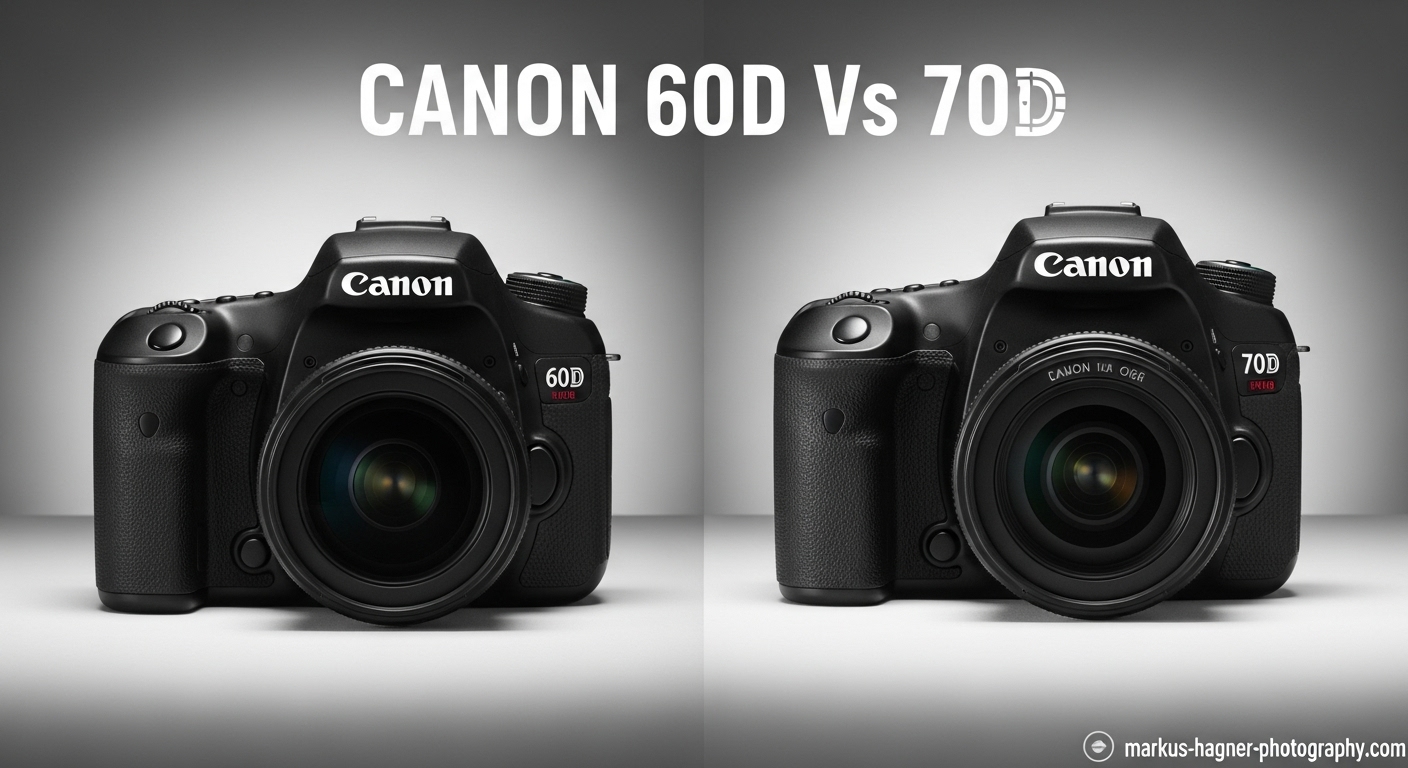
The Canon 60D and 70D represent two generations of Canon’s popular mid-range DSLR cameras, with the 70D being the successor to the 60D. When comparing the Canon 60D vs 70D, photographers will find significant differences in autofocus technology, video capabilities, and overall performance. The 70D introduced Canon’s revolutionary Dual Pixel CMOS AF system, which dramatically improved autofocus during live view and video recording. While both cameras share similar form factors and target the same enthusiast photographer market, the 70D offers several key upgrades that make it a more capable camera, especially for those interested in video work. In this comprehensive comparison, I’ll break down every aspect of these cameras to help you decide which one deserves a place in your camera bag.
A Brief History: Two Generations of Excellence
Canon 60D: The Reliable Workhorse
The Canon 60D was released in August 2010 as part of Canon’s enthusiast DSLR lineup. It replaced the 50D and introduced several new features, including an articulated LCD screen and full HD video recording. I remember when the 60D first hit the market—it was considered a significant upgrade for enthusiasts who wanted more advanced features than the Rebel series but didn’t need the professional-grade features of the 7D.
The 60D featured an 18-megapixel APS-C CMOS sensor and Canon’s DIGIC 4 image processor. It offered a maximum ISO of 6400 (expandable to 12800) and could shoot continuously at 5.3 frames per second. The camera was well-received for its build quality, ergonomic design, and excellent image quality for its class.
Canon 70D: The Game-Changer
Three years later, in August 2013, Canon introduced the 70D as the successor to the 60D. The 70D brought several significant improvements, most notably Canon’s Dual Pixel CMOS AF technology. This was a game-changer for live view and video autofocus, addressing one of the biggest weaknesses of previous DSLRs.
The 70D featured a 20.2-megapixel APS-C CMOS sensor and the more advanced DIGIC 5+ image processor. It offered improved ISO performance (up to 12800, expandable to 25600) and a slightly faster continuous shooting speed of 7 frames per second. When I first got my hands on the 70D, I was immediately impressed by how much smoother the autofocus was in live view compared to my older 60D.
Design and Build Quality: Evolution Not Revolution
Canon 60D: Sturdy and Functional
The Canon 60D features a polycarbonate body with a metal chassis, striking a balance between durability and weight. It weighs approximately 755 grams (body only) and measures 144.5 × 105.8 × 78.6 mm. The camera feels substantial in hand, with a comfortable grip that makes extended shooting sessions comfortable.
One of the standout features of the 60D is its fully articulated 3.0-inch LCD screen with 1,040,000 dots. This was a significant upgrade over the fixed screens of previous models, making it much easier to shoot from awkward angles or for video work.
The 60D’s control layout is well-thought-out, with a mode dial on top, a quick control dial on the back, and various buttons for frequently used functions. The camera also features a top LCD panel for quickly checking settings without turning on the main screen.
Canon 70D: Refined and Improved
The Canon 70D maintains a similar form factor to the 60D but with some refinements. It weighs slightly more at 775 grams (body only) and has nearly identical dimensions of 139 × 104.3 × 78.5 mm. The build quality feels slightly more premium, with improved texture on the grip and better weather sealing.
The 70D also features a fully articulated 3.0-inch LCD screen, but with a major upgrade: it’s a touchscreen with 1,040,000 dots. This touchscreen functionality adds a new dimension to camera operation, allowing you to select focus points, navigate menus, and even trigger the shutter with a tap.
Canon made some subtle but significant improvements to the control layout on the 70D. The buttons are slightly larger and more tactile, and the mode dial now features a locking mechanism to prevent accidental changes. The top LCD panel is also improved, with better visibility in bright conditions.
Sensor and Image Quality: More Than Just Megapixels
Canon 60D: Solid Performance
The Canon 60D features an 18-megapixel APS-C CMOS sensor paired with Canon’s DIGIC 4 image processor. This combination delivers excellent image quality with good dynamic range and color accuracy. The native ISO range is 100-6400, expandable to 12800.
In my experience shooting with the 60D, I found that it produces clean images up to ISO 1600. At higher ISOs, noise becomes more noticeable, but the images remain usable with proper post-processing. The 18-megapixel resolution provides plenty of detail for most applications, including large prints and cropping.
The 60D’s sensor delivers pleasing colors with Canon’s characteristic look, which tends to be slightly warm with excellent skin tones. JPEG straight out of the camera looks great, but RAW files offer plenty of flexibility for post-processing.
Canon 70D: A Step Forward
The Canon 70D features a 20.2-megapixel APS-C CMOS sensor with the more advanced DIGIC 5+ image processor. While the increase in resolution is modest, the real improvement comes in the sensor technology itself. The 70D’s sensor uses Canon’s Dual Pixel CMOS AF technology, which dedicates each pixel to both imaging and phase-detection autofocus.
The native ISO range of the 70D is 100-12800, expandable to 25600. In real-world use, I’ve found that the 70D delivers noticeably better high-ISO performance than the 60D. Images at ISO 3200 are very usable, and even ISO 6400 can produce acceptable results with careful post-processing.
The 20.2-megapixel sensor provides excellent detail and slightly more cropping flexibility than the 60D. The color science is similar to the 60D but with slightly improved dynamic range, especially in shadow areas. The DIGIC 5+ processor also contributes to better overall image quality with more refined noise reduction and sharper details.
Autofocus System: A Quantum Leap
Canon 60D: Capable but Limited
The Canon 60D features a 9-point autofocus system with all cross-type points at the center. The system is similar to what was found in the 50D and Rebel series of the time. In practice, the 60D’s autofocus is generally reliable in good lighting conditions but can struggle in low light or with low-contrast subjects.
The center autofocus point is the most accurate and sensitive, especially with lenses that have apertures of f/2.8 or wider. The outer points are less sensitive and work best with lenses that have apertures of f/5.6 or wider. I’ve found that for most general photography, the 60D’s autofocus is adequate, but it can be frustrating when shooting fast-moving subjects or in challenging lighting.
One limitation of the 60D is its contrast-detect autofocus in live view mode, which is notoriously slow and hunts for focus. This makes the 60D less than ideal for video work or for photographers who prefer using live view for still photography.
Canon 70D: Revolutionary Dual Pixel CMOS AF
The Canon 70D features a 19-point autofocus system, all cross-type, with a dual cross-type sensor at the center. This is a significant improvement over the 60D’s 9-point system, providing better subject tracking and more focus point options for composition.
The real game-changer, however, is Canon’s Dual Pixel CMOS AF technology. This revolutionary system dedicates each pixel on the sensor to both imaging and phase-detection autofocus. The result is dramatically improved autofocus performance in live view and video mode.
In my experience, the 70D’s Dual Pixel CMOS AF is a revelation. Live view autofocus is now fast and accurate, approaching the performance of dedicated camcorders. This makes the 70D much more versatile for video work and for photographers who prefer using live view.
The 70D also introduces improved AI Servo AF II algorithm, which provides better tracking of moving subjects. Combined with the 19-point AF system, this makes the 70D significantly better for action and sports photography than the 60D.
Video Capabilities: From Basic to Professional
Canon 60D: Good for Its Time
The Canon 60D was one of the first Canon DSLRs to offer full HD video recording at 1920×1080 resolution with frame rates of 24p, 25p, and 30p. It also offers standard HD recording at 1280×720 with frame rates of 50p and 60p. The camera uses the H.264 codec with a bit rate of approximately 45 Mbps.
When the 60D was released, its video capabilities were impressive for a mid-range DSLR. The articulated screen made it easier to shoot video from various angles, and manual exposure control allowed for creative cinematography. However, the 60D lacks many features that videographers now take for granted, such as clean HDMI output, headphone jack, or zebras.
The biggest limitation of the 60D for video work is its autofocus system. The contrast-detect AF in live view is slow and prone to hunting, making it nearly unusable for recording video. This means videographers need to rely on manual focus, which can be challenging, especially with moving subjects.
Canon 70D: A Videographer’s Dream
The Canon 70D builds on the 60D’s video capabilities with several significant improvements. It offers the same resolution options (1080p at 24p, 25p, 30p and 720p at 50p, 60p) but with the all-important Dual Pixel CMOS AF system.
The Dual Pixel CMOS AF transforms the 70D into a capable video camera. The autofocus is smooth, accurate, and nearly silent, making it practical for recording video with autofocus. The system offers various AF modes, including Face Detection Tracking, FlexiZone – Single, and FlexiZone – Multi, giving videographers different options depending on their needs.
The 70D also introduces a built-in stereo microphone, which is a significant improvement over the 60D’s mono microphone. While external microphones are still recommended for professional work, the built-in mic is surprisingly good for casual use.
Other video improvements on the 70D include manual audio level control (which the 60D also has), video snapshot mode for creating short video clips, and the ability to capture still images while recording video. The 70D also offers digital zoom (3x-10x) in video mode, which can be useful for getting closer to the action without changing lenses.
LCD Screen and Interface: Touch Meets Tradition
Canon 60D: Functional and Clear
The Canon 60D features a 3.0-inch articulated LCD screen with 1,040,000 dots. The screen is bright and clear, with good visibility even in bright outdoor conditions. The articulation is a major advantage, allowing you to flip the screen out and rotate it for shooting from high or low angles, or even for self-portraits.
The interface of the 60D is straightforward and intuitive. The Quick Control screen provides easy access to most settings, and the menu system is logically organized. The physical buttons are well-placed and provide good tactile feedback, making it easy to adjust settings without taking your eye from the viewfinder.
One limitation of the 60D’s interface is the lack of touchscreen functionality. All navigation and settings adjustments must be done using physical buttons and dials, which can be slower than touchscreen operation, especially when selecting focus points in live view.
Canon 70D: Touch and Go
The Canon 70D retains the 3.0-inch articulated LCD screen with 1,040,000 dots but adds a crucial feature: touchscreen functionality. The touchscreen is responsive and accurate, supporting multi-touch gestures like pinch-to-zoom for image review.
The touchscreen transforms the camera’s interface, making it faster and more intuitive to navigate menus, select focus points, and adjust settings. In live view mode, you can simply tap on the screen to select your focus point, and even trigger the shutter with a double-tap. This makes the 70D much more user-friendly for photographers transitioning from smartphones or mirrorless cameras.
The physical interface of the 70D is similar to the 60D but with some refinements. The buttons are slightly larger and more tactile, and the mode dial now has a locking mechanism to prevent accidental changes. The Quick Control screen is also improved, with better organization and more visual feedback.
Connectivity Options: Going Wireless
Canon 60D: Wired and Simple
The Canon 60D offers basic connectivity options for its time. It features a mini-USB port for connecting to a computer and a mini-HDMI port for connecting to external displays or TVs. The camera also has a standard 3.5mm remote shutter release terminal and a proprietary N3-type remote terminal for advanced remote controls.
One notable omission on the 60D is built-in WiFi. To transfer images wirelessly or control the camera remotely, you need to purchase the optional WFT-E7A wireless file transmitter, which is bulky and expensive. This limits the 60D’s connectivity options compared to more modern cameras.
Canon 70D: Embracing Wireless
The Canon 70D introduces built-in WiFi connectivity, a significant upgrade over the 60D. The WiFi allows you to transfer images to your smartphone or tablet, control the camera remotely using Canon’s free EOS Remote app, and print directly to compatible WiFi printers.
Setting up the WiFi on the 70D is straightforward, and the connection is generally stable and reliable. I’ve found the remote control functionality particularly useful for wildlife photography, where I can trigger the camera from a distance without disturbing the subject.
In addition to WiFi, the 70D retains the mini-USB and mini-HDMI ports of the 60D, as well as the remote terminals. The 70D also adds GPS compatibility via the optional GP-E2 GPS receiver, which can geotag your images automatically.
Battery Life: Power to Shoot All Day
Canon 60D: Reliable Endurance
The Canon 60D uses the LP-E6 battery, which has a capacity of 1800mAh. According to CIPA standards, the 60D can capture approximately 1100 shots on a single charge. In real-world use, I’ve found that the battery life is generally excellent, often lasting through a full day of shooting with moderate use of live view and image review.
The LP-E6 battery is widely used across Canon’s mid-range and professional DSLRs, making it easy to find replacements and third-party alternatives. The battery also communicates with the camera, providing accurate remaining power information and shutter count.
Canon 70D: Slightly Improved
The Canon 70D uses the LP-E6N battery, an updated version of the LP-E6 with a capacity of 1865mAh. According to CIPA standards, the 70D can capture approximately 920 shots on a single charge, which is slightly less than the 60D despite the higher capacity battery.
The discrepancy between the CIPA ratings and real-world performance can be attributed to the more advanced features of the 70D, such as the touchscreen and Dual Pixel CMOS AF, which consume more power. In my experience, the 70D’s battery life is still very good, typically lasting through a full day of shooting, but you might want to carry a spare battery for extended use or when shooting a lot of video.
The LP-E6N is backward compatible with the 60D and other cameras that use the LP-E6, and vice versa. This makes it easy to use batteries interchangeably between the two cameras if you own both.
Performance in Real-World Use: How They Handle in the Field
Canon 60D: Dependable and Predictable
Having shot extensively with the Canon 60D, I can attest to its reliability and consistent performance. The camera handles well, with a comfortable grip and well-placed controls that make it easy to adjust settings on the fly. The viewfinder is bright and clear, providing 96% coverage of the frame.
The 60D’s continuous shooting speed of 5.3 frames per second is adequate for most general photography, including portraits, landscapes, and casual action shots. However, it can feel limiting when shooting fast-moving subjects like sports or wildlife. The buffer depth is also modest, allowing approximately 58 JPEGs or 16 RAW files in a single burst.
In terms of autofocus performance, the 60D is generally reliable in good lighting conditions but can struggle in low light or with low-contrast subjects. The 9-point AF system is adequate for most situations but lacks the sophistication of more advanced systems.
Canon 70D: More Responsive and Versatile
The Canon 70D builds on the 60D’s strengths while addressing many of its weaknesses. The camera feels slightly more refined in hand, with improved ergonomics and a more substantial grip. The viewfinder is similar to the 60D, with 98% coverage and 0.95x magnification.
The 70D’s continuous shooting speed of 7 frames per second is a significant improvement over the 60D, making it much more capable for action and sports photography. The buffer depth is also improved, allowing approximately 65 JPEGs or 23 RAW files in a single burst.
The autofocus system is where the 70D truly shines. The 19-point AF system with all cross-type points provides better subject tracking and more focus point options for composition. Combined with the improved AI Servo AF II algorithm, the 70D is significantly better at tracking moving subjects than the 60D.
The Dual Pixel CMOS AF system transforms the live view experience, making it fast and accurate enough for practical use in various situations. This is particularly useful for macro photography, where precise focus is critical, and for video work, where smooth autofocus is essential.
Price and Value: Getting the Most for Your Money
Canon 60D: Budget-Friendly Option
As of August 2026, the Canon 60D is available on the used market for approximately $200-$300 for the body only, depending on condition. This makes it an attractive option for photographers on a tight budget or those looking to get into DSLR photography without spending a lot of money.
Despite its age, the 60D still offers excellent image quality and a full set of features that are more than adequate for most enthusiasts and even some professionals. The camera is built to last, and many examples are still going strong after years of use.
The 60D is compatible with Canon’s extensive range of EF and EF-S lenses, making it easy to build a versatile system over time. The LP-E6 battery is widely available and relatively inexpensive, both as genuine Canon products and as third-party alternatives.
Canon 70D: Premium Performance at a Reasonable Price
The Canon 70D is currently available on the used market for approximately $350-$500 for the body only, depending on condition. While it’s more expensive than the 60D, it offers significant improvements in autofocus, video capabilities, and overall performance.
For photographers who can afford the extra cost, the 70D represents better value in the long run. The Dual Pixel CMOS AF system alone is worth the premium for anyone interested in video work or live view photography. The improved autofocus system, faster continuous shooting, and better high-ISO performance also make it a more capable camera overall.
Like the 60D, the 70D is compatible with Canon’s extensive range of EF and EF-S lenses. The LP-E6N battery is slightly more expensive than the LP-E6 but is still widely available and reasonably priced.
Also Read: Leica M2 vs M3
Who Should Choose Which Camera?
The Canon 60D Is For You If:
- You’re on a tight budget but still want a capable DSLR
- You primarily shoot still photos and don’t need advanced video features
- You prefer a simpler interface without touchscreen functionality
- You don’t shoot a lot of action or sports photography
- You’re comfortable with manual focus for video work
- You’re just starting out with DSLR photography and want an affordable entry point
The Canon 70D Is For You If:
- You need reliable autofocus for video work
- You shoot a lot of action or sports photography
- You want the convenience of wireless image transfer and remote control
- You prefer a more modern interface with touchscreen functionality
- You need better low-light performance
- You’re willing to pay a premium for features that will serve you well into the future
My Personal Experience with Both Cameras
I’ve owned and shot extensively with both the Canon 60D and 70D, and each has earned a special place in my photography journey. I bought the 60D back in 2011 when I was getting more serious about photography, and it served me well for several years. The camera was reliable, produced excellent images, and helped me develop my skills.
I remember one particular landscape photography trip to the mountains where the 60D’s articulated screen was invaluable. I was able to compose shots from low angles without having to lie on the ground, and the image quality was stunning. The camera’s battery life also impressed me, lasting through two full days of shooting without needing a recharge.
When the 70D was released in 2013, I was hesitant to upgrade at first, but the promise of Dual Pixel CMOS AF eventually convinced me. The difference was night and day, especially for video work. I remember shooting a friend’s wedding shortly after getting the 70D, and the reliable autofocus during the ceremony was a lifesaver. I could focus on composition and timing without worrying about missing critical moments due to focus hunting.
For portrait work, I’ve found that both cameras perform admirably, but the 70D’s improved autofocus system makes it easier to nail focus, especially when shooting wide open with fast primes. The touchscreen is also a game-changer for quickly selecting focus points when composing portraits.
In terms of image quality, both cameras produce excellent results, but I’ve found that the 70D’s RAW files have slightly more latitude for post-processing, especially in shadow areas. The improved high-ISO performance is also noticeable when shooting in low-light conditions.
If I had to choose just one today, I would go with the 70D without hesitation. The Dual Pixel CMOS AF alone is worth the premium, and the other improvements add up to a significantly more capable and versatile camera. However, I understand that not everyone can afford the extra cost, and the 60D remains a solid choice for photographers on a budget.
Pros and Cons Summary
Canon 60D
Pros:
- Excellent image quality for its class
- Articulated LCD screen for flexible shooting angles
- Good battery life
- Affordable on the used market
- Compatible with wide range of Canon lenses
- Reliable and durable build quality
Cons:
- Limited 9-point autofocus system
- Slow contrast-detect AF in live view
- No built-in WiFi
- No touchscreen functionality
- Lower maximum ISO (6400 native)
- Slower continuous shooting (5.3 fps)
Canon 70D
Pros:
- Revolutionary Dual Pixel CMOS AF for live view and video
- 19-point all cross-type autofocus system
- Touchscreen interface for intuitive operation
- Built-in WiFi for wireless connectivity
- Better high-ISO performance
- Faster continuous shooting (7 fps)
- Improved video capabilities
Cons:
- More expensive than the 60D
- Slightly shorter battery life
- Still limited by DSLR form factor for video
- No headphone jack for audio monitoring
- No 4K video recording (by modern standards)
- Older technology compared to current models
Also Read: Tamron 28-200mm vs Sony 24-240
Final Verdict: Which Camera Deserves Your Money?
After extensively using both cameras, I can confidently say that the Canon 70D is the superior camera in almost every aspect. The Dual Pixel CMOS AF technology alone makes it worth the extra cost, especially if you’re interested in video work or prefer using live view for still photography.
That said, the Canon 60D remains a capable camera that can produce excellent results in the right hands. If you’re on a tight budget or primarily shoot still photos in good lighting conditions, the 60D offers tremendous value for money.
For photographers who can afford the extra cost, I recommend the 70D without reservation. Its improved autofocus system, faster continuous shooting, better low-light performance, and wireless connectivity make it a more versatile camera that will serve you well for years to come.
Ultimately, the best camera is the one that fits your needs and budget. Both the 60D and 70D are capable tools that can help you create stunning images, but the 70D offers more room to grow as your skills develop.
FAQ: Answering Your Questions About the Canon 60D and 70D
Are these cameras still worth buying in 2026?
Yes, both cameras can still be good purchases in 2026, depending on your needs and budget. The 60D is an excellent budget option for beginners or those on a tight budget, while the 70D offers more advanced features that remain relevant today. However, if you need the latest technology like 4K video or advanced autofocus tracking, you might want to consider newer models.
Can I use modern Canon lenses on these cameras?
Yes, both cameras are compatible with Canon’s EF and EF-S lenses. This includes modern lenses released after these cameras were manufactured. However, they are not compatible with Canon’s newer RF mount lenses without an adapter, and even with an adapter, functionality may be limited.
How do these cameras compare to modern mirrorless options?
Modern mirrorless cameras generally offer advantages in size, weight, autofocus performance, and video features. However, the 60D and 70D still offer excellent image quality, optical viewfinders (which some photographers prefer), and compatibility with Canon’s extensive lens lineup at a fraction of the cost of new mirrorless systems.
Which camera is better for video?
The 70D is significantly better for video work due to its Dual Pixel CMOS AF system, which provides smooth and reliable autofocus during recording. The 70D also has a built-in stereo microphone and offers more video-related features, making it the clear choice for videographers.
Do these cameras have good battery life?
Both cameras offer good battery life, with the 60D having a slight edge. The 60D can capture approximately 1100 shots on a single charge, while the 70D can capture about 920 shots. In real-world use, both cameras typically last through a full day of shooting, but carrying a spare battery is recommended for extended use.
Can I shoot professionally with these cameras?
Yes, both cameras can be used for professional work, depending on your specific needs. Many professional photographers have used these cameras for paid work, especially in genres like portraits, weddings, and events. However, for demanding applications like sports or wildlife photography, you might benefit from newer models with more advanced autofocus systems and faster continuous shooting speeds.
Pro Tips for Using These Cameras
- Invest in quality glass: Both cameras will benefit greatly from good lenses. Consider investing in Canon’s L-series lenses or high-quality third-party options to get the most out of these cameras.
- Use back-button focus: Both cameras support back-button focus, which separates the autofocus function from the shutter release. This can give you more control over focusing and is especially useful for action photography.
- Shoot in RAW: Both cameras capture RAW files that give you much more flexibility in post-processing compared to JPEGs. The extra dynamic range and editing latitude can make a significant difference in your final images.
- Customize your buttons: Take advantage of the custom functions on both cameras to tailor the controls to your shooting style. This can make your workflow more efficient and intuitive.
- Keep your sensor clean: Both cameras are susceptible to dust on the sensor, especially when changing lenses. Learn how to clean your sensor properly or have it serviced regularly to maintain image quality.
- Use an external microphone for video: While the 70D has a built-in stereo microphone, an external microphone will significantly improve your audio quality for video work.
Don’t Miss Out on Future Photography Insights!
If you found this comparison helpful, be sure to bookmark this page for future reference. Photography is an ever-evolving field, and I’m constantly updating my content with new insights, tips, and reviews. By bookmarking this site, you’ll stay in the loop with the latest photography techniques, equipment reviews, and creative inspiration.
Whether you’re a seasoned photographer or just starting your journey, there’s always something new to discover in the world of photography. Happy shooting!