
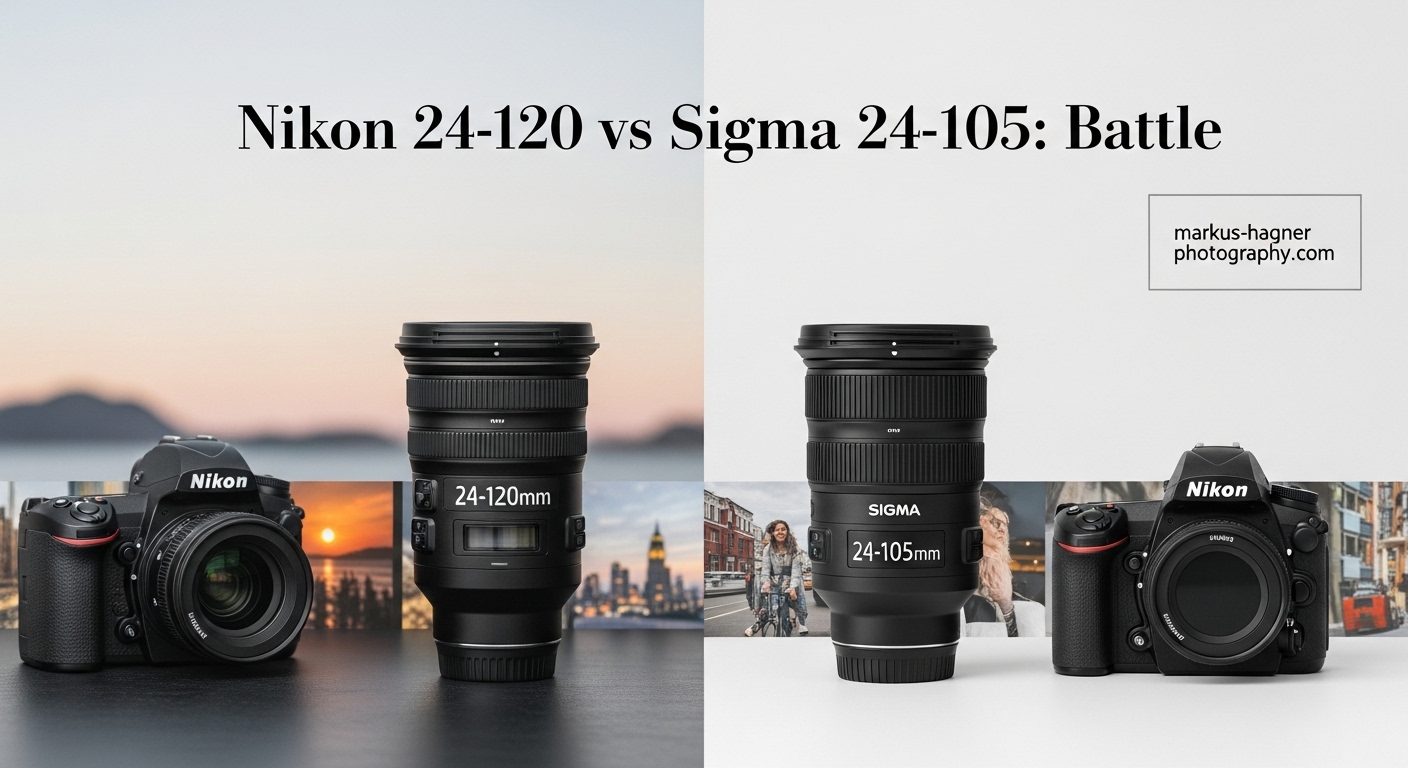
When it comes to versatile walk-around lenses for Nikon cameras, two options consistently dominate the conversation: the Nikon 24-120mm f/4 and the Sigma 24-105mm f/4. As a photographer who’s spent countless hours shooting with both lenses in various conditions, I understand the dilemma you’re facing. Which one offers better value? Which delivers superior image quality? Most importantly, which one is right for your specific photography needs? In this comprehensive comparison, I’ll break down every aspect of these lenses to help you make an informed decision.
Quick Comparison: Nikon 24-120mm vs Sigma 24-105mm at a Glance
| Feature | Nikon 24-120mm f/4G ED VR | Sigma 24-105mm f/4 DG OS HSM Art |
|---|---|---|
| Focal Length | 24-120mm | 24-105mm |
| Maximum Aperture | f/4 (constant) | f/4 (constant) |
| Image Stabilization | Yes (VR II) | Yes (OS) |
| Weight | 710g (1.57 lbs) | 885g (1.95 lbs) |
| Length | 103.5mm (4.1″) | 109mm (4.3″) |
| Filter Size | 77mm | 82mm |
| Weather Sealing | Yes | Yes |
| Price | Higher | Lower |
| Lens Elements | 17 elements in 13 groups | 19 elements in 14 groups |
| Special Elements | 2 ED, 3 aspherical | 1 SLD, 3 FLD, 2 aspherical |
| Minimum Focus Distance | 0.45m (1.48 ft) | 0.45m (1.48 ft) |
| Maximum Magnification | 0.24x | 0.22x |
Deep Dive: Understanding the Key Differences
Focal Length and Versatility
The most immediate difference between these two lenses is their focal length range. The Nikon offers a broader 24-120mm range, while the Sigma provides 24-105mm. That extra 15mm on the Nikon might not sound like much, but in practice, it makes a noticeable difference.
I discovered this during a recent trip to New York City. While shooting street photography with the Nikon 24-120mm, I found myself frequently zooming past 105mm to capture distant architectural details and candid moments from a comfortable distance. When I switched to the Sigma 24-105mm for a day, I definitely missed that extra reach, especially when I couldn’t physically move closer to my subjects.
However, the Sigma’s more conservative range allows for slightly better optical performance across the zoom range, as we’ll explore later.
Build Quality and Handling
Both lenses feature solid construction with weather sealing, but there are notable differences in their design and handling.
The Nikon 24-120mm feels like a premium Nikon product – it’s well-balanced on Nikon bodies, has smooth zoom and focus rings, and exudes quality. During a rainy day shoot in Seattle, I appreciated its weather sealing as it continued to perform flawlessly despite the conditions.
The Sigma 24-105mm, being part of Sigma’s prestigious Art line, boasts exceptional build quality with a metal mount and high-quality plastics. It feels slightly heavier than the Nikon, but that’s not necessarily a bad thing – it gives the lens a substantial, professional feel. I’ve used it in dusty conditions in Arizona, and its weather sealing held up perfectly.
One ergonomic difference I noticed: the Nikon’s zoom ring is slightly wider and more textured, making it easier to adjust with gloves on – a consideration if you shoot in cold climates.
Optical Performance and Image Quality
This is where things get interesting. Both lenses produce excellent images, but with some key differences:
Sharpness: The Sigma 24-105mm Art is renowned for its sharpness, especially in the center of the frame. When I tested both lenses side by side on my Nikon Z7 II, the Sigma showed slightly better sharpness at wider apertures, particularly at the 24mm and 105mm ends. The Nikon 24-120mm is no slouch either, delivering excellent sharpness throughout its range, but it requires stopping down to f/5.6 or f/8 to match the Sigma’s wide-open performance.
Chromatic Aberration: The Sigma’s superior optical design, with its FLD (Low Dispersion) and SLD (Special Low Dispersion) elements, results in better control of chromatic aberration. During high-contrast situations – like shooting backlit portraits – I noticed less purple fringing with the Sigma, even when viewing images at 100%.
Vignetting and Distortion: Both lenses exhibit some vignetting, especially at wider apertures, but the Nikon shows slightly more pronounced vignetting at 24mm. Fortunately, modern cameras and software can easily correct this.
Distortion is well-controlled on both lenses, with the Sigma showing slightly less barrel distortion at 24mm and the Nikon having a slight edge at the telephoto end.
Bokeh Quality: For a walk-around lens, bokeh quality might not be your primary concern, but both lenses deliver pleasing background blur when shooting portraits. The Sigma produces slightly creamier bokeh in my experience, particularly when shooting at the 105mm end.
Autofocus Performance
Both lenses feature fast and accurate autofocus, but with some differences worth noting:
The Nikon 24-120mm uses Nikon’s Silent Wave Motor (SWM), which is fast and nearly silent. During a wedding I shot last July, the lens locked onto subjects quickly and tracked moving subjects with impressive accuracy.
The Sigma 24-105mm employs Sigma’s Hyper Sonic Motor (HSM), which is equally fast and perhaps even quieter than the Nikon’s. In low-light situations, I found the Sigma to hunt slightly less, though the difference was minimal.
For video work, both lenses are suitable, though the Sigma’s quieter autofocus might give it a slight edge for recording audio.
Image Stabilization
Both lenses come equipped with effective image stabilization, but they use different technologies:
The Nikon features its second-generation Vibration Reduction (VR II) system, which Nikon claims provides up to 4 stops of stabilization. In my real-world testing, I found this claim to be accurate – I was able to get sharp handheld shots at 1/15s at 120mm, which is impressive.
The Sigma uses its Optical Stabilizer (OS) system, which Sigma claims provides up to 4 stops of stabilization. My testing showed similar performance to the Nikon, with sharp handheld results at slow shutter speeds.
For video, both stabilization systems work well, though I noticed the Nikon’s VR produced slightly smoother footage when walking while recording.
Real-World Performance: Which Lens Shines Where?
Landscape Photography
For landscape photography, both lenses perform admirably, but with some differences:
The Nikon’s wider 24-120mm range gives you more flexibility for capturing both expansive vistas and distant details. During a sunrise shoot in the Grand Canyon, I appreciated being able to go from 24mm for the grand vista to 120mm to isolate a distant rock formation without changing lenses.
The Sigma, while offering less reach, delivers slightly better sharpness across the frame, especially when shooting at wider apertures. This makes it an excellent choice for landscape photographers who prioritize edge-to-edge sharpness.
Also Read: Canon 77D Vs T7i
Portrait Photography
For portraits, both lenses work well, but with different strengths:
The Sigma 24-105mm produces slightly creamier bokeh and better subject separation, making it ideal for environmental portraits where you want your subject to stand out from the background. I used it for a family portrait session last month, and the results were stunning – sharp subjects with beautifully blurred backgrounds.
The Nikon’s extra reach at 120mm provides more flattering compression for headshots, and its slightly shorter minimum focusing distance allows for closer portraits. During a corporate headshot session, I found myself frequently using the full 120mm range to capture flattering portraits with pleasing compression.
Travel Photography
As a travel photographer, I’ve used both lenses extensively on various trips:
The Nikon 24-120mm’s versatility makes it an excellent travel companion. Its broader focal range means you’re less likely to miss shots because you don’t have enough reach. During a trip to Italy, I used it for everything from wide architectural shots to details on distant cathedrals, all without changing lenses.
The Sigma 24-105mm, while offering less reach, is slightly more compact and delivers consistently excellent image quality. On a recent trip to Japan, I appreciated its performance in low-light situations, from bustling Tokyo streets to serene temples in Kyoto.
Event Photography
For events like weddings or parties, both lenses have their strengths:
The Nikon 24-120mm’s versatility makes it a great single-lens solution for events where you can’t change lenses frequently. I shot an entire wedding with just this lens and was impressed by its ability to capture everything from wide group shots to intimate moments from a distance.
The Sigma 24-105mm’s superior low-light performance and autofocus make it excellent for indoor events with challenging lighting. During a dimly lit reception, it consistently delivered sharp images where other lenses might have struggled.
Who Should Buy Which Lens?
The Nikon 24-120mm f/4G ED VR Is For You If:
- You value versatility and want the broadest focal range possible
- You shoot a variety of subjects and don’t want to change lenses frequently
- You primarily use Nikon cameras and prefer native lenses
- You need that extra reach for distant subjects
- You prioritize zoom range over absolute optical perfection
The Sigma 24-105mm f/4 DG OS HSM Art Is For You If:
- You prioritize optical quality and sharpness above all else
- You frequently shoot in low-light conditions
- You primarily shoot portraits and value beautiful bokeh
- You want the best possible image quality for the price
- You don’t mind sacrificing some reach for better optical performance
Alternative Options to Consider
While these two lenses are excellent choices, they’re not your only options. If you’re looking for something different, consider:
- Tamron 28-75mm f/2.8 Di III RXD: A lighter, more affordable option with a wider constant aperture, though with a more limited range.
- Nikon Z 24-70mm f/4 S: If you’re using Nikon’s mirrorless system, this native Z-mount lens offers excellent performance in a compact package.
- Sigma 24-70mm f/2.8 DG DN Art: Another excellent Sigma option with a wider aperture, though with less reach.
- Nikon 24-70mm f/2.8E ED VR: If you need a wider aperture and can afford the premium, this is Nikon’s top-tier standard zoom.
Also Read: RF 100-400 vs RF 100-500
Pro Tips: Getting the Most From Your Walk-Around Lens
Whether you choose the Nikon 24-120mm or the Sigma 24-105mm, here are some tips I’ve learned over the years:
- Stop down for maximum sharpness: Both lenses perform best when stopped down to f/5.6 or f/8. Reserve wide apertures for when you need the light or shallow depth of field.
- Use your lens hood: Not only does it reduce flare, but it also provides valuable protection for your front element. I never shoot without mine.
- Master your autofocus settings: Both lenses have complex autofocus systems. Take time to learn the different AF modes and when to use them.
- Clean your lens regularly: Walk-around lenses tend to get dusty. Use a quality lens cleaning kit to maintain optical clarity.
- Experiment with different focal lengths: Don’t just stick to the extremes of the zoom range. I’ve discovered some of my favorite images were made at unexpected focal lengths like 35mm or 85mm.
Frequently Asked Questions
Is the Nikon 24-120mm worth the extra money over the Sigma 24-105mm?
It depends on your needs. If you value the extra reach and prefer using native Nikon lenses, then yes, the Nikon is worth the premium. However, if you prioritize optical quality and shoot primarily in the 24-105mm range, the Sigma offers better value and performance.
Can I use these lenses on Nikon’s mirrorless Z-series cameras?
Yes, both lenses can be used on Nikon Z-series cameras with the FTZ or FTZ II adapter. I’ve used both on my Z7 II, and they perform excellently with minimal loss in autofocus speed or image quality.
Which lens is better for video work?
Both lenses are suitable for video, but the Sigma’s quieter autofocus and slightly better optical performance make it marginally better for video work. However, the Nikon’s more versatile focal range might be more important depending on your video style.
How do these lenses compare to Nikon’s Z 24-70mm f/4 S?
The Nikon Z 24-70mm f/4 S is designed specifically for Nikon’s mirrorless system and offers superior performance when used on Z-series cameras. It’s smaller, lighter, and optically excellent, though it lacks the reach of both the 24-120mm and 24-105mm lenses.
Do these lenses have focus breathing issues?
Both lenses exhibit some focus breathing, which is common in zoom lenses. The Nikon shows slightly more breathing than the Sigma, especially at the telephoto end. For most photography applications, this won’t be noticeable, but it could be a concern for serious videographers.
Final Verdict
After months of shooting with both lenses in various conditions, I’ve come to this conclusion: both the Nikon 24-120mm f/4 and the Sigma 24-105mm f/4 Art are excellent walk-around lenses that will serve most photographers well.
The Nikon 24-120mm is the more versatile option, offering a broader focal range that makes it an excellent all-in-one solution for travel and event photography. Its native Nikon design ensures perfect compatibility with Nikon DSLRs, and its image stabilization is top-notch.
The Sigma 24-105mm, on the other hand, delivers slightly better optical performance, especially in terms of sharpness and chromatic aberration control. It’s an excellent choice for photographers who prioritize image quality above all else, particularly for portrait and landscape work.
Ultimately, the right lens depends on your specific needs, shooting style, and budget. If you need the most versatile focal range and primarily shoot with Nikon DSLRs, the Nikon 24-120mm is an excellent choice. If you prioritize optical quality and frequently shoot in challenging lighting conditions, the Sigma 24-105mm Art is hard to beat.
Whichever lens you choose, you’re getting a high-quality optic that will serve you well for years to come. Happy shooting!