
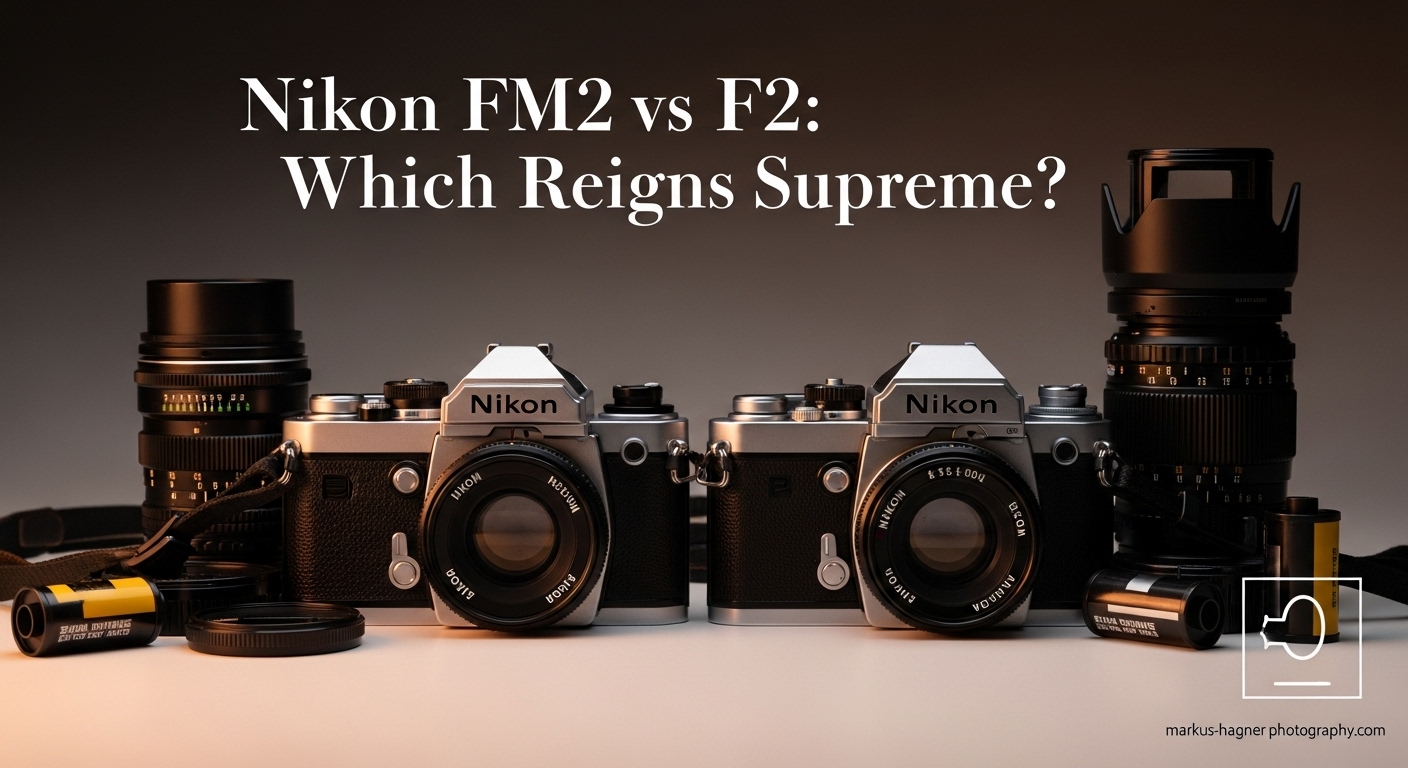
As a film photography enthusiast who’s spent countless hours shooting with both these legendary Nikon cameras, I’m excited to share my comprehensive comparison between the Nikon FM2 and F2. These two cameras represent different eras of Nikon’s engineering excellence, and choosing between them isn’t just about specs—it’s about finding the right tool for your photographic journey.
The Battle of Nikon’s Mechanical Marvels
The Nikon FM2 and F2 are both exceptional mechanical SLR cameras that have earned their place in photography history. The F2, introduced in 1971, was Nikon’s flagship professional camera for nearly a decade, while the FM2, launched in 1982, became the go-to choice for serious enthusiasts and professionals who preferred a more compact yet robust camera body. Both cameras offer fully mechanical operation, meaning they can function without batteries, making them reliable choices for photographers who venture into extreme conditions or simply appreciate the tactile experience of pure mechanical photography.
A Brief History: Two Legends Born in Different Eras
Nikon F2: The Professional’s Workhorse
The Nikon F2 arrived in 1971 as the successor to the original Nikon F, which had already established itself as the preferred camera for many professional photographers. I’ve discovered that the F2 was Nikon’s answer to the growing demands of photojournalists and studio photographers who needed a rugged, reliable system that could withstand the rigors of daily professional use.
What made the F2 special was its modular design. Unlike modern cameras, the F2 allowed photographers to swap viewfinders, focusing screens, and even the motor drive. This modularity meant that a photojournalist could equip their F2 differently than a studio photographer, customizing the camera to their specific needs.
The F2 was produced until 1980, and during its nearly decade-long run, Nikon introduced several variants including the F2S, F2SB, F2A, and F2AS, each with different metering capabilities.
Nikon FM2: The Enthusiast’s Dream
The Nikon FM2, introduced in 1982, represented a different philosophy. While the F2 was designed as a no-compromise professional system, the FM2 targeted advanced amateurs and professionals who wanted a more compact and lightweight camera without sacrificing durability or functionality.
I remember when I first held an FM2—I was struck by how it managed to feel substantial yet more manageable than the bulkier F2. The FM2 was notable for its high shutter speed of 1/4000 second (in later models), which was impressive for a mechanical camera of its time.
The FM2 remained in production until 2001, with minor updates along the way, including the FM2n in 1984, which improved the flash sync speed to 1/250 second.
Design and Build Quality: Tanks of Different Sizes
Nikon F2: Built Like a Tank
The first thing you’ll notice about the Nikon F2 is its substantial build quality. Weighing approximately 730g (body only), the F2 feels solid in your hands—no surprise since it was built to withstand the demands of professional photographers who might be shooting in war zones, on mountain expeditions, or in bustling newsrooms.
The F2 features all-metal construction with brass top and bottom plates. The controls are large and easy to operate, even with gloves on—a thoughtful touch for photojournalists working in challenging conditions. The shutter release is positioned comfortably on the front right of the camera, falling naturally under your index finger.
One of the F2’s standout design features is its modular viewfinder system. The standard DE-1 prism is non-metered, but photographers could choose from various Photomic finders with built-in light meters, including the DP-1, DP-2, DP-3, DP-11, and DP-12, each offering different metering capabilities.
Nikon FM2: Compact Yet Rugged
In contrast, the Nikon FM2 tips the scales at around 540g (body only), making it significantly lighter than the F2. Despite its lighter weight, the FM2 doesn’t compromise on build quality. It features an all-metal chassis with a durable finish that has stood the test of time.
The FM2 has a more compact form factor that many photographers, myself included, find more comfortable for extended shooting sessions. The controls are well-placed and intuitive, with the shutter speed dial located on the top plate and the aperture control on the lens, as is typical with Nikon cameras.
Unlike the F2, the FM2 has a fixed pentaprism viewfinder with a built-in light meter. While this means less customization than the F2, it also results in a more streamlined package that’s ready to shoot right out of the box.
Features and Specifications: A Head-to-Head Comparison
Let’s dive into the nitty-gritty details of how these two cameras stack up against each other:
Shutter Mechanism
Nikon F2:
- Shutter speeds: 1 second to 1/2000 second + Bulb
- Titanium foil horizontal-travel focal plane shutter
- Flash sync speed: 1/80 second
- Mechanical operation (no batteries needed for shutter operation)
Nikon FM2:
- Shutter speeds: 1 second to 1/4000 second + Bulb (early models up to 1/2000)
- Titanium vertical-travel focal plane shutter
- Flash sync speed: 1/200 second (early models) or 1/250 second (FM2n)
- Mechanical operation (no batteries needed for shutter operation)
I’ve found that the FM2’s higher shutter speeds and faster flash sync give it an edge in certain situations, particularly when shooting fast-moving subjects or when using fill flash in bright conditions.
Metering System
Nikon F2:
- No built-in meter in base model
- Optional Photomic finders with various metering patterns (center-weighted, average, etc.)
- Meter requires batteries (depending on finder)
- Meter display: needle or LEDs in viewfinder (depending on finder)
Nikon FM2:
- Built-in center-weighted metering
- Requires two SR44 or LR44 batteries for meter operation
- Meter display: +/– LEDs in viewfinder
- Match-needle system on top plate
The FM2’s integrated metering system is more convenient for everyday shooting, but the F2’s modular approach allows photographers to choose the metering system that best suits their needs or to shoot without a meter entirely.
Viewfinder
Nikon F2:
- Interchangeable viewfinders
- 100% field of view with standard prism
- Multiple focusing screen options
- No hot shoe (accessory shoe on finder)
Nikon FM2:
- Fixed pentaprism viewfinder
- 93% field of view
- Interchangeable focusing screens
- Built-in hot shoe
The F2’s 100% viewfinder coverage is a significant advantage for precise composition, while the FM2’s built-in hot shoe makes attaching flashes more convenient.
Film Handling
Nikon F2:
- Takes standard 35mm film (135 format)
- Manual film advance with single-stroke lever
- Frame counter: manual reset type
- Multiple exposure capability
Nikon FM2:
- Takes standard 35mm film (135 format)
- Manual film advance with single-stroke lever
- Frame counter: automatic reset type
- Multiple exposure capability
Both cameras offer similar film handling capabilities, with the FM2 having a slight edge with its automatic frame counter reset.
Size and Weight
Nikon F2:
- Dimensions: 152.5 × 97 × 65mm
- Weight: 730g (body only)
Nikon FM2:
- Dimensions: 142 × 90 × 60mm
- Weight: 540g (body only)
The FM2’s more compact dimensions and lighter weight make it a more portable option, especially for travel or street photography.
Also Read: Canon 77D Vs T7i
Performance in Real-World Use: How They Handle in the Field
Having shot extensively with both cameras, I can tell you that their real-world performance differs in ways that specs alone don’t capture.
Nikon F2: The Uncompromising Professional
The F2 excels in situations where reliability and customization are paramount. I’ve taken my F2 on assignments in challenging environments, from dusty deserts to humid rainforests, and it has never let me down.
The camera’s substantial weight actually helps stabilize it when shooting handheld at slower shutter speeds. The large, tactile controls are easy to adjust without taking your eye from the viewfinder—a crucial feature when capturing decisive moments.
One aspect I particularly appreciate about the F2 is its smooth film advance. The winding lever has just the right amount of resistance, making it easy to advance film quickly and steadily when shooting rapidly unfolding scenes.
The modular viewfinder system, while adding complexity, offers incredible flexibility. I’ve used different finders for different situations—from the waist-level finder for discreet street photography to the Photomic finder with its built-in meter for studio work.
Nikon FM2: The Versatile All-Rounder
The FM2, while less customizable than the F2, offers a more streamlined shooting experience that many photographers prefer. Its lighter weight makes it my go-to choice for travel and street photography, where I might be carrying the camera for hours on end.
The FM2’s higher shutter speeds have come in handy on numerous occasions. I remember shooting a motorsports event where the 1/4000 second shutter speed allowed me to freeze fast-moving action that would have been challenging with the F2’s 1/2000 second limit.
The built-in metering system on the FM2 is surprisingly accurate and responsive. While I often use a handheld meter for critical work, the FM2’s meter has proven reliable enough for most situations, making it a more convenient option for spontaneous shooting.
One area where the FM2 truly shines is flash photography. The faster flash sync speed (1/250 second on the FM2n) gives you more flexibility when balancing flash with ambient light, particularly in bright conditions.
Lens Compatibility: The Nikon F Mount Advantage
Both the F2 and FM2 use Nikon’s F mount, which means they’re compatible with a vast range of lenses. However, there are some differences in functionality depending on the lens type.
Nikon F2 Lens Compatibility
The F2 works with virtually all Nikon F mount lenses, including:
- Non-AI lenses (with stop-down metering)
- AI and AI-S lenses (full metering with appropriate finder)
- Series E lenses
- Most modern AF lenses (manual focus and aperture control only)
The F2’s compatibility with non-AI lenses is a significant advantage for photographers who want to use vintage Nikon glass. I’ve collected several pre-AI lenses over the years, and being able to use them on my F2 without modification is a real pleasure.
Nikon FM2 Lens Compatibility
The FM2 is compatible with:
- AI and AI-S lenses (full metering)
- Series E lenses
- Most modern AF lenses (manual focus and aperture control only)
- Non-AI lenses (with stop-down metering or after conversion)
The FM2 requires AI or AI-S lenses for full metering functionality. While it’s possible to use non-AI lenses, you’ll need to use stop-down metering, which is less convenient. Some photographers have their non-AI lenses converted to AI specifications to use them more easily on the FM2.
Price and Value: Investment in Photographic History
When considering these cameras, it’s important to understand their current market value and what you’re getting for your money.
Nikon F2 Market Value
As of August 2026, Nikon F2 bodies typically range from $300 to $800, depending on condition, model, and included accessories. F2s with Photomic finders generally command higher prices than base models with non-metered finders.
The F2 represents excellent value for a camera of its build quality and historical significance. I’ve found that well-maintained F2s often work as well today as they did when they were new, a testament to Nikon’s engineering.
Nikon FM2 Market Value
Nikon FM2 bodies currently range from $200 to $500, with the later FM2n models generally fetching higher prices due to their improved specifications.
The FM2 offers tremendous value, providing professional-level build quality and features at a more accessible price point than the F2. Its continued production until 2001 means there are generally more FM2s available on the market, which helps keep prices reasonable.
Long-Term Value Considerations
Both cameras have proven to be excellent long-term investments. Unlike digital cameras that depreciate rapidly, well-maintained F2s and FM2s have held their value and even appreciated in recent years as film photography has experienced a resurgence.
From my perspective, the value of these cameras extends beyond their monetary worth. They’re tools that can last a lifetime with proper care, and they offer a shooting experience that many modern cameras can’t match.
Also Read: RF 100-400 vs RF 100-500
Who Should Choose Which Camera?
The Nikon F2 Is For You If:
- You’re a professional photographer who needs the utmost reliability
- You value customization and want the flexibility of interchangeable viewfinders
- You primarily use vintage non-AI Nikon lenses
- You prefer a larger, heavier camera that provides excellent stability
- You appreciate the historical significance of owning Nikon’s flagship professional camera from the 1970s
- You shoot in challenging environments where the F2’s ruggedness is an advantage
The Nikon FM2 Is For You If:
- You’re an enthusiast or advanced amateur looking for a high-quality mechanical camera
- You prioritize portability and lighter weight
- You frequently shoot at higher shutter speeds or use flash
- You prefer a more streamlined shooting experience with built-in metering
- You’re on a tighter budget but still want professional-level build quality
- You want a camera that’s simple to use but capable of professional results
My Personal Experience with Both Cameras
I’ve been shooting with Nikon cameras for over two decades, and both the F2 and FM2 have earned permanent places in my camera bag. Each has its strengths, and I find myself reaching for one or the other depending on the situation.
For my professional work, particularly portrait and studio sessions, the F2 is often my first choice. The 100% viewfinder coverage gives me precise composition control, and the ability to switch finders allows me to adapt to different shooting scenarios. I remember one particular studio session where I used the waist-level finder for a low-angle portrait, and the client was amazed by the unique perspective I achieved.
For travel and street photography, the FM2 is my constant companion. Its lighter weight makes it ideal for carrying all day, and the faster shutter speeds have saved me on numerous occasions when shooting in bright conditions. During a trip to Venice last year, I appreciated how discreet the FM2 was compared to bulkier cameras, allowing me to capture candid street scenes without drawing attention.
One experience that stands out was when I was shooting landscapes in the mountains. I had both cameras with me, and I found myself using the F2 for carefully composed tripod shots, taking advantage of its precise viewfinder and sturdy build. For handheld shots while hiking, the FM2’s lighter weight and higher shutter speeds made it the more practical choice.
Ultimately, I believe both cameras are exceptional tools that can produce stunning results in the right hands. The choice between them comes down to personal preference and specific shooting needs.
Pros and Cons Summary
Nikon F2
Pros:
- Exceptional build quality and durability
- Modular design with interchangeable viewfinders
- 100% viewfinder coverage
- Compatible with non-AI lenses
- Smooth film advance and shutter release
- Historical significance as Nikon’s professional flagship
Cons:
- Heavy and bulky
- No built-in meter (requires separate finder)
- Lower maximum shutter speed (1/2000 second)
- Slower flash sync speed (1/80 second)
- More complex system with more components to maintain
- Generally more expensive than the FM2
Nikon FM2
Pros:
- Compact and lightweight
- Higher maximum shutter speed (1/4000 second)
- Faster flash sync speed (1/250 second on FM2n)
- Built-in center-weighted metering
- Simpler, more streamlined design
- Generally more affordable than the F2
- Excellent reliability in a smaller package
Cons:
- 93% viewfinder coverage (less than F2)
- Not compatible with non-AI lenses without modification
- Fixed viewfinder (less flexibility)
- Lighter build quality than F2 (though still excellent)
- Less historical significance than the F2
Final Verdict: Choosing Your Mechanical Companion
After extensively using both cameras, I can confidently say that you can’t go wrong with either the Nikon FM2 or F2. Both are exceptional cameras that represent the pinnacle of mechanical camera design from their respective eras.
If you prioritize customization, maximum build quality, and compatibility with vintage lenses, the Nikon F2 is the clear choice. It’s a camera that can handle anything you throw at it and will likely outlast you with proper care.
If you value portability, higher shutter speeds, and a more streamlined shooting experience, the Nikon FM2 is hard to beat. It offers most of the F2’s capabilities in a more compact and affordable package.
For photographers who can only choose one, I generally recommend the FM2 as a first mechanical Nikon. It’s more accessible, easier to use out of the box, and versatile enough for most shooting situations. As you grow more experienced and develop specific needs, you might then add an F2 to your collection for specialized applications.
Ultimately, the best camera is the one that inspires you to shoot. Both the FM2 and F2 have that magical quality that makes picking them up a joy rather than a chore. They’re cameras that become extensions of your vision, tools that disappear in use and allow you to focus on what matters most: creating compelling images.
FAQ: Answering Your Questions About the Nikon FM2 and F2
Are these cameras suitable for beginners?
While both cameras are fully manual and require understanding of photographic fundamentals, I believe the FM2 is slightly more beginner-friendly due to its built-in meter and more straightforward operation. That said, either camera can be a great learning tool if you’re willing to put in the effort to understand manual exposure.
Do these cameras require batteries to function?
Both cameras have fully mechanical shutters that operate without batteries. However, the FM2 requires batteries for its light meter, and the F2 requires batteries if you’re using a Photomic finder with a built-in meter. Without batteries, both cameras can still be used with a handheld light meter or by using the sunny 16 rule.
Can I use modern Nikon lenses on these cameras?
Both cameras are compatible with most modern Nikon F mount lenses, but with some limitations. You’ll be able to use modern lenses in manual focus and manual aperture mode only. Some modern G-type lenses (without aperture rings) won’t work properly without adapters.
Which camera is better for long-term investment?
Both cameras have proven to be excellent long-term investments, holding their value well as film photography has regained popularity. The F2, being Nikon’s professional flagship from its era, may have slightly more historical significance, but the FM2’s longer production run and popularity among enthusiasts also make it a solid investment.
How do these cameras compare to modern digital SLRs?
While both cameras lack the convenience and immediacy of digital, they offer a more tactile and deliberate shooting experience. Many photographers find that shooting with these mechanical cameras improves their understanding of exposure and composition. Additionally, the build quality of both the FM2 and F2 exceeds that of most modern consumer DSLRs.
Are parts and repairs still available for these cameras?
Yes, there are still reputable repair specialists who service these cameras, though parts are becoming increasingly scarce. Both cameras were built to last, and with proper care, they can continue functioning for decades. Regular maintenance, such as light seal replacement and occasional CLA (clean, lubricate, adjust), will keep them in top condition.
Pro Tips for Using These Classic Cameras
- Carry a handheld light meter: While both cameras have metering capabilities (with appropriate finders for the F2), a quality handheld meter will give you more accurate readings and greater control over your exposures.
- Replace the light seals: If you’re buying a used FM2 or F2, chances are the foam light seals have deteriorated. Replacing them is a simple DIY job that will prevent light leaks on your film.
- Use a quality camera strap: These cameras are heavy (especially the F2), so invest in a comfortable, wide strap to distribute the weight evenly during long shooting sessions.
- Keep a cleaning kit handy: Dust and debris can easily find their way into these mechanical cameras. A blower brush, soft cloth, and some isopropyl alcohol will help you keep your camera in top condition.
- Shoot a test roll: When you first get your camera, shoot a test roll and carefully examine the results. This will help you identify any issues with light leaks, shutter accuracy, or metering before you use it for important work.
- Join a film photography community: Connecting with other film photographers can provide valuable tips, resources, and inspiration. There are active communities online where you can share your experiences and learn from others.
Don’t Miss Out on Future Photography Insights!
If you found this comparison helpful, be sure to bookmark this page for future reference. Photography is an ever-evolving field, and I’m constantly updating my content with new insights, tips, and reviews. By bookmarking this site, you’ll stay in the loop with the latest film photography techniques, equipment reviews, and creative inspiration.
Whether you’re a seasoned film photographer or just starting your analog journey, there’s always something new to discover in the world of photography. Happy shooting!