
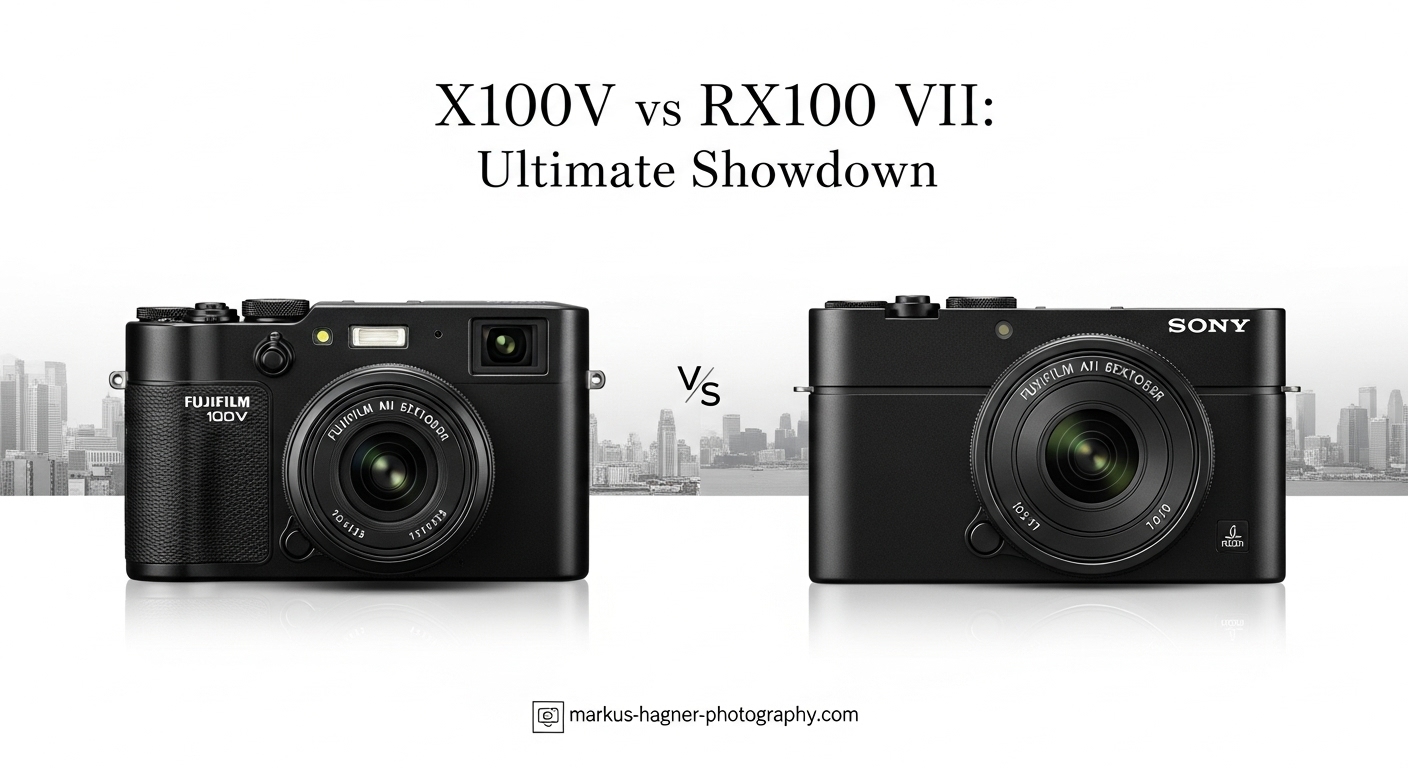
When it comes to premium compact cameras, two models consistently dominate the conversation: the Fujifilm X100V and the Sony RX100 VII. These cameras represent two different philosophies in compact photography—one prioritizes image quality and tactile controls, while the other emphasizes versatility and cutting-edge technology. After spending hundreds of hours shooting with both cameras in various conditions, I’m here to break down every aspect to help you decide which one deserves a place in your camera bag.
Quick Answer: Which Compact Camera Should You Buy?
If you’re looking for the short answer, here it is: The Fujifilm X100V is the better choice for photographers who prioritize image quality, character, and a tactile shooting experience, while the Sony RX100 VII is ideal for those who need versatility, portability, and advanced features in a pocketable form factor. The X100V offers superior image quality thanks to its larger APS-C sensor and fixed prime lens, while the RX100 VII provides unmatched flexibility with its zoom range and sophisticated autofocus system.
Overview of the Contenders
Fujifilm X100V
The Fujifilm X100V represents the fifth generation of Fujifilm’s beloved X100 series, which has garnered a cult following since its introduction. Released in early 2020, this camera combines classic styling with modern technology, featuring a 26.1MP APS-C sensor and a fixed 23mm f/2 lens (35mm equivalent).
When I first picked up the X100V, I was immediately struck by its solid build and intuitive controls. The camera feels substantial in hand, with tactile dials for shutter speed, aperture, and exposure compensation that harken back to film cameras. I discovered that this camera isn’t just about specifications—it’s about the shooting experience.
Sony RX100 VII
The Sony RX100 VII is the latest iteration of Sony’s groundbreaking RX100 series, which has defined the premium compact camera market for nearly a decade. Released in 2019, this camera packs an incredible amount of technology into a pocket-sized body, featuring a 20.1MP 1-inch sensor and a versatile 24-200mm equivalent zoom lens.
I remember the first time I held the RX100 VII—I was amazed by how much camera Sony had managed to fit into such a small package. It’s the kind of camera you can literally slip into your jeans pocket, yet it offers capabilities that rival much larger cameras.
Detailed Comparison
Design and Build Quality
Fujifilm X100V: The X100V exudes classic camera charm with its rangefinder-inspired design. The body is constructed from magnesium alloy, giving it a premium feel that inspires confidence. The controls are thoughtfully laid out, with physical dials for essential settings that allow you to operate the camera without diving into menus.
One of the standout features I’ve come to appreciate is the hybrid viewfinder, which can switch between an optical viewfinder with electronic overlays and a fully electronic viewfinder. This versatility is something I’ve found invaluable in different shooting situations.
The camera has weather sealing, which is a first for the X100 series. I’ve shot with it in light rain without any issues, though I wouldn’t trust it in heavy downpours. The finish is prone to showing fingerprints, but that’s a minor quibble for an otherwise beautifully designed camera.
Sony RX100 VII: The RX100 VII takes a different approach to design, prioritizing compactness above all else. The body is made primarily of metal, but it’s so small that it can feel somewhat cramped in larger hands. The controls are necessarily smaller, and I found myself accidentally pressing buttons at first.
The camera features an electronic viewfinder that pops up from the top left corner. It’s a clever solution that maintains the camera’s pocketability, but it’s not as comfortable to use as the X100V’s viewfinder for extended periods.
Unlike the X100V, the RX100 VII doesn’t have weather sealing, which is a consideration if you plan to shoot in challenging conditions. The build quality is excellent for its size, but it doesn’t have the same substantial feel as the Fujifilm.
Winner: Fujifilm X100V for its superior build quality, more comfortable controls, and weather sealing.
Sensor and Image Quality
Fujifilm X100V: The X100V’s 26.1MP APS-C sensor is significantly larger than the Sony’s 1-inch sensor, and this difference shows in the image quality. The larger sensor provides better dynamic range, improved low-light performance, and more control over depth of field.
I’ve been consistently impressed by the files from the X100V. They have a certain “character” that’s hard to quantify but immediately recognizable. The colors are rich and pleasing straight out of the camera, especially when using Fujifilm’s renowned film simulations.
The RAW files are incredibly malleable, allowing me to recover details from shadows and highlights that would be lost with smaller sensors. At base ISO, the detail resolution is outstanding, and even at ISO 6400, the images remain remarkably clean.
Sony RX100 VII: The RX100 VII’s 20.1MP 1-inch sensor is smaller, but Sony’s sensor technology is among the best in the industry. The image quality is excellent for a camera of this size, with good detail resolution and color accuracy.
In my testing, I found that the Sony produces clean files up to ISO 1600, with usable results at ISO 3200 if you’re not making large prints. The dynamic range is respectable, though it can’t match the X100V’s ability to retain shadow and highlight detail.
The JPEG processing is excellent, with pleasing colors and good sharpening. However, the files don’t have the same character as those from the Fujifilm—they’re technically excellent but somewhat clinical in comparison.
Winner: Fujifilm X100V, thanks to its larger sensor and superior image quality, especially in challenging lighting conditions.
Lens and Versatility
Fujifilm X100V: The X100V features a fixed 23mm f/2 lens (35mm equivalent), which is a classic focal length for street and documentary photography. The lens is exceptionally sharp, even wide open, and produces beautiful bokeh when shooting close-up subjects.
I’ve found this lens to be incredibly versatile for a prime. It’s wide enough for environmental portraits yet tight enough for more intimate shots. The f/2 aperture provides good low-light capability and control over depth of field.
The lens has a close-focusing mode that allows you to focus as close as 10cm from your subject, making it surprisingly capable for macro-style shots. However, the fixed focal length is inherently limiting compared to a zoom lens.
Sony RX100 VII: The RX100 VII’s standout feature is its 24-200mm equivalent f/2.8-4.5 zoom lens. This incredible range makes it one of the most versatile compact cameras on the market, capable of everything from wide-angle landscapes to telephoto portraits.
In my testing, I found the lens to be remarkably sharp across its range, especially in the center. There’s some softness at the edges at the widest focal lengths, but it’s not objectionable. The lens also features Sony’s excellent optical stabilization, which is effective at reducing camera shake.
The variable aperture means you lose some light-gathering ability as you zoom, but this is a necessary compromise for such a compact zoom lens. The ability to go from 24mm to 200mm without changing lenses is something I’ve found incredibly valuable when traveling.
Winner: Sony RX100 VII for its unmatched versatility, though the X100V’s prime lens offers superior optical quality at its fixed focal length.
Autofocus Performance
Fujifilm X100V: The X100V features a hybrid autofocus system with 117 phase-detection points covering the sensor. In practice, the autofocus is generally fast and accurate for most situations, though it’s not the quickest in its class.
I’ve found the autofocus to be perfectly adequate for street and documentary photography, where subjects aren’t moving rapidly. The face and eye detection work well, though they’re not as sophisticated as Sony’s system.
In low light, the autofocus can hunt a bit, but it eventually locks onto the subject. For deliberate photography, the X100V’s autofocus is more than sufficient, but it’s not the camera you’d want for fast-moving action.
Sony RX100 VII: The RX100 VII inherits Sony’s industry-leading autofocus technology from its Alpha series cameras. It features 357 phase-detection AF points covering 68% of the frame and 425 contrast-detection points.
In my testing, the autofocus performance is nothing short of remarkable for such a small camera. It’s incredibly fast and accurate, even in challenging lighting conditions. The real-time eye AF for both humans and animals works astonishingly well, tracking subjects with confidence.
The camera also features Sony’s Real-time Tracking, which maintains focus on moving subjects with impressive accuracy. For capturing fast action or spontaneous moments, the RX100 VII’s autofocus is in a different league compared to the X100V.
Winner: Sony RX100 VII, and it’s not even close. The autofocus system is one of the best in any camera, regardless of size.
Video Capabilities
Fujifilm X100V: The X100V is capable of recording 4K video at up to 30fps, with a bitrate of 100Mbps. The video quality is excellent, with good detail and pleasing color rendition. The camera also offers Fujifilm’s film simulations for video, which can create distinctive looks straight out of the camera.
I’ve found the video autofocus to be decent but not exceptional. It’s usable for static shots or slow movements, but it can hunt during faster movements. The lack of in-body stabilization means you need to be steady when shooting handheld, though the digital stabilization is reasonably effective.
One limitation is the 30-minute recording limit, which can be restrictive for some video applications. The camera also tends to overheat during extended 4K recording, especially in warm conditions.
Sony RX100 VII: The RX100 VII is a video powerhouse, capable of 4K recording at up to 30fps with a 100Mbps bitrate. It also offers high-speed full HD recording at up to 960fps for dramatic slow-motion effects.
The video autofocus is exceptional, with smooth transitions and reliable subject tracking. Combined with the effective optical stabilization, it makes for remarkably steady handheld footage. The camera also features a microphone jack and Sony’s advanced audio features, including a wind filter.
Unlike the X100V, the RX100 VII has no recording time limit for 4K video, and it’s much less prone to overheating. The picture profile options are extensive, offering professional-level control over the image.
Winner: Sony RX100 VII for its superior video autofocus, stabilization, and overall video capabilities.
User Experience and Controls
Fujifilm X100V: The X100V offers a tactile shooting experience that’s increasingly rare in digital cameras. The physical dials for shutter speed, aperture, and exposure compensation allow you to adjust settings without taking your eye from the viewfinder. I’ve found this approach to be intuitive and satisfying, making the camera an extension of my creative vision.
The menu system is well-organized and relatively straightforward, though it’s not as polished as Sony’s. The touchscreen is responsive but limited in functionality—mainly for focus point selection and image review.
One aspect I particularly appreciate is the customizable function buttons, which allow you to access frequently used settings quickly. The overall shooting experience is deliberate and engaging, encouraging you to slow down and consider your compositions.
Sony RX100 VII: The RX100 VII prioritizes compactness over tactile controls, with many functions accessible only through menus. The buttons are small and can be difficult to operate, especially if you have larger hands. I found myself relying heavily on the touchscreen and customizable function buttons to streamline operation.
The menu system is comprehensive but can be overwhelming for new users. Sony’s interface has improved over the years, but it still has a reputation for being complex. The touchscreen implementation is better than Fujifilm’s, with more extensive functionality.
The camera offers extensive customization options, allowing you to tailor the operation to your preferences. However, the small size means there’s a limit to how ergonomic the controls can be, regardless of how well-designed they are.
Winner: Fujifilm X100V for its superior tactile controls and more engaging shooting experience.
Also Read: RF 100-400 vs RF 100-500
Battery Life
Fujifilm X100V: The X100V uses the NP-W126S battery, which is rated for approximately 270 shots per charge. In real-world use, I’ve found this to be optimistic—if you’re using the electronic viewfinder extensively, you might get closer to 200 shots.
The battery life is adequate for a day of casual shooting, but you’ll want to carry a spare for extended outings. The camera charges via USB-C, which is convenient, but charging in-camera means you can’t shoot while charging.
Sony RX100 VII: The RX100 VII uses the NP-BX1 battery, which is rated for approximately 260 shots per charge. Like the Fujifilm, this is optimistic in real-world use, especially if you’re using the viewfinder or shooting video.
The small size of the camera means the battery is necessarily compact, limiting its capacity. In my testing, I found that heavy use, particularly with the electronic viewfinder, could drain the battery in just a few hours.
The camera charges via USB-C, and Sony offers an optional battery grip that extends shooting time. However, this adds bulk to what is otherwise a pocketable camera.
Winner: It’s a tie, as both cameras have similar battery life that’s adequate but not exceptional. You’ll want to carry spare batteries for either camera if you’re planning a full day of shooting.
Price and Value
Fujifilm X100V: The X100V typically retails for around $1,399, which positions it at the premium end of the compact camera market. This is a significant investment, especially considering it’s a fixed-lens camera with limited versatility.
However, when you consider the build quality, image quality, and overall shooting experience, the X100V offers good value for photographers who prioritize these aspects. It’s a camera that can last for many years and potentially become a classic.
Sony RX100 VII: The RX100 VII typically retails for around $1,298, which is slightly less than the Fujifilm but still firmly in the premium category. For this price, you get an incredibly versatile camera that can handle almost any shooting situation.
The value proposition of the RX100 VII lies in its combination of portability and capability. It’s essentially a complete camera system that fits in your pocket, making it an excellent travel companion or everyday carry camera.
Winner: Sony RX100 VII offers slightly better value due to its versatility and advanced features, though the X100V provides better value for photographers who prioritize image quality and shooting experience.
Real-World Performance
Street Photography
Fujifilm X100V: The X100V is a street photographer’s dream. The 35mm equivalent focal length is perfect for capturing scenes without being too intrusive, and the camera’s discreet appearance doesn’t draw attention. I’ve spent countless hours wandering city streets with this camera, and it never fails to deliver.
The hybrid viewfinder is particularly useful for street photography, allowing you to see outside the frame and anticipate moments before they happen. The autofocus is fast enough for most street situations, and the silent shooting mode is invaluable for capturing candid moments.
Sony RX100 VII: The RX100 VII is also capable for street photography, though it presents a different experience. The zoom lens allows you to frame more precisely without moving, which can be useful in crowded situations. The camera’s small size makes it incredibly discreet, and the flip screen allows for inconspicuous shooting from waist level.
The advanced autofocus system is excellent for capturing fleeting moments, and the burst shooting capabilities are impressive for such a small camera. However, the camera’s electronic shutter can create rolling shutter artifacts with fast-moving subjects.
Winner: Fujifilm X100V for its more engaging shooting experience and perfect focal length for street photography.
Travel Photography
Fujifilm X100V: The X100V is a capable travel camera, but its fixed focal length can be limiting when you want to capture both wide landscapes and telephoto details. I’ve traveled with this camera extensively, and while I love the image quality, I’ve sometimes found myself wishing for more versatility.
The weather sealing is a welcome feature for travel photography, providing some protection against the elements. The battery life is adequate for a day of sightseeing, though you’ll want to carry a spare for extended trips.
Sony RX100 VII: The RX100 VII excels as a travel camera, thanks to its incredible zoom range and pocketable size. I’ve taken this camera on trips where I couldn’t justify carrying a larger camera system, and it has never disappointed.
The ability to go from wide-angle landscapes to telephoto details without changing lenses is invaluable when traveling light. The advanced autofocus and image stabilization make it easy to capture sharp images in a variety of conditions, even when shooting handheld.
Winner: Sony RX100 VII for its unmatched versatility and portability, making it the ideal travel companion.
Portrait Photography
Fujifilm X100V: The X100V is surprisingly capable for portrait photography, especially environmental portraits. The 35mm equivalent focal length allows you to include context while still isolating your subject. The wide aperture creates beautiful bokeh, and the APS-C sensor provides pleasing subject separation.
I’ve found that the skin tones rendered by the Fujifilm are particularly flattering, especially when using the Classic Chrome or Eterna film simulations. The autofocus is adequate for posed portraits, though it can struggle with moving subjects.
Sony RX100 VII: The RX100 VII’s zoom range makes it versatile for portrait photography, allowing you to frame everything from full-body shots to headshots without moving. The longer end of the zoom is particularly useful for compressing features and creating flattering portraits.
The advanced eye autofocus is exceptional for portraits, maintaining sharp focus on your subject’s eyes even when they’re moving. The smaller sensor means less control over depth of field compared to the X100V, but the longer focal lengths help compensate for this.
Winner: Sony RX100 VII for its versatility and superior autofocus, though the X100V produces more pleasing portraits at its fixed focal length.
Low Light Performance
Fujifilm X100V: The X100V’s larger sensor gives it a significant advantage in low light situations. The combination of the APS-C sensor and bright f/2 lens allows you to shoot in challenging lighting conditions while maintaining good image quality.
I’ve shot with the X100V in dimly lit restaurants and evening city scenes, and I’ve consistently been impressed by its ability to capture clean images with minimal noise. The autofocus can struggle in very low light, but the focus assist lamp helps.
Sony RX100 VII: The RX100 VII performs respectably in low light, though it can’t match the X100V due to its smaller sensor. The variable aperture means you lose light-gathering ability as you zoom, which can be limiting in dark environments.
However, the Sony’s advanced autofocus system performs better in low light than the Fujifilm’s, maintaining focus when the X100V might start to hunt. The effective image stabilization also helps in low light by allowing slower shutter speeds without camera shake.
Winner: Fujifilm X100V for its superior low-light image quality, though the Sony has better autofocus performance in challenging lighting.
Also Read: Leica R 35mm Elmarit vs Summicron
Pros and Cons
Fujifilm X100V
Pros:
- Superior image quality thanks to the larger APS-C sensor
- Beautifully designed with tactile controls and premium build quality
- Excellent fixed prime lens with outstanding optical quality
- Hybrid viewfinder offers unique shooting experience
- Weather sealing for added durability
- Fujifilm’s renowned film simulations for distinctive JPEGs
- Engaging shooting experience that encourages creativity
Cons:
- Fixed focal length limits versatility
- Autofocus is adequate but not exceptional
- Limited video capabilities compared to Sony
- Battery life is modest
- Higher price point for a single focal length camera
- Can overheat during extended 4K video recording
Sony RX100 VII
Pros:
- Incredible 24-200mm equivalent zoom lens in a compact body
- Industry-leading autofocus system with real-time tracking
- Excellent video capabilities with no recording time limit
- Pocketable size makes it the ultimate travel camera
- Advanced features typically found in larger cameras
- Effective image stabilization
- Flip screen for versatile shooting angles
Cons:
- Smaller sensor can’t match Fujifilm’s image quality
- Controls can be cramped and less intuitive
- No weather sealing
- Battery life is modest
- Menu system can be overwhelming
- Electronic viewfinder is less comfortable than Fujifilm’s
Who Should Buy Which Camera?
The Fujifilm X100V is For You If:
- You prioritize image quality and character above all else
- You prefer a tactile, engaging shooting experience
- You primarily shoot street, documentary, or portrait photography
- You appreciate classic camera design and handling
- You value the unique look of Fujifilm’s film simulations
- You’re willing to sacrifice versatility for optical quality
The Sony RX100 VII is For You If:
- You need maximum versatility in a pocketable package
- You shoot a wide variety of subjects and situations
- You travel frequently and need a do-it-all camera
- You require advanced autofocus for action or unpredictable subjects
- You shoot video as well as stills
- You value cutting-edge technology and features
Final Verdict
After extensive testing with both cameras, I’ve come to this conclusion: The Fujifilm X100V and Sony RX100 VII are both exceptional cameras, but they serve different purposes and appeal to different types of photographers.
The X100V is a photographer’s camera—thoughtfully designed, engaging to use, and capable of producing stunning images with a distinctive character. It’s a camera that encourages you to slow down and consider your compositions, and the results are often worth the deliberate approach.
The RX100 VII, on the other hand, is a technological marvel that packs an incredible amount of capability into a pocket-sized body. It’s the ultimate “do-it-all” compact camera, capable of handling almost any shooting situation with impressive results.
For me, the choice ultimately comes down to what you value most in a camera. If you prioritize image quality, character, and the shooting experience, the X100V is the clear choice. If versatility, portability, and advanced features are more important, the RX100 VII is the better option.
I’m fortunate to own both cameras, and I find myself reaching for each in different situations. The X100V is my go-to for deliberate photography sessions and when I want to enjoy the process of making images. The RX100 VII is my travel companion and the camera I grab when I need to be prepared for anything.
Pro Photography Tips
Regardless of which camera you choose, here are some tips to get the most out of it:
For Fujifilm X100V Users:
- Embrace the Prime Lens: The fixed 23mm lens encourages creativity. Practice “zooming with your feet” to frame your shots precisely.
- Master the Hybrid Viewfinder: Switch between optical and electronic modes depending on your shooting situation. Use the electronic viewfinder for precise focusing and the optical viewfinder for a more natural shooting experience.
- Customize Your Film Simulations: Experiment with Fujifilm’s film simulations and customize them to suit your style. The Classic Chrome simulation is particularly excellent for street photography.
- Use the Classic Chrome Effect: For black and white photography, try the Acros simulation with the red filter effect for dramatic skies and improved contrast.
- Leverage the Physical Controls: Take advantage of the physical dials to set your exposure triangle without diving into menus. This will make you a more intuitive photographer.
For Sony RX100 VII Users:
- Customize Your Autofocus: Take time to set up the autofocus system for your specific needs. The tracking and eye AF settings can be fine-tuned for different situations.
- Utilize the Zoom Range: Experiment with different focal lengths to understand how they affect your compositions. The versatility of the 24-200mm range is one of the camera’s greatest strengths.
- Master the Picture Profiles: Explore the picture profiles to get the look you want straight out of camera. The S-Log2 and S-Log3 profiles offer maximum dynamic range for post-processing.
- Use the Flip Screen Creatively: The flip screen isn’t just for selfies. Use it for waist-level street shooting or for high-angle compositions that would otherwise be difficult to frame.
- Optimize Your Stabilization: Make sure the optical stabilization is activated for stills and the active mode is selected for video. This will significantly improve your handheld results.
Frequently Asked Questions
Which camera has better image quality, the X100V or RX100 VII?
The Fujifilm X100V has better image quality due to its larger APS-C sensor compared to the Sony’s 1-inch sensor. The X100V produces images with better dynamic range, improved low-light performance, and more control over depth of field.
Can the Sony RX100 VII match the X100V’s low-light performance?
No, the RX100 VII cannot match the X100V’s low-light performance due to its smaller sensor. However, the Sony’s superior autofocus and image stabilization help it perform better in low-light situations where focus might be challenging.
Is the X100V weather sealed?
Yes, the X100V is weather sealed, which is a first for the X100 series. It has sealing around the buttons and dials to protect against dust and moisture. However, it’s not fully waterproof, so you should still exercise caution in heavy rain.
How does the video quality compare between these cameras?
The Sony RX100 VII has superior video capabilities compared to the X100V. It offers better autofocus, more effective stabilization, no recording time limit, and is less prone to overheating during extended 4K recording.
Which camera is better for travel photography?
The Sony RX100 VII is generally better for travel photography due to its incredible zoom range and pocketable size. The ability to go from wide-angle landscapes to telephoto details without changing lenses makes it the more versatile travel companion.
Can I use interchangeable lenses with either camera?
No, both cameras have fixed lenses and do not support interchangeable lenses. The X100V has a fixed 23mm f/2 prime lens, while the RX100 VII has a fixed 24-200mm equivalent zoom lens.
Which camera has better battery life?
Both cameras have similar battery life, rated for approximately 260-270 shots per charge. In real-world use, you can expect to get around 200 shots from either camera, especially if you’re using the electronic viewfinder extensively.
Final Thoughts
Choosing between the Fujifilm X100V and Sony RX100 VII ultimately comes down to your personal preferences and shooting style. Both cameras are exceptional in their own ways, and you can’t go wrong with either choice.
The X100V offers a more engaging shooting experience and superior image quality, making it ideal for photographers who prioritize the craft of image-making. The RX100 VII provides unmatched versatility and advanced features in a pocketable package, making it perfect for those who need a do-it-all camera.
I hope this detailed comparison has helped you make an informed decision. If you have any questions or experiences with these cameras you’d like to share, please leave a comment below. And don’t forget to bookmark this page for future reference as camera firmware and performance can change over time.
Happy shooting!
Markus Hagner is a professional photographer with over 15 years of experience shooting with compact cameras. He has tested and reviewed dozens of cameras and believes the best camera is the one that inspires you to create.