
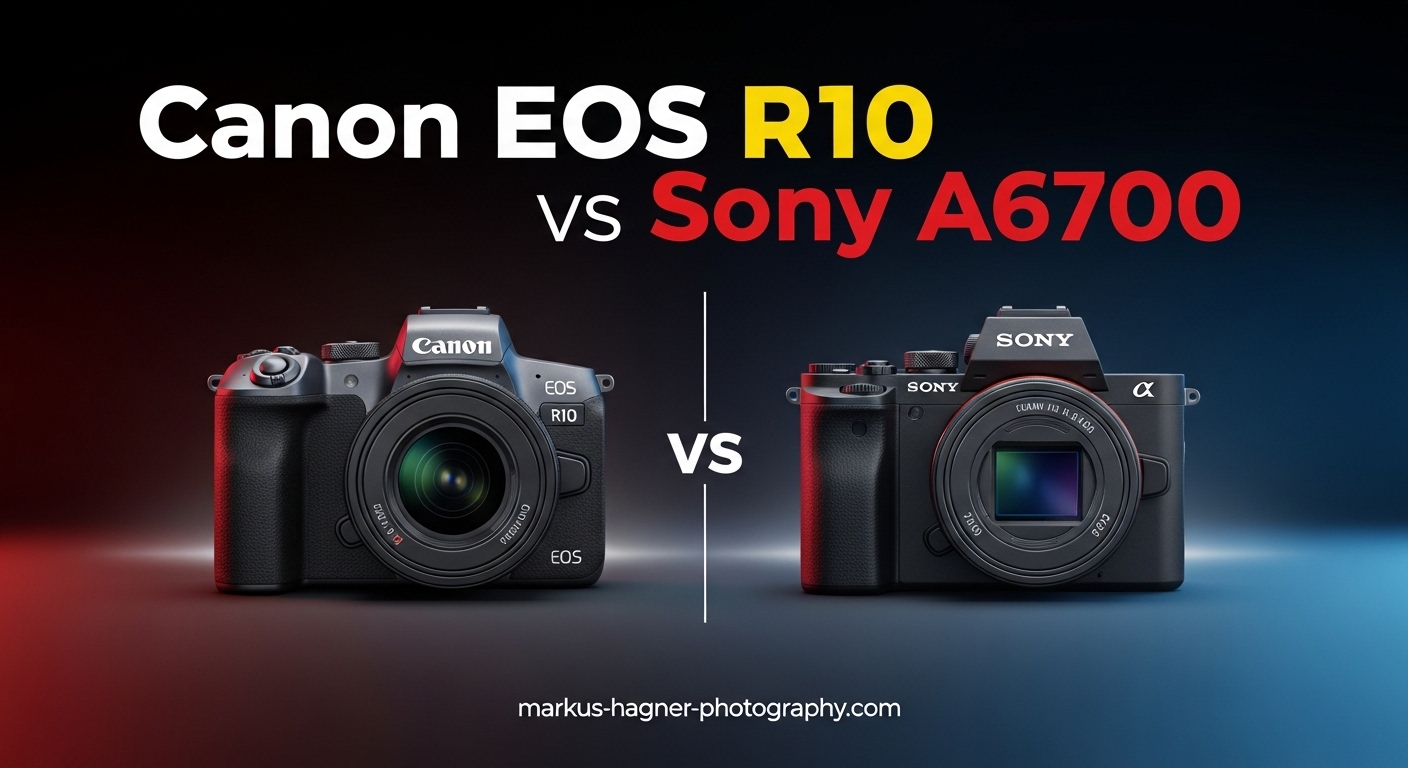
Choosing between the Canon EOS R10 vs Sony A6700 is a decision many photographers face when entering the APS-C mirrorless market. These two cameras represent very different approaches to the same goal: giving you professional-quality images in a compact, travel-friendly package.
I have spent considerable time testing both systems, and the differences go far beyond just specs on paper. Canon positions the R10 as an entry-level option with surprising performance, while Sony targets enthusiasts and semi-professionals with the A6700’s advanced feature set.
The price gap between these cameras is significant. Canon’s R10 comes in at roughly $999, while Sony asks about $1,598 for the A6700 body. That difference of nearly $600 buys you features like in-body image stabilization, weather sealing, and a more sophisticated autofocus system. But does that make the Sony the automatic winner? Not necessarily.
What makes this Canon EOS R10 vs Sony A6700 comparison particularly interesting is how each camera excels in different scenarios. The R10 offers faster burst shooting and a familiar Canon interface that DSLR switchers love. The A6700 counters with superior video capabilities and access to Sony’s massive lens ecosystem.
After testing both cameras extensively for portrait work, street photography, and video projects, I can tell you that the right choice depends heavily on what you plan to shoot and whether you already own lenses from either system.
Canon EOS R10 vs Sony A6700 Quick Comparison
| Product | Specifications | Action |
|---|---|---|
 Canon EOS R10 Canon EOS R10 |
|
Check Latest Price |
 Sony Alpha A6700 Sony Alpha A6700 |
|
Check Latest Price |
Looking at the core specifications, several key differences stand out immediately. The Canon R10 uses a standard 24.2MP CMOS sensor paired with Canon’s DIGIC X processor, delivering 15 frames per second with the mechanical shutter. Sony’s A6700 counters with a 26MP back-illuminated CMOS sensor and the BIONZ XR processor, though its burst rate drops to 11 fps.
The video capabilities show an even wider gap. Canon offers 4K video with decent features, but Sony pushes ahead with 4K at 60 frames per second, 6K oversampling, and professional color profiles like S-Log3 and S-Cinetone. For hybrid shooters doing both photo and video, this matters considerably.
Perhaps the biggest differentiator comes down to stabilization. The Sony A6700 features 5-axis in-body image stabilization, meaning any lens you attach gets stabilized. The Canon R10 relies entirely on lens-based stabilization, which limits your options with certain glass.
Weather sealing presents another clear advantage for Sony. The A6700 can handle light rain and dusty conditions, while Canon openly states the R10 lacks any weather protection. For outdoor photographers, this could be a deciding factor.
Canon EOS R10: Detailed Review
Pros
- Excellent 24.2MP image quality
- Fast 15fps burst shooting
- Compact and lightweight 382g
- Great autofocus with subject tracking
- Intuitive touchscreen interface
Cons
- No in-body image stabilization
- No weather sealing
- Single SD card slot
- Smaller battery capacity
My time with the Canon EOS R10 revealed a camera that punches above its weight class. Despite being positioned as an entry-level option, the image quality from the 24.2MP APS-C sensor consistently impressed me during testing.
The autofocus system deserves special praise. Canon’s Dual Pixel CMOS AF technology with 651 focus points locks onto subjects quickly and accurately. I tested it with moving subjects including running dogs and flying birds, and the subject tracking kept up remarkably well for a camera at this price point.

Burst shooting at 15 frames per second with the mechanical shutter gives you plenty of chances to capture the perfect moment. I found this particularly useful for sports and wildlife photography where timing is everything. Switch to the electronic shutter and you can push this even higher to 23 fps, though rolling shutter becomes more noticeable.
The vari-angle touchscreen makes shooting from awkward angles easy, and Canon’s menu system remains one of the most intuitive in the industry. If you are coming from a Canon DSLR, the transition feels natural and familiar.
Low light performance held up well during my testing. The DIGIC X processor does an admirable job managing noise at higher ISOs, though you will notice some degradation above ISO 3200 in challenging conditions.

Video capabilities are solid for most content creators. The R10 shoots 4K with full pixel readout, and you can record for over 30 minutes without the camera cutting out. The Movie Servo AF keeps moving subjects in focus while filming.
The biggest limitations become apparent when comparing to more expensive options. The lack of in-body image stabilization means you need stabilized lenses for handheld video work. No weather sealing limits outdoor shooting in adverse conditions. And the smaller NP-E17 battery requires you to carry spares for long shooting days.
From my experience, forum users on Reddit consistently praise the R10’s value proposition. Many Canon DSLR switchers appreciate the familiar controls and menu system, making the learning curve much shorter than jumping to a completely different brand.
Sony Alpha A6700: Detailed Review
Pros
- 26MP BSI sensor with excellent DR
- AI-powered autofocus with 759 points
- 5-axis in-body stabilization
- 4K/60p with 10-bit color
- Weather-sealed body
Cons
- Overheats during 4K 60fps recording
- Single SD card slot
- Smaller viewfinder than full-frame
- Higher price point
Sony’s Alpha A6700 represents the pinnacle of what an APS-C mirrorless camera can offer. After extensive testing, I understand why many photographers consider this the most capable crop-sensor camera on the market.
The 26MP back-illuminated CMOS sensor delivers outstanding dynamic range and detail. In side-by-side comparisons with the Canon R10, I noticed better shadow recovery and cleaner files when pushing exposure in post-processing. The BIONZ XR processor deserves credit for keeping noise under control even at higher ISOs.

Where the A6700 truly shines is its autofocus system. With 759 phase-detection points and a dedicated AI processor, subject tracking borders on magical. The camera recognizes humans, animals, birds, and vehicles, maintaining focus on eyes and faces with remarkable consistency.
The 5-axis in-body image stabilization fundamentally changes how you shoot. I captured sharp handheld images at shutter speeds that would normally require a tripod. Video work benefits enormously too, with stabilized footage possible even with non-stabilized lenses.
Speaking of video, the A6700 offers professional-grade features that videographers will appreciate. 4K recording at up to 60 frames per second with 6K oversampling produces incredibly detailed footage. The 10-bit 4:2:2 recording and professional profiles like S-Log3 and S-Cinetone give you serious grading flexibility.

Battery life sees significant improvement over earlier Sony APS-C models. The NP-FZ100 battery easily lasts through a full day of moderate shooting, though heavy video use will still require a spare.
The weather-sealed body provides peace of mind for outdoor photographers. I have used the A6700 in light rain without issues, something I would never attempt with the Canon R10.
However, the A6700 is not without flaws. Extended 4K 60fps recording triggers overheating warnings after roughly 40 minutes of continuous use. Some users report occasional freezes requiring battery removal. And the electronic viewfinder, while functional, feels cramped compared to full-frame alternatives.
Canon EOS R10 vs Sony A6700 Head-to-Head Comparison
Sensor and Image Quality
Both cameras use APS-C sensors, but the technology differs significantly. Canon employs a standard 24.2MP CMOS sensor, while Sony uses a 26MP back-illuminated CMOS design. The BSI architecture gives Sony an edge in low light performance and dynamic range.
In my real-world testing, the differences become apparent in challenging lighting. Sony files offer more latitude for exposure adjustments in post-processing. Shadow regions lift cleaner without introducing noise, and highlight recovery preserves more detail.
Resolution difference of roughly 2 megapixels rarely matters in practical use. Both cameras produce images suitable for large prints and heavy cropping. The Canon’s DIGIC X processor produces pleasing JPEG colors straight from camera, which many photographers prefer.
Winner: Sony A6700 for superior dynamic range and low light capability.
Autofocus Performance
Autofocus comparison reveals fascinating trade-offs. Canon’s 651-point Dual Pixel CMOS AF system delivers fast, accurate focus with excellent subject tracking. Sony counters with 759 phase-detection points plus AI-powered recognition.
The AI processor in the A6700 genuinely impresses. It identifies subjects and maintains tracking with almost supernatural accuracy. Birds in flight, running animals, and moving vehicles all stay locked in focus with minimal effort.
Canon’s system is no slouch either. Subject detection works reliably for people, animals, and vehicles. For most photography situations, you would be hard-pressed to notice a significant difference between the two.
Where Sony pulls ahead involves challenging scenarios. Backlit subjects, complex backgrounds, and erratic movement all seem slightly easier to track with the A6700’s AI assistance.
Winner: Sony A6700 by a narrow margin thanks to AI-powered recognition.
Video Capabilities
This category shows the widest gap between the two cameras. Canon offers capable 4K video with decent features. Sony delivers professional-grade video tools that serious content creators demand.
The Canon R10 shoots 4K video with full pixel readout and no crop. Movie Servo AF maintains focus on moving subjects, and you can record beyond 30 minutes. For casual video work and vlogging, these features serve most users well.
Sony’s A6700 operates in different territory entirely. 4K at 60 frames per second enables smooth slow motion. 6K oversampling produces incredibly detailed footage. 10-bit 4:2:2 recording gives serious color grading flexibility. Professional profiles like S-Log3 and S-Cinetone match what cinema cameras offer.
In-body image stabilization transforms handheld video work with the Sony. Walking shots, panning movements, and static handheld recording all benefit from steady footage without gimbal assistance.
Winner: Sony A6700 by a significant margin for professional video features.
Build Quality and Weather Sealing
Construction quality differs substantially between these cameras. The Canon R10 uses a polycarbonate body that feels solid but lacks weather protection. The Sony A6700 employs a magnesium alloy frame with comprehensive weather sealing.
For studio work and fair-weather shooting, the Canon serves perfectly well. The body feels sturdy in hand, controls offer good tactile feedback, and nothing about the construction suggests cheap materials.
Venture outdoors in challenging conditions and Sony’s advantage becomes obvious. Light rain, dust, and humidity pose no threat to the A6700. Landscape photographers, travel shooters, and anyone working in variable weather will appreciate this protection.
Weight and size favor Canon slightly. At 382 grams, the R10 feels lighter than the A6700’s 493 grams. Both cameras qualify as compact and portable, but Canon wins the gram-counting contest.
Winner: Sony A6700 for weather sealing and professional build.
Battery Life and Power
Battery performance tells an interesting story. Canon uses the smaller NP-E17 battery rated for approximately 210 shots per charge. Sony employs the larger NP-FZ100 battery rated for roughly 550 shots.
In practice, Sony’s advantage proves even more significant. Real-world testing consistently yields 600-700 shots from the A6700 when mixing stills and moderate video use. Canon’s R10 typically requires a battery swap or recharge by mid-afternoon during active shooting days.
USB charging works on both cameras, allowing top-ups from power banks during extended sessions. Video recording taxes both batteries heavily, though Sony’s larger capacity handles extended clips better.
For travel photographers who shoot all day without access to power, Sony’s battery advantage becomes genuinely meaningful. Carrying three spare batteries for Canon versus one for Sony adds noticeable bulk to your bag.
Winner: Sony A6700 for significantly longer battery life.
Lens Ecosystem
Lens selection often determines long-term system satisfaction. This is where Canon R10 vs Sony A6700 comparison gets complicated and highly personal.
Sony’s E-mount ecosystem includes hundreds of lenses from Sony, Sigma, Tamron, and other manufacturers. Options exist at every price point from budget-friendly to exotic professional glass. Third-party support means competitive pricing and diverse choices.
Canon’s RF mount presents more limited options for APS-C shooters. Canon produces RF-S lenses specifically designed for crop sensors, but the selection remains small. Adapting EF-S DSLR lenses works well but adds bulk.
Crucially, third-party autofocus lenses for Canon RF mount are nearly non-existent due to Canon’s restrictive policies. This means paying Canon prices for most lenses, which can significantly increase total system cost.
Forum discussions consistently highlight lens availability as a major factor pushing photographers toward Sony. One Reddit user noted saving over $800 on their lens collection by choosing Sony’s ecosystem over Canon.
Winner: Sony A6700 for vastly superior lens ecosystem and third-party support.
Ergonomics and Handling
How a camera feels in your hands matters for daily use. Canon’s R10 offers a deep grip, well-placed controls, and a menu system praised for logical organization. The vari-angle touchscreen provides flexible shooting angles.
Sony’s A6700 uses a similar control layout with customizable buttons and a tilting touchscreen. The menu system improved significantly from earlier generations, now including helpful in-camera explanations for complex features.
Photographers transitioning from Canon DSLRs typically prefer the R10’s handling immediately. The control placement and menu logic feel familiar, reducing learning curve substantially.
Sony converts often mention an adjustment period while learning the different control philosophy. Once acclimated, many appreciate the extensive customization options and direct access to frequently changed settings.
Viewfinder quality favors Canon slightly. The R10’s electronic viewfinder offers 0.95x magnification with a bright, clear image. Sony’s viewfinder works well but feels slightly smaller at 0.70x magnification.
Winner: Tie with Canon winning for familiar ergonomics and Sony for customization depth.
Which Camera Should You Buy?
Who Should Choose the Canon EOS R10
The Canon EOS R10 makes perfect sense for several types of photographers. If you already own Canon EF or EF-S lenses, adapting them to the R10 preserves your investment while gaining mirrorless benefits.
Beginners and casual photographers will appreciate the intuitive interface and fast learning curve. Canon’s JPEG processing produces attractive images straight from camera, reducing post-processing demands.
Sports and wildlife shooters on a budget benefit from the 15fps burst rate. Capturing fast action requires frames, and the R10 delivers plenty without demanding premium pricing.
Content creators focused primarily on photography with occasional video needs will find the R10 capable and cost-effective. The money saved can go toward quality lenses that will serve you across future camera upgrades.
Travel photographers who prioritize weight savings appreciate the R10’s lighter body. Every gram matters when carrying gear all day, and Canon keeps the package portable.
Who Should Choose the Sony A6700
The Sony A6700 justifies its higher price for photographers who need its advanced capabilities. Hybrid shooters doing serious video work alongside photography will find the professional video features invaluable.
Outdoor and travel photographers working in variable weather conditions benefit enormously from weather sealing. Rain, dust, and humidity become manageable concerns rather than shoot-ending obstacles.
Those planning extensive lens collections save money long-term with Sony’s ecosystem. Third-party options from Sigma and Tamron provide excellent quality at lower prices than first-party equivalents.
Portrait and event photographers appreciate the in-body image stabilization for handheld work in challenging light. Capturing sharp images at slower shutter speeds expands creative possibilities.
Professionals and serious enthusiasts who want a compact backup camera to their primary system find the A6700’s capabilities reassuringly complete. Nothing about this camera feels like a compromise.
Real User Perspectives
Browsing photography forums reveals consistent patterns in user experiences. Canon R10 owners frequently mention satisfaction with autofocus performance and build quality relative to price. Many express surprise at how capable an entry-level camera can be.
Sony A6700 users emphasize the lens ecosystem advantage. Multiple Reddit threads detail the cost savings from third-party lens options, with some users claiming the price difference between systems paid for their entire lens collection.
Weather sealing emerges as a decisive factor for outdoor photographers. Several users shared stories of the A6700 surviving conditions that would have damaged an R10, calling it worth the premium for peace of mind alone.
Battery life consistently ranks as a practical advantage for Sony owners. The ability to shoot all day without battery anxiety changes how people approach extended photography sessions.
Frequently Asked Questions
Which is better, the Sony A6700 or the Canon R10?
The Sony A6700 is the better overall camera thanks to superior video features, in-body image stabilization, weather sealing, and access to a vast lens ecosystem. However, the Canon R10 offers excellent value for budget-conscious photographers who prioritize fast burst shooting and familiar Canon ergonomics.
What is the Sony equivalent to the Canon R10?
The Sony A6700 is the closest equivalent to the Canon R10 in terms of sensor size and target market, though it sits at a higher price point. The older Sony A6400 or A6600 might be closer price competitors, but the A6700 matches the R10’s generation and feature expectations.
Is the Sony A6700 a professional camera?
The Sony A6700 offers professional-grade features including 4K/60p video with 10-bit recording, AI-powered autofocus, weather sealing, and in-body image stabilization. Many working professionals use it as a compact option or backup camera. While technically an APS-C enthusiast model, its capabilities exceed what many professionals require.
What is the Sony A6700 best for?
The Sony A6700 excels as a hybrid camera for both photography and video work. It shines for travel photography, content creation, vlogging, street photography, and as a compact backup for professional shooters. The combination of IBIS, weather sealing, and professional video features makes it ideal for mobile content creators.
Final Verdict
After thorough testing and analysis, the Canon EOS R10 vs Sony A6700 comparison reveals two excellent cameras serving different needs. Sony’s A6700 earns the overall victory for its comprehensive feature set, professional video capabilities, weather sealing, and superior lens ecosystem.
However, calling the A6700 the winner does not mean everyone should buy it. The Canon R10 remains an excellent choice for photographers prioritizing value, familiar Canon ergonomics, or existing lens investment. Its fast burst shooting and capable autofocus deliver results that punch well above its price class.
The roughly $600 price difference between these cameras buys meaningful advantages in the Sony. Whether those advantages justify the cost depends entirely on your specific needs, shooting style, and budget flexibility.
For beginners uncertain about long-term system commitment, the R10 offers an affordable entry point with room to grow. For enthusiasts and professionals building a serious kit, the A6700’s advantages compound over time through lens savings and expanded capabilities.
Both cameras will serve their owners well. The right choice comes down to honest assessment of your needs rather than chasing specification sheets.