
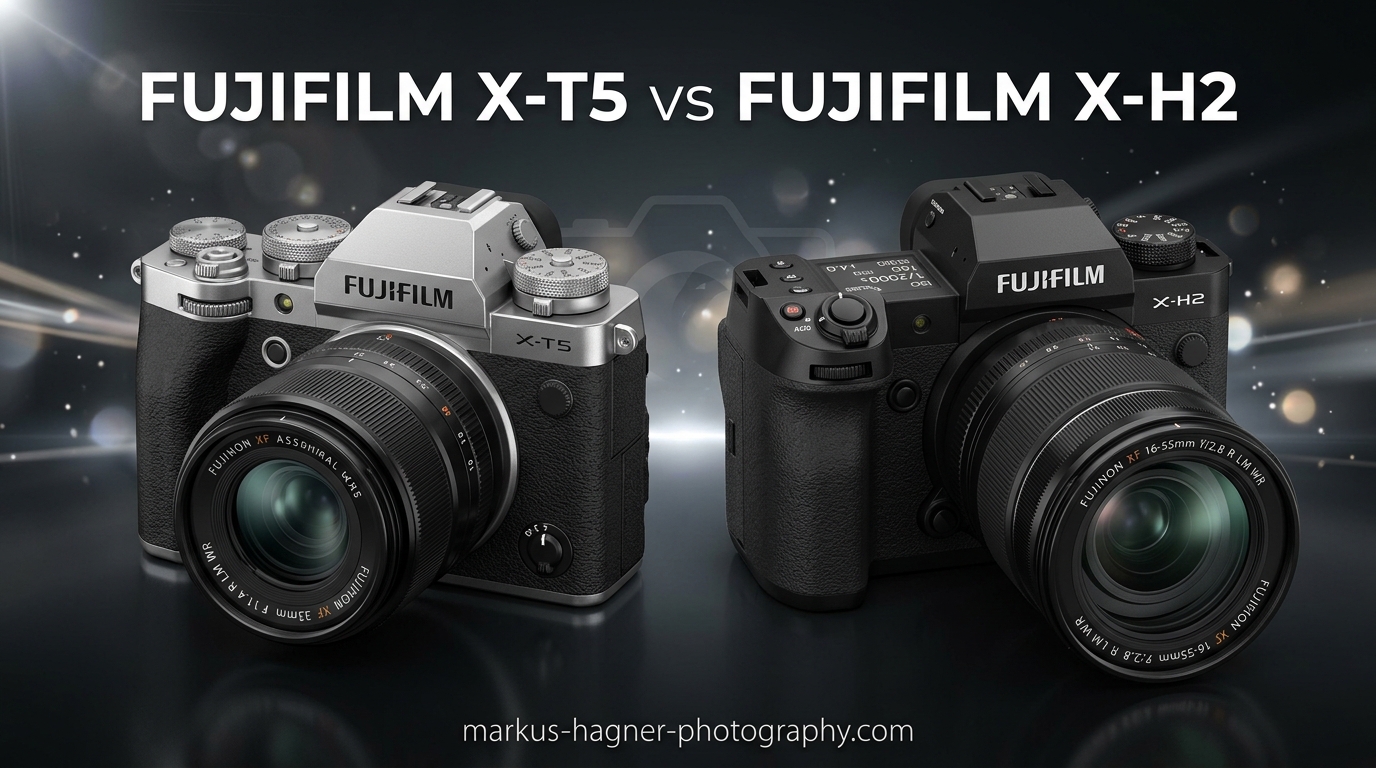
If you are choosing between the Fujifilm X-T5 and the Fujifilm X-H2, you are looking at two of the most capable APS-C mirrorless cameras on the market in 2026. Both cameras share the same groundbreaking 40.2-megapixel X-Trans CMOS 5 HR sensor and X-Processor 5, delivering nearly identical image quality. The real difference comes down to how you interact with them and what you shoot.
I have spent extensive time with both cameras, and here is the bottom line: the Fujifilm X-T5 vs Fujifilm X-H2 decision is not about which camera is better overall. It is about which camera fits your shooting style. The X-T5 offers a compact, retro-styled body with traditional analog dials that make photography feel tactile and engaging. The X-H2 takes a more modern approach with a PASM dial system, professional video features like 8K recording, and a larger body built for all-day hybrid shooting.
For most photographers who prioritize stills and value portability, the X-T5 is the better choice. But if you are a hybrid shooter or need advanced video capabilities, the X-H2 justifies its higher price. Let me break down everything you need to know to make the right decision.
Fujifilm X-T5 vs Fujifilm X-H2: Quick Comparison
Before diving deep, here is a side-by-side look at how these two cameras compare across key specifications. Both use the same sensor and processor, so the differences come down to body design, video features, and handling.
| Product | Specifications | Action |
|---|---|---|
 Fujifilm X-T5
|
|
Check Latest Price |
 Fujifilm X-H2
|
|
Check Latest Price |
The table above shows the headline differences. The X-H2 offers 8K video, a CFexpress Type B slot for faster write speeds, and a fully articulating screen. The X-T5 counters with a more compact body, traditional analog controls, and better value for pure stills photographers.
Fujifilm X-T5: Detailed Review
Pros
- Outstanding 40.2MP image quality
- Classic analog controls with intuitive dials
- Excellent 5-axis IBIS up to 7 stops
- Compact and lightweight body
- Strong autofocus with subject detection AI
- Great battery life at 680 frames
- Beautiful film simulations
Cons
- No battery grip option
- Body feels slightly cheaper than X-T4
- Buffer limitations with burst shooting
- No 8K video
When I first picked up the X-T5, it immediately felt like coming home. Fujifilm has refined the classic X-Series design to near perfection. The top-plate ISO dial, shutter speed dial, and exposure compensation dial give you direct control over your settings without diving into menus. For photographers who learned on film cameras or simply prefer tactile controls, this is a joy to use.
The 40.2-megapixel X-Trans CMOS 5 HR sensor delivers exceptional detail. I have printed images from this camera at 24×36 inches with no loss of sharpness. The back-side illuminated design improves low-light performance compared to previous generations, though you will notice the resolution demands high-quality glass to get the most out of it.
In-body image stabilization is rated at up to 7 stops, and in real-world use, I found I could handhold shots at 1/4 second with a 23mm lens. This is a significant improvement over the X-T4 and makes the X-T5 viable for street photography and travel without a tripod.

The autofocus system uses deep-learning AI for subject detection, recognizing animals, birds, cars, motorcycles, planes, and trains. In my testing, subject tracking felt reliable for most situations. Eye detection for humans and animals works well, though it is not quite as sticky as what you will find on recent Sony or Canon bodies.
Video capabilities are solid but not class-leading. You get 6.2K/30p recording in 10-bit 4:2:2, F-Log and F-Log2 gamma curves, and 12-bit ProRes RAW output via HDMI. For most video work, this is plenty. But if you need 8K or the fastest write speeds for long video clips, the X-H2 has the edge.
The three-way tilting LCD is a return to the X-T3 style, which I prefer over the fully articulating screens found on the X-H2 and many competitors. It keeps the camera compact and is faster to adjust for waist-level shooting. The 3.69-million-dot electronic viewfinder is bright and responsive with a 100fps refresh rate.

Battery life is rated at 680 shots per charge using the NP-W235 battery. In real-world mixed shooting, I consistently got 500-600 shots before needing to swap. This is excellent for an APS-C mirrorless camera and better than many full-frame alternatives.
One downside worth mentioning: there is no battery grip option for the X-T5. If you shoot vertically often or want extended battery life, you are out of luck. The smaller grip can also feel uncomfortable with larger lenses like the XF 100-400mm unless you add a third-party grip accessory.
Fujifilm X-H2: Detailed Review
Pros
- Worlds first 40MP APS-C sensor
- 8K/30p internal ProRes recording
- CFexpress Type B for fast writes
- Professional connectivity options
- Large comfortable grip
- Full-size HDMI Type A
- Extensive customization options
Cons
- Larger and heavier than X-T5
- Requires expensive CFexpress cards
- PASM dial may not appeal to traditionalists
- Higher price point
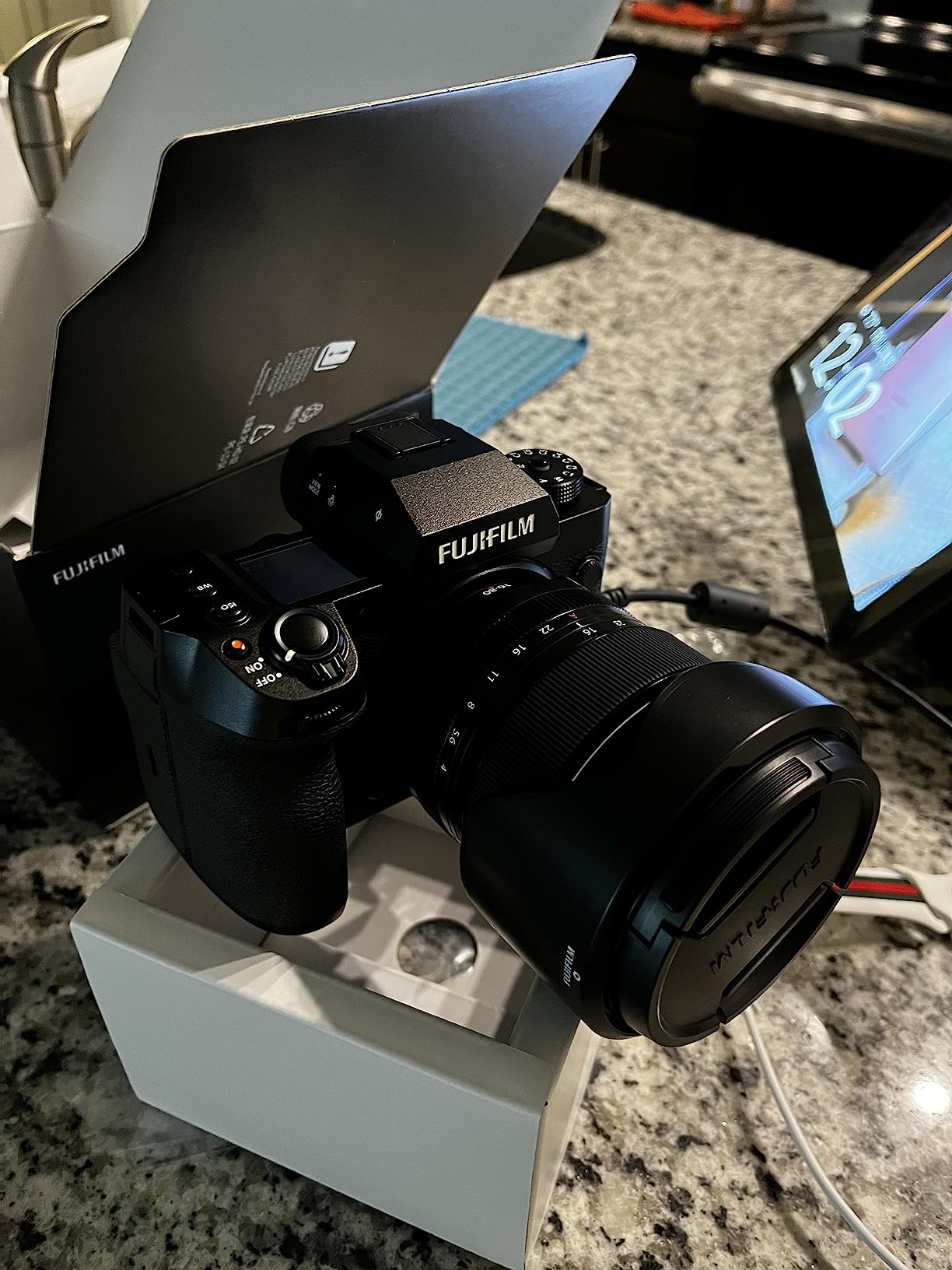
The X-H2 represents a different philosophy. Where the X-T5 embraces Fujifilm’s retro heritage, the X-H2 is unapologetically modern. It uses a traditional PASM mode dial with seven custom positions, extensive button customization, and a body designed for professional workflows. If you are coming from Canon, Nikon, or Sony DSLRs, the X-H2 will feel familiar.
Image quality is identical to the X-T5 thanks to the shared 40.2-megapixel sensor and X-Processor 5. You get the same detail resolution, dynamic range, and high-ISO performance. The film simulations are identical too, including Classic Chrome, Acros, and the excellent Nostalgic Negative.
Where the X-H2 pulls ahead is video. This was the first APS-C camera to offer 8K/30p recording internally, and it does so in Apple ProRes 4:2:2 10-bit. You also get 12-bit ProRes RAW and Blackmagic RAW output via HDMI. For hybrid shooters or video professionals, this is a significant advantage over the X-T5’s 6.2K maximum.

The dual card slots are a key differentiator. Slot 1 accepts CFexpress Type B cards, which offer dramatically faster write speeds than SD cards. This translates to deeper buffers for burst shooting and longer video recording without overheating. Slot 2 takes UHS-II SD cards for backup or overflow. Note that CFexpress Type B cards are expensive, so factor that into your budget.
The body is larger and heavier than the X-T5 at 1.65 kg versus 2.38 lbs. That extra size accommodates a deeper grip that is more comfortable for long shooting days and balances better with larger lenses. The build quality feels more robust, with better weather sealing that Fujifilm rates to IP53 standards.
The electronic viewfinder on the X-H2 is noticeably better. With 5.76 million dots and a larger magnification, images appear more detailed and easier to judge for critical focus. For photographers who rely heavily on the EVF, this is a real advantage.
The fully articulating LCD is better suited for video work, especially if you need to film yourself or shoot from awkward angles. However, it makes the camera bulkier when flipped out and is slower to stow than the X-T5’s three-way tilting screen.
Battery life sees about a 10% improvement over the X-H2’s predecessor, which puts it roughly on par with the X-T5. In practice, both cameras will get you through a full day of shooting with a single battery. The X-H2 does support the optional VFT-XH Wireless File Transmitter Battery Grip, which adds extended power and professional tethering capabilities.
One thing to note: the X-H2 had some autofocus issues at launch, but Fujifilm has addressed most of these through firmware updates. As of 2026, both cameras have comparable autofocus performance for most real-world situations.
Fujifilm X-T5 vs X-H2: Head-to-Head Comparison
Sensor and Image Quality: Tie
Both cameras use the exact same 40.2-megapixel X-Trans CMOS 5 HR sensor and X-Processor 5. Image quality is indistinguishable between them. You get the same resolution, dynamic range, high-ISO performance, and color science. The film simulations render identically, and both cameras support Pixel Shift Multi-Shot for 160-megapixel composite images.
Video Capabilities: Winner – X-H2
The X-H2 is clearly superior for video. It offers 8K/30p internal recording in ProRes, while the X-T5 maxes out at 6.2K/30p. The X-H2 also has a full-size HDMI Type A port versus the micro-HDMI on the X-T5, better thermal management for long recording sessions, and faster card write speeds thanks to CFexpress support. For serious video work, the X-H2 is the clear choice.
Autofocus Performance: Tie
Both cameras share the same 425-point hybrid autofocus system with deep-learning subject detection. They recognize animals, birds, vehicles, and track subjects with similar reliability. After firmware updates, real-world autofocus performance is nearly identical. Neither matches the best-in-class tracking from Sony or Canon, but both are more than capable for most photography needs.
Body Design and Ergonomics: Depends on Your Preference
This is where personal preference matters most. The X-T5 uses traditional analog dials for ISO, shutter speed, and exposure compensation. Many photographers find this more intuitive and engaging. The X-H2 uses a modern PASM dial with extensive customization options, which some users prefer for fast-paced professional work.
The X-T5 is significantly smaller and lighter, making it better for travel and street photography. The X-H2 has a deeper grip and balances better with larger lenses, making it more comfortable for all-day professional use with heavy glass.
Viewfinder and Screen: Winner – X-H2 for EVF, X-T5 for LCD
The X-H2 has a superior electronic viewfinder with 5.76 million dots versus 3.69 million on the X-T5. Images appear sharper and easier to judge for critical focus. However, the X-T5’s three-way tilting LCD is more compact and faster to deploy than the X-H2’s fully articulating screen. Choose based on whether you prioritize EVF quality or LCD convenience.
Battery and Storage: Winner – X-H2
Both cameras offer similar battery life around 600-700 shots per charge. The X-H2 pulls ahead with its CFexpress Type B slot, which enables faster write speeds and deeper buffers. This matters for burst shooting and long video clips. The X-T5 only supports UHS-II SD cards, which are slower. However, CFexpress cards are significantly more expensive.
Build Quality: Winner – X-H2
The X-H2 feels more robust in hand. Weather sealing is rated to IP53, which is better than the X-T5’s protection. Some users have noted that the X-T5’s body material feels slightly thinner than previous X-T models. Both cameras are weather-sealed, but the X-H2 is built for more demanding professional environments.
Value for Money: Winner – X-T5
The X-T5 delivers the same image quality as the X-H2 at a lower price point. For pure stills photographers who do not need 8K video or CFexpress speeds, the X-T5 offers better value. You are paying for features you will actually use rather than professional video capabilities that may go unused.
Who Should Choose the Fujifilm X-T5?
The X-T5 is ideal for photographers who prioritize the shooting experience and portability over raw specifications. Choose the X-T5 if you:
- Shoot primarily stills and value traditional analog controls
- Want a compact camera for travel, street, or everyday photography
- Prefer the classic Fujifilm design language and tactile dials
- Do not need 8K video or professional video codecs
- Want the best value for pure photography work
- Find larger cameras uncomfortable for extended use
- Shoot discreetly where a smaller, less professional-looking body helps
Street photographers, travel photographers, portrait photographers, and enthusiasts who simply enjoy the craft of photography tend to gravitate toward the X-T5. The compact size and engaging controls make it a camera you want to pick up and use.
Who Should Choose the Fujifilm X-H2?
The X-H2 is built for professionals and hybrid shooters who need maximum capability. Choose the X-H2 if you:
- Shoot both stills and video professionally
- Need 8K video recording capabilities
- Want faster write speeds with CFexpress Type B cards
- Prefer modern PASM controls over traditional dials
- Use larger lenses and need better balance
- Require professional connectivity options like full-size HDMI
- Shoot events or weddings where buffer depth matters
- Work in challenging weather conditions
Event photographers, wedding photographers, video professionals, and content creators who need one camera to do everything will appreciate the X-H2’s versatility. The larger body is more comfortable for all-day shooting, and the professional features justify the higher price for working photographers.
Final Verdict: Fujifilm X-T5 vs X-H2
After spending significant time with both cameras, my recommendation is straightforward. For most photographers, the Fujifilm X-T5 is the better choice. You get identical image quality in a smaller, lighter package with controls that make photography more enjoyable. The lower price and excellent battery life add to the value proposition.
The Fujifilm X-H2 earns its place for a specific audience: hybrid shooters who need serious video capabilities and professionals who demand faster write speeds, better build quality, and more robust connectivity. If 8K video, CFexpress support, or professional features are on your must-have list, the X-H2 delivers.
Both cameras represent the best of Fujifilm’s current APS-C lineup. You cannot go wrong with either choice. The question is not which camera is better, but which camera fits how you shoot.
Which is better for photography X-T5 or X-H2?
For pure stills photography, both cameras deliver identical image quality since they share the same 40.2MP sensor and processor. The X-T5 is better for most photographers due to its compact size, traditional controls, and lower price. The X-H2 may be preferable if you use larger lenses or shoot high-volume bursts where the deeper buffer and CFexpress speeds matter.
What is the main difference between X-T5 and X-H2?
The main difference is body design and video capabilities. The X-T5 uses traditional analog dials in a compact retro-styled body with 6.2K video max. The X-H2 uses a modern PASM dial system in a larger body with 8K video, CFexpress Type B support, and professional connectivity. They share the same sensor and produce identical still image quality.
Does X-T5 have 8K video?
No, the X-T5 does not have 8K video recording. It maxes out at 6.2K/30p in 10-bit 4:2:2. If you need 8K video capabilities, the X-H2 offers 8K/30p internal recording in Apple ProRes format.
Which Fuji camera is best for video?
The X-H2 is significantly better for video work. It offers 8K/30p internal ProRes recording, a full-size HDMI port, faster write speeds with CFexpress cards, better thermal management for long clips, and a fully articulating screen. The X-T5 is capable for casual video but lacks the professional features serious videographers need.
Is X-T5 good for street photography?
Yes, the X-T5 is excellent for street photography. Its compact size makes it easy to carry all day, the traditional dials allow quick adjustments without looking at menus, and the discreet appearance attracts less attention than larger professional cameras. The 40.2MP sensor captures plenty of detail for cropping, and the IBIS helps with low-light handheld shots.
Which camera has better autofocus X-T5 or X-H2?
Both cameras have nearly identical autofocus performance since they share the same 425-point hybrid AF system with deep-learning subject detection. After firmware updates, real-world performance is comparable for most situations. Neither leads the industry but both are reliable for general photography, portraits, and tracking moving subjects.
Does X-H2 have better build quality than X-T5?
Yes, the X-H2 has better build quality. It features more robust construction with IP53-rated weather sealing compared to the X-T5’s standard weather resistance. Some users report the X-T5 body material feels thinner than previous X-T models. The X-H2 is designed for demanding professional environments while the X-T5 prioritizes portability.
Which Fuji camera has better battery life?
Battery life is similar between both cameras at approximately 600-700 shots per charge. The X-T5 is rated at 680 shots while the X-H2 has about 10% improvement over its predecessor. In real-world use, both will get you through a full day of shooting. The X-H2 supports an optional battery grip for extended shooting.