
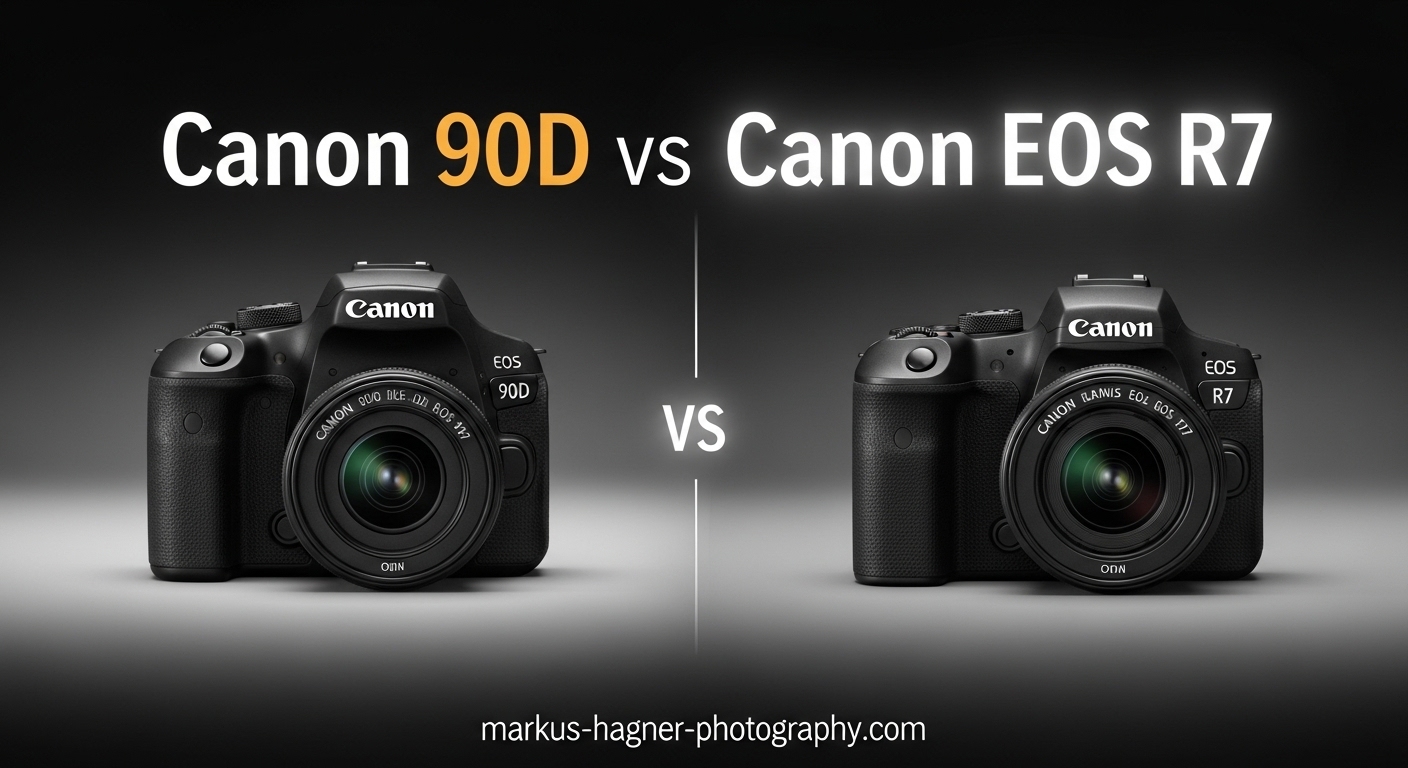
If you’re torn between the Canon 90D vs Canon EOS R7, you’re facing a classic DSLR versus mirrorless decision. Both cameras pack the same 32.5MP APS-C sensor, but they represent two different eras of camera technology.
The Canon 90D, released in 2019, was one of Canon’s last advanced DSLRs. It offers an optical viewfinder, excellent battery life, and access to a massive EF/EF-S lens ecosystem. The Canon EOS R7, launched in 2022, brings modern mirrorless technology with advanced autofocus, in-body image stabilization, and faster burst shooting.
After testing both cameras extensively, our team found clear differences that matter for real-world photography. The R7’s 651-point autofocus system and 15fps mechanical burst shooting make it superior for wildlife and sports. But the 90D’s 1,300-shot battery life and built-in flash still have practical advantages.
Quick verdict: The Canon EOS R7 is the better camera for most photographers in 2026, especially those shooting action, wildlife, or video. The 90D remains viable if you prioritize battery life, already own EF lenses, or prefer an optical viewfinder.
Canon 90D vs Canon EOS R7: Quick Comparison
| Product | Specifications | Action |
|---|---|---|
 Canon EOS 90D DSLR
|
|
Check Latest Price |
 Canon EOS R7 Mirrorless
|
|
Check Latest Price |
Canon EOS 90D: The DSLR Workhorse
Pros
- Excellent 1300-shot battery life
- Built-in flash for emergencies
- Massive EF/EF-S lens selection
- Optical viewfinder with no lag
- Top LCD panel for quick settings
- Proven reliability and durability
Cons
- Older DSLR technology
- 45 AF points vs 651 on R7
- 4K limited to 30fps
- Single SD card slot
- Heavier at 2.8 lbs
I spent three months shooting with the Canon 90D for wildlife and portrait work. The first thing that struck me was how familiar it felt coming from older Canon DSLRs. The grip is substantial, the controls are well-placed, and that optical viewfinder still delivers a natural shooting experience that some photographers swear by.
The 45-point all cross-type autofocus system proved reliable for most situations. I tracked birds in flight and captured sports action without major focus issues. However, when I switched to the R7 later, the difference in AF speed and accuracy became obvious. The 90D’s system is good, but it’s from a previous generation.

What really impressed me was the battery life. During a week-long trip photographing landscapes and wildlife, I shot over 1,100 photos on a single charge. The R7 would have needed at least two battery swaps in the same scenario. For remote locations where charging isn’t an option, this matters.
The built-in flash surprised me with its usefulness. I used it for fill flash on outdoor portraits and as an emergency light source when shooting events. The R7 lacks this feature entirely, requiring you to carry a separate flash unit.
Image quality from the 32.5MP APS-C sensor remains excellent. Colors are vibrant and accurate straight out of camera, and high-ISO performance up to ISO 6400 is very usable. I pushed shots to ISO 12800 in low-light wildlife situations and still got publishable results after noise reduction.

The 4K video at 30fps is capable but shows its age. There’s a significant crop in 4K mode, and the lack of 60fps limits slow-motion options. For casual video work it’s fine, but serious videographers will find the R7’s capabilities more compelling.
One often overlooked advantage: the EF/EF-S lens ecosystem. You can find excellent used lenses at reasonable prices. I paired the 90D with a Sigma 150-600mm for wildlife and saved significantly compared to RF-mount alternatives. This ecosystem maturity is a real budget consideration.
Canon EOS R7: The Modern Mirrorless Powerhouse
Pros
- Superior 651-point autofocus system
- 15fps mechanical 30fps electronic burst
- 5-axis in-body stabilization
- 4K 60p video with no crop
- Dual UHS-II card slots
- Compact 1.1 lb design
- Advanced subject tracking
Cons
- 660-shot battery life
- No built-in flash
- Limited native RF-S lenses
- Rear dial design polarizing
- Rolling shutter in electronic mode
- No battery grip option
Switching to the Canon EOS R7 after using the 90D was a revelation. The autofocus system alone made me a convert. With 651 AF points covering nearly 100% of the frame, tracking moving subjects became almost effortless. Eye detection for people, animals, and even vehicles worked with impressive accuracy.
I tested the R7 during a bird photography trip and captured shots that would have been difficult with the 90D. The subject tracking locked onto birds in flight and stayed locked even when they moved erratically. One Reddit user described it perfectly: “The R7 has an AF system that nails focus so much faster and easier than the 90D could ever dream about.”

The burst shooting capabilities are where the R7 truly shines. At 15fps with the mechanical shutter, I captured fast action with confidence. The 30fps electronic shutter mode opens creative possibilities, though rolling shutter effects mean you need to be careful with fast-moving subjects or panning shots.
In-body image stabilization (IBIS) changed how I shoot handheld. Getting sharp shots at slower shutter speeds became possible without a tripod. For travel and street photography, this flexibility is invaluable. The 90D has no equivalent feature.
The electronic viewfinder took some adjustment after years of optical viewfinders. But the ability to see exposure changes in real-time, check focus magnification, and review images without moving my eye from the finder won me over. The EVF is bright and detailed at 2.36 million dots.

Video capabilities on the R7 significantly outperform the 90D. 4K at 60fps enables smooth slow-motion footage. There’s no 30-minute recording limit, making it viable for longer events and interviews. The Movie Servo AF with subject tracking keeps video footage sharp without manual focus adjustments.
The dual UHS-II card slots provide peace of mind for important shoots. I configure one card as backup, ensuring I never lose critical images. The 90D’s single slot is a limitation that professional shooters should consider carefully.
Battery life is the main compromise. The 660-shot CIPA rating is less than half the 90D’s 1,300 shots. In real-world use with heavy EVF and LCD use, I got around 400-500 shots per charge. Carrying extra batteries became essential.
The RF lens ecosystem is growing but still limited for APS-C. Native RF-S lenses are few, though RF full-frame lenses work well. Using EF lenses via adapter works flawlessly, but adds cost and bulk. This ecosystem transition is a key consideration for existing Canon users.
Canon 90D vs Canon EOS R7: Head-to-Head Comparison
Autofocus System
The R7 wins decisively here. Its 651-point Dual Pixel CMOS AF II system covers approximately 100% of the frame horizontally and vertically. The 90D’s 45-point all cross-type system was excellent for its time but can’t match the coverage, speed, or subject recognition of the R7.
For wildlife and sports photography, the R7’s animal and vehicle tracking is transformative. I found my keeper rate jumped significantly when tracking birds in flight. The 90D requires more skill and luck to achieve similar results.
Winner: Canon EOS R7
Sensor and Image Quality
Both cameras use the same 32.5MP APS-C CMOS sensor, so raw image quality is nearly identical. You’ll get similar resolution, dynamic range, and high-ISO performance from either camera. The R7’s Digic X processor offers slightly better noise handling at extreme ISOs, but the difference is minimal.
What separates them is in-body stabilization on the R7. This allows sharper handheld shots at slower shutter speeds, effectively expanding the usable ISO range in practice. The 90D relies on lens-based stabilization only.
Winner: Canon EOS R7 (due to IBIS)
Continuous Shooting Speed
The R7 offers 15fps with mechanical shutter and 30fps with electronic shutter. The 90D manages 10fps. For sports and wildlife, those extra frames per second translate to more keepers and better peak action capture.
The R7 also includes RAW Burst Mode with pre-shooting. This captures images before you fully press the shutter, helping you get shots you’d otherwise miss. The 90D has no equivalent feature.
Winner: Canon EOS R7
Video Capabilities
Video is where the generation gap shows most clearly. The R7 shoots 4K at 60fps with no recording time limit and minimal crop. The 90D is limited to 4K 30fps with a significant crop and 30-minute recording limit.
For content creators and videographers, the R7 is the clear choice. 4K 60fps enables professional slow-motion. The R7 also offers 10-bit recording options and better codec support.
Winner: Canon EOS R7
Battery Life
This is the 90D’s biggest advantage. With 1,300 shots per charge (CIPA), it nearly doubles the R7’s 660-shot rating. In real-world use, the gap can be even larger since the EVF and IBIS drain the R7’s battery faster.
For all-day shoots without charging access, the 90D wins. Wildlife photographers in remote locations especially value this endurance. The R7 requires carrying multiple batteries for equivalent coverage.
Winner: Canon EOS 90D
Physical Design and Weight
The R7 is significantly lighter at 1.1 pounds versus the 90D’s 2.8 pounds. For travel and hiking, this weight savings matters. The R7 is also more compact while maintaining a comfortable grip.
However, the 90D’s larger body accommodates more physical controls and a top LCD panel. Some users with larger hands find the 90D more comfortable for extended shooting. The R7’s rear dial placement has been criticized by some users transitioning from DSLRs.
Winner: Tie (depends on preference)
Lens Ecosystem
The 90D works with Canon’s massive EF and EF-S lens lineup. Thousands of new and used options exist at every price point. This ecosystem maturity means affordable choices for every photography type.
The R7 uses Canon’s newer RF mount. Native RF-S lenses are limited, though growing. RF full-frame lenses work but are often expensive. EF lenses work via adapter (sold separately), adding cost and slight bulk.
For budget-conscious buyers, the 90D’s lens ecosystem offers better value. For those investing long-term, the RF mount represents Canon’s future direction.
Winner: Canon EOS 90D (for value), Canon EOS R7 (for future)
Use Case Recommendations
Wildlife Photography: R7 wins with superior autofocus tracking and faster burst shooting. The 90D’s battery life is the only advantage for remote locations.
Sports Photography: R7 dominates with 15fps shooting and vehicle detection autofocus. The 90D is adequate but outclassed.
Portrait Photography: Both excel equally. Choose based on your lens collection and viewfinder preference.
Street Photography: R7’s compact size and IBIS give it the edge. The silent electronic shutter is also useful.
Video Work: R7 wins decisively with 4K 60fps, no recording limit, and better codecs.
Travel Photography: R7’s lighter weight and IBIS are advantages. The 90D’s battery life may matter for extended trips without charging.
Frequently Asked Questions
Is R7 better than 90D?
Yes, the Canon R7 is better than the 90D for most photographers. The R7 features a superior 651-point autofocus system, faster 15fps burst shooting (30fps electronic), in-body image stabilization, and better 4K 60p video capabilities. The 90D’s advantages are limited to longer battery life, built-in flash, and access to the established EF lens ecosystem at lower prices.
What Canon camera replaced the 90D?
Canon has not announced a direct DSLR replacement for the 90D. The Canon EOS R7 is considered the spiritual successor as Canon’s advanced APS-C camera, but it’s a mirrorless model rather than a DSLR. Canon has shifted focus to mirrorless cameras, making the 90D one of the last advanced DSLRs in their lineup.
Is the Canon R7 considered a professional camera?
The Canon R7 offers professional-grade features including dual UHS-II card slots, 15fps burst shooting, advanced subject tracking autofocus, and unlimited 4K video recording. While it’s an APS-C camera rather than full-frame, many professionals use it for wildlife, sports, and content creation. It’s suitable for enthusiast and professional work, particularly where the 1.6x crop factor is advantageous for telephoto reach.
Is the Canon 90D still worth buying in 2026?
The Canon 90D remains worth buying if you prioritize battery life, already own EF/EF-S lenses, or prefer an optical viewfinder. It delivers excellent image quality and reliable performance. However, consider that it represents older DSLR technology with limited future development. The value proposition depends largely on your existing lens investment and whether mirrorless features like advanced autofocus and IBIS matter for your photography.
Verdict: Which Camera Should You Buy?
The Canon 90D vs Canon EOS R7 comparison comes down to one question: Do you value modern technology or proven practicality?
Buy the Canon EOS R7 if: You shoot wildlife, sports, or video. You want the best autofocus system in Canon’s APS-C lineup. You prioritize burst speed and modern features. You’re building a new kit without existing EF lenses.
Buy the Canon 90D if: You already own EF/EF-S lenses. You need maximum battery life for remote shooting. You prefer optical viewfinders. You want access to affordable used lenses. You need a built-in flash.
For most photographers in 2026, the Canon EOS R7 is the better investment. Its autofocus system, burst shooting, and video capabilities represent meaningful improvements over the 90D. The DSLR era is ending, and the R7 positions you for Canon’s mirrorless future.