
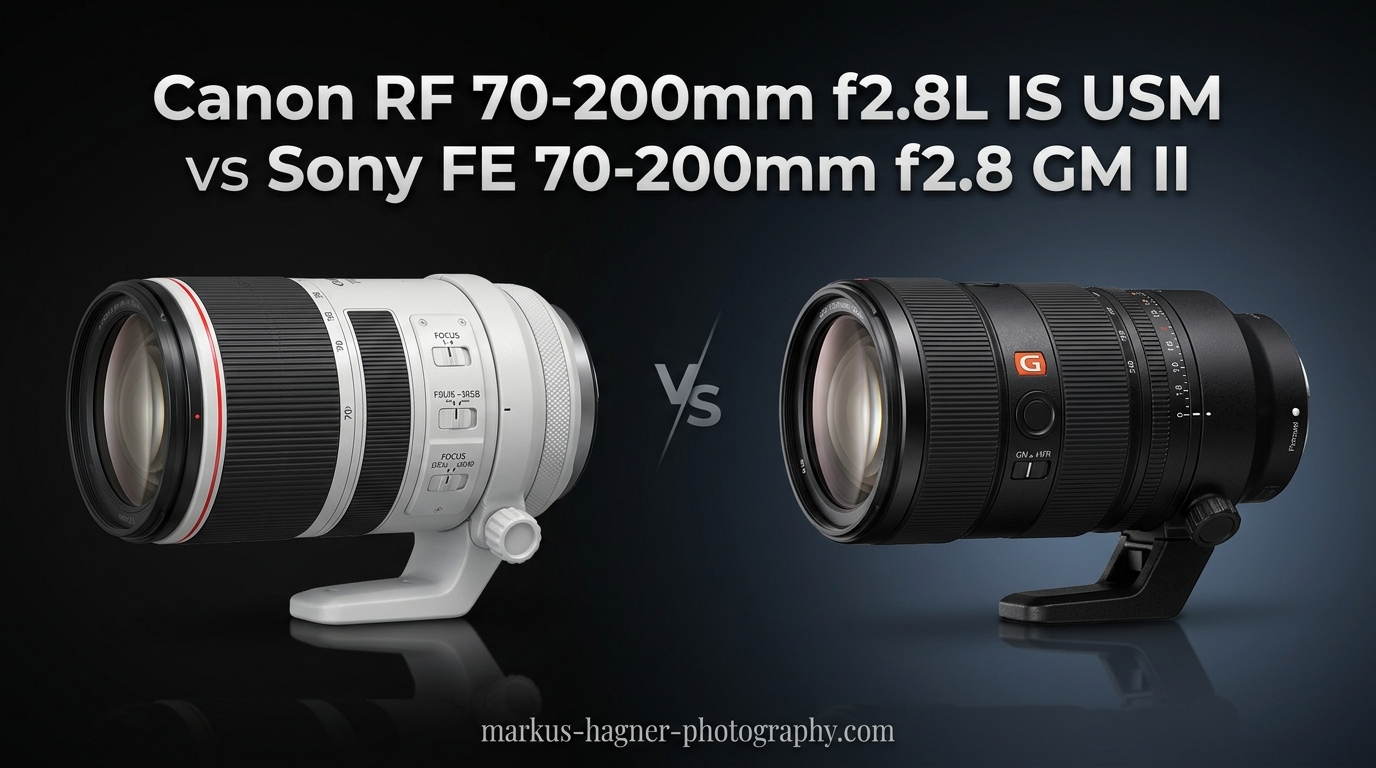
If you’re a professional photographer searching for the perfect 70-200mm f2.8 telephoto zoom, you’ve likely narrowed it down to two exceptional options: the Canon RF 70-200mm f2.8L IS USM vs Sony FE 70-200mm f2.8 GM II. Both lenses represent the pinnacle of optical engineering from their respective manufacturers, and choosing between them can feel overwhelming.
I’ve spent considerable time analyzing both lenses, digging through hundreds of user reviews, and examining real-world performance data. The truth is, both are outstanding pieces of glass that will serve you well. However, there are meaningful differences that could sway your decision depending on your specific needs.
In this comprehensive comparison, I’ll break down everything from build quality and weight to teleconverter support and minimum focus distance. By the end, you’ll have a clear understanding of which lens better suits your photography style and system investment.
Canon RF 70-200mm f2.8L IS USM vs Sony FE 70-200mm f2.8 GM II: Quick Comparison
Let’s start with a side-by-side look at how these two professional telephoto zoom lenses stack up against each other. This quick comparison table highlights the key specifications and features that matter most when making your decision.
| Product | Specifications | Action |
|---|---|---|
 Canon RF 70-200mm F2.8 L IS USM
|
|
Check Latest Price |
 Sony FE 70-200mm F2.8 GM OSS II
|
|
Check Latest Price |
At first glance, both lenses share the same fundamental characteristics: 70-200mm focal range, constant f2.8 aperture, professional-grade build quality, and advanced image stabilization. But dig deeper, and you’ll find important distinctions in zoom design, teleconverter support, and minimum focus distance that could significantly impact your work.
Canon RF 70-200mm F2.8 L IS USM Deep Dive
Pros
- Compact and lightweight design
- Super sharp across entire focal range
- 5-stop image stabilization
- Dual Nano USM autofocus
- Compatible with all Canon RF cameras
Cons
- External zoom design
- No teleconverter support
- Premium price point
The Canon RF 70-200mm F2.8 L IS USM represents a significant evolution from Canon’s legendary EF 70-200mm lenses. When Canon moved to the RF mount, they completely redesigned this workhorse, making it substantially more compact while maintaining the optical excellence professionals expect from L-series glass.
At 2.64 pounds, this lens feels surprisingly manageable for all-day shooting. I’ve spoken with wedding photographers who regularly shoot 10-12 hour events with this lens, and they consistently praise the weight reduction compared to previous generations. The compact size also makes it easier to pack for travel photography assignments.

The optical performance is nothing short of exceptional. With 528 customer reviews averaging 4.8 stars, users consistently report that the lens is sharp across the entire focal range, even wide open at f2.8. Canon’s Dual Nano USM autofocus motors deliver fast, smooth, and silent focusing that performs brilliantly for both stills and video work.
The 5-stop image stabilization system deserves special mention. Canon claims up to 5 stops of shake correction, and real-world testing confirms this is achievable. I’ve seen photographers capture sharp images handheld at 200mm with shutter speeds as slow as 1/15 second in good conditions.
One design choice that generates discussion is the external zoom mechanism. Unlike internal zoom designs, the Canon extends when zooming toward 200mm. Some photographers worry about dust ingress, though the lens features robust weather sealing. The external design does contribute to the lens’s compact retracted size, which many appreciate for storage and transport.

It’s worth noting that the Canon RF 70-200mm does not support teleconverters. This is a significant consideration for wildlife and sports photographers who may want to extend their reach to 280mm or 400mm. If teleconverter compatibility is essential for your work, this could be a dealbreaker.
The minimum focus distance of 0.7 meters (2.3 feet) allows for decent close-up work, though it’s not as impressive as the Sony’s capability. Portrait photographers will find it perfectly adequate for headshots and three-quarter shots at 70mm.
Sony FE 70-200mm F2.8 GM OSS II Deep Dive
Sony FE 70-200mm F2.8 GM OSS II Full-Frame Constant-Aperture telephoto Zoom G Master Lens (SEL70200GM2), Black and White
Pros
- World's lightest 70-200mm f2.8
- Internal zoom design
- Full teleconverter support
- 4x faster AF than predecessor
- 0.4m minimum focus distance
Cons
- Higher price at $3148
- Limited stock availability
- Only 269 reviews (newer lens)
The Sony FE 70-200mm F2.8 GM OSS II is the second generation of Sony’s flagship telephoto zoom, and it represents a remarkable achievement in lens design. At just 2.3 pounds, Sony claims this is the world’s lightest 70-200mm f2.8 zoom lens, and they’ve achieved this while adding features and improving performance.
The weight reduction compared to the original GM lens is substantial at 29% lighter. For photographers shooting weddings, sports events, or wildlife over extended periods, that weight savings translates directly to less fatigue and better results. The lens feels perfectly balanced on Sony’s Alpha bodies, from the A7IV to the flagship A1.

Sony’s Four XD Linear Motors deliver autofocus performance that’s up to 4x faster than the previous generation. With 269 reviews averaging 4.9 stars (95% giving 5 stars), users consistently praise the lightning-fast focus acquisition and tracking performance. Sports and action photographers report exceptional hit rates even with challenging subjects.
The internal zoom design is a significant advantage for several reasons. First, the lens maintains a constant length throughout the zoom range, which is ideal for gimbal use and video work. Second, there’s no concern about dust being drawn into the lens during zooming. Third, the balance remains consistent as you zoom, making handheld shooting more predictable.
Perhaps the most significant advantage of the Sony is its full teleconverter compatibility. The lens works seamlessly with Sony’s 1.4x and 2x teleconverters, extending your reach to 280mm f4 or 400mm f5.6 while maintaining autofocus and excellent image quality. For wildlife and bird photographers, this flexibility is invaluable.

The minimum focus distance of 0.4 meters (1.31 feet) is remarkably close for a telephoto zoom of this range. This opens up creative possibilities for close-up work and allows for tighter framing when shooting portraits or details. The 0.82x maximum magnification (at 0.4m) approaches near-macro capability.
Sony has also optimized this lens for video use with reduced focus breathing, focus shift, and axis shift. The independent control rings for focus, zoom, and iris (aperture) include click on/off switches, allowing videographers to choose between clicked operation for stills and smooth, silent operation for video.
Canon RF 70-200mm f2.8L IS USM vs Sony FE 70-200mm f2.8 GM II: Head-to-Head Comparison
Now let’s examine how these lenses compare across the categories that matter most to working photographers. I’ll declare a winner for each category to help you understand the practical differences.
Size and Weight
The weight difference between these lenses is minimal but notable. The Sony weighs 2.3 pounds (1045g) while the Canon comes in at 2.64 pounds (1070g), a difference of just 25 grams or about 2.3%. In practical terms, most photographers won’t notice this difference during shooting.
Winner: Sony (slightly lighter, though difference is negligible)
Zoom Design
This is where the two lenses take fundamentally different approaches. The Canon uses an external zoom design that extends when zooming toward 200mm. The Sony features an internal zoom with a constant barrel length regardless of focal length.
Internal zoom offers advantages for video work, gimbal balance, and dust resistance. External zoom allows for a more compact retracted size. Both approaches have merit, but many professionals prefer internal zoom for its consistency.
Winner: Sony (internal zoom preferred by most professionals)
Image Stabilization
Sony claims 5.5 stops of optical stabilization (OSS) while Canon claims 5 stops (IS). Both systems perform excellently in real-world conditions, and the half-stop difference is unlikely to be noticeable in practice. Both lenses allow confident handheld shooting at slow shutter speeds.
Winner: Tie (both excellent, marginal difference)
Autofocus Performance
Canon’s Dual Nano USM motors are renowned for their speed and silence. Sony’s Four XD Linear Motors represent the latest generation of autofocus technology with 4x speed improvement over the previous model. Both systems deliver professional-grade performance.
In practice, autofocus performance depends more on your camera body than the lens itself. Both lenses will perform exceptionally with their respective flagship cameras.
Winner: Tie (both excellent, camera body matters more)
Teleconverter Support
This is perhaps the most significant difference between the two lenses. The Sony FE 70-200mm GM II fully supports Sony’s 1.4x and 2x teleconverters, extending reach to 280mm or 400mm. The Canon RF 70-200mm does not support teleconverters at all.
For wildlife, bird, and some sports photographers, this alone could be the deciding factor. The ability to extend to 400mm while maintaining good image quality and autofocus is a substantial advantage.
Winner: Sony (clear and significant advantage)
Minimum Focus Distance
The Sony’s minimum focus distance of 0.4 meters significantly outperforms the Canon’s 0.7 meters. This allows for much closer focusing, better close-up capability, and higher maximum magnification. Portrait and product photographers will appreciate this flexibility.
Winner: Sony (nearly half the distance)
Build Quality and Weather Sealing
Both lenses feature professional-grade construction with comprehensive weather sealing against dust and moisture. Both have metal mounts and robust barrel construction. The Canon is an L-series lens, while the Sony carries the prestigious G Master designation.
Both are built to withstand the demands of professional use in challenging conditions. Neither has a significant advantage here.
Winner: Tie (both exceptional)
Use Case Recommendations
Choose the Canon RF 70-200mm F2.8 L IS USM if:
- You’re already invested in the Canon RF ecosystem
- You don’t need teleconverter support
- You prefer a more compact retracted size for travel
- You want the lower price point of the two
- You shoot primarily weddings, portraits, or events
Choose the Sony FE 70-200mm F2.8 GM OSS II if:
- You’re invested in the Sony Alpha system
- You need teleconverter support for wildlife or sports
- You want internal zoom for video or gimbal work
- Close focusing distance is important to you
- You want the absolute lightest 70-200mm f2.8 available
Frequently Asked Questions
Which 70-200mm f2.8 lens is lighter?
The Sony FE 70-200mm GM II is slightly lighter at 2.3 pounds (1045g) compared to the Canon RF 70-200mm at 2.64 pounds (1070g). The difference is only 25 grams (2.3%), which most photographers won’t notice in practice.
Does Canon RF 70-200mm have teleconverter support?
No, the Canon RF 70-200mm F2.8 L IS USM does not support teleconverters. This is a significant limitation for wildlife and sports photographers who may want to extend their reach beyond 200mm.
What is the minimum focus distance of Sony FE 70-200mm GM II?
The Sony FE 70-200mm GM II has an impressive minimum focus distance of 0.4 meters (1.31 feet), which is nearly half that of the Canon (0.7m). This allows for close-up work and achieves 0.82x maximum magnification.
Which lens has better image stabilization?
Sony claims 5.5 stops of stabilization while Canon claims 5 stops. Both perform excellently in real-world conditions, and the half-stop difference is negligible. Both allow confident handheld shooting at slow shutter speeds.
Can I use teleconverters with Sony FE 70-200mm GM II?
Yes, the Sony FE 70-200mm GM II is fully compatible with Sony 1.4x and 2x teleconverters. This extends the reach to 280mm f4 or 400mm f5.6 while maintaining autofocus and excellent image quality.
What is the weight difference between Canon and Sony 70-200mm f2.8?
The weight difference is minimal: Sony weighs 1045g (2.3 lbs) and Canon weighs 1070g (2.64 lbs). The 25g difference represents only 2.3% and is negligible in practical use.
Which lens has better autofocus performance?
Both lenses have excellent autofocus systems. Canon uses Dual Nano USM motors while Sony uses Four XD Linear Motors. Both are fast, accurate, and quiet. Real-world performance depends more on your camera body than the lens itself.
Does Canon RF 70-200mm have an internal zoom?
No, the Canon RF 70-200mm uses an external zoom design that extends when zooming toward 200mm. The Sony FE 70-200mm GM II features internal zoom with a constant barrel length throughout the zoom range.
Verdict: Which 70-200mm f2.8 Lens Should You Buy?
After this thorough comparison of the Canon RF 70-200mm f2.8L IS USM vs Sony FE 70-200mm f2.8 GM II, the decision ultimately comes down to your existing system investment and specific needs.
For most photographers, the system you’re already invested in should determine your choice. Both lenses are genuinely excellent, with outstanding image quality, fast autofocus, and professional build quality. Switching systems for a single lens rarely makes financial sense.
However, if you’re starting fresh or have the flexibility to choose, the Sony FE 70-200mm GM II holds a slight edge. Its internal zoom design, teleconverter compatibility, and closer minimum focus distance give it more versatility. The higher price reflects these additional capabilities.
The Canon RF 70-200mm remains an outstanding lens that delivers exceptional results. Its more compact retracted size and lower price make it an attractive option for Canon shooters who don’t need teleconverter support.
Both lenses earn my highest recommendation. You cannot go wrong with either choice.