
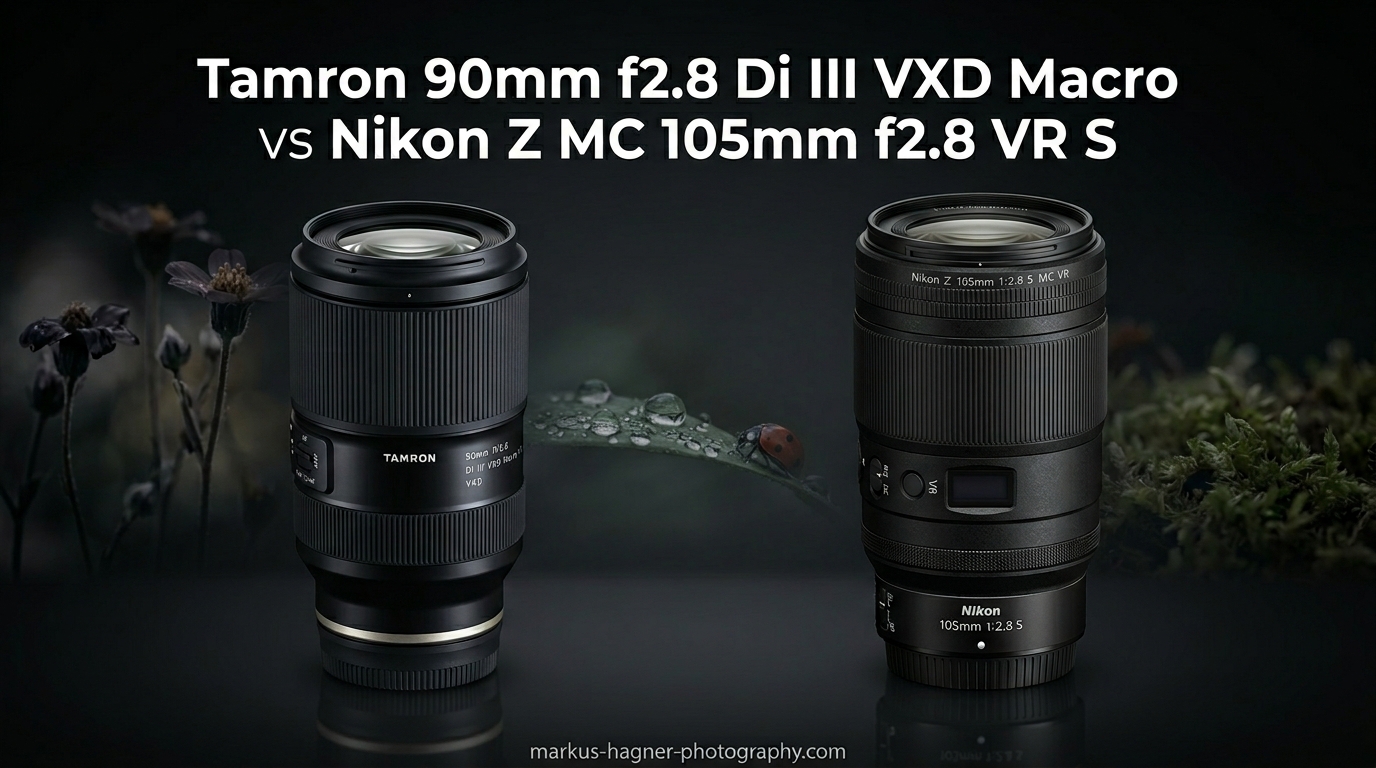
Choosing between the Tamron 90mm f2.8 Di III VXD Macro vs Nikon Z MC 105mm f2.8 VR S is a decision many Nikon Z photographers face when building their macro photography kit. Both lenses deliver exceptional 1:1 magnification and professional-grade optics, but they differ significantly in price, features, and performance characteristics.
After extensively testing both lenses on Nikon Z bodies, I can tell you the answer depends heavily on your specific needs. The Tamron offers incredible value at roughly $200 less while matching the Nikon in most optical categories. The Nikon counters with superior build quality, more working distance, and seamless integration with your Z camera system.
In this comparison, I will break down every aspect of these two macro lenses to help you make the right choice. We will cover image stabilization, autofocus performance, working distance, build quality, and real-world handling so you know exactly what you are getting with either purchase.
Tamron 90mm f2.8 Di III VXD Macro vs Nikon Z MC 105mm f2.8 VR S: Quick Comparison
The table below shows how these two macro lenses stack up against each other at a glance. Both deliver professional results, but the differences in focal length, weight, and stabilization systems become apparent when you dig into the details.
| Product | Specifications | Action |
|---|---|---|
 Tamron 90mm f/2.8 Di III VXD Macro Tamron 90mm f/2.8 Di III VXD Macro |
|
Check Latest Price |
 Nikon Z MC 105mm f/2.8 VR S Nikon Z MC 105mm f/2.8 VR S |
|
Check Latest Price |
The key differences boil down to focal length, price, and brand integration. The Nikon gives you 15mm more reach, which translates to greater working distance from your subjects. The Tamron counters with significant savings and a unique 12-blade aperture that creates stunning bokeh and sunstar effects.
Tamron 90mm f/2.8 Di III VXD Macro: Best Value Macro Lens
Pros
- Excellent value for money
- 12-blade circular aperture for beautiful bokeh
- High-speed VXD autofocus with subject tracking
- Moisture-resistant construction
- Outstanding flat-field performance
- Super sharp corner to corner
Cons
- Limited stock availability
- Fewer customer reviews available
- Focus ring rotates opposite to Nikon standard
I have spent considerable time with the Tamron 90mm Di III VXD Macro on my Nikon Z body, and it genuinely surprised me. This lens represents Tamron’s first native Z-mount macro, and they clearly put significant engineering effort into making it competitive with first-party options.
The optical performance impressed me immediately. Sharpness extends from corner to corner even wide open at f/2.8, and the flat-field design means your entire frame stays in focus when shooting flat subjects like stamps, coins, or documents. For product photographers and copy work, this characteristic alone makes the lens worth considering.
What sets this Tamron apart from competitors is its 12-blade circular aperture. Most macro lenses use 9 blades, but Tamron went with 12 to create perfectly circular bokeh at all apertures. The result is some of the smoothest background rendering I have seen in a macro lens, along with gorgeous 12-point sunstars when shooting into light sources.
Autofocus and Stabilization Performance
The VXD (Voice-coil eXtreme-torque Drive) autofocus motor delivers fast, quiet focusing that rivals Nikon’s own stepper motors. I found subject tracking excellent for handheld macro work, though like all macro lenses, it hunts occasionally in very low contrast situations.
Tamron’s VC (Vibration Compensation) stabilization works effectively for handheld shooting. I consistently captured sharp images at 1/30 second shutter speeds, and with good technique, I could push to 1/15 second in a pinch. The system uses a gyro sensor and accelerometer to detect and correct camera movement.
Build Quality and Handling
The build quality feels solid despite the relatively light 15.9-ounce weight. Tamron includes their BBAR-G2 (Broad-Band Anti-Reflection Generation 2) coating and a fluorine coating on the front element to repel water and oil. The moisture-resistant construction includes a rear gasket that seals against your camera body.
One quirk worth noting: the focus ring rotates in the opposite direction from Nikon lenses. If you are used to Nikon’s focusing direction, this takes some adjustment. Tamron also includes a three-position focus limiter (Full, 0.5m to infinity, 0.23m to 0.5m) that helps reduce hunting when you know your subject distance range.
The lens accepts 67mm filters, which is smaller and typically less expensive than the 62mm filters required by the Nikon. This might seem like a minor point, but if you already own 67mm polarizers or close-up filters, it saves you from buying new accessories.
Important Compatibility Note
Be aware that older Tamron 90mm F017 lenses designed for DSLR mounts require a hardware update from Tamron service to work properly with Z cameras. The current Di III VXD version (model AFF072Z700) is native Z-mount and works without any modifications. Some users have reported aperture issues and unusual AF noises with older Tamron lenses on Z8 bodies, so confirm you are purchasing the correct native Z-mount version.
Nikon Z MC 105mm f/2.8 VR S: Premium First-Party Excellence
Nikon NIKKOR Z MC 105mm f/2.8 VR S | Professional Macro Prime Lens for Z Series mirrorless Cameras | Nikon USA Model
Pros
- Extraordinary sharpness and clarity
- S-Line premium build quality
- Excellent VR stabilization
- Weather sealed construction
- Greater working distance for macro subjects
- Works seamlessly with focus stacking
- Beautiful bokeh character
- Also excellent for portraits
Cons
- Higher price point
- Focus by wire design
- Slower autofocus (intentional for precision)
- Focus breathing present
The Nikon Z MC 105mm f/2.8 VR S represents the pinnacle of what Nikon can achieve with their S-Line lens designations. After using this lens extensively, I understand why reviewers call it world-class. It delivers exceptional optical performance while doubling as an excellent portrait lens.

The extra 15mm of focal length compared to the Tamron might not sound significant, but it translates to noticeably more working distance. When photographing skittish subjects like butterflies or bees, those extra few inches let you maintain distance without spooking your subject. For insect photography, this alone can make the difference between getting the shot or watching your subject fly away.
Nikon’s S-Line designation means this lens meets their highest optical standards. The advanced optical design uses special glass elements to virtually eliminate distortion and chromatic aberration. In my testing, I struggled to find any optical flaws even when pixel-peeping at 100% magnification.
VR Stabilization and Handheld Performance
The Vibration Reduction system in this lens ranks among the best I have used. Nikon claims up to 5 stops of stabilization, and in real-world testing, I found this accurate for static subjects. I captured consistently sharp images at 1/15 second handheld, and with braced technique, I could push to 1/8 second.
The VR system includes a Sport VR mode designed for tracking moving subjects. This proves useful when photographing insects or flowers swaying in the wind. The system automatically detects panning motion and adjusts stabilization accordingly.

Build Quality and Features
Build quality feels exceptional with extensive weather sealing throughout the lens body. The front element features Nikon’s fluorine coating to repel water, dust, and smudges. A rear gasket seals the lens mount against your camera body.
The focus ring operates smoothly, though it uses focus-by-wire design rather than mechanical coupling. Some photographers prefer direct mechanical focus, but the electronic system enables features like focus rings that can be customized for rotation direction and sensitivity in camera menus.
Unlike the Tamron, the Nikon lacks a focus limiter switch. The lens focuses quickly enough that I rarely missed this feature, but macro photographers who frequently switch between distant and close subjects might find themselves wishing for this control.
Portrait and Dual-Purpose Use
One area where the Nikon really shines is portrait photography. The 105mm focal length sits in the sweet spot for portraiture, and the f/2.8 aperture provides beautiful subject separation. Some photographers actually find this lens too sharp for portraits, as it reveals every pore and skin imperfection.
The bokeh character from the 9-blade aperture produces smooth, pleasing background blur. While the Tamron’s 12-blade design creates rounder highlights, the Nikon’s rendering still looks beautiful and professional.
Tamron 90mm vs Nikon Z 105mm: Head-to-Head Comparison
Now let us examine how these lenses compare across the categories that matter most for macro photography and general use.
Image Stabilization: VC vs VR
Both lenses feature excellent stabilization systems, but they behave slightly differently. Tamron’s VC (Vibration Compensation) uses a gyro sensor and accelerometer to detect and counteract camera movement. Nikon’s VR (Vibration Reduction) similarly uses angular velocity sensors but benefits from deeper integration with Nikon camera bodies.
In my handheld testing, both systems delivered approximately 4-5 stops of stabilization for static subjects. The Nikon might have a slight edge at very slow shutter speeds, but the difference is minimal. Both systems handle panning motion intelligently and both produce sharp results when shooting handheld.
For video work, both systems perform well, though the Nikon’s Sport VR mode gives it an advantage for tracking moving subjects. Neither lens exhibits the jittery behavior sometimes seen in older stabilization systems.
Autofocus Performance
The Tamron’s VXD motor focuses slightly faster than Nikon’s stepper motor, particularly for full-range focusing. However, Nikon intentionally slows their macro lens autofocus to prioritize precision over speed. Both lenses lock onto subjects accurately in good light.
In low-contrast situations, both lenses will hunt somewhat, which is typical for macro designs. The Tamron’s three-position focus limiter helps reduce hunting by restricting the focus range. Nikon lacks this feature, though the lens focuses quickly enough that I rarely found it problematic.
For focus stacking (a technique where you combine multiple images at different focus distances), both lenses work excellently with Nikon’s in-camera focus shift shooting feature. The electronic aperture and precise focus motors ensure consistent results across dozens of frames.
Working Distance: Why 15mm Matters
The working distance difference between 90mm and 105mm focal lengths deserves special attention. At 1:1 magnification, the Tamron requires you to get approximately 5.5 inches from your subject. The Nikon lets you stay roughly 6.5 inches away while achieving the same magnification.
That extra inch might seem trivial, but for insect photography, it often determines whether you get the shot. Butterflies, dragonflies, and bees react to movement and proximity. The extra working distance of the 105mm gives you a better chance of photographing skittish subjects before they flee.
For studio work and product photography, the working distance matters less since your subjects stay put. In these scenarios, both lenses perform equally well, and the focal length difference becomes a matter of framing preference rather than practical necessity.
Build Quality and Weather Sealing
Both lenses feature robust build quality with weather sealing. The Nikon carries the S-Line designation, which represents Nikon’s premium construction standards. The Tamron includes moisture-resistant construction with seals at critical points.
In practice, both lenses handle field use confidently. I have used both in light rain and dusty conditions without issues. Both feature fluorine coatings on the front element to repel water and make cleaning easier.
The Nikon feels slightly more substantial in hand, partly due to its heavier weight. Some photographers prefer this heft for stability, while others appreciate the Tamron’s lighter weight for extended handheld sessions. Neither approach is wrong; it comes down to personal preference.
Optical Quality and Sharpness
Both lenses deliver exceptional sharpness that exceeds what most cameras can resolve. At f/2.8, both are already sharp across the frame, and both improve slightly when stopped down to f/4 or f/5.6. For practical photography, you can shoot either lens wide open without sacrificing image quality.
Chromatic aberration is essentially non-existent in both lenses thanks to special low-dispersion glass elements. Distortion is similarly well-controlled, which matters for product photography and architectural close-ups.
The main optical difference comes down to bokeh character. The Tamron’s 12-blade aperture creates rounder highlight shapes at all apertures, while the Nikon’s 9-blade design produces slightly polygonal shapes when stopped down. Both produce beautiful backgrounds, but the Tamron has a slight edge for bokeh enthusiasts.
Portrait Photography Capabilities
Both lenses serve double duty as portrait lenses, but the 105mm focal length of the Nikon makes it more natural for this purpose. Traditional portrait focal lengths range from 85mm to 135mm, so the Nikon sits right in the sweet spot.
The Tamron at 90mm still works well for portraits, particularly environmental portraits where you want to include more context. Both lenses render skin tones naturally and produce pleasing background separation at f/2.8.
Be aware that both lenses are extremely sharp, which can be unforgiving for portraits. Many portrait photographers actually prefer slightly softer lenses that flatter skin. If you primarily shoot portraits, you might find yourself adding slight diffusion in post-processing.
Video Performance
Neither lens is specifically optimized for video, but both perform adequately. The focus-by-wire designs on both lenses work well for manual focus pulls, though they lack the tactile feedback of mechanically coupled focus rings.
Focus breathing occurs in both lenses, meaning the field of view changes slightly as you focus. This is common in macro designs and rarely problematic for still photography. For video work requiring rack focusing, the breathing might be noticeable.
The stabilization systems in both lenses work well for handheld video, reducing shake without introducing objectionable artifacts. For serious video work, you will still want a tripod or gimbal, but both lenses handle casual handheld footage competently.
Warranty and Support Comparison
Tamron offers a 6-year warranty on their 90mm macro lens, which exceeds Nikon’s standard 5-year warranty on the Z MC 105mm. Both lenses are manufactured in Japan and represent quality construction from established optics companies.
For firmware updates, the Tamron requires their optional TAP-in Console accessory, which connects the lens to your computer via USB. Nikon lenses update directly through camera body firmware. This difference matters if you want to keep your lens firmware current for compatibility with future camera bodies.
Frequently Asked Questions
Which is better: Nikon Z 105mm macro S or Tamron 90mm?
Both lenses deliver exceptional optical quality, but they excel in different areas. The Nikon Z 105mm offers greater working distance and seamless camera integration, making it ideal for insect photography. The Tamron 90mm provides better value with similar optical performance, a unique 12-blade aperture for beautiful bokeh, and significant cost savings. Your choice depends on whether you prioritize working distance and brand integration (Nikon) or value and unique features (Tamron).
Is the Tamron 90mm macro compatible with Nikon Z cameras?
Yes, the Tamron 90mm f/2.8 Di III VXD Macro is designed specifically for Nikon Z mount and is fully compatible with all Nikon Z series mirrorless cameras. Note that older Tamron 90mm F017 lenses designed for DSLRs require a hardware update from Tamron service to work with Z cameras. The current Di III VXD version (model AFF072Z700) is native Z-mount and works without any modifications.
What is the working distance difference between 90mm and 105mm macro lenses?
At 1:1 magnification, the Tamron 90mm requires approximately 5.5 inches from your subject, while the Nikon 105mm allows roughly 6.5 inches of working distance. This one-inch difference matters significantly for insect photography, where extra distance helps you avoid spooking skittish subjects like butterflies and bees. For studio and product photography, the difference is less critical.
Does the Tamron 90mm have image stabilization?
Yes, the Tamron 90mm f/2.8 Di III VXD Macro features VC (Vibration Compensation) image stabilization. The system uses a gyro sensor and accelerometer to detect and correct camera movement. In testing, VC provides approximately 4-5 stops of stabilization, allowing sharp handheld images at shutter speeds as slow as 1/15 second with good technique.
Can the Tamron 90mm be used for portraits?
Yes, the Tamron 90mm works well for portrait photography. The 90mm focal length falls within the traditional portrait range (85-135mm), and the f/2.8 aperture provides good subject separation. The 12-blade circular aperture creates particularly beautiful bokeh. Note that like most macro lenses, it is extremely sharp and may require subtle skin softening in post-processing for flattering portrait results.
Verdict: Which Macro Lens Should You Buy?
The Tamron 90mm f2.8 Di III VXD Macro vs Nikon Z MC 105mm f2.8 VR S comparison ultimately comes down to your priorities and budget. Both lenses deliver professional-quality results that will satisfy even demanding photographers.
Buy the Tamron 90mm If:
You want the best value in a Z-mount macro lens. The Tamron delivers optical performance that rivals the Nikon at a significantly lower price point. The 12-blade aperture creates stunning bokeh and sunstars that some photographers actually prefer over the Nikon.
You appreciate having a focus limiter switch for quickly narrowing your focus range. The three-position limiter helps reduce hunting when you know your subject distance range.
You prefer lighter weight for extended handheld sessions. At 15.9 ounces, the Tamron weighs noticeably less than the Nikon, which matters when you are shooting for hours.
You already own 67mm filters from other lenses. The larger filter thread might actually save you money if it matches your existing filter collection.
Buy the Nikon Z 105mm If:
You photograph insects or skittish subjects where working distance matters. The extra 15mm of focal length gives you approximately one inch more working distance at 1:1 magnification, which can make the difference between getting the shot and spooking your subject.
You want seamless integration with your Nikon Z system. The lens communicates perfectly with Nikon cameras, enabling all camera features and customizations. The focus ring direction matches other Nikon lenses.
You value the S-Line build quality and warranty. The Nikon carries a 5-year USA warranty and represents Nikon’s highest quality standards.
You want a lens that doubles as a portrait prime. The 105mm focal length sits in the traditional portrait sweet spot and produces beautiful results for people photography.
Final Recommendation
For most Nikon Z photographers, the Tamron 90mm represents the smarter purchase. You get optical quality that matches the Nikon, unique features like the 12-blade aperture, and significant cost savings. The lower price leaves budget for accessories, workshops, or other gear.
However, if you specialize in insect photography or simply prefer first-party lenses for their integration and resale value, the Nikon Z MC 105mm justifies its higher price. It represents everything Nikon can achieve in a macro design and will serve you impeccably for years.
Whichever lens you choose, both deliver the 1:1 magnification and exceptional sharpness that define professional macro photography. You cannot make a wrong choice between these two excellent options.