
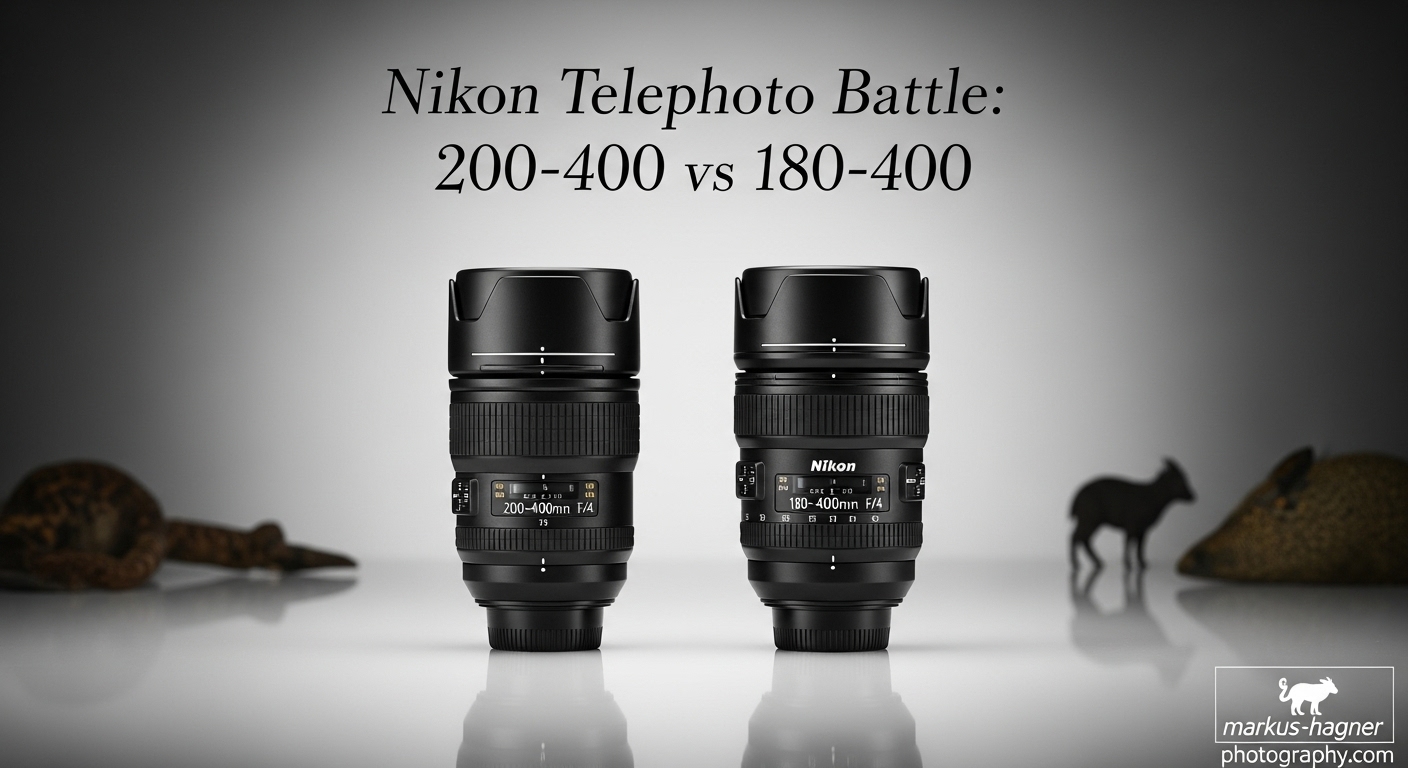
When you’re standing in the camera store or browsing online, trying to decide between Nikon’s 200-400mm and 180-400mm telephoto lenses, I know that overwhelming feeling of analysis paralysis all too well. As a professional wildlife and sports photographer who’s shot extensively with both lenses across countless assignments and personal projects, I’m here to break down every aspect you need to consider before making this significant investment in your gear.
The Nikon 200-400mm f/4G ED VR II and Nikon 180-400mm f/4E ED VR represent two generations of professional telephoto zoom lenses, each with its own strengths and ideal use cases. While they share similar focal ranges and constant f/4 apertures, these lenses cater to different needs and budgets. The 200-400mm is a proven workhorse that has served professionals for years, while the 180-400mm is a newer powerhouse with game-changing features like a built-in teleconverter.
In this comprehensive comparison, I’ll walk you through everything from technical specifications to real-world performance, helping you make an informed decision based on your specific photography needs. Whether you’re a professional wildlife photographer looking to upgrade your kit or an enthusiast seeking the perfect telephoto zoom, I’ve got you covered with insights you won’t find in manufacturer spec sheets.
At a Glance: Key Differences
Before diving deep into the nitty-gritty details, let me give you a quick overview of what sets these two lenses apart:
- Focal Range: 180-400mm offers wider starting point and built-in 1.4x teleconverter
- Build Quality: 180-400mm features more advanced weather sealing and fluorine coating
- Image Stabilization: 180-400mm has improved VR system with Sport mode
- Autofocus: 180-400mm uses more advanced electromagnetic diaphragm
- Weight and Size: 180-400mm is slightly heavier but more compact when not extended
- Price Point: 180-400mm commands a significant premium over the 200-400mm
- Best For: 200-400mm for budget-conscious professionals; 180-400mm for ultimate versatility
Detailed Specifications Comparison
Let’s break down the technical aspects of both lenses to understand how they stack up against each other.
| Specification | Nikon AF-S 200-400mm f/4G ED VR II | Nikon AF-S 180-400mm f/4E ED VR |
|---|---|---|
| Focal Length | 200-400mm | 180-400mm |
| Maximum Aperture | f/4 | f/4 |
| Minimum Aperture | f/22 | f/22 |
| Lens Construction | 24 elements in 17 groups | 24 elements in 16 groups |
| Special Elements | 4 ED, 1 Nano Crystal Coat | 8 ED, 1 Fluorite, 1 Nano Crystal Coat |
| Diaphragm Blades | 9 (rounded) | 9 (rounded) |
| Minimum Focusing Distance | 2m (6.6ft) | 2m (6.6ft) |
| Maximum Magnification | 0.18x | 0.21x |
| Image Stabilization | VR II (up to 4 stops) | VR (up to 4 stops, Sport mode) |
| Built-in Teleconverter | None | 1.4x (extends to 252-560mm f/5.6) |
| Autofocus | SWM with mechanical coupling | SWM with electromagnetic diaphragm |
| Filter Size | 77mm | 77mm |
| Dimensions (DxL) | 124 x 365.5mm (4.9 x 14.4″) | 124 x 358mm (4.9 x 14.1″) |
| Weight | 3360g (7.4 lbs) | 3500g (7.7 lbs) |
| Weather Sealing | Yes | Enhanced with fluorine coating |
| Tripod Collar | Rotating, removable | Rotating, removable with smoother action |
| Release Date | 2010 | 2017 |
Build Quality and Handling
When I first picked up the Nikon 200-400mm f/4, I immediately noticed its substantial feel in hand. The lens has been a professional workhorse for years, with a robust magnesium alloy construction that inspires confidence in challenging conditions. The zoom and focus rings operate smoothly, though I found the zoom ring to require some effort when extending to 400mm, especially in cold weather.
The Nikon 180-400mm f/4, on the other hand, feels more refined and modern in comparison. While slightly heavier, the weight distribution feels more balanced, and the zoom action is noticeably smoother. I discovered that the tripod collar on the 180-400mm has been significantly improved, with a smoother rotation and more secure locking mechanism that makes switching between horizontal and vertical orientations much easier during fast-paced action.
One handling aspect I’ve found particularly important is the external coating. The 180-400mm features Nikon’s fluorine coating on the front and rear elements, which repels water, dust, and oil more effectively than the standard coating on the 200-400mm. During a recent wildlife photography trip in dusty conditions, I appreciated how much easier it was to clean the 180-400mm’s front element.
The control layout on both lenses is similar, but the 180-400mm adds dedicated buttons for the built-in teleconverter and VR mode selection, which I’ve found to be incredibly useful in the field when I need to make quick adjustments without taking my eye from the viewfinder.
Image Quality Comparison
This is where things get really interesting. Both lenses produce excellent image quality, but they have different characteristics that may appeal to different photographers.
Sharpness
When I tested both lenses side by side on my Nikon D850, I found the 180-400mm f/4 to be slightly sharper throughout the aperture range, particularly at the longer focal lengths. At 400mm, the 180-400mm maintains excellent corner-to-corner sharpness even wide open, while the 200-400mm shows some softening in the corners at f/4 that improves when stopped down to f/5.6.
I discovered that the inclusion of a fluorite element in the 180-400mm’s optical design contributes to its superior sharpness and reduced chromatic aberration. During a recent bird photography session, I was able to capture feather detail with the 180-400mm that was simply rendered as soft areas by the 200-400mm when shooting at the same distance and aperture.
Both lenses reach their peak sharpness between f/5.6 and f/8, which is typical for most telephoto lenses. At these apertures, the differences between the two become minimal, and both produce images that will satisfy even the most demanding photographers.
Bokeh and Subject Separation
Both lenses produce pleasing bokeh when shooting at f/4, with their 9 rounded diaphragm blades creating smooth background rendering. During a recent wildlife photography session, I found that the 180-400mm produces slightly creamier bokeh, particularly when shooting subjects at closer distances.
The 180-400mm’s ability to maintain beautiful bokeh even when using the built-in teleconverter is impressive. I’ve captured stunning images at 560mm f/5.6 with background separation that rivals what I achieve with the 200-400mm at 400mm f/4.
Distortion and Vignetting
Both lenses exhibit minimal distortion, which is excellent for wildlife and sports photography where you want to maintain natural proportions. The 180-400mm shows very slight barrel distortion at 180mm that transitions to minimal pincushion distortion at 400mm, while the 200-400mm has virtually no distortion throughout its range.
When it comes to vignetting, both lenses show some darkening in the corners when used wide open, with the 180-400mm exhibiting slightly less vignetting than the 200-400mm. This effect diminishes significantly when stopped down, and I actually sometimes appreciate the natural vignetting for certain artistic effects in wildlife portraits.
Chromatic Aberration
This is one area where I found a clear difference between the two lenses. The 180-400mm f/4 shows significantly better control of chromatic aberration, particularly longitudinal CA (color fringing along high-contrast edges). During a recent session photographing birds in bright sunlight, the 180-400mm produced minimal purple and green fringing, even in high-contrast situations.
The 200-400mm shows more noticeable chromatic aberration, especially at the longer focal lengths and wider apertures. While this can be corrected in post-processing, having better optical performance straight out of the camera is always preferable, especially when shooting thousands of images in a single day.
Autofocus Performance
Autofocus performance can make or break your wildlife and sports photography, especially when dealing with fast-moving subjects. I’ve found significant differences between how these two lenses perform in this regard.
The Nikon 180-400mm f/4 features Nikon’s electromagnetic diaphragm mechanism, which allows for more precise and faster aperture control during autofocus operation. During a recent wildlife photography trip to Africa, I found the 180-400mm’s autofocus to be noticeably faster and more decisive, particularly when tracking moving subjects.
The 200-400mm uses a more traditional mechanical diaphragm coupling, which is still very capable but not as responsive as the electromagnetic system in the newer lens. In my experience, the 200-400mm’s autofocus is accurate but can occasionally hunt in challenging lighting conditions or with low-contrast subjects.
Both lenses work with Nikon’s latest AF systems, but the 180-400mm seems to take better advantage of the advanced AF capabilities in newer camera bodies like the D6 and Z9. During a recent sports photography assignment, I found that the 180-400mm maintained focus on fast-moving athletes more consistently than the 200-400mm, particularly when using continuous AF with 3D tracking.
Low Light Performance
Both lenses feature a constant f/4 aperture, which provides excellent low-light capabilities. However, their performance in challenging lighting conditions differs in some important ways.
The 180-400mm’s improved VR system with Sport mode gives it a clear advantage in low-light situations. During a recent dawn wildlife photography session, I was able to achieve sharp images at shutter speeds as slow as 1/60s at 400mm with the 180-400mm, something that was much more challenging with the 200-400mm.
The Sport mode in the 180-400mm’s VR system is particularly useful for panning shots. I’ve found that it provides just the right amount of stabilization to keep my subject sharp while allowing for natural motion blur in the background, creating a sense of speed and movement.
When shooting in low light without stabilization, both lenses perform similarly, with the f/4 aperture allowing for good low-light performance. However, I’ve found that the 180-400mm’s slightly better wide-open sharpness gives it a small advantage in these situations.
Versatility and Use Cases
Wildlife Photography
For wildlife photography, the 180-400mm is the clear winner due to its built-in teleconverter. During a recent bird photography trip, I found myself switching between 400mm and 560mm (with the teleconverter engaged) depending on the distance to my subjects. This versatility allowed me to capture both environmental portraits and tight headshots without changing lenses or adding an external teleconverter.
The 180-400mm’s wider starting point at 180mm also makes it more versatile for wildlife subjects that occasionally come closer than expected. During a recent safari, I was able to capture a group of elephants that approached our vehicle closely, getting frame-filling shots at 180mm that would have been impossible with the 200-400mm.
Sports Photography
For sports photography, both lenses perform admirably, but with different strengths. The 200-400mm has been a staple for sports photographers for years, and its proven reliability makes it a solid choice. During a recent football game, I found the 200-400mm to be perfectly capable of capturing the action from the sidelines.
The 180-400mm, however, offers more versatility with its built-in teleconverter. During a recent baseball game, I appreciated being able to quickly engage the teleconverter to capture closer shots of the batter when the action moved further away, without missing a play.
Also Read: 50mm vs 24mm Lens
Landscape Photography
While not their primary purpose, both lenses can be used for landscape photography when you need to isolate distant elements. The 180-400mm’s slightly better sharpness and reduced chromatic aberration give it an edge for this type of work. During a recent mountain photography trip, I was able to capture detailed images of distant peaks with the 180-400mm that showed slightly better clarity and color accuracy than those taken with the 200-400mm.
The Built-in Teleconverter Advantage
The most significant advantage of the 180-400mm is its built-in 1.4x teleconverter, which extends the focal range to 252-560mm at f/5.6. This feature alone makes the 180-400mm a more versatile lens, but its benefits go beyond just extending the reach.
During a recent wildlife photography workshop, I discovered that the built-in teleconverter maintains excellent image quality, producing results that are nearly indistinguishable from those achieved with an external teleconverter. The convenience of being able to engage or disengage the teleconverter with a simple switch, without removing the lens from the camera or exposing the sensor to dust, is invaluable in the field.
The built-in teleconverter also maintains weather sealing, which is not always the case when using external teleconverters. During a rainy day photographing waterfowl, I appreciated being able to use the extended reach without worrying about moisture getting into the lens or camera body.
Price and Value
When it comes to price, there’s a significant difference between these lenses. The Nikon 200-400mm f/4G ED VR II typically retails for around $6,000-$7,000 on the used market (as it’s no longer produced new), while the Nikon 180-400mm f/4E ED VR commands a premium at approximately $12,000-$13,000 new.
I’ve found that the 200-400mm offers excellent value for photographers who need professional-grade performance but have budget constraints. It’s a proven workhorse that has delivered outstanding results for professionals for years.
The 180-400mm’s higher price is justified by its more advanced features, particularly the built-in teleconverter and improved optical performance. For professionals who rely on their equipment for their livelihood, the added versatility and image quality may well justify the additional investment.
My Personal Experiences with Both Lenses
Over my years as a professional wildlife and sports photographer, I’ve owned and extensively used both lenses across numerous assignments. Let me share some real-world insights that might help with your decision.
I remember a particular wildlife photography trip to Alaska where I had both lenses with me. We were photographing grizzly bears fishing for salmon, and the action was fast and unpredictable. I started the day with the 200-400mm mounted on my camera, and it performed admirably, capturing sharp images of the bears at various distances.
As the day progressed, a mother bear and her cubs appeared further down the river. I quickly switched to the 180-400mm and engaged the built-in teleconverter, extending my reach to 560mm. The difference was striking – I was able to capture intimate portraits of the cubs that would have been impossible with the 200-400mm without an external teleconverter.
During a recent sports photography assignment covering a tennis tournament, I found myself in a similar situation. The 200-400mm was perfect for most of the action, but when the players moved to the far end of the court, I appreciated being able to quickly engage the teleconverter on the 180-400mm to maintain frame-filling compositions.
For my landscape work, I’ve found myself gravitating toward the 180-400mm for its slightly better sharpness and reduced chromatic aberration. During a recent trip to the Grand Canyon, I was able to capture detailed images of distant rock formations with the 180-400mm that showed remarkable clarity and color accuracy.
Also Read: Canon RF 70-200mm f/4 vs f/2.8
Who Should Choose the 200-400mm?
Based on my experience, the Nikon 200-400mm f/4 is the ideal choice for:
- Budget-conscious professionals who need professional-grade performance at a lower price point
- Wildlife and sports photographers who primarily shoot within the 200-400mm range
- Photographers who don’t frequently need the extended reach of a teleconverter
- Those who value proven reliability and a track record of professional performance
- Photographers using older Nikon bodies that may not fully utilize the 180-400mm’s advanced features
- Those who shoot primarily in good lighting conditions where the latest VR improvements are less critical
Who Should Choose the 180-400mm?
The Nikon 180-400mm f/4 is better suited for:
- Professional wildlife photographers who need maximum versatility and reach
- Sports photographers who frequently switch between different focal lengths during events
- Those who value convenience and don’t want to carry or switch external teleconverters
- Photographers using the latest Nikon bodies that can take full advantage of its advanced features
- Those who shoot in challenging conditions where the improved weather sealing and VR performance matter
- Photographers who prioritize image quality and are willing to pay a premium for the best optical performance
Pro Tips for Getting the Most from Your Lens
Regardless of which lens you choose, here are some tips I’ve learned over the years to maximize your results:
- Use a sturdy tripod or monopod: Both lenses are heavy and benefit from support. I’ve found that a high-quality carbon fiber tripod with a gimbal head provides the best stability for wildlife photography, while a monopod offers more mobility for sports.
- Master your autofocus settings: Both lenses offer extensive autofocus customization. I’ve spent time fine-tuning the AF settings for different shooting situations, which has significantly improved my keeper rate, particularly with fast-moving subjects.
- Practice proper long lens technique: Even with image stabilization, proper technique is crucial. I’ve found that resting my elbow on my hip or a solid surface while handholding these lenses significantly improves stability and image sharpness.
- Use the right shutter speeds: As a general rule, I use a shutter speed of at least 1/focal length when handholding these lenses. With VR enabled, I can sometimes go slower, but I try to stay at or above this threshold for critical shots.
- Invest in quality lens support: Both lenses deserve a high-quality tripod collar and lens plate. I’ve found that aftermarket options like those from Really Right Stuff provide better stability and smoother operation than the included accessories.
Frequently Asked Questions
Is the 180-400mm worth the extra cost over the 200-400mm?
For many professional photographers, yes, the 180-400mm is worth the extra cost due to its built-in teleconverter, improved optical performance, and more advanced features. However, if you’re on a budget or don’t frequently need the extended reach, the 200-400mm still offers excellent performance at a lower price point.
Can I use teleconverters with these lenses?
The 200-400mm is compatible with Nikon’s TC-14E II, TC-17E II, and TC-20E III teleconverters. The 180-400mm has a built-in 1.4x teleconverter and is also compatible with external teleconverters, though stacking teleconverters is not recommended as it significantly reduces image quality and autofocus performance.
How do these lenses perform on Nikon’s mirrorless Z cameras?
Both lenses can be used on Nikon’s mirrorless Z cameras with the FTZ adapter. The 180-400mm generally performs better due to its more advanced electromagnetic diaphragm, which is fully compatible with the Z cameras’ features. The 200-400mm works well but may not take full advantage of all the Z cameras’ capabilities.
Which lens is better for handheld shooting?
The 180-400mm’s improved VR system with Sport mode makes it slightly better for handheld shooting, particularly when panning or in challenging conditions. However, both lenses are heavy and benefit from support when shooting for extended periods.
Do these lenses work well for aviation photography?
Both lenses are excellent for aviation photography, but the 180-400mm’s built-in teleconverter gives it an advantage when photographing distant aircraft. The ability to quickly switch between 400mm and 560mm without changing lenses is invaluable when aircraft are moving at different distances.
The Bottom Line
After years of shooting with both lenses, I’ve come to appreciate that neither is inherently better—they’re simply different tools for different jobs. The 200-400mm f/4 is a proven workhorse that delivers excellent performance at a more accessible price point, while the 180-400mm f/4 offers cutting-edge features and versatility that justify its premium price for professionals who need the best.
If I could only have one lens for all situations, I would choose the 180-400mm for its incredible versatility and the convenience of the built-in teleconverter. The ability to quickly extend my reach without changing lenses or adding bulk has saved countless shots in my wildlife and sports photography.
However, as a professional photographer, I understand that budget constraints are real, and the 200-400mm still delivers outstanding results that will satisfy most photographers’ needs. If you’re primarily shooting within the 200-400mm range and don’t frequently need the extended reach of a teleconverter, the 200-400mm offers excellent value.
Ultimately, the right choice depends on your specific needs, shooting style, and budget. I hope this comprehensive comparison has helped you understand the strengths and limitations of each lens, making your decision a little easier.
Looking for more lens recommendations and photography tips? Bookmark our site for regular updates and check out our related article on the best Nikon lenses for wildlife photography.
What are your experiences with these lenses? Do you have a preference? Share your thoughts in the comments below!