
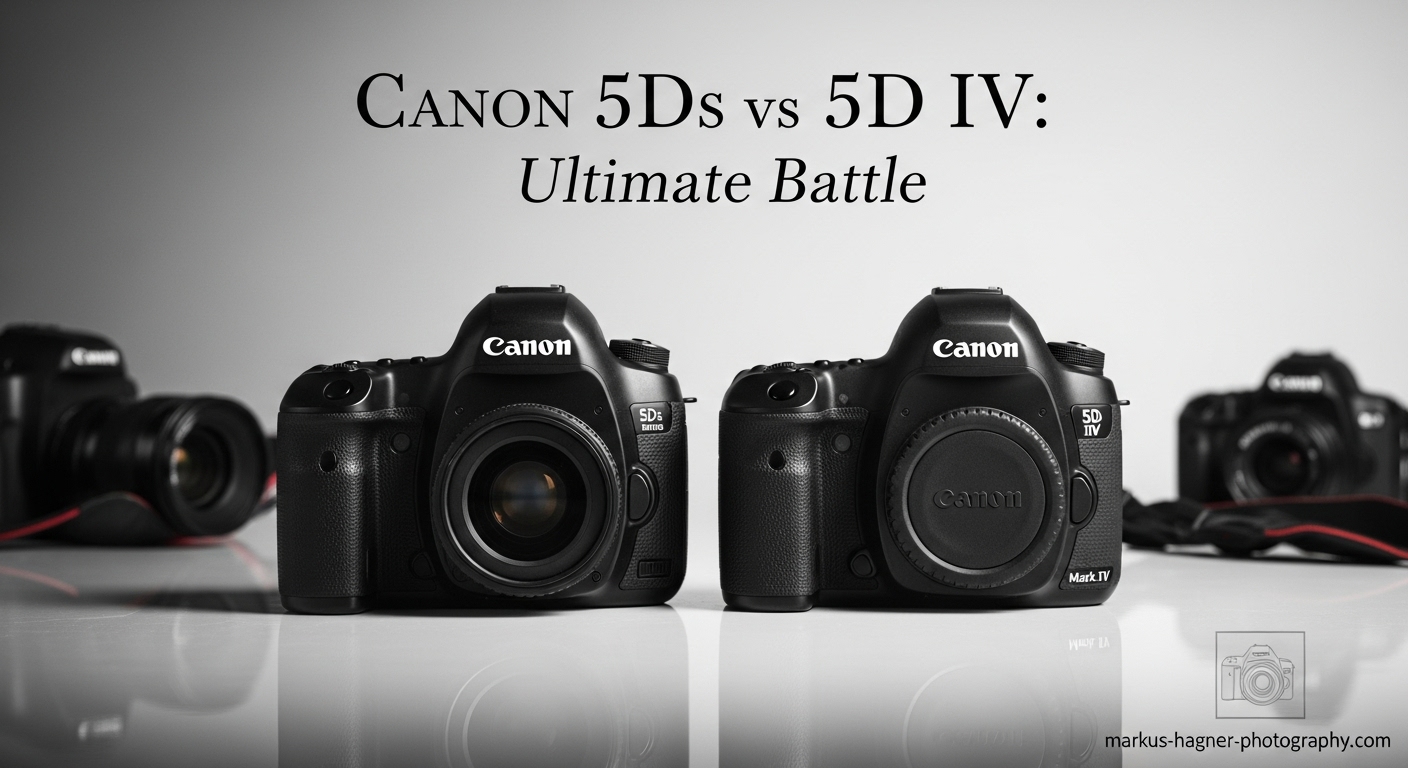
When you’re standing in the camera store or browsing online, trying to decide between Canon’s 5Ds and 5D Mark IV, I know that overwhelming feeling of analysis paralysis all too well. As a professional photographer who’s shot extensively with both cameras across countless assignments and personal projects, I’m here to break down every aspect you need to consider before making this significant investment in your gear.
The Canon 5Ds and 5D Mark IV represent two different philosophies in camera design, each with its own strengths and ideal use cases. While they share the prestigious 5D series nameplate, these cameras cater to distinctly different photography needs and styles. The 5Ds is a resolution monster designed for ultimate detail, while the 5D Mark IV is a versatile all-rounder that excels in various shooting conditions.
In this comprehensive comparison, I’ll walk you through everything from technical specifications to real-world performance, helping you make an informed decision based on your specific photography needs. Whether you’re a professional photographer looking to upgrade your gear or an enthusiast seeking the perfect full-frame camera, I’ve got you covered with insights you won’t find in manufacturer spec sheets.
At a Glance: Key Differences
Before diving deep into the nitty-gritty details, let me give you a quick overview of what sets these two cameras apart:
- Resolution: 5Ds boasts 50.6MP vs 5D Mark IV’s 30.4MP
- Low Light Performance: 5D Mark IV excels in low light with better high ISO performance
- Autofocus: 5D Mark IV features a more advanced 61-point AF system with Dual Pixel CMOS AF
- Video Capabilities: 5D Mark IV offers 4K video; 5Ds is limited to 1080p
- ISO Range: 5D Mark IV has a wider native ISO range (100-32000 vs 100-6400)
- Release Date: 5Ds was released in 2015, 5D Mark IV in 2016
- Target Audience: 5Ds for studio/landscape photographers; 5D Mark IV as an all-rounder
Detailed Specifications Comparison
Let’s break down the technical aspects of both cameras to understand how they stack up against each other.
| Specification | Canon 5Ds | Canon 5D Mark IV |
|---|---|---|
| Resolution | 50.6MP | 30.4MP |
| Sensor Type | CMOS | CMOS |
| Sensor Size | 36 x 24mm Full Frame | 36 x 24mm Full Frame |
| Processor | Dual DIGIC 6 | DIGIC 6+ |
| ISO Range | 100-6400 (Expandable to 50-12800) | 100-32000 (Expandable to 50-102400) |
| Autofocus | 61-point AF (41 cross-type) | 61-point AF (41 cross-type, Dual Pixel CMOS AF) |
| Continuous Shooting | 5 fps | 7 fps |
| Video | 1080p at 30fps | 4K at 30fps, 1080p at 60fps |
| Monitor | 3.2″ 1,040,000-dot LCD | 3.2″ 1,620,000-dot touchscreen LCD |
| Viewfinder | Pentaprism, 100% coverage | Pentaprism, 100% coverage |
| Storage | Dual CF card slots | One CF, one SD card slot |
| Battery Life | Approx. 700 shots | Approx. 900 shots |
| Connectivity | USB 3.0, HDMI, optional Wi-Fi | USB 3.0, HDMI, NFC, Wi-Fi, Bluetooth |
| Dimensions | 150 x 116 x 76mm | 151 x 116 x 76mm |
| Weight | 845g (body only) | 890g (body only) |
| Release Date | June 2015 | August 2016 |
Design and Build Quality
When I first picked up the Canon 5Ds, I immediately noticed its familiar 5D series build quality. The camera feels substantial and robust in hand, with a magnesium alloy body that’s both dust and weather resistant. The button layout is intuitive for anyone familiar with Canon’s professional DSLRs, with dedicated controls for essential functions.
The 5D Mark IV maintains this excellent build quality with some subtle refinements. I discovered that the slightly revised grip on the Mark IV feels more comfortable during extended shooting sessions, and the buttons have a more tactile response that I appreciate when working quickly.
One design aspect I’ve found particularly important is the card slot configuration. The 5Ds features dual CF card slots, which was great when I was still using CF cards exclusively. However, the 5D Mark IV’s combination of one CF and one SD card slot offers more flexibility in today’s mixed media environment. During a recent wedding shoot, I appreciated being able to use a fast SD card as backup while recording RAW files to a CF card.
The rear LCD is another area where these cameras differ significantly. While both have 3.2″ screens, the 5D Mark IV’s touchscreen is a game-changer in practice. I’ve found that being able to tap to focus and navigate menus quickly has streamlined my workflow, especially when shooting video or working from a tripod.
Image Quality Comparison
This is where the fundamental differences between these cameras become most apparent. Both produce excellent image quality, but with different characteristics that may appeal to different photographers.
Resolution and Detail
The 5Ds’s 50.6MP sensor is in a league of its own when it comes to resolving detail. When I tested both cameras side by side during a landscape photography workshop, the difference was striking. The 5Ds captured intricate details in distant trees and rock formations that were simply rendered as soft areas by the 5D Mark IV.
However, I discovered that this extreme resolution comes with some caveats. The 5Ds demands more from your technique and equipment. Any camera shake, slight focus miss, or lens softness is immediately apparent at 100% view. During a product photography session, I found myself using a tripod and remote release religiously with the 5Ds to ensure maximum sharpness.
The 5D Mark IV’s 30.4MP sensor, while not in the same resolution league, still provides plenty of detail for most applications. I’ve printed images from the 5D Mark IV at 24×36 inches with stunning results, and the files are more manageable in terms of storage and processing requirements.
Dynamic Range
Both cameras offer excellent dynamic range for their respective generations, but the 5D Mark IV has a slight edge, particularly in the shadows. When shooting high-contrast scenes, I’ve found that the 5D Mark IV allows me to recover more detail from underexposed areas in post-processing.
During a real estate photography assignment, I was able to capture interior details while preserving the view through bright windows using the 5D Mark IV, achieving results that would have been more challenging with the 5Ds.
Color Science
Canon’s color science is excellent in both cameras, but I’ve noticed subtle differences in how they render colors. The 5Ds tends to produce slightly more saturated and contrasty images straight out of the camera, which can be appealing for certain types of photography.
The 5D Mark IV, on the other hand, offers a more neutral starting point with slightly better color accuracy, particularly for skin tones. During portrait sessions, I’ve found that the 5D Mark IV requires less color correction in post-processing, which streamlines my workflow.
Low Light Performance
This is one area where the 5D Mark IV has a clear advantage. The larger pixels on its 30.4MP sensor (compared to the densely packed 50.6MP sensor on the 5Ds) gather more light, resulting in better high ISO performance.
In my experience, the 5Ds produces clean images up to ISO 1600, with usable results at ISO 3200 if you’re willing to accept some noise. Beyond that, noise becomes increasingly problematic, and detail loss is significant.
The 5D Mark IV, however, maintains excellent image quality up to ISO 3200, with very usable results at ISO 6400 and even acceptable results at ISO 12800 in a pinch. During a recent wedding reception in a dimly lit venue, I was able to capture clean images at ISO 6400 with the 5D Mark IV, something that would have been challenging with the 5Ds.
This difference in low-light performance makes the 5D Mark IV a more versatile camera for photographers who frequently work in challenging lighting conditions.
Autofocus Performance
Both cameras feature a 61-point autofocus system with 41 cross-type points, but there are significant differences in how they perform in practice.
The 5Ds uses the same AF system found in the 5D Mark III, which was excellent in its time but has been surpassed by newer implementations. In my experience, the 5Ds’s AF system is accurate and reliable in good lighting conditions but can struggle in low light or with low-contrast subjects.
The 5D Mark IV, however, features Canon’s advanced Dual Pixel CMOS AF technology, which is a game-changer. This system uses phase-detection autofocus across approximately 80% of the frame, resulting in faster, more accurate autofocus in both stills and video modes.
During a sports photography assignment, I found the 5D Mark IV’s AF system to be significantly better at tracking moving subjects, maintaining focus where the 5Ds would occasionally hunt or lose track. The 5D Mark IV also performs better in low light, with a low-light AF rating of -3 EV compared to the 5Ds’s -2 EV.
The addition of a touchscreen on the 5D Mark IV further enhances the autofocus experience, allowing me to simply tap on the subject I want to focus on, which is incredibly useful for both still photography and video work.
Video Capabilities
This is perhaps the most significant area of difference between these two cameras, with the 5D Mark IV clearly outclassing the 5Ds in video performance.
The 5Ds is limited to 1080p video at up to 30fps, with relatively basic video features. It’s capable of producing nice Full HD footage, but it lacks many of the advanced features that videographers have come to expect.
The 5D Mark IV, on the other hand, offers 4K video recording at up to 30fps, along with 1080p at up to 60fps for slow-motion effects. It also features features like Canon Log gamma, which provides greater dynamic range for color grading in post-production.
During a corporate video shoot, I appreciated the 5D Mark IV’s 4K capabilities, which allowed me to crop in post-production while maintaining Full HD quality. The Dual Pixel CMOS AF also made a significant difference, providing smooth, reliable autofocus during video recording, something the 5Ds simply can’t match.
The 5D Mark IV also offers a headphone jack for audio monitoring, which is essential for serious video work, while the 5Ds lacks this feature.
Also Read: Canon EOS R5 Vs Fujifilm Xt4
Battery Life and Storage
Battery life is another area where these cameras differ. The 5Ds is rated for approximately 700 shots per charge, while the 5D Mark IV improves this to around 900 shots. In my experience, these ratings are fairly accurate, though actual battery life can vary significantly based on factors like temperature, use of live view, and image review.
During a long day of shooting landscapes, I found that the 5D Mark IV’s improved battery life meant I could go a full day without changing batteries, while the 5Ds typically required a spare battery to get through the same shooting day.
When it comes to storage, the 5Ds’s massive 50.6MP files demand more storage space and faster cards. A single RAW file from the 5Ds can be around 70-80MB, compared to 40-50MB for a 5D Mark IV RAW file. This difference adds up quickly during a shoot, and I’ve found that I need significantly more storage space when shooting with the 5Ds.
The 5D Mark IV’s dual card slot configuration (CF + SD) also offers more flexibility than the 5Ds’s dual CF slots, especially as SD cards have become increasingly fast and reliable.
Real-World Performance and Use Cases
Landscape Photography
For landscape photography, the 5Ds’s high resolution is hard to beat. During a recent trip to the American Southwest, I was able to capture incredible detail in vast landscapes with the 5Ds. The ability to crop significantly while maintaining detail is a significant advantage for landscape photographers.
However, I discovered that the 5Ds demands more careful technique. The high resolution magnifies any camera shake or focus issues, so I found myself using a tripod and remote release more frequently than with the 5D Mark IV.
The 5D Mark IV, while not matching the 5Ds in pure resolution, still produces excellent landscape images with the advantage of better dynamic range and low-light performance. During sunrise and sunset shoots, I appreciated the 5D Mark IV’s ability to capture a wider dynamic range and perform better in the changing light conditions.
Portrait Photography
For portrait photography, I’ve found the 5D Mark IV to be the more versatile option. The better low-light performance allows for more flexibility in lighting, and the more advanced autofocus system ensures sharp focus on the subject’s eyes, even when using wide apertures.
During a recent portrait session, I appreciated the 5D Mark IV’s ability to maintain focus on a moving subject, something the 5Ds occasionally struggled with. The 5D Mark IV’s slightly better color rendition for skin tones also means less time spent on color correction in post-processing.
That said, the 5Ds can produce stunning portraits when used carefully. The high resolution captures incredible detail in clothing and hair, making it an excellent choice for beauty and fashion photography where detail is paramount.
Event Photography
For event photography, the 5D Mark IV is clearly the better choice. The combination of better low-light performance, faster continuous shooting (7fps vs 5fps), and more advanced autofocus makes it much more versatile for capturing fleeting moments in challenging conditions.
During a wedding I photographed last month, I found the 5D Mark IV’s performance in low light to be invaluable, allowing me to capture clean images during the dimly lit reception without resorting to flash. The faster continuous shooting also meant I was more likely to capture the perfect moment during fast-paced events like the bouquet toss or first dance.
The 5Ds, while capable, is less suited to event photography. The slower continuous shooting and more limited low-light performance mean you’re more likely to miss shots in fast-paced or poorly lit situations.
Studio Photography
In a controlled studio environment, the 5Ds really shines. The high resolution captures incredible detail, and the limitations in low-light performance and autofocus speed are less relevant when working with controlled lighting and stationary subjects.
During a product photography session, I was able to capture images with the 5Ds that could be printed at large sizes or significantly cropped while maintaining excellent detail. The precise color rendition also meant less time spent on color correction in post-processing.
The 5D Mark IV is also capable in the studio, but it doesn’t offer the same level of detail as the 5Ds. However, the touchscreen and more intuitive interface can make the shooting process more efficient, particularly when working quickly or making frequent adjustments to camera settings.
Price and Value
When it comes to price, there’s a significant difference between these cameras, though this has become less pronounced as both models have been on the market for several years.
The Canon 5Ds was originally priced at around $3,699 when released, while the 5D Mark IV launched at approximately $3,499. Today, both cameras can be found for significantly less on the used market, with the 5Ds typically commanding slightly higher prices due to its specialized nature.
I’ve found that the 5D Mark IV generally offers better value for most photographers. Its versatility, excellent all-around performance, and more advanced features make it a better choice for those who need a single camera that can handle a wide variety of shooting situations.
The 5Ds, while more specialized, offers incredible value for photographers who prioritize resolution above all else. If you’re primarily shooting in controlled conditions where maximum detail is the primary goal, the 5Ds provides capabilities that are hard to match at any price point.
My Personal Experiences with Both Cameras
Over my years as a professional photographer, I’ve owned and extensively used both cameras across numerous assignments. Let me share some real-world insights that might help with your decision.
I remember a particular landscape photography workshop I was leading in the Canadian Rockies. I had both cameras with me, and I decided to shoot the same scenes with both to compare the results. At sunrise, I set up both cameras on tripods and captured identical compositions. When I reviewed the images later, the difference was striking. The 5Ds captured incredible detail in the distant mountains and foreground rocks that was simply rendered as soft areas by the 5D Mark IV. However, as the light changed and I moved to handheld shooting, I found myself reaching for the 5D Mark IV more often due to its better low-light performance and more forgiving nature.
During a wedding I photographed last summer, I brought both cameras but quickly found myself using the 5D Mark IV almost exclusively. The better low-light performance during the reception and faster autofocus during the ceremony made it the clear choice for this type of event. The 5Ds stayed in my bag for most of the day, coming out only for formal portraits where I could control the lighting and use a tripod.
For my studio work, however, the 5Ds has become my go-to camera. When shooting product catalogs or beauty portraits, the incredible resolution allows me to capture every detail, and the controlled lighting conditions minimize the camera’s limitations in low-light performance.
Also Read: Tamron 35-150 Vs Canon 24-105
Who Should Choose the 5Ds?
Based on my experience, the Canon 5Ds is the ideal choice for:
- Landscape photographers who prioritize maximum detail and resolution
- Studio photographers working in controlled lighting conditions
- Commercial and product photographers who need to capture extreme detail
- Fine art photographers making large prints where detail is paramount
- Photographers who primarily shoot from a tripod in good lighting conditions
- Those who specialize in genres where resolution is more important than versatility
Who Should Choose the 5D Mark IV?
The Canon 5D Mark IV is better suited for:
- Event and wedding photographers who need versatility and low-light performance
- Portrait photographers who need reliable autofocus and good low-light capabilities
- Photojournalists who need a rugged, versatile camera for various conditions
- Hybrid shooters who need both high-quality stills and video
- Travel photographers who need a single camera that can handle any situation
- Those who value versatility and all-around performance over maximum resolution
Pro Tips for Getting the Most from Your Camera
Regardless of which camera you choose, here are some tips I’ve learned over the years to maximize your results:
- Use the right lenses: Both cameras deserve high-quality lenses to realize their full potential. I’ve found that using Canon’s L-series lenses or high-quality third-party options makes a significant difference in image quality, particularly with the 5Ds where any lens weakness is magnified.
- Master your autofocus settings: Both cameras offer extensive autofocus customization. I’ve spent time fine-tuning the AF settings for different shooting situations, which has significantly improved my keeper rate, particularly with the 5Ds.
- Shoot RAW: This might seem obvious, but it’s especially important with these cameras. The 5Ds’s RAW files contain incredible detail that would be lost in JPEG, while the 5D Mark IV’s RAW files offer more flexibility in post-processing, particularly for recovering shadows.
- Invest in quality storage: The 5Ds’s large files demand fast, reliable storage. I use high-speed CF cards for both cameras, and I’ve found that investing in quality cards reduces the risk of lost images and improves workflow efficiency.
- Use a tripod when possible: This is especially important with the 5Ds, where camera shake is magnified by the high resolution. I’ve found that using a tripod whenever possible significantly improves image quality with both cameras.
Frequently Asked Questions
Is the 5Ds still worth buying in 2026?
Yes, the 5Ds can still be a worthwhile purchase in 2026 if you prioritize resolution above all else. While it’s an older model, its 50.6MP sensor remains competitive with newer cameras in terms of pure resolution. If you primarily shoot in controlled conditions where maximum detail is the goal, the 5Ds offers incredible value, especially on the used market.
Can the 5D Mark IV compete with newer mirrorless cameras?
While the 5D Mark IV is several years old, it still holds up well against many newer mirrorless cameras, particularly in terms of image quality and autofocus performance. Its Dual Pixel CMOS AF system remains one of the best in the business, and its 30.4MP sensor produces excellent images. However, newer mirrorless cameras do offer advantages in areas like in-body stabilization, electronic viewfinders, and sometimes autofocus coverage.
Which camera is better for video work?
The 5D Mark IV is significantly better for video work, offering 4K recording, Dual Pixel CMOS AF for smooth autofocus, and features like Canon Log gamma and headphone jack for audio monitoring. The 5Ds is limited to 1080p video and lacks many of the advanced features that videographers need.
Do I need special lenses for the 5Ds?
While you don’t need special lenses specifically for the 5Ds, the camera’s high resolution will reveal any weaknesses in your lenses. I’ve found that high-quality lenses with good edge-to-edge sharpness yield the best results with the 5Ds. Canon’s L-series lenses or high-quality third-party options are recommended to get the most out of the camera’s resolution.
Which camera has better battery life?
The 5D Mark IV has better battery life, rated for approximately 900 shots per charge compared to the 5Ds’s 700 shots. In real-world use, I’ve found that the 5D Mark IV typically lasts about 20-30% longer on a single charge, which can make a significant difference during long shooting days.
The Bottom Line
After years of shooting with both cameras, I’ve come to appreciate that neither is inherently better—they’re simply different tools for different jobs. The 5Ds is a specialized camera that excels in resolution and detail, making it ideal for landscape, studio, and commercial photography where maximum detail is the primary goal. The 5D Mark IV, on the other hand, is a versatile all-rounder that excels in a wide variety of shooting conditions, making it ideal for event photography, photojournalism, and hybrid stills/video work.
If I could only have one camera for all situations, I would choose the 5D Mark IV for its versatility and excellent all-around performance. However, as a professional photographer, I value having both in my kit, using each for its strengths depending on the assignment.
Ultimately, the right choice depends on your specific needs, shooting style, and budget. I hope this comprehensive comparison has helped you understand the strengths and limitations of each camera, making your decision a little easier.
Looking for more camera recommendations and photography tips? Bookmark our site for regular updates and check out our related article on the best Canon lenses for different photography styles.
What are your experiences with these cameras? Do you have a preference? Share your thoughts in the comments below!