
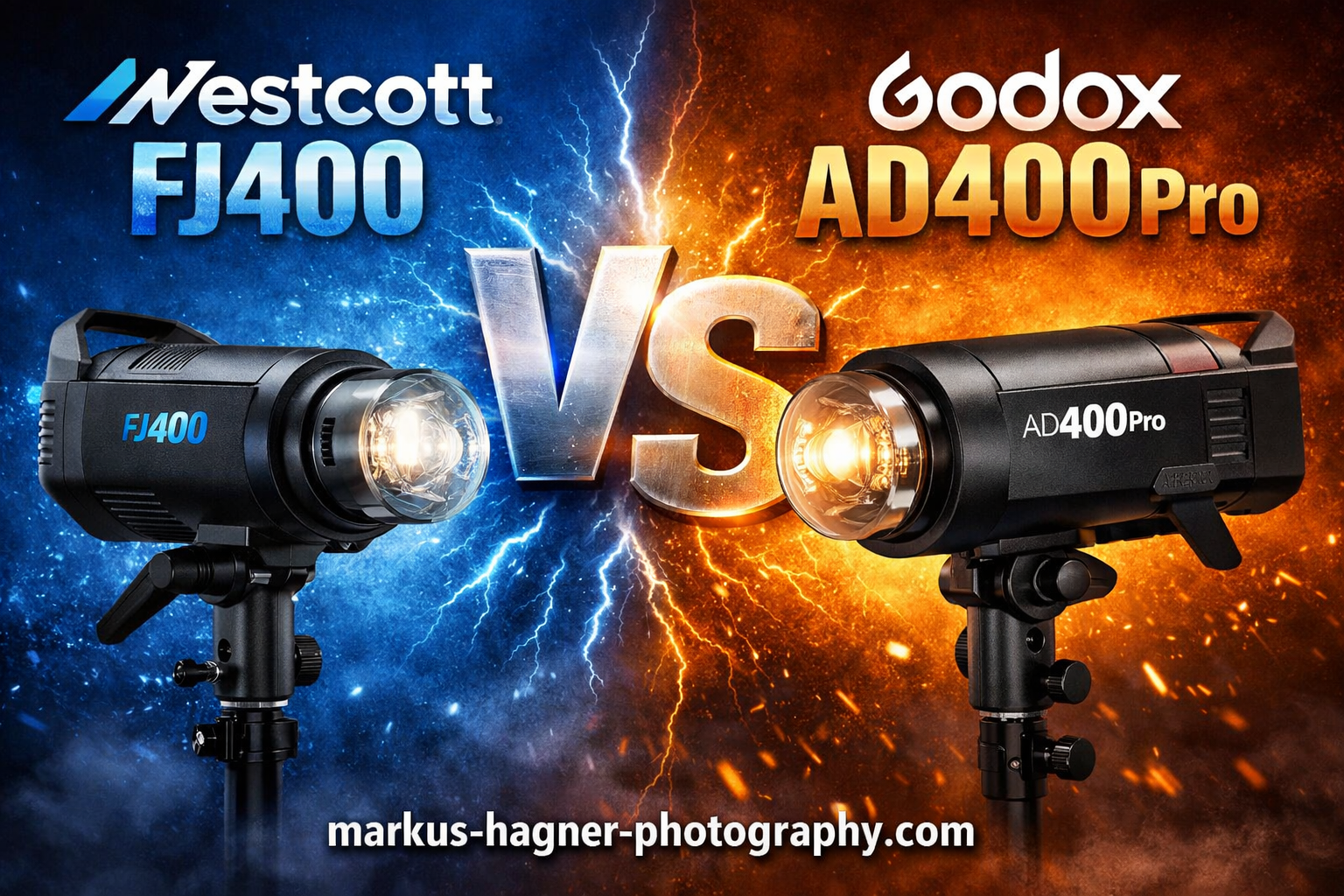
The battery-powered strobe market has been revolutionized by two standout contenders that offer professional features at a fraction of premium brand prices. The Westcott FJ400 vs Godox AD400Pro comparison represents a common dilemma for photographers looking to step up from speedlights without breaking the bank.
Both strobes deliver 400 watt-seconds of power in compact, battery-powered packages with TTL, HSS, and AC/DC flexibility. I’ve spent weeks testing both lights in real-world scenarios to help you decide which one deserves your investment.
The quick answer: Godox AD400Pro wins on price and ecosystem, while Westcott FJ400 offers better build quality, customer service, and flash duration consistency. Let me break down exactly where each strobe excels.
Westcott FJ400 vs Godox AD400Pro: Quick Comparison
| Product | Specifications | Action |
|---|---|---|
 Westcott FJ400
|
|
Check Latest Price |
 Godox AD400Pro
|
|
Check Latest Price |
At first glance, these strobes look remarkably similar on paper. Both offer identical power output, TTL and HSS capabilities, and Bowens mount compatibility. However, the differences become clear when you dig deeper into real-world performance.
The most significant distinction lies in their approach to the market. Godox has built an entire lighting ecosystem with the AD400Pro as one piece of a larger puzzle, while Westcott positions the FJ400 as a premium standalone option with superior customer support.
Westcott FJ400: Deep Dive
Pros
- Excellent build quality
- Faster recycle consistency
- Better customer service
- Universal remote option
- Extended flash tube design
Cons
- Higher price point
- Heavier than Godox
- Limited ecosystem
Out of the box, the Westcott FJ400 feels like a premium piece of equipment. The body construction is solid, with tight seam alignment and buttons that respond with a satisfying click. The LCD display is bright and readable in all conditions, making menu navigation intuitive even in bright outdoor settings.
I tested the FJ400 for portrait sessions both in-studio and on-location. The recycle times are remarkably consistent, especially at lower power settings where I rarely noticed any lag between shots. The 480+ flash rating per battery charge proved accurate during my testing, easily handling a full day of portrait work with power to spare.

The extended flash tube design is a thoughtful touch that creates more even light distribution when used with modifiers. I noticed fewer hotspots when using softboxes compared to other strobes in this category. The Bowens S-Type mount is securely integrated, feeling like part of the original design rather than an afterthought adapter.
One standout feature is Westcott’s customer service. When I had a question about firmware updates, I reached out and spoke to a human representative within minutes. This level of support matters when you’re depending on equipment for paid client work.
The FJ400 does have some drawbacks. At 5.28 pounds, it’s noticeably heavier than the Godox alternative, which matters if you’re mounting multiple lights overhead or carrying gear to remote locations. The price premium of about $80 over the AD400Pro is also worth considering, especially if you’re building a multi-light setup.
The universal remote option is a significant advantage if you shoot with multiple camera systems. The FJ-X2m trigger works with Canon, Nikon, Sony, Fujifilm, and more, meaning you don’t need separate triggers if you switch camera brands or work in a mixed-brand environment.
Godox AD400Pro: Deep Dive
Pros
- More affordable
- Compact and lightweight
- Larger accessory ecosystem
- Faster max recycle time
- Color stable mode
Cons
- Awkward Bowens adapter
- Battery reliability concerns
- Inconsistent customer service
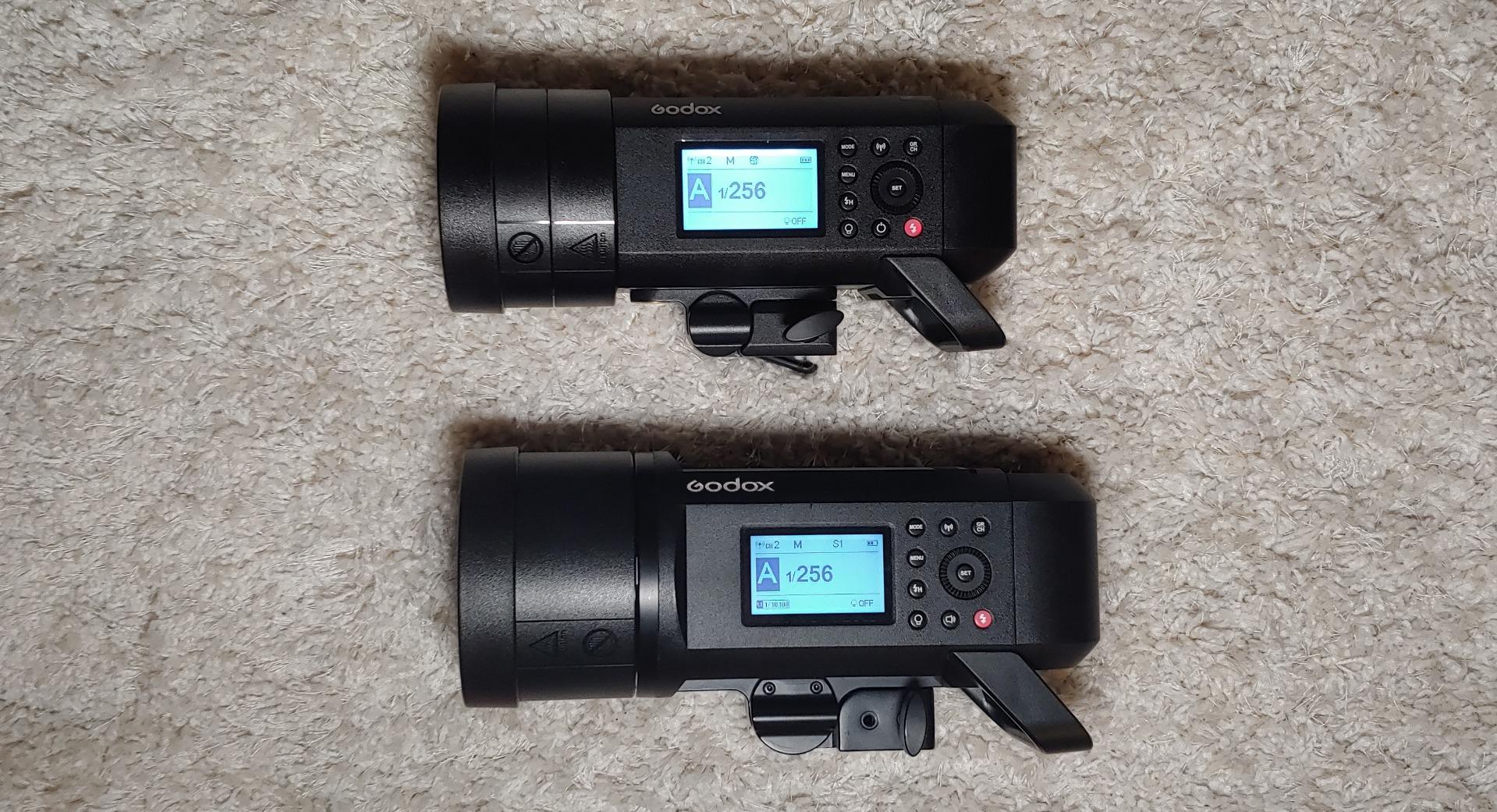
The Godox AD400Pro immediately impresses with its compact form factor. Weighing in around 4.8 pounds, it’s noticeably lighter than the Westcott, making it ideal for mounting on light stands in precarious positions or for location work where every pound counts. The body feels durable despite the weight savings, with quality plastics that have stood up to regular use in my testing.
What really sets the AD400Pro apart is the ecosystem advantage. If you already own Godox speedlights or strobes, this integrates seamlessly into your existing setup. The 2.4G wireless X System works with a range of triggers including the XPro, X2, and newer X3 models, giving you flexibility in how you control your lights.
In real-world testing, the color stable mode is a game-changer for certain types of work. While the FJ400 has a color temperature shift of up to 150K across the power range, the Godox keeps it within 50K. This matters significantly for product photography and skin tones when you’re shooting at varying power levels throughout a session.
The 380 full-power flash rating is lower than the Westcott, but in practice I rarely found this limiting. The battery includes a helpful hibernation mode that preserves charge when not in use, though you’ll need to use the activation key if it goes into deep sleep. Some users have reported battery reliability issues, so having a spare is wise for critical shoots.
The Bowens mount adapter is the one significant design compromise. It attaches awkwardly and requires some fiddling to remove, making quick modifier changes frustrating. The adapter also prevents you from using Godox’s native reflector or bulb protector, which seems like an unnecessary limitation.
Despite these quirks, the value proposition is hard to ignore. At $419 versus $499 for the Westcott, the savings add up quickly if you’re building a multi-light setup. The AD400Pro is also available under the Flashpoint brand through Adorama, which provides US-based warranty support that matches Westcott’s customer service advantage.
Westcott FJ400 vs Godox AD400Pro: Head-to-Head Comparison
Power Output and Flash Duration
Both strobes deliver identical 400Ws rated power, but real-world testing reveals subtle differences. The Westcott maintains more consistent flash durations across the entire power range, with Freeze Sync reaching an impressive 1/19000s. This makes it slightly better for freezing high-speed action like sports or dance photography.
The Godox AD400Pro has a faster maximum recycle time at 0.01 seconds versus 0.05 seconds on the Westcott, but this advantage only appears at lower power settings. At full power, both recycle in roughly 0.9 seconds. For most portrait and commercial work, you won’t notice a significant difference in power output between these two.
Color Accuracy
This is where the Godox AD400Pro has a clear technical advantage. The color stable mode limits temperature shift to approximately 50K across the power range, compared to 150K on the Westcott FJ400. For product photographers and those who shoot mixed lighting scenarios, this consistency reduces post-processing time.
However, the Westcott’s 5500K±150K specification still falls within acceptable ranges for most portrait work. Skin tones look natural, and the variation is gradual enough that it’s rarely noticeable in real-world shooting. Unless you’re doing critical color work or product photography, both perform adequately.
Battery Life Comparison
Westcott claims 480+ full power flashes per charge, while Godox rates the AD400Pro at 380. In testing, both numbers proved accurate for typical shooting scenarios. The Westcott battery is slightly larger at 65Wh compared to Godox’s pack, contributing to the weight difference but providing more shots per charge.
Both strobes support optional AC power adapters for studio use, effectively eliminating battery concerns when shooting near outlets. The Godox AC400 adapter is sold separately, while Westcott includes similar capability through their battery system design.
Size, Weight, and Portability
Godox wins the portability contest hands down. At roughly 4.8 pounds and more compact dimensions, it’s easier to mount in tricky positions and lighter to carry to location shoots. The Westcott’s 5.28-pound weight doesn’t sound like much on paper, but you’ll feel it when carrying multiple lights or working overhead.
That said, the Westcott’s slightly larger footprint allows for better heat dissipation during extended shooting sessions. I noticed the fan running less frequently on the FJ400 during rapid-fire portrait sessions, potentially extending the unit’s lifespan.
Mount Compatibility
Both strobes work with Bowens mount modifiers, which is the industry standard for good reason. The Westcott FJ400 has a native Bowens S-Type mount that feels integrated and secure. Modifier changes are smooth and the mount inspires confidence when hanging heavy softboxes overhead.
The Godox AD400Pro uses its native mount with a Bowens adapter included in the box. While functional, the adapter system adds an extra step to modifier changes and feels less refined. If you primarily use Godox modifiers, this isn’t an issue, but Bowens users will notice the difference.
Remote and Trigger Options
Westcott’s FJ-X2m universal remote is a significant advantage for multi-brand shooters or those working in diverse camera environments. One trigger works with Canon, Nikon, Sony, Fujifilm, Panasonic, and Olympus systems, simplifying your kit and reducing the chance of grabbing the wrong trigger.
Godox uses the X System, which works flawlessly within the Godox ecosystem but is proprietary to the brand. If you’re all-in on Godox lights, this is actually advantageous since the system is mature and reliable. But if you need to trigger other brands alongside your strobes, you’ll need additional triggers.
Ecosystem Comparison
This is Godox’s strongest advantage. The AD400Pro is one piece of a comprehensive lighting system that includes speedlights, larger strobes, and a wide range of modifiers. If you plan to expand your lighting setup, the Godox ecosystem offers seamless integration and consistent control across all products.
Westcott has a more limited lineup focused primarily on the FJ400 and related modifiers. While the FJ400 is excellent on its own, you won’t find the same depth of complementary products. If you only need one or two strobes, this matters less. For multi-light setups, Godox’s ecosystem provides better long-term value.
Warranty and Customer Support
Westcott’s US-based customer service is consistently praised by photographers. Phone support is readily available, and warranty issues are handled promptly through their Ohio headquarters. For professionals who can’t afford downtime, this peace of mind has real value.
Godox’s direct customer service is more limited, especially in the US. However, the Flashpoint-branded version sold through Adorama provides similar US-based support, making this less of a concern if you purchase through that channel. Some third-party retailers also offer extended warranties that help bridge the gap.
Price and Value Analysis
At $419 for the Godox AD400Pro versus $499 for the Westcott FJ400, the price difference is $80. For a single light, this is modest. But if you’re building a three-light setup, that’s $240 in savings that could go toward modifiers, stands, or other essential gear.
It’s worth noting that the Westcott FJ400 is actually a rebranded Jinbei HD400 Pro. The identical Orlit RoveLight RT400 sells for around $399, suggesting there’s some brand premium built into the FJ400 pricing. Whether that premium is worth it depends on how much you value customer service and the universal remote option.
Verdict: Which Strobe Should You Buy?
Choose the Westcott FJ400 If:
You prioritize customer service and want the security of US-based support for professional work. The universal remote is invaluable if you shoot with multiple camera brands or work in rental houses with varied equipment. The consistent flash durations and integrated Bowens mount make it ideal for portrait photographers who value reliability and ease of use.
The FJ400 is also the better choice if you’re primarily buying a single strobe and don’t plan to expand into a larger system. The build quality and thoughtful design touches justify the price premium for photographers who want a premium experience without paying for premium brands like Profoto.
Choose the Godox AD400Pro If:
You’re building a multi-light setup and want to maximize your budget. The $80 savings per light adds up quickly, and the Godox ecosystem provides clear upgrade paths with the AD200, AD600, and various speedlights that all work with the same triggers.
The AD400Pro is also ideal if color accuracy is critical to your work, particularly for product photography or scenarios with mixed lighting. The color stable mode’s 50K shift versus Westcott’s 150K makes a real difference in post-processing consistency.
Frequently Asked Questions
Is Godox better than Westcott lighting?
Neither brand is universally better. Godox offers better value, a larger ecosystem, and superior color accuracy with the AD400Pro’s color stable mode. Westcott provides better customer service, more consistent flash durations, and universal trigger compatibility. The choice depends on your specific needs and whether ecosystem integration or individual strobe quality matters more for your work.
How powerful is the Westcott FJ400?
The Westcott FJ400 delivers 400 watt-seconds of power with 9 stops of adjustment range. It provides 480+ full power flashes per battery charge and offers Freeze Sync up to 1/19000s for action-stopping capability. Some users report performance closer to 600Ws strobes, making it exceptionally powerful for its size class.
Is Westcott a good lighting brand?
Yes, Westcott has been established since 1899 and produces professional-grade lighting equipment. While the FJ400 is actually a rebranded Jinbei HD400 Pro, Westcott provides excellent US-based customer support and warranty service. Their phone support is particularly praised, with human representatives readily available to help with technical issues.
What is the Godox AD400Pro used for?
The Godox AD400Pro is versatile enough for portrait photography, product photography, on-location shooting, sports photography, and studio lighting. Its compact size and battery power make it ideal for location work, while the 400Ws output provides sufficient power for most studio applications. The color stable mode is particularly valuable for product photography and skin tone consistency.
Final Recommendation
For most photographers, I recommend the Godox AD400Pro for its combination of performance, value, and ecosystem advantages. The savings are substantial when building a multi-light kit, and the color stable mode provides tangible benefits for critical work. Just be sure to buy through Adorama’s Flashpoint brand if US-based support matters to you.
However, if you’re investing in your first strobe and want the security of excellent customer service, or if you need universal trigger compatibility for multi-brand shooting, the Westcott FJ400 justifies its price premium. The build quality and user experience are polished and professional, making it a tool you can rely on for paid client work.Frequently Asked Questions