
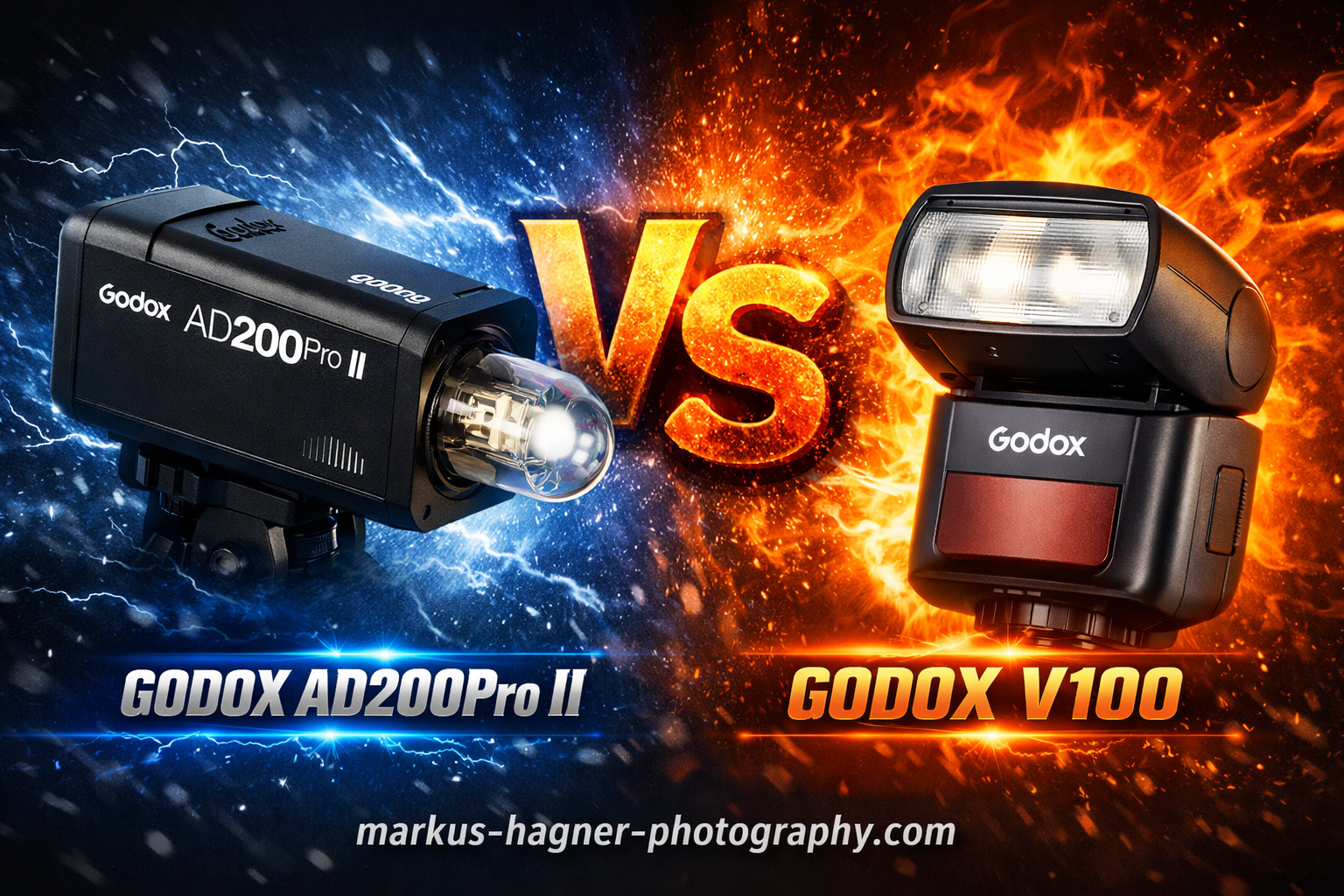
Choosing between the Godox AD200Pro II vs Godox V100 comes down to one fundamental question: do you need an off-camera powerhouse or an on-camera speedlight? After testing both units extensively, I can tell you they serve completely different purposes despite their similar price points.
The Godox AD200Pro II is a 200Ws pocket strobe designed for off-camera lighting setups. It packs nearly three times the power of traditional speedlights into a portable body with interchangeable flash heads. The Godox V100, on the other hand, is a 100Ws on-camera flash with a fixed round head design optimized for run-and-gun shooting.
Our team compared these two units over several weeks of portrait sessions, wedding coverage, and studio work. The short answer? If you shoot primarily off-camera with modifiers, get the AD200Pro II. If you need on-camera flash capability for events, the V100 is your answer. But there’s more nuance to this decision than that simple split.
Godox AD200Pro II vs Godox V100: Quick Comparison
| Product | Specifications | Action |
|---|---|---|
 Godox AD200Pro II 200W Pocket Flash
|
|
Check Latest Price |
 Godox V100 100W On-Camera Flash
|
|
Check Latest Price |
At a glance, the biggest difference is power output. The AD200Pro II delivers 200Ws compared to the V100’s 100Ws. That’s double the light output, which matters significantly when you’re shooting through softboxes or bouncing off large surfaces. But power isn’t everything. The V100’s round head produces a more natural falloff pattern that many portrait photographers prefer.
Another key distinction is how you use them. The AD200Pro II excels as an off-camera light on stands. The V100 is designed to sit on your camera’s hot shoe. While you can use the AD200Pro II on-camera with an extension cable or bracket, it’s bulky and awkward. The V100 simply isn’t powerful enough to drive large modifiers effectively off-camera.
Godox AD200Pro II Deep Dive
Pros
- Powerful 200Ws output
- Excellent battery life at 500 full power flashes
- Fast recycle time of 0.01-1.8 seconds
- Interchangeable bare bulb and Fresnel heads
- Enhanced color screen display
- Compatible with previous AD200 accessories
- One-tap wireless sync with X3 trigger
Cons
- Larger and heavier than speedlights
- Not designed for on-camera use
- Round head fit is tight with some modifiers
- Mounting options limited at launch
I’ve been using the AD200Pro II for portrait sessions and real estate photography, and it consistently impresses me with its balance of power and portability. The 200Ws output gives you enough juice to overpower ambient light outdoors or fill large softboxes indoors without maxing out your power settings.
The interchangeable head system is what sets this unit apart from traditional speedlights. You get the bare bulb H200J II head for soft, wraparound light, and the Fresnel head for more focused output with longer throw. Both heads now include bi-color modeling lamps, which is a significant upgrade from the original AD200Pro.
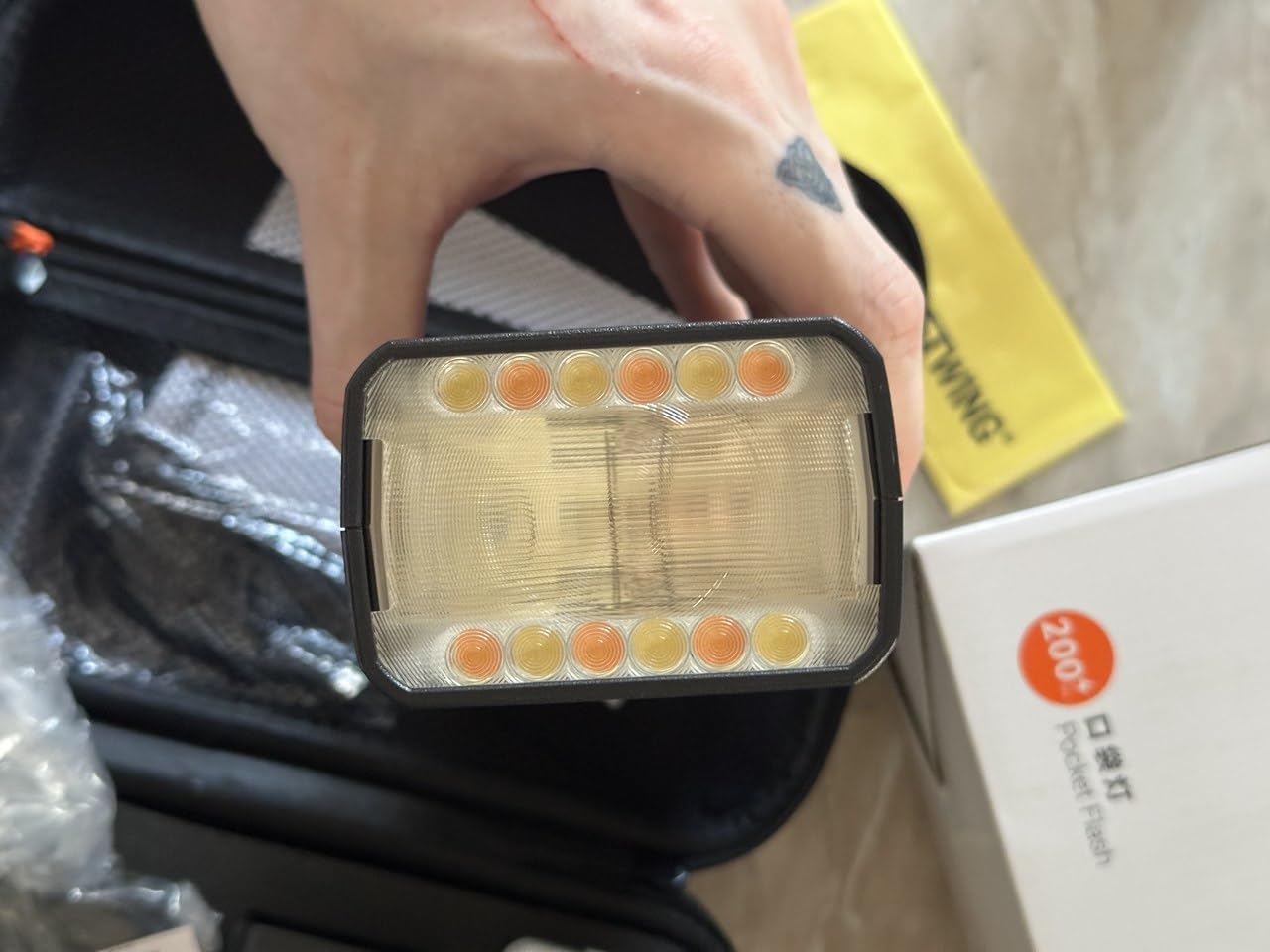
The enhanced color screen is genuinely useful. It displays flash duration at each power level, which matters when you’re freezing fast motion. The interface is clearer and more intuitive than previous models, making it easier to adjust settings quickly on location.
Battery life is excellent. The 14.4V/2900mAh lithium-ion pack delivers 500 full-power flashes per charge. In practice, I’ve shot entire portrait sessions without dropping below 50% battery. The recycle time of 0.01 to 1.8 seconds means you’re rarely waiting for the flash to recharge, even at full power.
One-tap wireless sync with the X3 trigger is a game-changer for workflow. You hold the button down, and it pairs instantly. No more fumbling through menus to set channels and groups. The Godox 2.4G wireless system works reliably at distances up to 100 meters, and it’s compatible with Canon, Nikon, Sony, Fujifilm, Olympus, Panasonic, and Leica cameras.
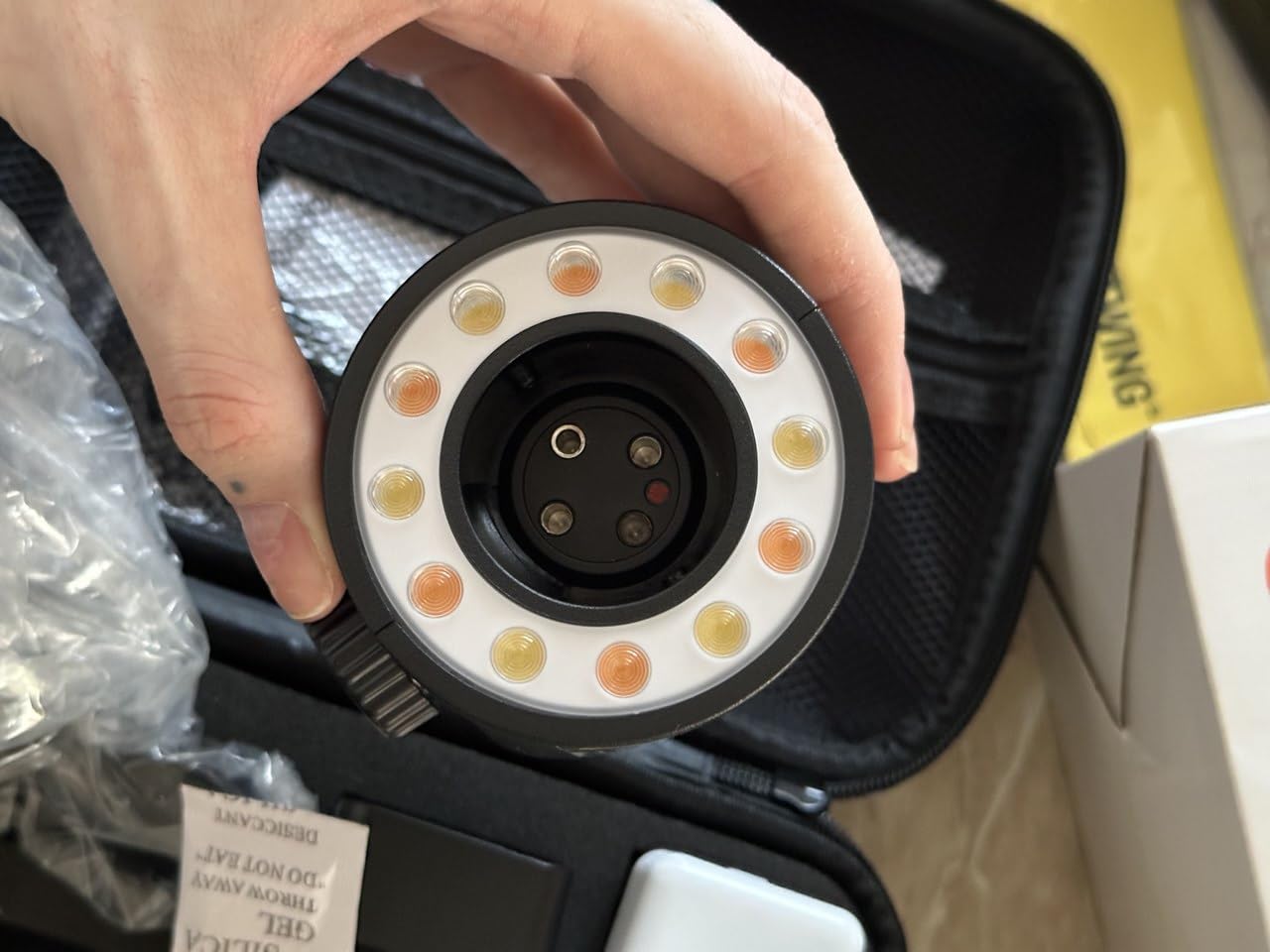
Heat management has improved significantly over the original AD200Pro. I’ve run this unit through extended product photography sessions with frequent full-power pops, and it hasn’t throttled or shut down. The two-step power up feature also prevents accidental battery drain when the unit is packed in your bag.
For modifiers, the AD200Pro II works with Bowens-mount accessories through the included S-type bracket. This opens up a massive ecosystem of softboxes, beauty dishes, and modifiers. The bare bulb head spreads light evenly through large modifiers, producing that soft, professional look portrait photographers want.
The main drawback is size and weight. At 4.07 pounds, this isn’t something you want hanging off your camera hot shoe. It’s designed for light stands and brackets. If you need to move quickly and shoot on-camera, this isn’t the right tool. But for controlled off-camera lighting setups, it’s hard to beat at this price point.
Godox V100 Deep Dive
Pros
- Compact on-camera design
- Intuitive 2.3 inch touchscreen interface
- Global shutter compatible with Sony A9 III
- Beautiful round head light quality
- Magnetic accessories for quick changes
- Detachable sub-flash for fill light
- Seamless Godox wireless integration
Cons
- Heavier than typical speedlights
- Touchscreen can accidentally change settings
- Only 70 full power flashes
- Magnetic ring sold separately
- Requires firmware update before use
The Godox V100 is what happens when Godox takes everything they learned from the V1 and V1 Pro and builds a next-generation on-camera flash. The 100Ws output puts it well above traditional speedlights, which typically max out around 60-70Ws. That extra power makes a real difference when you’re bouncing off ceilings or shooting through diffusers.
The 2.3-inch full-color touchscreen is the standout feature. Adjusting power, switching between TTL and manual modes, and navigating settings feels intuitive. You tap and swipe rather than pressing buttons. It’s a modern interface that matches the experience photographers expect from their cameras and phones.
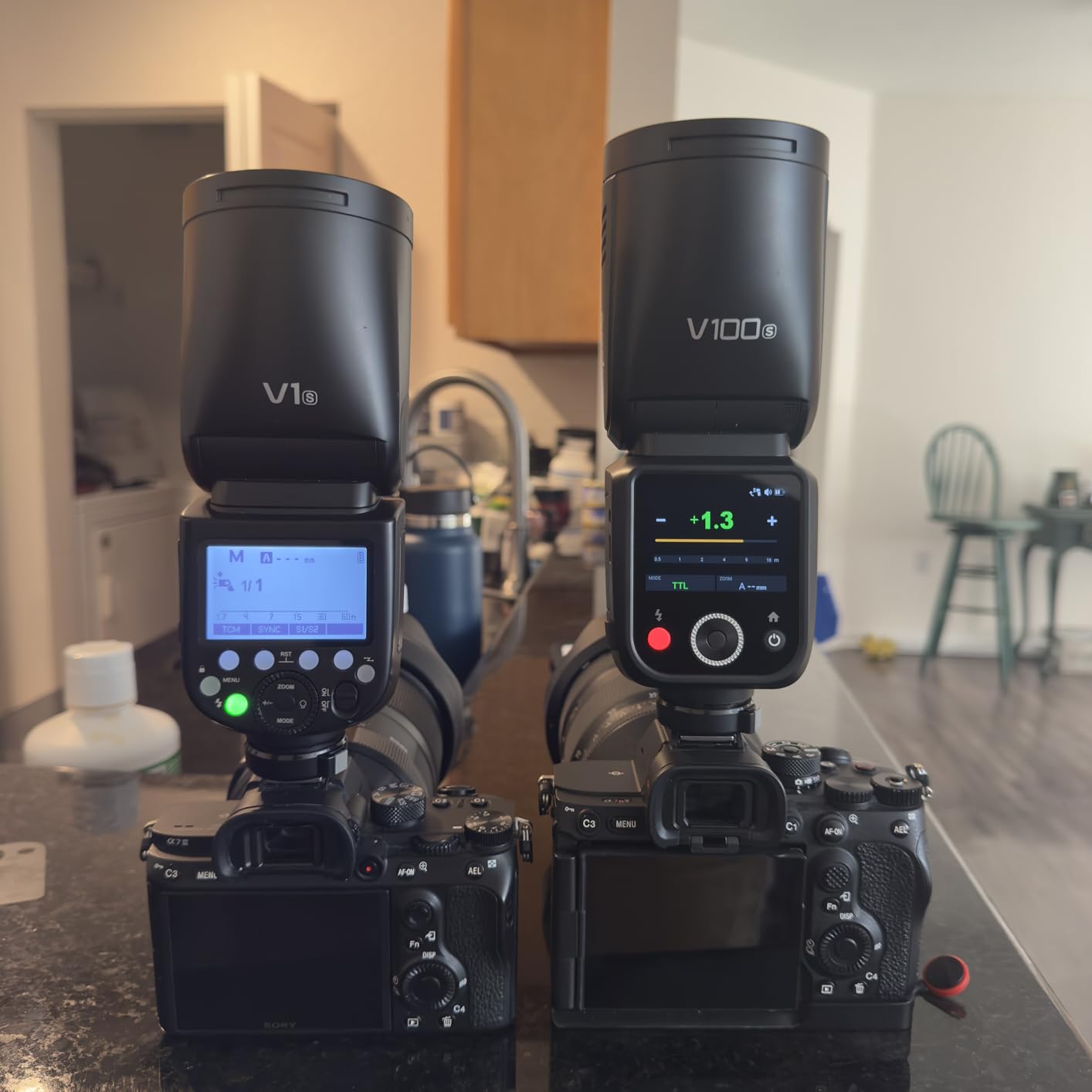
Global shutter compatibility is a significant feature for Sony shooters. The V100 works seamlessly with the Sony A9 III’s global shutter mode, requiring TTL mode with HSS enabled. This matters because global shutter cameras can’t use traditional flash sync methods. The V100 handles this automatically.
The round head design produces light that falls off naturally at the edges. Unlike rectangular speedlight heads that create harsh shadows, the V100’s round pattern mimics the quality you’d get from a beauty dish or softbox. For portrait and wedding photographers shooting on-camera flash, this light quality is immediately noticeable.
Battery performance is solid for an on-camera flash. You get 70 consecutive full-power flashes from the built-in lithium battery. That’s less than the AD200Pro II, but remember this is a smaller, lighter unit designed for mobility. For typical event coverage with TTL and moderate power settings, you’ll get through a full wedding day on one charge.
The magnetic accessory system is clever. You can snap on diffusers, bounce cards, and color gels in seconds. The catch is that the magnetic ring adapter is sold separately, which adds to the total cost. Once you have it, though, changing accessories mid-shoot becomes incredibly fast.
The detachable sub-flash (SU-1) continues the design from the V1 Pro. This small fill light sits forward on the flash head and provides subtle fill for shadows. It’s useful for close-up portrait work where you want a catchlight and a bit of fill without setting up additional lights.
At 1.51 pounds, the V100 is heavier than typical speedlights. After several hours of shooting, you’ll feel it on your wrist. The size is also larger than traditional flashes, which can feel unbalanced on smaller camera bodies. If you shoot with a compact mirrorless camera, consider how this weight will affect your handling.
Some users report touchscreen sensitivity issues, though firmware updates have addressed most concerns. I recommend updating the firmware before your first shoot. The screen can also register accidental touches if your face or cheek brushes against it while shooting in portrait orientation.
Godox AD200Pro II vs Godox V100: Head-to-Head Comparison
Power Output: 200Ws vs 100Ws
The power difference between these two units is significant and affects real-world performance. The AD200Pro II’s 200Ws output gives you approximately one stop more light than the V100’s 100Ws. In practical terms, this means you can shoot at lower power settings, achieve faster recycle times, and use smaller apertures for greater depth of field.
More importantly, the extra power matters when you’re using modifiers. A large softbox absorbs a lot of light. With the AD200Pro II at half power, you might get the same output as the V100 at full power through the same modifier. This gives you more headroom and faster recycle times in demanding situations.
Winner: Godox AD200Pro II – The 200Ws output provides significantly more flexibility, especially when using light modifiers.
Flash Head Design: Bare Bulb vs Round Head
The AD200Pro II features interchangeable heads. The bare bulb H200J II spreads light evenly in all directions, making it ideal for softboxes and umbrellas where you want even illumination across the modifier surface. The Fresnel head focuses light for more directional output with greater reach.
The V100 has a fixed round head that produces beautiful light quality with natural falloff at the edges. This design mimics the light pattern of professional strobes and beauty dishes. For direct flash photography, the round head creates more flattering shadows than rectangular speedlight heads.
These designs serve different purposes. The AD200Pro II’s bare bulb excels when you’re filling modifiers evenly. The V100’s round head produces better direct flash quality. Neither is inherently better; they’re optimized for different workflows.
Winner: Tie – Each design excels in its intended use case. Choose based on your shooting style.
On-Camera vs Off-Camera Capability
This is where the Godox AD200Pro II vs Godox V100 comparison becomes clearest. The V100 is designed to sit on your camera’s hot shoe. Its weight distribution, controls, and form factor all prioritize on-camera use. You can pull it out of your bag, mount it, and start shooting in seconds.
The AD200Pro II can technically be used on-camera with an extension cable and bracket, but it’s cumbersome. The unit is heavy, the controls face sideways when mounted this way, and you’ll need a bracket system to support the weight. It’s possible but not practical for extended shooting.
Forum discussions consistently highlight this distinction. Photographers who need on-camera flash capability for events, weddings, or run-and-gun situations choose the V100. Those who set up off-camera lighting for portraits, products, or controlled environments choose the AD200Pro II.
Winner: Godox V100 – Superior on-camera ergonomics and usability make this the clear choice for on-camera flash work.
Battery Life and Recycle Time
The AD200Pro II’s 14.4V/2900mAh battery delivers 500 full-power flashes with recycle times from 0.01 to 1.8 seconds. This is professional-grade performance that can handle extended studio sessions or all-day location shoots without needing a recharge or battery swap.
The V100 provides 70 consecutive full-power flashes from its built-in battery. Recycle times are fast at typical power settings, though full-power pops take longer to recharge than the AD200Pro II. For event photography with TTL auto exposure, you’ll rarely hit full power, so real-world battery life is better than the numbers suggest.
The AD200Pro II’s battery is removable, so you can carry spares for marathon shoots. The V100’s battery is built-in, meaning you need to recharge the entire unit when it runs low. This is a consideration for all-day events where charging opportunities might be limited.
Winner: Godox AD200Pro II – Significantly more flashes per charge and removable battery design provide greater endurance for demanding shoots.
Wireless System and Trigger Compatibility
Both units use Godox’s 2.4G X wireless system, which means they’re compatible with the full range of Godox triggers and receivers. You can control either unit from an X2T, X3, or XPro trigger mounted on your camera. Both support TTL, HSS up to 1/8000s, and remote power control.
The AD200Pro II supports one-tap wireless sync with the X3 trigger, which simplifies the pairing process considerably. You hold the button, and it connects. The V100 uses the standard pairing process through the menu system, which takes a few more seconds but works reliably.
Both units integrate seamlessly with other Godox lights. You can mix the AD200Pro II and V100 in the same lighting setup, controlling them from the same trigger. This is valuable if you’re building a multi-light kit and want both on-camera and off-camera capabilities.
Winner: Tie – Both use the same excellent Godox wireless system with full TTL, HSS, and remote control capabilities.
Modifier Compatibility
The AD200Pro II works with Bowens-mount modifiers through the included S-type bracket. This opens up access to hundreds of softboxes, beauty dishes, snoots, and grids from Godox and third-party manufacturers. The bare bulb head fills modifiers evenly, producing consistent light quality across the entire modifier surface.
The V100 uses a magnetic accessory system for small modifiers like diffusers and bounce cards. For larger modifiers, you’ll need speedlight-style softboxes with mounts designed for hot-shoe flashes. The round head’s light pattern works well with these smaller modifiers, but you won’t get the same output as the AD200Pro II through large softboxes.
If you’re building a serious off-camera lighting kit with large modifiers, the AD200Pro II is the better choice. The Bowens mount ecosystem is vast and professional-grade. The V100 works well with smaller, portable modifiers suited to on-camera and event photography.
Winner: Godox AD200Pro II – Bowens mount compatibility and higher power output make it better suited for large modifiers.
Build Quality and Portability
The AD200Pro II feels robust and well-constructed. The body is solid, controls are tactile, and the enhanced color screen is protected by a recessed design. At 4.07 pounds, it’s substantial but manageable on a light stand. The form factor is compact enough to fit in a camera bag while delivering studio-grade power.
The V100 also exhibits excellent build quality. The touchscreen is responsive, the head tilts and rotates smoothly, and the overall construction feels premium. At 1.51 pounds, it’s heavier than typical speedlights but still manageable on-camera. The larger size provides better heat dissipation for sustained use.
For location work, the V100 wins on portability. It fits in a jacket pocket and mounts instantly on your camera. The AD200Pro II requires stands, brackets, and more setup time. But for studio work or planned location shoots, the AD200Pro II’s build quality inspires confidence in professional environments.
Winner: Tie – Both are well-built for their intended purposes. The V100 is more portable; the AD200Pro II is more robust for studio use.
Value for Money
Both units are priced identically at around $349 at the time of writing. This creates an interesting value proposition. The AD200Pro II gives you more power, interchangeable heads, better battery life, and Bowens mount compatibility. The V100 gives you on-camera usability, touchscreen interface, and round head light quality.
From a pure specifications standpoint, the AD200Pro II offers more features per dollar. But value isn’t just about specs. If you’re an event photographer who needs on-camera flash, the V100’s features are worth more to you than the AD200Pro II’s extra power. The right choice depends entirely on your shooting style.
Consider the total system cost too. The AD200Pro II needs light stands and triggers to reach its potential. The V100 works out of the box but benefits from the separately-sold magnetic ring adapter for accessories. Factor in these additional costs when comparing value.
Winner: Depends on Use Case – The AD200Pro II offers more features per dollar for off-camera work. The V100 provides better value for on-camera flash needs.
Who Should Buy the Godox AD200Pro II?
The AD200Pro II is the right choice if you prioritize off-camera lighting power and versatility. It’s ideal for portrait photographers who work with softboxes and beauty dishes, product photographers who need consistent studio lighting, and real estate photographers who need to light large interiors.
Wedding photographers who set up off-camera lighting for formal portraits will appreciate the power and modifier compatibility. If you’re building a multi-light off-camera setup and want lights that can grow with your skills, the AD200Pro II is a solid foundation.
This is also the better choice for beginners who want to learn off-camera flash. The interchangeable heads let you experiment with different light qualities, and the Bowens mount compatibility means you can invest in modifiers that will work with larger strobes if you upgrade later.
Who Should Buy the Godox V100?
The V100 is the clear choice if you need on-camera flash capability. Event photographers, wedding photographers who shoot reception and ceremony moments on-camera, and photojournalists who need powerful fill flash will benefit from the V100’s design.
Sony shooters with global shutter cameras like the A9 III should consider the V100 for its native compatibility. The touchscreen interface and modern controls also appeal to photographers who prefer intuitive, menu-driven operation over button-based controls.
If you’re upgrading from a basic speedlight and want more power without sacrificing on-camera usability, the V100 provides a significant step up. The 100Ws output is genuinely useful for bouncing off high ceilings or shooting through diffusers in challenging lighting conditions.
Godox AD200Pro II vs Godox V100: Decision Matrix
Use this quick reference to match your primary photography type to the right flash:
Portrait Photography (Studio/Controlled): AD200Pro II – More power for modifiers, interchangeable heads for different light qualities.
Portrait Photography (Location/On-Location): AD200Pro II – Battery life and power output handle variable conditions better.
Wedding Photography (Formal Portraits): AD200Pro II – Drives large softboxes and groups shots with ease.
Wedding Photography (Reception/Events): V100 – On-camera capability with bounce flash and fast adjustments.
Event Photography: V100 – Designed for on-camera use with intuitive controls for rapid adjustments.
Product Photography: AD200Pro II – Consistent power output and modifier compatibility for controlled lighting.
Real Estate Photography: AD200Pro II – Power to light large rooms, battery life for extended shoots.
Beginner Learning Off-Camera Flash: AD200Pro II – More versatile for experimentation and skill development.
Frequently Asked Questions
Is the Godox V100 worth it?
Yes, the Godox V100 is worth it for photographers who need powerful on-camera flash. The 100Ws output significantly exceeds typical speedlights, the round head produces beautiful light quality, and the touchscreen interface makes adjustments intuitive. For event and wedding photographers who shoot on-camera flash frequently, the V100 offers excellent value despite its premium price.
Is the AD200Pro II good for beginners?
The AD200Pro II is an excellent choice for beginners learning off-camera flash. The interchangeable heads let you experiment with different light qualities, the enhanced color screen makes settings easy to understand, and the Godox X system works reliably without complex configuration. The power output gives you room to grow, and the Bowens mount compatibility means your modifier investments will transfer to larger strobes later.
Can you use the AD200Pro II on camera?
Technically yes, but it’s not practical for extended use. The AD200Pro II weighs 4.07 pounds and is designed for light stands. You can mount it on-camera using an extension cable and bracket, but the weight is unbalanced and controls become awkward to reach. If you need on-camera flash capability, the V100 is designed specifically for that purpose.
Which is better for wedding photography?
It depends on your shooting style. For formal portraits and off-camera lighting setups during wedding formals, the AD200Pro II is better due to its power and modifier compatibility. For reception coverage and ceremony moments requiring on-camera flash, the V100 excels. Many wedding photographers eventually own both to cover all situations.
Is 100Ws enough power for modifiers?
100Ws works well with smaller modifiers like speedlight softboxes, small umbrellas, and magnetic diffusers. However, it struggles to fill large softboxes or provide enough power to overcome bright ambient light outdoors. If you regularly use large modifiers like 60-inch softboxes or need to overpower sunlight, the AD200Pro II’s 200Ws output is more appropriate.
Final Verdict: Godox AD200Pro II vs Godox V100
After extensive testing, the Godox AD200Pro II vs Godox V100 comparison reveals two excellent products serving different needs. Neither is universally better than the other. The right choice depends entirely on how you work.
For off-camera lighting work with modifiers, the Godox AD200Pro II is the superior choice. Its 200Ws output, interchangeable heads, excellent battery life, and Bowens mount compatibility make it a versatile foundation for professional lighting setups. At $349, it offers exceptional value for portrait, product, and real estate photographers.
For on-camera flash work, the Godox V100 is the clear winner. The round head produces beautiful light quality, the touchscreen interface is intuitive, and the on-camera ergonomics are excellent. Event and wedding photographers who need powerful, portable on-camera flash will find this unit delivers exactly what they need.
If you’re still undecided, consider this: many photographers eventually own both. The V100 handles on-camera duties during events, while the AD200Pro II powers off-camera setups for portraits and products. Both integrate seamlessly through the Godox X system, allowing you to build a cohesive lighting kit over time.