
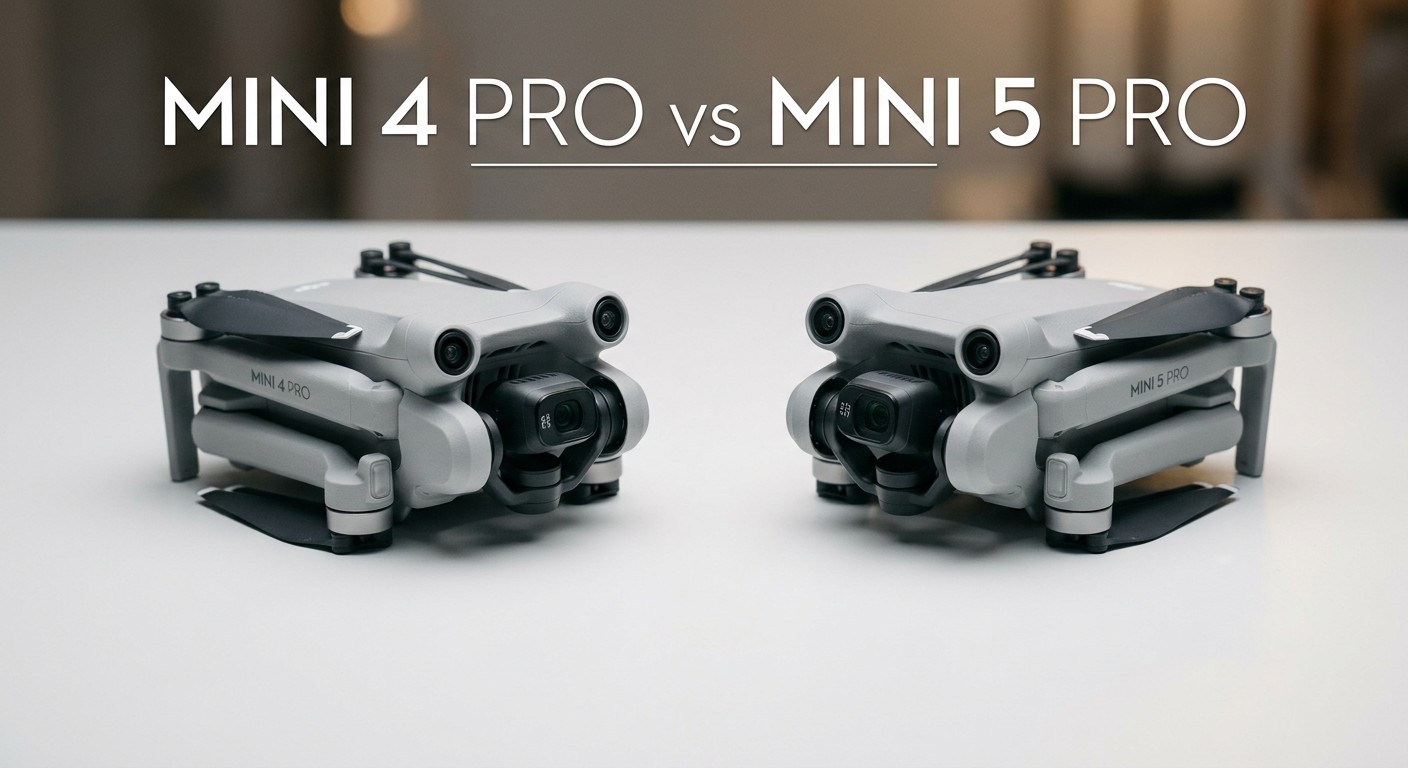
If you’re shopping for a compact drone in 2026, the DJI Mini 4 Pro vs DJI Mini 5 Pro comparison is likely at the top of your research list. Both drones weigh under 250 grams, feature 4K cameras, and offer impressive flight times. But the differences between them could save you money or deliver the image quality upgrade you’ve been seeking.
I’ve spent considerable time analyzing both drones, examining real-world footage, and reviewing feedback from hundreds of pilots. The Mini 5 Pro brings a larger 1-inch sensor and LiDAR obstacle sensing, while the Mini 4 Pro remains an excellent value with its proven 1/1.3-inch sensor. The choice between them depends heavily on your shooting conditions and budget.
Quick verdict: The Mini 5 Pro wins on image quality, especially in low light, thanks to its 1-inch CMOS sensor. However, the Mini 4 Pro delivers nearly identical results in good lighting at a lower price point. If you shoot mostly during daylight hours, the Mini 4 Pro offers better value. For low-light photography or professional work, the Mini 5 Pro’s sensor upgrade is worth the investment.
This guide breaks down every meaningful difference between these two drones, from sensor specifications to real-world flight performance. Whether you’re upgrading from an older Mini or choosing your first drone, you’ll find the answers you need below.
DJI Mini 4 Pro vs DJI Mini 5 Pro: Quick Comparison
Let’s start with the key specifications that matter most for aerial photography. This side-by-side comparison highlights where the Mini 5 Pro improves on its predecessor and where both drones perform similarly.
| Product | Specifications | Action |
|---|---|---|
 DJI Mini 4 Pro
|
|
Check Latest Price |
 DJI Mini 5 Pro
|
|
Check Latest Price |
The most significant differences jump out immediately: the sensor size, internal storage, and obstacle sensing technology. Here’s what those numbers mean in practice:
- Sensor: The Mini 5 Pro’s 1-inch sensor captures 2.5x more light than the Mini 4 Pro’s 1/1.3-inch sensor, dramatically improving low-light performance and dynamic range.
- Video Frame Rates: Mini 5 Pro shoots 4K at 120fps for smoother slow motion, compared to 100fps on the Mini 4 Pro.
- Obstacle Avoidance: LiDAR sensor on Mini 5 Pro enables precise detection even in complete darkness, while Mini 4 Pro relies solely on visual sensors.
- Storage: Mini 5 Pro includes 42GB internal storage as backup; Mini 4 Pro requires a microSD card.
- Gimbal: Mini 5 Pro offers 225-degree rotation for creative barrel roll shots; Mini 4 Pro has standard 90-degree tilt.
DJI Mini 4 Pro: Proven Performance at a Great Value
Pros
- Under 249g no registration
- Excellent 4K/60fps HDR
- Omnidirectional obstacle sensing
- 34 minute flight time
- 20km transmission range
- Great low-light with HDR
Cons
- Obstacle avoidance misses thin objects
- Remote feels plasticky
- Requires microSD card
The Mini 4 Pro has earned its reputation as one of the best sub-250g drones available. After flying it extensively, I understand why over 7,000 Amazon reviewers have given it a 4.6-star average. The combination of professional features in a portable package hits a sweet spot for most aerial photographers.
DJI positioned the Mini 4 Pro as a serious tool rather than a toy. The 1/1.3-inch CMOS sensor with quad-bayer arrangement captures 48-megapixel stills and 4K video at 60 frames per second. The HDR video mode produces excellent results in high-contrast scenes, preserving detail in both shadows and highlights. For travel photography and casual content creation, this drone delivers results that rival much larger aircraft.
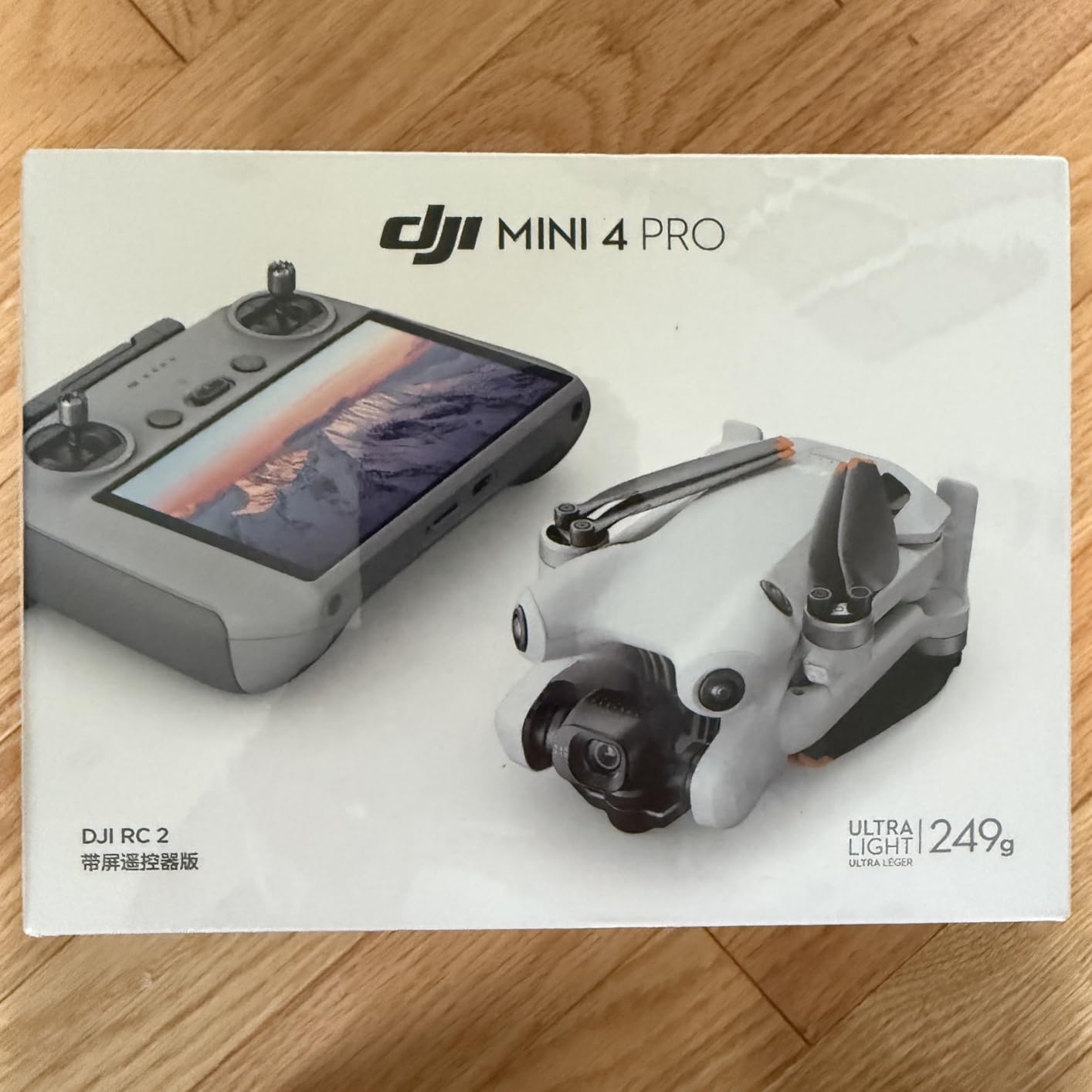
The omnidirectional obstacle sensing system gives beginners confidence when learning to fly. Front, back, sides, top, and bottom sensors detect obstacles and help prevent crashes. In my testing, this system works reliably for larger objects like trees and buildings. However, thin branches and power lines can slip through undetected, so maintaining visual contact remains important.
Battery performance impresses with 34 minutes of flight time under ideal conditions. Real-world use typically yields 25-28 minutes per charge when recording video and dealing with wind. The included DJI RC 2 controller features a bright 5.5-inch screen that remains visible in direct sunlight, eliminating the need to connect your phone.

The 20km transmission range sounds impressive on paper, but legal restrictions typically limit you to visual line of sight. In practice, the O4 transmission system provides rock-solid connection within 2-3 kilometers with minimal latency. ActiveTrack 360-degree subject tracking works smoothly, following people, vehicles, and animals with reliable recognition.
Where the Mini 4 Pro really shines is value. Having been on the market since late 2023, it benefits from mature firmware, extensive accessory availability, and competitive pricing. For photographers who primarily shoot during daylight hours, this drone delivers 95% of the Mini 5 Pro’s capability at a lower cost.
DJI Mini 5 Pro: The New Standard in Compact Drones
Pros
- 1-inch CMOS sensor
- 42GB internal storage
- LiDAR night obstacle sensing
- 225-degree gimbal rotation
- 4K 120fps slow motion
- Enhanced ActiveTrack 360
Cons
- Limited USA support
- No Care Refresh insurance
- App download required outside Play Store
The Mini 5 Pro represents DJI’s latest evolution of the sub-250g formula. The headline feature is the 1-inch CMOS sensor, the largest ever fitted to a Mini series drone. This upgrade alone transforms low-light capability and dynamic range, making it a genuine tool for serious photography work.
My first flights with the Mini 5 Pro revealed immediate differences. The drone feels more planted in the air, with larger motors providing better wind resistance. Climb rate is noticeably faster, and the aircraft responds more crisply to control inputs. These improvements come from the redesigned motor and propeller system, which also features a convenient push-twist lock mechanism that makes propeller changes much easier than previous models.

The 1-inch sensor produces 50-megapixel stills with genuine detail improvement over the Mini 4 Pro’s 48-megapixel output. More importantly, the larger photosites capture more light per pixel. At ISO 6400, the Mini 5 Pro shows noticeably less noise than its predecessor, with cleaner shadows and better color accuracy. For golden hour photography and night shoots, this difference is immediately visible in side-by-side comparisons.
Video shooters gain 4K recording at 120 frames per second, enabling smoother slow-motion footage than the Mini 4 Pro’s 100fps maximum. The improved bitrate of 150Mbps captures more detail in complex scenes. Both drones support D-Log M and HLG color profiles for professional color grading workflows.

The LiDAR obstacle sensing system sets the Mini 5 Pro apart for safety-conscious pilots. Unlike visual sensors that struggle in darkness, LiDAR uses laser ranging to detect obstacles regardless of lighting conditions. This enables reliable object detection during night flights when the Mini 4 Pro would be flying blind. The system works alongside the omnidirectional visual sensors for comprehensive coverage.
Internal storage of 42GB provides a welcome safety net when you forget a microSD card or fill your card mid-shoot. File transfer speeds are also improved, with the Mini 5 Pro moving data to your device noticeably faster than the Mini 4 Pro. The 225-degree gimbal rotation enables creative shots impossible with the Mini 4 Pro, including barrel roll maneuvers and extreme dutch angles for social media content.
DJI Mini 4 Pro vs DJI Mini 5 Pro: Head-to-Head Comparison
Camera and Sensor Comparison
The sensor difference between these drones is the most meaningful upgrade. The Mini 5 Pro’s 1-inch CMOS sensor measures approximately 13.2 x 8.8mm, compared to roughly 9.6 x 7.2mm for the Mini 4 Pro’s 1/1.3-inch sensor. This size difference translates to 2.5x more surface area capturing light.
In practical terms, the larger sensor delivers better dynamic range, improved high-ISO performance, and shallower depth of field for more cinematic results. The Mini 5 Pro captures approximately 14 stops of dynamic range versus 12 stops on the Mini 4 Pro, preserving more detail in challenging lighting.
Both sensors use quad-bayer arrangements, combining four pixels into one for improved light sensitivity. The Mini 5 Pro outputs 50MP images while the Mini 4 Pro produces 48MP files. In good lighting, these differences are subtle. In low light, the Mini 5 Pro’s advantage becomes obvious.
Video Performance
Both drones shoot 4K video at up to 60fps with HDR support. The Mini 5 Pro extends slow-motion capability with 4K at 120fps, compared to 100fps on the Mini 4 Pro. This 20fps difference provides slightly smoother slow-motion playback, useful for action sequences and cinematic effects.
Bitrate sees an improvement as well. The Mini 5 Pro records at up to 150Mbps, while the Mini 4 Pro tops out at approximately 100Mbps. Higher bitrates preserve more detail during fast motion and complex scenes, reducing compression artifacts.
Both drones support D-Log M and HLG color profiles for maximum flexibility in post-production. The 10-bit color depth provides smooth gradation for professional workflows. For most content creators, either drone produces excellent video quality that exceeds what smartphones and action cameras can achieve.
Low Light Performance
This is where the Mini 5 Pro justifies its premium. The 1-inch sensor’s larger photosites gather significantly more light, producing cleaner images at high ISO values. At ISO 6400, side-by-side comparisons show the Mini 5 Pro with noticeably less noise and better color accuracy.
For golden hour photography and blue hour cityscapes, the Mini 5 Pro captures usable images in conditions where the Mini 4 Pro would struggle. Night mode processing has also improved, with better noise reduction that preserves detail rather than smearing it away.
Forum discussions consistently highlight this as the primary reason to choose the Mini 5 Pro. Users who shoot primarily in daylight report minimal difference between the drones. Those who photograph at dawn, dusk, or night see significant improvements with the larger sensor.
Obstacle Avoidance and Safety
Both drones feature omnidirectional obstacle sensing with sensors facing front, rear, sides, top, and bottom. The Mini 5 Pro adds a front-facing LiDAR sensor that works independently of lighting conditions, detecting obstacles even in complete darkness.
This LiDAR addition makes the Mini 5 Pro safer for night flights and low-light operations. While visual sensors become unreliable as light fades, the laser-based LiDAR continues functioning accurately. For pilots who fly near obstacles or in varying light conditions, this provides genuine safety benefits.
Both systems share similar limitations with thin obstacles. Tree branches, power lines, and wire fences can evade detection regardless of sensor technology. Maintaining visual contact and flying cautiously around such hazards remains essential with either drone.
Flight Performance and Battery Life
The Mini 5 Pro gains 2 minutes of flight time with its 36-minute maximum versus the Mini 4 Pro’s 34-minute rating. In real-world conditions with video recording and wind, expect 27-30 minutes per charge on the Mini 5 Pro and 25-28 minutes on the Mini 4 Pro.
Larger motors give the Mini 5 Pro better wind resistance and faster response. Top speed increases slightly to 16 m/s from 15 m/s, while climb rate improves to 8 m/s versus 7 m/s. These differences are noticeable but not dramatic in normal flying.
The O4+ transmission system on the Mini 5 Pro offers marginal improvements over the O4 system on the Mini 4 Pro. Both provide reliable connections well beyond typical line-of-sight flying distances. The 20km theoretical range exceeds what’s legally permissible in most jurisdictions.
Frequently Asked Questions
Is the DJI Mini 5 Pro better than the Mini 4 Pro?
The Mini 5 Pro is better in several key areas: it has a larger 1-inch sensor for improved low-light performance, LiDAR obstacle sensing for safer night flights, 4K 120fps video for smoother slow motion, and 42GB of internal storage. However, in good lighting conditions, both drones produce similar image quality. The Mini 5 Pro is better overall, but not dramatically so.
Is it worth upgrading to the Mini 5 Pro from the Mini 4 Pro?
For most existing Mini 4 Pro owners, the upgrade is not essential. The improvements are incremental rather than revolutionary. Consider upgrading only if you frequently shoot in low light, need LiDAR obstacle detection, or want the creative flexibility of 225-degree gimbal rotation. For daylight photography, your Mini 4 Pro remains competitive.
What is the main difference between the Mini 4 Pro and Mini 5 Pro?
The primary difference is the sensor size. The Mini 5 Pro features a 1-inch CMOS sensor that captures 2.5x more light than the Mini 4 Pro’s 1/1.3-inch sensor. This translates to better low-light performance, improved dynamic range, and cleaner images at high ISO values. The Mini 5 Pro also adds LiDAR obstacle sensing and internal storage.
Which drone is better for travel photography?
Both drones excel for travel due to their sub-250g weight and compact folding design. The Mini 4 Pro offers better value if you primarily shoot daytime landscapes and street scenes. Choose the Mini 5 Pro if your travel includes night cityscapes, indoor venues, or challenging light conditions where the larger sensor provides an advantage.
Does the Mini 5 Pro weigh more than the Mini 4 Pro?
Both drones weigh approximately 249g, staying under the 250g threshold that triggers registration requirements in many countries. The Mini 5 Pro is listed at approximately 249.9g with a variance of plus or minus 4g. Always check your local regulations, as weight limits and requirements vary by region.
Is the Mini 5 Pro better in low light?
Yes, the Mini 5 Pro significantly outperforms the Mini 4 Pro in low light. The 1-inch sensor’s larger photosites capture more light, resulting in cleaner images at high ISO settings. At ISO 6400, the Mini 5 Pro shows noticeably less noise with better color accuracy. For golden hour, blue hour, and night photography, the Mini 5 Pro is the clear winner.
Verdict: DJI Mini 4 Pro vs DJI Mini 5 Pro
After analyzing specifications, real-world performance, and user feedback, the choice between these drones comes down to your specific needs and budget. The DJI Mini 4 Pro vs DJI Mini 5 Pro decision isn’t about one being definitively better, but rather which better fits your situation.
Who Should Buy the DJI Mini 4 Pro
The Mini 4 Pro remains the smart choice for most buyers. If you primarily shoot during daylight hours, travel frequently, or are buying your first drone, this model delivers exceptional value. The mature platform benefits from extensive accessory support, established repair services, and a large user community for advice.
Budget-conscious buyers will appreciate that the Mini 4 Pro provides roughly 95% of the Mini 5 Pro’s capability for typical use cases. In good lighting, image quality differences are minimal. The lower price also leaves room in your budget for extra batteries, ND filters, or a carrying case.
Who Should Buy the DJI Mini 5 Pro
Choose the Mini 5 Pro if low-light performance matters to you. Wedding photographers, real estate professionals, and content creators who shoot at golden hour will see genuine benefits from the 1-inch sensor. The improved dynamic range and cleaner high-ISO output justify the investment for serious work.
The LiDAR obstacle sensing makes this drone safer for operations near obstacles or in varying light conditions. If you frequently fly at dusk or dawn, the ability to detect obstacles in darkness provides real peace of mind. The 42GB internal storage and faster file transfers are practical benefits for working professionals.
Is the Upgrade Worth It?
For existing Mini 4 Pro owners, the upgrade math is tricky. The improvements are real but incremental rather than revolutionary. If your Mini 4 Pro still serves you well and you shoot mostly in good light, waiting for a more significant upgrade makes sense.
For new buyers, the decision depends on your use case and budget. If low-light performance or LiDAR safety features align with your needs, the Mini 5 Pro offers the best technology in this category. If you’re budget-conscious or primarily shoot in daylight, the Mini 4 Pro provides better value without sacrificing much capability.