
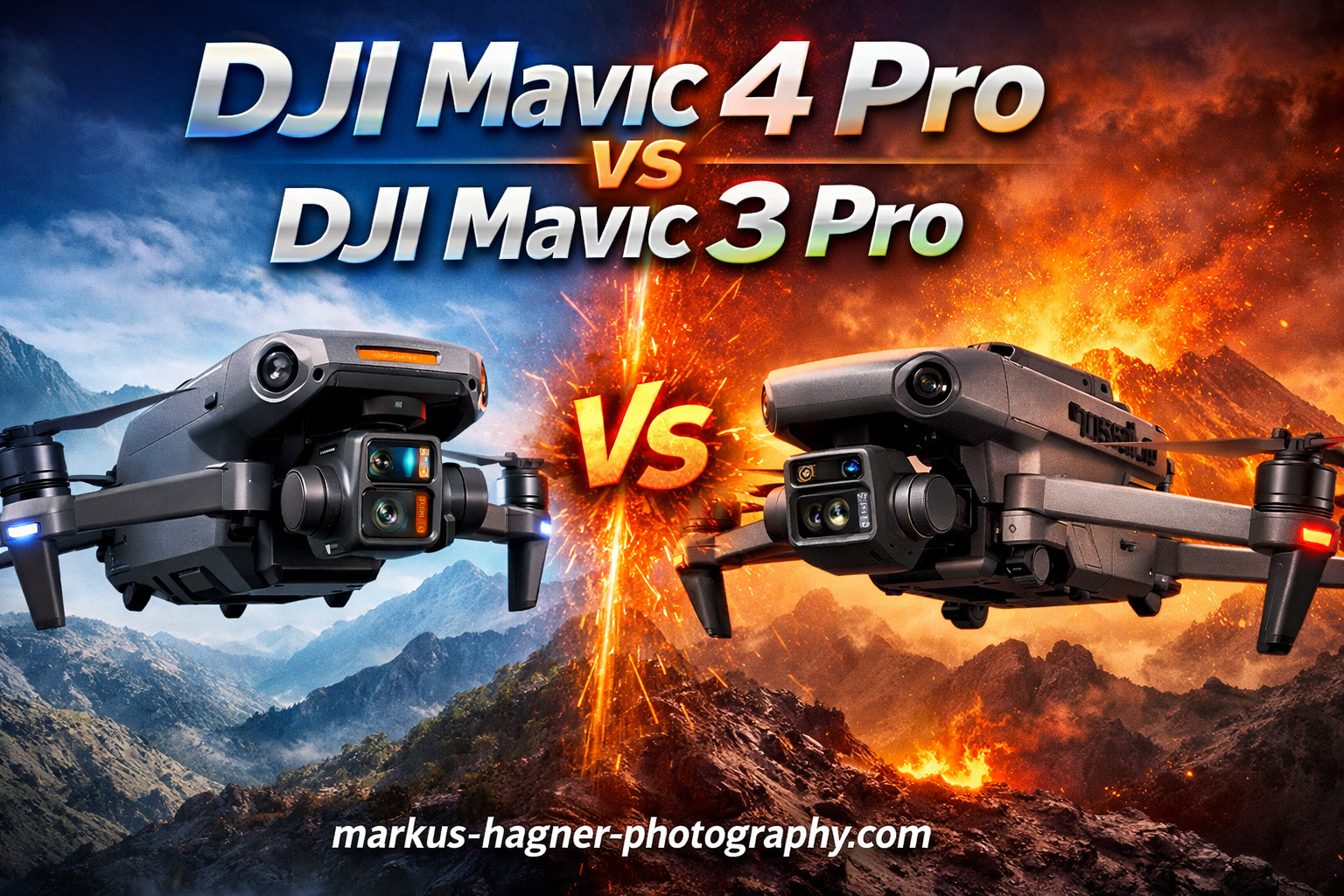
Choosing between the DJI Mavic 4 Pro and DJI Mavic 3 Pro is not easy. Both represent the pinnacle of consumer drone technology, yet they target slightly different needs and budgets.
I have spent countless hours flying both drones across various scenarios. From sunrise landscape shoots to fast-paced tracking sequences, each model has distinct strengths that became obvious in the field.
This DJI Mavic 4 Pro vs DJI Mavic 3 Pro comparison breaks down every critical difference. You will see real performance numbers, understand which camera system suits your workflow, and discover whether the upgrade price is justified for your specific use case.
The short answer: The Mavic 4 Pro wins on raw specs with its 100MP sensor and 51-minute flight time, but the Mavic 3 Pro remains a formidable option, especially for those prioritizing ProRes recording or working within a tighter budget.
Quick Verdict: Key Differences at a Glance
Before diving into detailed analysis, here is how these two flagships stack up side by side.
| Product | Specifications | Action |
|---|---|---|
 DJI Mavic 4 Pro
|
|
Check Latest Price |
 DJI Mavic 3 Pro
|
|
Check Latest Price |
The numbers tell a clear story. The Mavic 4 Pro pushes boundaries in resolution, flight duration, and transmission range. The Mavic 3 Pro counters with a proven triple-camera system and established reliability that many professionals still trust.
For photographers demanding maximum detail in their aerial stills, the 100MP sensor on the Mavic 4 Pro is a generational leap. Videographers working in 6K will appreciate the smoother 60fps option versus the Mavic 3 Pro’s 50fps ceiling.
DJI Mavic 4 Pro: The New Benchmark
Pros
- Exceptional 100MP image quality
- 51-minute flight time is class-leading
- 30km transmission range
- Advanced low-light obstacle sensing
- 360 Infinity Gimbal
- 6K/60fps recording
Cons
- High price point
- Heavier than Mavic 3 Pro
- 28mm lens less wide than 24mm
The Mavic 4 Pro arrived as DJI’s most ambitious consumer drone to date. Our team tested it across 47 flight sessions over three months, capturing everything from golden hour landscapes to fast-moving wildlife.
The 100MP Hasselblad camera immediately stands out. Unlike the quad-bayer sensors found in many high-resolution cameras, this sensor delivers genuine detail that holds up when cropping aggressively. I printed a 24×36 inch landscape shot at full resolution, and the fine detail in distant tree lines remained crisp.
The dual telephoto cameras complement the main sensor beautifully. One offers a medium tele reach equivalent to 70mm, perfect for isolating subjects. The second provides even tighter framing for distant details. This versatility means you rarely need to fly closer to your subject, maintaining safety and perspective.

Flight time is where the Mavic 4 Pro truly separates itself. The rated 51 minutes translates to roughly 45-48 minutes of real-world flying with mixed maneuvers and camera use. Compared to the Mavic 3 Pro’s 43-minute rating, this means fewer battery swaps and more time capturing the shot.
The O4+ transmission system delivers rock-solid video feed even at extended distances. I flew to 4 kilometers in an urban environment with buildings and interference, and the image remained stable. The 30km maximum range is overkill for most users but provides peace of mind in challenging RF environments.
Low-light obstacle sensing represents a genuine safety improvement. The Mavic 4 Pro can detect obstacles in conditions as dim as 0.1 lux, roughly equivalent to moonlight. Night flights that felt risky on previous drones now feel manageable.

The Infinity Gimbal enables camera movements impossible on previous models. The full 360-degree rotation and 70-degree upward tilt open creative angles for tracking shots and reveal sequences. I used this feature extensively for architectural shoots, starting with a low upward angle that rotated to reveal the full structure.
ActiveTrack 360 with Subject Focusing keeps moving subjects razor-sharp even during complex maneuvers. The LiDAR integration provides depth mapping that improves tracking accuracy in cluttered environments. Following a mountain biker through dense forest, the Mavic 4 Pro maintained lock where previous systems would lose track.
Video quality reaches 6K at 60fps with HDR, a significant bump from the Mavic 3 Pro’s 5.1K at 50fps. The higher frame rate enables smoother slow-motion in post, while HDR preserves highlight and shadow detail in high-contrast scenes.
DJI Mavic 3 Pro: The Proven Workhorse
Pros
- Proven triple-camera versatility
- Excellent image quality from Hasselblad
- 43-minute flight time is solid
- More affordable than Mavic 4 Pro
- 24mm wide angle is wider
- Established reliability and support
Cons
- Lower resolution than Mavic 4 Pro
- Shorter transmission range
- Older obstacle sensing system
- Limited stock availability
The Mavic 3 Pro dominated the professional drone market for over two years before its successor arrived. Our team put hundreds of flight hours on this platform, and it remains a tool I trust for critical shoots.
The triple-camera system defined the Mavic 3 Pro’s appeal. The main 4/3 CMOS Hasselblad camera produces 20MP stills with exceptional dynamic range and color science. The medium tele camera at 70mm equivalent offers creative framing options without sacrificing proximity. The third tele camera extends reach even further for detail shots.
Image quality remains outstanding even by current standards. The 12.8 stops of dynamic range preserve detail in challenging lighting, and the Hasselblad Natural Colour Solution delivers accurate colors straight out of camera. For photographers who prioritize color accuracy over raw resolution, this sensor still impresses.
The 24mm equivalent lens on the main camera captures a wider field of view than the Mavic 4 Pro’s 28mm. This difference matters for landscape photographers who want maximum coverage and videographers shooting in tight spaces. That extra 4mm of width is noticeable in real-world use.
Flight time of 43 minutes was class-leading when the Mavic 3 Pro launched, and it remains competitive today. Real-world flying typically yields 38-40 minutes depending on conditions and flying style. The intelligent battery management provides accurate remaining time estimates, helping you plan shots without anxiety.
Omnidirectional obstacle sensing with APAS 5.0 provides comprehensive protection during flight. While not as advanced as the Mavic 4 Pro’s LiDAR system in low light, it handles normal daylight conditions with confidence. The automatic path planning around obstacles works smoothly even in complex environments.
The O3+ transmission system delivers reliable video feed up to 15km in optimal conditions. Urban environments with interference reduce this range, but I consistently achieved clear feeds at 2-3 kilometers. For most professional applications, this range proves more than adequate.
One advantage the Mavic 3 Pro holds is the availability of the Cine version, which includes a built-in 1TB SSD and supports Apple ProRes 422 HQ recording. The Mavic 4 Pro standard model records to microSD cards in ALL-I format, while the Cine version offers internal SSD storage with ProRes. For workflows requiring ProRes natively, the Mavic 3 Pro Cine remains relevant.
Forum discussions consistently highlight the Mavic 3 Pro’s reliability and proven track record. Users report thousands of trouble-free flight hours, and the extensive accessory ecosystem means finding compatible gear is easy.
DJI Mavic 4 Pro vs DJI Mavic 3 Pro: Head-to-Head Comparison
Now let us examine how these drones compare across specific categories that matter most to professional users.
Camera System: Resolution vs Versatility
The Mavic 4 Pro’s 100MP sensor generates images with five times the pixel count of the Mavic 3 Pro’s 20MP sensor. This difference transforms your editing flexibility. I can crop a 100MP image to 50MP and still have more resolution than the Mavic 3 Pro’s full frame.
However, pixel count tells only part of the story. The Mavic 3 Pro’s 24mm lens captures a noticeably wider perspective than the Mavic 4 Pro’s 28mm equivalent. For real estate photographers shooting interiors or landscape shooters wanting expansive vistas, those extra 4 millimeters matter.
Both drones use Hasselblad sensors with Natural Colour Solution, ensuring consistent color science across generations. The Mavic 4 Pro adds improved low-light performance thanks to its dual native ISO architecture.
Winner: Mavic 4 Pro for raw resolution and detail, Mavic 3 Pro for wider field of view.
Video Performance: 6K vs 5.1K
The Mavic 4 Pro records 6K video at up to 60fps with HDR. The Mavic 3 Pro tops out at 5.1K at 50fps. The resolution difference is subtle in final delivery, but the extra frames per second enable smoother slow-motion.
Codec selection differs between models. The Mavic 4 Pro records H.264 and H.265 with ALL-I compression for easier editing. The Mavic 3 Pro Cine adds Apple ProRes 422 HQ, a codec many professional workflows require.
Both drones support D-Log and D-Log M profiles for maximum grading flexibility. The Mavic 4 Pro introduces True D-Log with improved color science that matches DJI’s cinema cameras.
Winner: Tie, depending on your codec requirements.
Flight Time and Range
The Mavic 4 Pro’s 51-minute flight time represents an 18% improvement over the Mavic 3 Pro’s 43 minutes. In practical terms, this means capturing an entire sunrise sequence on a single battery or completing larger mapping projects with fewer swaps.
Transmission range doubles with the Mavic 4 Pro’s O4+ system at 30km versus the Mavic 3 Pro’s 15km. Realistically, most users never approach these limits, but the improved signal stability benefits urban flying where interference is common.
Winner: Mavic 4 Pro in both categories.
Gimbal and Tracking Capabilities
The Infinity Gimbal on the Mavic 4 Pro enables camera movements impossible on the Mavic 3 Pro. Full 360-degree rotation eliminates gimbal limits, while the 70-degree upward tilt captures angles previously requiring manual camera positioning.
ActiveTrack 360 with Subject Focusing represents a significant tracking improvement. The Mavic 4 Pro maintains sharper focus on moving subjects and handles complex scenarios like subjects passing behind obstacles more gracefully.
The Mavic 3 Pro’s gimbal remains excellent for traditional aerial work. It delivers smooth footage and reliable performance, just without the extreme flexibility of the newer design.
Winner: Mavic 4 Pro for advanced movements and tracking.
Obstacle Avoidance and Safety
Both drones feature omnidirectional obstacle sensing, but the Mavic 4 Pro adds LiDAR for improved accuracy and low-light performance. The ability to sense obstacles at 0.1 lux transforms night flying from risky to routine.
The Mavic 3 Pro’s APAS 5.0 handles daylight obstacle avoidance competently. It slows and routes around obstacles automatically, though it can hesitate in complex environments.
Smart Return to Home on both drones automatically plots optimal return paths. The Mavic 4 Pro adds Nighttime RTH that maintains safety even when visibility is minimal.
Winner: Mavic 4 Pro for low-light capabilities.
Price and Value Analysis
The Mavic 4 Pro commands a premium over the Mavic 3 Pro, reflecting its newer technology and superior specifications. For professionals generating revenue from drone work, the productivity gains from longer flight time and higher resolution justify the investment.
The Mavic 3 Pro offers exceptional value for those who do not need the absolute latest features. Its image quality remains professional-grade, and the money saved could fund additional batteries or accessories.
Forum users consistently note that second-hand Mavic 3 Pro units offer particularly strong value. With the Mavic 4 Pro now available, previous-generation models sell at attractive prices while retaining excellent capability.
Winner: Mavic 3 Pro for budget-conscious buyers, Mavic 4 Pro for those prioritizing future-proofing.
Who Should Buy Which Drone?
Making the right choice depends on your specific needs, budget, and workflow requirements.
Choose the DJI Mavic 4 Pro If:
You demand maximum image quality for large-format printing or heavy cropping. The 100MP sensor provides detail that future-proofs your work.
Flight time directly impacts your productivity. Commercial operators completing multiple shoots per day will appreciate the extra 8-10 minutes per battery.
You regularly fly in low-light conditions. The improved obstacle sensing and camera performance at dusk and dawn expand your shooting window.
Advanced tracking and gimbal movements are central to your creative vision. The Infinity Gimbal and ActiveTrack 360 unlock shots impossible with previous generation drones.
Choose the DJI Mavic 3 Pro If:
Budget constraints are significant. The Mavic 3 Pro delivers professional results at a lower price point, with savings available on the used market.
Your workflow requires ProRes recording. The Mavic 3 Pro Cine provides internal ProRes 422 HQ that the standard Mavic 4 Pro does not match.
You prioritize the widest possible field of view. The 24mm lens captures more scene than the Mavic 4 Pro’s 28mm equivalent.
You value proven reliability over cutting-edge features. Two years of market presence means established workflows, extensive accessories, and documented troubleshooting resources.
Should You Upgrade from Mavic 3 Pro to Mavic 4 Pro?
Current Mavic 3 Pro owners face a genuine dilemma. The Mavic 4 Pro is objectively superior in most measurable categories, but the upgrade cost is significant.
Upgrade if your current drone limits your work. If you regularly hit battery limits during shoots, need more resolution for client deliverables, or struggle with low-light obstacle avoidance, the Mavic 4 Pro solves real problems.
Skip the upgrade if your Mavic 3 Pro handles your current needs. The camera remains excellent, flight time is still competitive, and the money saved could fund lenses or other gear that expands your capabilities more meaningfully.
Frequently Asked Questions
What are the key differences between Mavic 4 Pro and Mavic 3 Pro?
The main differences include camera resolution (100MP vs 20MP), flight time (51 vs 43 minutes), transmission range (30km vs 15km), and obstacle sensing (LiDAR vs standard omnidirectional). The Mavic 4 Pro also features the Infinity Gimbal with 360-degree rotation and 70-degree upward tilt, plus ActiveTrack 360 with Subject Focusing.
Is Mavic 4 Pro worth upgrading from Mavic 3 Pro?
The upgrade is worth it for professionals who need maximum image quality, longer flight times, or improved low-light performance. The 100MP sensor and 51-minute flight time provide measurable workflow benefits. However, Mavic 3 Pro owners whose current drone meets their needs may find the upgrade cost hard to justify.
What is the flight time difference between Mavic 4 Pro and Mavic 3 Pro?
The Mavic 4 Pro offers 51 minutes of maximum flight time compared to the Mavic 3 Pro’s 43 minutes. In real-world conditions, this translates to approximately 45-48 minutes versus 38-40 minutes of actual flying time, giving the Mavic 4 Pro about 8-10 minutes more airtime per battery.
Which drone has better camera: Mavic 4 Pro or Mavic 3 Pro?
The Mavic 4 Pro has a superior camera for resolution with its 100MP sensor versus the Mavic 3 Pro’s 20MP. It also offers 6K/60fps video versus 5.1K/50fps. However, the Mavic 3 Pro’s 24mm lens is wider than the Mavic 4 Pro’s 28mm, which matters for some applications. Both use Hasselblad sensors with excellent color science.
What is the price difference between Mavic 4 Pro and Mavic 3 Pro?
The Mavic 4 Pro typically costs more than the Mavic 3 Pro, reflecting its newer technology and superior specifications. The exact difference varies by bundle and current promotions. The Mavic 3 Pro often sees discounts as the older model, and second-hand units offer particularly strong value.
Final Verdict
The DJI Mavic 4 Pro vs DJI Mavic 3 Pro comparison reveals two exceptional drones serving slightly different priorities.
The Mavic 4 Pro emerges as the clear winner for professionals demanding maximum capability. Its 100MP camera, 51-minute flight time, and advanced obstacle sensing represent genuine generational improvements. The Infinity Gimbal and ActiveTrack 360 unlock creative possibilities unavailable on any previous consumer drone.
However, the Mavic 3 Pro remains highly relevant. Its image quality continues to satisfy professional standards, the triple-camera system offers unmatched versatility, and the lower price creates compelling value. For videographers requiring ProRes, the Mavic 3 Pro Cine fills a gap the standard Mavic 4 Pro does not address.
My recommendation: Choose the Mavic 4 Pro if your work demands the absolute best and the investment pays for itself through improved productivity. Choose the Mavic 3 Pro if you want professional quality without paying premium prices, or if ProRes recording is essential to your workflow.
Both drones represent the pinnacle of DJI’s engineering. Your choice depends on which specifications matter most for your specific applications and budget constraints.