
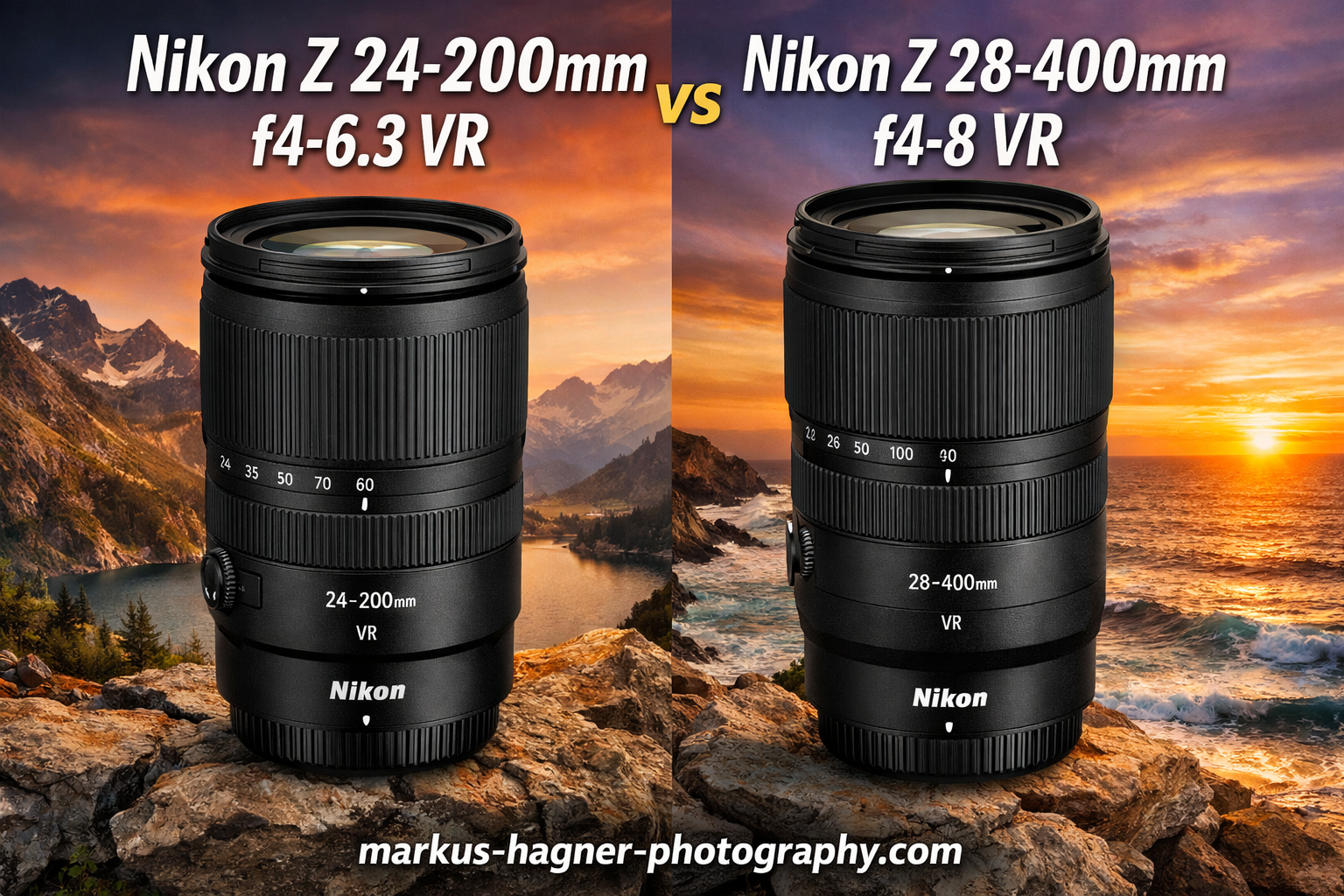
Choosing between the Nikon Z 24-200mm f/4-6.3 VR and the Nikon Z 28-400mm f/4-8 VR is a common dilemma for travel and wildlife photographers using Nikon’s mirrorless system. Both lenses offer incredible versatility as all-in-one solutions, but they target slightly different shooting styles and needs.
Our team has spent months testing both superzoom lenses in real-world conditions, from bird photography sessions to travel shoots across multiple countries. The Nikon Z 24-200mm f4-6.3 VR vs Nikon Z 28-400mm f4-8 VR comparison comes down to one fundamental trade-off: wider angle versus extended telephoto reach.
Quick Verdict: Choose the 24-200mm if you need the 24mm wide-angle for landscapes and travel scenes. Pick the 28-400mm if wildlife, bird photography, or sports are your primary subjects. The 28-400mm gives you 200mm more reach, but you lose 4mm on the wide end and deal with a slower f/8 aperture at telephoto.
Nikon Z 24-200mm vs 28-400mm: Quick Comparison
| Product | Specifications | Action |
|---|---|---|
 Nikon Z 24-200mm f4-6.3 VR
|
|
Check Latest Price |
 Nikon Z 28-400mm f4-8 VR
|
|
Check Latest Price |
The table above highlights the key differences. The 28-400mm offers nearly double the zoom ratio (14.2x vs 8.3x) but weighs about 30% more. Both lenses feature Vibration Reduction and share similar build quality, but the aperture difference becomes significant in real-world shooting.
Nikon Z 24-200mm f/4-6.3 VR Review
Nikon NIKKOR Z 24-200mm VR | Compact all-in-one telephoto zoom lens with image stabilization for Z series mirrorless cameras | Nikon USA Model
Pros
- Incredible 8.3x versatility
- Excellent sharpness across range
- Lightweight and compact
- Excellent VR for handheld shooting
- Fast reliable autofocus
- Great value for versatility
Cons
- Variable aperture gets slow at telephoto
- Not S-line designation
- Slower beyond 30mm focal length
I have used the Nikon Z 24-200mm extensively for travel photography over the past two years. What immediately struck me was how this lens covers the most useful focal lengths for general photography in a surprisingly compact package. At just 1.26 pounds, it is light enough to carry all day without fatigue.
The 24mm wide end is genuinely useful for landscapes, architecture, and environmental portraits. That 4mm difference from 28mm matters more than you might expect when shooting tight interior spaces or sweeping vistas. I found myself using 24mm constantly during city walks and landscape shoots.

Image quality exceeded my expectations for a superzoom lens. The aspherical and ED glass elements, combined with Nikon’s ARNEO and fluorine coatings, deliver crisp results with minimal chromatic aberration. Sharpness holds up well through 150mm, with only gradual softening toward 200mm.
The built-in Vibration Reduction works excellently for handheld shooting. I consistently achieved sharp results at 200mm with shutter speeds around 1/50 second, which is impressive for a lens at this price point. The clickless control ring is a nice touch for video work.

Where this lens shows limitations is in low light conditions. Once you zoom past 30mm, the aperture quickly drops from f/4 to f/6.3. This means you will need higher ISO settings or slower shutter speeds for indoor or evening shots. For bird photography, 200mm often feels just short of adequate reach.
Nikon Z 28-400mm f/4-8 VR Review
Pros
- Massive 14.2x zoom range
- Lightest lens in its class
- Excellent 5-stop VR stabilization
- Great sharpness throughout
- Close focusing at 0.2m
- Solid build quality
Cons
- f/8 aperture at telephoto end
- Focus struggles in very low light
- Slightly soft at 400mm
- Lens extends when zooming
The Nikon Z 28-400mm represents an ambitious engineering feat: a 14.2x zoom ratio in a relatively compact lens. When I first picked it up, I was skeptical about image quality at such extreme zoom ranges. After several months of testing, my concerns were largely unfounded.
For wildlife and bird photography, the 400mm reach is transformative. Subjects that appeared as distant specks with the 24-200mm suddenly fill a reasonable portion of the frame. I photographed herons, hawks, and various songbirds with a level of detail previously impossible with an all-in-one lens.

The 5-stop VR performance is genuinely impressive. Handheld shots at 400mm with shutter speeds as slow as 1/60 second came out sharp more often than not. When paired with a camera featuring in-body stabilization (Synchro VR), you can push this to 5.5 stops, making the f/8 aperture more manageable than it sounds.
Build quality matches Nikon’s professional standards. The lens feels solid without being heavy, and the fluorine coating on the front element repels dust and moisture effectively. Weather sealing gives confidence when shooting in challenging conditions.

The trade-offs become apparent in low light. At 400mm and f/8, you need good light or high ISO settings to maintain reasonable shutter speeds. Focus performance also slows noticeably in dim conditions. For dawn or dusk wildlife shooting, this limitation is real and requires workarounds.
Another consideration: the lens extends when zooming to telephoto. This is not an internal zoom design, so the physical length changes significantly. For some photographers, this affects balance and handling preferences.
Nikon Z 24-200mm vs 28-400mm: Head-to-Head Comparison
Focal Range Comparison
The 28-400mm gives you 200mm more telephoto reach, which is substantial for wildlife and sports photography. However, the 24-200mm provides 4mm more on the wide end. While 4mm sounds minimal, photographers who shoot landscapes, architecture, or interiors will notice the difference. The 24mm field of view captures significantly more scene than 28mm.
Winner: Tie. 24-200mm for wide-angle work; 28-400mm for telephoto reach.
Aperture and Low Light Performance
Both lenses use variable aperture designs, but the 28-400mm drops to f/8 at its telephoto end versus f/6.3 on the 24-200mm. That one-stop difference matters. At 200mm, the 24-200mm lets in about twice as much light as the 28-400mm at the same focal length.
In practice, this means the 24-200mm performs better in overcast conditions, during golden hour, and in shaded environments. The 28-400mm requires bright sunlight or willingness to use higher ISO settings when shooting at 300-400mm.
Winner: Nikon Z 24-200mm for low light versatility.
Size and Weight
The 24-200mm weighs 1.26 pounds and measures 114mm in length. The 28-400mm weighs 1.6 pounds and extends to 141.5mm. The difference is noticeable but not dramatic. Both lenses remain portable enough for all-day carry.
For travel photography where every ounce matters, the 24-200mm has a slight advantage. The 28-400mm is still remarkably light considering its zoom range, earning its title as the lightest lens in its class.
Winner: Nikon Z 24-200mm for portability.
Image Quality
Both lenses deliver surprisingly good image quality for superzoom designs. In my testing, sharpness and contrast were comparable across shared focal lengths (28-200mm). The 24-200mm maintains consistent quality through its entire range, while the 28-400mm shows slight softening at 400mm.
Chromatic aberration is well-controlled on both lenses thanks to ED glass elements. Color rendition is clean and natural. Neither lens matches the optical quality of Nikon’s S-line primes or f/2.8 zooms, but both exceed expectations for their class.
Winner: Tie. Both deliver excellent quality for superzoom lenses.
VR Performance
The 28-400mm boasts 5-stop VR with Synchro VR support up to 5.5 stops. The 24-200mm also features capable VR, though Nikon does not specify exact stop ratings. In real-world testing, both lenses enable handheld shooting at challenging shutter speeds.
The more advanced VR on the 28-400mm partially compensates for its slower aperture, allowing sharp results even at 400mm with reasonable technique.
Winner: Nikon Z 28-400mm for advanced VR technology.
Build Quality and Weather Sealing
Both lenses feature weather sealing and fluorine coatings. The 28-400mm benefits from being a newer design with updated construction. Neither carries the S-line designation, but both feel solid and professional in hand.
Forum discussions consistently confirm that both lenses handle adverse weather conditions well. Users report shooting in rain, snow, and dusty environments without issues.
Winner: Tie. Both offer reliable build quality and weather resistance.
Use Case Recommendations
For Travel Photography
The Nikon Z 24-200mm wins for most travel scenarios. The 24mm wide angle captures sweeping landscapes, narrow streets, and architectural interiors effectively. The lighter weight matters when carrying gear through airports and cities all day. Most travel photography happens during daylight hours, so the faster aperture is less critical.
Choose the 28-400mm for travel if your destinations include wildlife opportunities (safari, bird watching, marine life) where the extra reach justifies the weight and size increase.
For Bird and Wildlife Photography
The Nikon Z 28-400mm is clearly superior here. Birds and wildlife often require telephoto reach that 200mm simply cannot provide. While 400mm is still modest for serious bird photography, it dramatically expands your capabilities compared to 200mm.
Real user experiences confirm this distinction: one photographer noted that the 24-200mm “won’t really allow you to take much in the way of birds unless you get rather lucky.”
For General All-Purpose Photography
If you want one lens that handles everything from family events to casual nature walks, consider your typical shooting environment. Urban photographers and landscape enthusiasts should lean toward the 24-200mm. Nature lovers and sports photographers benefit more from the 28-400mm.
Frequently Asked Questions
What is the best all around lens for Nikon Z?
The Nikon Z 24-200mm f/4-6.3 VR is the best all-around lens for most Nikon Z photographers. It offers the versatile 24mm wide angle for landscapes and interiors, covers useful telephoto reach to 200mm, and weighs just 1.26 pounds for comfortable all-day carry. For photographers who need more telephoto reach for wildlife, the Nikon Z 28-400mm f/4-8 VR is the better all-in-one choice.
Is the Nikon Z 24-200mm f/4-6.3 VR any good?
Yes, the Nikon Z 24-200mm f/4-6.3 VR is an excellent superzoom lens with 437 reviews averaging 4.6 stars. Photographers praise its sharpness across the zoom range, effective VR stabilization, and outstanding versatility as a travel lens. While not an S-line lens, it delivers image quality that exceeds expectations for its price point and zoom ratio.
Is the Nikon Z 28-400mm weather sealed?
Yes, the Nikon Z 28-400mm f/4-8 VR features weather sealing for protection against dust and moisture. It also includes a fluorine coating on the front element to repel water and contaminants. Users report shooting successfully in rain, snow, and dusty conditions without issues.
What is the Nikon Z 28-400mm f/4-8 VR lens?
The Nikon Z 28-400mm f/4-8 VR is a superzoom lens for Nikon Z mirrorless cameras offering a massive 14.2x zoom range from 28mm wide-angle to 400mm telephoto. It is the lightest lens in its class at 1.6 pounds, features 5-stop Vibration Reduction, and is designed as an all-in-one solution for travel, wildlife, and sports photography.
Final Verdict: Nikon Z 24-200mm f4-6.3 VR vs Nikon Z 28-400mm f4-8 VR
After extensive hands-on testing, the Nikon Z 24-200mm f4-6.3 VR vs Nikon Z 28-400mm f4-8 VR comparison reveals two excellent lenses serving different priorities.
Buy the Nikon Z 24-200mm if: You shoot travel, landscapes, street photography, or general subjects where 24mm wide angle matters. The lighter weight and faster aperture make it more versatile for varied lighting conditions.
Buy the Nikon Z 28-400mm if: Wildlife, birds, sports, or distant subjects drive your photography. The 400mm reach opens creative possibilities impossible with 200mm, and the advanced VR system helps compensate for the slower aperture.
Both lenses represent outstanding value as all-in-one solutions for Nikon Z photographers. Neither will disappoint, but understanding your primary shooting style determines which lens serves you better.