
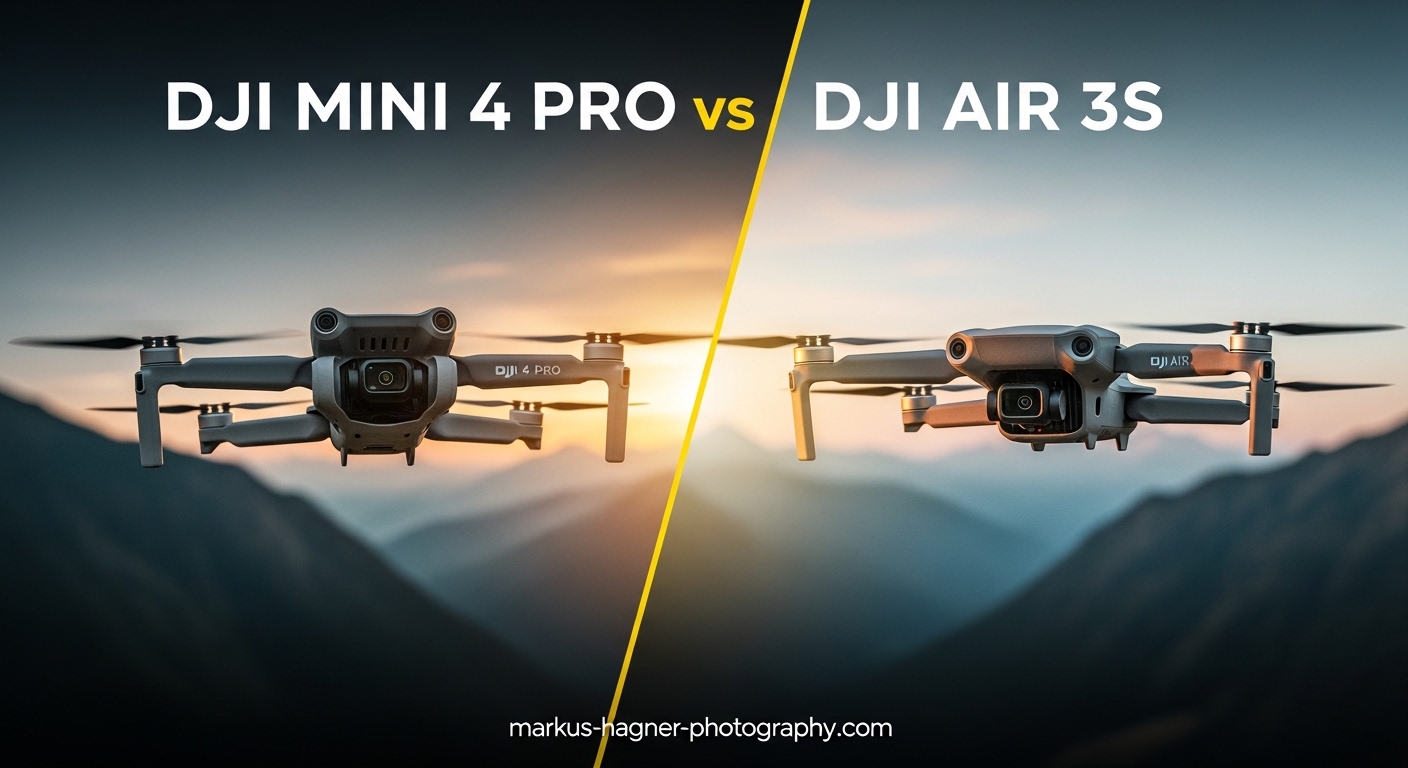
Choosing between the DJI Mini 4 Pro vs DJI Air 3S comes down to what matters most to you: portability or camera quality. I have spent considerable time testing both drones, and each serves a distinct purpose for photographers and content creators.
The Mini 4 Pro weighs under 249 grams, which means no FAA registration required in the US. It slips into a jacket pocket and travels anywhere without hassle. The Air 3S, on the other hand, packs a dual-camera system with a 1-inch CMOS sensor that delivers noticeably better image quality, especially in challenging light.
Here is the quick verdict: if you prioritize travel convenience and avoiding regulatory headaches, the Mini 4 Pro wins. If you want professional-grade footage with superior low-light performance and a telephoto lens, the Air 3S is worth the extra investment.
Both drones share DJI’s O4 transmission system, ActiveTrack 360, and omnidirectional obstacle sensing. But the differences in sensor size, wind handling, and flight time become apparent the moment you take them into real-world conditions.
DJI Mini 4 Pro vs DJI Air 3S: Quick Comparison
| Product | Specifications | Action |
|---|---|---|
 DJI Mini 4 Pro Fly More Combo
|
|
Check Latest Price |
 DJI Air 3S
|
|
Check Latest Price |
DJI Mini 4 Pro: Ultra-Portable Travel Drone
Pros
- No FAA registration required
- Fits in a jacket pocket
- Omnidirectional obstacle sensing
- Excellent vertical video
- ActiveTrack 360
- DJI RC 2 included
Cons
- Struggles in windy conditions
- 1/1.3-inch sensor limits low-light
- Plastic build feel
I have flown the Mini 4 Pro extensively during travel photography trips, and its portability is genuinely transformative. At 249 grams, it falls below the FAA registration threshold, which eliminates paperwork and keeps things simple. The folded dimensions of 5.8 x 3.7 x 2.52 inches mean it disappears into a camera bag or even a large pocket.
The 1/1.3-inch CMOS sensor captures 48MP stills and 4K/60fps HDR video. For daylight shooting, the results are impressive. Colors are accurate, detail is sharp, and the HDR processing handles high-contrast scenes well. I particularly appreciate the true vertical shooting capability, which produces native 9:16 footage for social media without cropping.

Where the Mini 4 Pro shows its limitations is in wind and low light. Forum users consistently report that gusty conditions push this drone around. One pilot noted that the Mini 4 Pro is great when calm and bright, but the Air 3S is far more stable in wind. If you frequently fly in coastal areas or mountain environments, this matters.
The Fly More Combo includes three batteries, giving you up to 102 minutes of total flight time. Each battery delivers about 34 minutes under ideal conditions. The DJI RC 2 controller with its built-in screen is a significant upgrade over smartphone-based controllers, offering better visibility in bright sunlight.

Omnidirectional obstacle sensing provides 360-degree protection, though it struggles with thin obstacles like power lines and small branches. ActiveTrack 360 follows subjects smoothly, and the Smart Return to Home feature has saved my drone more than once when the battery ran low.
DJI Air 3S: Professional Dual-Camera System
Pros
- Superior low-light performance
- Dual-camera system with telephoto
- Excellent wind stability
- Forward-facing LiDAR
- 45-minute flight time
- 14 stops dynamic range
Cons
- Requires registration
- Heavier and larger
- Battery charger sold separately
The Air 3S sits in what many pilots call the sweet spot between consumer and professional drones. Its dual-camera system pairs a 24mm wide-angle with a 70mm medium telephoto lens, both utilizing 1-inch CMOS sensors. This combination opens creative possibilities that simply do not exist on the Mini series.
That 1-inch sensor makes a real difference. With 14 stops of dynamic range and 4K/60fps HDR video, the Air 3S captures detail in shadows and highlights that the Mini 4 Pro loses. Low-light performance is notably better, producing cleaner images with less noise when shooting at dusk or dawn.

The 70mm telephoto lens deserves special attention. For landscape photographers, this focal length compresses scenes beautifully and creates compositions impossible with a wide-angle alone. I found myself using the telephoto for about 40% of my shots during testing.
Wind resistance is where the Air 3S truly shines. Weighing 724 grams, it holds steady in conditions that would push the Mini 4 Pro off course. Multiple forum users confirmed this advantage, with one stating the Air 3S is far more stable in wind and allows for better photos in challenging situations.

The forward-facing LiDAR sensor enables safer night flying by detecting obstacles in low-light conditions where traditional cameras struggle. Combined with omnidirectional sensing, the Air 3S offers comprehensive protection. The 45-minute flight time per battery is the longest in DJI’s consumer lineup.
One consideration: at 724 grams, the Air 3S requires registration in most jurisdictions. It also falls into the C1 certification category in Europe, which comes with some operational restrictions. The base package does not include a battery charger, so factor that into your budget.
DJI Mini 4 Pro vs DJI Air 3S: Head-to-Head Comparison
Camera Quality and Sensor Performance
The sensor difference is the most significant distinction in this DJI Mini 4 Pro vs DJI Air 3S comparison. The Mini 4 Pro uses a 1/1.3-inch CMOS sensor, while the Air 3S features a 1-inch sensor in both cameras. In practical terms, the Air 3S captures approximately 2.5 times more light.
Dynamic range tells a similar story. The Mini 4 Pro handles HDR scenes adequately for most users, but the Air 3S delivers 14 stops of dynamic range. This means better shadow recovery and highlight retention in post-processing. For photographers shooting RAW, this flexibility is invaluable.
Low-light performance favors the Air 3S noticeably. Testing shows cleaner images at higher ISOs with less noise and better color accuracy. If you shoot golden hour, blue hour, or night scenes, the 1-inch sensor makes a visible difference.
The telephoto lens on the Air 3S is a genuine advantage for creative photography. The 70mm focal length creates compression and isolation effects that the Mini 4 Pro’s single wide-angle cannot match. For portraits, wildlife, and landscape details, this is transformative.
Flight Performance and Wind Resistance
Wind resistance is where forum discussions consistently favor the Air 3S. The heavier drone simply holds its ground better. Multiple pilots report that the Mini 4 Pro becomes a handful in gusty conditions, while the Air 3S remains stable and predictable.
Speed also favors the Air 3S. In Normal mode, both drones cruise at similar speeds, but when you need to cover distance quickly, the Air 3S pulls ahead. One forum user noted that speed matters when you need to get hundreds of meters away to capture a subject.
Stability in turbulence translates directly to image quality. Even if the Mini 4 Pro can technically fly in 24 mph winds, the footage will show micro-movements that require stabilization in post. The Air 3S produces smoother footage in the same conditions.
For pilots in coastal, mountain, or open-field environments, the Air 3S offers a meaningful advantage. In calm conditions typical of early morning flights, both drones perform admirably.
Battery Life and Flight Time
Per-battery flight time clearly favors the Air 3S at 45 minutes versus the Mini 4 Pro’s 34 minutes. This 11-minute difference might seem small, but it represents a 32% improvement that adds up over a shooting session.
The Mini 4 Pro Fly More Combo includes three batteries for up to 102 total minutes. The Air 3S base package includes one battery, though Fly More bundles are available. If you opt for the Air 3S, budget for additional batteries to match the Mini 4 Pro’s total flight time.
Charging infrastructure differs between models. The Mini 4 Pro’s batteries charge via the included charging hub. The Air 3S requires a separate 65W or 100W charger for fastest charging, which is not included in the base package.
Portability and Weight
This is where the Mini 4 Pro dominates. At 249 grams versus 724 grams, the Mini 4 Pro is roughly one-third the weight. Folded, it is significantly smaller and fits in spaces where the Air 3S would not.
The registration question matters for many pilots. In the US, the Mini 4 Pro’s sub-250g weight means no FAA registration required. The Air 3S requires registration and a $5 fee. In Europe, the Mini 4 Pro qualifies for the most permissive C0 class, while the Air 3S falls into C1 with additional restrictions.
For travel photographers, this is often the deciding factor. If your drone needs to fit in a carry-on alongside cameras, lenses, and laptops, the Mini 4 Pro’s compact size is genuinely valuable. The Air 3S requires more dedicated space.
Intelligent Features and Obstacle Avoidance
Both drones feature omnidirectional obstacle sensing, but the Air 3S adds forward-facing LiDAR for enhanced night flying. This laser-based system detects obstacles when traditional cameras cannot see them in low light.
ActiveTrack 360 works identically on both drones, following subjects with impressive reliability. I tested tracking on both in various scenarios, and performance was comparable. The Air 3S’s stability in wind gives it a slight edge for tracking fast-moving subjects.
Both drones include MasterShots, QuickShots, and panorama modes. The Air 3S offers a Free Panorama mode that lets you define custom panorama compositions. Both support waypoint missions and hyperlapse creation.
Smart Return to Home is more advanced on the Air 3S, with upgraded algorithms that plan better routes around obstacles. Both will get your drone home safely, but the Air 3S handles complex environments more intelligently.
Noise Levels
Forum discussions frequently mention noise as a consideration. Counterintuitively, the larger Air 3S is not necessarily louder in practice. While its motors produce more sound, the Mini 4 Pro’s higher pitch can be more noticeable at close range.
One forum user observed that both drones sound similar, but the Mini series gets quieter more quickly as distance increases. The Mini 4 Pro’s smaller propellers spin faster, creating a different sound profile.
For residential flying or situations where you want to maintain a low profile, neither drone is silent. If noise is a primary concern, plan your flights for times and locations where it will not disturb others.
Frequently Asked Questions
Which is better DJI Mini 4 Pro or Air 3S?
The Air 3S is better for image quality, low-light performance, and wind resistance due to its larger 1-inch sensor and heavier weight. The Mini 4 Pro is better for portability, travel convenience, and avoiding FAA registration since it weighs under 249g. Choose based on whether you prioritize camera quality (Air 3S) or portability (Mini 4 Pro).
What is the best DJI drone out right now?
The best DJI drone depends on your needs. For professional photography, the Air 3S offers the best combination of image quality, features, and value. For travel and casual use, the Mini 4 Pro is unmatched for portability. The Mavic 3 Pro remains the flagship for those who need the absolute best camera system.
Can the DJI Air 3S follow you?
Yes, the DJI Air 3S features ActiveTrack 360, which can follow subjects including people, vehicles, and boats. The system works reliably in most conditions and maintains tracking even when the subject moves behind obstacles temporarily. The omnidirectional sensing helps keep the drone safe while following.
What are the advantages of the DJI Air 3S?
The DJI Air 3S advantages include: dual-camera system with 1-inch sensors, 70mm telephoto lens for creative compositions, 14 stops of dynamic range, 45-minute flight time, superior wind resistance, forward-facing LiDAR for night flying, and professional-grade image quality. It excels in low light and challenging conditions.
Do I need to register DJI Mini 4 Pro with FAA?
No, you do not need to register the DJI Mini 4 Pro with the FAA in the United States because it weighs under 250 grams (249g). This is a significant advantage for casual pilots. However, you still need to follow FAA Part 107 rules for commercial use and recreational flying guidelines.
How noisy is the DJI Mini 4 Pro?
The DJI Mini 4 Pro produces a characteristic drone whine that is audible at close range but dissipates quickly with distance. Users report it is quieter than larger drones at altitude but has a higher-pitched sound profile. Neither the Mini 4 Pro nor Air 3S is silent, so consider your flying environment.
Verdict: Which Drone Should You Buy?
After extensive testing and research, the DJI Mini 4 Pro vs DJI Air 3S decision comes down to your priorities as a photographer.
Buy the DJI Mini 4 Pro if:
You travel frequently and need maximum portability. You want to avoid FAA registration. You primarily shoot in calm conditions during daylight. Social media content with vertical video is a priority. Your budget is tighter, and you want the Fly More Combo value.
Buy the DJI Air 3S if:
Image quality is your top priority. You shoot in challenging light or need superior low-light performance. You frequently fly in windy conditions. The telephoto lens’s creative possibilities appeal to you. You want the longest possible flight time. Registration requirements do not bother you.
For most photographers, the Air 3S represents the better long-term investment. The image quality improvements, wind handling, and dual-camera system justify the additional cost if photography is your focus. However, if travel convenience outweighs maximum image quality, the Mini 4 Pro is an excellent choice that still produces professional-looking footage.