
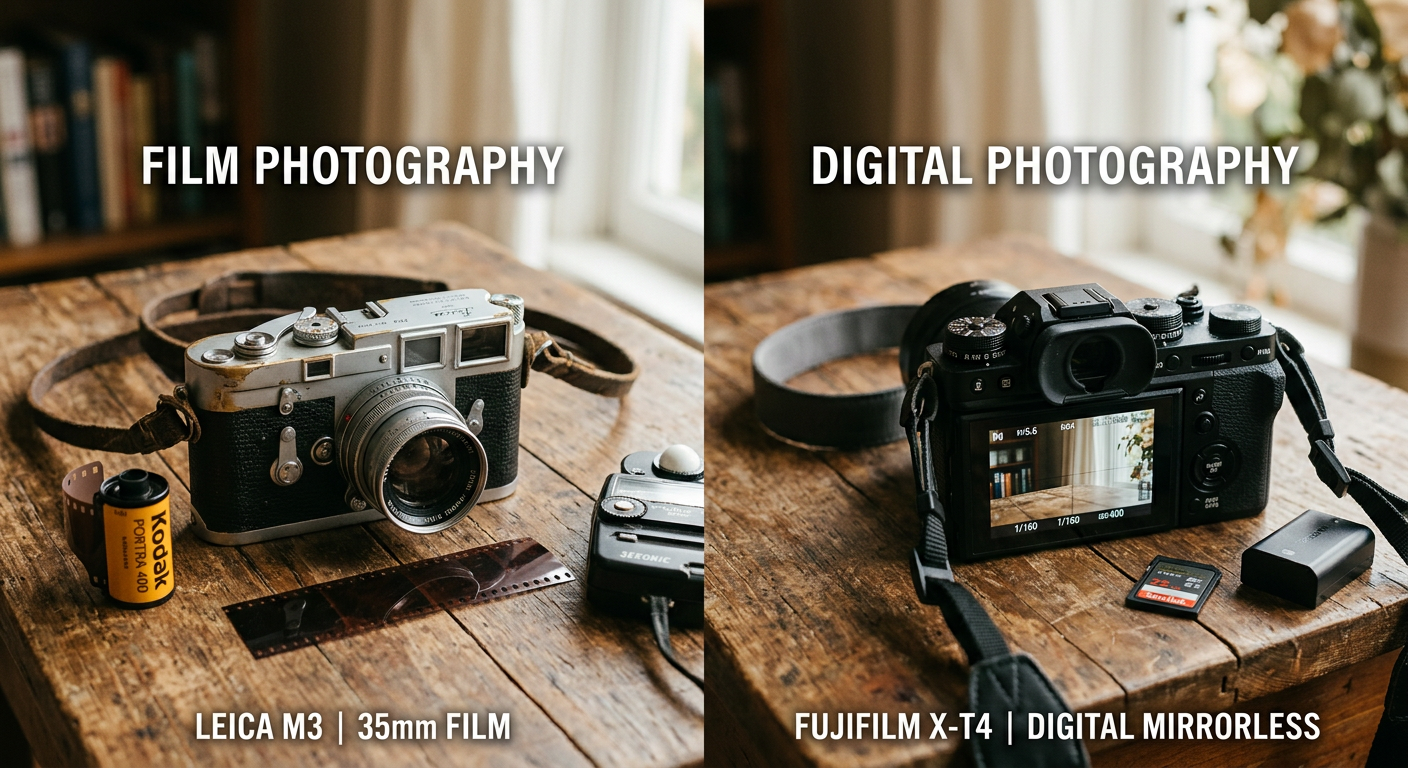
The film photography vs digital photography debate has been running for decades, and it shows no signs of stopping. After spending 15 years shooting both mediums across weddings, landscapes, and street photography, I’ve developed a practical perspective that cuts through the purist arguments on both sides.
Film photography captures images on light-sensitive chemical emulsion, requiring development in a lab before you see results. Digital photography uses electronic sensors to convert light directly into data you can view instantly. Neither approach is objectively better, but each serves different creative goals, budgets, and shooting styles.
In 2026, this conversation feels more relevant than ever. Film has experienced a remarkable renaissance among Gen Z photographers seeking tangible, analog experiences in our screen-saturated world. Meanwhile, digital cameras have reached unprecedented resolution and dynamic range capabilities. Understanding both mediums helps you choose the right tool for your vision.
Here’s my quick verdict after thousands of frames on each: digital wins for learning, commercial work, and high-volume shooting. Film wins for intentional creative projects, unique aesthetics, and the meditative experience many photographers crave. Most working photographers I know eventually end up using both.
Film Photography vs Digital Photography: Quick Comparison
Let me break down the fundamental differences between these two approaches. This comparison covers the key factors most photographers consider when choosing between film and digital.
| Feature | Film Photography | Digital Photography |
|---|---|---|
| Capture Method | Chemical reaction on light-sensitive emulsion | Electronic sensor converts light to data |
| Immediate Feedback | None until development (hours to weeks) | Instant preview on LCD screen |
| Cost Structure | Low equipment, high per-shot cost ($1-2/shot) | High equipment, near-zero per-shot cost |
| Shots Per Session | Limited (24-36 per roll) | Unlimited (memory card capacity) |
| Dynamic Range | Excellent highlight retention, forgiving exposure | Great shadow recovery, can clip highlights |
| Resolution | Determined by film format and scan quality | Fixed by sensor (20-60MP typical) |
| ISO Performance | Grain increases with speed, remains pleasing | Digital noise increases, less aesthetic |
| Color Rendering | Unique character per film stock | Neutral, requires post-processing |
| Workflow Speed | Days to weeks for final images | Minutes to hours for final images |
| Equipment Durability | Mechanical cameras last decades | Electronics may become obsolete |
| Learning Curve | Steep, forces mastery of fundamentals | Gentle, allows experimentation |
| Post-Processing | Limited after development | Extensive RAW editing options |
Key Takeaway: Film prioritizes the experience and unique aesthetic at the cost of speed and money. Digital prioritizes efficiency, flexibility, and volume at the cost of that tangible, intentional feeling many photographers treasure.
The Fundamental Difference in Experience
Shooting film feels different from the moment you pick up the camera. You’re working with a mechanical tool that operates without batteries (in many cases), requires manual focus, and demands deliberate exposure decisions. Each shutter press costs money and uses one of your limited frames.
Digital photography offers immediate gratification. You can check exposure, composition, and focus instantly. You can shoot hundreds of frames without additional cost. The camera can handle focus, exposure, and even subject tracking automatically. This efficiency comes with a trade-off: the shooting experience can feel more clinical.
Why This Comparison Matters in 2026
The photography landscape has shifted dramatically. Film camera prices have surged as demand from younger photographers outstrips the supply of working vintage equipment. Film stock prices have increased significantly, with color negative film now costing $15-25 per roll before processing.
Simultaneously, digital cameras have matured. Full-frame mirrorless cameras now offer 40-60 megapixels, incredible autofocus systems, and video capabilities that rival cinema cameras. The gap between what film and digital can achieve has narrowed in some areas while widening in others.
Image Quality and Technical Performance
Image quality comparisons between film and digital reveal fascinating trade-offs rather than clear winners. Each medium excels in different technical areas, and understanding these differences helps you match the right tool to your creative goals.
Resolution and Detail Rendering
Digital resolution is straightforward: your sensor has a fixed number of photosites that determine maximum resolution. A 45-megapixel camera captures 45 megapixels of data, period. Modern full-frame cameras routinely deliver 40-60 megapixels, with medium format digital reaching 100 megapixels or more.
Film resolution is more complex. A 35mm frame scanned at high resolution can yield 20-40 megapixels of usable detail, depending on the film stock and scanner quality. Medium format film (6×4.5cm, 6x6cm, 6x7cm) can resolve significantly more detail than most digital cameras, with some estimates suggesting 80-100+ megapixel equivalence for 6×7 format.
In my experience shooting both, 35mm film produces roughly comparable detail to a 24-megapixel digital camera when scanned professionally. Medium format film genuinely out-resolves most digital systems I’ve used, but at the cost of larger, heavier equipment and higher per-shot expenses.
Dynamic Range and Exposure Latitude
Dynamic range refers to how many stops of light a medium can capture from deepest shadow to brightest highlight. This is where film and digital take fundamentally different approaches.
Color negative film excels at highlight retention. Overexpose by 2-3 stops, and you can often recover beautiful highlight detail during scanning. This “exposure latitude” makes film forgiving for challenging lighting situations. Shadows tend to block up, but the highlight rolloff creates a pleasing, organic transition that many photographers prefer.
Digital sensors handle shadows better than highlights. Underexpose by 3-4 stops, and modern RAW files often allow clean shadow recovery. Overexpose highlights, however, and they clip permanently to pure white with harsh transitions. This means digital photographers must protect highlights more carefully than film shooters.
My practical takeaway: film forgives overexposure, digital forgives underexposure. Both can capture roughly 12-14 stops of dynamic range in optimal conditions, but they handle exposure errors differently.
Grain vs Digital Noise
The texture added by higher ISO settings differs fundamentally between film and digital, and this difference significantly impacts the final aesthetic.
Film grain is a physical property of the silver halide crystals or dye clouds in the emulsion. It has an organic, random structure that many photographers find pleasing. Even at high ISOs (3200-6400 on pushed film), the grain has character and can enhance the mood of an image rather than detract from it.
Digital noise results from electronic interference and small signal variations in the sensor. It tends to be more uniform and less organic than film grain. Modern noise reduction algorithms have improved dramatically, but aggressive noise reduction can also reduce detail and create plastic-looking skin tones.
In my work, I often add film grain to digital images in post-processing to give them more texture and character. I rarely wish for digital noise characteristics when shooting film.
Color Rendering and Film Stocks
One of film’s most celebrated qualities is its unique color rendering. Each film stock has a distinctive “look” that defines the image character.
Kodak Portra 400 delivers warm skin tones, soft contrast, and excellent highlight handling. It’s become the gold standard for portrait and wedding photography on film.
Kodak Ektar 100 offers saturated colors and fine grain, ideal for landscape and product photography where vibrant, punchy results are desired.
Fujifilm Velvia 50 (discontinued but still available) produces incredibly saturated colors favored by landscape photographers for decades.
Ilford HP5 Plus and Kodak Tri-X are classic black and white films with distinctive grain structures and tonal rendering that define the “film look” most people recognize.
Digital cameras capture relatively neutral color that requires post-processing to achieve a specific look. You can mimic film stocks with presets and profiles, but many photographers argue that genuine film has subtle qualities in color transition and highlight rendering that remain difficult to replicate perfectly.
Workflow: From Shooting to Final Output
The complete workflow from pressing the shutter to holding a finished image differs dramatically between film and digital photography. Understanding these differences helps you choose the medium that fits your timeline and working style.
The Film Photography Workflow
Film photography demands patience and planning. Here’s what the typical process looks like:
1. Preparation: You load film into your camera before shooting, committing to a specific ISO and color palette for the entire roll (24-36 frames). Changing film type mid-shoot requires finishing or wasting the current roll.
2. Shooting: Each exposure requires careful consideration of exposure, focus, and composition. You cannot check your results until development. Many film photographers use external light meters and take notes about their settings.
3. Development: After shooting, you send or bring your film to a lab (or develop it yourself). Standard color development (C-41) typically takes 1-3 business days at professional labs. Black and white development varies by lab.
4. Scanning: Your negatives must be scanned to create digital files. Scan quality significantly impacts final image quality. Professional scans cost more but capture more detail and dynamic range than budget scans.
5. Post-Processing: Film scans typically require some color correction, exposure adjustment, and dust removal. The extent depends on the scan quality and your aesthetic preferences.
Total time from shooting to final image: typically 3-10 days for lab processing, longer if you mail film to a specialized lab.
The Digital Photography Workflow
Digital offers immediate results and streamlined processing:
1. Preparation: Insert a memory card, set your ISO, and you’re ready to shoot. You can change ISO and white balance between every shot if desired.
2. Shooting: Review images immediately on the LCD. Check focus, exposure, and composition. Use histogram displays to verify exposure accuracy. Shoot as many frames as your memory cards allow.
3. Import: Transfer images to your computer, typically within hours of shooting. Many photographers import and begin editing the same day.
4. Culling: Review hundreds of images and select the best shots. Software like Photo Mechanic or Lightroom makes this process efficient.
5. Post-Processing: Edit RAW files to adjust exposure, color, contrast, and apply your creative vision. Presets and profiles can speed up the process for consistent results.
Total time from shooting to final image: hours to days, depending on your volume and editing style.
The Anticipation Factor
One aspect of film workflow that its advocates treasure is the anticipation. Waiting for scans to arrive creates excitement and surprise that digital’s immediacy cannot replicate. Many photographers describe the feeling of opening a scan email as similar to receiving gifts.
This delayed gratification also changes how you remember shoots. With film, you recall the experience of making photographs rather than immediately reviewing them. Some photographers find this creates a stronger emotional connection to their work.
Time Investment Comparison
While digital provides faster results, the total time investment can be comparable. Film photographers spend less time culling (because they shoot fewer frames) and less time post-processing (because film stocks provide a “baked-in” look). Digital photographers spend more time at the computer sorting and editing.
For a typical portrait session, I might shoot 300 digital frames and spend 2-3 hours editing. With film, I’d shoot 4-6 rolls (100-200 frames) and spend 30 minutes making minor adjustments to scans. The film approach costs more but demands less screen time.
Cost Breakdown: Equipment, Film, and Long-Term Investment
Cost is often the deciding factor for photographers choosing between film and digital. The cost structures are fundamentally different, making direct comparison challenging but essential.
Initial Equipment Investment
Film cameras offer excellent value for the features they provide. A fully mechanical 35mm SLR from the 1980s can cost $200-500 and deliver professional-quality images. These cameras often feature metal construction, bright viewfinders, and complete manual control without requiring batteries.
Medium format film cameras provide larger negatives (and thus higher potential resolution) at a fraction of the cost of digital medium format. A Mamiya 645 or Bronica system can be acquired for $500-1500, while a digital medium format camera starts around $5000 and can exceed $10,000.
Digital cameras require significant upfront investment. A quality full-frame mirrorless camera body costs $2000-4000. Adding lenses, memory cards, and other accessories easily pushes the total over $5000 for a professional kit. However, this investment provides unlimited shooting capacity with no per-shot cost.
Cost Per Shot Analysis (2026 Prices)
Here’s where film’s ongoing costs become apparent. Current film photography costs in 2026 break down approximately as follows:
35mm Color Negative Film:
- Film purchase: $15-25 per roll (36 exposures)
- Development and basic scan: $10-18 per roll
- High-quality scan: $20-40 per roll
- Total per roll: $25-65
- Cost per shot: $0.70-1.80
Medium Format (120) Film:
- Film purchase: $12-20 per roll (12-16 exposures depending on format)
- Development and basic scan: $12-20 per roll
- High-quality scan: $25-50 per roll
- Total per roll: $24-70
- Cost per shot: $1.50-5.80
For comparison, digital photography costs essentially zero per shot after your initial equipment investment. A $3000 camera used for 50,000 shots costs $0.06 per frame in equipment depreciation alone.
Long-Term Cost Comparison
Let’s compare costs over one year of moderate photography (2,000 shots):
Film Photography:
- Camera purchase (one-time): $400
- 56 rolls of film at $20 each: $1,120
- Development and scanning at $15 per roll: $840
- Year One Total: $2,360
- Year Two (no camera purchase): $1,960
Digital Photography:
- Camera body and lens: $3,500
- Memory cards and storage: $150
- Year One Total: $3,650
- Year Two (no major purchases): $50
The crossover point comes around 3-4 years of regular shooting. Digital costs more upfront but becomes more economical over time. Film costs less initially but continues costing money indefinitely.
Budget Considerations for Beginners
For photographers on tight budgets, digital typically makes more financial sense. The ability to shoot thousands of frames while learning, receive instant feedback, and make mistakes without financial penalty accelerates skill development.
Film can work for budget-conscious photographers who shoot sparingly and savor each frame. A $300 film camera and 20 rolls of film per year costs less than most digital kits. The key is honest self-assessment: will you actually shoot less, or will the medium’s limitations frustrate you?
Learning Curve and Skill Development
How you learn photography differs substantially between film and digital. Each medium teaches different lessons and suits different learning styles.
What Film Teaches You
Film photography forces mastery of fundamentals because mistakes are costly and invisible until development. You must understand:
Exposure: Without instant feedback, you develop an intuitive understanding of aperture, shutter speed, and ISO relationships. Many experienced film photographers can estimate exposures accurately without meters.
Light: Film’s limited dynamic range (especially slide film) teaches you to read light and position yourself relative to it. You learn to see contrast and anticipate how it will render.
Composition: With only 36 frames per roll, you compose more carefully. The constraint encourages intentional framing and eliminates the “spray and pray” approach.
Patience: Waiting for development builds patience and separates the experience of shooting from the experience of reviewing.
What Digital Teaches You
Digital’s instant feedback accelerates learning through immediate reinforcement:
Cause and Effect: Make an exposure mistake, see it immediately, correct it on the next shot. This tight feedback loop helps internalize technical concepts quickly.
Experimentation: Try unusual techniques without cost penalty. Long exposures, multiple exposures, extreme angles—digital invites play.
Post-Processing: Digital necessitates learning editing software, which develops your eye for color, contrast, and tonal relationships. These skills transfer to evaluating any photograph.
Volume Management: Shooting hundreds of frames teaches you to cull ruthlessly and identify what makes one image stronger than another.
The Mistake Tolerance Factor
Digital forgives mistakes generously. A badly exposed shot costs nothing but the time to delete it. Film punishes mistakes with wasted money and missed moments. This difference significantly impacts the learning experience.
For beginners, digital’s forgiveness reduces anxiety and encourages experimentation. You can photograph the same subject 50 different ways and discover what works. With film, anxiety about wasting shots can inhibit creativity.
However, some photographers argue that film’s consequences create stronger discipline. When every frame matters, you think more carefully about every decision. This intentionality can become a permanent habit that improves your digital photography too.
Mental Health and Creative Benefits
An often-overlooked aspect of this comparison is the psychological experience of each medium. Forum discussions and personal experience reveal meaningful differences.
Film as Mindful Practice: Many photographers describe film as a form of meditation. The mechanical process—advancing film, manually focusing, winding shutters—creates a tactile, present-moment experience. Without an LCD to check, you remain connected to your subject rather than your screen.
Film as Digital Detox: For photographers who spend their workdays at computers, film offers a creative practice entirely separate from screens. The camera requires no charging, no menu diving, no firmware updates. It simply works.
Digital as Efficient Tool: Digital excels when photography is work rather than meditation. Wedding photographers, photojournalists, and commercial shooters benefit from digital’s speed and reliability. The tool gets out of the way when efficiency matters.
Recommendation for Beginners
Based on my experience teaching photography and watching students progress, I recommend digital for most beginners. The instant feedback accelerates learning dramatically, and the lack of per-shot cost removes a significant barrier to practice.
That said, motivated beginners with patience and discipline can learn successfully on film. Some photography schools still require film for introductory courses because it forces fundamental understanding. The key is matching the medium to your personality and learning style.
How to Choose the Right Medium for Your Photography
By now you understand the technical, financial, and experiential differences between film and digital. Here’s a practical framework for choosing which medium suits your specific situation.
When Film Is the Better Choice
Consider film photography when:
You want intentional, slow photography: If you’re seeking a more contemplative, deliberate practice that forces you to slow down and consider each frame carefully, film delivers this naturally.
You love the film aesthetic: If you find yourself adding film grain presets to digital images and admiring the unique color rendering of specific film stocks, shooting actual film gives you that look authentically.
You’re photographing special occasions mindfully: For travel, personal projects, and meaningful life events where the experience of photographing matters as much as the results, film creates tangible memories.
You want archival negatives: Properly stored film negatives can last 100+ years without format obsolescence. Digital files require migration and backup diligence.
You enjoy mechanical cameras: If you appreciate well-made tools with tactile controls, manual focus, and no battery dependence, vintage film cameras offer an experience modern digital cannot match.
When Digital Is the Better Choice
Consider digital photography when:
You’re learning photography: The instant feedback loop accelerates skill development. You can experiment freely and correct mistakes immediately.
You shoot professionally: Clients expect quick turnaround. Commercial work, events, and photojournalism demand digital’s speed and reliability.
You need high volume: Sports, wildlife, and any situation requiring hundreds of frames makes film prohibitively expensive for most photographers.
You require video: Digital cameras offer excellent video capabilities. Film motion picture cameras exist but require specialized knowledge and significant budget.
You need low-light performance: Modern digital cameras can shoot cleanly at ISO 12,800 or higher. High-speed film (ISO 3200+) produces visible grain and costs more.
You want extensive post-processing control: RAW files offer tremendous flexibility for adjusting exposure, color, and tone after capture. Film scans allow adjustments but within more constrained limits.
The Hybrid Approach
Many experienced photographers eventually adopt both mediums, using each for its strengths. Common hybrid strategies include:
Film for personal work, digital for professional work: This approach lets you earn income with digital’s efficiency while maintaining film as a creative practice without commercial pressure.
Digital for coverage, film for special moments: Wedding photographers sometimes shoot digital for the bulk of coverage and add a few rolls of film for key moments like portraits and ceremonies.
Medium format film for ultimate quality: Some photographers use digital for convenience but break out medium format film when maximum resolution and image quality matter most.
Digital for learning, film for mastery: Beginners can start with digital, then add film later to deepen their understanding and slow their process.
Use Case Recommendations
Here are my specific recommendations by photography type:
Wedding Photography: Digital is standard for most coverage. Film works beautifully for portraits and detail shots where its unique aesthetic adds value.
Portrait Photography: Both work well. Film creates a distinctive look clients often love. Digital offers flexibility and faster delivery.
Street Photography: Digital allows quick, candid shooting. Film forces patience and often yields fewer but more considered images. Both are valid approaches.
Landscape Photography: Large format or medium format film still out-resolves digital for those willing to carry the equipment. Digital offers convenience and the ability to bracket exposures for blending.
Travel Photography: Digital provides convenience and unlimited shooting. Film creates more intentional, memorable travel experiences but requires planning and lab access.
Commercial and Product Photography: Digital’s tethered shooting, immediate client review, and post-processing flexibility make it the professional standard.
Frequently Asked Questions
Which is better, film or digital photography?
Neither is objectively better. Film offers an intentional, tactile experience with unique aesthetic qualities and tangible negatives. Digital provides instant feedback, unlimited shooting capacity, and efficient workflow. The best choice depends on your creative goals, budget, and how you prefer to work. Many photographers use both mediums for different purposes.
What is the difference between film and digital photography?
Film photography captures images chemically on light-sensitive emulsion, requiring lab development before viewing results. Digital photography uses electronic sensors to convert light directly into digital data viewable instantly. Film has limited shots per roll (24-36) and ongoing per-shot costs. Digital allows unlimited shooting after equipment purchase with immediate review and extensive post-processing options.
Is film photography making a comeback?
Yes, film photography has experienced a significant resurgence, particularly among Gen Z photographers seeking tangible, analog experiences. Film camera prices have increased due to demand, and film stock production has expanded. The appeal lies in film’s deliberate process, unique aesthetic, and escape from screen-saturated digital life. Social media has amplified this trend through the distinctive film look.
Why is film photography so expensive?
Film photography costs stem from multiple factors: film stock prices have risen due to lower production volumes and increased demand. Color negative film now costs $15-25 per roll. Professional development and scanning adds $10-40 per roll. Each shot costs approximately $0.70-2.00 compared to essentially zero per shot with digital. Limited shots per roll (24-36) means you pay for every frame, including mistakes.
Is film or digital better for beginners?
Digital is generally better for beginners because instant feedback accelerates learning. You can experiment freely, correct mistakes immediately, and shoot thousands of frames without additional cost. Film can teach valuable discipline and fundamentals, but the lack of feedback and per-shot cost can frustrate new photographers. Many beginners start with digital, then add film once they understand basic concepts.
Does film photography look better than digital?
Film has a distinctive aesthetic that many find appealing, but it is not objectively better. Film offers organic grain structure, unique color rendering from each stock, and pleasing highlight rolloff. Digital produces sharper images with more detail and cleaner files. Film looks can be approximated digitally with presets, though purists argue genuine film has subtle qualities difficult to replicate. Preference is subjective.
Can you learn photography on film or digital?
You can learn photography on either medium successfully. Film forces mastery of exposure fundamentals because mistakes are costly and invisible until development. Digital provides instant feedback that accelerates technical learning through trial and error. Film teaches intentionality and patience; digital teaches experimentation and post-processing. Many photography educators recommend digital for beginners due to faster learning curves, but film remains valid for disciplined learners.
Final Verdict
After 15 years of shooting both film and digital photography, I’ve concluded that the film photography vs digital photography debate misses the point. These are different tools for different creative goals, not competitors where one must win.
Digital photography excels for learning, professional work, and any situation requiring efficiency, volume, or speed. Its instant feedback accelerates skill development, and the lack of per-shot costs encourages experimentation. For most photographers, especially beginners, digital is the practical choice.
Film photography offers something digital cannot replicate: an intentional, tactile experience that changes how you see and photograph the world. The medium’s constraints encourage thoughtful composition, and the distinctive aesthetic has genuine artistic value. For photographers seeking a more meditative practice or specific look, film delivers.
My recommendation? If you’re new to photography, start with digital to learn fundamentals quickly. Once you understand exposure and composition, try film to experience a different approach. Many photographers find that both mediums have a place in their creative lives. The best camera is the one that helps you make photographs you love—whether it uses film or pixels.