
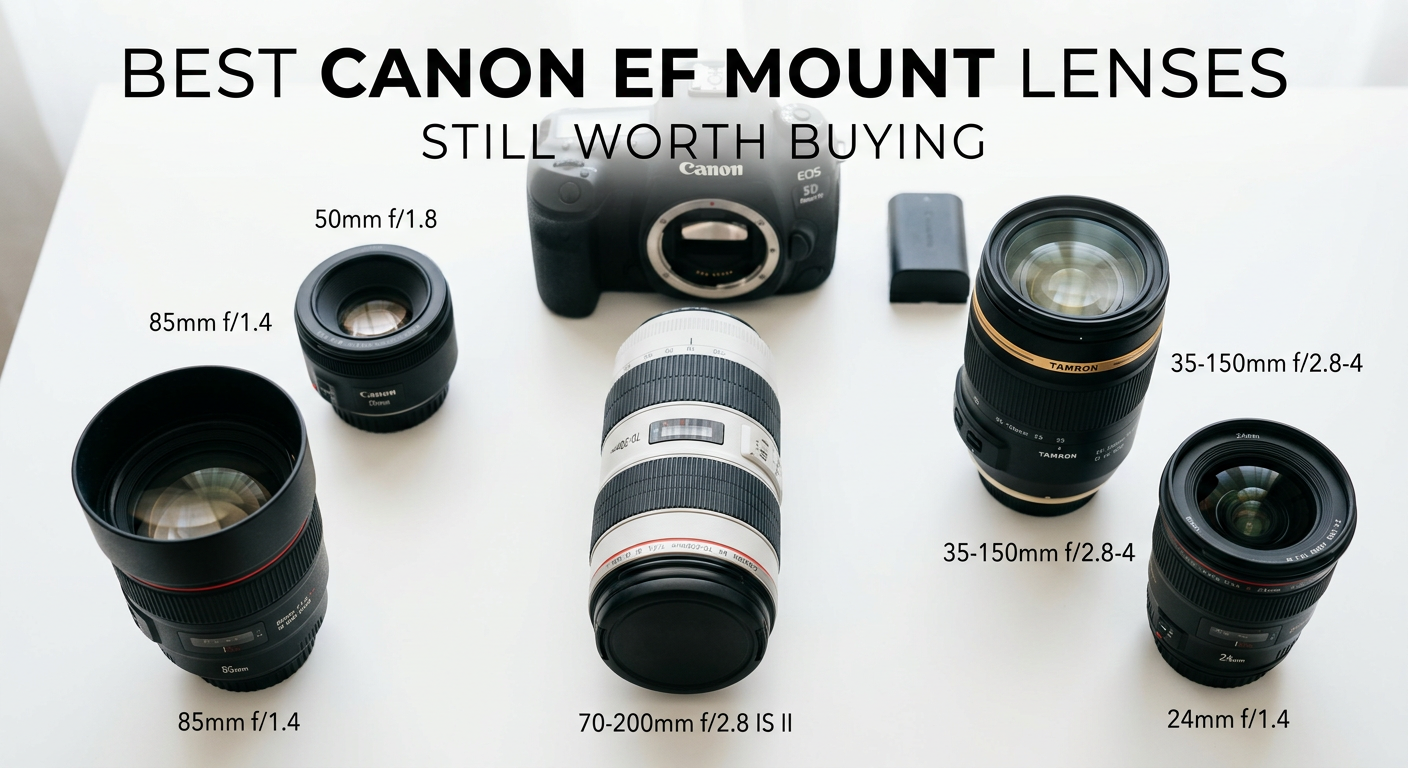
Canon’s EF mount has been the backbone of professional photography since 1987, and even as the industry shifts toward mirrorless RF mount systems, EF lenses remain incredibly relevant in 2026. Whether you’re still shooting with a Canon DSLR or have made the jump to an EOS R series mirrorless camera, the EF ecosystem offers exceptional optics at prices that make more sense than ever. The used market has made legendary L-series glass accessible to enthusiasts, while Canon’s EF-to-RF mount adapter ensures these lenses work flawlessly on modern mirrorless bodies.
After testing dozens of lenses over the years and watching the market evolve, I’ve narrowed down the eight best Canon EF mount lenses that are genuinely still worth buying. These selections balance optical quality, build construction, and current market value. Some are legendary workhorses that have defined professional photography for decades, while others represent incredible value propositions that outperform their newer RF counterparts. If you’re building a kit on a budget or looking to expand your creative options without breaking the bank, these EF lenses deserve your attention.
This guide covers everything from nifty fifty primes to professional zoom workhorses, including one third-party option that rivals Canon’s own L-series. I’ll explain who each lens is perfect for, where they fall short, and why they remain smart purchases even as Canon’s RF mount dominates new development. Let’s dive into the best Canon EF mount lenses still worth your money in 2026.
Table of Contents
- Top 3 Canon EF Mount Lenses Worth Buying in 2026
- 8 Best Canon EF Mount Lenses in 2026
- 1. Canon EF 50mm f/1.8 STM Lens – The Budget Classic
- 2. Canon EF 50mm f/1.4 USM Standard Lens – The Step-Up Prime
- 3. Canon EF 85mm f/1.8 USM Medium Telephoto Lens – Portrait Perfection
- 4. Canon EF 70-200mm f/4L IS II USM Telephoto Zoom – Professional Reach
- 5. Canon EF 100mm f/2.8L IS USM Macro Lens – The Dual-Purpose Champion
- 6. Canon EF 24-70mm f/2.8L II USM Standard Zoom – The Professional Workhorse
- 7. Canon EF 16-35mm f/4L IS USM Wide-Angle Zoom – Landscape Excellence
- 8. Sigma 35mm F1.4 Art DG HSM Lens – Third-Party Excellence
- How to Choose the Right Canon EF Lens in 2026
- FAQ
- Final Thoughts on Canon EF Lenses in 2026
Top 3 Canon EF Mount Lenses Worth Buying in 2026


Canon EF 24-70mm f/2.8L II USM
- Professional workhorse
- Constant f/2.8
- L-series build
- Sharp at all focal lengths

Sigma 35mm F1.4 Art DG HSM
- Exceptional optics
- f/1.4 aperture
- Metal construction
- USB dock compatible
8 Best Canon EF Mount Lenses in 2026
| Product | Specifications | Action |
|---|---|---|
| Canon EF 50mm f/1.8 STM |
|
Check Latest Price |
 Canon EF 50mm f/1.4 USM Canon EF 50mm f/1.4 USM |
|
Check Latest Price |
 Canon EF 85mm f/1.8 USM Canon EF 85mm f/1.8 USM |
|
Check Latest Price |
 Canon EF 70-200mm f/4L IS II USM Canon EF 70-200mm f/4L IS II USM |
|
Check Latest Price |
 Canon EF 100mm f/2.8L IS USM Macro Canon EF 100mm f/2.8L IS USM Macro |
|
Check Latest Price |
| Canon EF 24-70mm f/2.8L II USM |
|
Check Latest Price |
 Canon EF 16-35mm f/4L IS USM Canon EF 16-35mm f/4L IS USM |
|
Check Latest Price |
| Sigma 35mm F1.4 Art DG HSM |
|
Check Latest Price |
1. Canon EF 50mm f/1.8 STM Lens – The Budget Classic
Pros
- Exceptional value for money
- Creamy bokeh at f/1.8
- Smooth STM autofocus
- Compact and lightweight
Cons
- No image stabilization
- Plastic construction
- Focus-by-wire manual focus
The Canon EF 50mm f/1.8 STM is arguably the best value lens in Canon’s entire lineup. I’ve recommended this lens to countless photographers over the years, and it never fails to deliver results that far exceed its modest price point. The STM stepping motor provides near-silent autofocus that’s perfect for both stills and video, a significant upgrade over the older micro-motor versions. At just 159 grams, it’s barely noticeable in your bag, making it an ideal travel companion.
What struck me most when I first used this lens was the quality of the bokeh. The 7-blade circular aperture creates that dreamy background blur that makes subjects pop, especially at close distances. Shooting wide open at f/1.8 gives you that professional look without the professional price tag. On APS-C cameras, the effective focal length becomes 80mm, which is perfect for portraits.
Sharpness is impressive even at f/1.8, though stopping down to f/2.8 or f/4 brings out the best in this lens. The improved build quality with the metal mount feels more substantial than the previous plastic-mount version. Focus acquisition is quick in good light, though it can hunt a bit in very dim conditions since there’s no image stabilization to help with slower shutter speeds.
For anyone building their first lens kit or looking for a lightweight walkaround option, this 50mm delivers professional-looking results at an entry-level price. The combination of sharpness, bokeh quality, and STM autofocus makes it a no-brainer purchase that punches well above its weight class.
Best Use Cases for This Lens
Portrait photography on a budget is where this lens truly shines. The 50mm focal length on full-frame cameras provides a natural perspective that flatters faces without distortion. It’s also excellent for street photography, low-light indoor shooting, and casual event coverage where you want that shallow depth of field look. Video shooters will appreciate the smooth, silent STM motor during focus pulls.
This lens is particularly valuable for photographers transitioning from kit lenses who want to experience what a fast prime can do. The learning curve is minimal, and the results are immediately visible in your images. Wedding photographers often keep one of these in their bag as a lightweight backup that still delivers beautiful results.
Who Should Skip This Lens
If you need image stabilization for handheld low-light work, the lack of IS will be frustrating. Sports and wildlife photographers will find the focal length too short for most applications. Professionals who demand weather sealing and rugged construction should look at the L-series alternatives. Additionally, if you primarily shoot video and need full-time manual focus override with tactile focus rings, the focus-by-wire system may feel imprecise.
2. Canon EF 50mm f/1.4 USM Standard Lens – The Step-Up Prime
Pros
- Fast f/1.4 aperture
- Quick USM autofocus
- Superior build quality
- Full-time manual focus
Cons
- No image stabilization
- Older design
- Average low-light AF
Stepping up from the f/1.8 version, the Canon EF 50mm f/1.4 USM offers that extra stop of light gathering and a more robust build that serious photographers appreciate. I’ve used this lens extensively for portrait sessions and low-light events, and the f/1.4 aperture makes a noticeable difference when light gets scarce. The ring-type USM autofocus is quick and decisive, with full-time manual focus override that the STM version lacks.
The build quality feels more substantial in hand, with a metal mount and better overall construction. The 8-blade diaphragm produces pleasing bokeh that rivals much more expensive lenses. While it’s showing its age compared to newer designs, the optical quality remains competitive, especially when stopped down slightly from wide open.
In practice, the extra light transmission at f/1.4 means you can shoot at lower ISOs in dim conditions, resulting in cleaner files. The depth of field is incredibly shallow at f/1.4, which creates beautiful subject isolation but also demands precise focus technique. The super multi-layer coating helps control flare and maintains contrast in backlit situations.
This lens occupies a sweet spot between the budget f/1.8 and the expensive f/1.2L. For photographers who want better build quality and that extra stop of aperture without the L-series price tag, it remains a compelling choice in 2026.
Ideal Photography Styles
Available light photography is where this lens excels. The fast f/1.4 aperture lets you capture images in conditions where slower lenses would require flash or unacceptable ISO settings. Portrait photographers will appreciate the extremely shallow depth of field for creative effects. Documentary and street photographers benefit from the compact size and quick autofocus response.
Event photography, particularly weddings and indoor gatherings, is another strong suit. The ability to shoot at f/1.4 or f/2 without flash while maintaining fast shutter speeds makes this lens invaluable for candid moments in challenging lighting.
Drawbacks to Consider
The older micro-USM design can hunt in very low contrast situations, sometimes slower than the newer STM technology. There’s no weather sealing, so outdoor photographers in wet conditions should be cautious. The lens design dates back several decades, meaning optical coatings and correction technologies lag behind modern alternatives. Some users also report durability concerns with the focus mechanism over extended heavy use.
3. Canon EF 85mm f/1.8 USM Medium Telephoto Lens – Portrait Perfection
Pros
- Exceptional portrait quality
- Fast USM autofocus
- Compact for focal length
- Outstanding value
Cons
- No image stabilization
- No included hood
- Chromatic aberration wide open
Often called “the portrait lens that should have an L designation,” the Canon EF 85mm f/1.8 USM has been a favorite among portrait photographers for years. I’ve always been impressed by how this relatively affordable lens produces images with that professional separation between subject and background. The compression at 85mm flatters faces beautifully, and the f/1.8 aperture creates creamy bokeh that makes subjects stand out.
The ring-type USM autofocus is among Canon’s best, providing instant focus acquisition with full-time manual override. Unlike focus-by-wire systems, you can grab the focus ring and adjust even while in AF mode. This responsiveness makes it excellent for capturing fleeting expressions during portrait sessions.
At 425 grams, it’s substantial enough to feel professional but light enough for extended handheld shooting. The Super Spectra coating handles backlighting well, maintaining contrast even in challenging conditions. Sharpness is excellent from f/2 onwards, with the f/1.8 setting being perfectly usable for most situations.
This lens has earned its reputation through consistent performance across thousands of portrait sessions. For photographers who primarily shoot people, it offers exceptional value that rivals lenses costing twice as much.
Portrait Photography Performance
The 85mm focal length is widely considered ideal for portraits because it provides flattering facial compression without distortion. Head and shoulder portraits look natural, while three-quarter and full-body shots maintain pleasing proportions. The background blur at f/1.8 separates subjects from distracting backgrounds effectively, even at moderate distances.
Focus speed is crucial for portrait work, and this lens delivers. Catching genuine expressions requires quick AF response, and the 85mm f/1.8 rarely misses. The minimum focus distance of 2.8 feet allows for reasonably tight framing while maintaining working distance for comfortable subject interaction.
Situations Where It Falls Short
Without image stabilization, handheld shooting in low light requires careful technique or higher ISO settings. Chromatic aberration can appear in high-contrast areas when shooting wide open, though this is correctable in post-processing. The lens hood is sold separately, which feels like unnecessary cost-cutting on an otherwise excellent optic. Sports and wildlife photographers will find the focal length too short for most field applications.
4. Canon EF 70-200mm f/4L IS II USM Telephoto Zoom – Professional Reach
Pros
- Exceptional 5-stop IS
- L-series build quality
- Weather sealed
- Sharp throughout range
Cons
- No tripod collar included
- f/4 less versatile than f/2.8
- Limited track record
The Canon EF 70-200mm f/4L IS II USM represents the ideal balance between professional quality and practical portability. I’ve carried the f/2.8 version for full-day shoots, and the weight difference with this f/4 version is immediately noticeable. The 5-stop image stabilization is genuinely impressive, allowing handheld shooting at speeds I wouldn’t have thought possible for a telephoto zoom.
Canon has refined this lens significantly from the Mark I version. The improved minimum focus distance of 3.3 feet opens up near-macro possibilities that the original couldn’t achieve. The three IS modes include Mode 3 for tracking moving subjects, which activates stabilization only during exposure, making it ideal for panning shots.
Optical quality lives up to L-series expectations, with Fluorite and UD elements controlling aberrations throughout the zoom range. Sharpness remains consistent from 70mm to 200mm, even wide open at f/4. The weather-sealed construction provides confidence when shooting in adverse conditions.
For photographers who want telephoto reach without the back-breaking weight of the f/2.8 version, this lens is the answer. The image stabilization alone makes it worth considering over non-IS alternatives.
Wildlife and Sports Applications
The 70-200mm range covers most sports and wildlife situations where you can get reasonably close to the action. The fast autofocus acquisition and tracking capabilities make it suitable for moving subjects. For wildlife, pairing this with a teleconverter extends reach while maintaining acceptable image quality, though you’ll lose a stop of light.
The IS system transforms handheld wildlife photography, allowing sharp images at shutter speeds that would normally show camera shake. Bird photographers particularly appreciate the combination of reach and handholdability for capturing perched subjects.
Weight and Handling Considerations
At 780 grams, this lens is significantly lighter than the f/2.8 IS versions that weigh over 1.4 kilograms. For hiking, travel, or all-day event coverage, the weight savings matter. The white L-series finish reflects heat during outdoor shooting, though it also attracts attention. The tripod collar is sold separately, which adds cost if you need it for balanced mounting on tripods or monopods.
5. Canon EF 100mm f/2.8L IS USM Macro Lens – The Dual-Purpose Champion
Pros
- True 1:1 macro
- L-series build
- Hybrid IS system
- Excellent portrait lens
Cons
- Heavy for prime
- Slower AF than alternatives
- Limited on APS-C
The Canon EF 100mm f/2.8L IS USM Macro is what I call a “do-it-all” lens. It excels at macro photography but also produces stunning portraits, making it a versatile addition to any kit. The Hybrid IS system provides approximately 2 stops of stabilization benefit for handheld macro work, which is genuinely useful when you’re trying to capture tiny subjects without a tripod.
True 1:1 life-size magnification means subjects appear on your sensor at their actual size, revealing details invisible to the naked eye. The working distance at 1:1 is comfortable, allowing you to photograph skittish insects without spooking them. The L-series construction includes weather sealing, giving you confidence when shooting in damp conditions like morning dew scenarios.
As a portrait lens, the 100mm focal length provides flattering compression, and the f/2.8 aperture creates smooth background blur. The 9-blade diaphragm produces beautiful bokeh that rivals dedicated portrait lenses. Many photographers actually buy this lens primarily for portraits, with macro as a bonus capability.
The inner focusing system means the lens doesn’t extend during focusing, maintaining its balance and working distance. This design also allows for consistent performance with filters and close-up accessories.
Macro Photography Capabilities
The Hybrid IS system is specifically designed for macro work, compensating for both angular and shift camera movement. This technology makes handheld macro photography practical in situations where tripods are impractical. Focus stacking for extended depth of field is straightforward with the precise manual focus ring and consistent focus positioning.
The 0.99-foot minimum focus distance allows you to get close enough for true macro magnification while maintaining enough working distance for lighting and subject access. Product photographers will find this lens invaluable for detailed commercial work.
Portrait and General Use
Beyond macro, this lens serves as an excellent short telephoto for portraits and details. The focal length is ideal for headshots and tight compositions. On APS-C cameras, the effective 160mm focal length becomes quite long for portraits but excellent for candid work at events. The autofocus, while slower than some alternatives, is accurate and reliable for static subjects.
6. Canon EF 24-70mm f/2.8L II USM Standard Zoom – The Professional Workhorse
Pros
- Exceptional sharpness
- Constant f/2.8
- Professional build
- Weather sealed
Cons
- No image stabilization
- Heavy at 805g
- Premium pricing
Part of Canon’s legendary “Holy Trinity” of professional zoom lenses, the EF 24-70mm f/2.8L II USM is the standard zoom that many professionals consider essential. I’ve used this lens for everything from weddings to corporate events, and its consistency across the focal range is remarkable. The optical quality rivals prime lenses, with edge-to-edge sharpness that holds up even at f/2.8.
The redesigned Mark II version improved significantly on the original, with better corner sharpness and reduced distortion. The constant f/2.8 aperture throughout the zoom range provides consistent exposure and depth of field control. For event photographers who need to work quickly without changing lenses, this focal range covers 90% of situations.
Build quality is quintessential L-series, with weather sealing and robust construction designed for professional abuse. The zoom lock prevents barrel extension when carried, addressing a common complaint with the original version. At 805 grams, it’s substantial but manageable for extended shooting sessions.
Many photographers find this lens makes their other optics obsolete because it handles so many situations so well. The investment is significant, but for working professionals, it pays for itself through reliability and image quality.
Professional Workflow Benefits
The 24-70mm range covers wide-angle to short telephoto, eliminating the need for multiple lens changes during fast-paced events. Wedding photographers particularly value this range for covering everything from group shots to intimate moments. The consistent f/2.8 aperture means your exposure settings remain constant as you zoom, allowing for faster shooting without compensation adjustments.
The ring-type USM autofocus is instant and accurate, with full-time manual override for fine adjustments. For professionals who can’t afford missed shots, this reliability is invaluable.
Investment Considerations
The lack of image stabilization is the primary criticism, though many professionals work with strobes or in situations where shutter speed isn’t limiting. The weight becomes noticeable during all-day events, but the optical quality justifies the bulk. The 82mm filter thread matches other L-series lenses, allowing filter sharing. For photographers considering this lens, the used market offers significant savings on what remains a current professional standard.
7. Canon EF 16-35mm f/4L IS USM Wide-Angle Zoom – Landscape Excellence
Pros
- Prime-like corner sharpness
- 4-stop IS
- Lighter than f/2.8 version
- Weather sealed
Cons
- f/4 less versatile in low light
- Slight barrel distortion
- Plastic construction
The Canon EF 16-35mm f/4L IS USM fills a gap that existed in Canon’s lineup for years: a high-quality wide-angle zoom with image stabilization. I’ve always found the f/2.8 versions overkill for most landscape work, where you’re typically stopped down anyway. The f/4 version offers better corner sharpness than its faster siblings while adding IS, making it arguably more practical for most photographers.
The 4-stop image stabilization transforms handheld landscape photography. Early morning and evening shoots become possible without hauling a tripod. The IS also benefits video work significantly, smoothing out handheld footage at these wide focal lengths. For travel photographers trying to minimize gear, this lens plus a telephoto covers most situations.
Optical performance is exceptional, with corner sharpness that rivals prime lenses. Many landscape photographers actually prefer this to the f/2.8 version for its superior edge performance. The 9-blade diaphragm creates beautiful sunstars when stopped down, a consideration for landscape photographers who frequently include the sun in compositions.
The narrower lens hood design is more practical than the petal hoods on faster wide-angles, fitting better in camera bags and providing adequate shading for the intended use cases.
Landscape and Architecture Performance
The 16-35mm range covers ultra-wide to moderate wide-angle, ideal for expansive landscapes and interior architecture. At 16mm, you can capture dramatic perspectives that aren’t possible with standard zooms. The distortion is well-controlled for a lens this wide, and what distortion exists is easily corrected in post-processing.
Architecture photographers will appreciate the minimal chromatic aberration and consistent sharpness across the frame. Real estate photographers find this range perfect for capturing room interiors while maintaining natural proportions.
Video and Handheld Shooting
The combination of wide focal length and effective IS makes this lens exceptional for video work. Handheld walk-throughs and stabilized wide shots are achievable without gimbals. The stepping motor provides smooth autofocus transitions for video, though it’s not as silent as STM designs. For run-and-gun documentary work, this lens and the 24-70mm f/4 make a compact, stabilized pair.
8. Sigma 35mm F1.4 Art DG HSM Lens – Third-Party Excellence
Pros
- Exceptional optical quality
- Sharp at f/1.4
- Metal construction
- USB dock compatible
Cons
- Heavy at 665g
- No image stabilization
- May need AF calibration
The Sigma 35mm F1.4 Art DG HSM changed perceptions about third-party lenses when it launched. I remember the photography community buzzing about how Sigma had produced optics that matched or exceeded Canon’s own L-series at a lower price point. Years later, this lens still holds up as one of the sharpest 35mm options available for Canon EF mount.
Sharpness at f/1.4 is genuinely impressive, with detail resolution that many lenses can’t match even stopped down. The bokeh quality is smooth and pleasing, though the rendering character differs slightly from Canon equivalents. The metal construction feels premium and substantial, weighing in at 665 grams.
The USB dock compatibility is a standout feature, allowing photographers to fine-tune autofocus for specific camera bodies. This addresses the main criticism of earlier Sigma lenses: inconsistent autofocus calibration. With proper setup, the HSM motor provides fast, accurate focus acquisition.
For photographers who want L-series optical quality without L-series pricing, this lens represents exceptional value. It’s frequently called “the best value in high-end glass” and has earned its place among professional kits.
Optical Quality vs Canon L-Series
In direct comparisons, the Sigma 35mm Art often measures sharper than Canon’s own 35mm f/1.4L at equivalent apertures. The center resolution at f/1.4 is remarkable, and the lens maintains quality well into the corners by f/2.8. Color rendering and contrast are comparable to Canon glass, with some photographers preferring the Sigma’s rendering for certain subjects.
The Super Multi-Layer Coating handles flare well, though some users report slight vignetting at f/1.4 that’s easily corrected in post. Build quality matches professional standards, with tight tolerances and solid feel throughout.
Autofocus Reliability
Early units had inconsistent autofocus, but Sigma’s USB dock allows firmware updates and micro-adjustment per camera body. With proper calibration, focus accuracy rivals native Canon lenses. The HSM motor is quick but not quite as refined as Canon’s latest ring-type USM designs. For critical work, some photographers prefer live view focusing to ensure accuracy. The focus ring is well-damped for manual focus, though it’s electronic rather than mechanically coupled.
How to Choose the Right Canon EF Lens in 2026
Selecting the right lens depends on your camera body, shooting style, and budget. With Canon’s shift to RF mount, EF lens buyers in 2026 should consider several factors that weren’t relevant just a few years ago.
EF vs EF-S: Understanding the Difference
Canon EF lenses are designed for full-frame cameras, projecting an image circle large enough to cover a 36x24mm sensor. EF-S lenses are designed specifically for APS-C crop sensor cameras, with a smaller image circle. EF lenses work on both full-frame and APS-C bodies, while EF-S lenses only mount on crop sensor cameras. For photographers who might upgrade to full-frame later, EF lenses offer better long-term investment value.
EF-to-RF Adapter Compatibility
One of the biggest advantages of EF lenses in 2026 is their compatibility with Canon’s mirrorless EOS R cameras via the EF-to-RF mount adapter. Most EF lenses perform excellently on RF bodies, with autofocus performance often improving due to the more advanced processing in mirrorless cameras. This means your EF lens investment remains relevant even if you switch to mirrorless. The adapter adds minimal bulk and maintains full electronic communication between lens and camera.
Prime vs Zoom: Making the Choice
Prime lenses typically offer better optical quality, wider maximum apertures, and lower weight than zooms covering similar focal lengths. They force you to think about composition and perspective more deliberately. Zoom lenses offer convenience and flexibility, allowing you to frame shots without moving or changing lenses. For event and travel photography, zooms often make more sense. For portrait, low-light, and artistic work, primes usually deliver superior results.
New vs Used Market Considerations
The used market for EF lenses has never been better for buyers. As photographers migrate to RF mount, quality EF glass floods the secondhand market at attractive prices. L-series lenses in particular hold value well and represent safe used purchases due to their durability. When buying used, check for smooth zoom and focus operation, clean glass without scratches or fungus, and functional autofocus. Reputable used dealers offer warranties that reduce risk compared to private sales.
L-Series: What the Red Ring Means
Canon’s L-series designation indicates professional-grade optics and construction. These lenses feature weather sealing, robust build quality, and optical designs that prioritize image quality over cost. The red ring isn’t just aesthetic; it represents Canon’s highest standards. For working professionals and serious enthusiasts, L-series lenses deliver consistent performance and longevity that justifies their premium pricing.
Motor Types: USM vs STM vs Nano USM
Canon uses several autofocus motor technologies in EF lenses. Ring-type USM (Ultrasonic Motor) provides fast, accurate autofocus with full-time manual override, ideal for still photography. STM (Stepping Motor) offers smooth, silent focus perfect for video. Nano USM combines speed of USM with smoothness of STM. Your choice should depend on whether you prioritize stills performance, video capabilities, or hybrid shooting.
Image Stabilization Importance
In-lens image stabilization compensates for camera shake, allowing slower shutter speeds handheld. This is particularly valuable for telephoto lenses where shake is magnified, and for video work. Canon’s IS systems typically provide 3-5 stops of stabilization depending on the lens. For tripod-based work or flash photography, IS becomes less critical. Consider your typical shooting scenarios when evaluating whether IS is worth the additional cost and weight.
FAQ
Which Canon EF lenses have image stabilization?
Several Canon EF lenses feature image stabilization, including the EF 70-200mm f/4L IS II USM (5-stop IS), EF 100mm f/2.8L IS USM Macro (Hybrid IS), EF 16-35mm f/4L IS USM (4-stop IS), EF 24-105mm f/4L IS USM, and various telephoto lenses. Lenses with IS in their name include built-in stabilization that helps reduce camera shake for sharper handheld images.
What’s the difference between Canon EF and EF-S lenses?
Canon EF lenses are designed for full-frame cameras and project an image circle large enough for 36x24mm sensors. EF-S lenses are designed specifically for APS-C crop sensor cameras with smaller image circles. EF lenses work on both full-frame and APS-C bodies, while EF-S lenses only fit crop sensor cameras. For photographers planning to upgrade to full-frame, EF lenses offer better long-term value.
Is Canon still making EF lenses?
Canon has effectively discontinued development of new EF lenses, focusing resources on RF mount optics for mirrorless cameras. However, many EF lenses remain in production and available new. The used market offers excellent value on EF glass as photographers transition to RF mount. Existing EF lenses continue to be supported and work excellently on both DSLRs and RF mirrorless cameras via adapter.
What is the Holy Trinity of Canon lenses?
The Holy Trinity refers to Canon’s three professional f/2.8 L-series zoom lenses: the EF 16-35mm f/2.8L (wide-angle), EF 24-70mm f/2.8L (standard zoom), and EF 70-200mm f/2.8L (telephoto zoom). Together, these three lenses cover virtually every focal length most professionals need with consistent f/2.8 aperture and L-series quality throughout.
Can I use EF lenses on RF mount cameras?
Yes, EF lenses work excellently on Canon RF mount mirrorless cameras using the EF-EOS R mount adapter. autofocus performance often improves on mirrorless bodies due to advanced processing. The adapter maintains full electronic communication, supporting autofocus, aperture control, and image stabilization. This compatibility makes EF lenses a smart investment even for photographers using or planning to switch to mirrorless.
Final Thoughts on Canon EF Lenses in 2026
The Canon EF mount ecosystem remains one of photography’s great values in 2026. Whether you’re shooting with a DSLR or have embraced mirrorless, these eight lenses represent the best combination of optical quality, build construction, and current market pricing. The EF 50mm f/1.8 STM delivers incredible results at an unbeatable price point, making it our Editor’s Choice for budget-conscious photographers. The EF 24-70mm f/2.8L II USM remains the professional workhorse that defines Canon’s zoom quality, while the Sigma 35mm f/1.4 Art proves that third-party options can match or exceed first-party optics.
For portrait work, the EF 85mm f/1.8 USM offers exceptional value with results that belie its price. Landscape photographers will find the EF 16-35mm f/4L IS USM perfectly suited to their needs with its combination of wide-angle reach and stabilization. The EF 100mm f/2.8L IS USM Macro serves double duty for both close-up and portrait work, while the EF 70-200mm f/4L IS II USM provides professional telephoto reach without the weight penalty of faster alternatives.
These lenses continue to deliver professional results whether mounted on a classic DSLR or adapted to the latest RF mount mirrorless body. The key is matching the lens to your specific needs and shooting style. With careful selection, your EF lens investments will serve you well for years to come.