
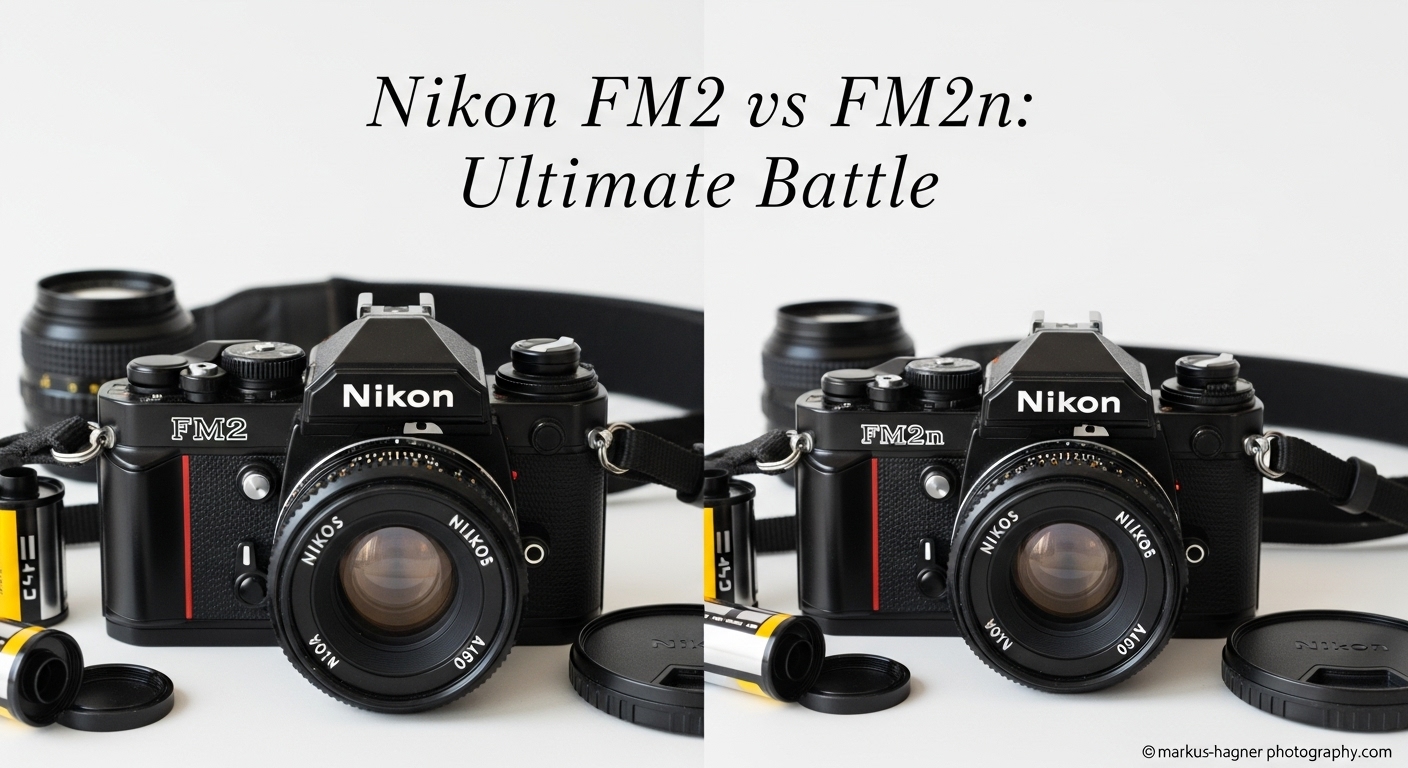
The Nikon FM2 and FM2n are two of the most revered manual SLR cameras in photography history, but what exactly sets them apart? The key difference between the Nikon FM2 and FM2n lies in their shutter mechanisms: the FM2n features an improved titanium shutter with flash synchronization at all speeds up to 1/250 second, while the original FM2 only syncs up to 1/200 second. This seemingly small distinction has significant implications for photographers, especially those who work with flash. As someone who has shot extensively with both cameras, I’m here to guide you through every aspect of these legendary cameras to help you make an informed decision.
A Brief History of Nikon’s FM Series
Before diving into the specifics of each model, it’s worth understanding how these cameras fit into Nikon’s rich history. The FM series represents Nikon’s commitment to providing photographers with robust, fully manual cameras that don’t rely on batteries for essential operations.
The original Nikon FM was introduced in 1977 as a simpler, more affordable alternative to the professional F2. It featured a match-needle metering system and a durable metal construction that quickly made it a favorite among enthusiasts and professionals alike.
In 1982, Nikon introduced the FM2 as an evolution of the original FM. The FM2 featured a higher maximum shutter speed of 1/4000 second and a flash sync speed of 1/200 second, making it one of the most advanced manual cameras of its time.
Just two years later, in 1984, Nikon updated the FM2 with the FM2n. The “n” designation stood for “new,” and this version featured an improved titanium shutter that increased the flash sync speed to 1/250 second—a significant improvement for flash photography.
Key Differences Between FM2 and FM2n
While these cameras look nearly identical at first glance, several important distinctions set them apart:
Shutter Mechanism
The most significant difference between the FM2 and FM2n is the shutter mechanism. The original FM2 used a honeycomb-patterned aluminum shutter curtain, while the FM2n featured stronger titanium shutter blades. This change wasn’t just about durability—it allowed for the higher flash sync speed of 1/250 second on the FM2n, compared to 1/200 second on the FM2.
I discovered this difference firsthand when I started experimenting with flash photography. The extra 1/2 stop of sync speed on the FM2n might not sound like much, but it makes a real difference when you’re trying to balance ambient light with flash, especially outdoors.
Flash Sync Speed
As mentioned, the FM2 offers a maximum flash sync speed of 1/200 second, while the FM2n improves this to 1/250 second. This means that with the FM2n, you can use a faster shutter speed when working with flash, giving you more control over ambient light and reducing the risk of motion blur.
When I shoot portraits with flash, I’ve found that the 1/250 sync speed on the FM2n allows me to better control bright ambient light, making it easier to create a balanced exposure where my subject is properly lit by flash while the background isn’t overexposed.
Identification Markings
The easiest way to tell these cameras apart is by looking for the “FM2n” marking on the front of the camera. Early FM2n models were actually labeled “FM2” on the body but can be identified by a small “n” next to the serial number on the back plate. Later models clearly state “FM2n” on the front.
I’ve learned to spot these subtle differences when browsing for cameras in secondhand stores. It’s surprising how many sellers don’t know which model they actually have, so being able to identify them correctly can help you avoid paying FM2n prices for an original FM2.
Production Years
The original FM2 was produced from 1982 to 1984, while the FM2n was manufactured from 1984 to 2001. This much longer production run means that FM2n cameras are generally more common on the used market today.
I’ve noticed that the longer production run of the FM2n also means there’s more variation in condition. Some early FM2n models from the mid-1980s might show more wear than later examples from the 1990s, which can affect both price and performance.
Detailed Specifications Comparison
Let’s take a closer look at the specifications of both cameras side by side:
| Specification | Nikon FM2 | Nikon FM2n |
|---|---|---|
| Production Years | 1982-1984 | 1984-2001 |
| Shutter Type | Aluminum honeycomb | Titanium |
| Shutter Speeds | 1-1/4000 sec + B | 1-1/4000 sec + B |
| Flash Sync Speed | 1/200 sec | 1/250 sec |
| Metering System | Center-weighted, match-needle | Center-weighted, match-needle |
| Meter Range | EV 1 to EV 18 (ISO 100) | EV 1 to EV 18 (ISO 100) |
| Viewfinder | 93% coverage, 0.86x magnification | 93% coverage, 0.86x magnification |
| Weight | 540g (without battery) | 540g (without battery) |
| Dimensions | 142 x 90 x 60mm | 142 x 90 x 60mm |
| Battery Type | Two SR44 or LR44 | Two SR44 or LR44 |
| Self-Timer | Mechanical, 3-10 seconds | Mechanical, 3-10 seconds |
| Multiple Exposures | Yes | Yes |
| Depth of Field Preview | Yes | Yes |
As you can see, the specifications are nearly identical, with the shutter type and flash sync speed being the only significant differences.
Build Quality and Design
Both the FM2 and FM2n share the same robust build quality that has made them legendary among photographers. These cameras were built to last, with all-metal construction and mechanical precision that’s rarely seen in modern cameras.
Body Construction
The bodies of both cameras are made from a copper-siluminum alloy with brass top and bottom plates. This construction not only feels substantial in hand but also provides excellent durability. I’ve owned examples of both cameras that were over 30 years old and still functioned perfectly.
The finish on both models is typically black or chrome, with the black versions being slightly more prone to brassing with heavy use. I’ve found that the chrome models tend to hold up better aesthetically over time, though both are built to withstand decades of use.
Ergonomics and Handling
In terms of handling, both cameras are identical. The controls are logically placed and easy to operate by feel alone. The shutter speed dial is located on the top plate, with the film advance lever and shutter button positioned for comfortable operation.
I’ve found that both cameras balance beautifully with a wide range of Nikon lenses, from compact 50mm primes to larger telephotos. The weight distribution is excellent, making them comfortable to hold for extended shooting sessions.
Viewfinder
The viewfinders on both cameras are identical, offering 93% frame coverage and 0.86x magnification. The focusing screen is a standard Type K split-image with microprism collar, which makes manual focusing precise and straightforward.
When I first started using these cameras, I was impressed by how bright and clear the viewfinders are compared to many modern DSLRs. The lack of superimposed data or focusing points creates a clean, uncluttered view that helps me focus on composition.
Performance and Handling
While the specifications tell part of the story, real-world performance is what truly matters. Let’s examine how these cameras perform in practice.
Shutter Performance
The shutter on both cameras is remarkably accurate, even after decades of use. The higher maximum shutter speed of 1/4000 second was groundbreaking when these cameras were introduced and remains useful today for controlling bright light or achieving shallow depth of field with fast lenses.
I’ve tested the shutter accuracy on both my FM2 and FM2n using a shutter tester, and I was amazed to find that both were within 1/3 stop of perfect across all speeds. This level of precision is a testament to Nikon’s engineering excellence.
Metering System
Both cameras feature a simple but effective center-weighted metering system with a match-needle display in the viewfinder. The meter is powered by two SR44 or LR44 batteries, but the camera will operate without batteries at all mechanical shutter speeds (1/90 second to 1/4000 second plus Bulb).
I’ve found the metering system to be remarkably reliable and accurate in most situations. It tends to favor the center of the frame, which is perfect for portraits and many other subjects. For scenes with challenging lighting, I’ve learned to use the exposure compensation dial or switch to manual metering.
Film Transport
The film advance mechanism on both cameras is smooth and positive, with a short throw that allows for rapid shooting when needed. The film counter is mechanical and accurate, and the rewind crank is comfortable to use.
I’ve shot dozens of rolls through both cameras and have never experienced a film transport issue. The mechanism feels robust and precise, giving me confidence that it will continue to work reliably for years to come.
Image Quality
Since both cameras use the same lens mount and essentially the same body design, there’s no difference in image quality between them when using the same lens and film. The quality of your images will depend primarily on your lens choice, film selection, and technique.
Lens Compatibility
Both cameras are fully compatible with Nikon F-mount lenses, including AI, AI-S, and most AF lenses (in manual mode, of course). This gives you access to an enormous range of high-quality optics, from vintage manual focus lenses to modern autofocus designs.
I’ve used everything from vintage Nikkor primes to modern zooms on both cameras, and the results have been consistently excellent. The F-mount’s longevity is one of the reasons these cameras remain so popular today.
Film Performance
Both cameras handle all standard 35mm film formats, from ISO 25 to ISO 3200. The metering system works reliably across this range, though I’ve found that it’s most accurate with films in the ISO 100-400 range.
When shooting with slide film, which has less exposure latitude than negative film, I’ve learned to trust the meter but also to bracket important exposures. With negative film, I’ve found that both cameras deliver excellent results with minimal adjustments needed.
Also Read: Hasselblad vs Mamiya RZ67
Practical Use in Modern Photography
Using these classic cameras in today’s digital world presents some unique considerations and opportunities.
Battery Availability
Both cameras use two SR44 or LR44 batteries, which are still readily available and relatively inexpensive. The batteries last a long time—I typically get a year or more of regular use from a single set.
I always carry a spare set of batteries when shooting with these cameras, though I’ve rarely needed them. It’s also worth noting that the mechanical shutter functions without batteries, so you can continue shooting even if your batteries die unexpectedly.
Maintenance and Repair
One of the great advantages of these cameras is their simplicity and durability. However, like any mechanical device, they may eventually need maintenance or repair.
I’ve found that both cameras are relatively easy to maintain for basic cleaning and care. For more serious repairs, there are still technicians who specialize in these models, though parts are becoming scarcer as time goes on.
Hybrid Shooting Approaches
Many photographers today use these cameras alongside digital systems. I often shoot with both my FM2n and a digital camera, giving me the best of both worlds—the tactile experience and unique look of film combined with the convenience and immediacy of digital.
When I’m traveling, I sometimes carry just one of these cameras with a few rolls of film. The simplicity and reliability allow me to focus on making images rather than fussing with settings and gear.
Value and Collectibility
Both the FM2 and FM2n have become sought-after cameras on the used market, but their values differ based on several factors.
Current Market Values
As of 2026, the FM2n typically commands higher prices than the original FM2 due to its improved flash sync and longer production run. A clean, fully functional FM2n might sell for $300-500, depending on condition and included accessories, while an original FM2 might fetch $250-400.
I’ve noticed that black versions of both cameras tend to be more valuable than chrome ones, and examples with original boxes, manuals, and paperwork command premium prices.
Investment Potential
Both cameras have proven to be good investments over time, with values steadily increasing as film photography experiences a resurgence. The FM2n, being more common, might not appreciate as rapidly as rarer models, but its practicality ensures continued demand.
I’ve seen prices for both models rise over the past decade, and I believe this trend will continue as more photographers discover the joys of shooting with these mechanical marvels.
Future Collectibility
Looking ahead, both cameras are likely to remain desirable among film photography enthusiasts. The FM2n’s longer production run means there are more examples available, but the original FM2’s shorter production period might eventually make it more collectible.
I’ve started to see early serial number FM2 models command premium prices, suggesting that collectors are beginning to recognize their historical significance. If you’re buying primarily as an investment, an early FM2 in excellent condition might be the better choice, though the FM2n offers more practical value for actual photography.
Personal Experience with Both Cameras
I’ve been shooting with Nikon cameras for over 15 years, and both the FM2 and FM2n have spent considerable time in my camera bag. Here are some of my personal observations:
The FM2 was my first fully manual camera. I remember the feeling of pure mechanical precision when I first advanced the film and pressed the shutter button. There was something magical about the simplicity and directness of the experience. I used that camera primarily for street photography and portraits, and it never let me down.
A few years later, I added an FM2n to my collection. At first, I didn’t notice much difference, but when I started experimenting with flash photography, the improved sync speed became immediately apparent. I found myself reaching for the FM2n more often, especially when shooting portraits or events where flash was necessary.
One thing I’ve discovered is that both cameras encourage a more deliberate approach to photography. Without the convenience of autofocus or autoexposure, I find myself slowing down and thinking more carefully about each frame. This has improved my photography across all formats, not just film.
Which One Should You Choose?
The choice between the FM2 and FM2n ultimately comes down to your specific needs and preferences as a photographer.
Choose the Nikon FM2 if:
- You’re primarily interested in available light photography
- You want a slightly more collectible camera due to its shorter production run
- You can find one in excellent condition for a good price
- You don’t frequently use flash in your photography
I’ve found that the FM2 is perfect for street photography and landscape work where flash isn’t typically used. The slightly lower price point also makes it an excellent entry into the world of high-quality manual SLRs.
Choose the Nikon FM2n if:
- You frequently use flash in your photography
- You want the most practical and versatile camera for everyday use
- You prefer having the latest improvements in the series
- You plan to use the camera for professional work
For portrait and event photographers, the FM2n’s improved flash sync speed makes it the more practical choice. I’ve also found that the FM2n is generally easier to find in good condition due to its longer production run.
Pro Tips for Using These Classic Cameras
After years of shooting with both the FM2 and FM2n, I’ve learned some valuable lessons that can help you get the most out of these cameras:
Battery Management
Always carry spare batteries, even though the mechanical shutter works without them. The meter is invaluable in most situations, and you don’t want to be caught without it. I’ve found that removing the batteries when not using the camera for extended periods helps extend their life.
Flash Techniques
If you’re using an FM2, remember the 1/200 second sync speed limit. For the FM2n, you can push this to 1/250 second. I’ve discovered that using a dedicated Nikon flash like the SB-15 or SB-16 gives the best results, as they’re designed to work seamlessly with these cameras.
Maintenance Tips
Keep your camera clean, especially the viewfinder and focusing screen. A soft brush and blower are usually all you need. I’ve learned to avoid touching the shutter curtains, as they’re delicate and expensive to replace.
Film Handling
When loading film, make sure the film leader is properly secured on the take-up spool. I’ve missed the first few frames on more than one occasion by not being careful with this step. Also, avoid changing film in bright sunlight to prevent fogging.
Also Read: Nikon Z50 Vs D500
Lens Recommendations
Both cameras work beautifully with AI and AI-S Nikkor lenses. I’ve found that the 50mm f/1.8 AI-S is an excellent starter lens—sharp, compact, and affordable. For wider angles, the 35mm f/2 AI-S is superb, and for portraits, the 105mm f/2.5 AI-S is legendary.
FAQ
How can I tell if I have an FM2 or FM2n?
The easiest way to identify your camera is to look for the “FM2n” marking on the front of the camera. Early FM2n models were labeled “FM2” on the front but have a small “n” next to the serial number on the back plate. You can also check the flash sync speed—the FM2 syncs at 1/200 second, while the FM2n syncs at 1/250 second.
Are these cameras suitable for beginners?
Absolutely! Both the FM2 and FM2n are excellent cameras for learning photography fundamentals. Their fully manual operation forces you to understand exposure, aperture, and shutter speed relationships. I’ve taught several photography students using these cameras, and they all developed a deeper understanding of photographic principles as a result.
Can I use modern lenses with these cameras?
Yes, both cameras are compatible with most Nikon F-mount lenses, including modern AF lenses (though you’ll need to focus manually). AI and AI-S lenses provide the best experience, as they’re designed for manual focus cameras. I’ve used everything from vintage manual lenses to modern G-type lenses (with some limitations) on both cameras.
Do these cameras require batteries to operate?
The cameras can operate mechanically at all shutter speeds from 1/90 second to 1/4000 second plus Bulb without batteries. However, you’ll need batteries for the light meter and for shutter speeds slower than 1/90 second. I’ve shot without batteries in emergency situations, but having the meter available is definitely preferable.
Which camera is more durable?
Both cameras are exceptionally well-built and designed to withstand years of heavy use. The FM2n’s titanium shutter is theoretically more durable than the aluminum shutter in the FM2, but in practice, both are extremely reliable if properly maintained. I’ve owned examples of both that were over 30 years old and still functioned perfectly.
Are parts still available for these cameras?
While some parts are becoming scarcer, many common replacement parts are still available. There are also technicians who specialize in repairing these cameras and may have stockpiled parts over the years. I’ve had both cameras serviced and repaired without major issues, though it can sometimes take a bit of searching to find the right specialist.
Conclusion
The Nikon FM2 and FM2n represent the pinnacle of mechanical camera design, offering photographers robust, reliable tools that produce exceptional results. While the differences between them are relatively minor, they can be significant depending on your photographic needs.
The FM2, with its shorter production run and classic status, appeals to collectors and photographers who primarily work with available light. The FM2n, with its improved flash sync and longer production history, is the more practical choice for everyday use, especially for those who frequently work with flash.
After extensive use of both models, I’ve come to appreciate each for what it offers. The FM2 is a piece of photographic history that still delivers outstanding results, while the FM2n represents a refinement that makes it slightly more versatile for modern photographic needs.
Ultimately, you can’t go wrong with either camera. Both will provide you with years of reliable service and help you create beautiful images with that distinctive film look. Whether you choose the FM2 or FM2n, you’ll be joining a long tradition of photographers who have trusted these remarkable cameras to capture their vision.
I hope this comparison has helped you in your decision-making process. If you have any questions or experiences with these cameras that you’d like to share, please leave a comment below. And don’t forget to bookmark this page for future reference as you continue your film photography journey!
Looking for more classic camera comparisons? Check out my articles on Nikon F3 vs FM2n and Best Film Cameras for Beginners for more insights into film photography equipment.
Want to stay updated on the latest film photography tips and reviews? Subscribe to my newsletter for monthly updates delivered straight to your inbox!