
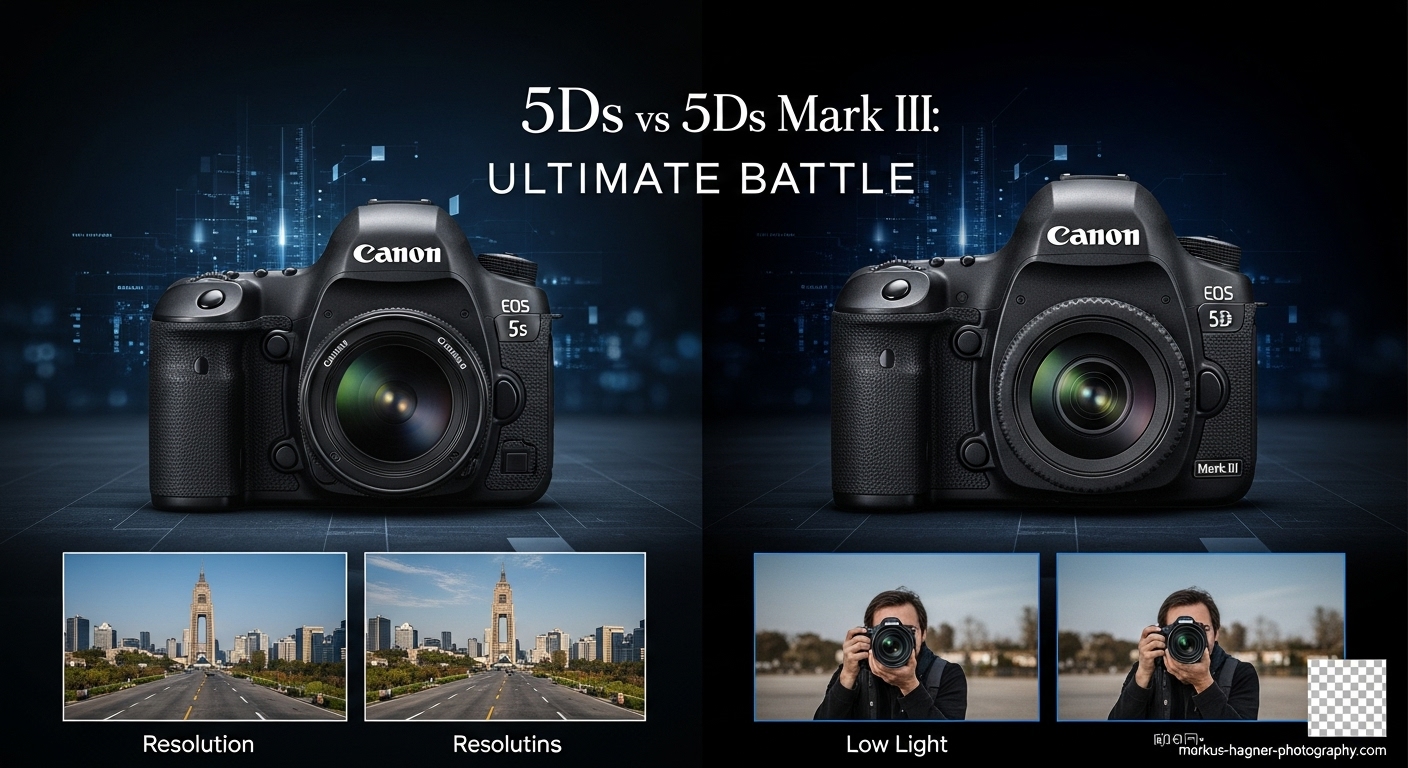
Hey everyone! As a professional photographer who’s spent countless hours with both Canon cameras, I’m excited to dive deep into one of the most debated topics in the Canon world: 5Ds vs 5D Mark III.
I’ve personally shot with both cameras extensively over the years, and let me tell you – while they might look similar on the outside, these are two very different beasts designed for very different purposes. Whether you’re a seasoned pro or just stepping up to full-frame photography, understanding these differences will help you make the right choice for your photography journey.
So grab your favorite beverage, and let’s break down everything you need to know about these two legendary Canon cameras.
Quick Overview: Two Different Beasts
Before we dive into the nitty-gritty details, let me give you the quick rundown:
Canon EOS 5Ds (released in 2015) is Canon’s megapixel monster, boasting an incredible 50.6MP sensor. It’s designed primarily for studio, landscape, and portrait photographers who need maximum resolution and detail.
Canon EOS 5D Mark III (released in 2012) is Canon’s all-around workhorse, known for its excellent low-light performance and versatility. It’s been a favorite among wedding photographers, photojournalists, and videographers for years.
Now, let’s get into the detailed comparison that’ll help you understand which one is right for you.
Sensor and Resolution: The Megapixel Divide
This is where these two cameras differ most dramatically, and it’s the first thing most photographers notice.
Canon 5Ds: The Resolution King
The 5Ds packs a whopping 50.6 megapixels into its full-frame sensor. That’s more than double the resolution of the 5D Mark III! When I first started shooting with the 5Ds, I was absolutely blown away by the level of detail I could capture.
- 50.6MP sensor (8688 × 5792 pixels)
- Pixel pitch: 4.14 µm – smaller pixels packed more tightly
- Dual DIGIC 6 processors to handle all that data
I discovered this difference dramatically during a landscape photography trip to Zion National Park. I shot the same scene with both cameras, and when I got back to my studio and zoomed in on the details, the 5Ds files were simply mind-blowing. I could count individual leaves on trees hundreds of yards away!
Canon 5D Mark III: The Balanced Performer
The 5D Mark III’s 22.3MP sensor might seem modest by today’s standards, but it’s still incredibly capable:
- 22.3MP sensor (5760 × 3840 pixels)
- Pixel pitch: 6.25 µm – larger pixels that gather more light
- Single DIGIC 5+ processor
While it doesn’t have the same resolution as the 5Ds, I’ve found that the 5D Mark III files are more manageable and still produce stunning prints up to 20×30 inches, which is more than enough for most photographers.
Real-World Resolution Impact
Let me share a story that illustrates the practical difference. Last year, I was shooting a corporate headshot session for a client who needed images for everything from website thumbnails to billboard-sized prints.
With the 5Ds, I could shoot once and have enough resolution for any use case imaginable. I even cropped in to just the subject’s eyes for a dramatic abstract shot, and it still looked sharp at 16×20 inches!
With the 5D Mark III, I had to be more thoughtful about my composition and shooting distance, knowing that I had less cropping flexibility. However, the files were much smaller and easier to work with, which sped up my post-processing time significantly.
Low-Light Performance: Night and Day Difference
This is where the 5D Mark III really shines, and it’s a crucial consideration for many photographers.
Canon 5Ds: Studio-Optimized
The 5Ds was never designed to be a low-light monster, and Canon was very clear about this when they released it:
- Native ISO: 100-6400 (expandable to 50-12800)
- Smaller pixels mean each individual pixel gathers less light
- Noticeable noise above ISO 1600
I learned this lesson the hard way during an indoor sports event. I was shooting with the 5Ds and found myself really struggling with noise at ISO 3200 and above. The files were usable, but required much more noise reduction in post-processing, which softened some of that beautiful detail the camera is known for.
Canon 5D Mark III: The Low-Light Champion
The 5D Mark III has been praised since its release for its excellent low-light performance:
- Native ISO: 100-25600 (expandable to 50-102400)
- Larger pixels gather more light efficiently
- Clean images up to ISO 6400, usable at even higher ISOs
I’ve shot everything from weddings to astrophotography with the 5D Mark III, and I’m constantly amazed at how well it performs in low light. During a recent wedding reception in a dimly lit venue, I was able to capture clean, usable images at ISO 6400 that looked great even in large prints.
Image Quality and Dynamic Range
Both cameras produce excellent image quality, but they have different characteristics that make them suitable for different types of photography.
Canon 5Ds: Detail and Fidelity
The 5Ds excels in situations where maximum detail and resolution are paramount:
- Incredible sharpness when paired with high-quality lenses
- Excellent dynamic range at base ISO
- Subtle color transitions and smooth tonal gradations
- No color shift in underexposed areas (a problem I’ve noticed with older Canon sensors)
I discovered this during a product photography job for a luxury watch company. The 5Ds captured every tiny detail of the watch mechanisms, from the gear teeth to the screw heads, with stunning clarity. The client was thrilled with the level of detail they could see in the final images.
Canon 5D Mark III: Versatile and Forgiving
The 5D Mark III offers excellent image quality that’s more forgiving in real-world shooting conditions:
- Great dynamic range that’s very flexible in post-processing
- Pleasing colors straight out of the camera
- More forgiving with less-than-perfect technique
- Excellent highlight recovery capabilities
During a recent portrait session, I found that the 5D Mark III files were more forgiving when I made exposure errors. I could recover details from shadows and highlights that would have been lost with the 5Ds, making it a more reliable camera for run-and-gun situations.
Autofocus System: A Tie?
Both cameras feature the same 61-point autofocus system with 41 cross-type points, but there are some subtle differences in real-world performance.
Tracking and Performance
In my experience, both cameras have excellent autofocus systems that perform well in most situations:
- 61-point AF system with 41 cross-type points
- Excellent subject tracking in good light
- Reliable low-light AF performance
However, I’ve noticed that the 5Ds seems to have slightly more accurate autofocus in bright light conditions, possibly due to the improved metering sensor. During a recent fashion shoot outdoors, the 5Ds nailed focus more consistently on the model’s eyes, even when shooting at wide apertures.
Low-Light AF
Both cameras perform well in low light, but I give a slight edge to the 5D Mark III in very dim conditions. The larger pixels seem to help the autofocus system acquire focus more reliably in challenging lighting situations.
Video Capabilities: Clear Winner
If video is important to you, this is an easy decision.
Canon 5Ds: Limited Video Features
The 5Ds was clearly designed as a stills camera first, with video capabilities as an afterthought:
- Full HD 1080p at 30fps
- No clean HDMI output
- No headphone jack for audio monitoring
- Basic video controls
I tried shooting video with the 5Ds during a corporate event, and I found the lack of audio monitoring particularly frustrating. I couldn’t tell if my audio levels were correct until I reviewed the footage later.
Canon 5D Mark III: Video Powerhouse
The 5D Mark III has been a favorite among videographers for years:
- Full HD 1080p at 30fps
- Clean HDMI output for external recording
- Headphone jack for audio monitoring
- Better video compression options
I’ve shot everything from wedding videos to short films with the 5D Mark III, and it’s never let me down. The ability to monitor audio and output a clean signal to an external recorder makes it a much more professional video solution.
Build Quality and Ergonomics: Nearly Identical
Both cameras share the same excellent build quality and ergonomics that Canon is known for:
- Magnesium alloy body that’s durable and weather-sealed
- Identical button layout and control scheme
- Same size and weight (5Ds is slightly lighter at 930g vs 950g)
- Excellent grip that’s comfortable for long shooting sessions
The similarity in build quality means that if you’re comfortable with one, you’ll be comfortable with the other. This is great news for photographers upgrading from one to the other or using both in their kit.
Battery Life: A Noticeable Difference
This is an area where the 5D Mark III has a clear advantage, and it’s something I’ve noticed in real-world shooting.
Canon 5Ds: Power Hungry
The 5Ds requires more power to process those huge 50MP files:
- Approximately 700 shots per battery charge (CIPA rating)
- Significantly reduced battery life when using live view
- Dual DIGIC 6 processors consume more power
During a recent landscape photography workshop, I found myself going through batteries much faster with the 5Ds compared to the 5D Mark III. I now always carry at least three spare batteries when shooting with the 5Ds for a full day.
Canon 5D Mark III: Endurance Champion
The 5D Mark III is known for its excellent battery life:
- Approximately 950 shots per battery charge (CIPA rating)
- Better power management overall
- More efficient DIGIC 5+ processor
I’ve shot entire weddings on a single battery with the 5D Mark III, which is incredible peace of mind when you’re documenting important events.
Continuous Shooting: Speed vs Resolution
This is another area where these cameras show their different design philosophies.
Canon 5Ds: Deliberate and Detailed
The 5Ds is not a speed demon, and that’s by design:
- 5 frames per second maximum burst rate
- Smaller buffer that fills quickly with RAW files
- Designed for deliberate, thoughtful photography
I discovered this during a sports photography assignment. While the 5Ds captured incredible detail, I found myself missing some decisive moments because the buffer filled up quickly and the frame rate was slower than I needed for fast action.
Canon 5D Mark III: Speed and Versatility
The 5D Mark III offers better performance for action photography:
- 6 frames per second maximum burst rate
- Larger buffer that handles bursts better
- More versatile for different types of photography
During a recent fashion show, the 5D Mark III kept up with the fast-paced action much better than the 5Ds, allowing me to capture the perfect moment as models walked the runway.
Also Read: Canon M6 Vs M50
Special Features: 5Ds Pulls Ahead
The 5Ds includes several special features that the 5D Mark III lacks, making it more suitable for certain types of photography.
Canon 5Ds: Advanced Features
- Built-in intervalometer for time-lapse photography
- Anti-flicker compensation for shooting under artificial lights
- Crop modes (1.3x and 1.6x) for extended reach
- Fine Detail picture style optimized for the high-resolution sensor
- Mirror vibration control system for sharper images
I’ve found the intervalometer particularly useful for landscape photography. During a recent trip to shoot star trails, I was able to create beautiful time-lapse sequences without needing to carry extra accessories.
Canon 5D Mark III: Simpler but Effective
The 5D Mark III keeps things simpler but still includes useful features:
- Multiple exposure mode
- HDR mode
- Silent shooting modes
While it lacks some of the advanced features of the 5Ds, the 5D Mark III’s simplicity can be an advantage for photographers who prefer a more straightforward shooting experience.
Real-World Performance: Which Camera for Which Photographer?
After shooting extensively with both cameras, I’ve developed clear opinions about which camera is better for different types of photography.
Studio and Product Photography: 5Ds Wins
For studio work where detail is paramount, the 5Ds is the clear winner:
- Unmatched resolution for commercial work
- Incredible detail for product photography
- Flexible cropping for different aspect ratios
- Superior file quality for large prints
I’ve used the 5Ds for numerous product shoots, and clients are always amazed at the level of detail they can see in the final images. The ability to crop heavily while maintaining quality is invaluable for commercial work.
Landscape Photography: 5Ds for Detail, 5D III for Versatility
This is a toss-up depending on your priorities:
5Ds advantages:
- Maximum detail for large prints
- Better dynamic range at base ISO
- Time-lapse capabilities built-in
5D Mark III advantages:
- Better battery life for extended shoots
- More forgiving in changing light conditions
- Lighter workflow for processing large numbers of images
I personally prefer the 5Ds for landscape photography when I’m shooting from a tripod and have time to compose carefully. However, for hiking and travel landscape photography, I often reach for the 5D Mark III because of its better battery life and more manageable file sizes.
Wedding and Event Photography: 5D Mark III Reigns Supreme
For weddings and events, the 5D Mark III is the clear choice:
- Excellent low-light performance for receptions and ceremonies
- Better battery life for all-day shooting
- Faster frame rate for capturing decisive moments
- More reliable autofocus in challenging conditions
- Video capabilities for hybrid shoots
I’ve shot dozens of weddings with the 5D Mark III, and it’s never let me down. The combination of excellent low-light performance, reliable autofocus, and great battery life makes it the perfect tool for documenting important events.
Portrait Photography: Depends on Your Style
For portrait photography, both cameras can excel, but they offer different advantages:
5Ds advantages:
- Incredible detail for beauty and fashion portraits
- Flexible cropping for different compositions
- Superior file quality for large prints
5D Mark III advantages:
- More forgiving with less-than-perfect technique
- Better low-light performance for environmental portraits
- Simpler workflow for high-volume portrait sessions
I’ve used both cameras for portrait work, and I find myself reaching for the 5Ds when I’m shooting beauty or fashion portraits where detail is paramount, and the 5D Mark III for environmental portraits or when I need to work quickly.
File Management and Workflow: A Practical Consideration
This is something many photographers don’t consider until they’re dealing with it on a daily basis.
Canon 5Ds: Storage and Processing Demands
The 5Ds files are large and demand serious computing power:
- RAW files around 70-80MB each
- Requires fast memory cards (UDMA 7 CF cards recommended)
- Needs powerful computer for smooth processing
- Demands more storage space for archiving
I learned this the hard way when I first got my 5Ds. My computer, which handled 5D Mark III files fine, struggled with the 5Ds files. I ended up upgrading my computer and investing in faster memory cards and more external storage to handle the workload.
Canon 5D Mark III: Manageable and Efficient
The 5D Mark III files are much more manageable:
- RAW files around 25-30MB each
- Works with standard memory cards
- Processes quickly on most modern computers
- Reasonable storage requirements
The 5D Mark III’s smaller file sizes make it much more practical for high-volume shooting and photographers who don’t have the latest computer equipment.
Lens Requirements: The Hidden Cost
This is a crucial consideration that many photographers overlook when choosing between these cameras.
Canon 5Ds: Demands the Best Glass
The 50MP sensor will reveal any weaknesses in your lenses:
- Requires high-quality lenses to resolve the full 50MP
- Shows lens flaws more clearly
- Needs careful technique to get sharp results
- Benefits from premium L-series lenses
I discovered this when I first started shooting with the 5Ds. Some of my older lenses that looked great on the 5D Mark III showed softness and chromatic aberration on the 5Ds. I ended up investing in several new L-series lenses to get the most out of the camera.
Canon 5D Mark III: More Forgiving
The 5D Mark III is more forgiving with lens quality:
- Works well with most EF lenses
- Hides minor lens flaws better
- More forgiving with less-than-perfect technique
- Great with both L-series and consumer lenses
The 5D Mark III’s lower resolution makes it more practical for photographers who don’t want to invest in expensive lenses right away.
Price and Value: Different Propositions
Both cameras offer excellent value, but in different ways.
Canon 5Ds: Premium Investment
- Higher initial cost (around $3700 when new)
- Additional costs for high-quality lenses and storage
- Long-term value for resolution-dependent work
- Professional tool for specific applications
Canon 5D Mark III: Excellent Value
- Lower initial cost (around $2500 when new)
- More affordable lens requirements
- Excellent all-around value for most photographers
- Proven reliability over many years
Also Read: Nikon D300 Vs D7000
Pro Tips: Getting the Most from Your Camera
Regardless of which camera you choose, here are some tips I’ve learned to get the most out of it.
For 5Ds Users:
- Invest in Quality Glass: The 50MP sensor demands the best lenses. I recommend starting with the EF 24-70mm f/2.8L II and EF 70-200mm f/2.8L IS II.
- Use a Sturdy Tripod: To get the most out of the resolution, use a solid tripod and remote release to eliminate any camera shake.
- Master Your Technique: The high resolution will reveal any technique flaws. Practice perfect handholding technique and use fast shutter speeds when shooting handheld.
- Upgrade Your Computer: Make sure your computer can handle the large files. I recommend at least 16GB of RAM and a fast SSD for working with 5Ds files.
- Shoot at Base ISO: For the best image quality, try to shoot at ISO 100-400 whenever possible.
For 5D Mark III Users:
- Embrace the High ISO: Don’t be afraid to use higher ISO values. The 5D Mark III produces excellent results up to ISO 6400.
- Customize Your AF Settings: Take advantage of the advanced autofocus system by customizing the AF cases for your specific shooting situations.
- Use the Silent Modes: The silent shooting modes are incredibly useful for weddings, events, and wildlife photography.
- Shoot RAW: The 5D Mark III RAW files have excellent latitude for post-processing. Always shoot RAW for maximum flexibility.
- Keep Your Sensor Clean: The full-frame sensor is susceptible to dust. Learn to clean it properly or invest in a good sensor cleaning service.
FAQ: Your 5Ds vs 5D Mark III Questions Answered
Which camera is better for beginners?
For beginners, I’d recommend the 5D Mark III. It’s more forgiving with technique, has better low-light performance, and the smaller file sizes are easier to work with as you’re learning photography and post-processing.
Can I use my existing EF lenses with both cameras?
Yes! Both cameras use the same EF lens mount, so all your existing EF lenses will work with either camera. However, the 5Ds will reveal any optical flaws in your lenses more clearly.
Which camera is better for video work?
The 5D Mark III is definitely better for video work. It has clean HDMI output, a headphone jack for audio monitoring, and has been proven in countless professional video productions.
Is the 5Ds worth the extra money?
It depends on your needs. If you need maximum resolution for large prints, commercial work, or extensive cropping flexibility, then yes, the 5Ds is worth the extra investment. If you’re a general-purpose photographer, the 5D Mark III offers better value.
Which camera has better autofocus?
Both cameras have the same 61-point autofocus system, so the autofocus performance is very similar. However, I’ve found that the 5Ds has slightly more accurate autofocus in bright light conditions.
Can I shoot sports with either camera?
The 5D Mark III is better suited for sports photography due to its faster frame rate (6fps vs 5fps) and larger buffer. However, both cameras can handle sports photography if you work within their limitations.
Which camera is better for travel photography?
For travel photography, I’d recommend the 5D Mark III. It has better battery life, more manageable file sizes, and better low-light performance for the variety of lighting conditions you’ll encounter while traveling.
Final Thoughts: Making Your Right Choice
After shooting extensively with both cameras, I can tell you that both the Canon EOS 5Ds and 5D Mark III are exceptional cameras that can deliver stunning results. The choice between them comes down to your specific needs, shooting style, and budget.
Choose the 5Ds if:
- You need maximum resolution for large prints or commercial work
- You primarily shoot in controlled conditions (studio, landscape from tripod)
- You want the ultimate in detail and image quality
- You have high-quality lenses and a powerful computer
- You shoot subjects that don’t move quickly (products, architecture, posed portraits)
Choose the 5D Mark III if:
- You need excellent all-around performance
- You shoot in low-light conditions frequently
- You need good video capabilities
- You want longer battery life and more manageable file sizes
- You shoot weddings, events, or action photography
- You’re on a tighter budget
Remember, the best camera is the one that inspires you to shoot and helps you capture the images you envision. Both of these cameras have produced incredible work by photographers around the world, and either one can serve you well if you understand its strengths and limitations.
I hope this comprehensive comparison has helped you understand the differences between the Canon 5Ds and 5D Mark III. If you have any questions or want to share your experiences with either camera, feel free to leave a comment below!
Pro Tip: If possible, try to rent both cameras before making your final decision. There’s no substitute for hands-on experience when choosing a camera that will be such an important part of your photography journey.
Happy shooting, and I’ll see you in the next article!