
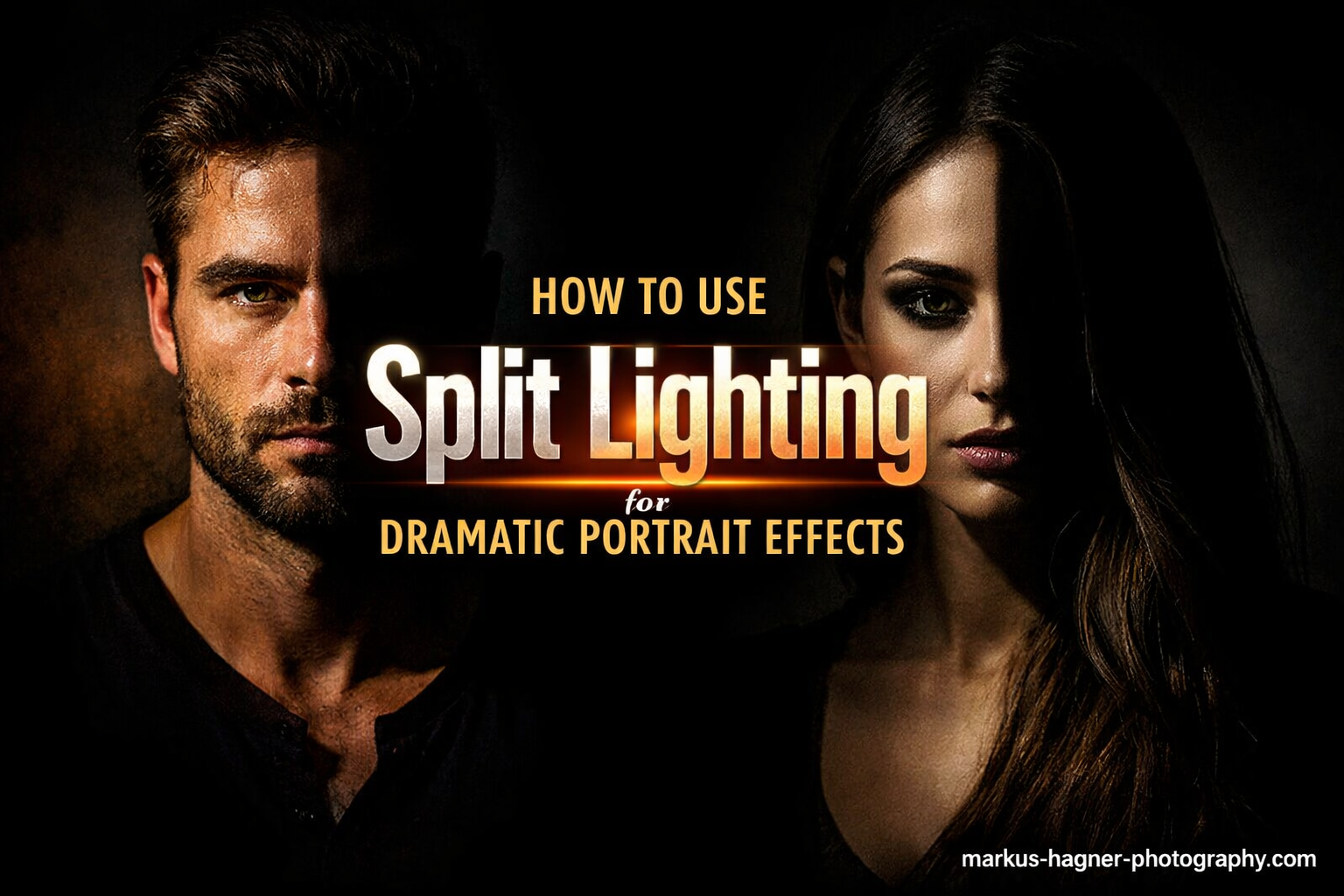
Split lighting creates some of the most striking portraits you will ever shoot. One half of your subject’s face glows with light while the other half falls into deep shadow. This dramatic division catches attention immediately and adds emotional weight to any portrait. In this guide, I will show you exactly how to master split lighting for dramatic portrait effects, from basic setup to advanced techniques that will transform your portrait photography in 2026.
You will learn the precise light positioning that creates that perfect 50/50 split, which subjects benefit most from this technique, and how to avoid the common mistakes that ruin split lighting attempts. Whether you shoot with professional strobes, affordable LED panels, or natural window light, the principles remain the same. I have tested these techniques with dozens of subjects over the past three years, and the results consistently impress clients who want portraits with real visual impact.
What Is Split Lighting in Photography?
Split lighting is a portrait photography technique that illuminates exactly half of a subject’s face while leaving the other half in shadow. The light splits the face down the center, creating a dramatic division between light and dark sides. This high-contrast effect is achieved by positioning a single light source at a 90-degree angle to the subject, directly from the side.
The key characteristic of split lighting is that imaginary line running down the center of the face. Everything on one side receives full illumination while the other side falls into complete darkness. Unlike Rembrandt lighting or loop lighting, which create gradual transitions between light and shadow, split lighting produces a hard edge with minimal middle tones. This creates intensity, mystery, and power in your portraits.
Positioning the light at exactly 90 degrees to your subject’s nose is critical. Move the light forward even 10 degrees and you drift into Rembrandt territory. Move it back and you lose the clean split entirely. I recommend starting with your light positioned perpendicular to your camera, then fine-tuning by watching how the shadow falls across your subject’s nose and cheek.
When to Use Split Lighting for Portraits?
Split lighting works best when you want to create drama, mystery, or intensity in your portraits. The technique conveys power and assertiveness, making it ideal for subjects who want to project confidence or strength. I reach for split lighting when shooting actors, musicians, athletes, and anyone seeking a bold, memorable portrait.
This lighting pattern excels at making wider faces appear narrower. Because one half of the face disappears into shadow, the overall face shape looks more slender. Subjects with round or square faces often prefer split lighting for this slimming effect. The technique also emphasizes bone structure and facial features by creating strong shadows that define contours.
Consider split lighting for these specific situations:
Fashion and editorial photography: Split lighting creates the dramatic look magazines want for covers and feature spreads. The high contrast draws the eye and holds attention.
Character-driven portraits: Actors, authors, and artists often benefit from split lighting because it adds depth and complexity to their image. The technique suggests there is more to the person than meets the eye.
Male portraits: While split lighting works beautifully for any gender, it tends to be requested frequently for male subjects who want a masculine, powerful appearance. The hard shadows accentuate jawlines and cheekbones.
Black and white photography: Split lighting translates exceptionally well to monochrome. The strong contrast between light and dark creates the kind of tonal range that makes black and white images pop.
Low key photography: When your entire image uses a dark tonal range, split lighting fits naturally into the aesthetic. The technique keeps backgrounds dark while putting all attention on the illuminated portion of the face.
Avoid split lighting when you want soft, approachable portraits. This technique creates tension and drama by design. For friendly, warm images, consider loop lighting or butterfly lighting instead.
How to Set Up Split Lighting: Step-by-Step Guide
Equipment You Need
One of the beauties of split lighting is how little equipment it requires. You can achieve professional results with a single light source. Here is what I recommend based on your budget and shooting style.
Light sources that work well:
Speedlights offer portability and affordability. A single speedlight mounted on a light stand gives you everything needed for split lighting. I started with a basic speedlight setup and still use it for location shoots.
Studio strobes provide more power and faster recycling times. If you shoot in a dedicated studio space, a monolight strobe makes split lighting consistent and repeatable. Most strobes also offer modeling lights that help you preview the shadow placement.
LED continuous lights let you see the split effect in real time. For beginners, this visual feedback is incredibly helpful. You watch the shadow move as you adjust the light position. LED panels have become affordable and work perfectly for split lighting.
Natural light from a window creates beautiful split lighting without any equipment cost. A large window with indirect sunlight produces soft but dramatic splits. I love using window light for split lighting because it teaches you to read light direction naturally.
Light modifiers to consider:
Softboxes soften the light while maintaining directionality. A medium softbox positioned at 90 degrees creates split lighting with slightly feathered shadow edges. This works well when you want drama but not harsh shadows.
Umbrellas spread light more broadly but still work for split lighting. Use a shoot-through umbrella close to your subject for a larger apparent light source. The shadows will be softer but the split remains visible.
Bare bulb or direct flash produces the hardest shadows with the most dramatic split. This raw look suits edgy portraits and fashion work. I use bare flash when I want that film noir aesthetic.
Step-by-Step Setup Process
Follow these steps to create perfect split lighting every time. I have refined this process over hundreds of portrait sessions.
Step 1: Position your subject.
Have your subject stand or sit facing directly toward your camera. Their nose should point straight at your lens. This head-on position ensures the light splits the face evenly. Ask them to keep their chin level, not tilted up or down.
Step 2: Place your light at 90 degrees.
Position your light source directly to the side of your subject, at a perfect right angle to your camera. The light should be at the same height as your subject’s face. If you imagine a line running from your camera through your subject, the light sits perpendicular to that line.
Step 3: Check the split.
Look at your subject’s face. You should see a clean division running down the center of their nose and chin. One eye sits in full light, the other in shadow. The illuminated side of the face should end right at the center line. If the lit area extends past center, move your light further to the side.
Step 4: Adjust the light distance.
Move your light closer or farther from your subject to control intensity and shadow hardness. Closer light creates larger apparent source size and slightly softer shadow edges. Farther light produces harder shadows with more dramatic contrast. I typically position my light 3 to 5 feet from the subject.
Step 5: Fine-tune the height.
Raise or lower your light until the shadow from the nose runs perfectly horizontal across the cheek. If the shadow angles up or down, your light is too high or too low. The goal is a shadow that follows the cheekbone line naturally.
Step 6: Set your camera exposure.
Expose for the highlighted side of the face. Let the shadow side fall dark. I typically shoot at base ISO, with an aperture around f/5.6 to f/8 for sufficient depth of field. Shutter speed depends on your sync speed if using flash. The key is exposing correctly for the lit portion while allowing shadows to go deep.
Step 7: Direct your subject’s pose.
Small head turns affect split lighting dramatically. Ask your subject to keep their face square to the camera. Even a 5-degree turn can shift the split and ruin the effect. I have them practice holding still before taking the actual shots.
Natural Light Split Lighting Technique
Window light creates gorgeous split lighting without any equipment. Find a window that receives indirect daylight, not direct sun streaming through. Direct sun creates hot spots and overly harsh shadows. Overcast days or north-facing windows work beautifully.
Position your subject perpendicular to the window, with one shoulder toward the glass. Their face should angle slightly toward the camera, which sits parallel to the window wall. The window becomes your key light at 90 degrees.
Move your subject closer to or farther from the window to control light intensity. Within 2 feet of the window produces strong contrast. Six feet back softens the effect considerably. I love this technique for environmental portraits where you want split lighting with a natural, candid feel.
Softening Split Lighting with Reflectors
Pure split lighting creates deep shadows with no detail. Sometimes you want drama but not complete blackness on the shadow side. A reflector bounces light back into shadows while maintaining the split effect.
Place a white reflector or bounce board on the shadow side of your subject, angled to catch stray light from your key light. Position it close enough to open up shadow detail but far enough that you still see clear tonal difference between sides. I use this technique for corporate headshots where clients want drama but not extremes.
Silver reflectors bounce more light than white ones. Use silver when you want brighter shadows. Gold reflectors add warmth to the shadow side, which can create interesting color contrast. I prefer white or silver for most split lighting work.
Split Lighting Variations and Advanced Techniques
Split Lighting with Color Gels
Color gels transform split lighting into something extraordinary. Place a colored gel over your key light to tint the illuminated side of the face. The shadow side remains neutral, creating striking color contrast. This technique works beautifully for creative portraits, album covers, and editorial work.
Blue and teal gels create cool, moody atmospheres. Red and orange gels suggest warmth, danger, or intensity. Purple gels add an otherworldly, cinematic quality. I often use complementary colors, placing one gel on the key light and another on a fill light for rich color interplay.
For a simpler approach, gel only your key light and leave shadows natural. The single color against neutral tones draws immediate attention. This technique appears frequently in music photography and fashion editorials.
Comparing Split Lighting to Other Patterns
Understanding how split lighting differs from other portrait lighting patterns helps you choose the right technique for each subject.
Split lighting vs Rembrandt lighting: Rembrandt lighting positions the light at 45 degrees rather than 90 degrees. This creates a small triangle of light on the shadow side of the face, beneath the eye. Rembrandt produces drama with slightly less intensity than split lighting. The transition between light and shadow is more gradual.
Split lighting vs Loop lighting: Loop lighting sits at approximately 30 to 45 degrees from center. A small shadow from the nose loops down toward the corner of the mouth. Loop lighting is more flattering and less dramatic than split lighting. Most portrait photographers use loop as their default pattern.
Split lighting vs Butterfly lighting: Butterfly lighting positions the light directly in front and above the subject. A butterfly-shaped shadow appears under the nose. This pattern emphasizes cheekbones and works well for beauty photography. It creates glamour rather than drama.
Split lighting vs Broad and Short lighting: These terms describe which side of the face faces the camera, not light position. Broad lighting means the lit side faces the camera, making faces appear wider. Short lighting means the shadow side faces the camera, creating a slimming effect. Split lighting combined with short lighting produces maximum drama and face-slimming impact.
Choose split lighting when you want maximum drama and contrast. Choose Rembrandt when you want classic portrait lighting with some moodiness. Choose loop or butterfly for flattering, approachable portraits.
Indoor vs Outdoor Split Lighting
Indoor split lighting gives you complete control. You position the light exactly where you want it, control ambient light levels, and create consistent results. Studios work best for split lighting because you can black out windows and control every light source.
Outdoor split lighting requires working with available light or supplementing with portable strobes. Late afternoon sun at a low angle can create split lighting naturally. Position your subject so the sun hits them from the side at 90 degrees. A building or wall behind them provides a dark background. For more control, use a portable strobe or speedlight positioned to create the split.
Common Split Lighting Mistakes to Avoid
I see photographers make the same split lighting errors repeatedly. Avoid these mistakes and your results will improve immediately.
Mistake 1: Incorrect light angle.
The most common error is positioning the light too far forward. Instead of a clean 50/50 split, you get Rembrandt lighting by accident. Check your subject’s face carefully. If both eyes receive any light, your light has drifted forward from 90 degrees. Move it back until one eye sits completely in shadow.
Mistake 2: Shadows too dark with lost detail.
While split lighting is meant to be high-contrast, you may want some detail in the shadow side. If shooting digital, expose to retain highlight detail and lift shadows in post-processing. If shooting film, rate your stock slightly lower and develop normally. Adding a reflector opens shadows while maintaining the split.
Mistake 3: Wrong face positioning.
Subjects naturally turn toward light sources. This instinct ruins split lighting because it changes the angle relationship between light and face. Coach your subject to hold their position facing the camera. Small turns of even a few degrees shift the split dramatically.
Mistake 4: Ignoring skin tone considerations.
Darker skin tones can lose detail in shadow areas more easily than lighter skin tones. With dark-skinned subjects, consider using a reflector to open shadows slightly. The split remains visible but you retain texture and dimension in the shadow side. Expose for the highlight side but be mindful of how much contrast your final medium can handle.
Mistake 5: Post-processing too heavily.
Split lighting photos suffer when photographers push contrast too far in editing. The technique already produces high contrast naturally. Adding excessive contrast in post creates harsh, unpleasant images with blocked-up shadows and blown highlights. Make subtle adjustments that enhance the existing drama rather than manufacturing fake contrast.
Split Lighting Photography Examples and Inspiration
Split lighting has a rich history in both photography and cinema. The technique appears throughout film noir, where dramatic shadows create suspense and moral ambiguity. Directors like Orson Welles used split lighting to suggest characters with hidden motives or divided loyalties.
In portrait photography, split lighting became popular for celebrity and character studies. Richard Avedon and Irving Penn used variations of split lighting to create iconic images with lasting impact. Their subjects appear complex, dimensional, and emotionally present.
Contemporary photographers use split lighting for everything from album covers to advertising campaigns. The technique translates across genres because it creates immediate visual interest. Fashion photographers use it for edgy editorial spreads. Sports photographers use it for powerful athlete portraits. Fine art photographers use it for intimate character studies.
For inspiration, study film noir stills from the 1940s and 1950s. Look at how directors used single light sources to split faces and create psychological tension. Then apply those same principles to your portrait work. The dramatic language of cinema translates directly to still photography.
When choosing between split lighting and other patterns, consider your subject’s goals. Split lighting conveys intensity, power, and mystery. It suggests complexity and hidden depths. If your subject wants to appear approachable and warm, choose a different pattern. If they want to command attention and spark curiosity, split lighting delivers.
Frequently Asked Questions
When to use split lighting?
Use split lighting when you want to create dramatic, high-contrast portraits. It works best for subjects who want to project power, mystery, or intensity. Split lighting is ideal for fashion photography, character portraits, black and white work, and making wider faces appear narrower. Avoid it when you want soft, approachable, or friendly portraits.
What is the split portrait effect?
The split portrait effect divides the face into equal halves of light and shadow. One side receives full illumination while the other falls into complete darkness, creating a dramatic line down the center of the face. This effect is achieved by positioning a light source at exactly 90 degrees to the subject, directly from the side.
What is the rule of 3 in portrait?
The rule of thirds in portrait photography divides the frame into nine equal sections using two horizontal and two vertical lines. Positioning your subject’s eyes along the upper third line creates balanced, visually pleasing compositions. This compositional guideline works alongside lighting techniques like split lighting to create professional portraits.
What is the 3 lighting rule?
The three-point lighting system uses a key light, fill light, and hair light to create dimensional portraits. The key light is your main source, the fill light softens shadows, and the hair light separates your subject from the background. Split lighting is a simplified approach using only the key light positioned at 90 degrees for maximum drama.
Final Thoughts on Split Lighting
Split lighting remains one of the most powerful tools in portrait photography because it creates immediate visual impact with minimal equipment. Position your light at 90 degrees, keep your subject facing the camera, and watch the drama unfold. The technique works with any light source from professional strobes to natural window light.
Mastering split lighting for dramatic portrait effects takes practice, but the results justify the effort. Start with basic single-light setups, then experiment with reflectors, color gels, and natural light variations. Each approach teaches you something new about reading light and controlling shadow. Your portraits will gain depth, emotion, and the kind of visual presence that commands attention.
The next time you want a portrait with real impact, reach for split lighting. One light, one subject, one perfect angle. That is all you need to create images that viewers remember.