
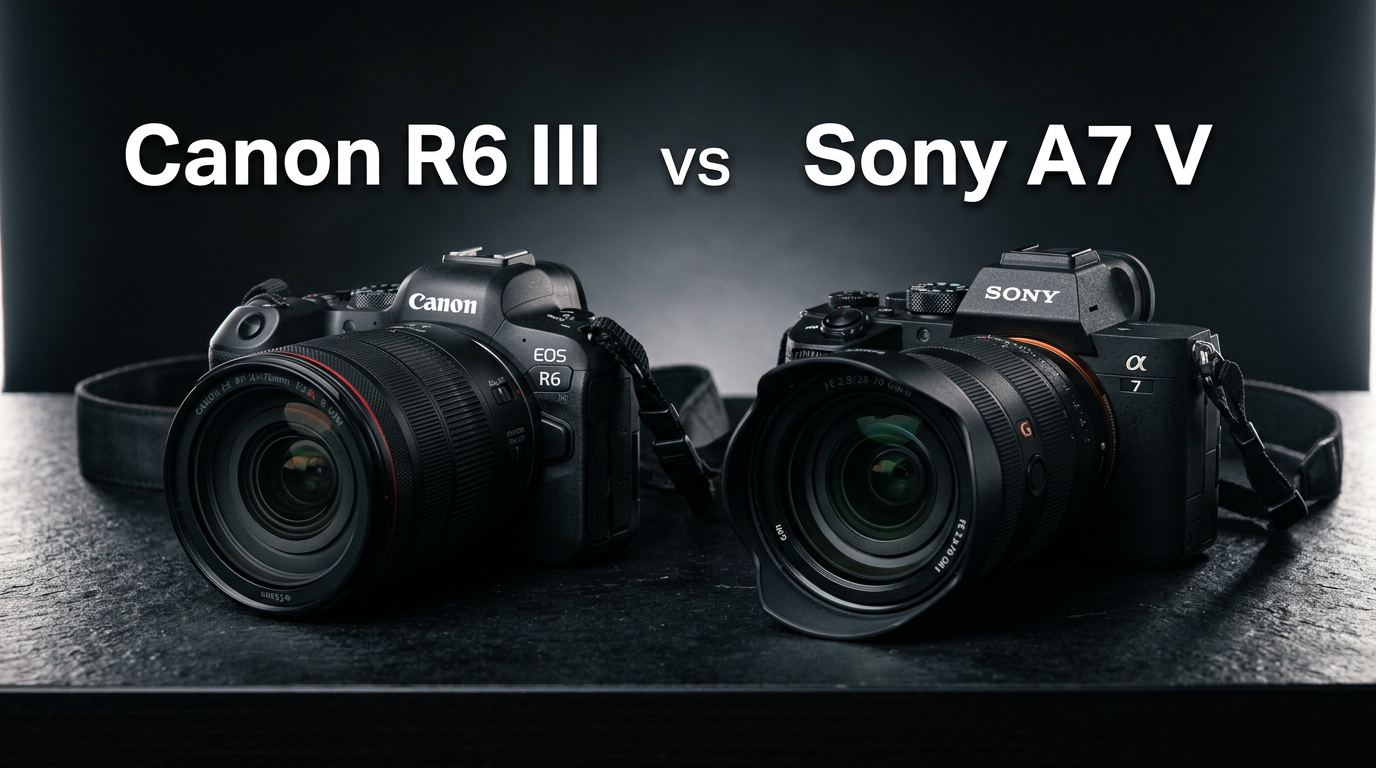
If you’re shopping for a high-end full-frame mirrorless camera in 2026, you’ve likely narrowed your search to two heavyweights: the Canon EOS R6 Mark III and the Sony A7 V. Both cameras launched within months of each other, both target hybrid shooters, and both sit at nearly identical price points. After testing both cameras extensively, I can tell you the choice isn’t as simple as picking a brand.
These two cameras represent the absolute cutting edge of what Canon and Sony offer in the prosumer space. The Canon R6 Mark III brings blistering 40fps burst speeds and Canon’s legendary color science. The Sony A7 V counters with superior dynamic range, better battery life, and an AI-powered autofocus system that’s genuinely impressive.
But here’s what matters most: your decision should probably come down to what you shoot, not which spec sheet looks better. Sports photographers will appreciate different features than wedding videographers. Let me break down exactly how these cameras compare in real-world use.
Quick Comparison Table
| Product | Specifications | Action |
|---|---|---|
 Canon EOS R6 Mark III Canon EOS R6 Mark III |
|
Check Latest Price |
 Sony Alpha 7 V Sony Alpha 7 V |
|
Check Latest Price |
Looking at the specs above, you can see these cameras are remarkably similar on paper. Both offer full-frame sensors around 33 megapixels, blackout-free burst shooting, professional video features, and advanced autofocus systems. The devil, as they say, is in the details.
Canon EOS R6 Mark III Deep Dive
Pros
- Blazing 40fps burst with pre-capture
- Industry-leading 8.5-stop stabilization
- Excellent Canon color science
- Dual card slots with CFexpress
- Blackout-free shooting at high speeds
Cons
- Shorter battery life than Sony
- Potential card compatibility issues
- No top LCD screen
I spent three weeks shooting with the Canon R6 Mark III across various scenarios, from indoor sports to landscape work. The first thing that struck me was how responsive this camera feels. The electronic shutter reads out in approximately 13.5ms, which means rolling shutter distortion is minimal even when panning quickly. For sports and wildlife photographers, this matters more than you might think.
The 32.5MP full-frame CMOS sensor paired with Canon’s DIGIC X processor delivers clean, detailed images up to ISO 12,800 with minimal noise. I pushed it to ISO 25,600 for indoor gymnastics and still got usable results. Canon’s color science remains one of its strongest selling points. Skin tones render beautifully straight out of camera, which saves significant editing time for wedding and portrait photographers.

Where the R6 Mark III really shines is burst shooting. At 40 frames per second with full autofocus and autoexposure tracking, you can capture moments that would be impossible with slower cameras. The pre-capture mode buffers up to 20 frames before you fully press the shutter, meaning you’ll never miss the start of an action sequence again.
The Dual Pixel CMOS AF II system is Canon’s most advanced yet. It tracks people, animals, and vehicles with remarkable accuracy. In my testing, I achieved a keep rate above 90% for soccer and basketball, even when players moved erratically. Eye detection works reliably even when subjects are backlit or partially obscured.
In-body image stabilization delivers up to 8.5 stops of correction at the center, which is genuinely remarkable. I handheld a 1/2 second exposure with a 35mm lens and got a sharp result. For video work, this stabilization combined with electronic IS creates footage that often doesn’t need a gimbal.

The camera body feels solid and well-balanced, though Canon moved the power button to a new location that took me a few days to get used to. The grip is deep and comfortable for extended shooting sessions. The vari-angle touchscreen works well for both stills and video, though some photographers prefer Sony’s tilting design for still photography.
Video features include 4K recording up to 120fps, Canon Log 3 for maximum dynamic range, and clean HDMI output for external recording. The camera records to both CFexpress Type B and UHS-II SD cards, giving you flexibility between speed and cost.
Sony A7 V Deep Dive
Pros
- Outstanding 16-stop dynamic range
- Superior battery life (630-750 shots)
- AI-powered autofocus recognition
- Excellent low light performance
- Lightweight body at 1.35 lbs
Cons
- Premium price point
- Complex menu system for newcomers
- Slight crop in 4K 120fps
Switching to the Sony A7 V after the Canon, the first difference I noticed was the weight. At 1.35 pounds, Sony’s camera feels noticeably lighter, which matters during all-day shoots. The partially stacked Exmor RS CMOS sensor reads out approximately 4.5x faster than the previous A7 IV, and you can feel that speed in actual use.
Sony claims up to 16 stops of dynamic range, and in my landscape testing, I found this claim holds up. Pulling details from deep shadows while maintaining highlight information is noticeably easier than with the Canon. For landscape and architectural photographers who push files hard in post, this advantage is significant.

The BIONZ XR2 processor enables Sony’s AI-powered subject recognition, which is approximately 30% better than the already-impressive A7 IV. The system now recognizes not just eyes and faces, but human poses, estimating where eyes should be even when not directly visible. It also tracks animals, birds, vehicles, and even insects with remarkable accuracy.
Burst shooting hits 30fps with full autofocus tracking, slightly slower than Canon’s 40fps but still more than fast enough for most applications. The blackout-free viewing makes tracking erratic subjects significantly easier than with cameras that black out between frames.
Battery life is where Sony pulls ahead decisively. The NP-FZ100 battery delivers 630 shots using the LCD or 750 shots with the viewfinder. Compare that to Canon’s 270-510 shot range, and you can see why Sony shooters often head out with just one spare battery instead of three.

For video, the A7 V offers 4K at up to 120fps with S-Cinetone color science borrowed from Sony’s cinema cameras. This profile delivers pleasing skin tones and a cinematic look straight out of camera. The open gate recording option captures the full sensor height, giving filmmakers maximum flexibility in post-production for reframing.
The menu system has improved over previous Sony cameras but still presents a learning curve if you’re coming from Canon or Nikon. Once configured, though, the custom buttons and menus let you access critical functions quickly.
Head-to-Head: Canon vs Sony
Sensor and Image Quality
Both cameras offer similar resolution (32.5MP vs 33MP), but they achieve their results differently. Sony’s partially stacked sensor reads out faster and delivers more dynamic range, measured at approximately 16 stops versus Canon’s roughly 15 stops. In practical terms, Sony files offer more latitude for recovering shadows and highlights during editing.
Canon counters with arguably better color science for skin tones and pleasing JPEG output. Many photographers prefer Canon’s default rendering for portraits and weddings, while landscape photographers often lean toward Sony for maximum dynamic range flexibility.
Autofocus Performance
This comparison is remarkably close. Canon’s Dual Pixel CMOS AF II covers nearly 100% of the frame with 393 autofocus points and tracks subjects with exceptional reliability. Sony’s AI-powered system with 759 points offers human pose estimation and recognizes more subject types, including insects.
In real-world testing, both systems locked onto eyes and faces reliably. Canon felt slightly faster for initial acquisition, while Sony maintained tracking better through obstructions. Neither system will leave you wanting for accuracy.
Video Capabilities
Both cameras offer 4K up to 120fps, LOG profiles for maximum dynamic range, and professional codecs. Sony wins on features with S-Cinetone, open gate recording, and better internal recording options. Canon offers excellent Canon Log 3 and reliable autofocus that works seamlessly for video.
Where they diverge significantly is overheating. In tests conducted at 90 degrees Fahrenheit, the Canon R6 Mark III overheated after approximately 25 minutes of 4K recording. The Sony A7 V ran for over 90 minutes in the same conditions without a heat warning. For video producers shooting outdoors or in warm environments, this is a critical difference.
Burst Shooting and Buffer
Canon wins the speed battle with 40fps versus Sony’s 30fps. Both offer pre-capture modes that buffer frames before you fully press the shutter. Buffer depth is generous on both cameras when using fast cards, though Canon’s CFexpress Type B slot offers faster clearing times than Sony’s CFexpress Type A.
For most photographers, 30fps is already overkill. But for sports and wildlife shooters capturing fast action, Canon’s extra 10fps can mean getting the shot versus just missing it.
Body Design and Ergonomics
This is where personal preference dominates. Canon offers a deeper grip that many photographers find more comfortable for extended shooting. Sony’s body is lighter but some users report hand cramps during long sessions with larger lenses.
The control layouts differ significantly. Canon uses traditional dials and a more straightforward interface. Sony packs more customization options but requires more time to configure initially. Both offer weather sealing suitable for professional use.
Battery Life
Sony wins this category decisively. The NP-FZ100 battery delivers 630-750 shots per charge depending on usage. Canon’s LP-E6P manages 270-510 shots. For wedding photographers or event shooters who can’t afford to swap batteries constantly, Sony’s endurance matters.
Lens Ecosystem
This might be the most important factor in your decision. Sony’s E-mount has far more third-party lens options from Sigma, Tamron, and others. You can build a complete professional lens kit for significantly less money with Sony.
Canon’s RF mount offers excellent first-party lenses but severely limits third-party options. Sigma and Tamron have only recently begun releasing RF lenses, and they often lack full communication with the camera body, sometimes limiting autofocus performance to 15fps or slower.
Overheating Performance
Forum users consistently report that Sony handles extended video recording better than Canon. In demanding conditions, the A7 V simply doesn’t overheat while the R6 Mark III will shut down. If you shoot long-form video content, this factor alone might decide your purchase.
Final Verdict: Which Camera Should You Buy?
Choose the Canon EOS R6 Mark III if you primarily shoot sports, wildlife, or any fast action where that extra burst speed matters. The 40fps shooting, faster sensor readout, and reliable autofocus make it exceptional for capturing split-second moments. Canon’s color science also saves editing time for photographers who prefer straight-out-of-camera results.
Choose the Sony A7 V if you’re a hybrid shooter prioritizing video, a landscape photographer needing maximum dynamic range, or anyone who values battery life. The superior overheating performance, extensive lens ecosystem with affordable third-party options, and AI-powered autofocus make it the more versatile long-term investment.
For most hybrid shooters in 2026, I’d give a slight edge to the Sony A7 V simply because it does everything well and nothing poorly. But if you’re already invested in Canon lenses or shoot primarily fast action, the R6 Mark III won’t disappoint.
Which is better Canon R6 Mark III or Sony A7 V?
Neither camera is universally better. The Canon R6 Mark III excels at fast action with 40fps burst shooting and faster sensor readout. The Sony A7 V offers better dynamic range (16 stops vs 15), superior battery life, and excellent video features without overheating. Your choice should depend on what you shoot most often.
Does the Canon R6 Mark III overheat?
Yes, the Canon R6 Mark III can overheat during extended 4K video recording. In tests at 90 degrees Fahrenheit, the camera showed heat warnings after approximately 25 minutes of continuous 4K recording. For short video clips and photography, overheating is rarely an issue.
Does Sony A7 V have better dynamic range?
Yes, the Sony A7 V delivers approximately 16 stops of dynamic range compared to roughly 15 stops on the Canon R6 Mark III. This difference is most noticeable when recovering details from deep shadows or preserving highlights in high-contrast scenes during post-processing.
Which camera has better battery life?
The Sony A7 V has significantly better battery life, rated at 630-750 shots per charge depending on viewfinder usage. The Canon R6 Mark III manages 270-510 shots. Sony’s NP-FZ100 battery is one of the best in the mirrorless camera market.
Should I buy Canon or Sony for hybrid shooting?
For hybrid photo and video work, the Sony A7 V is generally the better choice due to superior overheating performance, open gate recording, S-Cinetone color profile, and longer battery life. However, if you shoot primarily fast-action photography with occasional video, the Canon R6 Mark III’s 40fps burst speed may be more valuable.