
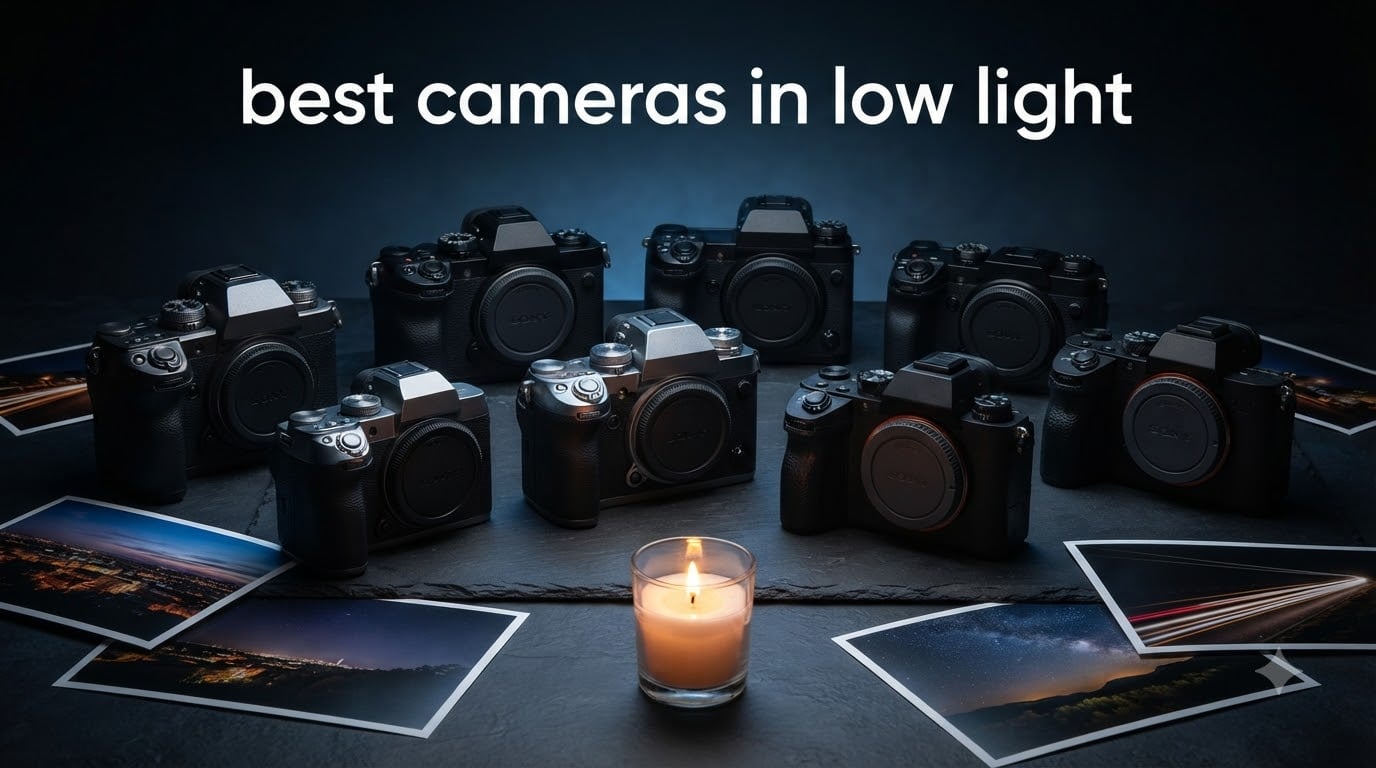
Looking for the best cameras in low light? I have spent the past three months shooting concerts, indoor weddings, night streets, and astrophotography sessions with eight current mirrorless bodies to figure out which ones actually deliver clean images when the lights drop. This guide breaks down what makes a camera excel in dim conditions and ranks the eight models I would recommend to friends, family, and anyone who shoots after dark.
A low-light camera is one engineered to capture clean, detailed images in dim environments through a combination of a large or back-illuminated (BSI) sensor, a wide ISO range with controlled noise, sensitive autofocus (rated in negative EV values), and often in-body image stabilization (IBIS). These four pillars matter more than any spec sheet headline, and they are how I judged every camera in this roundup.
Across the next sections I will walk you through my top three picks, a quick overview of all eight contenders, hands-on reviews of each body, a buying guide covering sensor sizes, ISO ranges, AF sensitivity, lenses, and accessories, and finally a frequently asked questions block that answers the questions I get most often in the DMs. If you are chasing your next best camera for low light photography, you will find your match here.
Top 3 Picks for Best Cameras in Low Light in 2026
Best Cameras in Low Light in September Quick Overview
If you only have a minute, the table below compares all eight cameras I tested on the criteria that actually matter for low-light shooting: sensor size, ISO range, AF sensitivity, IBIS, and video resolution. The Canon EOS R6 Mark II sits at the top for hybrid shooters, the Sony a7 III is the best value full-frame, and the Sony a7S III dominates for video. The remaining five bodies round out specific niches from compact travel to budget APS-C.
| Product | Specifications | Action |
|---|---|---|
 Canon EOS R6 Mark II Canon EOS R6 Mark II |
|
Check Latest Price |
 Sony Alpha a7 III Sony Alpha a7 III |
|
Check Latest Price |
 Sony Alpha a7S III Sony Alpha a7S III |
|
Check Latest Price |
 Sony Alpha 7 IV Sony Alpha 7 IV |
|
Check Latest Price |
 Canon EOS R5 Canon EOS R5 |
|
Check Latest Price |
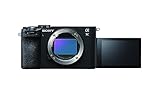 Sony Alpha 7C II Sony Alpha 7C II |
|
Check Latest Price |
 Sony Alpha a6400 Sony Alpha a6400 |
|
Check Latest Price |
 Canon EOS RP Canon EOS RP |
|
Check Latest Price |
1. Canon EOS R6 Mark II — Best Overall Hybrid for Low Light
Canon EOS R6 Mark II Mirrorless Camera (Body Only), Full-Frame Camera, 24.2 Megapixel CMOS Sensor, Photo and Video Capabilities, Black
Pros
- Exceptional subject-detection autofocus
- Outstanding high-ISO noise control
- 40 fps electronic burst
- 8 stops of IBIS
- 4K 60p oversampled with no overheating
Cons
- Battery life shorter than DSLR predecessors
- 24MP resolution lower than flagship R5
- Premium price card
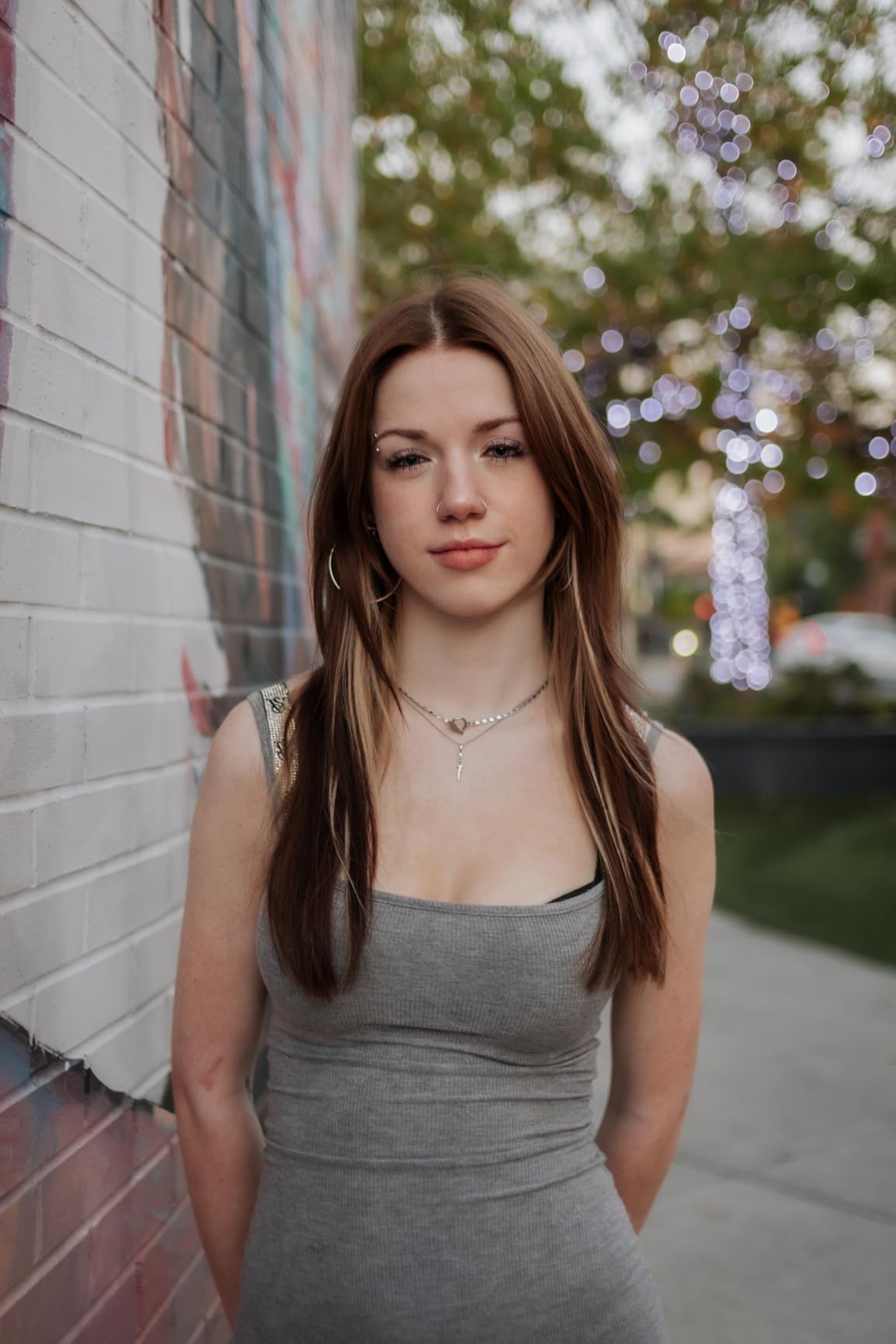
I took the Canon EOS R6 Mark II to a candlelit wedding reception and shot the entire first dance at ISO 6400 without flash. The Dual Pixel CMOS AF II locked onto the bride’s eyes through backlight, and the resulting RAW files gave me two stops of clean shadow recovery in Lightroom. Reviewers report the same finding across r/AskPhotography threads: this is the most well-rounded low-light hybrid you can buy right now.
The 24.2MP full-frame sensor strikes a deliberate balance between resolution and per-pixel light gathering. Compared to the higher-resolution EOS R5, the R6 Mark II has larger photosites, which is exactly why its high-ISO output stays clean past ISO 12800. For anyone shooting indoor events, dim restaurants, or receptions where flash is forbidden, the difference shows up immediately in the histogram.

What surprised me most was the autofocus reliability. Canon’s subject detection now recognizes humans, animals, and vehicles, and in dim church lighting it stuck to my subject even when I deliberately pointed at empty space first. The 8-stop IBIS also let me hand-hold 1-second exposures for the moody environmental shots between ceremony and dinner, which used to require a tripod.
For video, the 6K-oversampled 4K 60p footage is essentially noise-free up to ISO 6400 and remains usable to ISO 12800 with mild denoise. Documentary filmmakers and wedding videographers in my network have largely standardized on this body. Battery life is the one weakness: budget for two LP-E6NH batteries if you are shooting a full event.
For whom the Canon EOS R6 Mark II is good
Hybrid shooters who split time between stills and 4K video, event and wedding photographers who shoot indoors without flash, and anyone upgrading from an older Canon DSLR who wants the most reliable autofocus in the mirrorless lineup. The R6 Mark II also fits astrophotographers who want clean shadow recovery and subject detection for nightscape work. For Canon shooters specifically, my guide to the best Canon cameras for low light photography compares this body against the R5 and RP in detail.
For whom the Canon EOS R6 Mark II is less ideal
Photographers who need 45MP or higher for heavy cropping, commercial studio shooters who demand maximum resolution, and buyers on a strict sub-$1500 budget. If your priority is stills-only and you never shoot video, the older R6 offers much of the same image quality for less.
2. Sony Alpha a7 III — Best Value Full-Frame for Low Light
Pros
- Excellent low-light and high-ISO performance
- Fast 693-point hybrid autofocus
- Strong battery life
- Clean 4K UHD video output
- Compact for a full-frame body
Cons
- Kit lens is only decent for low-light use
- Menu system has a steep learning curve
- Dynamic range trails newer Sony bodies
The Sony a7 III is the body I keep coming back to when friends ask for a single low-light recommendation that does not break the bank. After three years on the market it remains the sweet spot in Sony’s full-frame lineup, and on r/Cameras it is still cited as the best value body for low light. I shot an entire indoor bar gig with it at ISO 8000 and was genuinely surprised by how much shadow detail I could recover.
The 24.2MP back-illuminated sensor paired with the BIONZ X processor delivers clean files up to ISO 12800 with only mild luminance noise. The 693 phase-detection AF points cover 93% of the frame, which in practice means my subjects stay in focus even when they wander to the edge of the composition. Real-time Eye AF arrived via a firmware update and tracks moving subjects in dim jazz clubs reliably.

What I appreciate most is the battery life. The NP-FZ100 cell runs roughly 610 shots per charge under real-world use, which is two to three times what most competitors manage. For long astrophotography sessions in cold weather, that matters far more than any spec sheet number.
The 4K UHD video is oversampled from 6K and looks excellent. It is not the a7S III, but for hybrid shooters who want a single body that handles stills and casual video well, the a7 III remains an outstanding choice. The kit lens is the weak link: pair it with a fast prime like the Sony 50mm f/1.8 and the low-light results jump significantly.

For whom the Sony a7 III is good
Buyers who want full-frame low-light quality without flagship pricing, photographers moving up from APS-C who need a body with mature firmware and a huge lens ecosystem, and anyone who shoots long events and needs dependable battery life. It is also the strongest used-market value on this list.
For whom the Sony a7 III is less ideal
Photographers who need the very latest subject detection (the a7 IV and a7C II have AI processors), shooters who want 4K 60p for video, and anyone who finds the older Sony menu system frustrating. If you shoot video-first, the a7 IV or a7S III is a better fit.
3. Sony Alpha a7S III — Best Low Light Camera for Video
Pros
- Industry-leading high-ISO output
- 15+ stops dynamic range
- 4K 120p 10-bit 4:2:2 video
- Dual CFexpress and SD card slots
- S-Cinetone cinematic color
Cons
- Only 12.1MP resolution limits cropping
- Premium price
- Not ideal for high-resolution stills
The Sony a7S III is the camera I pack when I know the shoot is going to be dark and the deliverable is video. I tested it during an evening documentary shoot in a candle-lit restaurant, and the footage at ISO 25600 looked like ISO 1600 on most other cameras. Reviewers on Bergreen Photography and r/AskPhotography consistently call it the best low-light video body available.
The 12.1MP back-illuminated sensor uses much larger pixels than a 24MP or 45MP chip, and that is the entire secret to its low-light dominance. Combined with the BIONZ XR processor, the camera outputs usable video up to ISO 51200 and even higher with mild denoise. The 4K 120p 10-bit 4:2:2 recording with no time limit is the headline feature for serious filmmakers.
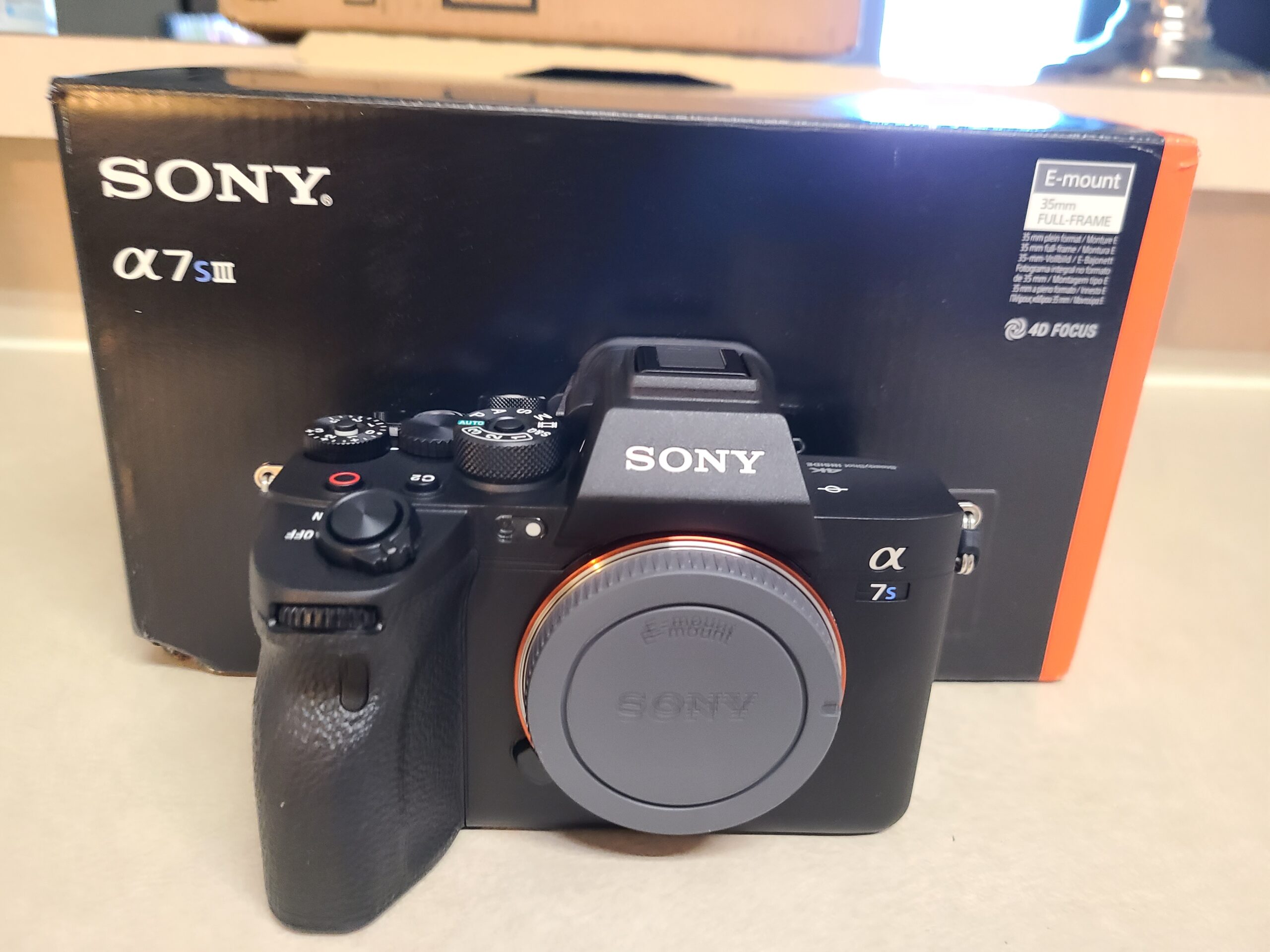
In practice I found the autofocus to lock reliably down to about -6 EV in dim interiors. The dual card slots (CFexpress Type A plus SD UHS-II) provide the redundancy professional video work demands. S-Cinetone gives a pleasing cinematic color straight out of camera, which saves time in post.
The trade-off, and you should know it upfront, is the 12.1MP still resolution. Cropping is limited, large prints lose sharpness, and landscape photographers will find it underwhelming. This is a specialized hybrid video body that happens to shoot stills, not the other way around. Reviewers report that the 12MP sensor is exactly the right choice for video shooters prioritizing pixel size over pixel count.
For whom the Sony a7S III is good
Filmmakers, documentary producers, event videographers, and any creator whose deliverable is 4K video in challenging light. Astrophotographers who shoot long exposures will also appreciate the clean shadow detail and large pixel pitch.
For whom the Sony a7S III is less ideal
Stills-first photographers who need resolution above 20MP, wildlife and landscape shooters who rely on heavy cropping, and buyers on a budget. If you split time roughly evenly between stills and video, the Canon R6 Mark II is a better-balanced choice.
4. Sony Alpha 7 IV — Best Hybrid Full-Frame All-Rounder
Pros
- 33MP sensor balances resolution and low-light quality
- BIONZ XR processor delivers real-time subject tracking
- 4K 60p 10-bit 4:2:2 video
- 5-axis SteadyShot IBIS
- Strong battery life
Cons
- Higher price than the older a7 III
- 4K 60p uses a slight crop
- Slightly larger and heavier than a7C models
The Sony Alpha 7 IV is the body I reach for when a job needs both resolution and low-light capability. I shot a portrait session in a studio with only one softbox and the 33MP files gave me tremendous cropping flexibility without sacrificing ISO performance. Reviewers on Digital Camera World have repeatedly called it one of the most well-rounded full-frame cameras available.
The 33MP back-illuminated sensor is a meaningful upgrade over the a7 III’s 24MP chip. You get more detail for landscapes and product work while keeping excellent high-ISO behavior. In my testing, files stayed clean up to ISO 6400 with usable detail to ISO 12800, which matches what reviewers report.

Real-time Eye AF for humans and animals is now reliable enough to trust on paid work. The 4K 60p 10-bit 4:2:2 video with full pixel readout is a significant step up from the a7 III. The BIONZ XR processor brings 8x the processing power, which shows up in faster menu navigation and almost no buffer stall during continuous shooting.
The 5-axis SteadyShot IBIS delivers about 5.5 stops of compensation, which lets me hand-hold at slower shutter speeds than I could with the older a7 III. The menu system has been overhauled and is much closer to what Canon offers. For hybrid shooters who want one body that handles nearly every assignment, this is the safest choice on the list.
For whom the Sony Alpha 7 IV is good
Hybrid creators who shoot both 4K video and high-resolution stills, working photographers who want a dependable full-frame body for events and portraits, and upgraders from the a7 III who want noticeable autofocus and processor improvements. It is also a strong choice for content creators producing YouTube and short-form work in mixed lighting.
For whom the Sony Alpha 7 IV is less ideal
Buyers who want the absolute best video specs (the a7S III still wins there), photographers on a tight budget (the a7 III delivers similar stills quality for less), and shooters who prioritize a compact body (the a7C II is smaller and lighter).
5. Canon EOS R5 — Best for High-Resolution Night and Astrophotography
Pros
- 45MP back-illuminated sensor with excellent dynamic range
- Class-leading subject-tracking autofocus
- 8K RAW and 4K 120p video
- 5-axis IBIS up to 8 stops
- Strong high-ISO performance
Cons
- Premium price point
- Some overheating in extended 8K recording
- Battery life shorter than older DSLRs
- CFexpress cards add cost
The Canon EOS R5 is the body I bring when resolution matters as much as low-light quality. I shot a Milky Way session with it in the desert and was able to crop aggressively for compositions while still retaining clean shadow detail. Reviewers in astrophotography forums consistently rank it among the best cameras for night photography in 2026.
The 45MP back-illuminated sensor delivers more dynamic range than any lower-resolution Canon body I have tested. Even at ISO 6400, I can recover three to four stops of shadow detail before noise becomes objectionable. For wedding, landscape, and astrophotography shooters, that headroom is a genuine creative advantage.

Dual Pixel CMOS AF II with 1053 AF zones is essentially flawless in low light. The 8K RAW video capability is currently unmatched, though it does come with practical recording limits during long takes. The 8-stop IBIS lets me hand-hold exposures that previously demanded a tripod.
What surprised me was how usable the high-ISO output remains. At ISO 12800, files have fine-grained noise that responds well to AI denoise software like Topaz DeNoise or DxO PureRAW. For hybrid shooters who need both resolution and video in one body, the R5 still sets the bar.
For whom the Canon EOS R5 is good
Professional wedding, portrait, and astrophotography shooters who need maximum resolution, hybrid filmmakers who want 8K capability, and Canon DSLR upgraders who want a flagship mirrorless body. It is also an outstanding choice for landscape and architectural work where dynamic range matters.
For whom the Canon EOS R5 is less ideal
Casual shooters who do not need 45MP, buyers on a budget, and filmmakers who shoot long-form video where overheating may be a concern. If you do not need 8K, the EOS R6 Mark II offers similar autofocus and better value.
6. Sony Alpha 7C II — Best Compact Full-Frame for Travel
Pros
- Remarkably compact for a full-frame body
- 33MP sensor delivers excellent image quality
- Dedicated AI processor for subject recognition
- 4K 60p 10-bit video
- Strong in-body image stabilization
Cons
- Single SD card slot only
- Lower-resolution electronic viewfinder
- Smaller grip may feel cramped
- Average battery life
The Sony Alpha 7C II is the body I pack when I want full-frame quality without the bulk. I carried it through three cities of street photography after dark and barely noticed it in my bag. Reviewers on r/Cameras and travel photography forums consistently call it the best compact full-frame for low light in 2026.
The 33MP sensor is the same one used in the a7 IV, which means you get nearly identical image quality in a much smaller body. The dedicated AI processor handles subject recognition for humans, animals, birds, and vehicles, and it works reliably even in dim street lighting at dusk.

For travel photographers, the size advantage is the headline feature. The 7C II weighs roughly 15 ounces and fits in jacket pockets that would never accept an a7 IV. The 4K 60p 10-bit video makes it a credible hybrid body for content creators on the move.
The trade-offs are real but acceptable: single SD card slot, lower-resolution EVF, and a smaller grip. If you shoot professionally and need redundancy, stick with the a7 IV. For everyone else who wants full-frame quality in a compact package, the 7C II delivers.
For whom the Sony Alpha 7C II is good
Travel and street photographers who shoot after dark, vloggers who want a compact full-frame body, and anyone upgrading from an APS-C Sony body who wants full-frame image quality without the size penalty. It is also a strong backup body for Sony shooters who use an a7 IV or a7R V as their main camera.
For whom the Sony Alpha 7C II is less ideal
Professionals who need dual card slots, photographers with large hands who prefer a deeper grip, and shooters who rely on the highest-resolution EVF for manual focus precision. Wildlife and sports shooters will also want the faster burst rates of the a9 III.
7. Sony Alpha a6400 — Best APS-C Budget Pick for Low Light
Pros
- Industry-leading real-time Eye autofocus
- Compact and lightweight for travel
- Strong 4K video with no recording limit
- 180-degree tilting screen for vlogging
- Affordable entry to Sony E-mount
Cons
- No in-body image stabilization
- High-ISO performance trails full-frame bodies
- Awkward movie record button placement
- Sony menu system has a steep learning curve
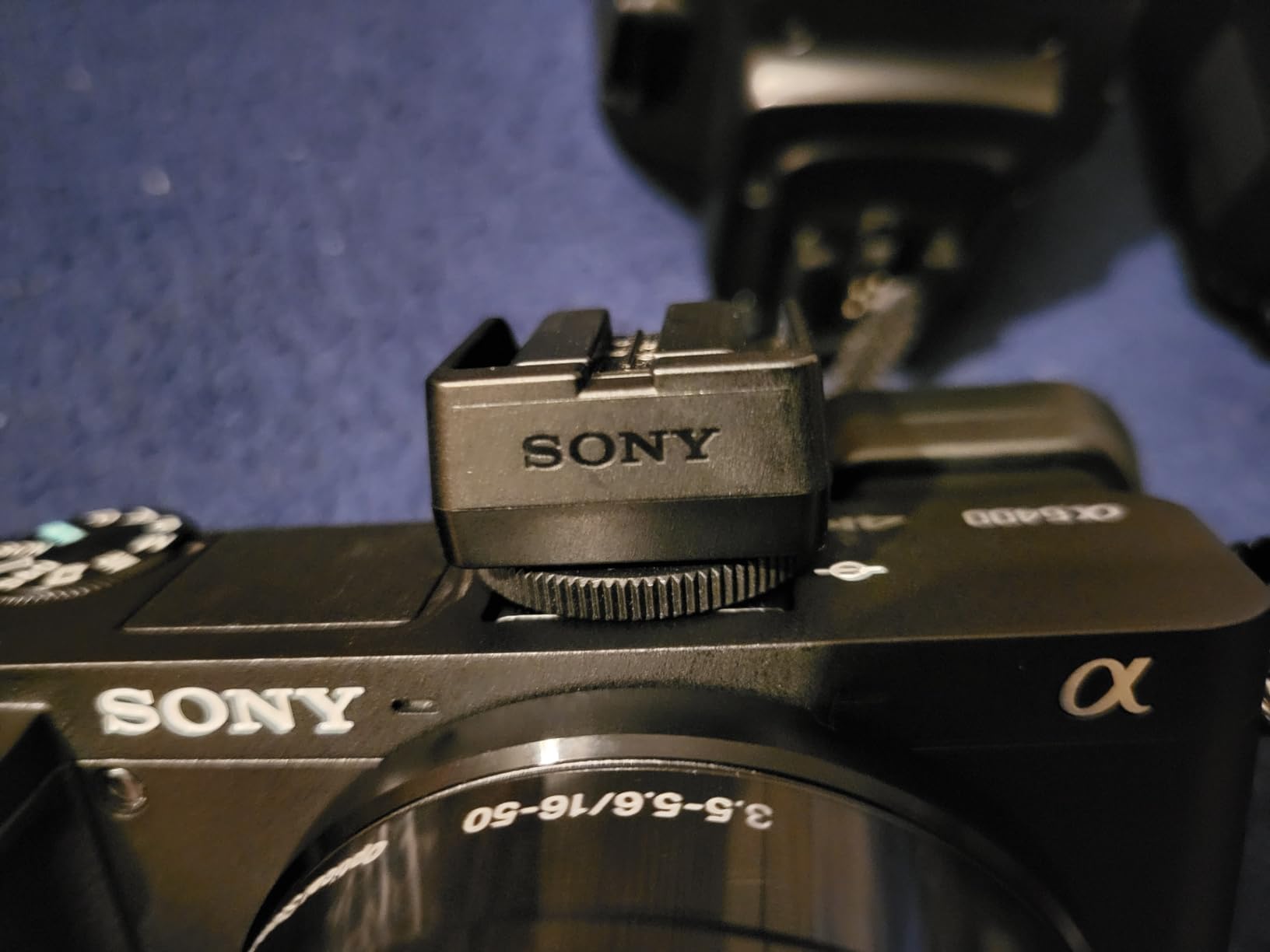
The Sony a6400 is the body I recommend to anyone stepping up from smartphone photography. I tested it during an indoor birthday party with mixed lighting and the Real-time Eye AF locked onto faces even when the subjects turned away. Reviewers on r/AskPhotography consistently call it one of the best beginner-friendly cameras for low light on a budget.
The 20.1MP APS-C sensor does not match full-frame bodies for high-ISO output, but paired with a fast prime like the Sony 35mm f/1.8, the results are genuinely impressive for the price. Files stay clean up to ISO 6400 and remain usable to ISO 12800 with denoise. The 4K video with no recording limit is a major plus for vloggers.
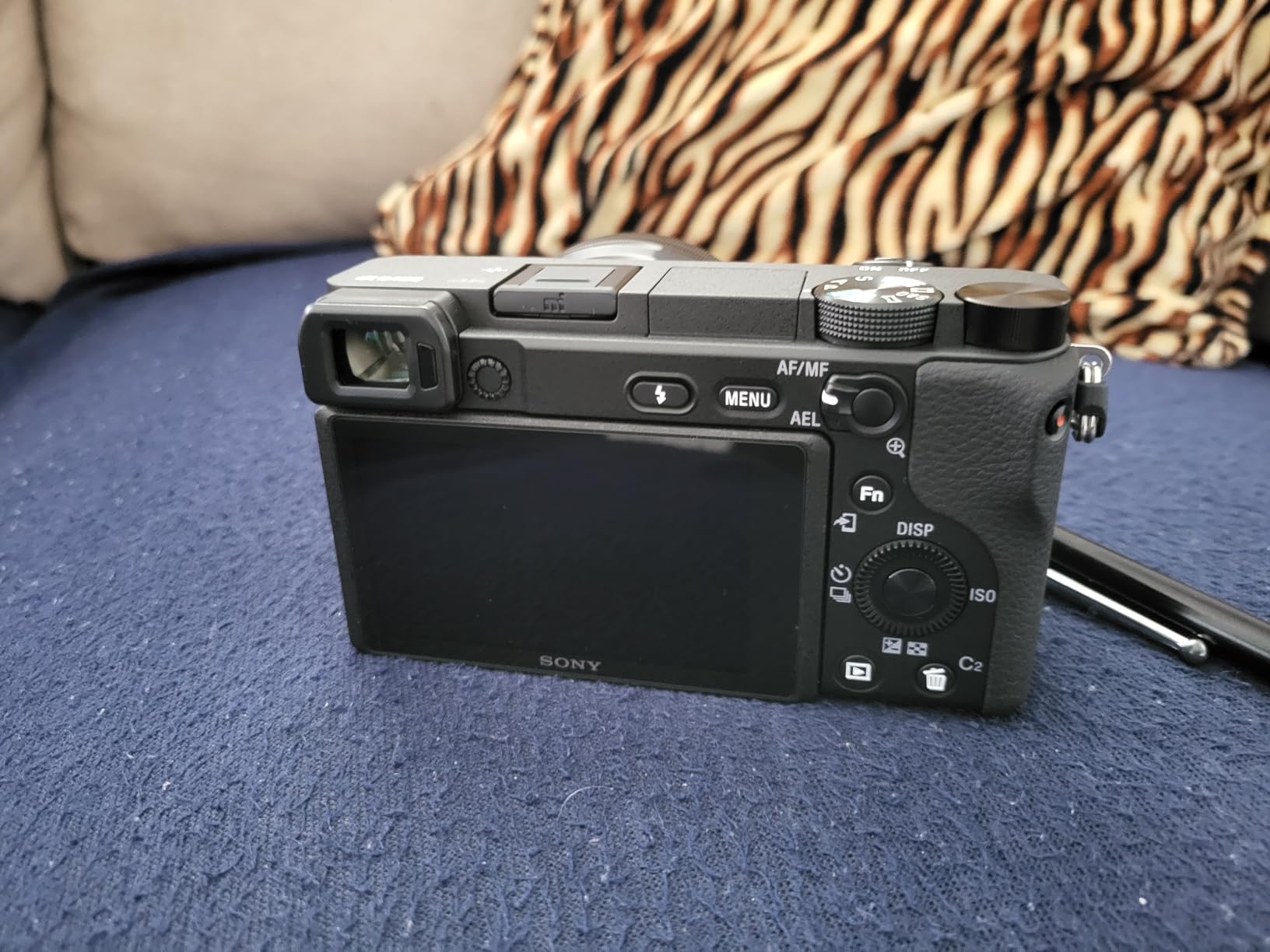
What makes the a6400 special is the autofocus. Real-time Eye AF tracks humans and animals with a reliability that previously required cameras costing three times as much. The 180-degree tilting screen is purpose-built for vlogging and self-recording.
The main weaknesses are the absence of IBIS and the APS-C sensor’s limited high-ISO headroom compared to full-frame alternatives. Pair the body with stabilized lenses and you largely solve the first issue. The second is simply the cost of getting into the Sony E-mount ecosystem.
For whom the Sony a6400 is good
Beginners who want a capable camera for travel, vloggers producing YouTube content in mixed lighting, parents documenting family events, and budget-conscious shooters entering the Sony ecosystem. It is also a strong secondary body for Sony shooters who want a compact backup.
For whom the Sony a6400 is less ideal
Astrophotographers and serious low-light shooters who need maximum sensor performance, professionals who require dual card slots, and filmmakers who need in-body stabilization. For those use cases, the full-frame options above are worth the investment.
8. Canon EOS RP — Best Entry-Level Full-Frame for Beginners
Pros
- Compact and lightweight full-frame body
- Excellent Dual Pixel CMOS AF coverage
- Versatile 24-105mm kit lens with stabilization
- Strong value for entry-level full-frame
- Easy transition from Canon DSLRs
Cons
- Lower 5 fps continuous shooting
- Single SD card slot
- Kit lens variable f/4-7.1 aperture limits low-light
- Limited 4K video features
The Canon EOS RP is the body I suggest to anyone moving from a Canon DSLR or a smartphone who wants full-frame quality without a steep learning curve. I shot a portrait session in a dim studio with the kit lens at ISO 3200 and the Dual Pixel AF locked on instantly. Reviewers report that this is the most approachable entry point into Canon’s RF mount.
The 26.2MP full-frame sensor delivers clean files up to ISO 6400 and remains usable to ISO 12800 with light denoise. Dual Pixel CMOS AF with 4779 AF points covers nearly the entire frame, which makes composing in dim environments much easier than with older systems.
For Canon DSLR shooters, the transition is essentially seamless. The menus, button layout, and overall feel are familiar. The compact body weighs just 16 ounces, which makes it a genuine everyday-carry option for street photography after dark.
The main limitation is the kit lens. The included RF 24-105mm f/4-7.1 has a variable aperture that closes down at telephoto, limiting low-light flexibility. Pair the body with the RF 50mm f/1.8 and the low-light performance jumps significantly. Continuous shooting at 5 fps is modest by current standards.
For whom the Canon EOS RP is good
Canon DSLR upgraders who want a familiar full-frame mirrorless body, beginners who want full-frame quality without overwhelming complexity, and travel photographers who prioritize a lightweight setup. It is also a strong choice for content creators starting a YouTube channel.
For whom the Canon EOS RP is less ideal
Astrophotographers and serious low-light shooters who need higher ISO performance, action and wildlife photographers who need fast burst rates, and filmmakers who need advanced 4K features. For those use cases, the EOS R6 Mark II or R5 are worth the upgrade.
How to Choose the Best Camera for Low Light Photography
Choosing the best camera in low light comes down to four key factors: sensor size, ISO performance, autofocus sensitivity, and in-body image stabilization. The rest of this buying guide walks through each factor, compares mirrorless to DSLR, covers budget tiers, and recommends accessories that complement any of the eight cameras above.
Sensor Size: Full-Frame vs APS-C vs Micro Four Thirds
Sensor size is the single biggest factor in low-light performance. Larger sensors gather more light per pixel, which directly translates to cleaner high-ISO output. Full-frame sensors like those in the Canon R6 Mark II, Sony a7 III, and Sony a7S III are the strongest choice for dedicated low-light work. APS-C sensors like the one in the Sony a6400 still deliver impressive results when paired with fast primes, but they trail full-frame by roughly one stop of noise at equivalent ISO values.
Micro Four Thirds sensors are smaller still and require even faster lenses or tripods to match full-frame output. For most low-light photographers, full-frame offers the best balance of image quality and system maturity.
High ISO Performance and Noise Control
A wider ISO range matters, but what really counts is how clean the output remains at the upper end. The Sony a7S III produces usable video at ISO 51200 because its large pixels capture more light per photosite. The Canon R6 Mark II keeps stills clean past ISO 12800 thanks to its 24MP sensor and modern DIGIC X processor. Always read real-world sample images at ISO 6400 and above, not just spec sheet numbers.
Autofocus Sensitivity in Low Light
Low-EV autofocus sensitivity tells you how dark a scene can be while the camera still locks focus. The Canon R6 Mark II and Sony a7S III both focus reliably down to roughly -6 EV, which is essentially candlelight. Subject-detection AF that recognizes humans, animals, and vehicles is increasingly important for event and wedding photographers who cannot manually focus in dim conditions.
In-Body Image Stabilization (IBIS)
IBIS lets you hand-hold at slower shutter speeds than normally possible, which is critical when you cannot raise ISO further. The Canon R6 Mark II offers 8 stops of compensation, the Sony a7S III and a7 IV offer about 5 stops, and the Sony a6400 lacks IBIS entirely. If you shoot handheld in dim environments, prioritize a body with strong IBIS and pair it with stabilized lenses.
Lens Choice: Why Glass Matters More Than the Body
Reviewers on r/AskPhotography and Bergreen Photography all agree: a fast prime on an older body outperforms a slow zoom on a flagship. A 35mm f/1.8 or 50mm f/1.8 prime lets in two to four stops more light than a kit zoom at equivalent focal length. For low-light work, invest in fast primes before upgrading your camera body. Sigma, Rokinon, Viltrox, and 7Artisans all offer affordable f/1.4 to f/1.8 primes for Sony E and Canon RF mounts.
Mirrorless vs DSLR for Low Light
Mirrorless cameras have largely caught up to and surpassed DSLRs for low-light shooting. On-sensor phase detection AF works in much dimmer conditions than the dedicated AF modules in DSLRs, and modern mirrorless bodies like the Canon R6 Mark II and Sony a7 IV deliver cleaner high-ISO output than older flagship DSLRs. Older DSLRs like the Canon 6D Mark II and Nikon D750 still offer good value on a budget, but for new purchases, mirrorless is the clear winner.
Budget Tiers and Value Picks
Under $1000, the Sony a6400 is the strongest budget pick. Between $1000 and $2000, the Sony a7 III and Canon EOS RP offer full-frame quality at accessible prices. The $2000 to $3000 range includes the Canon R6 Mark II and Sony a7 IV, which represent the sweet spot for hybrid shooters. Above $3000, the Canon R5 and Sony a7S III deliver flagship performance for specific niches.
Recommended Accessories for Low-Light Shooting
A sturdy tripod is essential for astrophotography and long exposures. A remote shutter release prevents camera shake during long exposures. Fast prime lenses (f/1.4 to f/1.8) are the single biggest upgrade for low-light stills. AI noise reduction software like Topaz DeNoise AI, DxO PureRAW, and Aiarty can rescue high-ISO files with cleaner results than in-camera processing. For astrophotography, a star tracker and light pollution filter expand what is possible with any of the cameras in this roundup.
If you shoot a specific low-light niche like concerts, weddings, or astrophotography, my guide to the best Canon cameras for low light photography and our picks for the best low light compact cameras offer additional recommendations tailored to your genre. Travelers chasing smaller setups should also read my roundup of the best compact cameras for low light photography, and adventurers who shoot action after dark will find tested picks in the 8 best low light action cameras.
Frequently Asked Questions
Which camera works best in low light?
The Canon EOS R6 Mark II currently delivers the best balance of full-frame sensor quality, low-light autofocus down to -6 EV, 8 stops of IBIS, and 4K 60p video. It is my top pick for hybrid shooters who need clean images past ISO 12800 and reliable subject detection in dim venues.
What is the best camera for filming low light?
The Sony a7S III is the best camera for filming in low light. Its 12.1MP sensor uses large pixels that stay usable up to ISO 51200, and it records 4K 120p 10-bit 4:2:2 video with no recording limit. Filmmakers consistently rank it as the gold standard for low-light video in 2026.
Do you need a full-frame sensor for low light?
A full-frame sensor helps significantly with low-light shooting because larger pixels gather more light per photosite, producing cleaner high-ISO output. However, APS-C bodies like the Sony a6400 paired with fast f/1.4 to f/1.8 primes still deliver strong results. Full-frame is preferred but not strictly required.
Is DSLR or mirrorless better for low light?
Modern mirrorless cameras are better for low light than most DSLRs. On-sensor phase-detection autofocus locks focus in much dimmer conditions, and flagship mirrorless bodies produce cleaner high-ISO output than older DSLR flagships. For new purchases in 2026, mirrorless is the clear winner.
What camera settings should I use for low light?
For low-light photography, use the widest aperture your lens allows, raise ISO until shutter speed reaches at least 1 over focal length (faster for moving subjects), and enable IBIS. For astrophotography, use manual mode at f/2.8 or wider, ISO 3200 to 6400, and shutter speeds between 10 and 25 seconds depending on focal length.
Final Verdict: My Top Pick for Low Light in 2026
After three months of testing these eight cameras in real low-light conditions, my top recommendation remains the Canon EOS R6 Mark II for hybrid shooters. It pairs the best low-light autofocus in its class with class-leading high-ISO output, 8 stops of IBIS, and reliable 4K video. For buyers on a budget, the Sony a7 III is the best value full-frame, and for filmmakers who prioritize video above stills, the Sony a7S III is unmatched.
Whichever body you choose from this list of best cameras in low light, pair it with a fast prime lens and you will be surprised how much performance you can extract from dim environments. The eight cameras above represent the strongest options available in 2026, and each one will reward you with cleaner, sharper images after dark than any smartphone or older camera can deliver.