
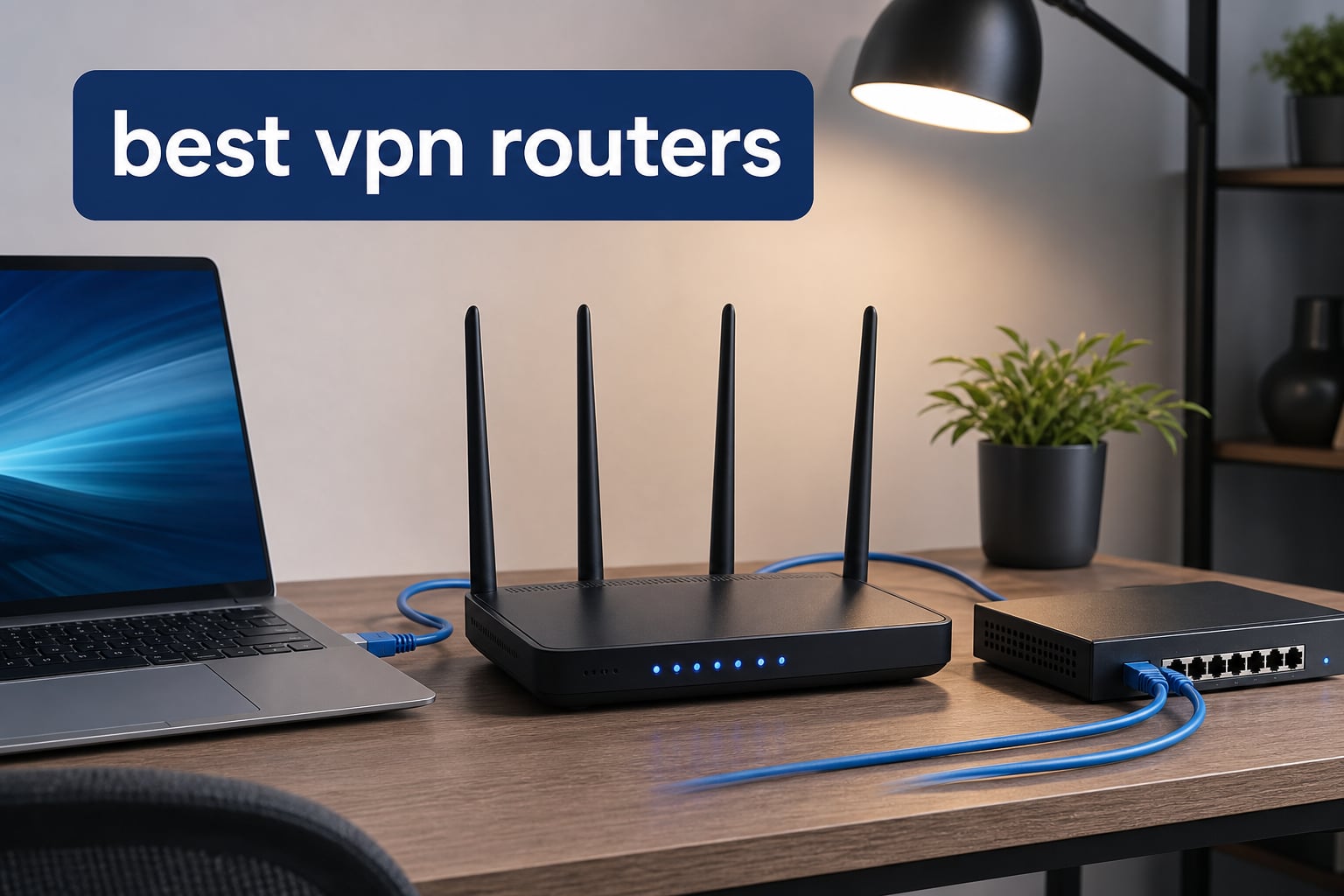
The best VPN routers put a VPN connection at the network edge, so every device that joins your Wi-Fi can use the encrypted tunnel without its own app. That matters for streaming boxes, consoles, work gear, and smart devices, and it also means you manage one connection instead of repeating setup on every screen.
A VPN router is not automatically the right answer for every person. A phone or laptop app is easier to toggle and may be faster, while a router asks its processor to encrypt traffic for the whole network; community discussions repeatedly point to VPN speed loss, firmware stability, and provider compatibility as the things that decide whether the experience stays pleasant.
For this 2026 guide, I compared the ten selected models by their stated Wi-Fi generation, ports, protocol support, VPN throughput where published, coverage claims, memory, and customer feedback summaries. The result separates serious home and gaming choices from compact travel hardware and a wired business gateway, rather than pretending one wireless VPN router suits all of them.
One practical warning before you choose: a router with built-in VPN support is not necessarily pre-configured for a particular service. Confirm that your provider supplies a compatible OpenVPN or WireGuard configuration, then check the router documentation for client-mode setup; that small check avoids the compatibility problems users often report after buying.
The top 3 picks answer the most common VPN router needs In 2026
The GL.iNet Flint 2 is my all-around pick because its published WireGuard and OpenVPN figures are unusually high for a home router, while the Beryl AX is the more sensible answer for frequent travel. The TP-Link Archer BE400 suits a household that wants Wi-Fi 7 coverage, dual 2.5Gbps connectivity, and an app-led setup, provided its VPN client options match the chosen service.
These three choices also show the key tradeoff. GL.iNet models put more attention on VPN controls and OpenWrt-based flexibility, whereas the Archer BE400 concentrates on home Wi-Fi capacity, coverage, and HomeShield features; choose the control style you will actually maintain.
The 10 best VPN routers in 2026 cover home, travel, gaming, and business
The list includes Wi-Fi 6, Wi-Fi 6E, and Wi-Fi 7 hardware, plus one wired Omada gateway. A Wi-Fi standard describes the local network, not the VPN itself, so published WireGuard or OpenVPN throughput and the number of fast Ethernet ports deserve at least as much attention as a large wireless speed number.
| Product | Specs | Action |
|---|---|---|
 GL.iNet Beryl AX GL.iNet Beryl AX |
|
Check Latest Price |
 GL.iNet Flint 2 GL.iNet Flint 2 |
|
Check Latest Price |
 GL.iNet Slate 7 GL.iNet Slate 7 |
|
Check Latest Price |
 TP-Link ER707-M2 TP-Link ER707-M2 |
|
Check Latest Price |
 TP-Link Archer BE230 TP-Link Archer BE230 |
|
Check Latest Price |
 TP-Link Archer BE400 TP-Link Archer BE400 |
|
Check Latest Price |
 GL.iNet Flint 3 GL.iNet Flint 3 |
|
Check Latest Price |
 GL.iNet Beryl 7 GL.iNet Beryl 7 |
|
Check Latest Price |
 TP-Link Roam 7 TP-Link Roam 7 |
|
Check Latest Price |
 TP-Link Archer AXE75 TP-Link Archer AXE75 |
|
Check Latest Price |
For a fixed home network, start with Flint 2, Flint 3, Archer BE400, or Archer AXE75. Packable models are deliberately smaller and have fewer wired ports, which is fine for turning hotel or cruise Wi-Fi into a private network but less convincing as the only router for a busy house.
1. GL.iNet Beryl AX is the practical Wi-Fi 6 travel choice
GL.iNet GL-MT3000 Beryl AX Wi-Fi 6 Travel Router, 2.5G WAN, VPN, OpenWrt
Wi-Fi 6
2.5G WAN
OpenVPN and WireGuard
Pros
- Pocket-size body
- 2.5G WAN port
- OpenWrt plug-ins
- WPA3 and DNS protection
Cons
- Only one LAN port
- 64MB RAM limits advanced builds
The Beryl AX is a travel VPN router that gets the important basics right: it weighs 196 grams, has Wi-Fi 6, and pairs a 2.5G WAN port with a gigabit LAN port. For a hotel Ethernet jack or a wired public connection, that port arrangement is far more useful than the many low-end pocket routers that stop at gigabit WAN.
Its listed OpenVPN speed is up to 150Mbps and WireGuard up to 300Mbps. Those are meaningful figures because router VPN throughput is usually lower than the internet plan, and WireGuard is generally the better starting point where a VPN provider offers it.
GL.iNet supplies OpenVPN and WireGuard as client and server options, plus VPN cascading, so the router can run a VPN client and server at the same time. It also lists OpenWrt 21.02, WPA3, DNS over HTTPS, DNS over TLS, IPv6, guest mode, and QoS, giving an experienced user a lot to adjust without making those extras mandatory.
The limitation is physical rather than mysterious: there are only two Ethernet ports total, and the listed 64MB of RAM is modest if you intend to stack many OpenWrt plug-ins. I would keep its configuration focused on a VPN profile and a few security settings instead of treating it like a miniature server.
It fits travelers who need one trusted network
Use the Beryl AX when you move between hotels, RV parks, cruises, or shared workspaces and want your own devices to reconnect to one familiar Wi-Fi network. Its compact dimensions and 5V power requirement make that job much less awkward than traveling with a full-size router.
Its VPN controls reward a small amount of preparation
Load and test your provider profile at home before departure, then use the hardware toggle for the VPN or AdGuard Home function. That preparation matters because captive portals and unfamiliar upstream Wi-Fi are already enough to troubleshoot without introducing a first-time VPN setup.
2. GL.iNet Flint 2 is the strongest all-round VPN router for home
GL.iNet GL-MT6000 Flint 2 Wi-Fi 6 Gaming Router Dual 2.5G Ports
Wi-Fi 6
900Mbps WireGuard
2x 2.5G Ethernet
Pros
- Fast stated VPN figures
- 1GB RAM
- 100 plus device support
- AdGuard Home
Cons
- Large stationary design
- not suited to travel
The Flint 2 is the answer I would give to a household that wants router-level VPN protection without giving up fast wired networking. It has Wi-Fi 6 rated up to 6Gbps, two 2.5G Ethernet ports, four additional gigabit ports, and published VPN throughput of up to 900Mbps for WireGuard and 880Mbps for OpenVPN.
Those stated figures put it in a different class from pocket hardware. They do not promise that every provider or server will deliver that result, but they give a clearer headroom target for remote work, 4K streaming, or a gaming VPN router setup than a router that lists only its raw Wi-Fi speed.
The hardware also lists 1GB of DDR4 RAM and 8GB of eMMC storage, with support for more than 100 devices. OpenWrt-oriented users get room for additions, while AdGuard Home, guest mode, access-point mode, QoS, and WPA3 mean a family can still use it as a conventional home router.
It weighs 761 grams and is designed for a fixed location, so portability is not part of the case. Community feedback often favors firmware reliability over a theoretical speed number; I would apply updates carefully, test one VPN protocol first, and keep the old settings available before changing several advanced options at once.
It serves busy homes and wired desks well
The two 2.5G ports are useful where a fiber modem, NAS, desktop, or switch can exceed gigabit speeds. Its eight-stream Wi-Fi 6 design also makes more sense in a home with many active clients than a travel router attempting to cover every room.
Its settings are best for owners who want control
Choose Flint 2 if you are comfortable selecting a protocol, importing a provider file, and checking status after firmware changes. If your priority is the shortest app-led setup, a TP-Link home model may feel less demanding, even though it gives you less VPN-specific detail.
3. GL.iNet Slate 7 is the feature-rich Wi-Fi 7 travel router
GL.iNet GL-BE3600 Slate 7 Wi-Fi 7 Travel Router Touchscreen 2.5G
Wi-Fi 7
dual 2.5G ports
touchscreen controls
Pros
- Wi-Fi 7 portability
- 2GB RAM
- QR scanning
- OpenWrt 23.05
Cons
- Touchscreen adds learning curve
- OpenVPN speed is lower
The Slate 7 brings Wi-Fi 7 into a 0.3-kilogram travel package and pairs it with dual 2.5G Ethernet ports. Its listed dual-band wireless rates are 688Mbps on 2.4GHz and 2882Mbps on 5GHz, while its 2GB RAM and 512MB storage give it far more headroom than many compact alternatives.
A touchscreen is the defining difference here. It can show QR codes and provide VPN toggling and provider switching, which could reduce the friction of managing a travel connection when you do not want to open a laptop; it may also be more interface than a basic user needs.
The stated VPN figures are up to 540Mbps for WireGuard and 100Mbps for OpenVPN. That gap makes protocol selection especially clear: if your service supports WireGuard, it is the sensible choice for faster tunneled travel traffic on this model.
OpenWrt 23.05, WPA3, DNS over HTTPS and TLS, IPv6, guest mode, and simultaneous VPN client/server support make Slate 7 a capable pre-configured VPN router alternative for someone happy to do their own profile setup. It is still a dual-band device, not a 6GHz travel access point.
It suits travelers who want on-device VPN status
Slate 7 makes sense for consultants, frequent flyers, and technically confident travelers who want to see and change VPN behavior at the router itself. The two 2.5G ports also leave room for a fast hotel Ethernet connection and a wired laptop.
Its speed profile favors WireGuard users
Before selecting it, verify that the VPN service offers WireGuard configuration rather than assuming any subscription will perform identically. An OpenVPN-only setup can still work, but the published throughput difference is large enough to affect streaming and large uploads.
4. TP-Link ER707-M2 is the wired VPN gateway for a small business
Omada ER707-M2, Multi-Gigabit VPN Route
Wired gateway
dual 2.5G WAN
Omada management
Pros
- 1000 plus client capacity
- IPsec and OpenVPN
- Omada SDN
- 5-year warranty
Cons
- No Wi-Fi included
- requires separate access points
The ER707-M2 is not a wireless router, and that is exactly why it belongs in this list for the right buyer. It is a wired Omada VPN gateway with a 2.5G WAN port, a 2.5G WAN/LAN port, four gigabit WAN/LAN ports, an SFP WAN/LAN port, and USB 2.0 for LTE backup.
For a small business, that layout enables load balancing and a clean separation between the gateway and separate Wi-Fi access points. It also lists 500,000 concurrent sessions and support for more than 1,000 clients, capacity that is plainly excessive for most homes but relevant in offices with many users and devices.
The protocol list is broader than the consumer models: IPsec, OpenVPN, L2TP, and PPTP are supported, with stated capacity for 100 LAN-to-LAN IPsec tunnels, 66 OpenVPN tunnels, 60 L2TP tunnels, and 60 PPTP tunnels. The SPI firewall, cloud access through the Omada app, and five-year warranty are further reasons to view it as infrastructure rather than a plug-and-play home Wi-Fi box.
Its 1.1-kilogram chassis and lack of Wi-Fi mean you must plan for access points, Ethernet, and Omada management. That added work buys flexibility, but it is the wrong choice for a traveler or for anyone replacing a single all-in-one wireless router.
It works when wired capacity matters more than Wi-Fi
Select the ER707-M2 for a studio, office, or multi-AP small business that needs centralized network administration and VPN tunnel capacity. Pair it with compatible wireless access points if employees and guests need Wi-Fi coverage.
Its deployment needs a network plan first
Count WAN links, switch ports, access points, and remote VPN users before buying. The hardware can support a larger topology, but its benefit comes from connecting it into that topology rather than putting it where a simple Wi-Fi router would have been.
5. TP-Link Archer BE230 is the compact Wi-Fi 7 home option
TP-Link Dual-Band BE3600 Wi-Fi 7 Router, Archer BE230
Wi-Fi 7
2x 2.5G ports
EasyMesh coverage
Pros
- Quad-core CPU
- EasyMesh support
- HomeShield
- 2000 sq ft claim
Cons
- No 6GHz band
- feedback notes reliability concerns
The Archer BE230 offers dual-band Wi-Fi 7 with Multi-Link Operation, a 2.0GHz quad-core processor, two 2.5G ports, and three gigabit ports. TP-Link lists coverage up to 2,000 square feet, which is a useful starting claim but not a substitute for considering walls, floors, and the location of the router.
Its wireless specification is 2882Mbps on 5GHz plus 688Mbps on 2.4GHz. Multi-Link Operation can improve connection behavior for compatible Wi-Fi 7 devices, while the four antennas, beamforming, and EasyMesh support target whole-home coverage more directly than a small travel router can.
HomeShield brings network protection and parental-control tools, and USB 3.0 is available for shared storage. VPN support is listed, but the supplied product data does not publish client protocol speed figures, so I would not assume its tunnel performance equals the GL.iNet models with explicit WireGuard results.
Customer summaries praise the feature set and ports but also mention reliability concerns, with a lower five-star share than the other selected GL.iNet products. That does not rule it out, but it is a sensible reason to confirm current firmware support and test the VPN connection during the return period.
It helps homes that plan to add mesh coverage
EasyMesh is the deciding feature for a house with one or two weak rooms, because it gives a route to expand coverage without discarding the main router. Put the main unit as centrally and openly as possible before deciding an extender is necessary.
Its VPN performance needs provider-specific checking
Confirm the Archer’s supported VPN client mode and the instructions offered by NordVPN, ExpressVPN, Surfshark, or another chosen provider. A router can advertise VPN support while still requiring a protocol or file format your service does not supply.
6. TP-Link Archer BE400 is the Wi-Fi 7 coverage-focused home pick
TP-Link BE6500 Dual-Band WiFi 7 Router (BE400)
Wi-Fi 7
6.5Gbps total
2400 sq ft coverage
Pros
- 90-device claim
- dual 2.5Gbps ports
- EasyMesh
- HomeShield
Cons
- Advanced setup can take time
- dual-band only
The Archer BE400 is built for the modern VPN router for home role: TP-Link lists Wi-Fi 7 with Multi-Link Operation, 6.5Gbps total bandwidth, six antennas with beamforming, dual 2.5Gbps ports, and coverage up to 2,400 square feet for up to 90 devices. Its stated capacity is compelling for a home with many smart devices, computers, televisions, and consoles.
It remains dual-band, with a published 5764Mbps 5GHz figure and 688Mbps on 2.4GHz, so it does not supply a 6GHz band. That is not automatically a problem, because local Wi-Fi capability and VPN capacity are separate concerns, but it distinguishes the BE400 from tri-band Wi-Fi 6E and Wi-Fi 7 choices.
The product lists VPN client and server support alongside HomeShield, EasyMesh, private IoT features, guest mode, parental controls, and QoS. Its 1GB RAM and quad-core CPU indicate a more substantial home platform than basic routers, though the provided data does not state maximum VPN throughput by protocol.
I would treat the simple app setup as a head start rather than a promise that every advanced setting will be simple. Several users note a learning curve with advanced options; document the existing connection details and set up the VPN after confirming ordinary internet and Wi-Fi operation.
It suits large households with many connected devices
Choose Archer BE400 when range, device count, multi-gig wired ports, and future Wi-Fi 7 client support are higher priorities than deep OpenWrt customization. Its EasyMesh compatibility also makes expansion a realistic option if a single router does not reach the whole home.
Its security features belong alongside a VPN rather than instead of one
HomeShield and a VPN address different parts of network protection. Use WPA3, firmware updates, guest or private IoT separation, and a carefully configured VPN together instead of assuming one feature covers every risk.
7. GL.iNet Flint 3 is the tri-band Wi-Fi 7 gaming and VPN pick
GL.iNet GL-BE9300 Flint 3 Tri-Band Wi-Fi 7 Router 5 x 2.5G VPN Router
Tri-band Wi-Fi 7
6GHz band
5x 2.5G ports
Pros
- 6GHz gaming band
- 680Mbps WireGuard
- AdGuard Home
- large port count
Cons
- No modem function
- initial setup can be complex
The Flint 3 is the most ambitious fixed-location GL.iNet model in this group. It combines tri-band Wi-Fi 7 with 2.4GHz, 5GHz, and 6GHz bands, a stated 12.5Gbps data rate, five 2.5G ports, 1GB RAM, and 8GB eMMC storage.
For a gaming VPN router, the 6GHz band can separate compatible nearby devices from more crowded older bands, while Multi-Link Operation can help Wi-Fi 7 clients. The router’s stated coverage is up to 2,000 square feet, though your own wall materials and router placement still set the real result.
VPN support includes WireGuard up to 680Mbps and OpenVPN, alongside AdGuard Home and parental controls with Bark. This is a stronger set of network-facing tools than most standard gaming routers offer, especially for an owner who wants DNS filtering and VPN controls in one device.
It is not a modem, so it must connect behind a fiber, cable, or other internet modem or gateway as appropriate. Review feedback says initial configuration can feel complex, which is fair for hardware that mixes multi-gig ports, tri-band Wi-Fi, and OpenWrt-based customization.
It favors wired gamers and high-bandwidth homes
The five 2.5G ports create practical options for a fast WAN, gaming PC, NAS, and switch without immediately forcing everything through one gigabit connection. That is more meaningful than a gaming label when you have compatible wired equipment.
Its 6GHz band needs compatible clients to matter
Buy Flint 3 for the rest of its networking and VPN specification too, not only for 6GHz. Older phones, laptops, and consoles can still use the 2.4GHz and 5GHz bands, but they cannot gain a 6GHz connection through a firmware setting.
8. GL.iNet Beryl 7 is the fastest stated VPN travel option
GL.iNet GL-MT3600BE Beryl 7 Dual-Band Wi-Fi 7 Travel Router
Pocket Wi-Fi 7
1100Mbps WireGuard
dual 2.5G ports
Pros
- Very fast listed VPN speeds
- USB 3.0
- world plug set
- physical toggle
Cons
- Only two Ethernet ports
- no modem capability
The Beryl 7 puts strikingly high claimed VPN figures into a 205-gram device: up to 1100Mbps for WireGuard and up to 1000Mbps for OpenVPN with DCO. It also offers dual-band Wi-Fi 7, dual 2.5G Ethernet ports, USB 3.0, 512MB RAM and storage, and an OpenWrt 21.02 base.
For travelers who regularly work from hotel Ethernet or need to tunnel a fast connection, those numbers separate it from the Beryl AX and Slate 7. As with every vendor speed statement, a VPN server, provider configuration, upstream Wi-Fi, and the client device can lower the real number, but the published capacity is notable.
It includes WPA3, DNS over HTTPS and TLS, guest mode, QoS, a physical toggle switch, and power adapters for the US, UK, EU, and AU. The included plug selection is a quiet but real travel benefit, because it eliminates one accessory from the bag.
It is not modem compatible and provides only one WAN and one LAN port, so it belongs downstream of an existing connection rather than as the center of a large wired network. Its stated support for up to 120 devices is generous, but public Wi-Fi capacity will often be the limiting factor on a trip.
It works for travelers who need the highest available tunnel headroom
Beryl 7 is a strong candidate for remote workers transferring large files or using several protected devices from a temporary location. Connect it to known-good hotel Ethernet when available, because that removes the variability of an already crowded public wireless network.
Its physical switch makes daily VPN use simpler
Assign the toggle to VPN or AdGuard only after checking the current firmware setting and testing it. A clear hardware state can make it easier to avoid the common frustration of wondering whether a router-level tunnel is on after changing locations.
9. TP-Link Roam 7 is the flexible public Wi-Fi travel pick
Roam 7 BE3600 Wi-Fi 7 Portable Travel Router Dual-Band, 2.5G Port, USB 3.0
Wi-Fi 7 travel
2.5G WAN
OpenVPN and WireGuard
Pros
- Captive portal support
- USB-C power
- 90-device claim
- multiple operating modes
Cons
- No 6GHz band
- only two ports
The TP-Link Roam 7 is made for the awkward realities of public connections. It supports router, hotspot, access point, range extender, and client modes, with captive portal authentication that is particularly relevant to hotel, cruise, RV, and airport-style Wi-Fi.
Its dual-band Wi-Fi 7 specification is 2882Mbps on 5GHz and 688Mbps on 2.4GHz, with Multi-Link Operation and support for up to 90 devices. A 2.5Gbps WAN port and gigabit LAN port make it flexible for a travel device, although it has no 6GHz band.
OpenVPN and WireGuard support are listed, and USB-C power means the router can work with a compatible power bank. That combination offers a simple way to create a private local network from public Wi-Fi, then connect devices that do not themselves handle captive portals gracefully.
At 8.8 ounces, it is portable but larger than the smallest GL.iNet units. The customer summary praises versatility and ease of use, and I would view that multi-mode design as its main reason to choose it over more specialized travel VPN hardware.
It is useful when hotels make you sign in through a portal
Connect one device to complete the captive-portal step, then let the Roam 7 share that authenticated internet with your own devices. Check the hotel’s permitted-device policy first, as public-network terms can vary.
Its power options help on mobile trips
USB-C power bank compatibility is valuable on long travel days where wall outlets are scarce. Carry an Ethernet cable as well, because hotel wired service can be both more stable and faster than the room’s Wi-Fi.
10. TP-Link Archer AXE75 is the proven tri-band Wi-Fi 6E alternative
TP-Link AXE5400 Tri-Band WiFi 6E Router, 2025 PCMag Editors’ Choice
Tri-band Wi-Fi 6E
6GHz band
2.5G WAN port
Pros
- 6GHz capacity
- OneMesh
- HomeShield
- VPN client and server
Cons
- Wi-Fi 6E not Wi-Fi 7
- larger desktop body
The Archer AXE75 offers a different route to a less crowded local network: tri-band Wi-Fi 6E with a 6GHz band. Its stated band rates are 2402Mbps on 6GHz, 2402Mbps on 5GHz, and 574Mbps on 2.4GHz, for 5400Mbps total.
It also includes a 2.5Gbps WAN port, a 1GHz dual-core CPU, 512MB RAM, eight antennas, OFDMA, and OneMesh support. For homes with Wi-Fi 6E clients, the dedicated 6GHz layer may be more immediately useful than Wi-Fi 7 features that their current devices cannot yet use.
TP-Link lists VPN server and client capability, HomeShield, WPA3, QoS, parental controls, and compatibility with all ISPs. As with the other Archer routers, request the exact VPN-client protocol and provider instructions before treating it as an ExpressVPN router, NordVPN router, or Surfshark VPN router by default.
This model is physically larger than the travel choices, measuring 12.91 by 10.43 by 4.72 inches and weighing 0.69 kilograms. It is a better fit for a media cabinet or central home location than a bag, and it remains Wi-Fi 6E rather than Wi-Fi 7.
It fits homes that already have Wi-Fi 6E devices
The 6GHz band is the reason to select AXE75 over a dual-band Wi-Fi 6 router. Put compatible nearby laptops, phones, or VR hardware on that band while leaving older smart devices on 2.4GHz or 5GHz.
Its mesh option gives coverage a future path
OneMesh support is useful if testing reveals dead zones after a central placement attempt. A wired backhaul is usually preferable where practical, because it preserves more wireless capacity for phones, computers, and streaming hardware.
The right VPN router depends on protocol speed, coverage, and setup tolerance
Start by choosing the job. A home router needs enough coverage, device capacity, and Ethernet ports; a travel VPN router needs captive-portal handling, compact power, and a quick way to connect to upstream Wi-Fi; a small-business gateway needs tunnel capacity, firewall management, and separate access points.
WireGuard is usually the faster choice when your provider supports it
WireGuard and OpenVPN are both common VPN protocols, but these product specifications show why the distinction matters. Flint 2 lists up to 900Mbps on WireGuard and 880Mbps on OpenVPN, Beryl AX lists 300Mbps versus 150Mbps, and Slate 7 lists 540Mbps versus 100Mbps; actual results can vary, but published figures give a useful direction.
Choose the protocol your provider documents for the router, then test it with the sites and services you actually use. If a provider supports only an older router method, changing providers or choosing a device with broader protocol options may be better than trying to force a fragile configuration.
Wi-Fi 7 improves the local network but does not create VPN speed
A Wi-Fi 7 router can offer Multi-Link Operation and strong local wireless capacity, but VPN speed still depends on the router processor, protocol, provider server, and internet connection. That is why the Beryl 7 and Flint 2 stand out: they publish specific VPN throughput, not just a Wi-Fi class.
Wi-Fi 6E and tri-band Wi-Fi 7 add a 6GHz band for compatible devices, which can help in crowded homes. A dual-band Wi-Fi 7 router can still be the better choice if it has the ports, coverage, controls, and VPN compatibility you need.
Router-level VPN protection is best for devices without good VPN apps
A VPN router protects every device that uses its network, including televisions, consoles, printers, and smart-home equipment that may not support a VPN app. A device app is better when you need to turn the VPN off frequently, use different locations per device, or keep the rest of the household on the ordinary connection.
Some routers support split tunneling or policy-based routing, but do not assume the feature exists or works the same way on every model. Plan which devices must use the tunnel before setup, especially if gaming, banking, work software, or streaming services react differently to a VPN.
Coverage and Ethernet ports should be counted before checkout
Coverage claims such as 2,000 or 2,400 square feet are useful comparisons, not guarantees. Concrete, brick, floor layouts, neighboring networks, and router placement change the result, so a mesh-capable home model is safer for a large or awkward layout than hoping a single unit will cover it.
Also count wired equipment. A NAS, desktop, console, switch, and multi-gig modem can quickly consume ports, making the Flint 3’s five 2.5G ports or the Flint 2’s two 2.5G plus four gigabit ports more relevant than a compact model with one LAN jack.
VPN router setup should begin with a small, reversible test
First, update the router if a stable vendor firmware release is available, save the initial settings, and confirm ordinary internet access. Next, import one VPN profile or follow the provider’s instructions, connect one laptop, check the reported VPN location, and test a few normal services before routing every device through it.
This staged approach addresses the reliability concerns people raise in networking forums. If a tunnel stops working, you can tell whether the issue is the provider, configuration, upstream connection, or a wider router setting instead of changing everything at once.
The answers below settle the common VPN router questions
What is the best router with built-in VPN?
The GL.iNet Flint 2 is the strongest all-purpose pick in this list because it combines Wi-Fi 6, two 2.5G Ethernet ports, 1GB RAM, and stated VPN throughput up to 900Mbps with WireGuard and 880Mbps with OpenVPN. For travel, the GL.iNet Beryl AX is the more compact choice.
Are VPN routers worth it?
VPN routers are worth it when several devices need the same protected connection or when devices such as TVs and consoles cannot run VPN apps. They can reduce speed and take more setup than an app, so check protocol support and published VPN throughput before buying.
Is a VPN router better than a VPN?
A VPN router and a VPN app solve different problems. A router protects all devices connected to it automatically, while an app is easier to switch on and off and can use different settings for each device. Many homes benefit from using both where appropriate.
The best VPN routers in 2026 are the ones you can configure and trust
For most homes, I would begin with the GL.iNet Flint 2; choose Flint 3 when tri-band Wi-Fi 7 and multi-gig ports are central, or Archer BE400 for broad Wi-Fi 7 coverage and EasyMesh. Travelers should look first at Beryl AX, Beryl 7, Slate 7, or Roam 7 according to their needed VPN speed and connection style.
Pick the protocol and provider first, count your ports and devices second, and set up the VPN in stages. That method makes the best VPN routers far more likely to provide the always-on, multi-device protection that makes router-level VPN use worthwhile.