
The best 50mm lenses for Nikon give photographers a fixed, natural-looking field of view, a fast aperture, and a much simpler way to work on portraits, street scenes, and low-light sessions. This focal length is often called a nifty fifty because it asks us to move our feet, watch the edges of the frame, and make deliberate compositions instead of zooming.
The first decision is not aperture or brand; it is mount. An F-mount lens fits compatible Nikon DSLRs, while every other lens in this guide is made for Nikon Z mirrorless cameras, and the two mounts are not interchangeable without considering an adapter and its compatibility.
I built this 2026 shortlist from the eight verified listings supplied for this guide, looking at mount, aperture, focus type, optical construction, close-focus ability, body weight, weather resistance, and the listed customer feedback. The result includes autofocus and manual-focus options, a dedicated macro lens, and choices from Nikon, Meike, Viltrox, and TTArtisan.
There is no universal winner because a 50mm used on a Z30 or Z50 frames like a 75mm equivalent, while the same focal length on a full-frame Z camera stays a standard-angle view. Start with your camera mount and sensor size, then decide whether subject separation, quiet video focus, 1:1 macro work, or a compact walkaround setup matters most.
The Top 3 Nikon 50mm Picks Are Clear for Different Shooters (August 2026)
The Nikon NIKKOR Z 50mm f/1.2 S is the fullest-featured choice here for a photographer who wants an f/1.2 aperture and a weatherproof Z-mount body. The VILTROX AF 50mm F2.0 Air Z is the lightest autofocus option in this top group, while the TTArtisan 50mm f/2 gives manual-focus photographers a compact all-metal alternative.

The Best 50mm Lenses for Nikon in 2026 Are Compared Below
This overview puts compatibility before features: the Nikon AF-S 50mm f/1.8G is the sole F-mount DSLR choice in this eight-lens selection. The other seven are Nikon Z-mount lenses, so they are the relevant group for a Z5, Z6, Z7, Z8, Z9, Z30, Z50, Zfc, or another compatible Z-series body listed by the maker.
| Product | Specs | Action |
|---|---|---|
 Meike 50mm F1.8 Z Meike 50mm F1.8 Z |
|
View Lens Details |
| Nikon Z 50mm f/1.2 S |
|
View Lens Details |
 Nikon AF-S 50mm f/1.8G Nikon AF-S 50mm f/1.8G |
|
View Lens Details |
 VILTROX AF 50mm F2.0 Air Z VILTROX AF 50mm F2.0 Air Z |
|
View Lens Details |
 VILTROX 50mm F1.4 Pro Z VILTROX 50mm F1.4 Pro Z |
|
View Lens Details |
 Nikon Z MC 50mm f/2.8 Nikon Z MC 50mm f/2.8 |
|
View Lens Details |
 Nikon Z 50mm f/1.4 Nikon Z 50mm f/1.4 |
|
View Lens Details |
 TTArtisan 50mm f/2 TTArtisan 50mm f/2 |
|
View Lens Details |
1. Meike 50mm F1.8 Is a Compact Autofocus Z-Mount Prime
Meike 50mm F1.8 Full Frame STM Auto Focus Prime Lens for Nikon Z Mount Mirrorless Cameras: Z30, Z50, Z5, Z6, Z7, Z6II, Z7II, Z9, Zfc
f/1.8
Nikon Z mount
STM AF
11 elements
Pros
- f/1.8 aperture
- Quiet STM autofocus
- Full-frame and APS-C support
- Firmware update port
Cons
- No image stabilization
- Not water resistant
The Meike 50mm F1.8 is the straightforward choice when a Nikon Z shooter wants a 50mm f/1.8 nikon prime with autofocus and coverage for both full-frame and APS-C bodies. It is listed for the Z30, Z50, Z5, Z6, Z7, Z6II, Z7II, Z9, and Zfc, making its compatibility unusually easy to check before ordering.
Its 4.9 rating comes from 14 reviews, so that score is encouraging but based on a comparatively small feedback pool. I would treat the combination of its f/1.8 maximum aperture, nine-blade diaphragm, and 11-element, seven-group design as the main reason to consider it for portraits and available-light work.
Meike specifies an STM stepping motor for quiet, fast autofocus, plus a Type-C port for firmware updates. Those are practical details for a lens that may live on a Z body for both stills and 4K video, although the listing does not claim image stabilization or water resistance.
The 46.8-degree angle of view is consistent with a standard 50mm perspective on full frame. On a DX Z camera, expect the tighter 75mm-equivalent framing that can work very well for head-and-shoulders portraits but may feel less broad for indoor scenes.
Compatibility Is Its Strongest Buying Reason
This lens is for Nikon Z photographers who want autofocus on either a full-frame or APS-C Z body and want a conventional 50mm focal length. The verified compatibility list explicitly covers popular compact bodies such as the Z30, Z50, and Zfc alongside full-frame cameras.
It is not the correct pick for a Nikon F-mount DSLR. Mount names are easy to overlook in a search result, so checking the Z designation on both the camera and lens is more useful than comparing aperture numbers first.
Quiet Autofocus Is Its Key Video Consideration
The listed STM motor is intended to keep autofocus quiet and quick, which is relevant when camera microphones are close to the lens. Meike also lists 4K video capture compatibility, but it does not make a stated claim about focus breathing or weather sealing.
Photographers who rely on stabilization should look at the body-lens combination rather than assume this lens supplies it. The product data specifically says that the Meike has no image stabilization.
2. Nikon NIKKOR Z 50mm f/1.2 S Is the Fastest-Aperture Z Choice
Nikon NIKKOR Z 50mm f/1.2 S | Professional Extra-Large Aperture 50mm Prime Lens for Z Series mirrorless Cameras | Nikon USA Model
f/1.2
Nikon Z
Weatherproof
1090g
Pros
- f/1.2 aperture
- Weatherproof build
- Nano Crystal Coating
- 0.45m close focus
Cons
- 1090g weight
- No image stabilization
The Nikon NIKKOR Z 50mm f/1.2 S is the flagship-style option in this group for Z-mount photographers who prioritize the widest listed aperture. Nikon describes rendering power across the frame and lists a 17-element, 15-group optical construction, Nano Crystal Coating, and a weatherproof build.
The product has a 4.8 rating from 90 reviews, which is one of the deeper review samples in this selection. Its f/1.2 aperture is suited to situations where a photographer wants very shallow depth of field or needs more light through the lens without changing the focal length.
There is a physical tradeoff: Nikon lists the lens at 1090g with an 82mm filter size. That is a very different carry experience from the compact 200g and 220g alternatives below, and it is worth thinking about if the lens will accompany you for long events or travel days.
The 0.45m minimum focus distance is useful for closer environmental portraits and detail shots, though it is not a macro specification. Nikon positions this lens for studio, street, wedding photography, and portraits, so it has the broadest intended-use list among the verified Z lenses.
Subject Isolation Is the Main Reason to Choose f/1.2
An f/1.2 maximum aperture lets the photographer create a shallower depth of field than the f/1.4, f/1.8, f/2, and f/2.8 choices listed here at the same framing and focus distance. The nine-blade diaphragm supports the lens’s stated emphasis on rendering and blur control.
That extra aperture is most meaningful for deliberate portrait, wedding, street, and studio work. It will not make the lens lighter, smaller, or stabilized; the product data expressly lists no image stabilization.
Weatherproof Construction Suits Demanding Z Shoots
Nikon calls this body weatherproof and lists water resistance, which distinguishes it from several other options in this guide that are specifically marked not water resistant. That makes it the appropriate choice here for a photographer who gives build protection a high priority.
Its 47-degree real angle of view keeps the classic full-frame 50mm role, while its Z mount keeps the fit simple for Nikon Z-series mirrorless cameras. It is not an F-mount DSLR lens.
3. Nikon AF-S 50mm f/1.8G Is the F-Mount DSLR Pick
Nikon AF-S NIKKOR 50mm f/1.8G Len (Renewed)
f/1.8
Nikon F mount
SWM AF
185g
Pros
- Compact 185g body
- Silent Wave Motor
- Aspherical element
- FX and DX support
Cons
- Renewed item
- 90-day limited warranty
The Nikon AF-S NIKKOR 50mm f/1.8G is the only verified Nikon F-mount option in this roundup, making it the direct answer for a compatible Nikon DSLR owner. The listing identifies it as an FX-format prime that is optimized for edge-to-edge sharpness on both FX and DX format DSLRs.
This renewed listing carries a 4.8 rating from 30 reviews and has a 90-day limited warranty. Forum research repeatedly points to the 50mm f/1.8G as an F-mount value favorite, and its stated compact 185g weight explains why it remains a sensible everyday DSLR lens.
Nikon lists an aspherical element, Super Integrated Coating, and its Silent Wave Motor. The M/a focus-mode switch is another useful physical control, giving the user a quick way to move between autofocus and manual focus operation.
The lens focuses to 0.45m and has a 58mm filter thread. Its listed 0.15x maximum reproduction ratio is far short of the dedicated 1:1 macro option in this guide, but it is enough for ordinary close details, food, and portrait-context shots.
F-Mount Compatibility Makes This the DSLR Answer
Choose this lens when your Nikon camera uses the Nikon F mount and appears among compatible bodies. It is not a native Z-mount lens, so a Z-camera owner should instead start with the seven Z-mount choices in this article.
DX photographers should remember that the lens remains 50mm in focal length but delivers a tighter angle of view than on FX. Nikon’s listing specifically says it is optimized for both FX and DX format DSLRs, which is helpful for either sensor format.
Renewed Status Needs a Deliberate Check
This exact product is listed as renewed, not as a new retail lens, and its warranty is limited to 90 days. That is a material distinction when comparing it with lenses that carry a one-year warranty in the supplied product data.
It also has a stated stock warning in the listing data, so availability can change. Confirm the listing condition and included coverage at the time you view it rather than assuming that every 50mm f/1.8G offer is identical.
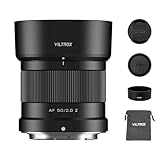
4. VILTROX AF 50mm F2.0 Air Z Is the Light Autofocus Choice
Pros
- 220g weight
- Eye and face AF
- Low focus breathing
- 9-blade diaphragm
Cons
- No image stabilization
- Not water resistant
The VILTROX AF 50mm F2.0 Air Z is the most appealing Nikon Z mount 50mm here for a photographer who puts portability and autofocus support first. At a listed 220g, it is far lighter than the f/1.2 S and the Viltrox f/1.4 Pro, yet it keeps autofocus and an f/2 maximum aperture.
Its 4.7 rating is based on 127 reviews, providing a larger review sample than several lenses in this group. Viltrox lists a 13-element, nine-group construction with three ED lenses, four high-refractive elements, one aspherical element, and HD nano-coating.
The STM motor and lead-screw focus system support eye and face AF according to the listing. That combination matters for a photographer tracking a person rather than placing a fixed focus point, and it is also why this lens makes sense for a casual creator working with a compatible Z body.
The f/2 aperture has less light-gathering potential than f/1.8, f/1.4, or f/1.2, but it is still a fast aperture lens compared with many zooms. Its 0.51m minimum focusing distance and 0.11x magnification place it squarely in normal-prime territory rather than macro territory.
Low Weight Makes It Easier to Carry Every Day
At 220g, this is only 20g heavier than the TTArtisan manual lens and 35g heavier than the F-mount Nikon f/1.8G, while retaining autofocus. That is a strong specification match for travel, daily walks, and a compact Z-camera kit.
The 58mm filter thread also keeps the front of the lens modest in size compared with the 77mm Viltrox f/1.4 Pro and 82mm Nikon f/1.2 S. These size details matter if you already own filters or want to keep a small bag.
Eye AF and Focus Breathing Support Video Creators
Viltrox lists support for eye and face AF, low distortion, and minimal breathing effect for video. Those claims make the Air Z the clearest choice in this guide for someone who wants autofocus behavior and framing stability to be part of the decision.
The lens itself does not have image stabilization and is not water resistant according to the product information. A user who shoots in wet conditions or wants a sealed body should consider the weather-resistant Viltrox f/1.4 Pro or Nikon f/1.2 S instead.
5. VILTROX 50mm F1.4 Pro Z Is a Weather-Sealed Portrait Alternative
Pros
- f/1.4 aperture
- Weather-sealed metal body
- Face and eye detection
- 15-element optics
Cons
- 0.8kg weight
- No image stabilization
The VILTROX 50mm F1.4 Pro Z gives Z-mount portrait photographers a fast f/1.4 aperture, a full-metal weather-sealed body, and the brand’s Dual HyperVCM autofocus system. Its 15 elements in 11 groups include three ED, eight HR, and one UA element, so the product data is especially detailed about its optical design.
This lens is rated 4.5 from 314 reviews, the largest review count among the products provided for this guide. The review data reports 76% five-star ratings, while the listing emphasizes balanced sharpness with soft bokeh for natural portraits.
At 0.8kg, it is a substantial lens rather than a small everyday pancake-style prime. That mass buys a weather-sealed construction and a front-element coating that repels water and smudges, but a photographer using a smaller Z body should think about how that weight feels in hand.
The Dual HyperVCM system is described as fast, silent, and precise, with face and eye detection support. That makes it a logical comparison with Nikon’s f/1.4 Z lens for shooters who want a fast aperture and autofocus, while the two lenses differ in physical weight and weather-resistance claims.
Weather Sealing Is the Practical Pro Feature
Viltrox specifies a dust- and splash-resistant full-metal body, unlike the Nikon Z 50mm f/1.4 and Viltrox Air Z listings, which are marked not water resistant. That direct difference may matter more than a small optical specification for photographers who work outdoors often.
The coated front element is designed to repel water and smudges, so regular field use is a stated part of its design. No lens should be treated as invulnerable, but this is the relevant feature set for a Z photographer who wants a protected body.
Portrait Rendering and Weight Need Equal Attention
The listing calls the rendering portrait-tuned and pairs it with f/1.4 and a 15-element design. Those features fit a photographer who cares about sharp subjects and a blurred background in portraits.
Before choosing it for all-day coverage, balance that goal against the stated 0.8kg weight and lack of image stabilization. A lighter f/2 lens can be easier to keep with you, while this model better suits someone who accepts a larger kit for its aperture and sealed build.
6. Nikon NIKKOR Z MC 50mm f/2.8 Is the 1:1 Macro Specialist
Nikon NIKKOR Z MC 50mm f/2.8 | Compact Macro Prime Lens for Z Series mirrorless Cameras | Nikon USA Model
1:1 macro
0.16m focus
Nikon Z
260g
Pros
- Life-size 1:1 macro
- 0.16m focus
- Compact 260g body
- 46mm filter
Cons
- f/2.8 aperture
- Manual focus can challenge beginners
The Nikon NIKKOR Z MC 50mm f/2.8 is the direct pick for a Nikon Z photographer who needs true 1:1 macro capability rather than just a general-purpose standard prime. Nikon lists a 0.16m minimum focus distance and life-size magnification, both of which separate it from every other lens in this eight-product list.
It is rated 4.5 from 65 reviews, with the supplied review summary reporting 72% five-star and 18% four-star ratings. The feedback summary praises macro capability and compact design, which matches Nikon’s stated goal of a small front-focusing lens that can stay on a camera for walkaround shooting.
The f/2.8 maximum aperture is less aggressive than the f/1.2 through f/2 choices elsewhere here, but this lens solves a different job. It is intended for life-size details, food, and everyday moments while maintaining the natural view associated with a 50mm lens.
Nikon lists a nine-blade diaphragm, fluorine coating, 46mm filter size, water resistance, and a weight around 260g. It also lists auto/manual focus, though careful manual focus remains an important skill when depth of field becomes extremely thin at macro distances.
Life-Size Macro Is Its Defining Capability
A 1:1 ratio means the lens is the only supplied option specifically built for life-size macro work. Select it for small objects, textures, food, flowers, and close details where the 0.11x to 0.15x reproduction ratios of the standard primes are not enough.
The 0.16m minimum focusing distance brings the lens much closer to a subject than the 0.45m, 0.51m, and 14.5-inch close-focus figures listed for other options. This is the specification to prioritize when macro is a real need rather than an occasional experiment.
Everyday Carry Remains Part of the Design
Despite its macro specialty, Nikon describes the 50mm field of view as suitable for snapshots, food photography, and everyday moments. The listed 260g weight and front-focusing design support that use better than a large specialist lens would.
Choose another lens if your first priority is the widest available aperture for portraits or low light. Choose this one if the ability to move from a normal scene to close 1:1 detail is more important than f/1.4 or f/1.8.
7. Nikon NIKKOR Z 50mm f/1.4 Is the Video-Focused Nikon Option
Pros
- f/1.4 aperture
- Fast quiet STM autofocus
- Suppressed focus breathing
- 14.5-inch close focus
Cons
- Not water resistant
- No image stabilization
The Nikon NIKKOR Z 50mm f/1.4 is the clearest native-Nikon choice for a Z user who makes video and wants f/1.4. Nikon calls it a video workhorse and lists a multi-focus STM motor designed for fast, quiet autofocus with suppressed focus breathing.
The listing has a 4.5 rating from 63 reviews, and its review summary reports that 79% of ratings are five stars. It is described as lightweight with minimal shift in center of gravity, a useful gimbal-oriented detail that distinguishes it from the very heavy f/1.2 S.
For video shooters, the stated linear manual focusing support on compatible Nikon Z bodies is also meaningful. Focus behavior can be as important as sharpness for recorded clips, and the product information directly addresses operational noise and focus breathing rather than only still-photo performance.
Nikon lists close focus at 14.5 inches and an f/1.4 aperture for detailed subjects with background blur. On APS-C or DX Z cameras, it has a stated 75mm-equivalent field of view, making it more portrait-oriented than a standard-angle lens on a full-frame Z camera.
Gimbal and Video Work Are Its Strongest Fits
Pick this lens when quiet autofocus, suppressed focus breathing, and a small change in center of gravity are higher priorities than weather resistance. Nikon specifically frames these traits around video work and compatible Z-series cameras.
Its f/1.4 aperture also supports blurred backgrounds without moving into the much heavier f/1.2 S category. That makes it an appropriate middle route for a creator who wants both stills and video features in one native Z lens.
DX Framing Turns It Into a Portrait Lens
On an APS-C or DX Nikon Z body, Nikon states that this 50mm delivers a 75mm-equivalent view. That tighter framing can be flattering for portraits, but it gives less room for a full-body subject or a small indoor space.
The body is listed as not water resistant, so this is not the Nikon choice to prioritize for exposed outdoor work. Users who need stated weather protection should compare the Z 50mm f/1.2 S and Viltrox 50mm F1.4 Pro Z instead.
8. TTArtisan 50mm f/2 Is a Compact Manual-Focus Z Lens
TTARTISAN 50mm f2 Full Frame Manual Focus Camera Lens for Nikon Z Mount Like Z5 Z6 Z7 Z6II Z6III Z7II ZFC Z30 Z50 Z50II Z9 Z8 ZF Black
f/2
Manual focus
200g
10 blades
Pros
- Compact 200g design
- All-metal body
- 10-blade diaphragm
- Tactile aperture clicks
Cons
- Manual focus only
- Not water resistant
- No image stabilization
The TTArtisan 50mm f/2 is for a Nikon Z photographer who actively wants a manual-focus shooting experience in a compact body. It weighs a listed 200g and is 3.5cm thick, while its all-metal construction and click-stop aperture ring create a more tactile process than autofocus lenses offer.
Its 4.3 rating comes from 24 reviews, and the supplied review summary says users praise build quality and value while recognizing manual focus as a limitation. This is not the best choice for fast-moving children, events, or unpredictable subjects when reliable autofocus is the priority.
The optical approach is simple: a 50mm full-frame lens, f/2 maximum aperture, ten-blade diaphragm, 43mm filter thread, and manual focus only. TTArtisan says its 45-degree angle of view mimics a natural perspective and positions it for food, architecture details, landscapes, city scenes, and documentary-style work.
Its compact dimensions make it one of the easiest lenses here to keep in a small bag. The tradeoff is intentional control: the photographer must set focus manually and should expect to spend more attention on magnification aids, focus confirmation, or repeated takes than with an eye-detect autofocus lens.
Manual Focus Is a Creative Requirement, Not a Minor Detail
Choose the TTArtisan only if manual focus is part of the appeal. The tactile system has click stops from f/2 through f/16, which can suit careful still life, street, landscape, or planned video focus transitions.
Skip it if face detection, eye AF, or silent continuous autofocus are essential to your work. The Meike, Viltrox, and Nikon Z autofocus choices are better aligned with those needs according to their listed focus systems.
Small Size and a 10-Blade Diaphragm Define Its Appeal
At 200g, this is the lightest lens in the group, even edging the 220g Viltrox Air Z. Its 10-blade diaphragm is specified for bokeh, and the metal body is described as sturdy with an anodized finish.
The product data says it has no image stabilization and is not water resistant. Pair that compact manual-focus appeal with realistic expectations about the conditions and subjects you photograph.
Choose a Nikon 50mm Lens by Matching Mount and Shooting Style
Pick the mount first. The Nikon AF-S 50mm f/1.8G is for Nikon F-mount DSLRs, while the Meike, both Nikon Z primes, both Viltrox lenses, Nikon Z MC macro, and TTArtisan are Nikon Z-mount options for mirrorless cameras.
Do not treat the mount label as a minor specification. The recurring forum question is whether an F-mount or Z-mount 50mm is appropriate, and a technically impressive lens is still the wrong recommendation if it does not fit the camera body you own.
Aperture Should Match the Background Blur You Need
Aperture numbers describe how wide the lens can open. From the verified options, f/1.2 gives the greatest potential for light gathering and shallow depth of field, followed by f/1.4, f/1.8, f/2, and f/2.8 at the same focal length, focus distance, and framing.
For maximum subject isolation, the Nikon Z 50mm f/1.2 S leads this list. The Nikon Z 50mm f/1.4 and Viltrox 50mm F1.4 Pro Z make sense when f/1.4 is enough, while f/1.8 and f/2 options keep the standard-prime approach more compact.
Do not assume f/2.8 is inadequate. The Nikon Z MC 50mm f/2.8 brings a different benefit: 1:1 macro magnification and a 0.16m minimum focus distance, so it is the better match for close detail work even though it is not the widest-aperture lens.
Autofocus Needs Depend on Subjects and Video
For portrait and family photography, autofocus and face or eye detection can reduce missed moments. The Viltrox Air Z and Viltrox f/1.4 Pro list face and eye AF support, while the Meike uses an STM system and the F-mount Nikon f/1.8G uses Nikon’s Silent Wave Motor.
For video, read past the autofocus label. Nikon specifically says its Z 50mm f/1.4 has a quiet multi-focus STM motor and suppressed focus breathing, while Viltrox specifies minimal breathing effect for the Air Z; these are the two listings that most directly address video behavior.
Manual focus is not automatically a disadvantage. The TTArtisan’s click stops and manual system can be satisfying for static scenes and controlled focus pulls, but it is a bad fit when an autofocus system needs to follow a moving subject.
Weight and Filters Affect the Kit You Actually Carry
The listed weights span from 200g for the TTArtisan to 1090g for the Nikon Z 50mm f/1.2 S. Between them are the Nikon F-mount f/1.8G at 185g, Viltrox Air Z at 220g, Nikon Z MC at about 260g, Viltrox Pro at 0.8kg, and Nikon Z f/1.4 at 0.93 pounds.
These figures are not just numbers on a specification sheet. They change how balanced a lens feels on a small body, whether it works comfortably on a gimbal, and whether you will pack it for an ordinary day of shooting.
Filter thread sizes also range from 43mm on the TTArtisan and 46mm on the macro lens to 82mm on the Nikon f/1.2 S. Photographers who use polarizers, neutral-density filters, or protective filters may prefer to account for existing filter sizes before committing to a lens.
Weather Resistance Should Be Read Literally
Only choose a weather-oriented model when the listing actually makes that claim. Nikon describes the Z 50mm f/1.2 S as weatherproof, and Viltrox describes the 50mm F1.4 Pro Z as weather-sealed, dust-resistant, and splash-resistant.
The Meike, Viltrox Air Z, Nikon Z 50mm f/1.4, and TTArtisan listings explicitly say they are not water resistant. This is a cleaner comparison than assuming a metal body or a premium aperture implies environmental protection.
DX Bodies Change the Field of View
On a full-frame Nikon, a 50mm is a standard-angle prime lens with a natural view. On DX or APS-C Nikon bodies, it frames more like 75mm equivalent, which is often excellent for portrait photography but narrower for environmental scenes, group photos, or vlogging at arm’s length.
The Meike listing expressly supports both full-frame and APS-C Nikon Z cameras, and Nikon explicitly states the 75mm-equivalent view of its Z 50mm f/1.4 on DX. Before choosing the best 50mm lenses for Nikon, picture the framing you need more often than the label on the barrel.
The Most Common Nikon 50mm Questions Have Straight Answers
What is the best Nikon F mount 50mm lens?
The Nikon AF-S NIKKOR 50mm f/1.8G is the F-mount recommendation in this eight-lens selection. It is a 185g FX-format prime with an f/1.8 aperture, Silent Wave Motor autofocus, an aspherical element, and stated optimization for FX and DX Nikon DSLRs. Check that your DSLR uses Nikon F mount before choosing it.
Which 50mm lens is best for Nikon Z mirrorless?
The Nikon NIKKOR Z 50mm f/1.2 S is the strongest Z-mount choice here for photographers who want an f/1.2 aperture, weatherproof build, Nano Crystal Coating, and 17-element optical construction. The Viltrox Air Z is a much lighter autofocus alternative, while the Nikon Z MC 50mm f/2.8 is the right Z option for 1:1 macro work.
What is the sharpest 50mm lens for Nikon?
The Nikon NIKKOR Z 50mm f/1.2 S is the specification-led choice when full-frame rendering is the priority: Nikon describes rendering power across the frame and lists 17 elements in 15 groups. For F-mount DSLRs, Nikon says the AF-S 50mm f/1.8G is optimized for edge-to-edge sharpness on FX and DX bodies.
Is the Nikon 50mm f/1.8 worth it?
For a compatible Nikon F-mount DSLR, the AF-S 50mm f/1.8G is compelling if you want a compact 185g prime, f/1.8 aperture, Silent Wave Motor autofocus, and a 58mm filter thread. This supplied listing is renewed and carries a 90-day limited warranty, so verify the condition and coverage before purchase.
Which is better: Nikon 50mm f/1.4 or f/1.8?
Choose f/1.4 when you want more light-gathering potential and shallower depth of field than f/1.8 at the same framing. The Nikon Z 50mm f/1.4 adds quiet multi-focus STM autofocus, suppressed focus breathing, and close focus at 14.5 inches. Choose the F-mount Nikon f/1.8G when you need F-mount DSLR compatibility and a compact 185g body.
The Right Nikon 50mm Is the One That Fits Your Mount and Work
For a Nikon Z photographer seeking the widest aperture and weatherproof build, the NIKKOR Z 50mm f/1.2 S is the clear first look. For portable autofocus, the VILTROX AF 50mm F2.0 Air Z is compelling; for macro, choose the NIKKOR Z MC 50mm f/2.8; and for a compatible F-mount DSLR, the AF-S 50mm f/1.8G is the dedicated answer.
Use this guide to the best 50mm lenses for Nikon in 2026 as a mount-first checklist, then choose the aperture, focus behavior, close-focus ability, and body size that match your photos. Open the lens details for the model that best fits the way you actually shoot.