
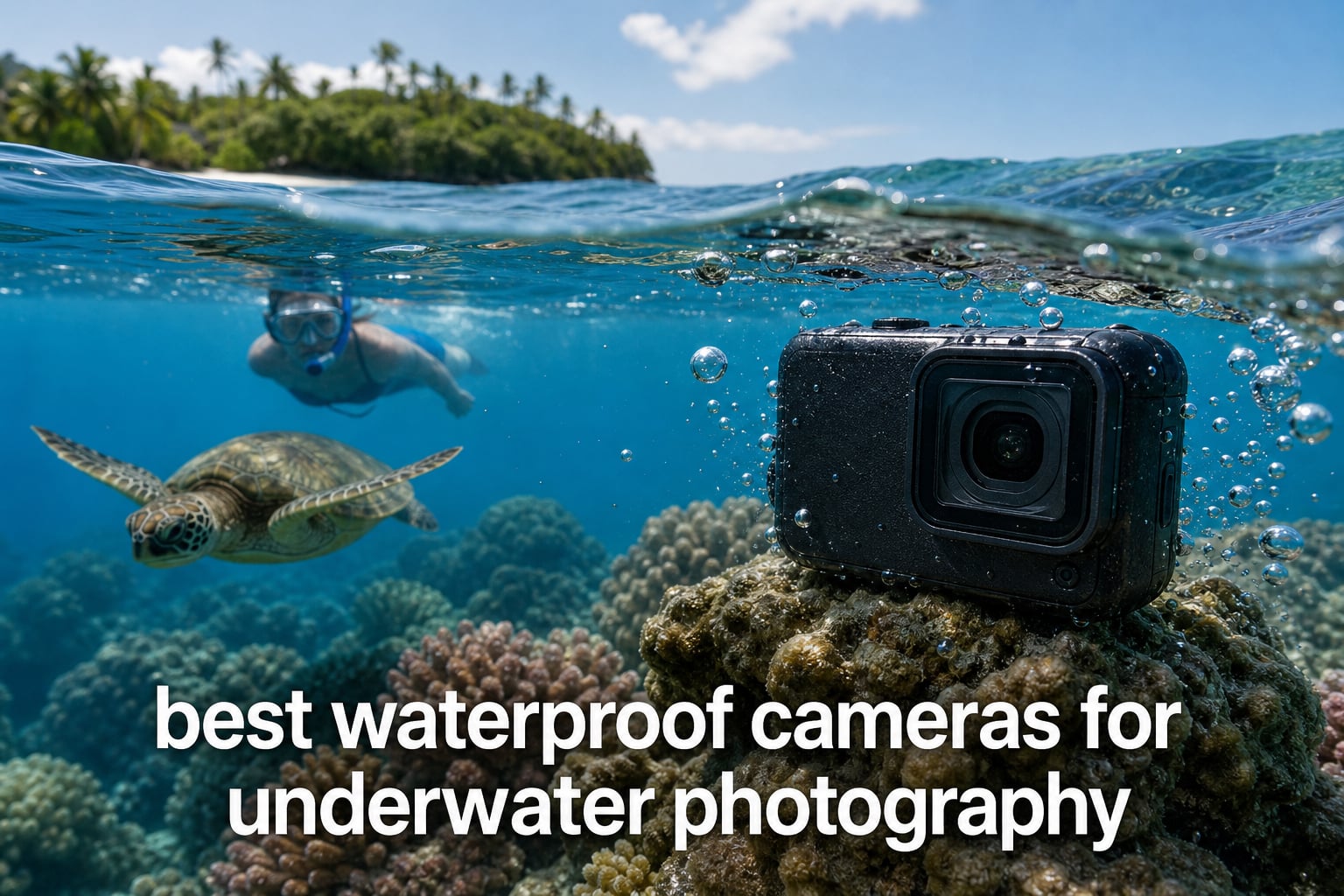
The best waterproof cameras for underwater photography do not all solve the same problem. A snorkeler usually needs a light camera that floats and works at the surface, while a diver may need a stated depth rating that goes much farther and controls that remain manageable with wet hands.
A waterproof camera is built with seals and gaskets that keep water out to a stated submersion limit. That makes it a better starting point than risking a standard camera near a pool, beach, kayak, or reef, but the number on the specification sheet is a limit to respect rather than a license to ignore maintenance.
I compared the 12 cameras in this guide using their listed depth ratings, video and still specifications, focusing system, stabilization, battery information, included items, customer-rating sample, and stated review feedback. I have not presented retailer specifications as hands-on tests; where a feature matters underwater, I explain what it means for the kind of shot you intend to make.
The short version is straightforward: choose the OM SYSTEM Tough TG-7 when close-up stills and a rugged compact body matter most, the DJI Osmo Action 5 Pro when stabilized video is the priority, and a housing-based action-camera bundle when deeper coverage is the requirement. Before going in, test every latch, inspect the seal, and rinse the camera with fresh water after saltwater use.
The top three picks answer the most common underwater needs In 2026
The OM SYSTEM Tough TG-7 is the strongest stills-oriented compact choice here because it combines a 50-foot rating with a bright f/2.0 lens, 4x optical zoom, RAW support, and specialized macro modes. The DJI Osmo Action 5 Pro is the video-led alternative with a 20-meter rating, a larger 1/1.3-inch sensor, 4K at 120fps, and extensive stabilization modes.
For a deeper action-camera setup, the AKASO EK7000 Pro bundle lists a 131-foot rating and includes a floating grip, carrying case, remote, and two batteries. Its fixed-focus, fisheye-style approach is less suited to deliberate macro stills, but its included housing and accessories make the purpose clear.


DJI Osmo Action 5 Pro
- 20-meter waterproof rating
- 4K at 120fps
- 1/1.3-inch sensor
- HorizonSteady

All 12 cameras make the depth and feature differences clear (August 2026)
Start with the depth figure, then read whether it applies to the camera itself or to a supplied housing. The compact models below emphasize easy stills, selfie screens, and floating designs, while the action cameras put more weight on wide video, stabilization, and mounts.
| Product | Specs | Action |
|---|---|---|
 SiSuSy 8K Underwater Camera SiSuSy 8K Underwater Camera |
|
Check Details |
 SPUNALP 8K Underwater Camera SPUNALP 8K Underwater Camera |
|
Check Details |
 Yifecial 4K Underwater Camera Yifecial 4K Underwater Camera |
|
Check Details |
 YISENCE 4K Underwater Camera YISENCE 4K Underwater Camera |
|
Check Details |
| DJI Osmo Action 5 Pro |
|
Check Details |
 DJI Osmo Action 6 DJI Osmo Action 6 |
|
Check Details |
| AKASO EK7000 Pro Bundle |
|
Check Details |
 AKASO Brave 7 LE Bundle AKASO Brave 7 LE Bundle |
|
Check Details |
| OM SYSTEM Tough TG-7 |
|
Check Details |
 YEEIN 4K Underwater Camera YEEIN 4K Underwater Camera |
|
Check Details |
 AKASO Brave 8 Lite AKASO Brave 8 Lite |
|
Check Details |
 SVBONY SVGo2 SVBONY SVGo2 |
|
Check Details |
1. The SiSuSy 8K camera is the deepest compact-style choice for surface dives
8K Underwater Camera WiFi 90MP 50FT Waterproof 32GB Card Dual-Screen Touch
50-foot IP68
8K video
75MP photos
Wi-Fi
Pros
- 50-foot IP68 rating
- Autofocus
- Floatable strap
- Dual touchscreens
Cons
- 90-minute stated battery
- 18x digital zoom
The SiSuSy has the strongest stated native depth figure among the compact-style cameras in this list: 50 feet with an IP68 designation. I would look at it first for snorkeling, shallow diving within that limit, and family water days where a floatable design reduces the chance of a lost camera.
Its listing combines 8K video, 75MP photos, autofocus, Wi-Fi, 18x digital zoom, and dual touchscreen displays. Those headline resolutions are useful context, but I would put more weight on autofocus and the stated deep-dive, low-light sensor claim when following moving swimmers or fish.
The 1800mAh battery is listed for 90 minutes, so this is not a camera I would take into the water without a charged backup plan. Its 290-gram weight and three-inch display should be easier to manage than a larger rig, especially when composing at the surface.
The review sample is small at 26 ratings, although the recorded average is 5.0 and the review summary praises waterproof performance, image quality, and ease of use. That is encouraging rather than conclusive, so checking the seal before every immersion remains part of the routine.
The 50-foot rating makes this a better match for deeper casual water use
This camera fits people who want one compact waterproof digital camera for snorkeling, pool shots, and dives that stay within 50 feet. The buoyancy strap, touchscreen controls, autofocus, and 32GB included storage are practical details for a first underwater outing.
The stated 90-minute battery asks for short, intentional shooting sessions
I would plan short clips and stills instead of leaving it recording continuously. Digital zoom is also not a replacement for moving closer to a subject, and underwater visibility should dictate how far away you attempt a shot.
2. The SPUNALP 8K camera is the long-battery pick for snorkeling days
8K Underwater Camera, 70MP 33FT WiFi Waterproof Digital Camera with 32GB
33-foot rating
8K video
70MP photos
5-hour battery
Pros
- Long stated battery
- Autofocus
- Wi-Fi
- Dual screens
Cons
- Wi-Fi does not work underwater
- 33-foot depth limit
The SPUNALP is aimed squarely at swimming and snorkeling, with a 33-foot depth rating and a floatable body. Its stated five-hour battery life stands out against many compact models, which makes it appealing for a long beach day where charging opportunities are scarce.
It records 8K video and 70MP photos according to the listing, with autofocus, a fill light, an 18x digital zoom, and front-and-back screens. The built-in SOS emergency function is unusual in this group and may be meaningful for paddlers or swimmers who value an extra signaling feature.
One limitation deserves to be stated plainly: Wi-Fi does not work underwater. I treat that as normal behavior rather than a defect; radio connections are for transferring files above water, not for controlling the camera below the surface.
The listing reports a 4.9 average from 54 ratings, and its review summary points to image quality, long battery life, and overall value. A 33-foot ceiling is enough for snorkeling and shallow recreation, but it is not the right figure to stretch toward more serious scuba use.
The long stated runtime supports all-day shore and boat outings
This is a sensible beginner underwater camera for travelers who want simple, longer-running coverage of surface activities. The included 32GB card and dual-screen layout remove a few setup steps, while autofocus helps with quick snapshots.
The 33-foot limit keeps this camera in the shallow-water category
I would choose it for reefs viewed while snorkeling, swimming pools, and waterline portraits, not for dives that approach or exceed its stated rating. Keep the compartment closed and dry before opening it to protect the seal.
3. The Yifecial 4K camera is a compact floating option for pools and snorkeling
4K Underwater Camera, 64MP 16FT Compact Waterproof Camera with 16GB Card
16-foot rating
4K video
64MP photos
16GB card
Pros
- Floatable design
- Autofocus
- Lightweight
- IPS screen
Cons
- 16-foot depth limit
- 70-minute stated battery
The Yifecial makes the most sense when portability and recovery matter more than deep-water range. It floats, weighs 0.29 pounds, and has a 16-foot rating, so I see it as a compact companion for pool use, surfing, swimming, and near-surface snorkeling.
The listing identifies 4K video, 64MP stills, autofocus, a 2.7-inch IPS HD screen, fill light, 16x digital zoom, and a supplied 16GB card. Its product title says 4K while the detailed specification lists 1080p video, so I would verify the recording mode in the camera itself before treating 4K as a deciding factor.
A 650mAh battery is listed for 70 minutes. That time can fall in cold water, a pain point frequently raised by divers, so turning the camera on only for actual shooting and warming a spare battery between uses are sensible habits.
The recorded average is 4.9 from 44 ratings, with feedback centered on ease of use, floatability, and image quality for the category. It is a small, shallow-water camera, not a scuba camera with a large safety margin.
The floating, lightweight body favors active family water sessions
I would hand this model to a casual swimmer who wants to capture moments without managing a heavy housing. Autofocus and the IPS screen are more useful here than a large digital-zoom number.
The 16-foot depth rating rules out deeper diving plans
Stay comfortably inside the stated 16-foot limit and avoid treating water resistance as interchangeable with waterproofing. If the itinerary includes deeper dives, use a product with a greater stated depth or a documented housing rating.
4. The YISENCE 4K camera is the easy selfie-oriented compact option
4K Underwater Camera 16FT Waterproof 64MP Dual-Screen with 32GB Card
16-foot IP68
4K video
64MP photos
dual screens
Pros
- Dual-screen design
- Floatable body
- Type-C charging
- 32GB card
Cons
- 16-foot depth limit
- 70-minute stated battery
The YISENCE is another shallow-water compact, rated to 15.97 feet and marked IP68 in its details. Its light 4.58-ounce body, floatable design, 32GB card, and dual-screen selfie setup make the intended user easy to identify: a swimmer or snorkeler who wants uncomplicated group photos.
The camera lists 4K video, 64MP photos, autofocus, a 2.7-inch display, 16x digital zoom, digital stabilization, and Type-C charging. I like Type-C charging for travel because it can reduce the number of separate cables in a bag, but its 70-minute stated battery still calls for power planning.
The listing calls it the number-one best seller in its underwater-photography category and reports a 4.8 average from 95 ratings. The customer summary emphasizes autofocus, floatability, and the dual screens, all of which line up with a casual surface-water role.
Dual screens are a convenience feature, not an underwater image-quality feature. For the clearest results, get near the subject, keep the sun behind you where possible, and shoot upward or across rather than through a long stretch of water.
The dual screens make group and self-portraits much simpler to frame
This is a good fit for families, resort travelers, and beginners who want a camera that can turn toward the group without guesswork. The lightweight body and floating design lower the handling burden in shallow water.
The shallow rating makes the use case clear before you pack it
I would not select this for scuba diving simply because it says waterproof. Its listed limit is around 16 feet, so use it where that margin matches the activity and where a dropped camera can still be recovered safely.
5. The DJI Osmo Action 5 Pro is the strongest pick for smooth underwater video
DJI Osmo Action 5 Pro Essential Combo, Waterproof Action Camera
20-meter rating
4K at 120fps
1/1.3-inch sensor
47GB storage
Pros
- 4K at 120fps
- Advanced stabilization
- Subject tracking
- Long stated battery
Cons
- 2x digital zoom
- Action-camera wide-angle view
The DJI Osmo Action 5 Pro is the action camera I would choose when smooth footage is the goal. It is waterproof to 20 meters, records 4K at 120fps, and uses a 1/1.3-inch sensor, a larger sensor size than the specification sheets disclose for many of the compact entries here.
RockSteady, RockSteady+, HorizonBalancing, and HorizonSteady are listed stabilization modes, alongside subject tracking, voice control, dual OLED touchscreens, Bluetooth, and Wi-Fi. For swimming or snorkeling footage, a wide angle and stable horizon are usually more valuable than a high zoom figure.
The stated battery life reaches 240 minutes and the camera has 47GB of built-in storage, which reduces the chance of immediately running out of space. I would still bring a suitable microSD card if the plan is long clips, high-frame-rate video, or a full day away from file transfers.
Its rating is 4.7 from 1,639 reviews, the largest strong review sample in this selection after the EK7000 Pro. Review feedback highlights video quality, stabilization, and low-light performance, though action-camera footage remains a wide-angle interpretation of a scene rather than a macro-camera substitute.
The 4K at 120fps recording suits motion and slow-motion sequences
Choose the Action 5 Pro for fins, surf, snorkeling passes, and moving subjects where stabilization makes the clip easier to watch. The dual OLED screens also help when the camera moves between forward-facing and selfie-style work.
The wide action-camera format is not the first choice for tiny close subjects
I would choose the TG-7 instead if close macro details are the main goal. The DJI’s stated 2x digital zoom does not change the basic wide-angle perspective, and physical distance still matters underwater.
6. The DJI Osmo Action 6 is the feature-rich choice for 8K action footage
DJI Osmo Action 6 Enhanced Combo, 8K Waterproof Action Camera
20-meter rating
8K video
variable f/2.0-f/4.0
50GB storage
Pros
- 8K video
- Variable aperture
- HorizonSteady
- Two batteries
Cons
- Fixed focus
- 2x digital zoom
The DJI Osmo Action 6 adds an 8K option, a 1/1.1-inch square sensor, and a variable f/2.0 to f/4.0 aperture to an action-camera format. It is listed as waterproof to 20 meters without a case, so its starting depth capability matches the Action 5 Pro.
Its Enhanced Combo includes two batteries, a 1.5-meter extension rod, and a battery case. I see that as particularly useful for travelers creating a sequence of above-water and underwater clips, since the extension rod can add perspective without bringing a separate selfie stick.
RockSteady, HorizonBalancing, and HorizonSteady are specified, as are gesture control, voice control, dual-person audio compatibility with DJI mic transmitters, 50GB built-in storage, and up to four hours of stated battery life. Those features support video workflow, but fixed focus means it is not designed around selective close focusing.
The 4.6 rating comes from 1,774 reviews, a substantial sample. The review summary credits video quality and stabilization, which is the right reason to consider it; 8K is a demanding recording option and requires thoughtful storage management.
The variable aperture gives video creators more exposure control
This model fits a creator who shoots both in bright surface light and lower light near the waterline and wants a compact action camera. The larger stated sensor and stabilized video modes strengthen that case.
The fixed-focus lens makes it less specialized for underwater macro work
I would not expect a fixed-focus action camera to replace a compact with dedicated macro modes. Its native 20-meter rating is useful, but deeper dive plans still need equipment rated for that depth and careful preparation.
7. The AKASO EK7000 Pro bundle is the straightforward deep-housing action option
AKASO EK7000 Pro 4K30 Action Camera with Touch Screen EIS 131FT Waterproof Underwater Camera 5X Zoom Remote Control with Waterproof Floating Hand Grip Bundle and Carrying Case Accessories Kit Bundle
131-foot housing rating
4K at 30fps
EIS
two batteries
Pros
- 131-foot rating with housing
- Floating hand grip
- EIS
- Carrying case
Cons
- Fixed-focus fisheye lens
- 5x digital zoom
The AKASO EK7000 Pro bundle lists 4K at 30fps, 20MP photos, electronic image stabilization, a touch screen, and a 131-foot waterproof rating. The depth figure belongs to the underwater setup with its supplied housing, which is an important distinction from cameras that quote a native, no-case rating.
It includes a floating hand grip, a carrying case, a remote-control wristband, and two rechargeable 1350mAh batteries. I would favor that package for someone who wants to start with an action-camera kit instead of selecting every basic accessory separately.
The 140-minute battery figure and 5x digital zoom are listed in the details. The fixed-focus, fisheye-type lens is expected on this kind of action camera; it is good for capturing the whole scene but less suitable for controlled composition of a small fish or coral detail.
It holds a 4.5 average from 10,973 ratings, by far the largest review count in this group. The review summary points to value and waterproof performance, while the 72% five-star share suggests the broad sample includes more mixed experiences than a small, nearly perfect sample.
The included housing and floating grip support a ready-to-use diving kit
This is a logical choice for divers and water-sports users who need the listed 131-foot coverage and want a physical grip for safer handling. Before every dive, inspect the housing gasket and make a shallow-water test part of the routine.
The fisheye fixed-focus lens favors broad scenes over deliberate still photography
I would use it for wide reef passes, board sports, and moving video rather than expecting optical zoom or macro control. Electronic stabilization can smooth clips, but it cannot fix fogging inside a housing or poor visibility.
8. The AKASO Brave 7 LE bundle is the dual-screen action option with a housing
AKASO Brave 7 LE 4K30FPS 20MP WiFi Action Camera with Touch Screen EIS 2.0 Zoom Remote Control 131ft Waterproof Underwater Camera with Waterproof Floating Hand Grip and Carrying Case Bundle
131-foot housing rating
4K video
dual screens
EIS 2.0
Pros
- Dual color screens
- 6-axis EIS
- Auto focus
- Wi-Fi
Cons
- 0.96-kilogram listed weight
- Digital zoom only
The AKASO Brave 7 LE is a 4K and 20MP action camera with a stated 131-foot rating when used with its included housing. It also brings dual color screens, which can be helpful when switching between forward video and a view where the camera operator needs to check framing.
Its feature list includes auto focus, Wi-Fi, 4x digital zoom, six-axis EIS 2.0 stabilization, and a floating hand grip with a carrying case. Wi-Fi is useful for moving clips after the session, but as with other wireless cameras, I would not expect it to function as an underwater connection.
The listed weight is 0.96 kilograms, which is heavier than many compact action-camera bodies. That makes grip security, buoyancy, and comfortable mounting more important, particularly if the camera will be held for an extended snorkel or dive.
The Brave 7 LE has a 4.5 average based on 585 ratings, and the review summary identifies the dual-screen design and stabilization as popular points. It is a video-oriented system with accessories, not a pocket compact focused on macro stills.
The front-and-back screen arrangement helps creators check framing quickly
I would choose this for travel logs, water sports, and paired self-facing and forward-facing clips. The floating grip bundled with it is a useful safety item for surface use and recovery.
The housing rating requires the same careful seal discipline as any diving setup
The camera can only meet the listed 131-foot figure when the housing is properly sealed and undamaged. Rinse it after saltwater exposure, dry it before opening, and keep sand away from the gasket channel.
9. The OM SYSTEM Tough TG-7 is the best compact stills and macro camera here
OM System OLYMPUS Tough TG-7 Red Underwater Camera, Waterproof, Freeze Proof, High Resolution Bright, 4K Video 44x Macro Shooting (Successor Olympus TG-6)
50-foot rating
4K video
4x optical zoom
RAW macro
Pros
- Bright f/2.0 lens
- Four macro modes
- RAW support
- 50-foot rugged body
Cons
- 12MP still resolution
- 4x optical zoom limit
The OM SYSTEM Tough TG-7 is the most purpose-built compact underwater photography camera in this selection. It is waterproof to 15 meters or 50 feet, with a bright f/2.0 lens, 4x optical zoom, RAW support, five underwater modes, and a variable macro system with four modes.
The 12MP still specification looks modest beside inflated-looking high-resolution claims, but the quality of the lens, sensor processing, autofocus control, and RAW workflow often matters more than a single megapixel figure. I would choose a camera with optical zoom and genuine macro tools over a large digital-zoom claim when image-making is the goal.
This tough camera is also freezeproof, shockproof, and crushproof, and it includes GPS, a manometer, and a thermometer. The 120fps high-speed movie capability and 4K video add flexibility, but the real distinction is its ability to move from wide underwater scenes to close detail at a stated one-centimeter macro distance.
Its average is 4.4 from 586 ratings, and the review summary emphasizes durability and macro capability. Diving forums in the supplied research repeatedly praise the TG range for its balance of compact size, durability, and capability, which matches the listed specification set.
The dedicated macro system makes small subjects a realistic target
This is the camera I would select for underwater macro photography, tide-pool details, small marine life, and travelers who want more still-image control than an action camera offers. The optical zoom and f/2.0 lens add useful flexibility without requiring a separate housing for the stated 50-foot limit.
The 12MP specification matters less than the shooting tools around it
If your only comparison is megapixels, this model can look outnumbered. If your comparison includes RAW capture, 4x optical zoom, macro modes, rugged construction, and underwater modes, the TG-7 has the clearer photographic case.
10. The YEEIN 4K camera is a lightweight shallow-water compact with a fill light
YEEIN Underwater Camera 4K 48MP Autofocus Selfie Dual Screen Waterproof Camera with Floating Strap and 32GB Card, 17FT Compact Waterproof Digital Camera, Fill Light Underwater Camera for Snorkeling
17-foot rating
4K video
48MP photos
32GB card
Pros
- Fill light
- Autofocus
- Floating strap
- Dual screens
Cons
- 17-foot depth limit
- Mixed review feedback
The YEEIN has a stated 17-foot waterproof rating, 4K video, 48MP photos, autofocus, dual screens, a floating strap, a fill light, and an included 32GB card. At 120 grams, it is among the lightweight compact choices for casual snorkeling and pool photography.
The fill light may help with nearby subjects, but underwater color and clarity change rapidly with depth and distance. I would use it sparingly at close range, then review results before relying on it; a light cannot restore color lost through a long stretch of water.
The detail listing says roughly three hours per full charge, which is strong on paper for a small camera. It also lists 18x digital zoom, though the same data does not provide clear optical-zoom information, so I would regard it as a crop-style reach rather than lens magnification.
This is the first model where I would pause over feedback: it has a 4.2 average from 297 ratings, with 67% five-star and 11% one-star ratings in the review summary. That does not make it unusable, but it gives careful setup, a pre-trip test, and a realistic return-window check more importance.
The fill light and floating strap support close, casual shallow-water photos
This model suits a vacationer photographing near the surface who wants a light compact body and a simple way to retrieve it if it slips. Autofocus and dual screens also reduce friction for quick group shots.
The review spread makes an early dry and shallow-water test sensible
I would test every button, card, charging function, focus behavior, and seal before depending on it for a special trip. The 17-foot rating is for shallow activity, not an invitation to use it as a deeper scuba camera.
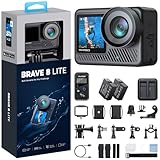
11. The AKASO Brave 8 Lite is the 4K60 action choice for snorkeling video
AKASO Brave 8 Lite Waterproof Action Camera 4K60 Ultra HD Video 48MP Photos
33-foot rating
4K at 60fps
48MP
HDR
Pros
- 4K at 60fps
- HDR
- SuperSmooth stabilization
- 33-foot native rating
Cons
- Mixed review feedback
- 90-minute stated battery
The AKASO Brave 8 Lite records 4K at 60fps and 48MP photos, with a 33-foot waterproof rating without a case. That native rating, HDR, dual screens, 5G Wi-Fi, SuperSmooth stabilization, and 8x slow motion give it a clear role as a snorkeling and water-sports video camera.
A 1/2-inch CMOS sensor and autofocus are listed, along with 5x digital zoom and two rechargeable batteries. I would use 4K60 for fluid action and reserve slow motion for short moments, because demanding video modes create larger files and make battery management matter more.
The listed 90-minute battery life is a planning figure, not a guarantee in cold water. It is also a 0.58-kilogram camera according to the details, so a secure wrist lanyard or mount is wise rather than relying on hand grip alone.
Its 4.1 average from 192 ratings includes 64% five-star and 12% one-star ratings in the supplied review insight. The capability list is strong, but I would validate your chosen video mode, stabilization setting, and card compatibility before a snorkeling trip.
The native 33-foot rating keeps snorkeling free of a separate housing
This is a useful pick for people who want stabilized 4K60 clips at the surface and in shallow water without building a larger diving system. The dual screens make it more flexible for travel-video framing.
The review spread rewards careful pre-trip setup rather than blind trust
I would record several test clips, check the audio and stabilization, and inspect the waterproof door before leaving home. For deeper diving, add a suitable housing only if its rating and instructions match the planned depth.
12. The SVBONY SVGo2 is the compact housing-based pick with optical zoom
SVBONY SVGo2 4K Underwater Camera with Floating Selfie Stick for Snorkeling
98-foot housing rating
4K video
50MP
5x optical zoom
Pros
- 5x optical zoom
- 98-foot housing rating
- Two batteries
- Lifetime warranty
Cons
- SD card not included
- Smaller review sample
The SVBONY SVGo2 combines a 4K at 30fps action-camera format with 50MP photos, EIS 2.0 stabilization, dual touchscreens, 5x optical zoom, and a stated 98-foot underwater rating with its waterproof housing. Optical zoom is a rare and useful claim in this group because it differs from simply enlarging pixels digitally.
It includes a floating selfie stick, a 2.4G remote with a stated 30-foot range, and two 1350mAh batteries for three hours of total recording time. The 140-degree wide-angle lens is still designed for broad views, while the zoom adds another framing option when visibility permits.
Its compact 61.2-gram weight could be welcome on a long day, and a lifetime warranty with a 30-day return policy is listed. The supplied data says an SD card is not included, so memory storage is one item to solve before the first session.
The recorded average is 4.1 from 67 ratings, the smallest sample among the action-camera options. I would view the rating alongside its 56% five-star share and focus on testing the housing seal, the card, and the controls before committing it to a deeper dive.
The 98-foot housing rating and optical zoom create a distinctive combination
This model fits a user who needs a listed deeper setup but still wants a compact, dual-screen device with a real 5x optical zoom specification. The floating selfie stick is most helpful at the surface, where a dropped camera can be recovered.
The required housing and separate card add two preparation steps
I would not skip a housing leak test in a sink or shallow water before a dive. Bring a compatible card, charge both batteries, and keep the seal clean and dry whenever the housing is opened.
The right depth, camera type, and preparation matter more than headline resolution
The key buying decision is not the biggest stated resolution. Pick the camera that fits the water activity, then use the stated depth rating, focusing tools, stabilization, storage, and handling features to narrow the field.
The depth rating must match the actual activity with a safety margin
For pool use and surface snorkeling, a 16- or 17-foot compact can be enough if you stay well within the stated limit. A native 33-foot or 50-foot rating creates more room for shallow diving, while the 98-foot and 131-foot figures in this guide apply to cameras used with their listed waterproof housings.
Do not confuse water-resistant with waterproof, and do not assume a rating makes a camera immune to a compromised door or dirty gasket. Forum discussions in the research repeatedly point out that lens fogging and seal issues can limit a camera well before a marketing depth figure becomes relevant.
A compact camera is better for stills and macro, while an action camera is better for broad video
Choose a compact underwater camera such as the TG-7 when you want optical zoom, close focusing, RAW files, and controls aimed at individual still images. The SiSuSy, SPUNALP, Yifecial, YISENCE, and YEEIN options focus more on simple point-and-shoot surface and shallow-water photography.
Choose an action camera when your priority is stabilized, wide-angle video of motion. The DJI models and AKASO models add high-frame-rate capture, horizon control, mounts, and video workflow features, but their perspective and often fixed-focus design make them less natural for serious macro work.
The light and distance determine underwater image quality more than the resolution label
Water absorbs color and contrast, so move closer rather than relying on digital zoom. For a beginner underwater camera, shooting within a short distance, keeping the sun behind or above you, and framing slightly upward toward the subject can produce cleaner results than shooting across open water.
Set the underwater mode if the camera offers one, and use the fill light only for nearby subjects. Auto white balance can struggle beneath the surface; looking at the playback after the first few shots gives you time to adjust position, distance, or mode before the moment passes.
The battery, storage card, and controls need a pre-water check
Cold water can reduce usable battery time, a concern raised often in diving communities. Charge the battery fully, bring a spare when the model supports one, format a compatible card in the camera, and practice finding the video and shutter controls before wearing a mask or gloves.
Built-in storage can help, but it is not unlimited: the DJI Action 5 Pro lists 47GB and the Action 6 lists 50GB. High-resolution and high-frame-rate clips create large files, so transfer footage after the session rather than discovering a full card at the start of a swim.
A smartphone case works for casual shots but is not a full camera replacement
A phone in a waterproof case can be fine for an occasional surface snapshot, especially when you already know the phone camera well. I would not treat it as equal to a dedicated system for repeated underwater use, deeper work, physical controls, floating recovery, macro modes, or a stated camera-and-housing depth setup.
Dedicated waterproof cameras also keep the phone free for navigation, contacts, and emergency use. If you use any case, follow its stated depth and sealing instructions just as closely as you would a camera housing.
Fresh-water rinsing and careful drying protect the seals after every outing
After saltwater exposure, rinse the closed camera or housing in fresh water, gently operate external controls while rinsing if the manufacturer allows it, and dry the outside completely. Open battery and card doors only when the exterior and your hands are dry.
Inspect the O-ring or gasket area for sand, hair, grit, or damage before every immersion. A camera that passed a previous trip can still leak if a seal is dirty, pinched, or opened in a damp environment.
The FAQ answers the most common underwater camera decisions
What is the best underwater camera for beginners?
The OM SYSTEM Tough TG-7 is the strongest beginner choice for people who want serious still photography because it combines a 50-foot rating, automatic and manual focus options, optical zoom, RAW support, and dedicated underwater and macro modes. For a simpler snorkeling camera, choose a floatable compact whose stated depth limit matches shallow water.
What is the best professional underwater camera?
Among these choices, the OM SYSTEM Tough TG-7 is the most photography-oriented compact because it offers RAW capture, a bright f/2.0 lens, 4x optical zoom, and four macro modes. For professional-style action video, the DJI Osmo Action 6 adds 8K recording, a larger stated sensor, variable aperture, and stabilization, but its fixed focus is less suited to macro stills.
What is the best cheap underwater camera for snorkeling?
The Yifecial, YISENCE, and YEEIN compact cameras are shallow-water options with floatable designs or straps, autofocus, and included memory cards in some cases. Select by the stated 16- to 17-foot depth range, battery plan, and preferred screen layout, and do not use one for dives beyond its specified limit.
What is the best waterproof camera for travel?
The OM SYSTEM Tough TG-7 is a strong travel camera for stills because its rugged body, 50-foot rating, optical zoom, and macro system work above and below water. Travelers focused on stabilized video may prefer the DJI Osmo Action 5 Pro, which lists a 20-meter rating, dual screens, built-in storage, and a long stated battery life.
What is the best underwater camera that doesn’t break the bank?
For a simple shallow-water compact, compare the Yifecial and YISENCE based on their floating designs, autofocus, and roughly 16-foot depth ratings. For a more serious housing-based action setup, the AKASO EK7000 Pro bundle stands out with its stated 131-foot housing rating, electronic stabilization, two batteries, floating grip, and large review sample.
The final choice comes down to stills, video, depth, and simplicity
For the best waterproof cameras for underwater photography in 2026, my stills-first recommendation is the OM SYSTEM Tough TG-7 because its macro system, RAW support, optical zoom, rugged construction, and 50-foot rating create the most balanced compact package. Pick the DJI Osmo Action 5 Pro for smooth, high-frame-rate video, or the AKASO EK7000 Pro bundle when the stated 131-foot housing rating and included accessories fit the mission.
Every option is only as waterproof as its clean, correctly closed seal. Match the stated rating to the activity, practice the controls before entering the water, and review the first few frames so you can correct color, distance, and framing while the scene is still there.